ignition Alfa Romeo Giulietta 2014 Workshop Manual
[x] Cancel search | Manufacturer: ALFA ROMEO, Model Year: 2014, Model line: Giulietta, Model: Alfa Romeo Giulietta 2014Pages: 280, PDF Size: 6.65 MB
Page 174 of 280
STARTING THE
ENGINEContact the Alfa Romeo Dealership
immediately if the warning light
stays on constantly on the
instrument panel.
JUMP STARTING
If the battery is flat, start the engine
using an auxiliary battery with the same
capacity or a little higher than the flat
one.
24) 25)
111)
Proceed as follows to start the car:
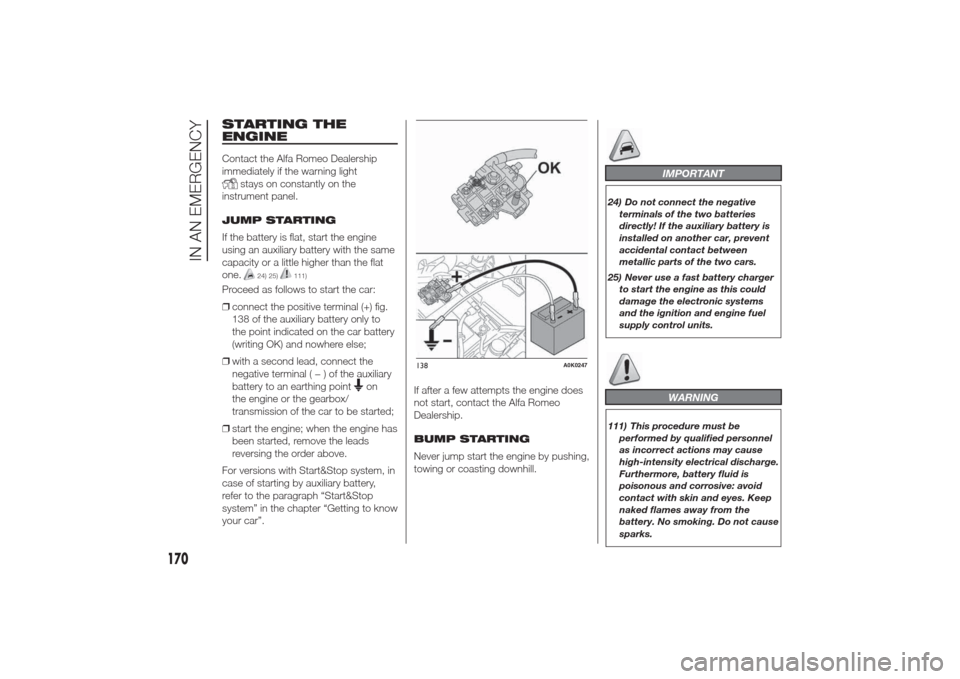
❒connect the positive terminal (+) fig.
138 of the auxiliary battery only to
the point indicated on the car battery
(writing OK) and nowhere else;
❒with a second lead, connect the
negative terminal(−)oftheauxiliary
battery to an earthing point
on
the engine or the gearbox/
transmission of the car to be started;
❒start the engine; when the engine has
been started, remove the leads
reversing the order above.
For versions with Start&Stop system, in
case of starting by auxiliary battery,
refer to the paragraph “Start&Stop
system” in the chapter “Getting to know
your car”.If after a few attempts the engine does
not start, contact the Alfa Romeo
Dealership.
BUMP STARTING
Never jump start the engine by pushing,
towing or coasting downhill.
IMPORTANT
24) Do not connect the negative
terminals of the two batteries
directly! If the auxiliary battery is
installed on another car, prevent
accidental contact between
metallic parts of the two cars.
25) Never use a fast battery charger
to start the engine as this could
damage the electronic systems
and the ignition and engine fuel
supply control units.
WARNING
111) This procedure must be
performed by qualified personnel
as incorrect actions may cause
high-intensity electrical discharge.
Furthermore, battery fluid is
poisonous and corrosive: avoid
contact with skin and eyes. Keep
naked flames away from the
battery. No smoking. Do not cause
sparks.
138
A0K0247
170
IN AN EMERGENCY
Page 199 of 280
WARNING
129) If the fuse blows again contact an Alfa Romeo Dealership.
130) Never replace a fuse with another with a higher amp rating; DANGER OF FIRE.
131) If a general protection fuse (MAXI-FUSE, MEGA-FUSE, MIDI-FUSE) blows, contact an Alfa Romeo Dealership.
132) Before replacing a fuse, make sure that the ignition key has been removed and that all the other services are
switched off and/or deactivated.
133) Contact an Alfa Romeo Dealership if a safety system (airbags, brakes), power unit system (engine, gearbox) or
steering system general protection fuse blows.
195
Page 200 of 280
BATTERY
RECHARGINGIMPORTANT The battery recharging
procedure is given as information only.
To carry out this operation contact
an Alfa Romeo Dealership.
IMPORTANT After turning the ignition
key to STOP, wait at least 1 minute
before disconnecting the electrical
supply to the battery.
Charging should be slow at a low
ampere rating for approximately 24
hours. Charging for a longer time may
damage the battery.
VERSIONS WITHOUT
Start&Stop SYSTEM
(for versions/markets, where provided)
To recharge, proceed as follows:
❒disconnect the negative battery
terminal;
❒connect the charger cables to the
battery terminals, observing the
polarity;
❒turn on the charger;
❒when it is recharged, turn the charger
off before disconnecting it from the
battery;
❒reconnect the negative battery
terminal.VERSIONS WITH
Start&Stop SYSTEM
(for versions/markets, where provided)
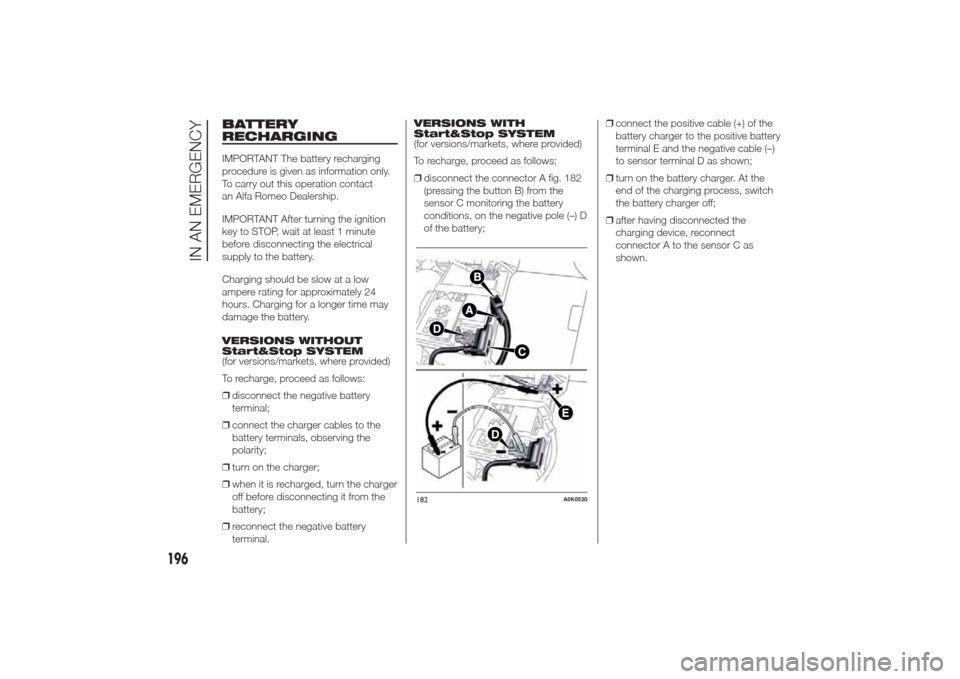
To recharge, proceed as follows:
❒disconnect the connector A fig. 182
(pressing the button B) from the
sensor C monitoring the battery
conditions, on the negative pole (–) D
of the battery;❒connect the positive cable (+) of the
battery charger to the positive battery
terminal E and the negative cable (–)
to sensor terminal D as shown;
❒turn on the battery charger. At the
end of the charging process, switch
the battery charger off;
❒after having disconnected the
charging device, reconnect
connector A to the sensor C as
shown.
182
A0K0530
196
IN AN EMERGENCY
Page 201 of 280
RAISING THE CARIf the car needs to be jacked up, go to
an Alfa Romeo Dealership which is
equipped with shop jacks and jack
arms.
IMPORTANT Be careful when
positioning the arm of the lift for
versions with side skirts.
TOWING THE CARThe tow ring provided with the car is
housed in the tool box in the boot.
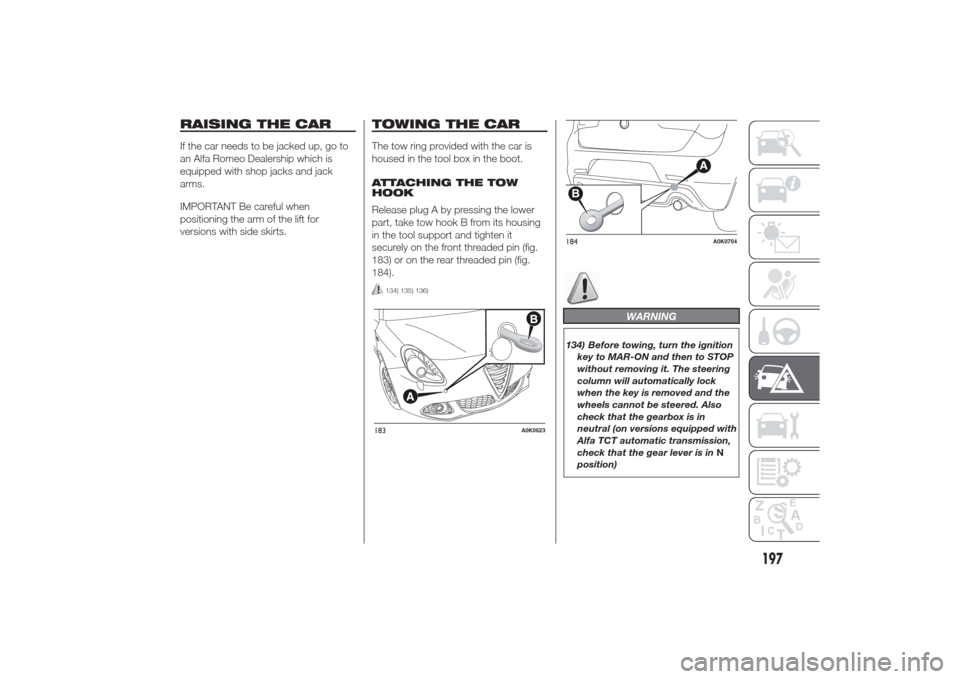
ATTACHING THE TOW
HOOK
Release plug A by pressing the lower
part, take tow hook B from its housing
in the tool support and tighten it
securely on the front threaded pin (fig.
183) or on the rear threaded pin (fig.
184).
134) 135) 136)
WARNING
134) Before towing, turn the ignition
key to MAR-ON and then to STOP
without removing it. The steering
column will automatically lock
when the key is removed and the
wheels cannot be steered. Also
check that the gearbox is in
neutral (on versions equipped with
Alfa TCT automatic transmission,
check that the gear lever is inN
position)
183
A0K0623
184
A0K0704
197
Page 220 of 280
WARNING
149) The road holding qualities of
the car also depend on the correct
inflation pressure of the tyres.
150) If tyre pressure is too low, it
may overheat and be severely
damaged as a result.
151) Do not switch tyres from the
left to the right side and vice
versa, in order to prevent
inversion of the rotation direction.
152) Do not repaint alloy wheel rims
at temperatures higher than
150°C. The mechanical
characteristics of the wheels
might be compromised.
WINDSCREEN/REAR
WINDOW WIPERSBLADES
It is advisable to replace the blades
about once a year.
153)
A few simple precautions can reduce
the possibility of damage to the blade:
❒if the temperature falls below zero,
make sure that ice has not frozen
the rubber to the glass. Use an
antifreeze product to release it if
required;
❒remove any snow from the glass;
❒do not operate the windscreen/rear
window wipers on dry glass.
Replacing the
windscreen wiper
blades
Proceed as follows:
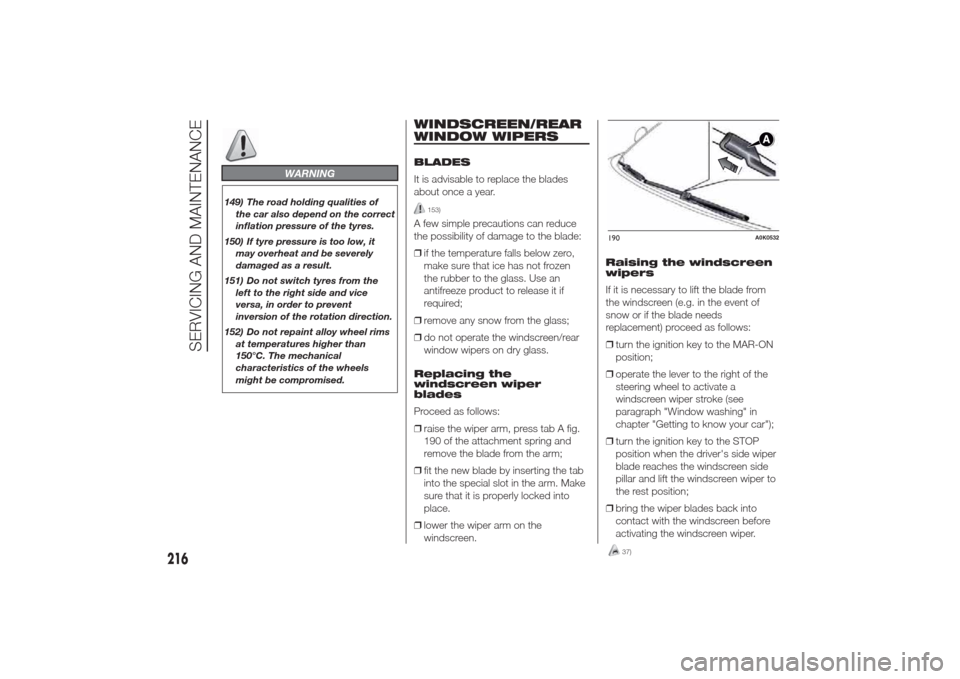
❒raise the wiper arm, press tab A fig.
190 of the attachment spring and
remove the blade from the arm;
❒fit the new blade by inserting the tab
into the special slot in the arm. Make
sure that it is properly locked into
place.
❒lower the wiper arm on the
windscreen.Raising the windscreen
wipers
If it is necessary to lift the blade from
the windscreen (e.g. in the event of
snow or if the blade needs
replacement) proceed as follows:
❒turn the ignition key to the MAR-ON
position;
❒operate the lever to the right of the
steering wheel to activate a
windscreen wiper stroke (see
paragraph "Window washing" in
chapter "Getting to know your car");
❒turn the ignition key to the STOP
position when the driver's side wiper
blade reaches the windscreen side
pillar and lift the windscreen wiper to
the rest position;
❒bring the wiper blades back into
contact with the windscreen before
activating the windscreen wiper.
190
A0K0532
216
SERVICING AND MAINTENANCE
37)
Page 223 of 280
❒remove the aerial from the roof when
using a carwash;
❒if high pressure jets or cleaners are
used to wash the car, keep a
distance of at least 40 cm from the
bodywork to avoid damage or
alteration. Bear in mind that a build
up of water could cause damage
to the car in the long term;
❒wash the bodywork using a low
pressure jet of water;
❒wipe a sponge with a slightly soapy
solution over the bodywork,
frequently rinsing the sponge;
❒rinse well with water and dry with a
jet of air or a chamois leather.
Dry the less visible parts (e.g. door
frames, bonnet, headlight frames, etc.)
with special care, as water may
stagnate more easily in these areas. Do
not wash the car after it has been left
in the sun or with the bonnet hot:
this may alter the shine of the
paintwork.
Exterior plastic parts must be cleaned
in the same way as the rest of the car.IMPORTANT
Avoid parking under trees; the resin
dropped by trees makes the paintwork
go opaque and increases the possibility
of corrosion.
Bird droppings must be washed off
immediately and thoroughly as the acid
they contain is particularly aggressive.
Windows
Use specific detergents and clean
cloths to prevent scratching or altering
the transparency.
IMPORTANT Wipe the rear window
inside gently with a cloth following the
direction of the filaments to avoid
damaging the heating device.
Front headlights
Use a soft cloth soaked in water and
detergent for washing cars.
IMPORTANT Never use aromatic
substances (e.g. petrol) or ketenes (e.g.
acetone) for cleaning the plastic lenses
of the front headlights.
IMPORTANT When cleaning with a
pressure washer, keep the water jet at
least 20 cm away from the headlights.Engine compartment
At the end of every winter, wash the
engine compartment thoroughly, taking
care not to aim the jet of water directly
at the electronic control units or at
the windscreen wiper motors. Have this
operation performed at a specialised
workshop.
IMPORTANT The washing should take
place with the engine cold and the
ignition key in the STOP position. After
the washing operation, make sure
that the various protections (e.g. rubber
caps and guards) have not been
removed or damaged.
IMPORTANT
6) Detergents cause water pollution.
Only wash your car in areas
equipped to collect and treat
wastewater from this type
of activity.
219
Page 275 of 280
– Door central
locking/unlocking ...................... 54
DPF (particulate filter) ..................... 87
DST system (Dynamic Steering
Torque)......................................... 67
Dual Pinion active steering ............. 79
Dusk sensor ................................... 36EBD system .................................. 65
Electric sun roof ............................. 52
Electric windows ............................ 56
– Controls .................................... 57"Electronic Q2" system ("E-Q2") .... 68Engine codes - bodywork
versions ....................................... 225
Engine compartment
– washing .................................... 219
Engine coolant temperature
indicator ....................................... 102
Engine............................................ 227
– engine cooling system fluid
level........................................... 212
– marking ..................................... 224
Engine oil
– consumption ............................. 211
– level check ................................ 211
EOBD system ................................ 79
ESC (Electronic Stability Control)
system ......................................... 65
External courtesy lights .................. 38
External lights................................. 35Extinguisher ................................... 51
Filling the tank ............................... 86
Fitting "Universal" child seat ........... 140
Fix&Go Automatic kit...................... 176
Flashing ......................................... 37
Fluids and lubricants ...................... 247
Fog lights ................................. 45-184"Follow Me Home" device ............. 38Front airbags................................. 146
Front armrest ................................. 48
Front driver side airbag................... 146
Front passenger airbag .................. 146
Front roof light
– bulb replacement ...................... 186
Fuel consumption .......................... 251
Fuel cut-off system......................... 46
Fuel level gauge ............................. 102
Fuel supply..................................... 231
Fuel tank cap ................................. 86
Fuses (if a fuse blows) .................... 187Gear Shift Indicator ....................... 91
Glove compartment courtesy
light
– bulb replacement ...................... 187Handbrake.................................... 156
Hazard warning lights..................... 45
HBA system ................................... 67
Headlights...................................... 64– Adjusting headlights abroad ...... 64
– bulb replacement ...................... 183
– Headlight alignment corrector.... 64
– Light beam direction.................. 64
Headlight washers ......................... 217
Head restraints............................... 18
– "Anti-Whiplash" device .............. 19
– Front headrests ......................... 18
– Rear head restraints .................. 19
Hill Holder system .......................... 66
Identification data
– bodywork paint plate ................. 224
– Chassis marking........................ 224
– engine marking.......................... 224
– identification data plate.............. 224
Ignition device ................................ 15
– Steering lock ............................. 16
Installing a Universal Isofix child
seat.............................................. 143
Installing electrical/electronic
devices ........................................ 81
Interior fittings ................................ 47
Interiors (cleaning) .......................... 220
iTPMS system ................................ 77Jack.............................................. 171Light clusters
– front light clusters (changing a
bulb).......................................... 183
INDEX