wheel Alfa Romeo Giulietta 2015 Owner's Guide
[x] Cancel search | Manufacturer: ALFA ROMEO, Model Year: 2015, Model line: Giulietta, Model: Alfa Romeo Giulietta 2015Pages: 288, PDF Size: 7.34 MB
Page 80 of 288

ACCESSORIES
PURCHASED BY THE
OWNER
If after purchasing the car, you decide
to install electrical accessories that
require a permanent electric supply
(radio, satellite anti-theft system, etc.) or
accessories that in any case burden
the electric supply, contact an Alfa
Romeo Dealership, whose qualified
personnel, besides suggesting the
most suitable devices from
Lineaccessori Alfa Romeo, will also
check whether the car's electrical
system is able to withstand the load
required, or whether it needs to be
integrated with a more powerful battery.
58)
INSTALLING ELECTRICAL
ELECTRONIC DEVICES
Electrical and electronic devices
installed after buying the car in the
context of after-sales service must carry
the following label:fig. 88Fiat Group Automobiles S.p.A.
authorises the installation of transceiver
devices on condition that such
installations are carried out in
a workmanlike fashion, following the
manufacturer’s instructions, at a
specialised centre.
IMPORTANT Traffic police may not
allow the car on the road if devices
have been installed which modify the
features of the car. This may also cause
invalidation of warranty in relation to
faults caused by the change either
directly or indirectly related to it.
Fiat Group Automobiles S.p.A. shall not
be liable for damage caused by the
installation of accessories either not
supplied or recommended by Fiat
Group Automobiles S.p.A. and/or not
installed in compliance with the
provided instructions.
RADIO TRANSMITTERS
AND MOBILE PHONES
Radio transmitter equipment (vehicle
mobile phones, CB radios, amateur
radio etc.) cannot be used inside the
car unless a separate aerial is mounted
on the roof.IMPORTANT The use of these devices
inside the passenger compartment
(without a separate aerial) may cause
the vehicle’s electronic systems to
malfunction. This could compromise
safety in addition to constituting a
potential hazard for passengers' health.
As far as the use of EC-approved
mobile phones is concerned (GSM,
GPRS, UMTS), follow the usage
instructions provided by the mobile
phone manufacturer.
WARNING
58) Take care when fitting additional
spoilers or non-standard alloy
wheels: they could reduce the
ventilation of the brakes and
affect efficiency in sharp,
repeated braking or on long
descents. Make sure that nothing
obstructs the pedal stroke (mats,
etc.).
88DISPOSITIVI-ELETTRONICI
76
GETTING TO KNOW YOUR CAR
/
Page 104 of 288
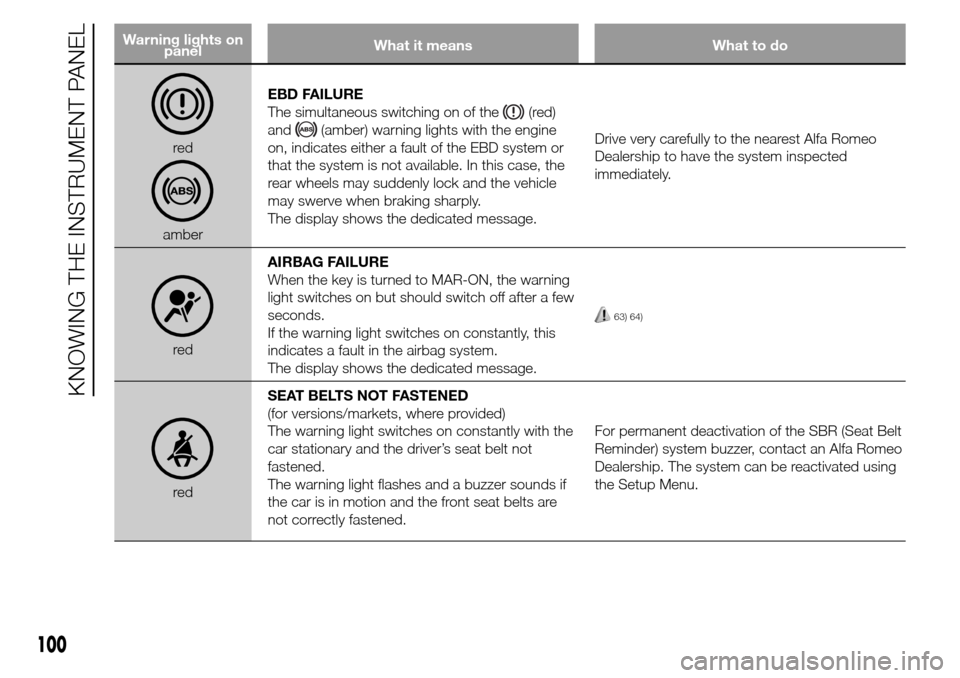
Warning lights on
panelWhat it means What to do
red
amberEBD FAILURE
The simultaneous switching on of the
(red)
and
(amber) warning lights with the engine
on, indicates either a fault of the EBD system or
that the system is not available. In this case, the
rear wheels may suddenly lock and the vehicle
may swerve when braking sharply.
The display shows the dedicated message.Drive very carefully to the nearest Alfa Romeo
Dealership to have the system inspected
immediately.
redAIRBAG FAILURE
When the key is turned to MAR-ON, the warning
light switches on but should switch off after a few
seconds.
If the warning light switches on constantly, this
indicates a fault in the airbag system.
The display shows the dedicated message.
63) 64)
redSEAT BELTS NOT FASTENED
(for versions/markets, where provided)
The warning light switches on constantly with the
car stationary and the driver’s seat belt not
fastened.
The warning light flashes and a buzzer sounds if
the car is in motion and the front seat belts are
not correctly fastened.For permanent deactivation of the SBR (Seat Belt
Reminder) system buzzer, contact an Alfa Romeo
Dealership. The system can be reactivated using
the Setup Menu.
100
KNOWING THE INSTRUMENT PANEL
Page 111 of 288

Warning lights on
panelWhat it means What to do
redDUAL PINION ACTIVE STEERING FAILURE
(for versions/markets, where provided)
When the key is turned to MAR-ON, the warning
light switches on but should switch off after a few
seconds.
If the warning light (or symbol on the display)
remains on, you may not have steering assistance
and the effort required to operate the steering
wheel could be notably increased; steering is,
however, possible.
The display shows the dedicated message.Contact an Alfa Romeo Dealership as soon as
possible.
IMPORTANT After the battery is disconnected,
the steering must be initialised. The warning light
switches on to indicate this. To carry out this
procedure, simply turn the steering wheel all the
way from one end to the other or drive in a
straight line for about 100 metres.
Warning lights on
panelWhat it means What to do
amberALFA ROMEO CODE SYSTEM FAILURE/
ALARM FAILURE
(for versions/markets, where provided)
The warning light (or symbol on the display) will
come on (on some versions, with a message on
the display) to indicate an Alfa Romeo CODE
system or alarm failure (for versions/markets,
where provided).Contact an Alfa Romeo Dealership as soon as
possible.
Break-in attempt
If this warning light flashes or, on some versions, if
the symbol appears in the display (together with a
message) this indicates a break-in attempt.Contact an Alfa Romeo Dealership as soon as
possible.
107
Page 121 of 288

Warning lights on
panelWhat it means What to do
amberiTPMS SYSTEM
When the key is turned to MAR-ON, the warning
light switches on but should switch off after a few
seconds.IMPORTANT Do not continue driving with one or
more flat tyres as handling may be
compromised. Stop the car, avoiding sharp
braking and steering. Repair immediately using
the dedicated kit (see the "Replacing a wheel"
paragraph in the "In an emergency" section) and
contact an Alfa Romeo Dealership as soon as
possible.
iTPMS failure/iTPMS temporarily deactivated
The warning light flashes for about 75 seconds and
then stays on constantly (together with a message
on the display) (see “Operating conditions”
paragraph) to indicate that the system is
temporarily deactivated or faulty.
The system goes back to normal operation when
the operating conditions allow it. If this is not the
case, carry out the Reset procedure after restoring
the normal operating conditions.If the malfunction warning persists, contact an
Alfa Romeo Dealership as soon as possible.
117
Page 122 of 288

Warning lights on
panelWhat it means What to do
amberLow tyre pressure
The warning light switches on constantly to
indicate that the tyre pressure is lower than the
recommended value, in order to guarantee long
tyre life and low fuel consumption, or to indicate a
slow loss of pressure.
In this way the iTPMS warns the driver that one or
more tyres may be flat and liable to puncture. In
this case it is advisable to restore the correct
pressure value (see the "Wheels" paragraph in the
"Technical specifications" section).
Once the normal operating conditions of the car
are restored, carry out the Reset procedure.In any situation in which the message on the
display is "See manual", it is ESSENTIAL to refer
to the contents of the "Wheels" paragraph in the
"Technical specifications" section, strictly
complying with the indications that you find
there.
IMPORTANT Do not continue driving with one or
more flat tyres as handling may be
compromised. Stop the car, avoiding sharp
braking and steering.
118
KNOWING THE INSTRUMENT PANEL
Page 144 of 288

FRONT AIRBAGS
“SMART BAG” SYSTEM
(MULTISTAGE FRONT
AIRBAGS)
The car features multistage front
airbags (“Smart bag”) for driver and
passenger.
The front (driver and passenger) airbags
protect occupants in the event of
head-on crashes of medium-high
severity, by placing the a cushion
between the occupant and the steering
wheel or dashboard.
Therefore non-deployment in other
types of impacts (side impacts, rear
shunts, roll-overs, etc.) does not
indicate a system malfunction.
Airbags are not a replacement of but
complementary to the seat belts, which
you are recommended to always wear.
In the event of impact, those not
wearing a seat belt are projected
forwards and may come into contact
with the bag which is still inflating. The
protection offered by the bag is
compromised in these circumstances.
85) 86) 88)
Front airbags may not activate in the
following situations:❒frontal impacts against highly
deformable objects not involving the
front surface of the car (e.g. wing
collision against guard rail, etc.);
❒jamming of the car underneath other
vehicles or protective barriers (e.g.
underneath a truck or a guard rail) as,
in this case, the bags would offer no
additional protection with respect
to the seat belt and their deployment
would be inappropriate. In these
cases, non-deployment does not
indicate a system malfunction.
FRONT DRIVER SIDE
AIRBAG
This consists of an instantly inflating
bag contained in a special
compartment in the centre of the
steering wheel fig. 120.FRONT PASSENGER
AIRBAG
This consists of an instantly inflating
bag contained in a special recess in the
dashboard fig. 121: this bag has a
larger volume than that of the driver's.
87)
FRONT PASSENGER
AIRBAG AND CHILD
RESTRAINT SYSTEMS
89)
ALWAYScomply with the instructions
on the label stuck on the passenger
side sun visor.
120A0K0364
121A0K0135
140
SAFETY
Page 147 of 288

WARNING
85) Do not apply stickers or other objects on the steering wheel, on the dashboard in the passenger side airbag area, on
side upholstery on the roof or on the seats. Never put objects (e.g. mobile phones) on the passenger's side dashboard
since they could interfere with correct inflation of the airbag and also cause serious injury to the passengers.
86) Always drive keeping your hands on the steering wheel rim so that the airbag can inflate freely if necessary. Do not
drive with your body bent forward. Keep the back of your seat upright and lean back into it.
87) When an active passenger airbag is fitted, DO NOT install rear facing child restraint systems on the front seat.
Deployment of the airbag in an accident could cause fatal injuries to the child regardless of the severity of the
impact. Therefore, always deactivate the passenger airbag when a rear facing child restraint system is installed on
the front passenger seat. The front passenger seat must also be positioned back as far as possible in order to avoid
the child restraint system from coming into contact with the dashboard. Immediately reactivate the passenger airbag
as soon as the child restraint system has been removed.
88) To deactivate the airbags, see the “Knowing your car” section, “Menu Items” paragraph.
89) When an active passenger airbag is fitted, DO NOT install rear facing child restraint systems on the front seat.
Deployment of the airbag in an accident could cause fatal injuries to the child regardless of the severity of the
impact.
143
Page 153 of 288

IMPORTANT
16) In the first period of use, we
recommend not to demand
maximum performance from the
car (for instance excessive
accelerations, extended travel at
maximum speed, sudden braking,
etc.).
17) With the engine off, do not leave
the key in the ignition switch on
MAR-ON to prevent draining
the battery.
18) A quick burst on the accelerator
before turning off the engine
serves absolutely no practical
purpose; it wastes fuel and is
especially damaging to
turbocharged engines.
19) If the
warning light flashes
for about 1 minute after starting
or during prolonged cranking, this
indicates a fault in the glow plug
preheating system. If the engine
starts, you may use the car
normally, but should contact an
Alfa Romeo Dealership as soon as
possible.
PARKING
Always remove the ignition key when
leaving the car.
When parking and leaving the car,
proceed as follows:
❒engage a gear (1st gear if parked
uphill or reverse if facing downhill)
and leave the wheels turned;
❒stop the engine and engage the
handbrake.
Block the wheels with a wedge or a
stone if the car is parked on a steep
slope.
On versions equipped with Alfa TCT
transmission, before releasing the brake
pedal, wait for letter P to be displayed.
IMPORTANTNEVERleave the car
with the gearbox in neutral (or, on
versions equipped with Alfa TCT
transmission, before placing the gear
lever at P).
HANDBRAKE
To engage it, pull lever A fig. 126
upwards until the car is secured.
When the handbrake is engaged and
the ignition key is at MAR-ON, the
warning light will switch on in the
instrument panel.To release it, raise lever A slightly, hold
down button B and lower the lever:
the
warning light on the instrument
panel switches off.
103) 104)
IMPORTANT Carry out these
manoeuvres with the brake pedal
pressed.
IMPORTANT For cars equipped with a
front armrest, lift it up to ensure that
it does not interfere with the action of
the handbrake.
126A0K0615
149
Page 156 of 288

POSITIONS OF THE
LEVER
Park (P)
Position P corresponds to the neutral
position of the transmission and locks
drive wheels mechanically.
It should only be engaged with the car
stationary and the handbrake should be
applied, if necessary.
With the ignition key at MAR-ON or with
engine running, or when the engine
switches off, if the gear lever is not
correctly positioned in P, letter P starts
flashing on the gear lever trim.
In this case, move the lever correctly to
position P.
21)
The ignition key can be removed only
when the lever is in position P. Moving
the lever from P to D must be
performed only when the car is
stationary and the engine at idling
speed.
Shifting from P to any other position of
the selector lever, with ignition key in
MAR-ON position, must be made
pressing the brake pedal and using the
button on the gear lever (see paragraph
"Selector lever").
If the battery is flat, to release the lever
you need to remove the gaiter and
operate the lever A fig. 132.IMPORTANT NEVER leave the car
before having positioned the selector
lever in P.
Reverse (R)
The engine cannot be started with the
lever in position R.
Shifting from R to N or D is free, while
shifting from R to P can be made by the
button on the gear lever, with engine
at idling speed.
22)
Neutral (N)
It corresponds to neutral for a standard
manual gearbox. The engine can be
started with the lever in position N.
Engage N in case of prolonged stops.
To move the lever from position N,
release the accelerator and make sure
the engine is stable at idling speed.Shifting from N to D is free, while
shifting from N to R or P can only be
made by the button on the gear lever.
Drive (D) - Automatic
forward gear
It is the lever position in standard
running conditions.
Shifting from D to N is free, while
shifting from D to R or P can only be
made by the button on the gear lever.
Sequential mode (+ / –)
Shifting the lever from position D on
side in stable position, the transmission
is used in sequential mode.
Shifting the lever in unstable position (+
or −) gears are changed.
Important information
IMPORTANT All movements of the gear
lever must be performed with car
stationary and engine idling only.
The drive wheels are mechanically
locked in position P.
Shifting from P to R is possible with
brake pedal pressed and button on
gear lever pressed.
Shifting from R to N and from N to D is
free.
132A0K0619
152
STARTING AND DRIVING
Page 157 of 288

Shifting from D to "Sequential mode" is
free.
Shifting from "Sequential mode" to D is
free.
Shifting from D to N is free.
Shifting from N to R is possible only
with button on gear lever pressed.
Shifting from R to P is possible only
with button on gear lever pressed.
STARTING THE ENGINE
Starting is only permitted with gear
lever in position P or N (with or without
brake pedal pressed).
On starting, the system is at N or P (the
latter means neutral, but with the car’s
wheels locked mechanically).
Start&Stop system
With car at a standstill and Start&Stop
system activated, the engine switches
off if the gear lever is in a position
other than R.
The Start&Stop system does not
operate when the gear lever is in R, for
making parking manoeuvres easier.
In the event of stops uphill, the engine
switching off is disabled to activate
the "Hill Holder" function (works only
with running engine).The engine restarts automatically if:
❒the brake pedal is released (and the
lever is not at N or P)
❒the lever is shifted to an unstable
position: +, − or R
❒the lever is shifted from D to the left
in "Sequential mode"
❒by the "+" or "–" paddles on the
steering wheel (for versions/markets,
where provided)
During the engine stop and start
sequence, the system passes through
the automatic engagement of neutral:
the display shows N.
IMPORTANT In some conditions (for
example with small gradients and brake
pedal not fully depressed), engine
switching off is not deactivated. In this
case, fully depress the brake pedal
to make the "Hill Holder" function
available and restart the engine, using
the gear lever or the paddles on the
steering wheel (for versions/markets,
where provided) as described
previously.ENGINE SWITCHING OFF
Engine can be switched off in any
position of the gear lever.
Versions with
Start&Stop system
To switch the engine off, you need to
stop the car by pressing the brake
pedal properly; if the pressure is not
enough, the engine will not be switched
off.
This feature can be exploited so that
the engine does not switch off in
particular traffic conditions.
Ignition key removal
The ignition key can be removed only if
the gear lever is in position P:
❒if the engine is switched off with the
gear lever in position P: the ignition
key can be removed within 30
seconds;
❒if the engine is switched off with the
gear lever in a position other than P:
the P letter on the display and on
the gear lever trim flashes for 5
seconds and an acoustic signal will
be emitted at the same time. Move
the lever to P within 5 seconds; then
it will be possible to remove the
ignition key for about 30 seconds.
153