climate control Alfa Romeo Giulietta 2016 User Guide
[x] Cancel search | Manufacturer: ALFA ROMEO, Model Year: 2016, Model line: Giulietta, Model: Alfa Romeo Giulietta 2016Pages: 288, PDF Size: 7.34 MB
Page 35 of 288
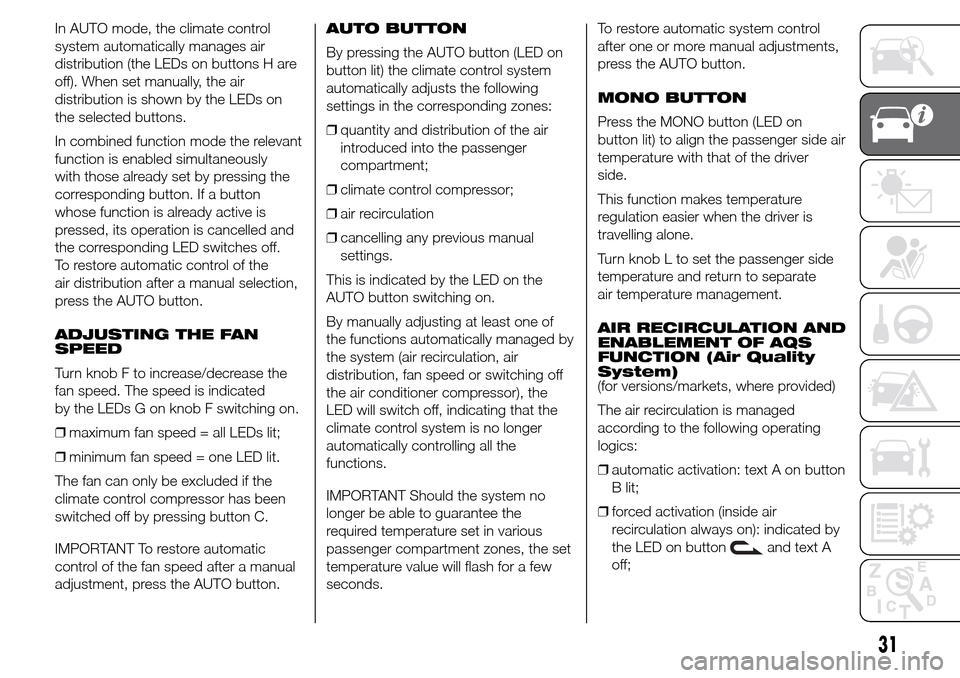
In AUTO mode, the climate control
system automatically manages air
distribution (the LEDs on buttons H are
off). When set manually, the air
distribution is shown by the LEDs on
the selected buttons.
In combined function mode the relevant
function is enabled simultaneously
with those already set by pressing the
corresponding button. If a button
whose function is already active is
pressed, its operation is cancelled and
the corresponding LED switches off.
To restore automatic control of the
air distribution after a manual selection,
press the AUTO button.
ADJUSTING THE FAN
SPEED
Turn knob F to increase/decrease the
fan speed. The speed is indicated
by the LEDs G on knob F switching on.
❒maximum fan speed = all LEDs lit;
❒minimum fan speed = one LED lit.
The fan can only be excluded if the
climate control compressor has been
switched off by pressing button C.
IMPORTANT To restore automatic
control of the fan speed after a manual
adjustment, press the AUTO button.AUTO BUTTON
By pressing the AUTO button (LED on
button lit) the climate control system
automatically adjusts the following
settings in the corresponding zones:
❒quantity and distribution of the air
introduced into the passenger
compartment;
❒climate control compressor;
❒air recirculation
❒cancelling any previous manual
settings.
This is indicated by the LED on the
AUTO button switching on.
By manually adjusting at least one of
the functions automatically managed by
the system (air recirculation, air
distribution, fan speed or switching off
the air conditioner compressor), the
LED will switch off, indicating that the
climate control system is no longer
automatically controlling all the
functions.
IMPORTANT Should the system no
longer be able to guarantee the
required temperature set in various
passenger compartment zones, the set
temperature value will flash for a few
seconds.To restore automatic system control
after one or more manual adjustments,
press the AUTO button.
MONO BUTTON
Press the MONO button (LED on
button lit) to align the passenger side air
temperature with that of the driver
side.
This function makes temperature
regulation easier when the driver is
travelling alone.
Turn knob L to set the passenger side
temperature and return to separate
air temperature management.
AIR RECIRCULATION AND
ENABLEMENT OF AQS
FUNCTION (Air Quality
System)
(for versions/markets, where provided)
The air recirculation is managed
according to the following operating
logics:
❒automatic activation: text A on button
B lit;
❒forced activation (inside air
recirculation always on): indicated by
the LED on button
and text A
off;
31
Page 36 of 288
❒forced deactivation (air recirculation
always off, air drawn in from the
outside): indicated by the LED on
buttons
switching off and text A
on button B off.
Forced activation/deactivation can be
selected by pressing button
.
When the
button is pressed (button
E off), the climate control system
automatically activates internal air
recirculation (LED on
button A
on). It is still possible to activate outside
air recirculation (LED on the button off)
and vice versa, by pressing button
.
The AQS (Air Quality System) function
(for versions/markets, where provided)
cannot be activated when the
button
is pressed (LED on button E off).
AQS (Air Quality System)
function activation
(for versions/markets, where provided)
The AQS function automatically
activates internal air recirculation when
the outside air is polluted (e.g. in traffic
queues and tunnels).IMPORTANT With the AQS function
active, after a preset time interval of the
internal air recirculation system
functioning, the climate control system
enables the intake of outside air for
approximately one minute to change
the air in the passenger compartment.
This takes place regardless of the
pollution level of the outside air.
IMPORTANT The engagement of the
recirculation system makes it possible
to reach the required heating/cooling
conditions faster. It is, however,
inadvisable to use it on rainy/cold days
as it would considerably increase the
possibility of the windows misting
up inside (especially if the climate
control system is off). When the outside
temperature is low, recirculation is
forced off (air drawn in from the outside)
to prevent the windows from misting
up.
In automatic operation, recirculation is
managed automatically by the system
according to outside environmental
conditions.
IMPORTANT It is advisable not to use
the air recirculation function when
the outside temperature is low to
prevent the windows from rapidly
misting up.CLIMATE CONTROL
COMPRESSOR
Press button C to activate/deactivate
the compressor (activation is indicated
by the lit LED on the button). The
system remembers that the
compressor has been switched off,
even after the engine has stopped.
When the compressor is switched off
the system deactivates air recirculation
to prevent the windows from misting
up and deactivates the AQS function
(for versions/markets, where provided).
In this case, although the climate
control system is capable of
maintaining the required temperature,
the AUTO LED switches off. The
temperatures will flash for a few
seconds if the required temperature
cannot be maintained.
To restore automatic control of
compressor engagement, press again
button C or the AUTO button.
With compressor off:
❒if the outside temperature is higher
than the set one, the system will
not be able to satisfy the request.
The temperature values will then flash
on the display for a few seconds to
indicate this;
❒the fan speed can be reset manually.
32
GETTING TO KNOW YOUR CAR
Page 37 of 288
With the compressor on and the engine
running, manual ventilation cannot be
lower than the minimum speed (only
one LED lit).
IMPORTANT With the compressor off,
air cannot be introduced to the
passenger compartment with
a temperature lower than the outside
temperature. Moreover, under certain
environmental conditions, windows
could mist up rapidly since the air is not
dehumidified.
RAPID WINDOW
DEMISTING/DEFROSTING
(MAX-DEF function)
Press the
button to activate (LED
on button on) the windscreen and side
windows demisting/defrosting function.
The climate control system carries out
the following operations:
❒switches on the air conditioning
compressor when climatic conditions
are suitable;
❒deactivates air recirculation;
❒sets maximum air temperature (HI) in
both zones;
❒sets fan speed according to the
engine coolant temperature;
❒directs air flow to windscreen and
front side windows diffusers;❒activates the heated rear window.
❒displays the fan speed (LED G lit).
IMPORTANT The MAX-DEF function
remains on for about 3 minutes from
when the engine coolant reaches the
appropriate temperature.
When the function is activated, the LED
on the AUTO button switches off.
With the function activated the only
possible manual adjustments are
adjusting the fan speed and turning the
heated rear window off.
When the B, C,
or AUTO buttons
are pressed, the climate control system
will turn the MAX-DEF off.
HEATED REAR WINDOW
DEMISTING/DEFROSTING
Press the
button to activate (LED
on button on) heated rear window
demisting/defrosting.
This function switches off automatically
after about 20 minutes or when the
engine is turned off. It is not switched
on automatically the next time the
engine is started.
For versions/markets where provided,
press the
button to activate
demisting/defrosting of exterior rear
view mirrors and heated nozzles (for
versions/markets, where provided).IMPORTANT Do not affix stickers to the
inside of the heated rear window over
the heating filaments, to avoid damage
that might cause them to stop working
properly.
Thermal comfort
windscreen
(for versions/markets, where provided)
Some versions feature a thermal
comfort windscreen which, with the car
exposed to the sun, reduces the
temperature in the passenger
compartment relative to the outside
temperature, thus ensuring greater
comfort.
Humidity sensor
(for versions/markets, where provided)
The humidity sensor helps to prevent
the windows from misting up. For
full functionality, it is advisable to
activate the AUTO function (LED N on).
When the outside temperature is low,
the system could automatically turn the
compressor on and turn air recirculation
off for safer driving.
33
Page 38 of 288
SWITCHING OFF/ON THE
CLIMATE CONTROL
SYSTEM
Switching off the
climate control system
Press the
button (LED on button off).
With climate control off:
❒air recirculation is on, thus isolating
the passenger compartment from
the outside;
❒the compressor is off;
❒the fan is off;
❒the heated rear window can be
switched on or off;
❒the AQS (Air Quality System) function
(for versions/markets, where
provided) cannot be activated.
IMPORTANT The climate control
system control unit stores the
temperatures set before the system
was switched off and restores them
when any button of the system is
pressed (except for button D).Switching on the climate
control system
To switch on the climate control system
in fully automatic mode press the AUTO
button.
START&STOP
Automatic Climate
Control
The dual zone automatic climate control
manages the Start&Stop function
(engine off when the car speed is zero)
to guarantee a suitable comfort inside
the car.
Specifically, the Start&Stop function is
turned off when the weather is
particularly hot or cold to guarantee an
adequate level of comfort inside the
passenger compartment; therefore, the
engine will not be stopped during
these transient conditions, even if the
speed is zero.
When the Start&Stop function is active
(engine off at zero car speed), the
climate control system will request
restarting of the engine if the inside
temperature conditions rapidly
deteriorate (or if the user requests
maximum cooling – LO – or quick
demisting – MAX DEF).With the Start&Stop function on (engine
off at zero speed), air flow is reduced
to the minimum to maintain comfort
conditions inside the passenger
compartment as long as possible when
the system is in AUTO mode (LED N
on).
The climate control system control unit
attempts to manage the discomfort
caused by the engine stopping
(compressor and engine coolant pump
off) but operation of the climate control
system can be enhanced by turning
the Start&Stop off by pressing the
dedicated button on the dashboard.
NoteIn particularly severe climate
conditions it is recommended to limit
the use of the Start&Stop function
to prevent the compressor from
continuously switching on and off, with
consequent rapid misting of the
windows and accumulation of humidity
with unpleasant smells in the passenger
compartment.
NoteWhen the Start&Stop function is
on (engine off and vehicle speed zero),
the automatic recirculation
management is turned off always taking
air in from outside, to reduce the
probability of window misting up (as the
compressor is off).
34
GETTING TO KNOW YOUR CAR
Page 39 of 288
ADDITIONAL HEATER
(for versions/markets, where provided)
This allows the passenger
compartment to be heated more
quickly in cold weather conditions. The
additional heater turns off automatically
after the required comfort conditions
are achieved.
Automatic dual zone
climate control system
(for versions/markets, where provided)
The additional heater activates
automatically depending on the
environmental conditions and with
engine started.
Manual climate control
system
The additional heater activates
automatically when knob A is turned to
the end of the red section and the fan
is set to at least 1
stspeed.
IMPORTANT The heater only works if
the outside temperature and engine
coolant temperature are low. The heater
will not activate if the battery voltage is
too low.
IMPORTANT
2) The climate control system
detects the passenger
compartment temperature with a
mean radiant temperature sensor
fitted in a cover under the internal
rear view mirror. Obstructing the
field of view of this sensor with
any object could cause the
climate control system to operate
with less than optimal efficiency
.
EXTERNAL LIGHTS
IN BRIEF
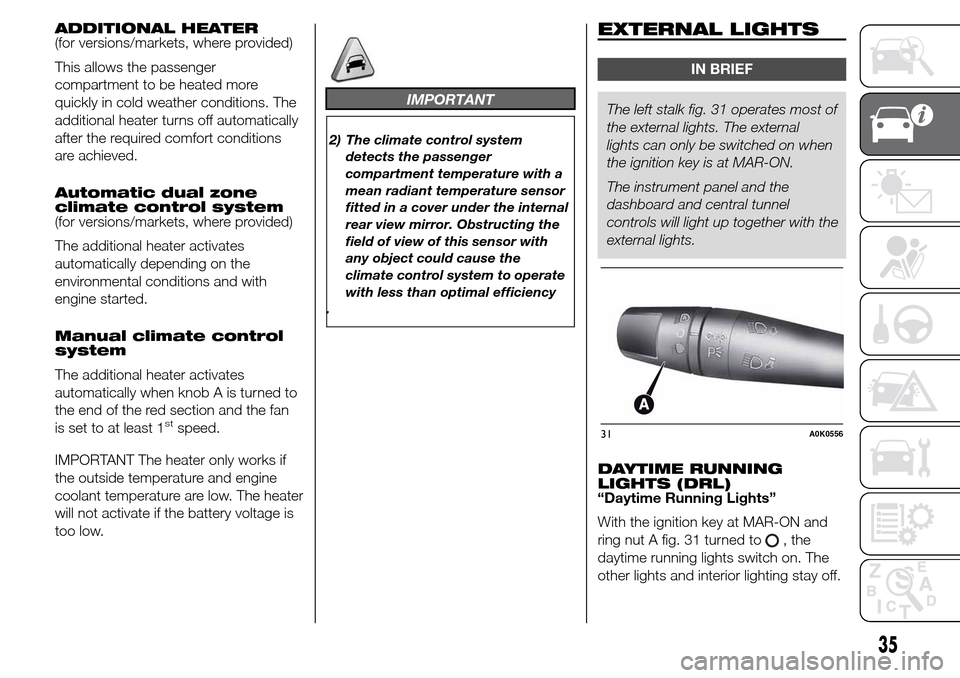
The left stalk fig. 31 operates most of
the external lights. The external
lights can only be switched on when
the ignition key is at MAR-ON.
The instrument panel and the
dashboard and central tunnel
controls will light up together with the
external lights.
DAYTIME RUNNING
LIGHTS (DRL)
“Daytime Running Lights”
With the ignition key at MAR-ON and
ring nut A fig. 31 turned to
, the
daytime running lights switch on. The
other lights and interior lighting stay off.
31A0K0556
35
Page 50 of 288
INTERIOR FITTINGS
STORAGE
COMPARTMENTS
19)
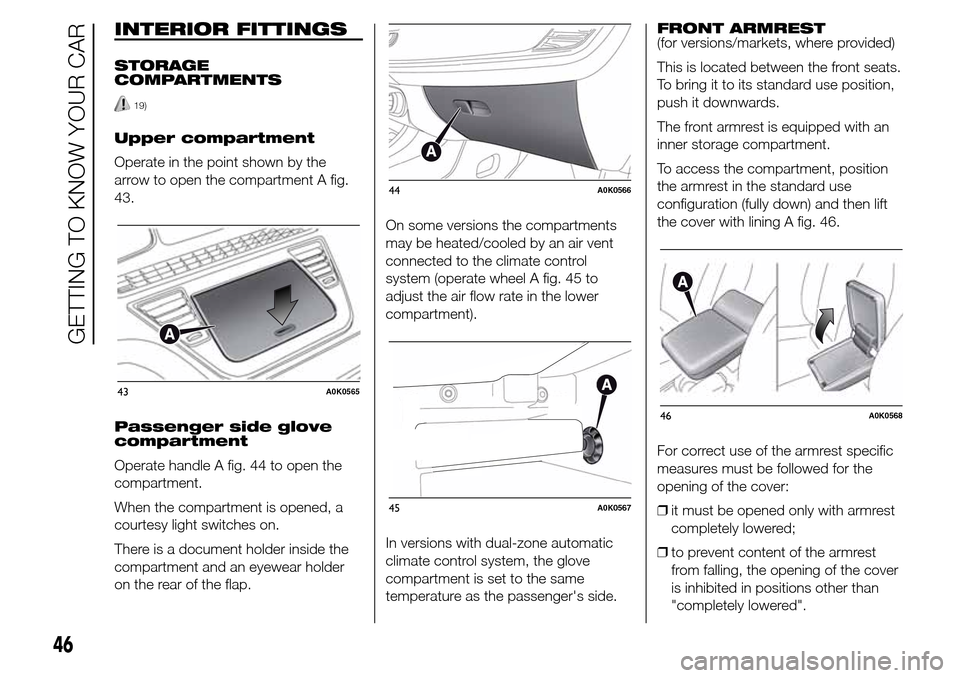
Upper compartment
Operate in the point shown by the
arrow to open the compartment A fig.
43.
Passenger side glove
compartment
Operate handle A fig. 44 to open the
compartment.
When the compartment is opened, a
courtesy light switches on.
There is a document holder inside the
compartment and an eyewear holder
on the rear of the flap.On some versions the compartments
may be heated/cooled by an air vent
connected to the climate control
system (operate wheel A fig. 45 to
adjust the air flow rate in the lower
compartment).
In versions with dual-zone automatic
climate control system, the glove
compartment is set to the same
temperature as the passenger's side.FRONT ARMREST
(for versions/markets, where provided)
This is located between the front seats.
To bring it to its standard use position,
push it downwards.
The front armrest is equipped with an
inner storage compartment.
To access the compartment, position
the armrest in the standard use
configuration (fully down) and then lift
the cover with lining A fig. 46.
For correct use of the armrest specific
measures must be followed for the
opening of the cover:
❒it must be opened only with armrest
completely lowered;
❒to prevent content of the armrest
from falling, the opening of the cover
is inhibited in positions other than
"completely lowered".
43A0K0565
44A0K0566
45A0K0567
46A0K0568
46
GETTING TO KNOW YOUR CAR
Page 74 of 288
❒driver's door not shut;
❒driver's seat belt not fastened;
❒reverse gear engaged (for example,
for parking manoeuvres);
❒for versions equipped with dual zone
automatic climate control (for
versions/markets, where provided), if
an adequate level of thermal comfort
has not been reached or with
MAX-DEF function activation;
❒during the first period of use, to
initialise the system.
ENGINE RESTARTING
CONDITIONS
Due to comfort, emission control and
safety reasons, the engine can restart
automatically without any action by the
driver, under special conditions, such
as:
❒battery not sufficiently charged;
❒reduced braking system vacuum
(e.g. if the brake pedal is pressed
repeatedly);
❒car moving (e.g. when driving on
roads with a gradient);
❒engine stopping by Start&Stop
system for over 3 minutes;❒for versions equipped with dual zone
automatic climate control system (for
versions/markets, where provided),
if an adequate level of thermal
comfort has not been reached or
MAX-DEF function activation.
With gear engaged, automatic engine
restarting is possible only by fully
depressing the clutch pedal. The driver
is informed by the displaying of a
message on the display and -
for versions/markets, where provided -
by the flashing of the symbol
.
Notes
If the clutch is not pressed, about 3
minutes after the engine stops, the
engine can be restarted only using the
ignition key.
In cases when the engine stops and
this is not desired, due for example to
the clutch pedal being released sharply
with a gear engaged, if the Start&Stop
system is activated, the engine can
be restarted by fully depressing the
clutch pedal or by placing the gear lever
in neutral.SAFETY FUNCTIONS
When the engine is stopped by the
Start&Stop system, if the driver releases
his/her seat belt and opens the driver's
or passenger's door, the engine can
be restarted only using the ignition key.
The driver is informed by a buzzer
and by the flashing of the symbol
on
the display; on some versions, a
message is displayed as well.
"ENERGY SAVING"
FUNCTION
(for versions/markets, where provided)
If, following automatic engine restarting,
the driver does not carry out any
action on the car for over 3 minutes,
the Start&Stop system stops the engine
once and for all, to prevent fuel
consumption. In these cases, the
engine can be restarted only using the
ignition key.
NOTE In any case, it is possible to keep
the engine running by deactivating the
Start&Stop system.
IRREGULAR OPERATION
In the event of malfunction, the
Start&Stop system is deactivated.
70
GETTING TO KNOW YOUR CAR
Page 91 of 288
MENU ITEMS
IMPORTANT WithUconnect™5"
radio system (for versions/markets
where provided), orUconnect™6.5"
Radio Nav system (for versions/
markets, where provided), some Menu
items are displayed and managed
through the system and not through the
instrument panel (refer to the dedicated
supplements).
Menu
This item allows you to access the
Setup Menu.
Press the
orbutton to
select the various Menu options. Hold
down the SET/
button to return
to the standard screen.
Lighting (Car interior
lighting adjustment)
(only with side lights on)
This function is used to set the
brightness of the instrument panel,
Uconnect™system controls (for
versions/markets where provided) and
automatic climate control system
controls (for versions/markets where
provided) to 8 levels.
Proceed as follows to adjust the light
intensity:❒press button SET/
briefly. The
level set previously flashes on the
display;
❒press button
orto set
the required brightness level;
❒briefly press the SET/
button to
go back to the menu screen or hold
the button down to go back to the
standard screen without saving.
NoteOn versions with reconfigurable
multifunction display, adjustment can
be made both with lights off ("Daytime"
mode brightness level) and with lights
on ("Nighttime" mode brightness level).
Speed Beep (Speed
limit)
With this function it is possible to set
the car speed limit (km/h or mph); when
this limit is exceeded the driver is
alerted.
To set the desired speed limit, proceed
as follows:
❒briefly press the SET/
button: the
display will show the wording "Speed
Beep";
❒press button
orto select
speed limit activation ("On") or
deactivation ("Off");❒if the function is on, press
or
to select the desired speed
limit and then press SET/
to
confirm.
IMPORTANT Setting is possible
between 30 and 200 km/h, or 20 and
125 mph, according to the previously
set unit. See the "Unit of Measurement"
paragraph described below. The
setting will increase/decrease by five
units each time button
/is
pressed. Hold down the
/
button to automatically
increase/decrease the setting rapidly.
Complete the adjustment with single
presses of the button when you
approach the desired value.
Briefly press the SET/
button to go
back to the menu screen or hold the
button down to go back to the
standard screen without saving.
To cancel the setting, proceed as
follows:
❒briefly press the SET/
button,
"On" will flash in the display;
❒press button
, "Off" will flash on
the display;
❒briefly press the SET/
button to
go back to the menu screen or hold
the button down to go back to the
standard screen without saving.
87
Page 162 of 288
WARNING
106) Using the levers incorrectly
(levers pushed towards the
dashboard, see fig. 137) could
break them.
107) Never leave children
unattended in the car. Always
remove the ignition key when
leaving the car and take the key
with you.
108) The Launch control function is
only available in Dynamic mode.
Regardless of what is explicitly
indicated in the description of
these modes, the ESC and ASR
systems are deactivated during
operation of the Launch Control
function. This means that vehicle
dynamic control is the sole
responsibility of the driver.
Therefore pay the utmost
attention when using the Launch
Control. Take into account traffic
and road surface conditions and
during manoeuvres make sure
there is enough room in the area
concerned.
SAVING FUEL
Here are some suggestions which can
help you to save fuel and lower harmful
emissions.
GENERAL
CONSIDERATIONS
Car maintenance
Checks and adjustments should be
carried out in accordance with the
“Scheduled Servicing Plan” (see
chapter “Maintenance and care”).
Tyres
Check the tyre pressures at least once
every four weeks: if the pressure is
too low, consumption levels increase as
resistance to rolling is higher.
Unnecessary loads
Do not travel with an overloaded boot.
The weight of the car and its
arrangement greatly affect fuel
consumption and stability.Roof rack/ski rack
Remove the roof rack or the ski rack
from the roof after use. These
accessories lower aerodynamic
penetration and adversely affect
consumption levels. When transporting
particularly large objects, use a trailer
if possible.
Electrical devices
Use the electrical devices only for the
necessary amount of time. The heated
rear window, additional headlights,
screen wipers and heater fan require a
considerable amount of energy;
increasing the current uptake increases
fuel consumption (by up to +25% in
an urban cycle).
Climate control system
Using the climate control system will
increase consumption: use the air vents
when the temperature outside permits.
Devices for
aerodynamic control
The use of non-certified devices for
aerodynamic control may adversely
affect air drag and fuel consumption.
158
STARTING AND DRIVING
Page 202 of 288
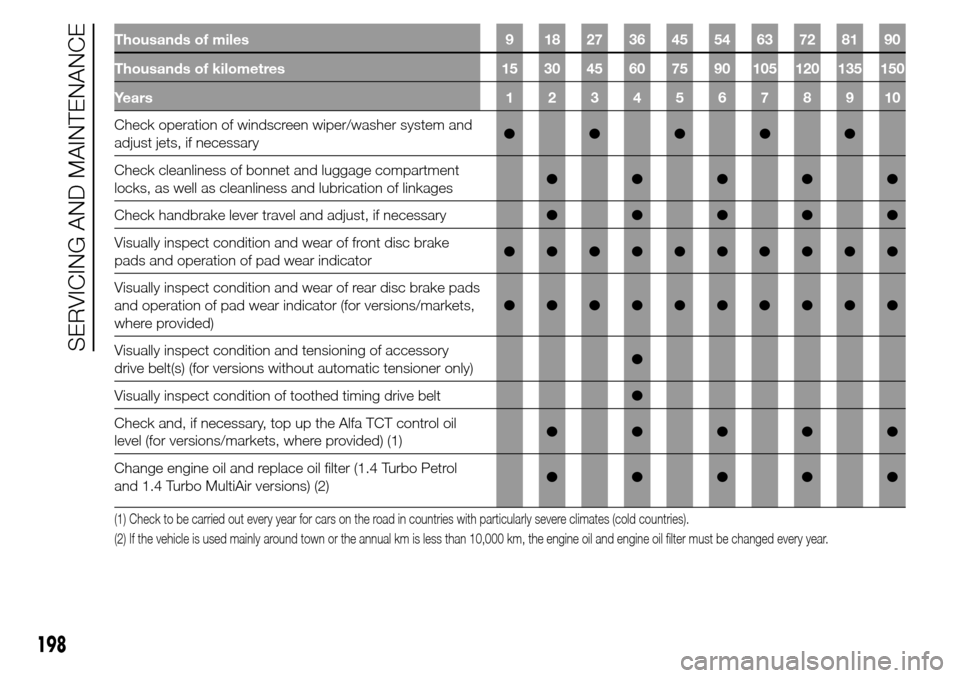
Thousands of miles 9 18 27 36 45 54 63 72 81 90
Thousands of kilometres 15 30 45 60 75 90 105 120 135 150
Years12345678910
Check operation of windscreen wiper/washer system and
adjust jets, if necessary●●●●●
Check cleanliness of bonnet and luggage compartment
locks, as well as cleanliness and lubrication of linkages●●●●●
Check handbrake lever travel and adjust, if necessary●●●●●
Visually inspect condition and wear of front disc brake
pads and operation of pad wear indicator●●●●●●●●●●
Visually inspect condition and wear of rear disc brake pads
and operation of pad wear indicator (for versions/markets,
where provided)●●●●●●●●●●
Visually inspect condition and tensioning of accessory
drive belt(s) (for versions without automatic tensioner only)●
Visually inspect condition of toothed timing drive belt●
Check and, if necessary, top up the Alfa TCT control oil
level (for versions/markets, where provided) (1)●●●●●
Change engine oil and replace oil filter (1.4 Turbo Petrol
and 1.4 Turbo MultiAir versions) (2)●●●●●
(1) Check to be carried out every year for cars on the road in countries with particularly severe climates (cold countries).
(2) If the vehicle is used mainly around town or the annual km is less than 10,000 km, the engine oil and engine oil filter must be changed every year.
198
SERVICING AND MAINTENANCE