dashboard Alfa Romeo Giulietta 2016 User Guide
[x] Cancel search | Manufacturer: ALFA ROMEO, Model Year: 2016, Model line: Giulietta, Model: Alfa Romeo Giulietta 2016Pages: 288, PDF Size: 7.34 MB
Page 57 of 288
The door lock knob can be realigned
(only when the battery charge has been
restored) as follows:
❒press button
on the key;
❒press the
locking/unlocking button
on the dashboard;
❒opening the door by inserting the key
in the front door pawl;
❒operate the internal door handle.
6)
Opening/closing
mechanism initialisation
If the battery is disconnected or the
protection fuse blows, the door
opening/closing mechanism must be
initialised as follows:
❒close all the doors;
❒press the
button on the key or the
button on the dashboard;
❒press the
button on the key or the
button on the dashboard.
IMPORTANT
4) Always use this device when
carrying children.
5) After engaging the device on both
rear doors, check for proper
engagement by trying to open a
rear door with the internal handle.
6) If the child lock was engaged and
the previously described locking
procedure carried out, operating
the internal opening handle will
not open the door, just the
realignment of the lock knob. To
open the door, pull the external
handle. The door central
locking/unlocking button
is not
disabled by the engagement of
the emergency lock.
ELECTRIC WINDOWS
These operate when the ignition key is
turned to MAR-ON and for about 3
minutes after turning the key to STOP
or removing it if one of the front doors is
open.
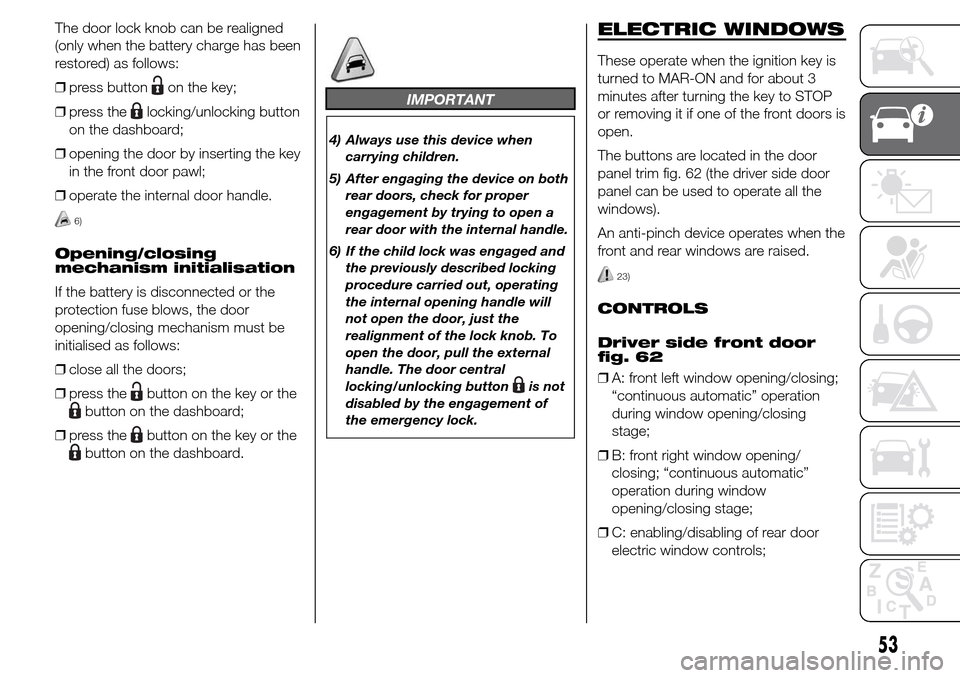
The buttons are located in the door
panel trim fig. 62 (the driver side door
panel can be used to operate all the
windows).
An anti-pinch device operates when the
front and rear windows are raised.
23)
CONTROLS
Driver side front door
fig. 62
❒A: front left window opening/closing;
“continuous automatic” operation
during window opening/closing
stage;
❒B: front right window opening/
closing; “continuous automatic”
operation during window
opening/closing stage;
❒C: enabling/disabling of rear door
electric window controls;
53
Page 76 of 288
WARNING
48) When replacing the battery,
always contact an Alfa Romeo
Dealership. The replacement
battery should be of the same
type (HEAVY DUTY) and should
have the same characteristics.
49) Before opening the bonnet,
make sure that the engine is off
and that the ignition key is in
the STOP position. Follow the
instructions on the dedicated
label on the front crossmember
(fig. 85). We recommend that you
remove the key from the ignition if
other people remain in the car.
The car should always be left after
the key has been removed or
turned to the STOP position.
During refuelling, make sure that
the engine is off (and that the
ignition key is in the STOP
position).
iTPMS (indirect Tyre
Pressure
Monitoring System)
(for versions/markets, where provided)
DESCRIPTION
The car can be equipped with the
iTPMS (indirect Tyre Pressure
Monitoring System) which monitors the
tyre inflation status thanks to wheel
speed sensors.
The system warns the driver if one or
more tyres are flat by the dedicated
warning light
continuously on and a
warning message on the display.
If one tyre only is flat, the system can
indicate its position: it is anyway
recommended to check the pressure
on all four tyres.
This indication is displayed also when
turning the engine off and on again until
the RESET procedure is carried out.
RESET PROCEDURE
The iTPMS system needs an initial
"self-learning" phase (with length
depending on the driving style and road
conditions: optimal conditions being
RESET procedure is carried out.❒whenever the tyre pressure is
modified;
❒when even only one tyre is changed;
❒when tyres are rotated/inverted;
❒when the space-saver wheel is fitted.
Before carrying out the RESET, inflate
the tyres to the rated pressure values
specified in the inflation pressure table
(see "Wheels" paragraph in the
"Technical specifications" section).
If the RESET is not carried out, in all
above cases, the warning lightmay
give false indications on one or more
tyres.
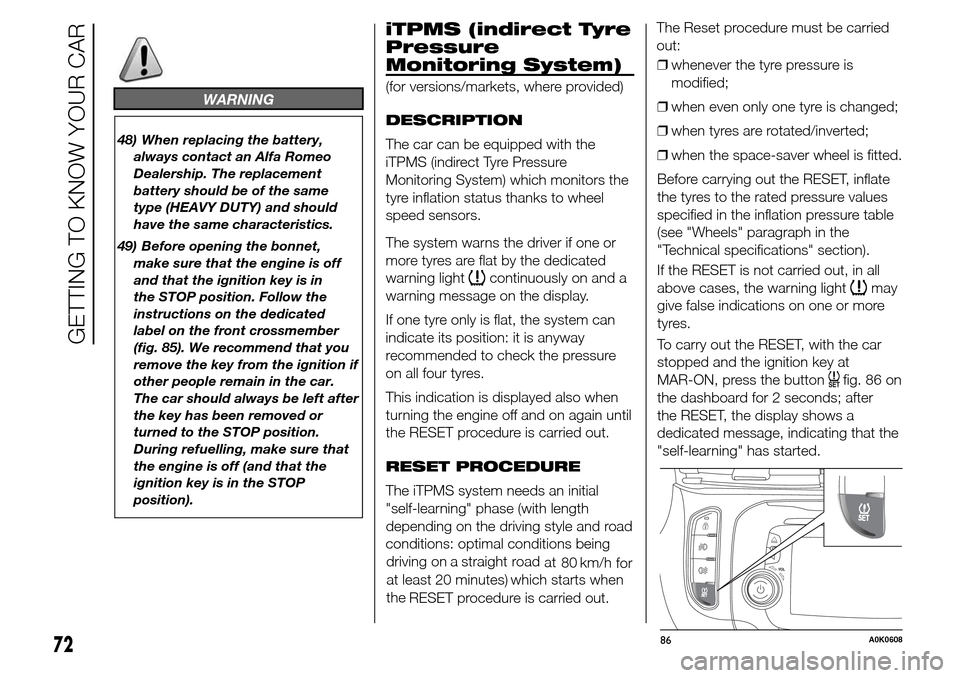
To carry out the RESET, with the car
stopped and the ignition key at
MAR-ON, press the button
fig. 86 on
the dashboard for 2 seconds; after
the RESET, the display shows a
dedicated message, indicating that the
"self-learning" has started.
86A0K060872
GETTING TO KNOW YOUR CAR
The Reset procedure must be carried
out:
which starts when driving
on
a
straight
road
at
80
km/h
for
at least 20 minutes)
the
Page 79 of 288
WARNING
56) It is absolutely forbidden to carry
out any after-market operation
involving steering system or
steering column modifications
(e.g. installation of anti-theft
device) that could adversely affect
performance and safety,
invalidate the warranty and also
result in non-compliance of the
car with type-approval
requirements.
WIRING FOR RADIO
SYSTEM
(for versions/markets, where provided)
If noUconnect™5" Radio or
Uconnect™6.5" Radio Nav was
requested with the car, it is provided
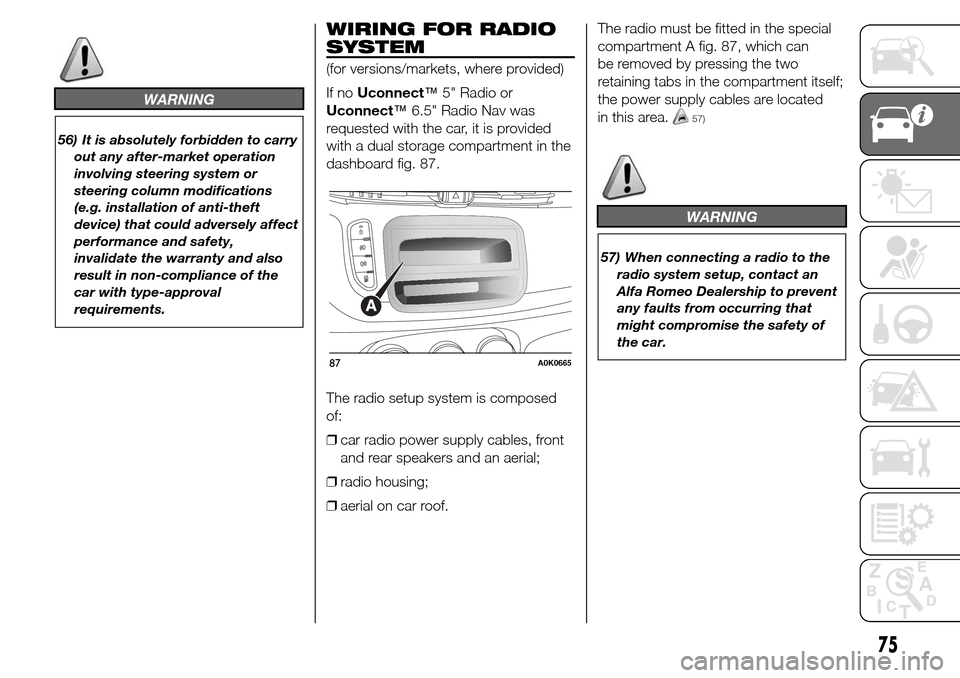
with a dual storage compartment in the
dashboard fig. 87.
The radio setup system is composed
of:
❒car radio power supply cables, front
and rear speakers and an aerial;
❒radio housing;
❒aerial on car roof.The radio must be fitted in the special
compartment A fig. 87, which can
be removed by pressing the two
retaining tabs in the compartment itself;
the power supply cables are located
in this area.
57)
WARNING
57) When connecting a radio to the
radio system setup, contact an
Alfa Romeo Dealership to prevent
any faults from occurring that
might compromise the safety of
the car.
87A0K0665
75
Page 82 of 288
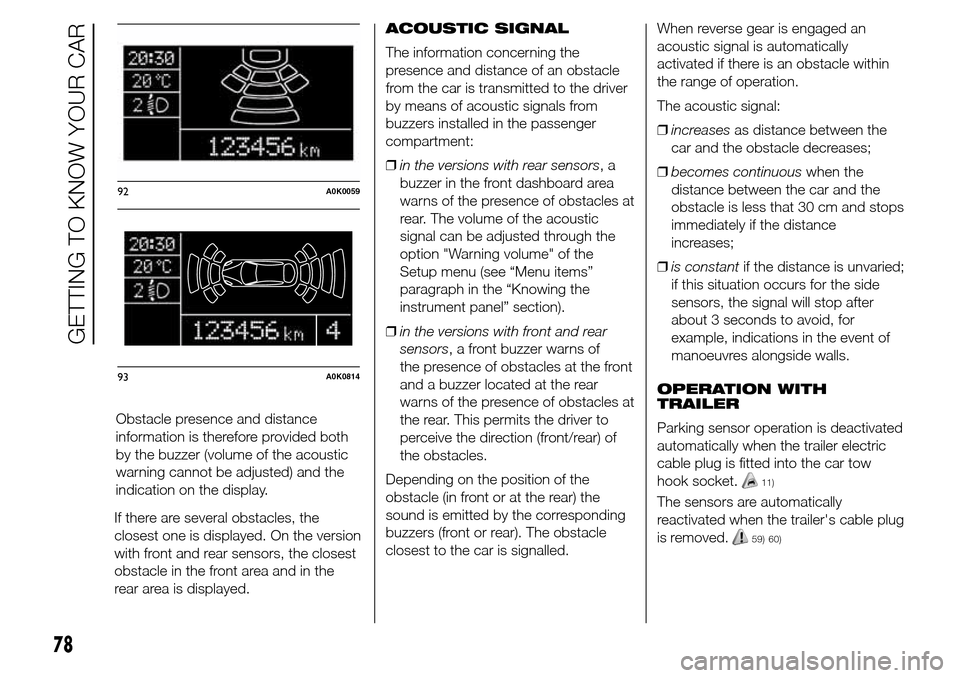
If there are several obstacles, the
closest one is displayed. On the version
with front and rear sensors, the closest
obstacle in the front area and in the
rear area is displayed.ACOUSTIC SIGNAL
The information concerning the
presence and distance of an obstacle
from the car is transmitted to the driver
by means of acoustic signals from
buzzers installed in the passenger
compartment:
❒in the versions with rear sensors,a
buzzer in the front dashboard area
warns of the presence of obstacles at
rear. The volume of the acoustic
signal can be adjusted through the
option "Warning volume" of the
Setup menu (see “Menu items”
paragraph in the “Knowing the
instrument panel” section).
❒in the versions with front and rear
sensors, a front buzzer warns of
the presence of obstacles at the front
and a buzzer located at the rear
warns of the presence of obstacles at
the rear. This permits the driver to
perceive the direction (front/rear) of
the obstacles.
Depending on the position of the
obstacle (in front or at the rear) the
sound is emitted by the corresponding
buzzers (front or rear). The obstacle
closest to the car is signalled.When reverse gear is engaged an
acoustic signal is automatically
activated if there is an obstacle within
the range of operation.
The acoustic signal:
❒increasesas distance between the
car and the obstacle decreases;
❒becomes continuouswhen the
distance between the car and the
obstacle is less that 30 cm and stops
immediately if the distance
increases;
❒is constantif the distance is unvaried;
if this situation occurs for the side
sensors, the signal will stop after
about 3 seconds to avoid, for
example, indications in the event of
manoeuvres alongside walls.
OPERATION WITH
TRAILER
Parking sensor operation is deactivated
automatically when the trailer electric
cable plug is fitted into the car tow
hook socket.
11)
The sensors are automatically
reactivated when the trailer's cable plug
is removed.
59) 60)
92A0K0059
93A0K0814
78
GETTING TO KNOW YOUR CAR
Obstacle presence and distance
information is therefore provided both
by the buzzer (volume of the acoustic
warning cannot be adjusted) and the
indication on the display.
Page 144 of 288
FRONT AIRBAGS
“SMART BAG” SYSTEM
(MULTISTAGE FRONT
AIRBAGS)
The car features multistage front
airbags (“Smart bag”) for driver and
passenger.
The front (driver and passenger) airbags
protect occupants in the event of
head-on crashes of medium-high
severity, by placing the a cushion
between the occupant and the steering
wheel or dashboard.
Therefore non-deployment in other
types of impacts (side impacts, rear
shunts, roll-overs, etc.) does not
indicate a system malfunction.
Airbags are not a replacement of but
complementary to the seat belts, which
you are recommended to always wear.
In the event of impact, those not
wearing a seat belt are projected
forwards and may come into contact
with the bag which is still inflating. The
protection offered by the bag is
compromised in these circumstances.
85) 86) 88)
Front airbags may not activate in the
following situations:❒frontal impacts against highly
deformable objects not involving the
front surface of the car (e.g. wing
collision against guard rail, etc.);
❒jamming of the car underneath other
vehicles or protective barriers (e.g.
underneath a truck or a guard rail) as,
in this case, the bags would offer no
additional protection with respect
to the seat belt and their deployment
would be inappropriate. In these
cases, non-deployment does not
indicate a system malfunction.
FRONT DRIVER SIDE
AIRBAG
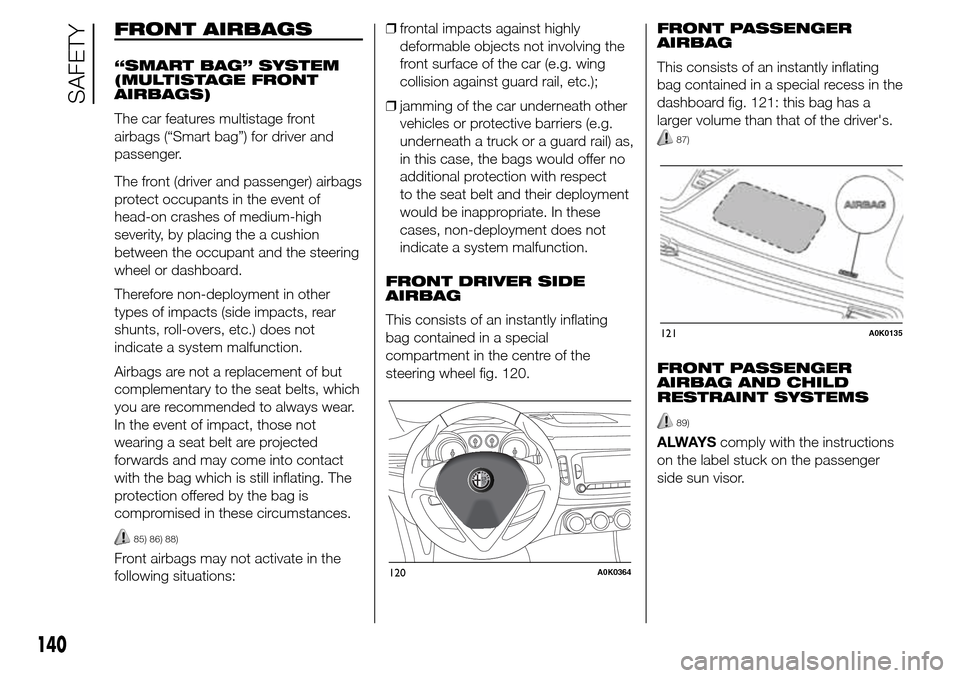
This consists of an instantly inflating
bag contained in a special
compartment in the centre of the
steering wheel fig. 120.FRONT PASSENGER
AIRBAG
This consists of an instantly inflating
bag contained in a special recess in the
dashboard fig. 121: this bag has a
larger volume than that of the driver's.
87)
FRONT PASSENGER
AIRBAG AND CHILD
RESTRAINT SYSTEMS
89)
ALWAYScomply with the instructions
on the label stuck on the passenger
side sun visor.
120A0K0364
121A0K0135
140
SAFETY
Page 147 of 288
WARNING
85) Do not apply stickers or other objects on the steering wheel, on the dashboard in the passenger side airbag area, on
side upholstery on the roof or on the seats. Never put objects (e.g. mobile phones) on the passenger's side dashboard
since they could interfere with correct inflation of the airbag and also cause serious injury to the passengers.
86) Always drive keeping your hands on the steering wheel rim so that the airbag can inflate freely if necessary. Do not
drive with your body bent forward. Keep the back of your seat upright and lean back into it.
87) When an active passenger airbag is fitted, DO NOT install rear facing child restraint systems on the front seat.
Deployment of the airbag in an accident could cause fatal injuries to the child regardless of the severity of the
impact. Therefore, always deactivate the passenger airbag when a rear facing child restraint system is installed on
the front passenger seat. The front passenger seat must also be positioned back as far as possible in order to avoid
the child restraint system from coming into contact with the dashboard. Immediately reactivate the passenger airbag
as soon as the child restraint system has been removed.
88) To deactivate the airbags, see the “Knowing your car” section, “Menu Items” paragraph.
89) When an active passenger airbag is fitted, DO NOT install rear facing child restraint systems on the front seat.
Deployment of the airbag in an accident could cause fatal injuries to the child regardless of the severity of the
impact.
143
Page 150 of 288
96) When the ignition key is in and
turned in the MAR-ON position
and the engine is off, the airbags
may deploy if the car is crashed
by another moving vehicle.
Therefore, even if the car is
stationary, when an active
passenger airbag is fitted, DO
NOT install rear facing child
restraint systems on the front
passenger seat. Deployment of
the airbag following an impact
could cause fatal injuries to the
child. Therefore, always
deactivate the passenger airbag
when a rear facing child restraint
system is installed on the front
passenger seat. The front
passenger seat must also be
positioned back as far as possible
in order to avoid the child
restraint system from coming into
contact with the dashboard.
Immediately reactivate the
passenger airbag as soon as the
child restraint system has been
removed. Also remember that,
if the key is turned to STOP, none
of the safety devices (airbags or
pretensioners) will be deployed in
the event of a collision. Non-
deployment in such cases does
not indicate a system malfunction.97) When the ignition key is turned
to MAR-ON, the
warning light
turns on (front airbag on
passenger's side enabled) and
blinks for a few seconds to remind
that the passenger airbag will
activate in the event of a collision.
Then it turns off.
98) The front airbags deploy in the
event of more severe collisions
than those required for deploying
the pretensioners. When the
impact is between the two
deployment thresholds, it is
normal that pretensioners only are
engaged.
99) The airbag does not replace seat
belts, but increases their
efficiency. Because front airbags
are not deployed for low-speed
crashes, side collisions, rear-end
shunts or rollovers, occupants are
protected, in addition to any side
bags, only by their seat belts,
which must therefore always be
fastened.
146
SAFETY
Page 158 of 288
In both cases, if the described
conditions and times are not respected,
the ignition key will be automatically
locked.
To remove the key, turn it to MAR-ON
and then to STOP.
IMPORTANT If the battery is flat and the
ignition key is engaged, the latter is
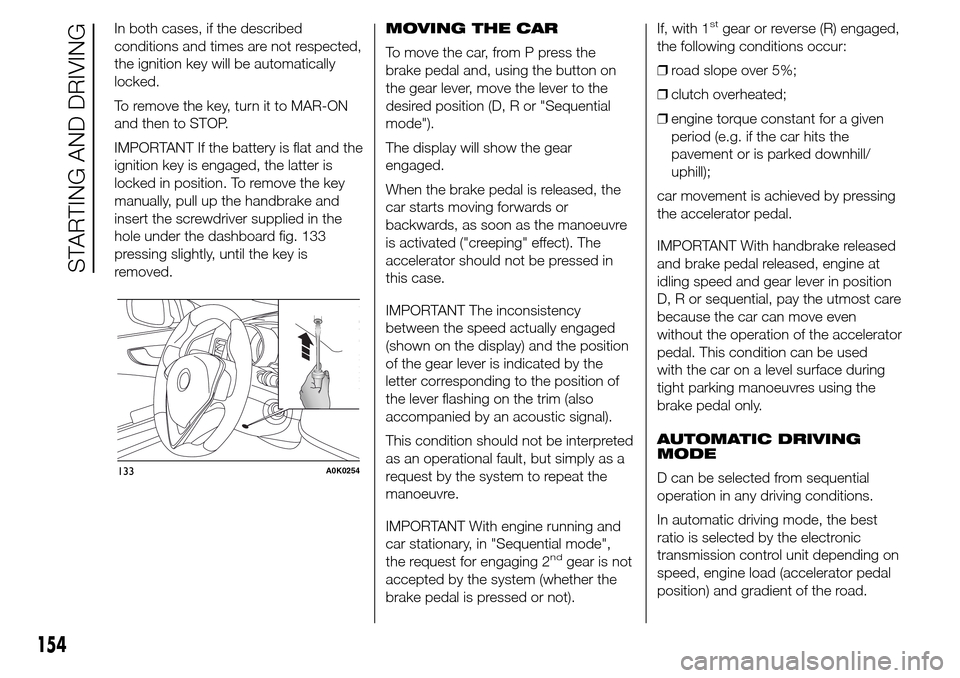
locked in position. To remove the key
manually, pull up the handbrake and
insert the screwdriver supplied in the
hole under the dashboard fig. 133
pressing slightly, until the key is
removed.MOVING THE CAR
To move the car, from P press the
brake pedal and, using the button on
the gear lever, move the lever to the
desired position (D, R or "Sequential
mode").
The display will show the gear
engaged.
When the brake pedal is released, the
car starts moving forwards or
backwards, as soon as the manoeuvre
is activated ("creeping" effect). The
accelerator should not be pressed in
this case.
IMPORTANT The inconsistency
between the speed actually engaged
(shown on the display) and the position
of the gear lever is indicated by the
letter corresponding to the position of
the lever flashing on the trim (also
accompanied by an acoustic signal).
This condition should not be interpreted
as an operational fault, but simply as a
request by the system to repeat the
manoeuvre.
IMPORTANT With engine running and
car stationary, in "Sequential mode",
the request for engaging 2
ndgear is not
accepted by the system (whether the
brake pedal is pressed or not).If, with 1
stgear or reverse (R) engaged,
the following conditions occur:
❒road slope over 5%;
❒clutch overheated;
❒engine torque constant for a given
period (e.g. if the car hits the
pavement or is parked downhill/
uphill);
car movement is achieved by pressing
the accelerator pedal.
IMPORTANT With handbrake released
and brake pedal released, engine at
idling speed and gear lever in position
D, R or sequential, pay the utmost care
because the car can move even
without the operation of the accelerator
pedal. This condition can be used
with the car on a level surface during
tight parking manoeuvres using the
brake pedal only.
AUTOMATIC DRIVING
MODE
D can be selected from sequential
operation in any driving conditions.
In automatic driving mode, the best
ratio is selected by the electronic
transmission control unit depending on
speed, engine load (accelerator pedal
position) and gradient of the road.
133A0K0254
154
STARTING AND DRIVING
Page 162 of 288
WARNING
106) Using the levers incorrectly
(levers pushed towards the
dashboard, see fig. 137) could
break them.
107) Never leave children
unattended in the car. Always
remove the ignition key when
leaving the car and take the key
with you.
108) The Launch control function is
only available in Dynamic mode.
Regardless of what is explicitly
indicated in the description of
these modes, the ESC and ASR
systems are deactivated during
operation of the Launch Control
function. This means that vehicle
dynamic control is the sole
responsibility of the driver.
Therefore pay the utmost
attention when using the Launch
Control. Take into account traffic
and road surface conditions and
during manoeuvres make sure
there is enough room in the area
concerned.
SAVING FUEL
Here are some suggestions which can
help you to save fuel and lower harmful
emissions.
GENERAL
CONSIDERATIONS
Car maintenance
Checks and adjustments should be
carried out in accordance with the
“Scheduled Servicing Plan” (see
chapter “Maintenance and care”).
Tyres
Check the tyre pressures at least once
every four weeks: if the pressure is
too low, consumption levels increase as
resistance to rolling is higher.
Unnecessary loads
Do not travel with an overloaded boot.
The weight of the car and its
arrangement greatly affect fuel
consumption and stability.Roof rack/ski rack
Remove the roof rack or the ski rack
from the roof after use. These
accessories lower aerodynamic
penetration and adversely affect
consumption levels. When transporting
particularly large objects, use a trailer
if possible.
Electrical devices
Use the electrical devices only for the
necessary amount of time. The heated
rear window, additional headlights,
screen wipers and heater fan require a
considerable amount of energy;
increasing the current uptake increases
fuel consumption (by up to +25% in
an urban cycle).
Climate control system
Using the climate control system will
increase consumption: use the air vents
when the temperature outside permits.
Devices for
aerodynamic control
The use of non-certified devices for
aerodynamic control may adversely
affect air drag and fuel consumption.
158
STARTING AND DRIVING
Page 174 of 288
"Fix&Go Automatic"
kit
This is located in the luggage
compartment (the kit container may
vary according to version - see fig.
149).
The kit also contains a screwdriver and
a tow hook.
The kit also contains:❒bottle A fig. 150 containing sealant
and fitted with: filling tube B and
adhesive label C with the wording
“max. 80 km/h” to be placed in
a clearly visible position (e.g. on the
dashboard) after repairing the tyre;
❒a compressor D complete with
pressure gauge and connectors;
❒an information leaflet fig. 151,
providing instructions for using the kit
correctly. This booklet should be
given to the persons charged with
handling the tyre treated with this kit;
❒a pair of gloves located in the side
compartment of the compressor;
❒adapters for inflating different
elements.
2)
118) 119) 121)
IMPORTANT The sealing liquid is
suitable for use at temperatures in the
range from –20°C to +50°C. The
sealant has an expiry date.
INFLATION PROCEDURE
120) 122) 123) 124) 125) 126)
Proceed as follows:
❒engage the handbrake, unscrew the
tyre valve cap, take out filler hose A
fig. 152 and tighten ring nut B on the
tyre valve;
❒make sure that switch A for the
compressor is in position0(off), start
the engine, insert the plug into the
luggage compartment power socket
(see fig. 154) or on central tunnel
(see fig. 155) and switch on the
compressor by bringing switch A to
positionI(on);
149A0K0515
150A0K0516
151A0K0517
170
IN AN EMERGENCY