heating Alfa Romeo Giulietta 2016 User Guide
[x] Cancel search | Manufacturer: ALFA ROMEO, Model Year: 2016, Model line: Giulietta, Model: Alfa Romeo Giulietta 2016Pages: 288, PDF Size: 7.34 MB
Page 99 of 288
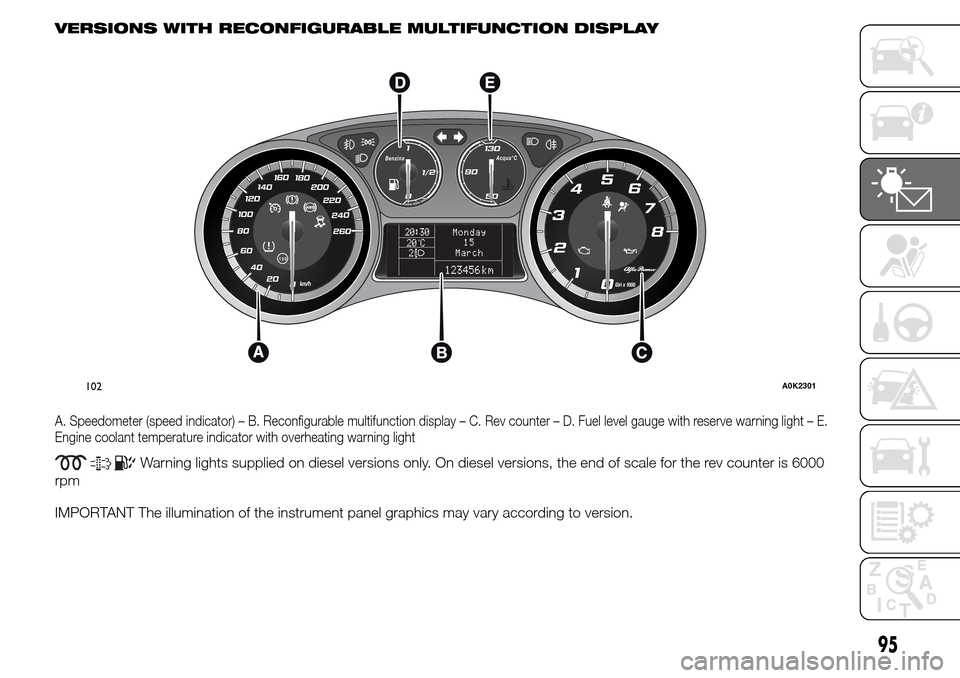
VERSIONS WITH RECONFIGURABLE MULTIFUNCTION DISPLAY
A. Speedometer (speed indicator) – B. Reconfigurable multifunction display – C. Rev counter – D. Fuel level gauge with reserve warning light – E.
Engine coolant temperature indicator with overheating warning light
Warning lights supplied on diesel versions only. On diesel versions, the end of scale for the rev counter is 6000
rpm
IMPORTANT The illumination of the instrument panel graphics may vary according to version.
260 240
220 200 180 160
140
100120
80
60
40
20
0
120
0Giri x 1000
2
1 345
6
7
8
0
1
1/2Benzina
50
130Acqua°C90
20:30
20 C°2
Monday
15
March
123456 km
102A0K2301
95
Page 100 of 288
SPEEDOMETER (SPEED
INDICATOR)
This shows the speed of the car.
REV COUNTER
This indicates the engine rpm.
FUEL LEVEL GAUGE
This shows the amount of fuel left in the
fuel tank.
The warning light in the gauge lights up
when there are only 8 to 10 litres of
fuel remaining in the tank; if this
happens, refuel as soon as possible.
Do not travel with the fuel tank almost
empty: any gaps in fuel delivery could
damage the catalytic converter.ENGINE COOLANT
TEMPERATURE
INDICATOR
The needle shows the temperature of
the engine coolant and starts supplying
indications when the fluid temperature
exceeds approx. 50°C.
Under normal conditions, the needle
assumes different positions within
the scale depending on the usage
conditions.
The warning light turns on to indicate
an overheating of the engine coolant. In
this case, stop the engine and contact
an Alfa Romeo Dealership.TRIP COMPUTER
IN BRIEF
The Trip computer is used to display
information on car operation when
the key is turned to MAR.
This function is characterised by two
separate memories, called "Trip A"
and "Trip B", where the car's
"complete missions" (journeys) are
recorded in a reciprocally
independent manner.
Both memories can be reset: i.e. start
of a new journey.
“Trip A” is used to display the figures
relating to:
❒Range
❒Distance travelled
❒Average fuel consumption
❒Instant fuel consumption
❒Average speed
❒Trip time (driving time).
“Trip B” may be used to display the
figures relating to:
❒Distance travelled B
❒Average consumption B
96
KNOWING THE INSTRUMENT PANEL
Page 110 of 288
Warning lights on
panelWhat it means What to do
redALFA TCT FAILURE
(for versions/markets, where provided)
When the key is turned to MAR-ON, the warning
light switches on but should switch off after a few
seconds.
The warning light flashes (together with a
message in the display and an acoustic signal) to
indicate that the transmission is faulty.
The warning light can switch on even in case of
transmission overheating, after a particularly
demanding use. In this case an engine
performance limitation is carried out.Contact an Alfa Romeo Dealership as soon as
possible.
If it is necessary to start the engine with a
transmission failure, follow the procedure
described in the "Alfa TCT" paragraph, in chapter
"Starting and driving".
redINCOMPLETE DOOR LOCKING
(for versions/markets, where provided)
The warning light (or symbol on the display) lights
up when one or more doors or the tailgate are not
closed correctly. An acoustic signal is activated
with the doors open and the car moving.
On some versions the warning light (or symbol on
the display) also lights up when the bonnet is not
closed correctly.
redSPEED LIMIT EXCEEDED
(for versions/markets, where provided)
The warning light switches on when the car
exceeds the speed limit value set in the Setup
Menu (e.g. 120 km/h).
On some versions a message is shown along
with a symbol on the display, and an acoustic
signal is emitted.
106
KNOWING THE INSTRUMENT PANEL
Page 118 of 288
Warning lights on
panelWhat it means What to do
amberGLOW PLUG HEATING/GLOW PLUG
HEATING FAILURE (diesel versions)
This warning light switches on when the key is
turned to MAR-ON. It will switch off as soon as
the heater plugs have reached a preset
temperature. The engine can be started as soon
as the warning light switches off.
IMPORTANT In mild or high temperature
conditions, the warning light comes on for a very
short time only.
Glow plug preheating failure
The warning light will flash (a message will appear
on the display, on some versions) to indicate a
fault in the glow plugs preheating system.Contact an Alfa Romeo Dealership as soon as
possible.
amberWATER IN DIESEL FILTER (diesel versions)
The warning light remains on constantly when
driving (together with a message in the display),
to indicate the presence of water in the diesel
filter.
14)
WARNING
68) Failure of thewarning light is indicated by thewarning light switching on. In addition, the airbag system
automatically disables the passenger side airbag. Before proceeding, contact an Alfa Romeo Dealership to have the
system checked immediately.
114
KNOWING THE INSTRUMENT PANEL
Page 137 of 288
76) If the belt has been subjected to
heavy strain, for example after an
accident, it must changed
completely together with the
anchors, anchor fastening screws
and the pretensioner. Even if the
belt has no visible defects, it could
have lost its resilience.
IMPORTANT
15) Operations which lead to
impacts, vibrations or localised
heating (over 100°C for a
maximum of six hours) in the area
around the pretensioner may
damage or deploy it. Contact an
Alfa Romeo Dealership should
intervention be necessary on
these components.
CARRYING
CHILDREN SAFELY
For optimal protection in the event of an
impact, all occupants must be seated
and wearing adequate restraint
systems, including newborn and other
children!
This prescription is compulsory in all EC
countries according to EC Directive
2003/20/EC.
Compared with an adult, a child's head
is larger and heavier in proportion to
his/her body and the child's muscular
and bone structures are not fully
developed. Therefore, correct restraint
systems other than adult seat belts
are necessary to reduce as much as
possible the risk of injuries in case
of accident, braking or sudden
manoeuvre.
Children must be seated safely and
comfortably. As far as the
characteristics of the child restraint
systems used allow, you are advised to
keep children in rear facing restraint
systems for as long as possible (at least
until 3–4 years old), since this is the
most protected position in the event of
an impact.
77) 78)
The choice of the most suitable child
restraint device depends on the weight
of the child; there are various types of
child restraint systems and you are
advised always to choose the one that
is most suitable for the child.
When over 1.50 m in height, from the
point of view of restraint systems,
children are considered as adults and
wear seat belts normally.
In Europe the characteristics of children
restraint systems are ruled by the
regulation ECE-R44, dividing them into
five weight groups:
Group Weight groups
Group0 upto10kg
Group 0+ up to 13 kg
Group 1 9-18 kg
Group 2 15-25 kg
Group 3 22-36 kg
133
Page 152 of 288
STARTING THE
ENGINE
PROCEDURE FOR
PETROL VERSIONS
Proceed as follows:
❒engage the handbrake and place the
gear lever in neutral;
❒fully depress the clutch pedal,
without touching the accelerator;
❒turn the ignition key to AVV and
release it as soon as the engine
starts.
IMPORTANT INFORMATION
100) 101)
102)
16) 17) 18)
❒If the engine does not start at the first
attempt, return the ignition key to
STOP before repeating the starting
procedure.
❒If, when the ignition key is at
MAR-ON, the
instrument panel
warning light (or the symbol on the
display) stays on together with the
warning light, turn the key to
STOP and then back to MAR-ON. If
the warning light (or the symbol on
the display) remains on, try with
the other keys provided with the car.
Contact an Alfa Romeo Dealership
if the engine still does not start.❒Never leave the ignition key at MAR
when the engine is stopped.
PROCEDURE FOR DIESEL
VERSIONS
Proceed as follows:
19)
❒engage the handbrake and place the
gear lever in neutral;
❒turn the ignition key to MAR-ON: the
warning lights
andon the
instrument panel will turn on (for
versions/markets, where provided);
❒wait for the warning lights to switch
off;
❒fully depress the clutch pedal,
without touching the accelerator;
❒turn the ignition key to AVV as soon
as warning light
switches off.
Waiting too long will waste the
heating work carried out by the glow
plugs. Release the key as soon as
the engine starts.
WARMING UP THE
ENGINE JUST AFTER IT
HAS STARTED
Proceed as follows:
❒drive off slowly, letting the engine turn
at medium speed without
accelerating abruptly;❒do not demand full performance at
first. It is advisable to wait until the
engine coolant temperature indicator
starts moving.
STOPPING THE ENGINE
Turn the ignition key to STOP while the
engine is idling.
IMPORTANT After a demanding drive,
before turning the engine off you should
let it idle so that the temperature in the
engine compartment decreases.
WARNING
100) It is dangerous to run the
engine in enclosed areas. The
engine takes in oxygen and
releases carbon dioxide, carbon
monoxide and other toxic gases.
101) The brake servo is not active
until the engine is started, so
you would need to apply much
more force than usual to the
brake pedal.
102) Do not start the engine by
pushing, towing or driving
downhill. These manoeuvres may
damage the catalytic converter.
148
STARTING AND DRIVING
Page 153 of 288
IMPORTANT
16) In the first period of use, we
recommend not to demand
maximum performance from the
car (for instance excessive
accelerations, extended travel at
maximum speed, sudden braking,
etc.).
17) With the engine off, do not leave
the key in the ignition switch on
MAR-ON to prevent draining
the battery.
18) A quick burst on the accelerator
before turning off the engine
serves absolutely no practical
purpose; it wastes fuel and is
especially damaging to
turbocharged engines.
19) If the
warning light flashes
for about 1 minute after starting
or during prolonged cranking, this
indicates a fault in the glow plug
preheating system. If the engine
starts, you may use the car
normally, but should contact an
Alfa Romeo Dealership as soon as
possible.
PARKING
Always remove the ignition key when
leaving the car.
When parking and leaving the car,
proceed as follows:
❒engage a gear (1st gear if parked
uphill or reverse if facing downhill)
and leave the wheels turned;
❒stop the engine and engage the
handbrake.
Block the wheels with a wedge or a
stone if the car is parked on a steep
slope.
On versions equipped with Alfa TCT
transmission, before releasing the brake
pedal, wait for letter P to be displayed.
IMPORTANTNEVERleave the car
with the gearbox in neutral (or, on
versions equipped with Alfa TCT
transmission, before placing the gear
lever at P).
HANDBRAKE
To engage it, pull lever A fig. 126
upwards until the car is secured.
When the handbrake is engaged and
the ignition key is at MAR-ON, the
warning light will switch on in the
instrument panel.To release it, raise lever A slightly, hold
down button B and lower the lever:
the
warning light on the instrument
panel switches off.
103) 104)
IMPORTANT Carry out these
manoeuvres with the brake pedal
pressed.
IMPORTANT For cars equipped with a
front armrest, lift it up to ensure that
it does not interfere with the action of
the handbrake.
126A0K0615
149
Page 161 of 288
❒the brake pedal is pressed for longer
than 10 minutes;
❒the driver's door is opened with
creeping deactivated (for example
with handbrake engaged) without
pressing brake and/or accelerator
pedals;
❒a fault has been detected in the
transmission.
IMPORTANT Shifting to neutral (N) -
operated by the system - involves
a situation of inconsistency between
gear lever position and gear engaged.
The manoeuvre is accompanied by
an acoustic inconsistency signal. This
acoustic signal continues until the gear
lever is placed in P or N, to restore
the correct transmission operation
conditions.
PARKING THE CAR
To park safely, with the brake pedal
pressed, P must be engaged and, in
case of parking uphills/downhills, the
handbrake must be engaged.
Before releasing the brake pedal, wait
until P appears on the display.
IMPORTANT NEVER leave the car
before having positioned the lever in P.TOWING THE CAR
Make sure that the transmission is in
neutral (N), checking that the car moves
when pushed, and proceed in the
same way as for towing a normal car
with a manual gearbox.
IMPORTANT If the transmission cannot
be put in neutral (N), do not tow the
car and contact an Alfa Romeo
Dealership. Should the lever be in P,
release it before towing (see paragraph
"Positions of the lever").
IMPORTANT
INFORMATION
With car stationary and gear engaged,
always keep the brake pedal pressed
until you decide to set off, then release
the brake and accelerate gradually.
During prolonged stops with the engine
running, it is advisable to keep the
transmission in neutral (N).
To protect the clutch, never use the
accelerator to keep the car stationary
(for example when stopped uphills/
downhills): clutch overheating could
damage it. Use the brake pedal instead
or the handbrake and only press the
accelerator pedal when you wish to set
off.If reverse (R) is engaged, only engage
the 1stgear (or vice versa) when the car
is completely stopped.
Although it is highly inadvisable, if you
are driving downhill and, for unexpected
reasons, you let the car move forward
with the transmission in neutral (N),
when there is a request to engage
a gear, depending on the speed of the
car, the system will automatically
engage the best gear for the correct
transmission of drive torque to the
wheels.
107)
IMPORTANT
21) If the car is on a gradient, always
pull the handbrake BEFORE
placing the gear lever in P.
22) Engage reverse only with the car
stationary, engine at idling speed
and accelerator fully released.
157
Page 177 of 288
123) Always indicate that the tyre
was repaired using the quick
tyre repair kit. Give the booklet to
the technicians who will be
handling the tyre that was treated
using the kit.
124) Repair is not possible if the
wheel rim is damaged (groove
is deformed, causing air to
escape). Do not remove foreign
bodies (screws or nails) from the
tyre.
125) Do not operate the compressor
for longer than 20 minutes
consecutively. Risk of
overheating. The kit is not suitable
for definitive repairs, so the
repaired tyres may only be used
temporarily.126) The bottle contains ethylene
glycol and latex: it may cause
an allergic reaction. It is harmful if
swallowed. It is irritant for the
eyes. It may cause sensitisation if
inhaled or on contact. Avoid
contact with eyes, skin and
clothes. In the event of contact,
rinse immediately with plenty
of water. If ingested, do not
induce vomiting. Rinse out your
mouth, drink large quantities
of water and seek immediate
medical attention. Keep out of the
reach of children. The product
must not be used by asthmatics.
Do not inhale the vapours during
insertion and suction. Call a
doctor immediately if allergic
reactions are noted. Store the
bottle in its proper compartment,
away from sources of heat. The
sealant fluid has an expiry date.
Replace the bottle containing
out-of-date sealant fluid.CHANGING A BULB
28)
127) 128) 129)
GENERAL
INSTRUCTIONS
❒Before changing a bulb check the
contacts for oxidation;
❒replace blown bulbs with others of
the same type and power;
❒after replacing a headlight bulb,
always check its alignment;
❒when a light is not working, check
that the corresponding fuse is intact
before changing the bulb. For the
location of fuses, refer to the
paragraph “If a fuse blows” in this
chapter.
173
Page 193 of 288
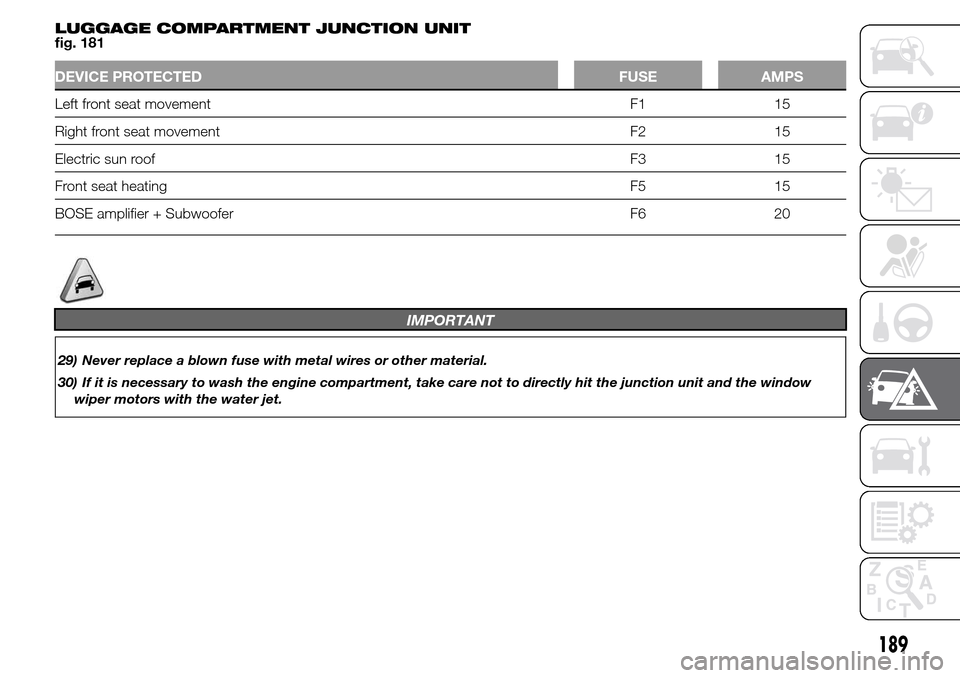
LUGGAGE COMPARTMENT JUNCTION UNIT
fig. 181
DEVICE PROTECTED FUSE AMPS
Left front seat movement F1 15
Right front seat movement F2 15
Electric sun roofF3 15
Front seat heating F5 15
BOSE amplifier + Subwoofer F6 20
IMPORTANT
29) Never replace a blown fuse with metal wires or other material.
30) If it is necessary to wash the engine compartment, take care not to directly hit the junction unit and the window
wiper motors with the water jet.
189