warning Alfa Romeo Giulietta 2016 User Guide
[x] Cancel search | Manufacturer: ALFA ROMEO, Model Year: 2016, Model line: Giulietta, Model: Alfa Romeo Giulietta 2016Pages: 288, PDF Size: 7.34 MB
Page 25 of 288
DOOR MIRRORS
Electric adjustment
The mirrors can only be adjusted/folded
with the ignition in the MAR position.
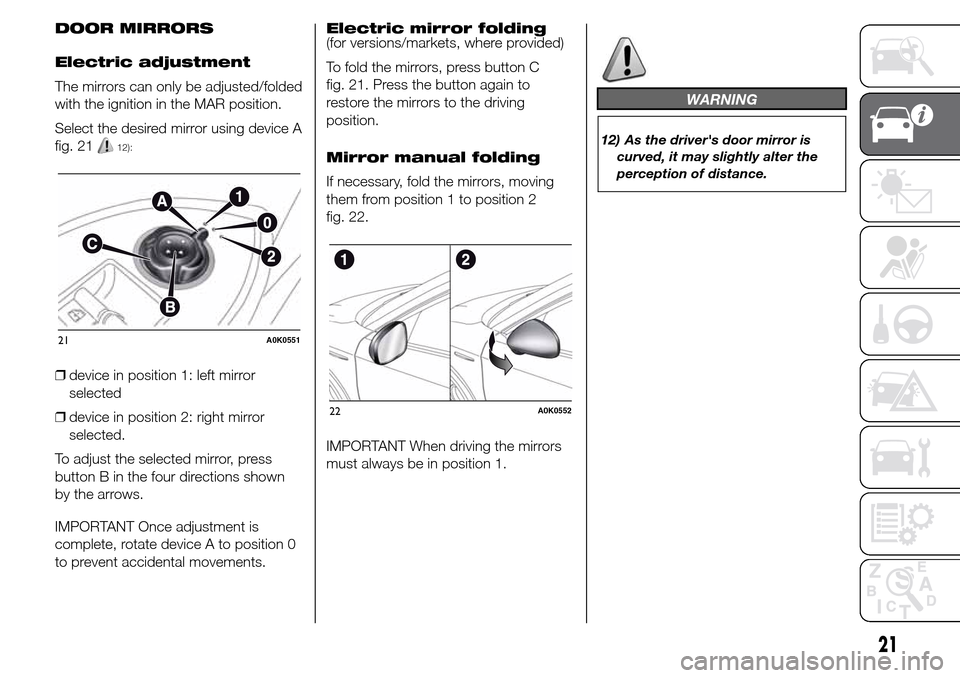
Select the desired mirror using device A
fig. 21
12):
❒device in position 1: left mirror
selected
❒device in position 2: right mirror
selected.
To adjust the selected mirror, press
button B in the four directions shown
by the arrows.
IMPORTANT Once adjustment is
complete, rotate device A to position 0
to prevent accidental movements.Electric mirror folding
(for versions/markets, where provided)
To fold the mirrors, press button C
fig. 21. Press the button again to
restore the mirrors to the driving
position.
Mirror manual folding
If necessary, fold the mirrors, moving
them from position 1 to position 2
fig. 22.
IMPORTANT When driving the mirrors
must always be in position 1.
WARNING
12) As the driver's door mirror is
curved, it may slightly alter the
perception of distance.
21A0K0551
22A0K0552
21
Page 40 of 288
IMPORTANT The daytime running lights
are an alternative to the dipped beam
headlights for driving during the
daytime in countries where it is
compulsory to have lights on during the
day; where it is not compulsory, the
use of daytime running lights is
permitted.
IMPORTANT Daytime running lights
cannot replace dipped beam headlights
when driving at night or through
tunnels. The use of daytime running
lights is governed by the Highway Code
of the country in which you are driving.
Comply with legal requirements.
SIDE LIGHTS/DIPPED
BEAM HEADLIGHTS
With the ignition key turned to
MAR-ON, turn ring nut A fig. 31 to
.
The daytime running lights are switched
off and the side lights and dipped
beam headlights are switched on. The
warning light switches on in the
instrument panel.PARKING LIGHTS
These lights can only be switched on
with ignition key at STOP or removed,
by moving ring nut A fig. 31 first to
position
and then to position.
The
warning light switches on
in the instrument panel.
AUTOMATIC LIGHTING
CONTROL (AUTOLIGHT)
(Dusk sensor)
(for versions/markets, where provided)
This infrared LED sensor, combined
with the rain sensor and located on the
windscreen, detects the variations in
outside brightness depending on the
light sensitivity set with the Setup
Menu: the greater the sensitivity, the
less external light is required to activate
the external lights.
Activation
The dusk sensor activates when ring
nut A fig. 31 is turned to
. In this
way the side lights and dipped beam
headlights are activated automatically
according to the external lighting
conditions.
IMPORTANT The sensor is unable to
detect the presence of fog. Therefore
under these circumstances, these lights
must be turned on manually.When the lights are turned on by the
sensor, the fog lights (for versions/
markets, where provided) and the rear
fog lights may be turned on.
When the lights are automatically
switched off, the front and rear fog
lights (if activated) are also switched off.
The next time the lights are switched
on automatically, the fog lights must be
reactivated manually (if required).
With the sensor active, it is possible to
flash the headlights but the main beam
headlights cannot be switched on. To
activate these lights, turn the ring nut A
to
and activate the fixed dipped
beam headlights.
When the lights have been activated
automatically and are then switched off
by the sensor, the dipped beam
headlights are switched off first,
followed by the side lights a few
seconds later.
If the sensor is activated but is
malfunctioning, the side lights and
dipped beam headlights are switched
on irrespective of the outside light
level and the sensor failure is indicated
on the display.
It is also possible to deactivate the
sensor and switch on the side lights
and dipped beam headlights.
36
GETTING TO KNOW YOUR CAR
Page 41 of 288
MAIN BEAM HEADLIGHTS
To activate the main beam headlights,
with ring nut A fig. 31 at
, pull the
stalk towards the steering wheel
beyond the end of travel position. The
warning light switches on in the
instrument panel.
When the stalk is pulled towards the
steering wheel again, beyond the end
of travel position, the main beam
headlights deactivate, the dipped beam
headlights reactivate and the
warning light switches off.
It is not possible to switch on the main
beam headlights constantly if automatic
light control is active.
FLASHING
To do this, pull the stalk towards the
steering wheel (unstable position)
regardless of the position of ring nut A
fig. 31. The
warning light switches
on in the instrument panel.
REAR FOG LIGHTS
For the activation and deactivation of
the rear fog lights, refer to the
"Controls" section.DIRECTION INDICATORS
Bring the stalk to the (stable) position:
❒upwards: activates right direction
indicator;
❒downwards: activates left direction
indicator.
Warning light
orwill blink on the
instrument panel.
The direction indicators are switched off
automatically when the steering wheel
is straightened.
"Lane change" function
If you wish to signal a lane change,
place the left stalk in the unstable
position for less than half a second. The
direction indicator on the side selected
will flash five times and then switch
off automatically.
“FOLLOW ME HOME”
DEVICE
This device allows you to illuminate the
area in front of the car for a certain
amount of time.Activation
With the key turned to STOP or
removed, pull stalk A towards the
steering wheel within 2 minutes from
when the engine is turned off.
Each time the stalk is moved, the lights
stay on for an extra 30 seconds up to
a maximum of 210 seconds; then
the lights are switched off automatically.
Also, each time the stalk is operated,
the
warning light on the
instrument panel switches on. The
display shows the time set for the
function and the corresponding
graphics.
The warning light comes on when the
lever is operated and stays on until
the function is automatically
deactivated. Each movement of the
stalk only increases the amount of time
the lights stay on.
Deactivation
Keep the stalk pulled towards the
steering wheel for more than 2
seconds.
37
Page 44 of 288
In the event of malfunction of the rain
sensor whilst it is active, the
windscreen wiper operates
intermittently at a speed consistent with
the sensitivity setting of the rain sensor,
regardless of whether there is rain on
the glass (sensor failure is indicated on
the display).
The sensor continues to operate and it
is possible to set the windscreen wiper
to continuous mode (1
stor 2ndspeed).
The failure indication remains for as
long as the sensor is active.
REAR WINDOW
WASHER/WIPER
(for versions/markets, where provided)
Activation
This operates only with the ignition key
turned to MAR.
Turn ring nut B fig. 32 from positionO
to position
to operate the rear
window wiper as follows:
❒in intermittent mode when the
windscreen wiper is not operating;
❒in synchronous mode (at half the
speed of the windscreen wiper) when
the windscreen wiper is operating;
❒in continuous mode with reverse gear
engaged and the control active.With reverse gear engaged and
windscreen wiper on, the rear window
wiper is activated in continuous mode.
Pushing the stalk towards the
dashboard (unstable position) will
activate the rear window washer jet.
Keep the stalk pushed for more than
half a second to activate the rear
window wiper as well. Releasing the
stalk will activate the smart washing
function, as described for the
windscreen wiper.
WARNING
13) Do not use the screen wiper to
remove layers of snow or ice
from the windscreen. In such
conditions, the windscreen wiper
may be subjected to excessive
stress and the motor cut-out
switch, which prevents operation
for a few seconds, may intervene.
If operation is not restored (even
after restarting that car with the
key), contact an Alfa Romeo
Dealership.
14) Do not operate the windscreen
wiper with the blades lifted from
the windscreen.
CRUISE CONTROL
(for versions/markets, where provided)
IN BRIEF
This is an electronically controlled
driving assistance device that allows
the desired car speed to be
maintained, without having to press
the accelerator pedal. This device
can be used at a speed above
30 km/h on long stretches of dry,
straight roads with few variations
(e.g. motorways).
The use of this device on extra-urban
roads with traffic is not therefore
recommended. Do not use it in town.
TURNING THE DEVICE
ON
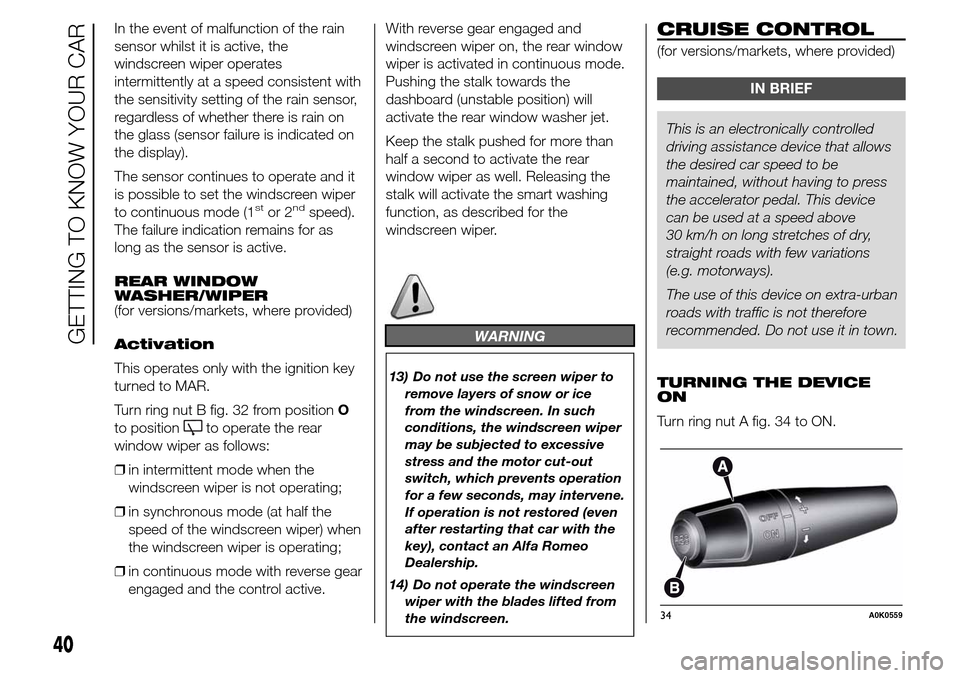
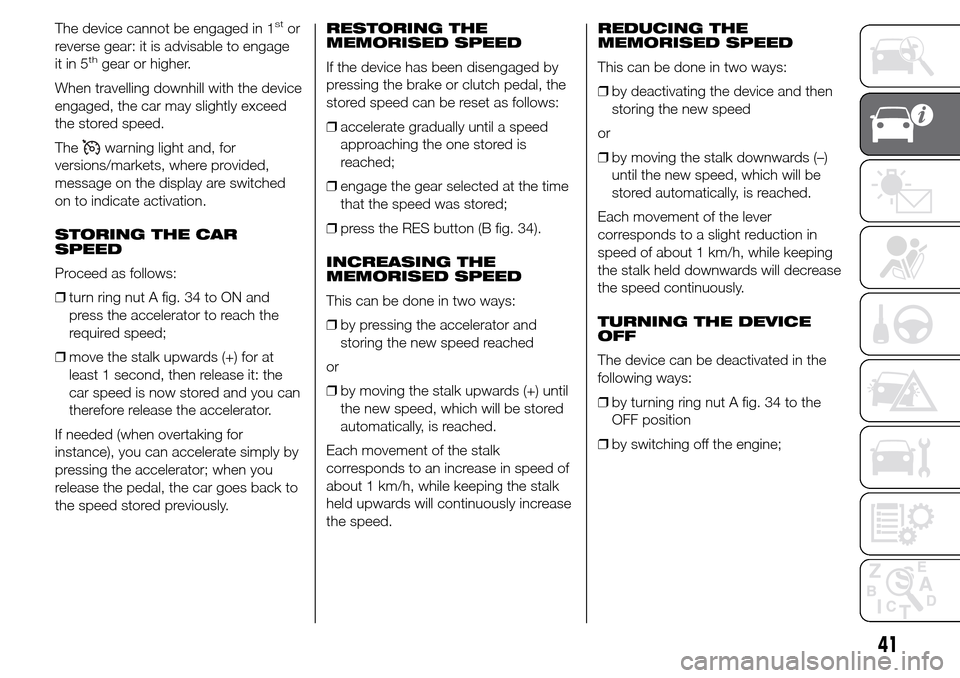
Turn ring nut A fig. 34 to ON.
34A0K0559
40
GETTING TO KNOW YOUR CAR
Page 45 of 288
The device cannot be engaged in 1stor
reverse gear: it is advisable to engage
it in 5
thgear or higher.
When travelling downhill with the device
engaged, the car may slightly exceed
the stored speed.
The
warning light and, for
versions/markets, where provided,
message on the display are switched
on to indicate activation.
STORING THE CAR
SPEED
Proceed as follows:
❒turn ring nut A fig. 34 to ON and
press the accelerator to reach the
required speed;
❒move the stalk upwards (+) for at
least 1 second, then release it: the
car speed is now stored and you can
therefore release the accelerator.
If needed (when overtaking for
instance), you can accelerate simply by
pressing the accelerator; when you
release the pedal, the car goes back to
the speed stored previously.RESTORING THE
MEMORISED SPEED
If the device has been disengaged by
pressing the brake or clutch pedal, the
stored speed can be reset as follows:
❒accelerate gradually until a speed
approaching the one stored is
reached;
❒engage the gear selected at the time
that the speed was stored;
❒press the RES button (B fig. 34).
INCREASING THE
MEMORISED SPEED
This can be done in two ways:
❒by pressing the accelerator and
storing the new speed reached
or
❒by moving the stalk upwards (+) until
the new speed, which will be stored
automatically, is reached.
Each movement of the stalk
corresponds to an increase in speed of
about 1 km/h, while keeping the stalk
held upwards will continuously increase
the speed.REDUCING THE
MEMORISED SPEED
This can be done in two ways:
❒by deactivating the device and then
storing the new speed
or
❒by moving the stalk downwards (–)
until the new speed, which will be
stored automatically, is reached.
Each movement of the lever
corresponds to a slight reduction in
speed of about 1 km/h, while keeping
the stalk held downwards will decrease
the speed continuously.
TURNING THE DEVICE
OFF
The device can be deactivated in the
following ways:
❒by turning ring nut A fig. 34 to the
OFF position
❒by switching off the engine;
41
Page 46 of 288
❒by pressing the brake pedal, the
clutch or the accelerator; in this
last case the system is not effectively
deactivated but the system gives
priority to the acceleration request.
The device still remains active,
without the need to press the RES
button to return to the previous
conditions once acceleration
is concluded.
Automatic deactivation
The device deactivates automatically in
the following cases:
❒if the ABS or ESC systems intervene;
❒with the car speed below the set
limit;
❒in the event of system failure.
15) 16)
WARNING
15) When travelling with the device
active, do not move the gear lever
to neutral.
16) In the event of device faults or
failures, turn the ring nut A to
OFF and contact an Alfa Romeo
Dealership.
ROOF LIGHTS
FRONT ROOF LIGHT
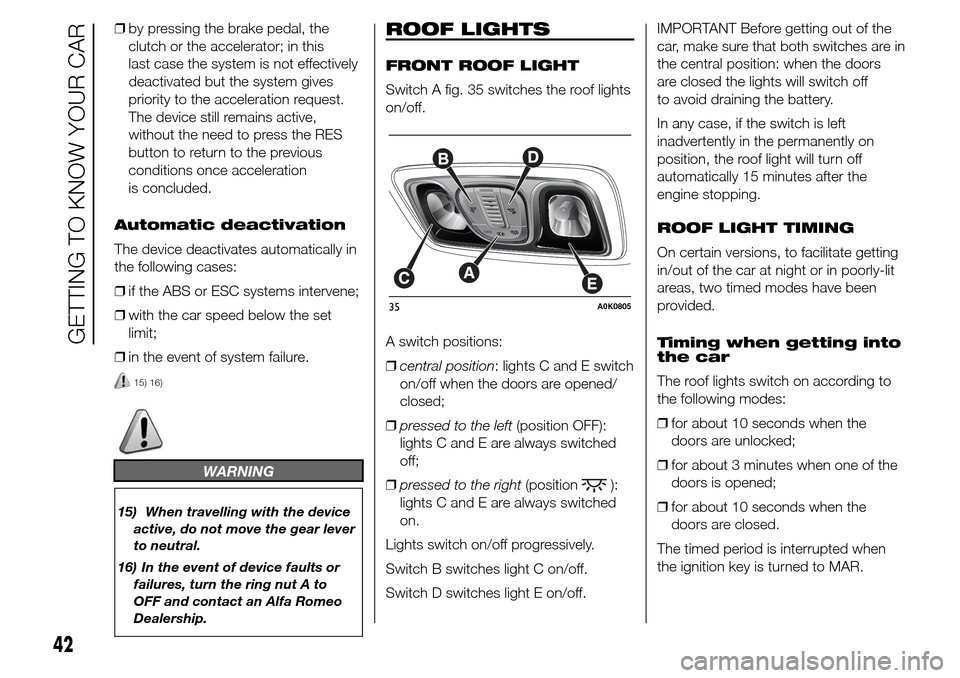
Switch A fig. 35 switches the roof lights
on/off.
A switch positions:
❒central position: lights C and E switch
on/off when the doors are opened/
closed;
❒pressed to the left(position OFF):
lights C and E are always switched
off;
❒pressed to the right(position
):
lights C and E are always switched
on.
Lights switch on/off progressively.
Switch B switches light C on/off.
Switch D switches light E on/off.IMPORTANT Before getting out of the
car, make sure that both switches are in
the central position: when the doors
are closed the lights will switch off
to avoid draining the battery.
In any case, if the switch is left
inadvertently in the permanently on
position, the roof light will turn off
automatically 15 minutes after the
engine stopping.
ROOF LIGHT TIMING
On certain versions, to facilitate getting
in/out of the car at night or in poorly-lit
areas, two timed modes have been
provided.
Timing when getting into
the car
The roof lights switch on according to
the following modes:
❒for about 10 seconds when the
doors are unlocked;
❒for about 3 minutes when one of the
doors is opened;
❒for about 10 seconds when the
doors are closed.
The timed period is interrupted when
the ignition key is turned to MAR.
35A0K0805
42
GETTING TO KNOW YOUR CAR
Page 48 of 288
CONTROLS
HAZARD WARNING
LIGHTS
Operation
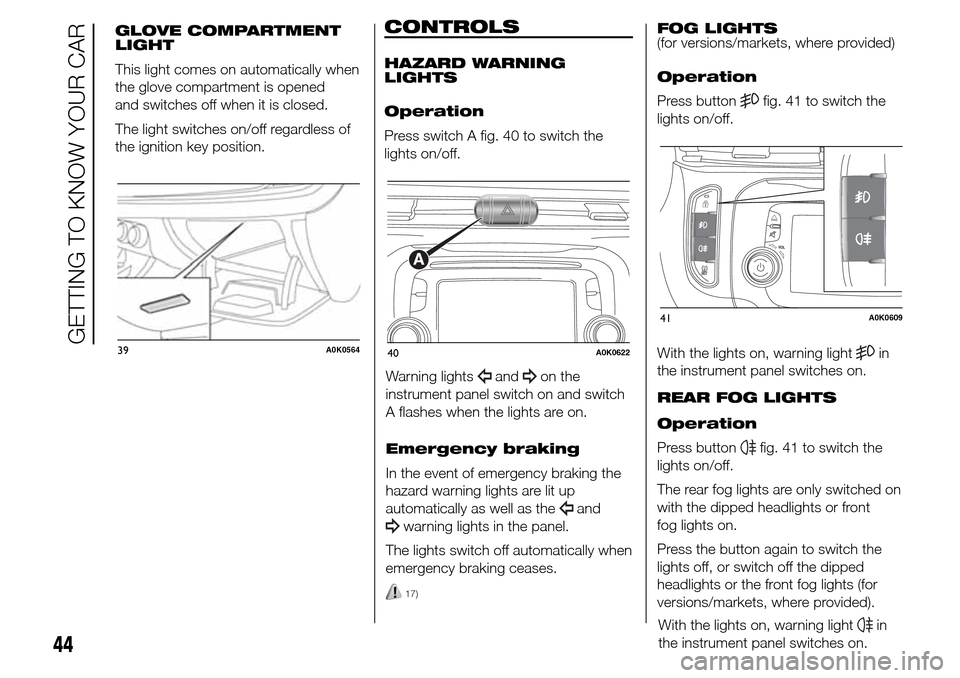
Press switch A fig. 40 to switch the
lights on/off.
Warning lights
andon the
instrument panel switch on and switch
A flashes when the lights are on.
Emergency braking
In the event of emergency braking the
hazard warning lights are lit up
automatically as well as the
and
warning lights in the panel.
The lights switch off automatically when
emergency braking ceases.
17)
FOG LIGHTS
(for versions/markets, where provided)
Operation
Press button
fig. 41 to switch the
lights on/off.
With the lights on, warning light
in
the instrument panel switches on.
REAR FOG LIGHTS
Operation
Press button
fig. 41 to switch the
lights on/off.
The rear fog lights are only switched on
with the dipped headlights or front
fog lights on.
Press the button again to switch the
lights off, or switch off the dipped
headlights or the front fog lights (for
versions/markets, where provided).
39A0K056440A0K0622
41A0K0609
44
GETTING TO KNOW YOUR CAR
GLOVE COMPARTMENT
LIGHT
This light comes on automatically when
the glove compartment is opened
and switches off when it is closed.
The light switches on/off regardless of
the ignition key position.
With the lights on, warning light
in
the instrument panel switches on.
Page 49 of 288
CENTRAL LOCKING
Operation
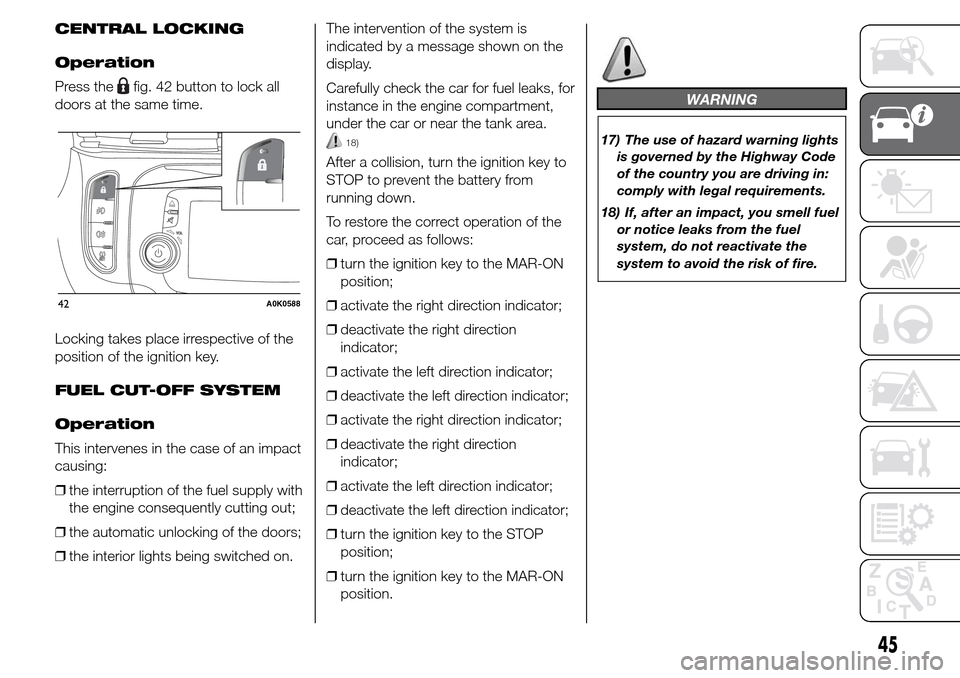
Press the
fig. 42 button to lock all
doors at the same time.
Locking takes place irrespective of the
position of the ignition key.
FUEL CUT-OFF SYSTEM
Operation
This intervenes in the case of an impact
causing:
❒the interruption of the fuel supply with
the engine consequently cutting out;
❒the automatic unlocking of the doors;
❒the interior lights being switched on.The intervention of the system is
indicated by a message shown on the
display.
Carefully check the car for fuel leaks, for
instance in the engine compartment,
under the car or near the tank area.
18)
After a collision, turn the ignition key to
STOP to prevent the battery from
running down.
To restore the correct operation of the
car, proceed as follows:
❒turn the ignition key to the MAR-ON
position;
❒activate the right direction indicator;
❒deactivate the right direction
indicator;
❒activate the left direction indicator;
❒deactivate the left direction indicator;
❒activate the right direction indicator;
❒deactivate the right direction
indicator;
❒activate the left direction indicator;
❒deactivate the left direction indicator;
❒turn the ignition key to the STOP
position;
❒turn the ignition key to the MAR-ON
position.
WARNING
17) The use of hazard warning lights
is governed by the Highway Code
of the country you are driving in:
comply with legal requirements.
18) If, after an impact, you smell fuel
or notice leaks from the fuel
system, do not reactivate the
system to avoid the risk of fire.
42A0K0588
45
Page 53 of 288
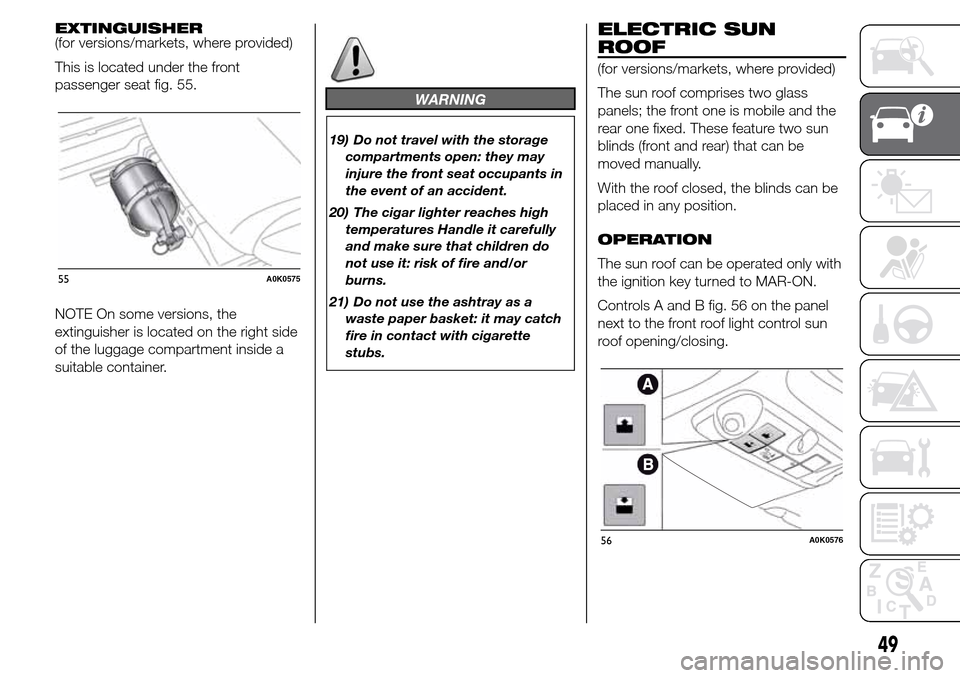
EXTINGUISHER
(for versions/markets, where provided)
This is located under the front
passenger seat fig. 55.
NOTE On some versions, the
extinguisher is located on the right side
of the luggage compartment inside a
suitable container.
WARNING
19) Do not travel with the storage
compartments open: they may
injure the front seat occupants in
the event of an accident.
20) The cigar lighter reaches high
temperatures Handle it carefully
and make sure that children do
not use it: risk of fire and/or
burns.
21) Do not use the ashtray as a
waste paper basket: it may catch
fire in contact with cigarette
stubs.
ELECTRIC SUN
ROOF
(for versions/markets, where provided)
The sun roof comprises two glass
panels; the front one is mobile and the
rear one fixed. These feature two sun
blinds (front and rear) that can be
moved manually.
With the roof closed, the blinds can be
placed in any position.
OPERATION
The sun roof can be operated only with
the ignition key turned to MAR-ON.
Controls A and B fig. 56 on the panel
next to the front roof light control sun
roof opening/closing.
55A0K0575
56A0K0576
49
Page 55 of 288
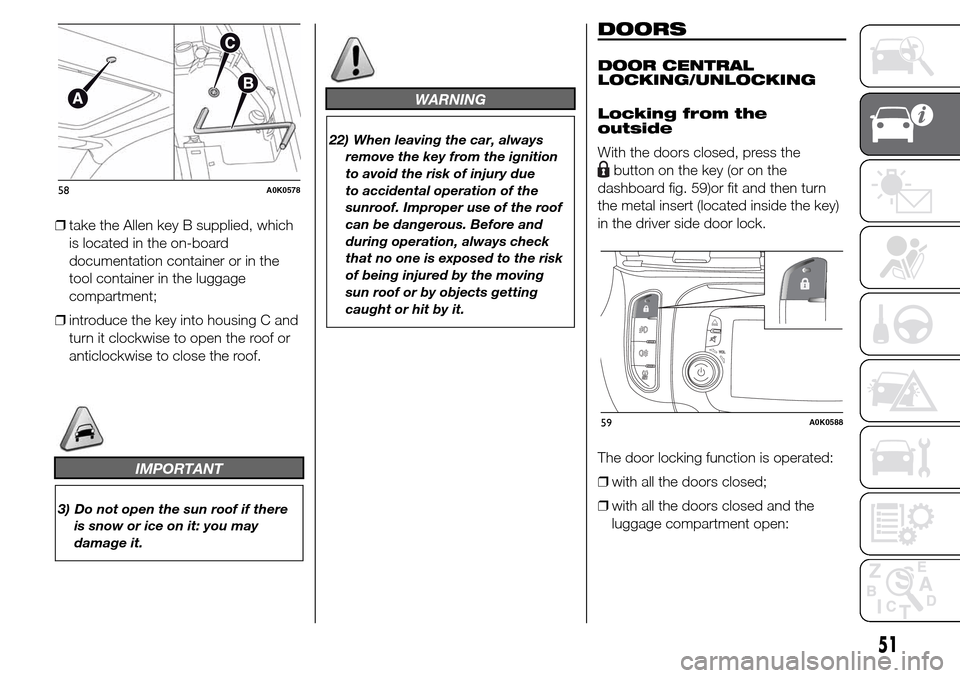
❒take the Allen key B supplied, which
is located in the on-board
documentation container or in the
tool container in the luggage
compartment;
❒introduce the key into housing C and
turn it clockwise to open the roof or
anticlockwise to close the roof.
IMPORTANT
3) Do not open the sun roof if there
is snow or ice on it: you may
damage it.
WARNING
22) When leaving the car, always
remove the key from the ignition
to avoid the risk of injury due
to accidental operation of the
sunroof. Improper use of the roof
can be dangerous. Before and
during operation, always check
that no one is exposed to the risk
of being injured by the moving
sun roof or by objects getting
caught or hit by it.
DOORS
DOOR CENTRAL
LOCKING/UNLOCKING
Locking from the
outside
With the doors closed, press the
button on the key (or on the
dashboard fig. 59)or fit and then turn
the metal insert (located inside the key)
in the driver side door lock.
The door locking function is operated:
❒with all the doors closed;
❒with all the doors closed and the
luggage compartment open:
58A0K0578
59A0K0588
51