warning Alfa Romeo Giulietta 2016 Owner's Guide
[x] Cancel search | Manufacturer: ALFA ROMEO, Model Year: 2016, Model line: Giulietta, Model: Alfa Romeo Giulietta 2016Pages: 288, PDF Size: 7.34 MB
Page 59 of 288
IMPORTANT With ignition key at STOP
or removed, the electric windows
remain active for about 3 minutes and
are deactivated when a door is opened.
IMPORTANT With the anti-crush
system, when the
button on the
remote control is pressed for longer
than 2 seconds the windows will open,
whilst if the
button is pressed for
longer than 2 seconds the windows will
close.
IMPORTANT
7) The system conforms to the
2000/4/EC standard concerning
the safety of passengers leaning
out of the passenger
compartment.
WARNING
23) Incorrect use of the electric
windows may be dangerous.
Before and during their operation,
ensure that any passengers are
not at risk from the moving glass
either by personal objects getting
caught in the mechanism or by
being hit by it directly. When
leaving the car, always remove
the key from the ignition to
prevent accidental operation of
the electric windows from being a
hazard for those still on board.
Electric window system
initialisation
The system must be re-initialised after
disconnecting the battery or if the
relevant protection fuse is blown.
Initialisation procedure:
❒fully close the window to initialise
manually;
❒after the window has reached the
upper end of travel, hold the up
button pressed for at least one
second.For versions/markets where provided,
after there has been no power supply
for the control units (battery replaced or
disconnected or protection fuses for
the electric window control units
replaced), the automatic operation of
the windows must be restored.
The restoration procedure must be
performed as described below with the
doors closed:
❒completely open the driver's door
window keeping the operating button
pressed for at least three seconds
after the (lower) end of travel position
is reached;
❒completely raise the driver side
window and hold the button down for
at least 3 seconds once the (upper)
end of travel position has been
reached;
❒proceed in the same way as
described in points 1 and 2 for the
passenger side door;
❒make sure that the initialisation is
correct by checking that the windows
work automatically.
55
Page 63 of 288
WARNING
24) A heavy load that has not been
secured may cause serious
injuries to passengers in the event
of an accident.
25) If you are travelling in an area
with limited opportunities for
refuelling and you wish to bring
petrol with you in a petrol can, you
must do so in compliance with
current regulations and using an
approved can, appropriately
secured to the load securing
attachments. However, the risks
of fire in case of collision increase
anyway.
BONNET
OPENING
Proceed as follows:
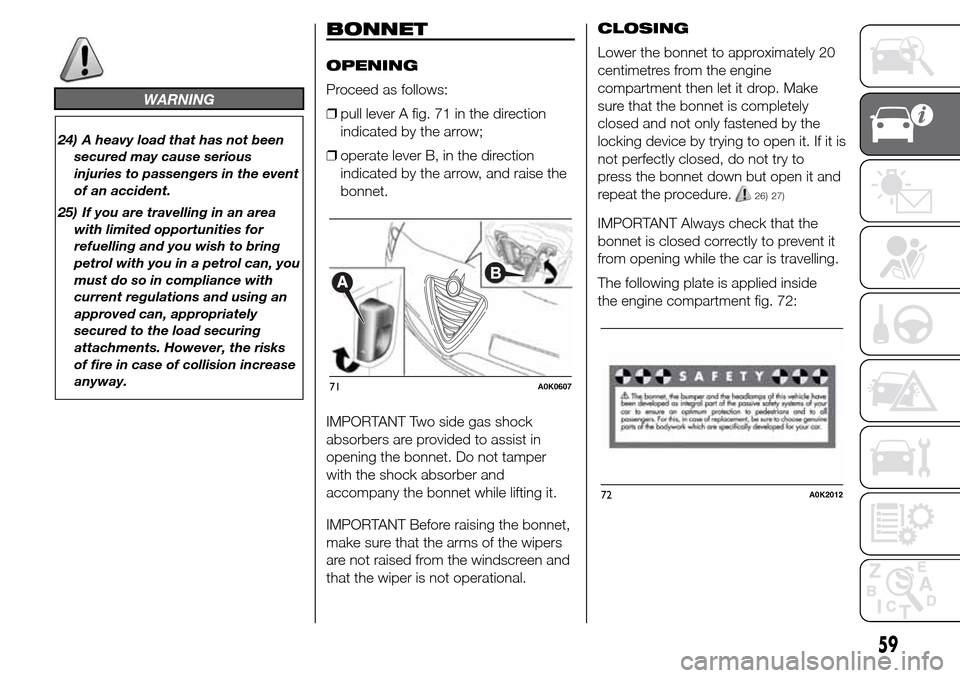
❒pull lever A fig. 71 in the direction
indicated by the arrow;
❒operate lever B, in the direction
indicated by the arrow, and raise the
bonnet.
IMPORTANT Two side gas shock
absorbers are provided to assist in
opening the bonnet. Do not tamper
with the shock absorber and
accompany the bonnet while lifting it.
IMPORTANT Before raising the bonnet,
make sure that the arms of the wipers
are not raised from the windscreen and
that the wiper is not operational.CLOSING
Lower the bonnet to approximately 20
centimetres from the engine
compartment then let it drop. Make
sure that the bonnet is completely
closed and not only fastened by the
locking device by trying to open it. If it is
not perfectly closed, do not try to
press the bonnet down but open it and
repeat the procedure.
26) 27)
IMPORTANT Always check that the
bonnet is closed correctly to prevent it
from opening while the car is travelling.
The following plate is applied inside
the engine compartment fig. 72:
71A0K0607
72A0K2012
59
Page 64 of 288
WARNING
26) For safety reasons, the bonnet
must always be properly closed
while driving. Therefore, make
sure that the bonnet is properly
closed and that the lock is
engaged. If you discover that the
bonnet is not perfectly closed
during travel, stop immediately
and close the bonnet in the
correct manner.
27) Perform these operations only
when the car is stationary.
ROOF RACK/SKI
RACK
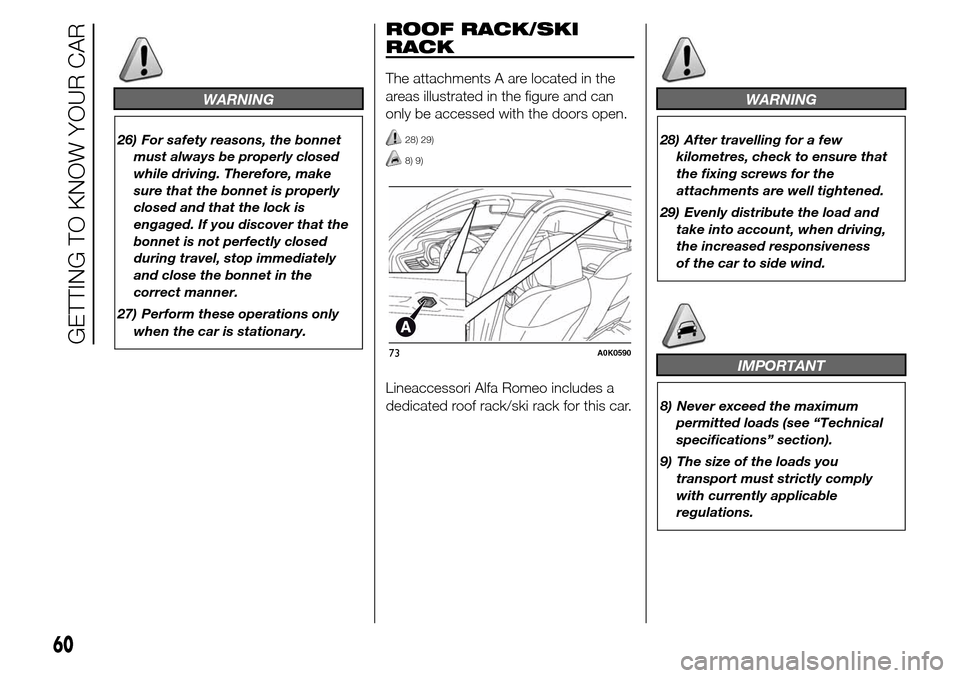
The attachments A are located in the
areas illustrated in the figure and can
only be accessed with the doors open.
28) 29)
8) 9)
Lineaccessori Alfa Romeo includes a
dedicated roof rack/ski rack for this car.
WARNING
28) After travelling for a few
kilometres, check to ensure that
the fixing screws for the
attachments are well tightened.
29) Evenly distribute the load and
take into account, when driving,
the increased responsiveness
of the car to side wind.
IMPORTANT
8) Never exceed the maximum
permitted loads (see “Technical
specifications” section).
9) The size of the loads you
transport must strictly comply
with currently applicable
regulations.
73A0K0590
60
GETTING TO KNOW YOUR CAR
Page 66 of 288
ESC SYSTEM
IN BRIEF
The ESC system improves the
directional control and stability of the
car in various driving conditions.
The ESC system corrects the car’s
understeer and oversteer, distributing
the brake force on the appropriate
wheels. The torque supplied by
the engine can also be reduced in
order to maintain control of the car.
30) 31) 32) 33) 34)
The ESC system uses sensors installed
on the car to determine the trajectory
that the driver intends to follow and
compares it with the car’s effective
trajectory. When the real trajectory
deviates from the desired trajectory, the
ESC system intervenes to counter the
car’s understeer or oversteer.
❒Oversteer: occurs when the car is
turning more than it should according
to the angle of the steering wheel.
❒Understeer: occurs when the car is
turning less than it should according
to the angle of the steering wheel.The ESC system also includes the
following systems:
❒EBD
❒ABS
❒CBC
❒ASR
❒HILL HOLDER
❒HBA
❒MSR
❒DST
❒“ELECTRONIC Q2” (“E-Q2”)
❒"PRE-FILL" (RAB - Ready Alert
Brake)
SYSTEM ACTIVATION
The ESC system switches on
automatically when the engine is
started and cannot be switched off.
SYSTEM INTERVENTION
This is indicated by the flashing of the
warning light on the instrument
panel, to inform the driver that the car is
in critical stability and grip conditions.EBD SYSTEM
The EBD system is an integral part of
the ESC system and intervenes during
braking, distributing the brake force
optimally between front and rear
wheels.
This guarantees greater braking stability
for the car, preventing sudden locking
of the rear wheels and the consequent
instability of the car.
ABS
This system, which is an integral part of
the braking system, prevents one or
more wheels from locking and slipping
in all road surface conditions,
irrespective of the intensity of the
braking action, ensuring that the car
can be controlled even during
emergency braking and optimising
stopping distances.
The system intervenes when braking
and the wheels are about to lock,
typically in emergency braking or
low-grip conditions, when locking may
be more frequent.
The system also improves control and
stability of the car when braking on a
surface where the grip of the left and
right wheels varies, or on corners.
62
GETTING TO KNOW YOUR CAR
Page 67 of 288
System intervention
A slight pulsing of the brake pedal and
noise indicates the intervention of the
ABS: this is completely normal when
the system intervenes.
35) 36) 37) 38) 39) 40) 41)
CBC (Cornering Brake
Control) SYSTEM
The system acts when braking on
corners, optimising the distribution of
brake pressure on the four wheels: the
system prevents the wheels on the
inside of the corner (less affected by the
weight of the car) from locking,
ensuring better stability and direction
for the car.
ASR (Anti-Slip
Regulation) SYSTEM
42) 43) 44)
This is an integral part of the ESC
system and automatically operates in
the event of one or both drive wheels
slipping, loss of grip on wet roads
(aquaplaning) and acceleration
on slippery, snowy or icy roads, etc.
Depending on the slipping conditions,
two different control systems are
activated:❒if the slipping involves both drive
wheels, the ASR system intervenes,
reducing the power transmitted by
the engine;
❒if the slipping only involves one of the
drive wheels, it also intervenes
automatically, braking the wheel that
is slipping.
System intervention
This is indicated by the flashing of the
warning light on the instrument
panel, to inform the driver that the car is
in critical stability and grip conditions.
HILL HOLDER SYSTEM
This is an integral part of the ESC
system and facilitates starting on
slopes, activating automatically in the
following cases:
❒uphill: car stationary on a road with a
gradient higher than 5%, engine
running, brake pressed and gearbox
in neutral or gear (other than reverse)
engaged;
❒downhill: car stationary on a road
with a gradient higher than 5%,
engine running, brake pressed and
reverse gear engaged.When setting off, the ESC system
control unit maintains the braking
pressure on the wheels until the engine
torque necessary for starting is
reached, or in any case for a maximum
of 2 seconds, allowing your right foot
to be moved easily from the brake
pedal to the accelerator.
When two seconds have elapsed,
without starting, the system is
automatically deactivated, gradually
releasing the braking pressure. During
this release stage it is possible to hear a
typical mechanical brake release noise,
indicating the imminent movement of
the car.
IMPORTANT The Hill Holder system is
not a parking brake; therefore, never
leave the car without having engaged
the handbrake, turned the engine
off and engaged first gear, so that it is
parked in safe conditions (for further
information read the "Parking"
paragraph in the "Starting and driving"
chapter).
63
Page 69 of 288
WARNING
30) The ESC system can’t alter the
natural laws of physics, and can’t
increase grip which depends on
the condition of the road.
31) The ESC system cannot prevent
accidents, including those due to
excessive speed on corners,
driving on low-grip surfaces or
aquaplaning.
32) The capability of the ESC system
must never be tested irresponsibly
and dangerously, in such a way
as to compromise personal safety
and the safety of others.
33) For the correct operation of the
ASR system, the tyres must of
necessity be the same make and
type on all wheels, in perfect
condition and, above all, of the
prescribed type and dimensions.
34) The performance of the ESC
and ASR systems must not
encourage the driver to take
unnecessary risks. Your driving
style must always be suited to the
road conditions, visibility and
traffic. The driver is always
responsible for road safety.35) When the ABS intervenes and
you feel the brake pedal pulsating,
do not reduce the pressure, but
hold it down firmly and
confidently; in doing so you will
brake in the shortest distance
possible, depending on the
current road conditions.
36) For maximum efficiency of the
braking system, a bedding-in
period of about 500 km is
required: during this period it is
advisable to avoid sharp, repeated
and prolonged braking.
37) If the ABS intervenes, this
indicates that the grip of the tyres
on the road is nearing its limit:
you must slow down to a speed
compatible with the available grip.
38) The ABS can’t overrule the
natural laws of physics, and can’t
increase the grip available
according to the condition of the
road.
39) The ABS cannot prevent
accidents, including those due to
excessive speed on corners,
driving on low-grip surfaces or
aquaplaning.
40) The capability of the ABS must
never be tested irresponsibly and
dangerously, in such a way as
to compromise personal safety
and the safety of others.41) For the correct operation of the
ABS, the tyres must of necessity
be the same make and type on all
wheels, in perfect condition and,
above all, of the prescribed type
and dimensions.
42) The ASR system can’t overrule
the natural laws of physics, and
can’t increase the grip available
according to the condition of
the road.
43) The ASR system cannot prevent
accidents, including those due to
excessive speed on corners,
driving on low-grip surfaces or
aquaplaning.
44) The capability of the ASR system
must never be tested irresponsibly
and dangerously, in such a way
as to compromise personal safety
and the safety of others.
45) The HBA system can’t alter the
natural laws of physics, and can’t
increase grip which depends on
the condition of the road.
46) The HBA system cannot prevent
accidents, including those due to
excessive speed on corners,
driving on low-grip surfaces or
aquaplaning.
65
Page 72 of 288
The activation of the Dynamic mode is
also shown by the change in the
instrument panel lighting that, after
decreasing, reaches the highest
luminosity and then returns to the
previously set values.
Disengagement
To deactivate “Dynamic” mode and
return to “Natural”, repeat the same
movement of the lever within the same
times. In this case, the LED
corresponding to “Natural” mode will
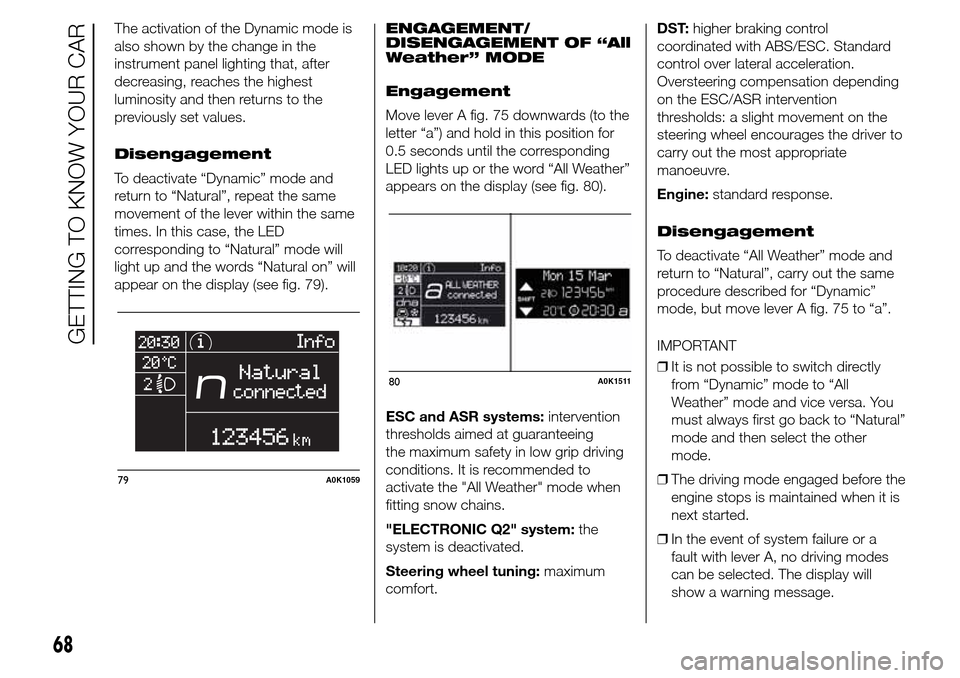
light up and the words “Natural on” will
appear on the display (see fig. 79).ENGAGEMENT/
DISENGAGEMENT OF “All
Weather” MODE
Engagement
Move lever A fig. 75 downwards (to the
letter “a”) and hold in this position for
0.5 seconds until the corresponding
LED lights up or the word “All Weather”
appears on the display (see fig. 80).
ESC and ASR systems:intervention
thresholds aimed at guaranteeing
the maximum safety in low grip driving
conditions. It is recommended to
activate the "All Weather" mode when
fitting snow chains.
"ELECTRONIC Q2" system:the
system is deactivated.
Steering wheel tuning:maximum
comfort.DST:higher braking control
coordinated with ABS/ESC. Standard
control over lateral acceleration.
Oversteering compensation depending
on the ESC/ASR intervention
thresholds: a slight movement on the
steering wheel encourages the driver to
carry out the most appropriate
manoeuvre.
Engine:standard response.
Disengagement
To deactivate “All Weather” mode and
return to “Natural”, carry out the same
procedure described for “Dynamic”
mode, but move lever A fig. 75 to “a”.
IMPORTANT
❒It is not possible to switch directly
from “Dynamic” mode to “All
Weather” mode and vice versa. You
must always first go back to “Natural”
mode and then select the other
mode.
❒The driving mode engaged before the
engine stops is maintained when it is
next started.
❒In the event of system failure or a
fault with lever A, no driving modes
can be selected. The display will
show a warning message.
79A0K1059
80A0K1511
68
GETTING TO KNOW YOUR CAR
Page 76 of 288
WARNING
48) When replacing the battery,
always contact an Alfa Romeo
Dealership. The replacement
battery should be of the same
type (HEAVY DUTY) and should
have the same characteristics.
49) Before opening the bonnet,
make sure that the engine is off
and that the ignition key is in
the STOP position. Follow the
instructions on the dedicated
label on the front crossmember
(fig. 85). We recommend that you
remove the key from the ignition if
other people remain in the car.
The car should always be left after
the key has been removed or
turned to the STOP position.
During refuelling, make sure that
the engine is off (and that the
ignition key is in the STOP
position).
iTPMS (indirect Tyre
Pressure
Monitoring System)
(for versions/markets, where provided)
DESCRIPTION
The car can be equipped with the
iTPMS (indirect Tyre Pressure
Monitoring System) which monitors the
tyre inflation status thanks to wheel
speed sensors.
The system warns the driver if one or
more tyres are flat by the dedicated
warning light
continuously on and a
warning message on the display.
If one tyre only is flat, the system can
indicate its position: it is anyway
recommended to check the pressure
on all four tyres.
This indication is displayed also when
turning the engine off and on again until
the RESET procedure is carried out.
RESET PROCEDURE
The iTPMS system needs an initial
"self-learning" phase (with length
depending on the driving style and road
conditions: optimal conditions being
RESET procedure is carried out.❒whenever the tyre pressure is
modified;
❒when even only one tyre is changed;
❒when tyres are rotated/inverted;
❒when the space-saver wheel is fitted.
Before carrying out the RESET, inflate
the tyres to the rated pressure values
specified in the inflation pressure table
(see "Wheels" paragraph in the
"Technical specifications" section).
If the RESET is not carried out, in all
above cases, the warning lightmay
give false indications on one or more
tyres.
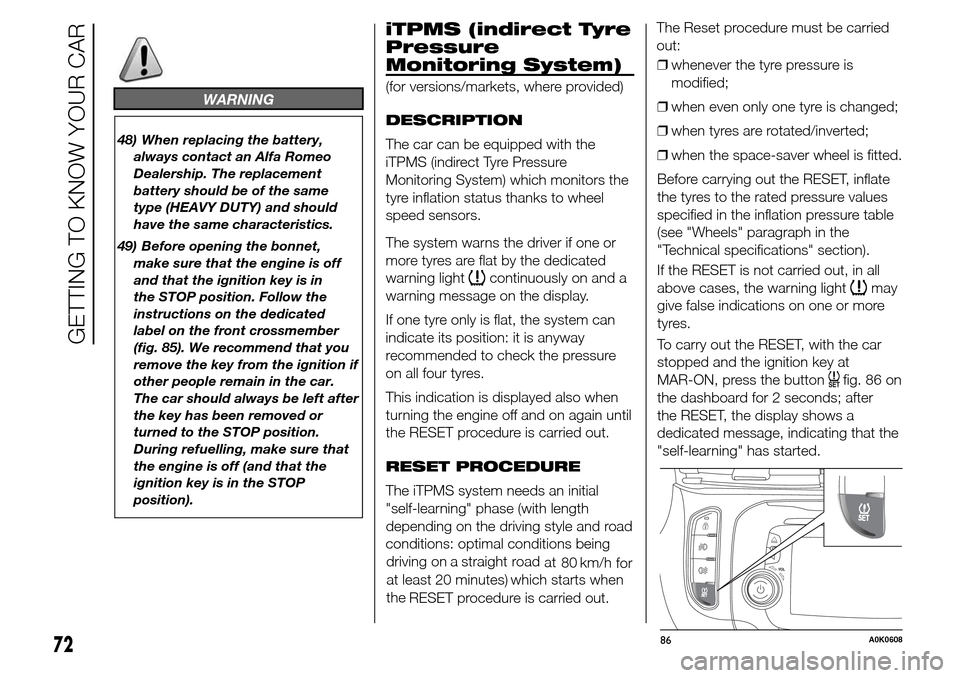
To carry out the RESET, with the car
stopped and the ignition key at
MAR-ON, press the button
fig. 86 on
the dashboard for 2 seconds; after
the RESET, the display shows a
dedicated message, indicating that the
"self-learning" has started.
86A0K060872
GETTING TO KNOW YOUR CAR
The Reset procedure must be carried
out:
which starts when driving
on
a
straight
road
at
80
km/h
for
at least 20 minutes)
the
Page 77 of 288
OPERATING CONDITIONS
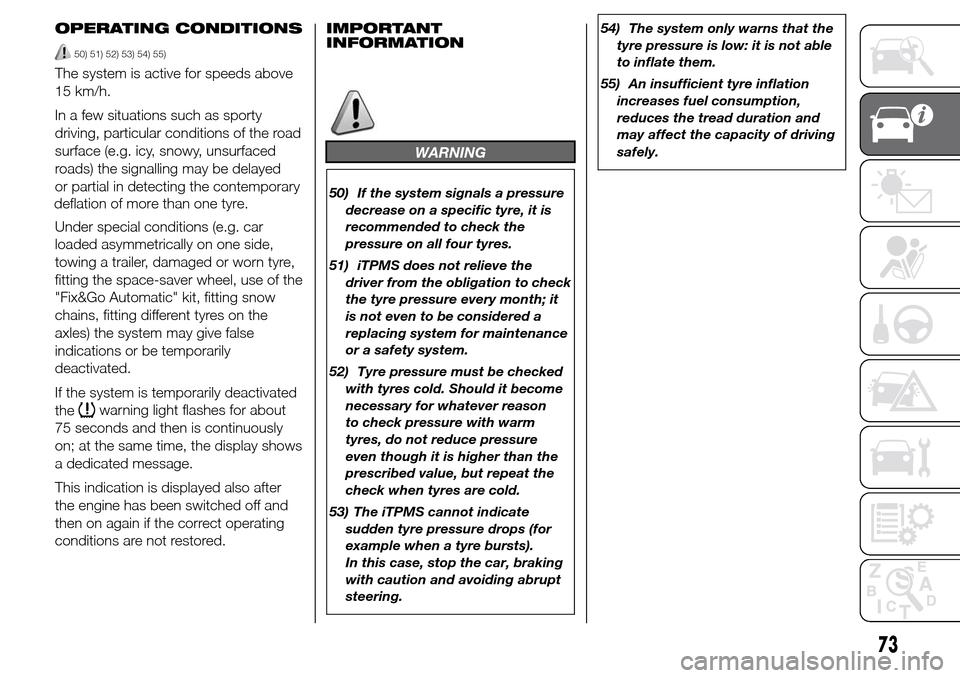
50) 51) 52) 53) 54) 55)
The system is active for speeds above
15 km/h.
In a few situations such as sporty
driving, particular conditions of the road
surface (e.g. icy, snowy, unsurfaced
roads) the signalling may be delayed
Under special conditions (e.g. car
loaded asymmetrically on one side,
towing a trailer, damaged or worn tyre,
fitting the space-saver wheel, use of the
"Fix&Go Automatic" kit, fitting snow
chains, fitting different tyres on the
axles) the system may give false
indications or be temporarily
deactivated.
If the system is temporarily deactivated
the
warning light flashes for about
75 seconds and then is continuously
on; at the same time, the display shows
a dedicated message.
This indication is displayed also after
the engine has been switched off and
then on again if the correct operating
conditions are not restored.IMPORTANT
INFORMATION
WARNING
50) If the system signals a pressure
decrease on a specific tyre, it is
recommended to check the
pressure on all four tyres.
51) iTPMS does not relieve the
driver from the obligation to check
the tyre pressure every month; it
is not even to be considered a
replacing system for maintenance
or a safety system.
52) Tyre pressure must be checked
with tyres cold. Should it become
necessary for whatever reason
to check pressure with warm
tyres, do not reduce pressure
even though it is higher than the
prescribed value, but repeat the
check when tyres are cold.
53) The iTPMS cannot indicate
sudden tyre pressure drops (for
example when a tyre bursts).
In this case, stop the car, braking
with caution and avoiding abrupt
steering.54) The system only warns that the
tyre pressure is low: it is not able
to inflate them.
55) An insufficient tyre inflation
increases fuel consumption,
reduces the tread duration and
may affect the capacity of driving
safely.
73
or partial in detecting the contemporary
deflation of more than one tyre.
Page 78 of 288
EOBD SYSTEM
(European On
Board Diagnosis)
(for versions/markets, where provided)
Operation
The EOBD system (European On Board
Diagnosis) carries out a continuous
diagnosis of the components of the car
related to emissions.
It also alerts the driver, by switching on
the
warning light on the instrument
panel, together with a message on
the display, when these components
are no longer in peak condition (see
“Warning lights and messages”
paragraph in the "Knowing the
instrument panel" chapter).
The aim of the EOBD system (European
On Board Diagnosis) is to:
❒monitor the system efficiency;
❒indicate an increase in emissions;
❒indicate the need to replace
damaged components.The car also has a connector, which
can interface with appropriate tools,
that makes it possible to read the error
codes stored in the electronic control
units together with a series of specific
parameters for engine operation and
diagnosis. This check can also be
carried out by the traffic control
authorities.
IMPORTANT After eliminating a fault, to
check the system completely, the Alfa
Romeo Dealership is obliged to run
tests and, if necessary, road tests
which may also require a long journey.
DUAL PINION
ACTIVE STEERING
Operation
This only operates with the key turned
to MAR-ON and the engine started.
The steering allows the force required
at the steering wheel to be adjusted
to suit driving conditions. The different
power assistance modes can be
selected via the d, n, a positions of the
“Alfa DNA System” lever (see paragraph
entitled “Alfa DNA System”).
56)
IMPORTANT After the battery is
disconnected, the steering must be
initialised. The warning light switches on
to indicate this. To carry out this
procedure, simply turn the steering
wheel all the way from one end to the
other or drive in a straight line for about
a hundred metres.
74
GETTING TO KNOW YOUR CAR