check engine Alfa Romeo Giulietta 2018 User Guide
[x] Cancel search | Manufacturer: ALFA ROMEO, Model Year: 2018, Model line: Giulietta, Model: Alfa Romeo Giulietta 2018Pages: 216, PDF Size: 3.39 MB
Page 51 of 216
Warning lights on
panelWhat it means What to do
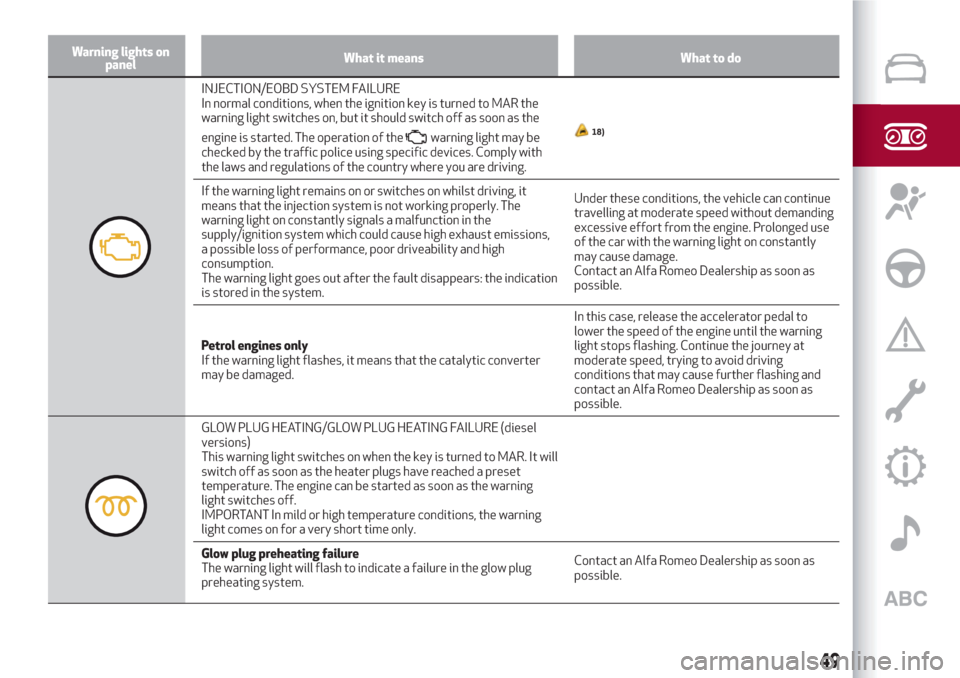
INJECTION/EOBD SYSTEM FAILURE
In normal conditions, when the ignition key is turned to MAR the
warning light switches on, but it should switch off as soon as the
engine is started. The operation of the
warning light may be
checked by the traffic police using specific devices. Comply with
the laws and regulations of the country where you are driving.18)
If the warning light remains on or switches on whilst driving, it
means that the injection system is not working properly. The
warning light on constantly signals a malfunction in the
supply/ignition system which could cause high exhaust emissions,
a possible loss of performance, poor driveability and high
consumption.
The warning light goes out after the fault disappears: the indication
is stored in the system.Under these conditions, the vehicle can continue
travelling at moderate speed without demanding
excessive effort from the engine. Prolonged use
of the car with the warning light on constantly
may cause damage.
Contact an Alfa Romeo Dealership as soon as
possible.
Petrol engines only
If the warning light flashes, it means that the catalytic converter
may be damaged.In this case, release the accelerator pedal to
lower the speed of the engine until the warning
light stops flashing. Continue the journey at
moderate speed, trying to avoid driving
conditions that may cause further flashing and
contact an Alfa Romeo Dealership as soon as
possible.
GLOW PLUG HEATING/GLOW PLUG HEATING FAILURE (diesel
versions)
This warning light switches on when the key is turned to MAR. It will
switch off as soon as the heater plugs have reached a preset
temperature. The engine can be started as soon as the warning
light switches off.
IMPORTANT In mild or high temperature conditions, the warning
light comes on for a very short time only.
Glow plug preheating failure
The warning light will flash to indicate a failure in the glow plug
preheating system.Contact an Alfa Romeo Dealership as soon as
possible.
49
Page 60 of 216
WARNING
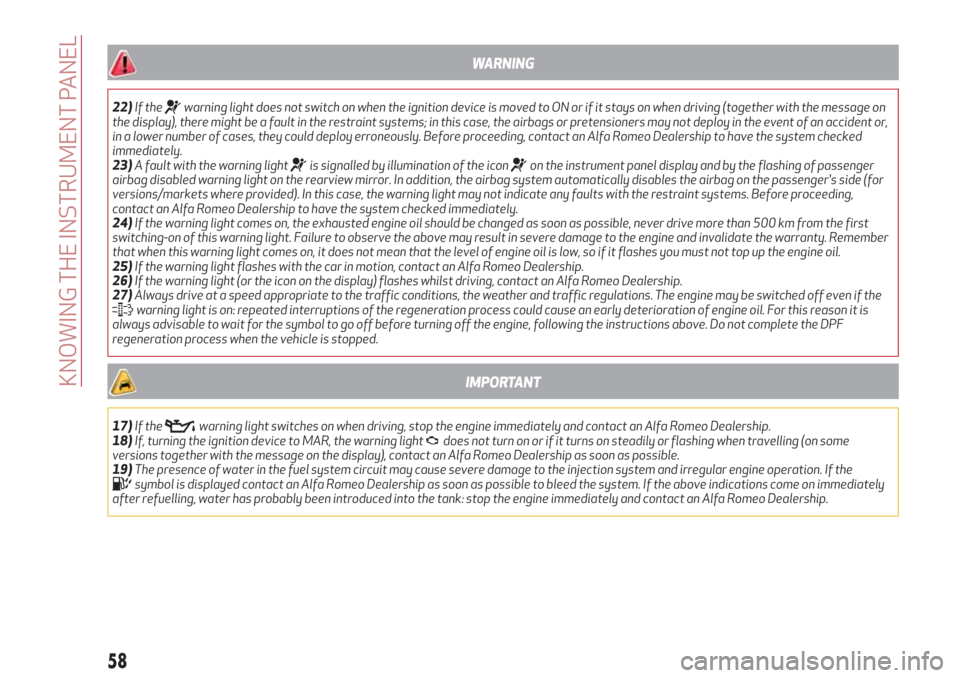
22)If thewarning light does not switch on when the ignition device is moved to ON or if it stays on when driving (together with the message on
the display), there might be a fault in the restraint systems; in this case, the airbags or pretensioners may not deploy in the event of an accident or,
in a lower number of cases, they could deploy erroneously. Before proceeding, contact an Alfa Romeo Dealership to have the system checked
immediately.
23)A fault with the warning light
is signalled by illumination of the iconon the instrument panel display and by the flashing of passenger
airbag disabled warning light on the rearview mirror. In addition, the airbag system automatically disables the airbag on the passenger's side (for
versions/markets where provided). In this case, the warning light may not indicate any faults with the restraint systems. Before proceeding,
contact an Alfa Romeo Dealership to have the system checked immediately.
24)If the warning light comes on, the exhausted engine oil should be changed as soon as possible, never drive more than 500 km from the first
switching-on of this warning light. Failure to observe the above may result in severe damage to the engine and invalidate the warranty. Remember
that when this warning light comes on, it does not mean that the level of engine oil is low, so if it flashes you must not top up the engine oil.
25)If the warning light flashes with the car in motion, contact an Alfa Romeo Dealership.
26)If the warning light (or the icon on the display) flashes whilst driving, contact an Alfa Romeo Dealership.
27)Always drive at a speed appropriate to the traffic conditions, the weather and traffic regulations. The engine may be switched off even if the
warning light is on: repeated interruptions of the regeneration process could cause an early deterioration of engine oil. For this reason it is
always advisable to wait for the symbol to go off before turning off the engine, following the instructions above. Do not complete the DPF
regeneration process when the vehicle is stopped.
IMPORTANT
17)If thewarning light switches on when driving, stop the engine immediately and contact an Alfa Romeo Dealership.
18)If, turning the ignition device to MAR, the warning lightdoes not turn on or if it turns on steadily or flashing when travelling (on some
versions together with the message on the display), contact an Alfa Romeo Dealership as soon as possible.
19)The presence of water in the fuel system circuit may cause severe damage to the injection system and irregular engine operation. If the
symbol is displayed contact an Alfa Romeo Dealership as soon as possible to bleed the system. If the above indications come on immediately
after refuelling, water has probably been introduced into the tank: stop the engine immediately and contact an Alfa Romeo Dealership.
58
KNOWING THE INSTRUMENT PANEL
Page 64 of 216
33)When the ABS intervenes and you feel
the brake pedal pulsating, do not reduce the
pressure, but hold it down firmly and
confidently; in doing so you will brake in the
shortest distance possible, depending on the
current road conditions.
34)To obtain the maximum efficiency of the
braking system, a bedding-in period of about
500 km is needed: during this period it is
better to avoid sharp, repeated and
prolonged braking.
35)If the ABS intervenes, this indicates that
the grip of the tyres on the road is nearing its
limit: you must slow down to a speed
compatible with the available grip.
36)The ABS cannot overrule the natural
laws of physics, and cannot increase the grip
available according to the condition of the
road.
37)The ABS cannot prevent accidents,
including those due to excessive speed on
corners, driving on low-grip surfaces or
aquaplaning.
38)The capability of the ABS must never be
tested irresponsibly and dangerously, in
such a way as to compromise personal
safety and the safety of others.
39)For the correct operation of the ABS, the
tyres must of necessity be the same make
and type on all wheels, in perfect condition
and, above all, of the prescribed type and
dimensions.
40)The ASR cannot overrule the natural
laws of physics, and cannot increase the grip
available according to the condition of the
road.
41)The ASR system cannot prevent
accidents, including those due to excessive
speed on corners, driving on low-grip
surfaces or aquaplaning.42)The capability of the ASR must never be
tested irresponsibly and dangerously, in
such a way as to compromise personal
safety and the safety of others.
43)The HBA system can’t overrule the
natural laws of physics, and can’t increase
the grip available according to the condition
of the road.
44)The HBA system cannot prevent
accidents, including those due to excessive
speed on corners, driving on low-grip
surfaces or aquaplaning.
45)The features of the HBA system must
never be tested in imprudent or dangerous
ways, with the possibility of putting the
safety of the driver, occupants or other road
users at risk.
46)DST is an aid for driving and does not
relieve the driver of responsibility for driving
the vehicle.iTPMS System (indirect Tyre
Pressure Monitoring System)
(for versions/markets, where provided)
DESCRIPTION
The car can be equipped with the iTPMS
(indirect Tyre Pressure Monitoring
System) which monitors the tyre inflation
status thanks to wheel speed sensors.
The system warns the driver if one or
more tyres are flat by the dedicated
warning light
continuously on and a
warning message on the display.
If one tyre only is flat, the system can
indicate its position: it is in any case
recommended to check the pressure on
all four tyres.
This indication is displayed also when
turning the engine off and on again until
the RESET procedure is carried out.
RESET PROCEDURE
The iTPMS needs an initial "self-learning"
phase (with length depending on the
driving style and road conditions: optimal
conditions being driving on a straight
road at 80 km/h for at least 20 minutes)
which starts when the RESET procedure
is carried out.
The Reset procedure must be carried out:
each time tyre pressure is modified;
when even only one tyre is changed;
when tyres are rotated/inverted;
62
SAFETY
Page 65 of 216
when the space-saver wheel is fitted.
Before carrying out the RESET, inflate
the tyres to the rated pressure values
specified in the inflation pressure table
(see "Wheels" paragraph in the "Technical
specifications" chapter).
If the RESET is not carried out, in all
above cases, the
warning light may
give false indications on one or more
tyres.
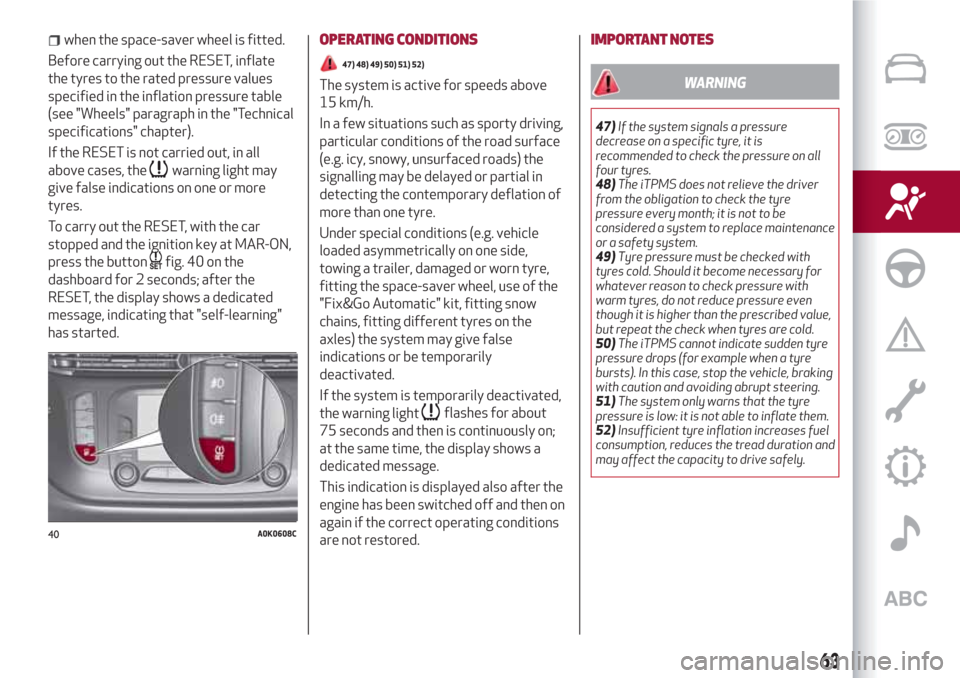
To carry out the RESET, with the car
stopped and the ignition key at MAR-ON,
press the button
fig. 40 on the
dashboard for 2 seconds; after the
RESET, the display shows a dedicated
message, indicating that "self-learning"
has started.
OPERATING CONDITIONS
47) 48) 49) 50) 51) 52)
The system is active for speeds above
15 km/h.
In a few situations such as sporty driving,
particular conditions of the road surface
(e.g. icy, snowy, unsurfaced roads) the
signalling may be delayed or partial in
detecting the contemporary deflation of
more than one tyre.
Under special conditions (e.g. vehicle
loaded asymmetrically on one side,
towing a trailer, damaged or worn tyre,
fitting the space-saver wheel, use of the
"Fix&Go Automatic" kit, fitting snow
chains, fitting different tyres on the
axles) the system may give false
indications or be temporarily
deactivated.
If the system is temporarily deactivated,
the warning light
flashes for about
75 seconds and then is continuously on;
at the same time, the display shows a
dedicated message.
This indication is displayed also after the
engine has been switched off and then on
again if the correct operating conditions
are not restored.
IMPORTANT NOTES
WARNING
47)If the system signals a pressure
decrease on a specific tyre, it is
recommended to check the pressure on all
four tyres.
48)The iTPMS does not relieve the driver
from the obligation to check the tyre
pressure every month; it is not to be
considered a system to replace maintenance
or a safety system.
49)Tyre pressure must be checked with
tyres cold. Should it become necessary for
whatever reason to check pressure with
warm tyres, do not reduce pressure even
though it is higher than the prescribed value,
but repeat the check when tyres are cold.
50)The iTPMS cannot indicate sudden tyre
pressure drops (for example when a tyre
bursts). In this case, stop the vehicle, braking
with caution and avoiding abrupt steering.
51)The system only warns that the tyre
pressure is low: it is not able to inflate them.
52)Insufficient tyre inflation increases fuel
consumption, reduces the tread duration and
may affect the capacity to drive safely.
40A0K0608C
63
Page 84 of 216
WARNING
79)Do not affix rigid objects to the garment
hooks or support handles.
80)Do not rest your head, arms or elbows on
the door, windows or the area in which the
Window bag is located to avoid possible
injury during airbag inflation.
81)Never lean your head, arms or elbows
out of the window.
82)If the
warning light does not switch
on when the key is turned to MAR, or stays
on while driving (on some versions together
with a message on the display) there may be
a fault in the restraint systems. In this case,
airbags or pretensioners may not be
activated in the case of an accident or (in a
lesser number of cases) they may be
activated incorrectly. Before proceeding,
contact an Alfa Romeo Dealership to have
the system checked immediately.
83)Do not travel carrying objects on your
lap, in front of your chest or between your
lips (pipe, pencils, etc.): they could cause
severe injury if the airbag is deployed.
84)If the car has been subject to theft,
attempted theft, vandalism, or flooding,
have the airbag system inspected at an Alfa
Romeo Dealership.85)The airbags may also be deployed when
the car is not moving, if the key is in the
ignition and turned to MAR-ON or when the
engine is off, if the car is hit by another
moving vehicle. Therefore, even if the vehicle
is stationary, when an active front
passenger airbag is fitted, DO NOT install
rearward facing child restraint systems on
the front passenger seat. Deployment of the
airbag following an impact could cause fatal
injuries to the child. Therefore, always
deactivate the passenger side airbag when a
rearward facing child restraint system is
installed on the front passenger seat. The
front passenger seat must also be
positioned back as far as possible in order to
prevent the child restraint system from
coming into contact with the dashboard.
Immediately reactivate the passenger
airbag as soon as the child restraint system
has been removed. Also remember that, if
the key is turned to STOP, none of the safety
devices (airbags or pretensioners) will be
deployed in the event of collision.
Non-deployment in such cases does not
indicate a system malfunction.
86)When the ignition key is turned to MAR,
the
warning light switches for few
seconds, then if the passenger airbag is
active it should switch off.
87)The front airbag is designed to be
deployed for impacts of a greater intensity
than for the pretensioners. For impacts
whose intensity falls between the two levels,
normally, only the pretensioners will be
activated.88)The airbag does not replace seat belts
but increases their efficiency. Because front
airbags are not deployed for low-speed
crashes, side collisions, rear-end shunts or
rollovers, occupants are protected, in
addition to any side bags, only by their seat
belts, which must therefore always be
fastened.
89)On cars with side bags, do not cover the
front seat backrests with extra covers.
82
SAFETY
Page 119 of 216
117)The vehicle's driving characteristics
will be modified with the space-saver wheel
fitted. Avoid violent acceleration and
braking, abrupt steering and fast cornering.
The overall duration of the space-saver
wheel is about 3000 km, after which the
relevant tyre must be replaced with another
one of the same type. Never install a
traditional tyre on a rim designed to be used
as a space-saver wheel. Have the wheel
repaired and refitted as soon as possible.
Using two or more space-saver wheels at the
same time is forbidden. Do not apply grease
to the bolt threads before fitting: they could
come unscrewed.
118)The jack may be used to replace
wheels only on the car that it comes with or
other cars of the same model. Never use the
jack for other purposes, such as lifting other
vehicle models. Never use it for repair
operations under the vehicle. Incorrect
positioning of the jack may cause the vehicle
to fall. Do not use the jack for loads higher
than the one shown on its label. Never install
snow chains on the space-saver wheel; if a
front tyre (driving wheel) is punctured and
you need to use snow chains, use a standard
wheel from the rear axle and install the
space-saver wheel on the rear axle. In this
way, with two normal front drive wheels, it is
possible to use snow chains.
119)Incorrectly fitting the wheel cap may
cause it to fall off when the car is in motion.
Never tamper with the inflation valve. Never
introduce tools of any kind between rim and
tyre. Regularly check the inflation pressure
of the tyres and space-saver wheel (see
chapter "Technical specifications").120)The jack is a tool developed and
designed only for changing a wheel, if a tyre
gets punctured or damaged, on the vehicle
with which it is supplied or on other vehicles
of the same model. Any other use, e.g. to jack
up other vehicle models or different things,
is strictly prohibited. Never use for
maintenance or repair activities under the
car or to exchange the summer/winter
wheels and vice versa. Never go under the
raised vehicle. Should it be necessary to
work under the vehicle, contact an Alfa
Romeo Dealership. Incorrect positioning of
the jack may cause the raised vehicle to fall:
use only in the positions indicated. Do not
use the jack for loads higher than the one
shown on its label. Never start the engine
with vehicle raised. If the vehicle is raised
more than necessary, everything can
become more unstable, with the risk of the
vehicle dropping violently. Thus, lift the
vehicle only as needed in order to access the
spare wheel.
IMPORTANT
35)When turning the jack handle make sure
that it can turn freely without scraping your
hand against the ground. The moving
components of the jack ("worm screw" and
joints) can also cause injuries: avoid touching
them. If you come into contact with
lubricating grease, clean yourself
thoroughly.
36)Contact an Alfa Romeo Dealership as
soon as possible to have the correct
tightening of the wheel bolts checked.
FIX&GO KIT
121) 122)
37)
DESCRIPTION
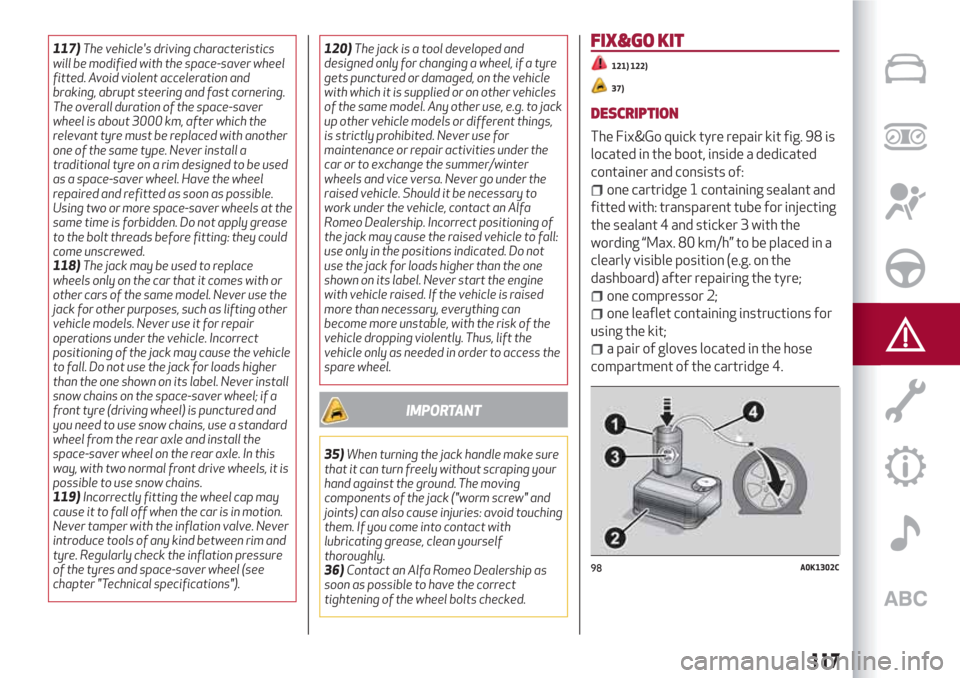
The Fix&Go quick tyre repair kit fig. 98 is
located in the boot, inside a dedicated
container and consists of:
one cartridge 1 containing sealant and
fitted with: transparent tube for injecting
the sealant 4 and sticker 3 with the
wording “Max. 80 km/h” to be placed in a
clearly visible position (e.g. on the
dashboard) after repairing the tyre;
one compressor 2;
one leaflet containing instructions for
using the kit;
a pair of gloves located in the hose
compartment of the cartridge 4.
98A0K1302C
117
Page 123 of 216
FUEL CUT-OFFSYSTEM
Operation
This intervenes in the case of an impact
causing:
the fuel supply cut-off with the engine
consequently switching off;
the automatic unlocking of the doors;
the switching on of the interior lights.
The intervention of the system is
indicated by a message shown on the
display.
Carefully check the vehicle for fuel leaks,
for instance in the engine compartment,
under the vehicle or near the tank area.
125)
After a collision, turn the ignition key to
STOP to prevent the battery from
running down.
To restore the correct operation of the
car, proceed as follows:
turn the ignition key to the MAR
position;
activate the right direction indicator;
deactivate the right direction
indicator;
activate the left direction indicator;
deactivate the left direction indicator;
activate the right direction indicator;
deactivate the right direction
indicator;
activate the left direction indicator;
deactivate the left direction indicator;
ignition key turned to the OFF
position;
turn the ignition key to the MAR-ON
position.
WARNING
125)If, after an impact, you smell fuel or
notice leaks from the fuel system, do not
reactivate the system to avoid the risk of
fire.
TCT - KEY REMOVAL
The ignition key can be removed only if
the gear lever is in position P (Park).
If the battery is flat and the ignition key is
engaged, the latter is locked in position.
To remove the key manually, proceed as
follows:
apply the handbrake;
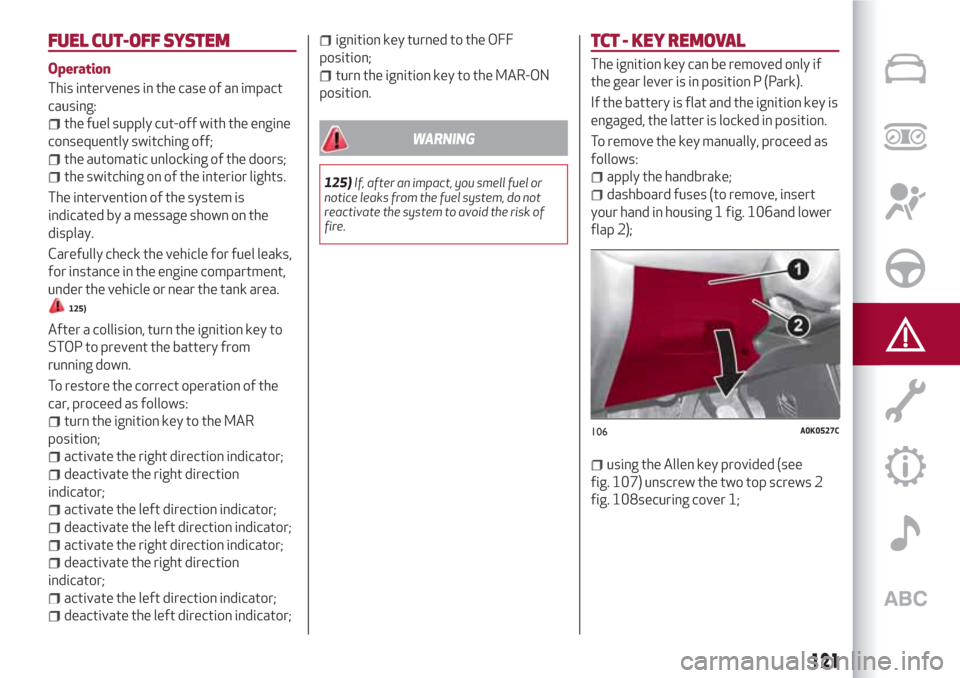
dashboard fuses (to remove, insert
your hand in housing 1 fig. 106and lower
flap 2);
using the Allen key provided (see
fig. 107) unscrew the two top screws 2
fig. 108securing cover 1;
106A0K0527C
121
Page 126 of 216
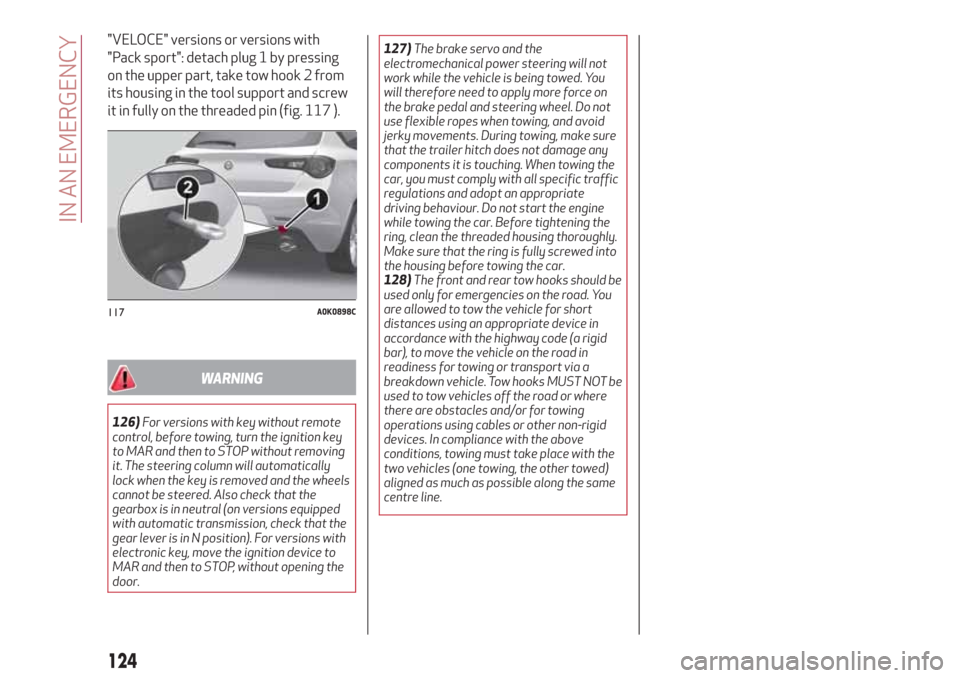
"VELOCE" versions or versions with
"Pack sport": detach plug 1 by pressing
on the upper part, take tow hook 2 from
its housing in the tool support and screw
it in fully on the threaded pin (fig. 117 ).
WARNING
126)For versions with key without remote
control, before towing, turn the ignition key
to MAR and then to STOP without removing
it. The steering column will automatically
lock when the key is removed and the wheels
cannot be steered. Also check that the
gearbox is in neutral (on versions equipped
with automatic transmission, check that the
gear lever is in N position). For versions with
electronic key, move the ignition device to
MAR and then to STOP, without opening the
door.127)The brake servo and the
electromechanical power steering will not
work while the vehicle is being towed. You
will therefore need to apply more force on
the brake pedal and steering wheel. Do not
use flexible ropes when towing, and avoid
jerky movements. During towing, make sure
that the trailer hitch does not damage any
components it is touching. When towing the
car, you must comply with all specific traffic
regulations and adopt an appropriate
driving behaviour. Do not start the engine
while towing the car. Before tightening the
ring, clean the threaded housing thoroughly.
Make sure that the ring is fully screwed into
the housing before towing the car.
128)The front and rear tow hooks should be
used only for emergencies on the road. You
are allowed to tow the vehicle for short
distances using an appropriate device in
accordance with the highway code (a rigid
bar), to move the vehicle on the road in
readiness for towing or transport via a
breakdown vehicle. Tow hooks MUST NOT be
used to tow vehicles off the road or where
there are obstacles and/or for towing
operations using cables or other non-rigid
devices. In compliance with the above
conditions, towing must take place with the
two vehicles (one towing, the other towed)
aligned as much as possible along the same
centre line.
117A0K0898C
124
IN AN EMERGENCY
Page 129 of 216
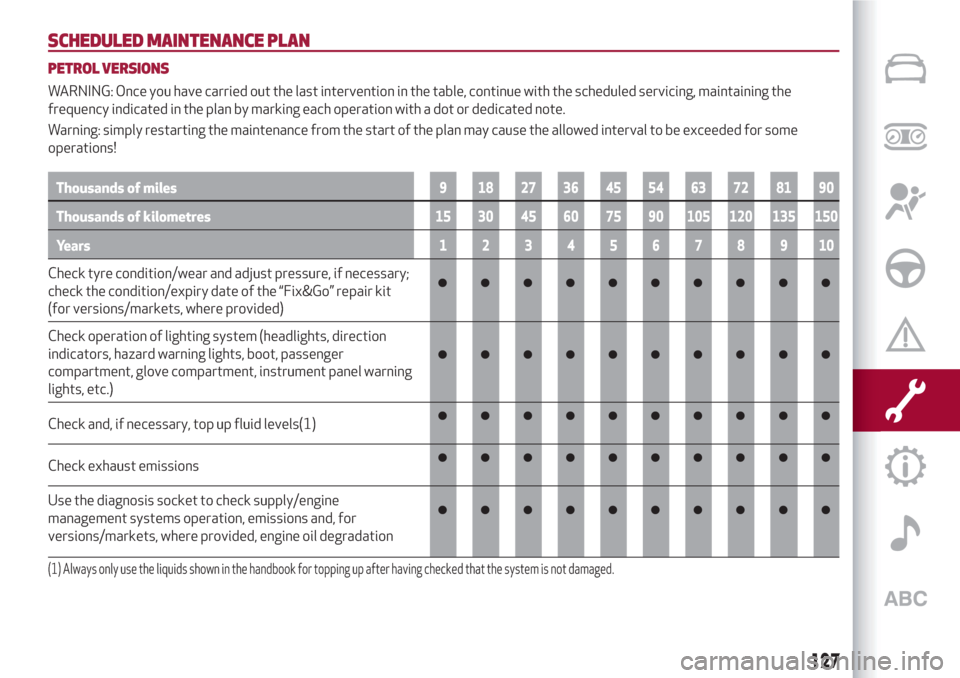
SCHEDULED MAINTENANCE PLAN
PETROL VERSIONS
WARNING: Once you have carried out the last intervention in the table, continue with the scheduled servicing, maintaining the
frequency indicated in the plan by marking each operation with a dot or dedicated note.
Warning: simply restarting the maintenance from the start of the plan may cause the allowed interval to be exceeded for some
operations!
Thousands of miles9 182736455463728190
Thousands of kilometres15 30 45 60 75 90 105 120 135 150
Years12345678910
Check tyre condition/wear and adjust pressure, if necessary;
check the condition/expiry date of the “Fix&Go” repair kit
(for versions/markets, where provided)
Check operation of lighting system (headlights, direction
indicators, hazard warning lights, boot, passenger
compartment, glove compartment, instrument panel warning
lights, etc.)
Check and, if necessary, top up fluid levels(1)
Check exhaust emissions
Use the diagnosis socket to check supply/engine
management systems operation, emissions and, for
versions/markets, where provided, engine oil degradation
(1) Always only use the liquids shown in the handbook for topping up after having checked that the system is not damaged.
127
Page 131 of 216
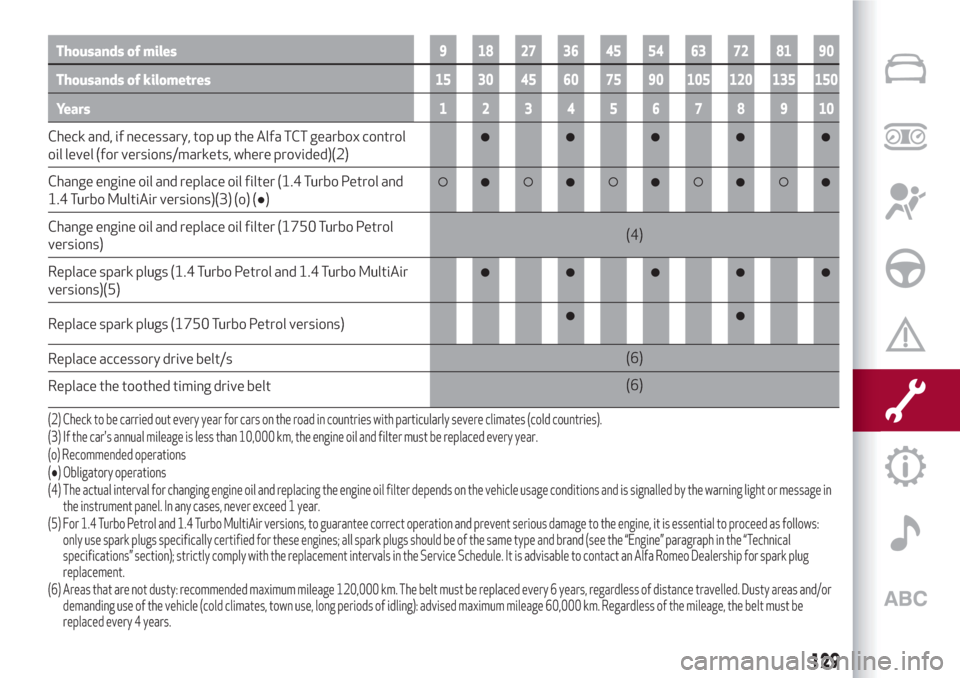
Thousands of miles9 182736455463728190
Thousands of kilometres15 30 45 60 75 90 105 120 135 150
Years12345678910
Check and, if necessary, top up the Alfa TCT gearbox control
oil level (for versions/markets, where provided)(2)
Change engine oil and replace oil filter (1.4 Turbo Petrol and
1.4 Turbo MultiAir versions)(3) (o) (●)
Change engine oil and replace oil filter (1750 Turbo Petrol
versions)(4)
Replace spark plugs (1.4 Turbo Petrol and 1.4 Turbo MultiAir
versions)(5)
Replace spark plugs (1750 Turbo Petrol versions)
Replace accessory drive belt/s(6)
Replace the toothed timing drive belt(6)
(2) Check to be carried out every year for cars on the road in countries with particularly severe climates (cold countries).
(3) If the car's annual mileage is less than 10,000 km, the engine oil and filter must be replaced every year.
(o) Recommended operations
(●) Obligatory operations
(4) The actual interval for changing engine oil and replacing the engine oil filter depends on the vehicle usage conditions and is signalled by the warning light or message in
the instrument panel. In any cases, never exceed 1 year.
(5) For 1.4 Turbo Petrol and 1.4 Turbo MultiAir versions, to guarantee correct operation and prevent serious damage to the engine, it is essential to proceed as follows:
only use spark plugs specifically certified for these engines; all spark plugs should be of the same type and brand (see the “Engine” paragraph in the “Technical
specifications” section); strictly comply with the replacement intervals in the Service Schedule. It is advisable to contact an Alfa Romeo Dealership for spark plug
replacement.
(6) Areas that are not dusty: recommended maximum mileage 120,000 km. The belt must be replaced every 6 years, regardless of distance travelled. Dustyareas and/or
demanding use of the vehicle (cold climates, town use, long periods of idling): advised maximum mileage 60,000 km. Regardless of the mileage, the beltmust be
replaced every 4 years.
129