ESP Alfa Romeo Giulietta 2018 Owner's Guide
[x] Cancel search | Manufacturer: ALFA ROMEO, Model Year: 2018, Model line: Giulietta, Model: Alfa Romeo Giulietta 2018Pages: 216, PDF Size: 3.39 MB
Page 103 of 216
TYPES OF BULBS
The car has the following bulbs:
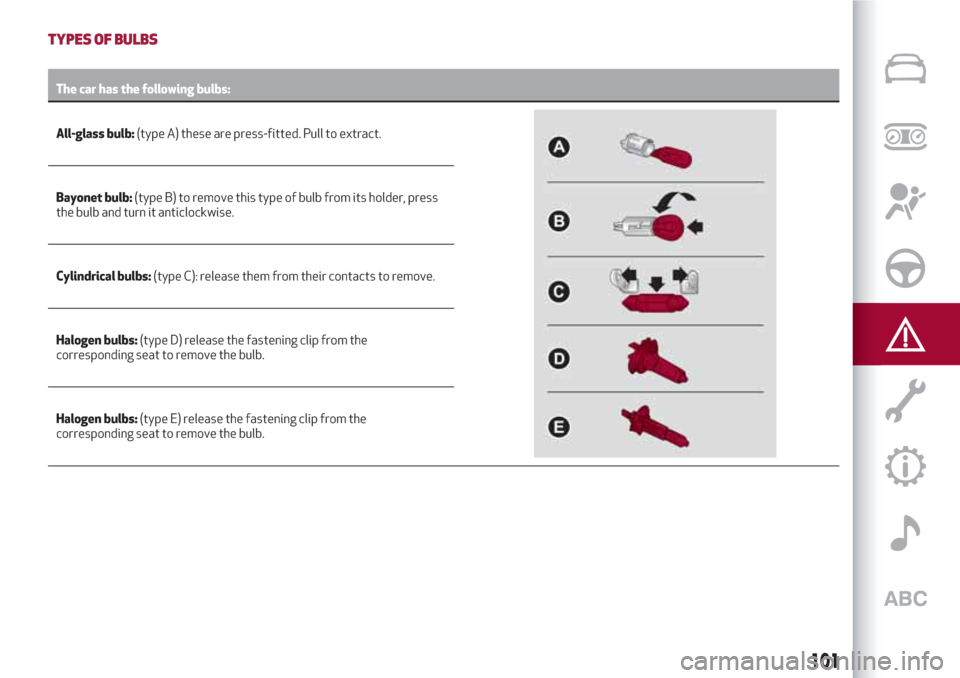
All-glass bulb:(type A) these
are press-fitted. Pull to extract.
Bayonet bulb:(type B) to remove this type of bulb from its holder, press
the bulb and turn it anticlockwise.
Cylindrical bulbs:(type C): release them from their contacts to remove.
Halogen bulbs:(type D) release the fastening clip from the
corresponding seat to remove the bulb.
Halogen bulbs:(type E) release the fastening clip from the
corresponding seat to remove the bulb.
101
Page 104 of 216
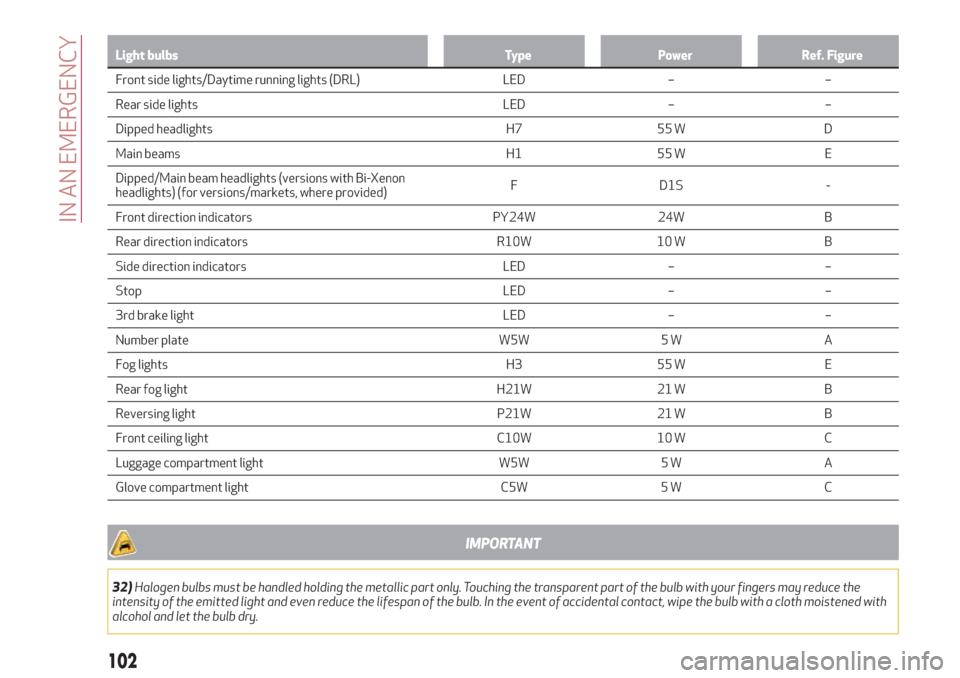
Light bulbs Type Power Ref. Figure
Front side lights/Daytime running lights (DRL) LED – –
Rear side lights LED – –
Dipped
headlights H7 55 W D
Main beams H1 55 W E
Dipped/Main beam headlights (versions with Bi-Xenon
headlights) (for versions/markets, where provided)F D1S -
Front direction indicators PY24W 24W B
Rear direction indicators R10W 10 W B
Side direction indicators LED – –
Stop LED – –
3rd brake light LED – –
Number plate W5W 5 W A
Fog lights H3 55 W E
Rear fog light H21W 21 W B
Reversing light P21W 21 W B
Front ceiling light C10W 10 W C
Luggage compartment light W5W 5 W A
Glove compartment light C5W 5 W C
IMPORTANT
32)Halogen bulbs must be handled holding the metallic part only. Touching the transparent part of the bulb with your fingers may reduce the
intensity of the emitted light and even reduce the lifespan of the bulb. In the event of accidental contact, wipe the bulb with a cloth moistened with
alcohol and let the bulb dry.
102
IN AN EMERGENCY
Page 109 of 216
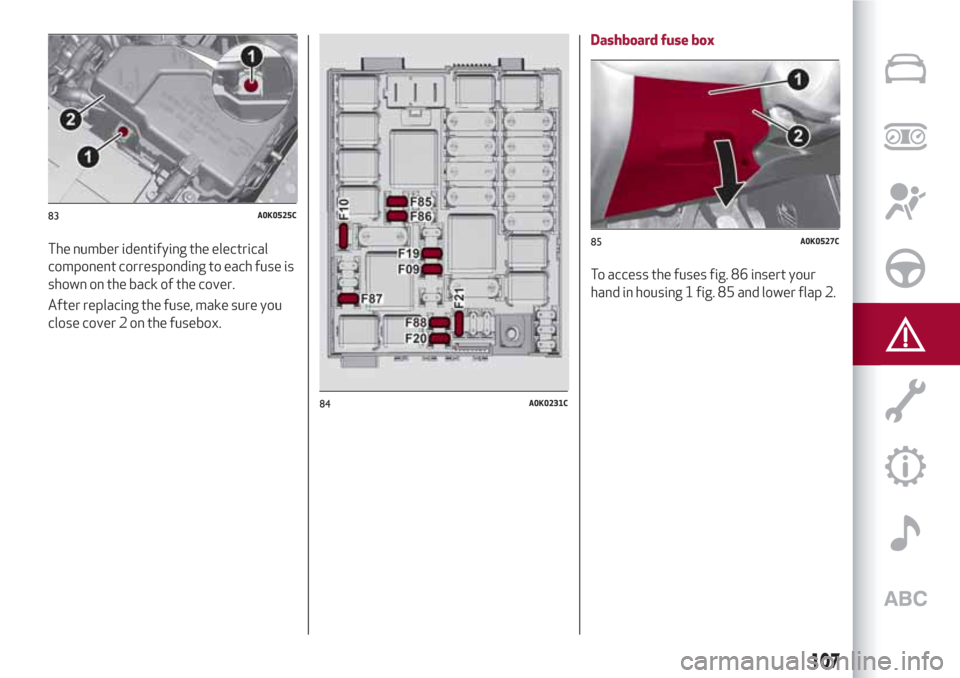
The number identifying the electrical
component corresponding to each fuse is
shown on the back of the cover.
After replacing the fuse, make sure you
close cover 2 on the fusebox.Dashboard fuse box
To access the fuses fig. 86 insert your
hand in housing 1 fig. 85 and lower flap 2.
83A0K0525C
84A0K0231C
85A0K0527C
107
Page 118 of 216
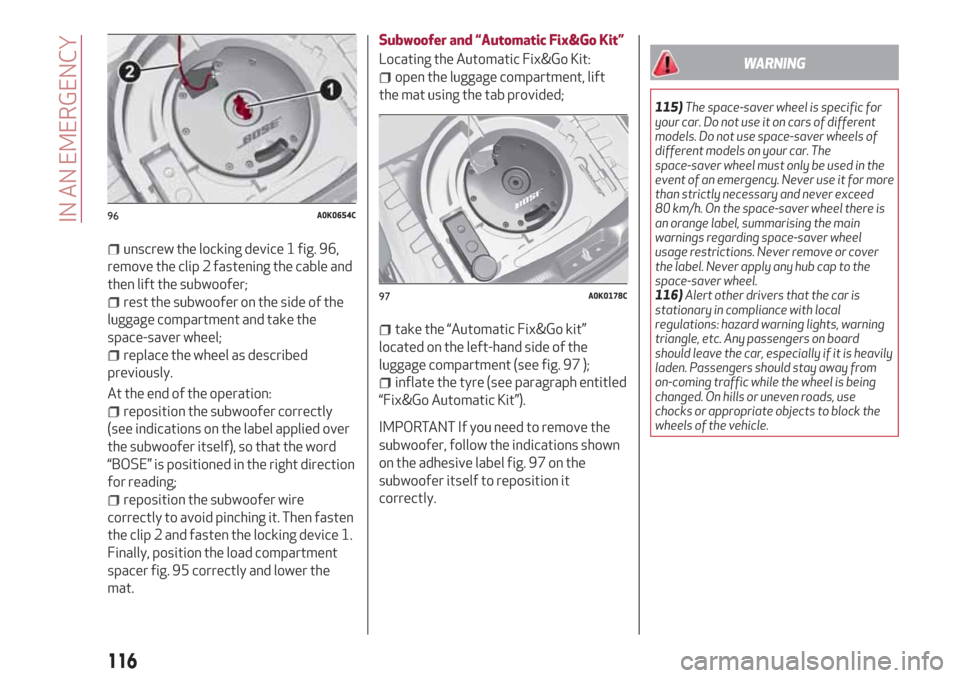
unscrew the locking device 1 fig. 96,
remove the clip 2 fastening the cable and
then lift the subwoofer;
rest the subwoofer on the side of the
luggage compartment and take the
space-saver wheel;
replace the wheel as described
previously.
At the end of the operation:
reposition the subwoofer correctly
(see indications on the label applied over
the subwoofer itself), so that the word
“BOSE” is positioned in the right direction
for reading;
reposition the subwoofer wire
correctly to avoid pinching it. Then fasten
the clip 2 and fasten the locking device 1.
Finally, position the load compartment
spacer fig. 95 correctly and lower the
mat.Subwoofer and “Automatic Fix&Go Kit”
Locating the Automatic Fix&Go Kit:
open the luggage compartment, lift
the mat using the tab provided;
take the “Automatic Fix&Go kit”
located on the left-hand side of the
luggage compartment (see fig. 97 );
inflate the tyre (see paragraph entitled
“Fix&Go Automatic Kit”).
IMPORTANT If you need to remove the
subwoofer, follow the indications shown
on the adhesive label fig. 97 on the
subwoofer itself to reposition it
correctly.
WARNING
115)The space-saver wheel is specific for
your car. Do not use it on cars of different
models. Do not use space-saver wheels of
different models on your car. The
space-saver wheel must only be used in the
event of an emergency. Never use it for more
than strictly necessary and never exceed
80 km/h. On the space-saver wheel there is
an orange label, summarising the main
warnings regarding space-saver wheel
usage restrictions. Never remove or cover
the label. Never apply any hub cap to the
space-saver wheel.
116)Alert other drivers that the car is
stationary in compliance with local
regulations: hazard warning lights, warning
triangle, etc. Any passengers on board
should leave the car, especially if it is heavily
laden. Passengers should stay away from
on-coming traffic while the wheel is being
changed. On hills or uneven roads, use
chocks or appropriate objects to block the
wheels of the vehicle.
96A0K0654C
97A0K0178C
116
IN AN EMERGENCY
Page 132 of 216
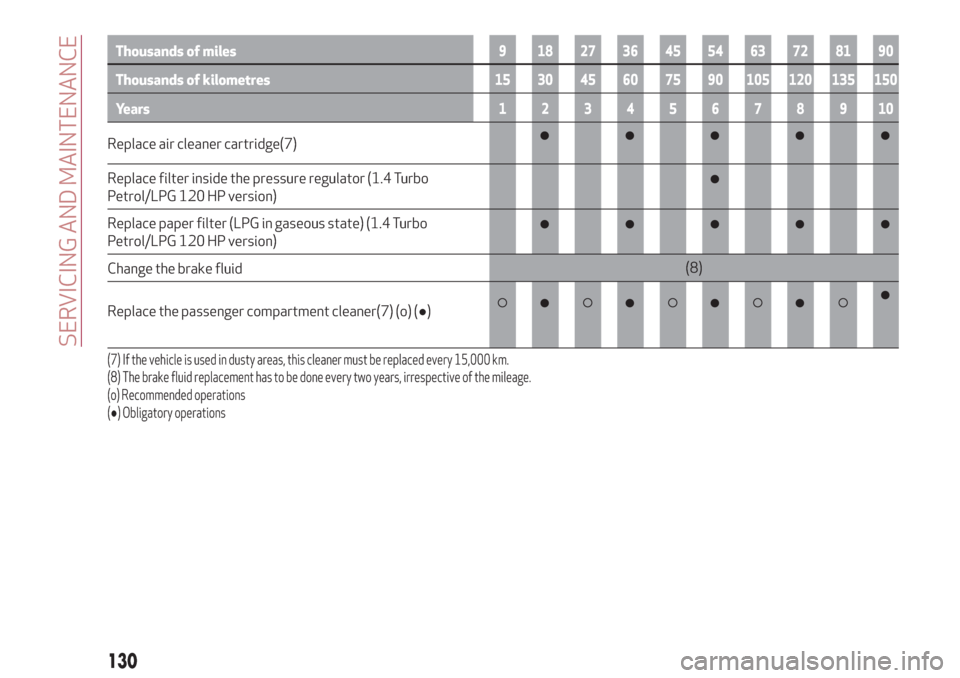
Thousands of miles9 182736455463728190
Thousands of kilometres15 30 45 60 75 90 105 120 135 150
Years12345678910
Replace air cleaner cartridge(7)
Replace filter inside the pressure regulator (1.4 Turbo
Petrol/LPG 120 HP version)
Replace paper filter (LPG in gaseous state) (1.4 Turbo
Petrol/LPG 120 HP version)
Change the brake fluid(8)
Replace the passenger compartment cleaner(7) (o) (●)
(7) If the vehicle is used in dusty areas, this cleaner must be replaced every 15,000 km.
(8) The brake fluid replacement has to be done every two years, irrespective of the mileage.
(o) Recommended operations
(●) Obligatory operations
130
SERVICING AND MAINTENANCE
Page 135 of 216
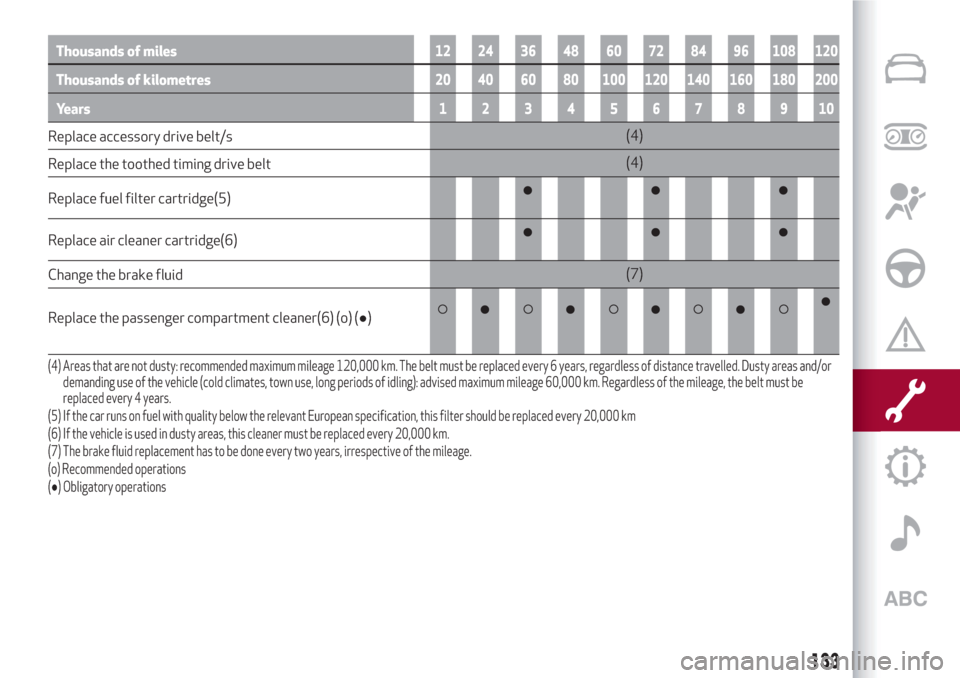
Thousands of miles12 24 36 48 60 72 84 96 108 120
Thousands of kilometres20 40 60 80 100 120 140 160 180 200
Years12345678910
Replace accessory drive belt/s(4)
Replace the toothed timing drive belt(4)
Replace fuel filter cartridge(5)
Replace air cleaner cartridge(6)
Change the brake fluid(7)
Replace the passenger compartment cleaner(6) (o) (●)
(4) Areas that are not dusty: recommended maximum mileage 120,000 km. The belt must be replaced every 6 years, regardless of distance travelled. Dustyareas and/or
demanding use of the vehicle (cold climates, town use, long periods of idling): advised maximum mileage 60,000 km. Regardless of the mileage, the beltmust be
replaced every 4 years.
(5) If the car runs on fuel with quality below the relevant European specification, this filter should be replaced every 20,000 km
(6) If the vehicle is used in dusty areas, this cleaner must be replaced every 20,000 km.
(7) The brake fluid replacement has to be done every two years, irrespective of the mileage.
(o) Recommended operations
(●) Obligatory operations
133
Page 152 of 216
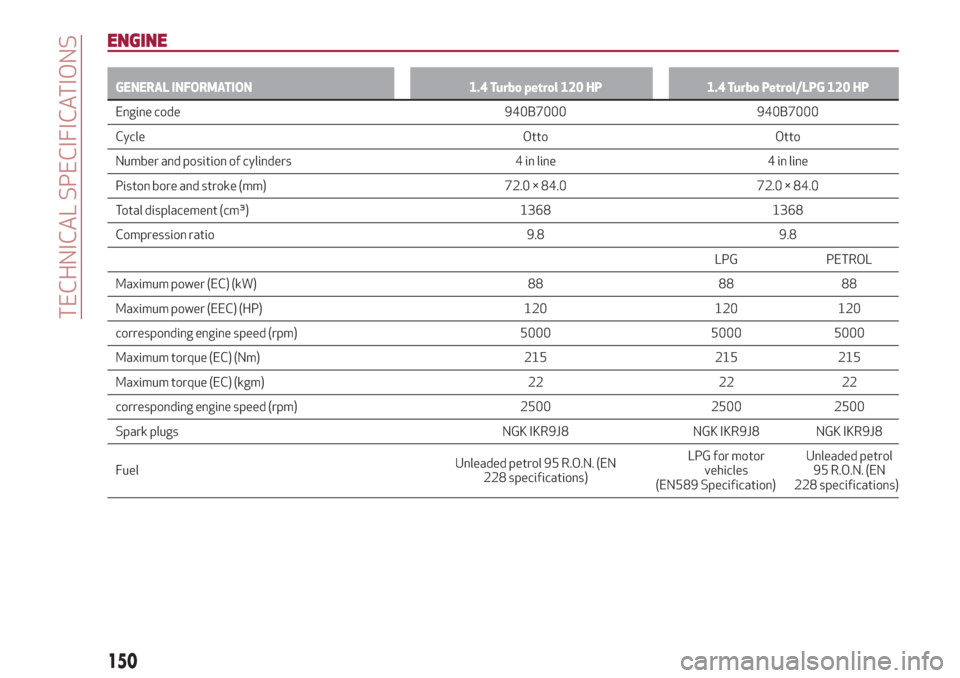
ENGINE
GENERAL INFORMATION 1.4 Turbo petrol 120 HP 1.4 Turbo Petrol/LPG 120 HP
Engine code 940B7000 940B7000
Cycle Otto Otto
Number and
position of cylinders 4 in line 4 in line
Piston bore and stroke (mm) 72.0 × 84.0 72.0 × 84.0
Total displacement (cm³) 1368 1368
Compression ratio 9.8 9.8
LPG PETROL
Maximum power (EC) (kW) 88 88 88
Maximum power (EEC) (HP) 120 120 120
corresponding engine speed (rpm) 5000 5000 5000
Maximum torque (EC) (Nm) 215 215 215
Maximum torque (EC) (kgm) 22 22 22
corresponding engine speed (rpm) 2500 2500 2500
Spark plugs NGK IKR9J8 NGK IKR9J8 NGK IKR9J8
FuelUnleaded petrol 95 R.O.N. (EN
228 specifications)LPG for motor
vehicles
(EN589 Specification)Unleaded petrol
95 R.O.N. (EN
228 specifications)
150
TECHNICAL SPECIFICATIONS
Page 153 of 216
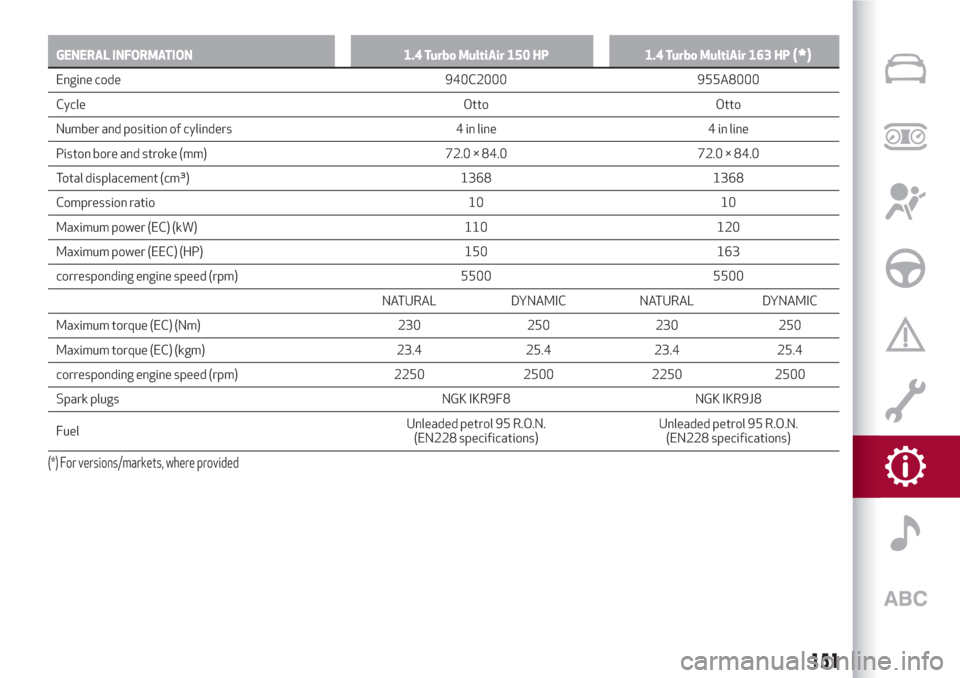
GENERAL INFORMATION 1.4 Turbo MultiAir 150 HP 1.4 Turbo MultiAir 163 HP(*)
Engine code 940C2000 955A8000
Cycle Otto Otto
Number and position of cylinders 4 in line 4 in line
Piston bore and stroke (mm) 72.0 × 84.0 72.0 × 84.0
Total displacement (cm³) 1368 1368
Compression ratio 10 10
Maximum power (EC) (kW) 110 120
Maximum power (EEC) (HP) 150 163
corresponding engine speed (rpm) 5500 5500
NATURAL DYNAMIC NATURAL DYNAMIC
Maximum torque (EC) (Nm) 230 250 230 250
Maximum torque (EC) (kgm) 23.4 25.4 23.4 25.4
corresponding engine speed (rpm) 2250 2500 2250 2500
Spark plugs NGK IKR9F8 NGK IKR9J8
FuelUnleaded petrol 95 R.O.N.
(EN228 specifications)Unleaded petrol 95 R.O.N.
(EN228 specifications)
(*) For versions/markets, where provided
151
Page 154 of 216
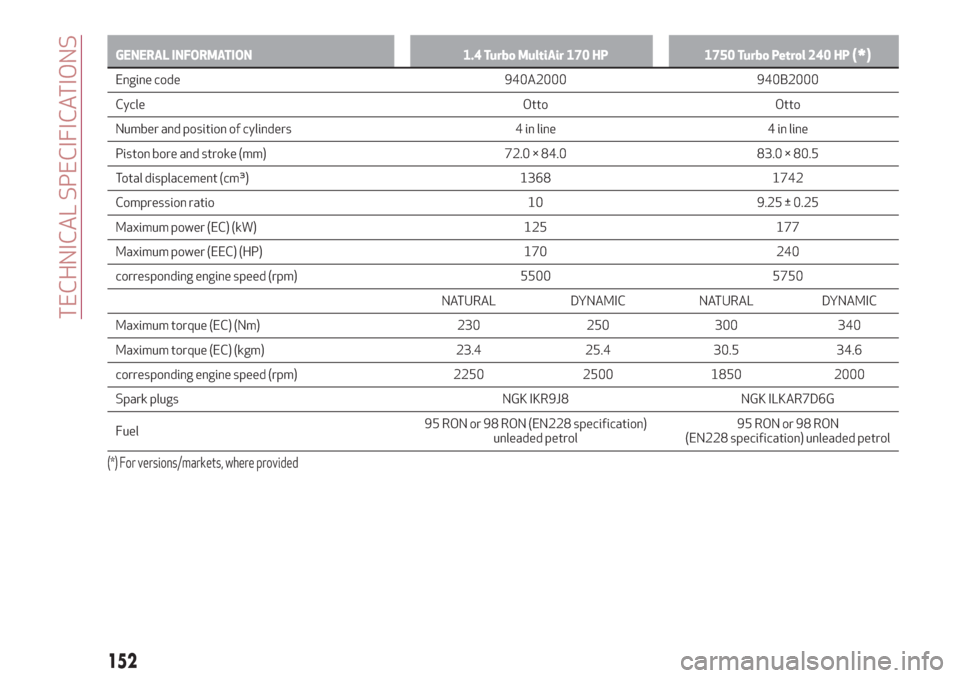
GENERAL INFORMATION 1.4 Turbo MultiAir 170 HP 1750 Turbo Petrol 240 HP(*)
Engine code 940A2000 940B2000
Cycle Otto Otto
Number and position of cylinders 4 in line 4 in line
Piston bore and stroke (mm) 72.0 × 84.0 83.0 × 80.5
Total displacement (cm³) 1368 1742
Compression ratio 10 9.25 ± 0.25
Maximum power (EC) (kW) 125 177
Maximum power (EEC) (HP) 170 240
corresponding engine speed (rpm) 5500 5750
NATURAL DYNAMIC NATURAL DYNAMIC
Maximum torque (EC) (Nm) 230 250 300 340
Maximum torque (EC) (kgm) 23.4 25.4 30.5 34.6
corresponding engine speed (rpm) 2250 2500 1850 2000
Spark plugs NGK IKR9J8 NGK ILKAR7D6G
Fuel95 RON or 98 RON (EN228 specification)
unleaded petrol95 RON or 98 RON
(EN228 specification) unleaded petrol
(*) For versions/markets, where provided
152
TECHNICAL SPECIFICATIONS
Page 155 of 216
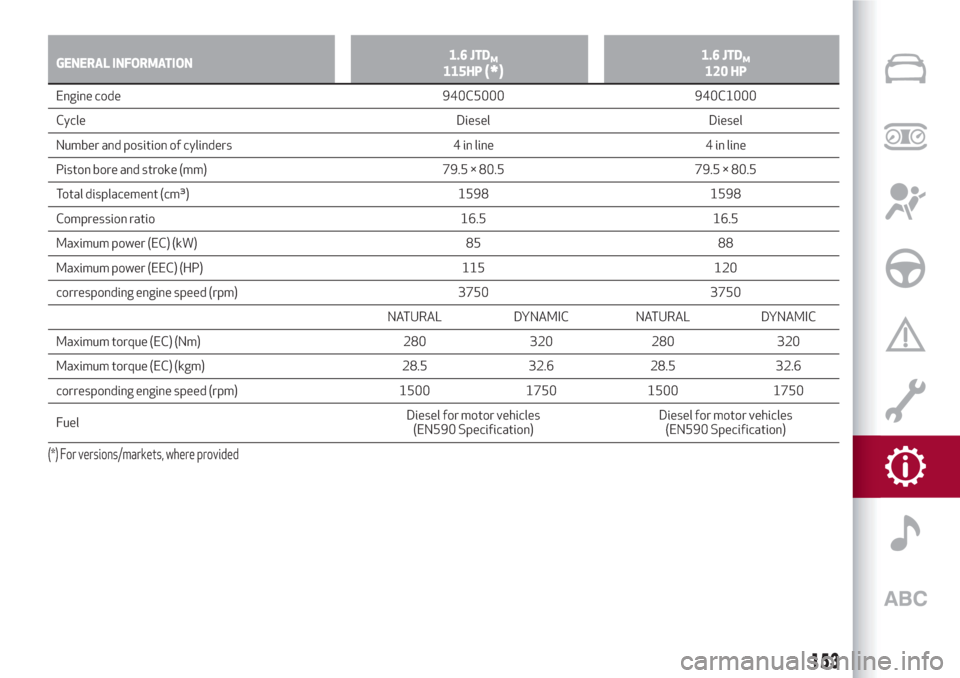
GENERAL INFORMATION1.6 JTDM115HP(*)1.6 JTDM120 HP
Engine code 940C5000 940C1000
Cycle Diesel Diesel
Number and
position of cylinders 4 in line 4 in line
Piston bore and stroke (mm) 79.5 × 80.5 79.5 × 80.5
Total displacement (cm³) 1598 1598
Compression ratio 16.5 16.5
Maximum power (EC) (kW) 85 88
Maximum power (EEC) (HP) 115 120
corresponding engine speed (rpm) 3750 3750
NATURAL DYNAMIC NATURAL DYNAMIC
Maximum torque (EC) (Nm) 280 320 280 320
Maximum torque (EC) (kgm) 28.5 32.6 28.5 32.6
corresponding engine speed (rpm) 1500 1750 1500 1750
FuelDiesel for motor vehicles
(EN590 Specification)Diesel for motor vehicles
(EN590 Specification)
(*) For versions/markets, where provided
153