battery Alfa Romeo GT 2006 Owner handbook (in English)
[x] Cancel search | Manufacturer: ALFA ROMEO, Model Year: 2006, Model line: GT, Model: Alfa Romeo GT 2006Pages: 307, PDF Size: 6.05 MB
Page 141 of 307

GETTING TO KNOW YOUR CAR
139fig. 133
A0A0112b
Unlocking the doors using the remote con-
trol, the roof light turns on gradually and tim-
ing is activated automatically for about 15
seconds. Locking the doors with the remote
control the roof light turns off gradually.
The lights are turned off moving the igni-
tion key to MAR(with the doors closed).
With switch (A) in the central position
(1), both lights are turned on when a door
is opened.
Pressing switch (A) to the left (position
0), the lights stay off (OFFposition).
Pressing switch (A) to the right (position
2) both lights stay on.
Switch (B) turns the lights on individually.
Pressing switch (B) to the left (position
0) the left light is turned on. Pressing the
switch to the right (position 2) the right light
is turned on.
With switch (B) in the central position (po-
sition1) the lights stay off.IMPORTANTTurning the ignition key to
STOP, turning the roof light on is only pos-
sible for 15 minutes; after which the system
turns it off to avoid draining the battery.
IMPORTANTBefore leaving the car,
make sure that both switches are in the cen-
tral position. By so doing, the roof lights will
turn off when the doors are closed. Forget-
ting a door open the lights will turn off au-
tomatically after a few seconds.COURTESY LIGHTS (fig. 133)
On the back of the driver’s or passenger’s
sun visor, opening the cover (A) the roof
lights turn on (B) at the side of the courtesy
mirror, with the ignition key at MAR. These
lights allow use of the courtesy mirror when
the light is poor.
IMPORTANTTurning the ignition key to
STOPthe lights can be activated only for
15 minutes: after which the system turns
them off to avoid draining the battery.
Page 142 of 307

GETTING TO KNOW YOUR CAR
140
REAR ROOF LIGHT (fig. 134)
IMPORTANTWhen a door is opened,
the roof light turns on and timing of about
3 minutes is activated automatically, after
which it goes off; closing the doors (within
the 3 minutes) a second timing of about 7
seconds is activated to allow vehicle start-
ing.
Unlocking the doors using the remote con-
trol, the roof light turns on gradually and tim-
ing is activated automatically for about 15
seconds. Locking the doors with the remote
control the roof light turns off gradually.
The light turns off in any case turning the
ignition key to MAR(with the door
closed).PUDDLE LIGHTS (fig. 135)
(for versions/markets where
applicable)
The light (A) housed in the doors turns on
when the associated door is opened, re-
gardless of the position of the ignition key.
fig. 134
A0A0633b
On the light there is a switch with three
positions.
When switch (A) is in the central posi-
tion (0) the light turns on automatically
when a door is opened.
Moving the switch to the right (position 1)
the light stays off.
Moving the switch to the left (position 2)
the light stays on.
IMPORTANTTurning the ignition key to
STOPthe roof light can be turned on for on-
ly 15 minutes; after which it is turned off to
avoid draining the battery.
IMPORTANTBefore leaving the car,
make sure that the switch (A) is in the cen-
tral position (0), so that the roof light turns
off when the doors are closed.
fig. 135
A0A0243b
Page 146 of 307
GETTING TO KNOW YOUR CAR
144
For the installation of a
cell phone and connection
to the provision in the car,
contact only Alfa Romeo Autho-
rised Services; this will guarantee
first-rate results with no possibil-
ity of any inconvenience that may
compromise the safety of the ve-
hicle.
The voice kit should be
purchased by the customer
as it must be compatible
with the customer’s phone.RADIO TRANSMITTERS
AND CELLULAR
TELEPHONES
Radio transceiver equipment (e.g.: e-tacs
mobile phones, HAM radio systems and the
like) shall not be used inside the car unless
a separate aerial is mounted outside the car.
The use of these devices inside the pas-
senger compartment (without external aer-
ial) may cause electrical systems equipping
the car to malfunction. This could compro-
mise car safety in addition to constituting
a potential hazard for the passengers.
In addition, transmission and reception of
these devices may be affected by the shield-
ing effect of the car body.
As concerns the use of mobile phones
(GSM, GPRS, UMTS) provided with offi-
cial EC approval, strictly comply with the in-
structions given by the mobile phone man-
ufacturer.
ACCESSORIES
PURCHASED
BY THE OWNER
If after buying the car, you decide to install
electrical accessories that require a perma-
nent electric supply (alarm, voice feature,
radionavigator with satellite antitheft, etc.)
or accessories that in any case burden the
electric supply, contact Alfa Romeo Autho-
rised Services, whose qualified personnel,
besides suggesting the most suitable devices
belonging to Lineaccessori Alfa Romeo, will
also evaluate the overall electric absorption,
checking whether the vehicle electric system
is able to withstand the load required, or
whether it needs to be integrated with a
more powerful battery.
Page 148 of 307
GETTING TO KNOW YOUR CAR
146
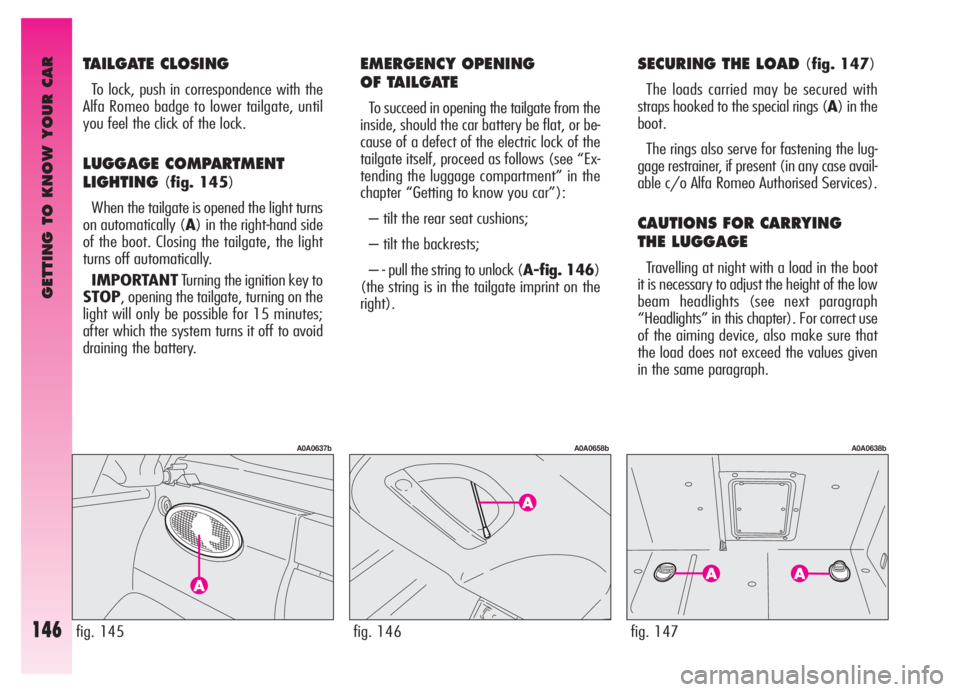
EMERGENCY OPENING
OF TAILGATE
To succeed in opening the tailgate from the
inside, should the car battery be flat, or be-
cause of a defect of the electric lock of the
tailgate itself, proceed as follows (see “Ex-
tending the luggage compartment” in the
chapter “Getting to know you car”):
– tilt the rear seat cushions;
– tilt the backrests;
– - pull the string to unlock (A-fig. 146)
(the string is in the tailgate imprint on the
right).
TAILGATE CLOSING
To lock, push in correspondence with the
Alfa Romeo badge to lower tailgate, until
you feel the click of the lock.
LUGGAGE COMPARTMENT
LIGHTING
(fig. 145)
When the tailgate is opened the light turns
on automatically (A) in the right-hand side
of the boot. Closing the tailgate, the light
turns off automatically.
IMPORTANTTurning the ignition key to
STOP, opening the tailgate, turning on the
light will only be possible for 15 minutes;
after which the system turns it off to avoid
draining the battery.
fig. 145
A0A0637b
fig. 146
A0A0658b
SECURING THE LOAD (fig. 147)
The loads carried may be secured with
straps hooked to the special rings (A) in the
boot.
The rings also serve for fastening the lug-
gage restrainer, if present (in any case avail-
able c/o Alfa Romeo Authorised Services).
CAUTIONS FOR CARRYING
THE LUGGAGE
Travelling at night with a load in the boot
it is necessary to adjust the height of the low
beam headlights (see next paragraph
“Headlights” in this chapter). For correct use
of the aiming device, also make sure that
the load does not exceed the values given
in the same paragraph.
fig. 147
A0A0638b
Page 153 of 307

GETTING TO KNOW YOUR CAR
151
Always take due care when braking on
bends, even with the help of the ABS.
The most important advice of all, howev-
er, is this:
When the ABS cuts in, and
you feel the pulsing on the
pedal, do not lighten the
pressure, but keep the pedal firm-
ly pressed with no fear; this way
you will stop in the least space
possible, compatibly with the con-
ditions of the road surface.
Following these instructions you will be
in the best braking condition under all cir-
cumstances.
IMPORTANTCars fitted with ABS may
only be fitted with the wheel rims, tyres and
brake linings of type and brand approved by
the Manufacturer.
The system is completed by the EBD (Elec-
tronic Brake Distributor) which distributes
the braking action through the control unit
and the ABS system sensors.The car is fitted with an
electronic braking distribu-
tor (EBD). If the
>andx
warning lights turn on simultane-
ously with the engine running, this
indicates an EBD system failure; in
this case with sharp braking the
rear wheels might lock too early,
with the possibility of skidding.
Driving extremely carefully, go to
the nearest Alfa Romeo Authorised
Service to have the system
checked.
The turning on of only the
>warning light with the
engine running normally in-
dicates a fault to the ABS system
only. In this case the braking sys-
tem is still efficient, though with-
out the aid of the anti-lock device.
Under these conditions perfor-
mance of the EBD system may be
reduced. In this case too, you are
advised to go immediately to the
nearest Alfa Romeo Authorised
Service to have the system checked
over, driving in such a way as to
avoid sharp braking.
If the low brake fluid lev-
el
xwarning light turns
on, stop the car immedi-
ately and contact the nearest Alfa
Romeo Authorised Service. Any
loss of fluid from the hydraulic sys-
tem will negatively affect the op-
eration of the braking system be it
of the conventional type or of the
type with ABS.
If the compact spare wheel
is used, operation of the
ABS system is cut off and
the
>warning light on the instru-
ment cluster turns on.
IMPORTANTIf the battery is run down
the
>andxwarning lights might turn
on when starting the engine and go off af-
ter starting. This should not be considered
as a fault but as a warning that during start-
ing the ABS is not active. The turning off
of the warning lights ensures normal system
operation.
Page 202 of 307

CORRECT USE OF THE CAR
200
STARTING PROCEDURE
FOR PETROL VERSIONS
IMPORTANTIt is important never to
press the accelerator before the engine
has started.
1) Make sure the handbrake is engaged.
2) Move the gear lever to neutral.
3) Fully depress the clutch pedal, so that
the starter motor is not forced to crank the
gears.
4) Ensure that the electric systems and
devices, especially if they absorb high
quantities of energy (e.g. heated
rearscreen), are switched off.
5) Turn the ignition key to the AV V
position and release it as soon as the
engine starts.
6) If the engine does not start, return
the key to STOP,then repeat the proce-
dure.
IMPORTANTIf it is difficult to start
the engine do not insist with extended
attempts which may damage the catalyst,
but contact Alfa Romeo Authorised
Services. The ignition switch is fitted with a safety
device which obliges the driver to return
the key to the STOPposition before
repeating the starting operation if the
engine does not start immediately.
Similarly, when the engine is running,
the device prevents the key being moved
from the MARto the AV Vposition.
STARTING
THE ENGINE
IMPORTANTThe car is fitted with an
electronic engine lock device. If the engine
fails to start, see the “Alfa Romeo CODE
system”.
C C
O O
R R
R R
E E
C C
T T
U U
S S
E E
O O
F F
T T
H H
E E
C C
A A
R R
We recommend that dur-
ing the initial period you
do not drive to full vehicle
performance (for example exces-
sive acceleration, long journeys
at top speed, hard braking etc.).
Running the engine in
confined areas is
extremely dangerous. The
engine consumes oxygen and
produces carbon monoxide which
is a highly toxic and lethal gas.
When the engine is
switched off never leave
the ignition key in the
MAR position to prevent point-
less current absorption from
draining the battery.
Page 203 of 307
CORRECT USE OF THE CAR
201
STARTING PROCEDURE
FOR JTD VERSIONS
1) Make sure the handbrake is
engaged.
2) Set the gearshift lever to neutral.
3) Turn the ignition key to MAR.The
reconfigurable multifunction display will
show the
mwarning light.
4) Wait for the
mto turn off, which
takes place sooner, the warmer the
engine. With the engine very warm the
light might stay on for such a short time
as to pass unnoticed.
5) Fully depress the clutch pedal.
6) Turn the ignition key to AV Vas
soon as the
mwarning light has gone
out. Waiting too long, makes the warming
work of the glow plugs useless .IMPORTANTThe electric devices
that absorb a high amount of energy (cli-
mate control, rearscreen heating, etc.) are
cut off automatically during starting.
If the engine does not start at the first
attempt, move the ignition key to STOP
before repeating starting.
If starting is difficult (with the Alfa
Romeo CODE system working properly),
do not insist with prolonged attempts.
Only use an auxiliary battery if the cause
is due to low battery charge. Never use a
battery charger to start the engine.
WARMING THE ENGINE
– Drive off slowly, at medium revs with-
out accelerating abruptly.
– Do not drive at full performance for
the initial kilometres of the journey. Wait
until the engine coolant temperature
reaches 50-60 °C.
Page 205 of 307

Never leave children
unattended in the vehicle.
Always remove the igni-
tion key when leaving the vehicle
and take it with you.To avoid useless con-
sumption of power and
possible draining of the
battery, never leave the ignition
key in the MAR position when
the engine is not running.
CORRECT USE OF THE CAR
203
PARKING
When the vehicle is parked, proceed as
follows:
– Switch off the engine.
– Engage the handbrake.
– Engage first gear if the vehicle is faced
uphill or reverse if the vehicle is facing
downhill.
– Turn the front wheels so that the vehi-
cle will immediately come to a halt if the
handbrake slips.
REDUCING RUNNING
COSTS AND
ENVIRONMENT
POLLUTION
By following a few simple guidelines, it
is possible to save vehicle running costs
and reduce harmful emissions.
GENERAL CONSIDERATIONS
Vehicle maintenance
To take care of the car maintenance
have the checks and adjustments carried
out in accordance with the “Scheduled
Maintenance Programme”.
Tyres
Check the pressure of the tyres routinely
at an interval of no more than 4 weeks: if
the pressure is too low consumption levels
increase as resistance to rolling is higher.
Useless loads
Never travel with an overload in the
boot. The weight of the vehicle (especial-
ly in urban traffic), and its geometry heav-
ily affect consumption levels and stability.Electric services
Use electric devices only for the amount
of time needed. Rearscreen heating, addi-
tional headlights, windscreen wipers and
heater fan need a considerable amount of
energy, therefore increasing the require-
ment of current increases fuel consump-
tion (up to +25% in the urban cycle).
Climate control system
The climate control system is a further
load bearing heavily on the engine induc-
ing higher consumption levels(up to
+20% on average). Outside temperature
permitting, preferably use the air vents.
Aerodynamic items
The use of non-certified aerodynamic
items may adversely affect air drag and
consumption levels.
Page 208 of 307

CORRECT USE OF THE CAR
206
For the electrical connection a 7 or 13
pole 12VDC connection must be used
(CUNA/UNI and ISO/DIN standards) fol-
lowing any reference instructions given by
the vehicle Manufacturer and/or towing
device Manufacturer.
Any electric brake should be supplied
directly by the battery through a cable
with a cross-section of no less than 2.5
mm
2. In addition to the electrical branch-
es, the vehicle electric system can only be
connected to the supply cable for an elec-
tric brake and to the cable for an internal
light, though not above 15W.INSTALLATION LAYOUT
(fig. 1)
The tow hook structure must be fas-
tened in the points shown by the
symbol Ø using 4 M8 screws and 7
M10 screws.
The inner plate (2) should have a
minimum thickness of 6 mm.
The inner plate (3) should have a
minimum thickness of 4 mm.
The inner plate (4) should have a
minimum thickness of 5 mm.
The fastening points (1) should be
fitted with 25 mm x 6 mm spacers.After assembly, the fas-
tening screw bores shall
be sealed to prevent pos-
sible exhaust gas infiltrations.
IMPORTANTIt is compulsory to fas-
ten a label (plainly visible) of suitable size
and material with the following wording:
MAX LOAD ON BALL 60 kg.
Page 211 of 307

CORRECT USE OF THE CAR
209
Keep your speed
down when snow
chains are fitted.
Do not exceed 50 km/h. Avoid
potholes, steps and pavements to
prevent damaging the tyres, sus-
pension and steering. Remember
that with snow chains fitted the
brake distance will increase.
VEHICLE INACTIVITY
If the vehicle is to be left inactive for
long periods, the following precautions
should be noted:
– House the vehicle under cover in a dry
and possibly ventilated place.
– Engage a gear.
– Check that the handbrake is not
engaged.
– Clean and protect the paintwork by
protective wax.
– Cover the rubber windscreen and
rearscreen wiper blades with talcum pow-
der and raise them off the glass.
– Open the windows slightly.
– Inflate the tyres to a pressure of 0.5
bars above normal. If possible rest the
tyres on wooden planks and periodically
check the pressure.
– Do not turn on the electronic alarm
system.– Disconnect the battery negative termi-
nal (–) from the battery and check the
battery charge. This check should be
repeated once a month during stowage.
Charge the battery if the loadless voltage
is below 12,5V.
– Do not empty the engine cooling sys-
tem.
– Cover the vehicle with a fabric or per-
forated plastic cover. Do not use compact
plastic covers which prevent the humidity
on the surface of the vehicle from evapo-
rating. Snow chains cannot be
fitted to the compact
spare wheel. So, if a front
(drive) wheel is punctured and
chains are needed, a rear wheel
should be fitted to the front of
the vehicle (inflate the tyres to
the specified pressure as soon as
possible) and the spare wheel
should be fitted to the rear. This
way, with two normal drive
wheels, snow chains can be fitted
to them to solve an emergency.
With snow chains fitted
it is advisable to turn off
the ASR system. Press
the ASR-OFF button, led on but-
ton on.