battery Alfa Romeo GT 2006 Owner handbook (in English)
[x] Cancel search | Manufacturer: ALFA ROMEO, Model Year: 2006, Model line: GT, Model: Alfa Romeo GT 2006Pages: 307, PDF Size: 6.05 MB
Page 213 of 307
IN AN EMERGENCY
211
STARTING WITH AN
AUXILIARY BATTERY
If the battery is flat (for battery with
optical hydrometer: dark colour without
green area in the centre), it is possible to
start the engine using an auxiliary battery
with the same capacity or a little higher
than the flat one.
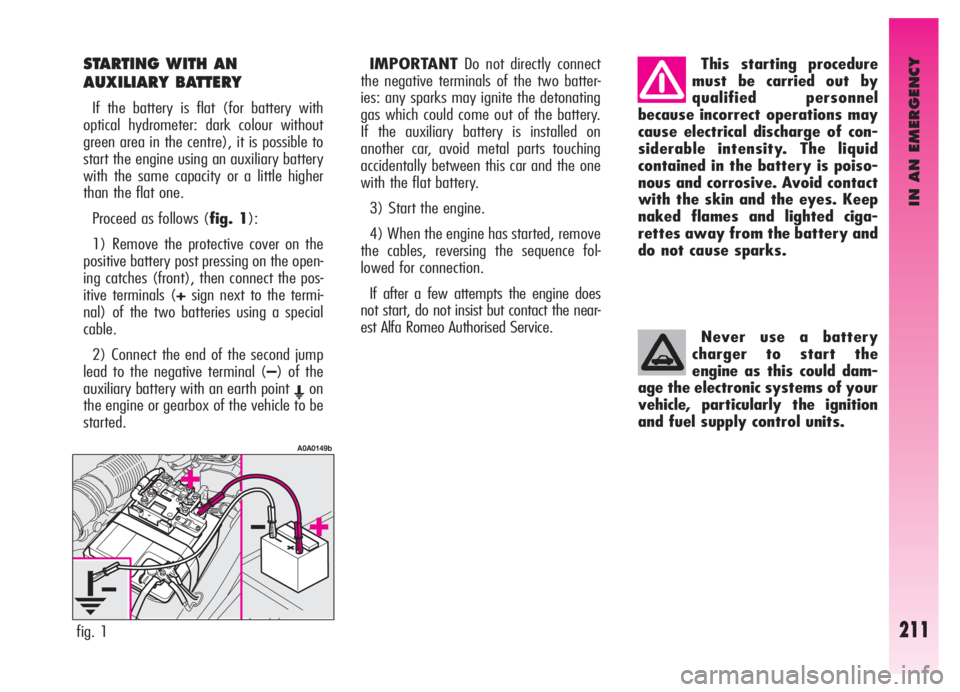
Proceed as follows (fig. 1):
1) Remove the protective cover on the
positive battery post pressing on the open-
ing catches (front), then connect the pos-
itive terminals (+sign next to the termi-
nal) of the two batteries using a special
cable.
2) Connect the end of the second jump
lead to the negative terminal (–) of the
auxiliary battery with an earth point
Eon
the engine or gearbox of the vehicle to be
started.IMPORTANTDo not directly connect
the negative terminals of the two batter-
ies: any sparks may ignite the detonating
gas which could come out of the battery.
If the auxiliary battery is installed on
another car, avoid metal parts touching
accidentally between this car and the one
with the flat battery.
3) Start the engine.
4) When the engine has started, remove
the cables, reversing the sequence fol-
lowed for connection.
If after a few attempts the engine does
not start, do not insist but contact the near-
est Alfa Romeo Authorised Service.
fig. 1
A0A0149b
This starting procedure
must be carried out by
qualified personnel
because incorrect operations may
cause electrical discharge of con-
siderable intensity. The liquid
contained in the battery is poiso-
nous and corrosive. Avoid contact
with the skin and the eyes. Keep
naked flames and lighted ciga-
rettes away from the battery and
do not cause sparks.
Never use a battery
charger to start the
engine as this could dam-
age the electronic systems of your
vehicle, particularly the ignition
and fuel supply control units.
Page 239 of 307
IN AN EMERGENCY
237
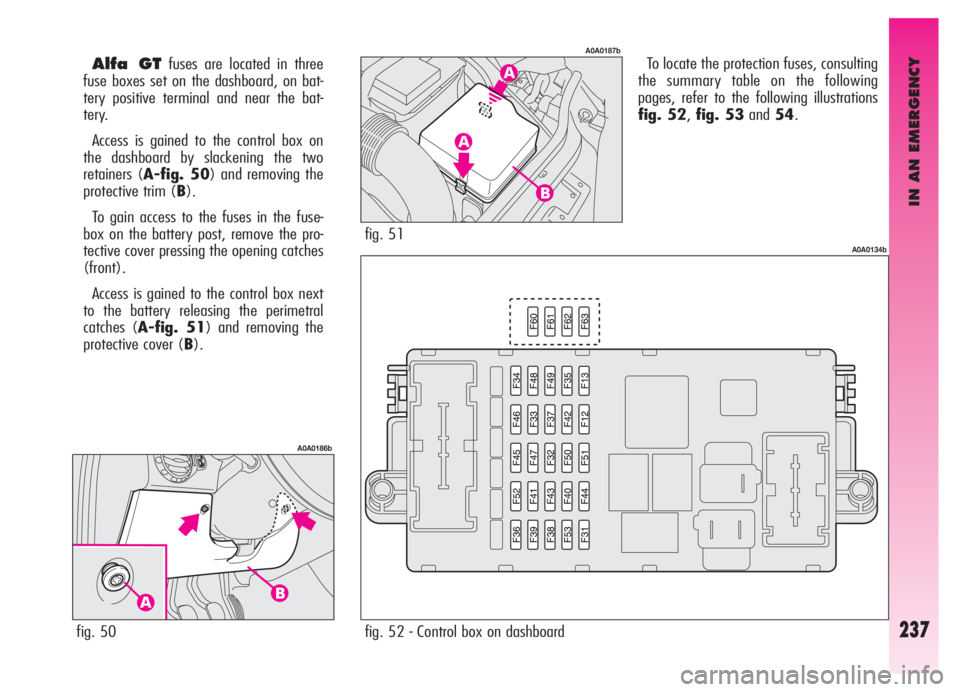
To locate the protection fuses, consulting
the summary table on the following
pages, refer to the following illustrations
fig. 52,fig. 53and54.Alfa GTfuses are located in three
fuse boxes set on the dashboard, on bat-
tery positive terminal and near the bat-
tery.
Access is gained to the control box on
the dashboard by slackening the two
retainers (A-fig. 50) and removing the
protective trim (B).
To gain access to the fuses in the fuse-
box on the battery post, remove the pro-
tective cover pressing the opening catches
(front).
Access is gained to the control box next
to the battery releasing the perimetral
catches (A-fig. 51) and removing the
protective cover (B).
fig. 50
A0A0186b
fig. 51
A0A0187b
fig. 52 - Control box on dashboard
A0A0134b
Page 240 of 307

IN AN EMERGENCY
238
fig. 53 - Control box next to battery
A0A0137b
fig. 54 - Control box on battery positive pole
A0A0215b
Page 245 of 307

IN AN EMERGENCY
243
IN THE EVENT OF A FLAT BATTERY
Before anything else, you are advised to
read the precautions for preventing the
battery from draining and for ensuring
long life in the “Vehicle maintenance”
chapter.
CHARGING THE BATTERY
IMPORTANTThe battery charging
procedure is described only for information
purposes. This operation should be carried
out by Alfa Romeo Authorised Services.
Charging should be slow at a low amp
rating for 24 hours. Charging for a longer
time may damage the battery.Charge the battery as follows:
– Disconnect the battery negative termi-
nal (–).
– Connect the charger cables to the bat-
tery terminal ensuring that the bias is cor-
rect.
– Turn on the charger.
– After charging, turn off the charger
before disconnecting it from the battery.
– Re-connect the battery negative termi-
nal (–).The liquid contained in
the battery is poisonous
and corrosive. Avoid con-
tact with the skin or eyes. The
battery should be charged in a
well ventilated place, away from
naked flames or possible sources
of sparks: danger of explosion
and fire.
Do not attempt to
charge a frozen battery:
it must firstly be thawed,
otherwise it may burst. If freez-
ing has occurred, the battery
should be checked by skilled per-
sonnel to make sure that the
internal elements are not dam-
aged and that the body is not
cracked, with the risk of leaking
poisonous and corrosive acid.
Page 248 of 307

IN AN EMERGENCY
246
other crashes is high. Leave the car imme-
diately and go beyond the guard-rail.
– If doors are blocked, do not try to get
out of the car breaking the windscreen
which is stratified. The windows and rear
screen are easier to break.
– Remove the ignition key of the vehi-
cles involved.
– If you note a smell of fuel or other
chemical products, do not smoke and
have a cigarette stubbed out.
– To put out fires, even small ones, use
the extinguisher, blankets, sand, or earth.
Never use water.
– If use of the lighting system is not nec-
essary, disconnect the battery negative
terminal (–).IN THE EVENT
OF AN ACCIDENT
– It is important to keep calm.
– If you are not directly involved, stop at
least a few dozen metres away from the
accident.
– On motorways, stop without blocking
the emergency lane.
– Turn the engine off and the hazard
warning lights on.
– At night, illuminate the place of the
accident with the headlights.
– Take care, do not risk being run over.
– Signal the accident placing the trian-
gle at regulation distance in a clearly visi-
ble place.
– Call the emergency organisation, giv-
ing the most accurate information possi-
ble. On motorways use the special phones
provided.
– In motorways pileups, especially with
poor visibility, the risk of being involved in
IF PEOPLE ARE INJURED
– An injured person must never be aban-
doned. Helping is compulsory also for per-
sons not directly involved in the accident.
– Do not crowd around injured people.
– Reassure the injured person that help
is on the way, and stay near to overcome
any panic.
– Release or cut the seat belt restraining
injured persons.
– Do not give injured persons anything
to drink.
– An injured person should never be
moved except in the following circum-
stances.
– Remove an injured person from the
car only in danger of fire, sinking or
falling. When removing an injured person:
do not pull the limbs or bend the head and
keep the body as horizontal as possible.
FIRST AID KIT
In addition to the first-aid kit, it is also
wise to keep an extinguisher and a blan-
ket in the car.
Page 250 of 307
VEHICLE MAINTENANCE
248
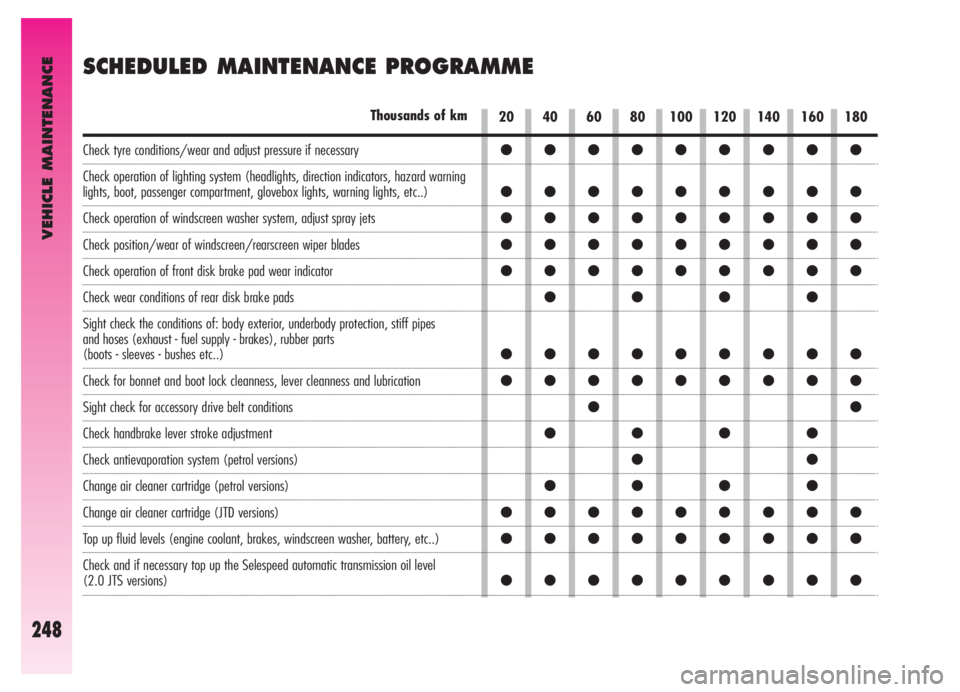
SCHEDULED MAINTENANCE PROGRAMME
20 40 60 80 100 120 140 160 180Thousands of km
Check tyre conditions/wear and adjust pressure if necessary
Check operation of lighting system (headlights, direction indicators, hazard warning
lights, boot, passenger compartment, glovebox lights, warning lights, etc..)
Check operation of windscreen washer system, adjust spray jets
Check position/wear of windscreen/rearscreen wiper blades
Check operation of front disk brake pad wear indicator
Check wear conditions of rear disk brake pads
Sight check the conditions of: body exterior, underbody protection, stiff pipes
and hoses (exhaust - fuel supply - brakes), rubber parts
(boots - sleeves - bushes etc..)
Check for bonnet and boot lock cleanness, lever cleanness and lubrication
Sight check for accessory drive belt conditions
Check handbrake lever stroke adjustment
Check antievaporation system (petrol versions)
Change air cleaner cartridge (petrol versions)
Change air cleaner cartridge (JTD versions)
Top up fluid levels (engine coolant, brakes, windscreen washer, battery, etc..)
Check and if necessary top up the Selespeed automatic transmission oil level
(2.0 JTS versions)
●●●●●●●●●
●●●●●●●●●
●●●●●●●●●
●●●●●●●●●
●●●●●●●●●
●●●●
●●●●●●●●●
●●●●●●●●●
●●
●●●●
●●
●●●●
●●●●●●●●●
●●●●●●●●●
●●●●●●●●●
Page 252 of 307
VEHICLE MAINTENANCE
250
ADDITIONAL
OPERATIONS
Every 1000 kmor before long jour-
neys, check and if necessary top up:
– engine coolant fluid level
– brake/hydraulic clutch control fluid
level
– power steering fluid level
– windscreen and headlamp washer
fluid level
– tyre pressure and conditions.
Every 3000 kmcheck and if necessary
top up the engine oil level.
The use of FL Seleniaproducts is rec-
ommended which have been designed
and made expressly for Alfa Romeo cars
(see “Refuelling” in the “Technical
Specifications” chapter).
ANNUAL INSPECTION
PROGRAMME
For cars with an annual mileage
of below 20,000 km (for exam-
ple about 10,000 km) the follow-
ing yearly inspection programme
is advised:
– Check tyre conditions/wear and if
necessary adjust the pressure (including
spare wheel)
– Check operation of lighting system
(headlights, direction indicators, hazard
warning lights, boot, passenger compart-
ment, glovebox lights, warning lights,
etc.)
– Check operation of windscreen wiper
system, spray jet adjustment
– Check position/wear of windscreen
– Check front disk brake pad conditions
and wear– Sight check for conditions of: engine,
gearbox, transmission, pipes (exhaust -
fuel supply - brakes), rubber parts (boots
- sleeves - bushes etc..), brake and fuel
supply system hoses
– Check for bonnet and boot lock clean-
ness, lever cleanness and lubrication
– Check battery charge
– Sight check for conditions of various
drive belts
– Check and if necessary top up fluid
levels (engine coolant, brakes, wind-
screen washer, battery etc. )
– Change engine oil and engine oil filter
– Change pollen filter.
Page 254 of 307

VEHICLE MAINTENANCE
252
Vehicle maintenance
should be entrusted to
Alfa Romeo Authorised
Services. For routine and minor
maintenance operations you wish
to carry out yourself, always
make sure you have the proper
equipment, genuine Alfa Romeo
spares and the necessary fluids;
do not however carry out these
operations if you have no experi-
ence.IMPORTANT
Pollen filter
If the vehicle is used frequently in dusty
or heavily polluted environments it is
advisable to replace the filtering element
more frequently; in particular it should be
replaced if a reduction of the amount of
air admitted to the passenger compart-
ment is noted. IMPORTANT
Battery
It is advisable to check the battery
charge, preferably at the onset of winter,
to prevent the possibility of the electrolyte
freezing.
This check should be carried out more
frequently if the car is used mainly for
short trips, or if it is fitted with accessories
that permanently absorb electricity even
with the ignition key removed, especially
in the case of after market accessories.
If the vehicle is used in hot climates or
particularly harsh conditions it is wise to
check the level of the battery fluid (elec-
trolyte) more frequently than specified in
the Scheduled Maintenance Programme.
Page 255 of 307
VEHICLE MAINTENANCE
253
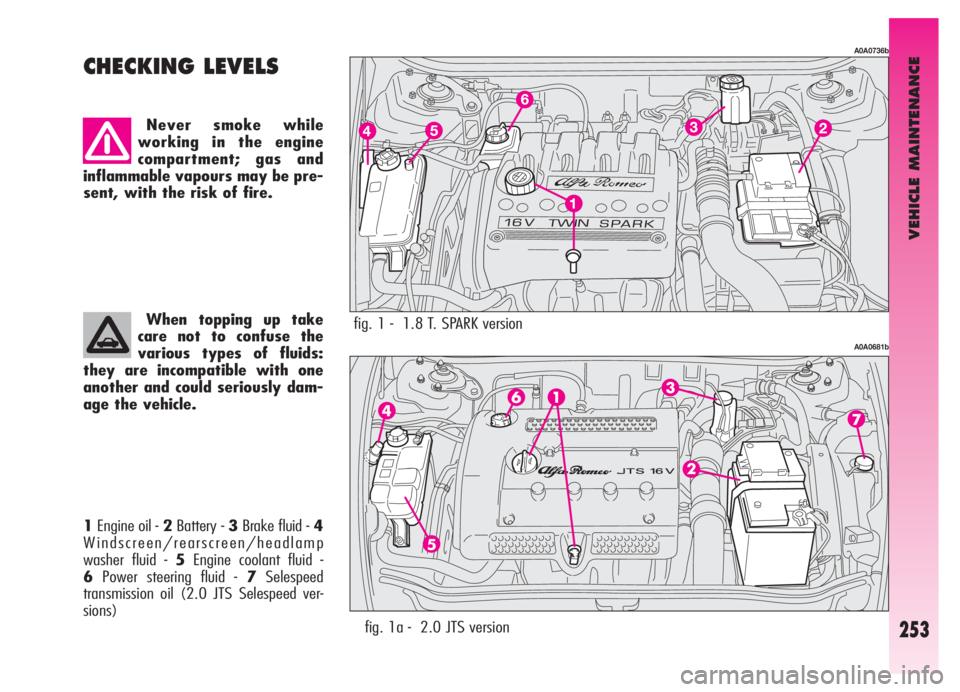
1Engine oil - 2Battery - 3Brake fluid -4
Windscreen/rearscreen/headlamp
washer fluid - 5Engine coolant fluid -
6Power steering fluid - 7Selespeed
transmission oil (2.0 JTS Selespeed ver-
sions)
CHECKING LEVELS
Never smoke while
working in the engine
compartment; gas and
inflammable vapours may be pre-
sent, with the risk of fire.
When topping up take
care not to confuse the
various types of fluids:
they are incompatible with one
another and could seriously dam-
age the vehicle.fig. 1 - 1.8 T. SPARK version
A0A0736b
A0A0681b
fig. 1a - 2.0 JTS version
Page 256 of 307

VEHICLE MAINTENANCE
254fig. 3 - JTD 16Vversion1Engine oil - 2Battery - 3Brake fluid -4
Windscreen/rearscreen/headlamp
washer fluid - 5Engine coolant fluid -
6Power steering fluid
A0A0396b A0A0683b
fig. 2 - 3.2 V6version
1Engine oil - 2Battery - 3Brake fluid -4
Windscreen/rearscreen/headlamp
washer fluid - 5Engine coolant fluid -
6Power steering fluid