seats Alfa Romeo GT 2006 Owner handbook (in English)
[x] Cancel search | Manufacturer: ALFA ROMEO, Model Year: 2006, Model line: GT, Model: Alfa Romeo GT 2006Pages: 307, PDF Size: 6.05 MB
Page 18 of 307
GETTING TO KNOW YOUR CAR
16
FRONT SEATSCENTRAL LOCKING
This allows central locking of the door
locks.
To engage central locking, the doors
must be perfectly shut, otherwise locking
is denied.
IMPORTANTWith central locking
engaged, pulling the inside lever for open-
ing one of the front doors causes the
unlocking of all the doors.
In the event of a power cut off (blown
fuse, battery disconnected, etc.) it is still
possible to work the lock by hand.
fig. 11
A0A0019b
Any adjustments are to
be carried out only with
the vehicle stationary.
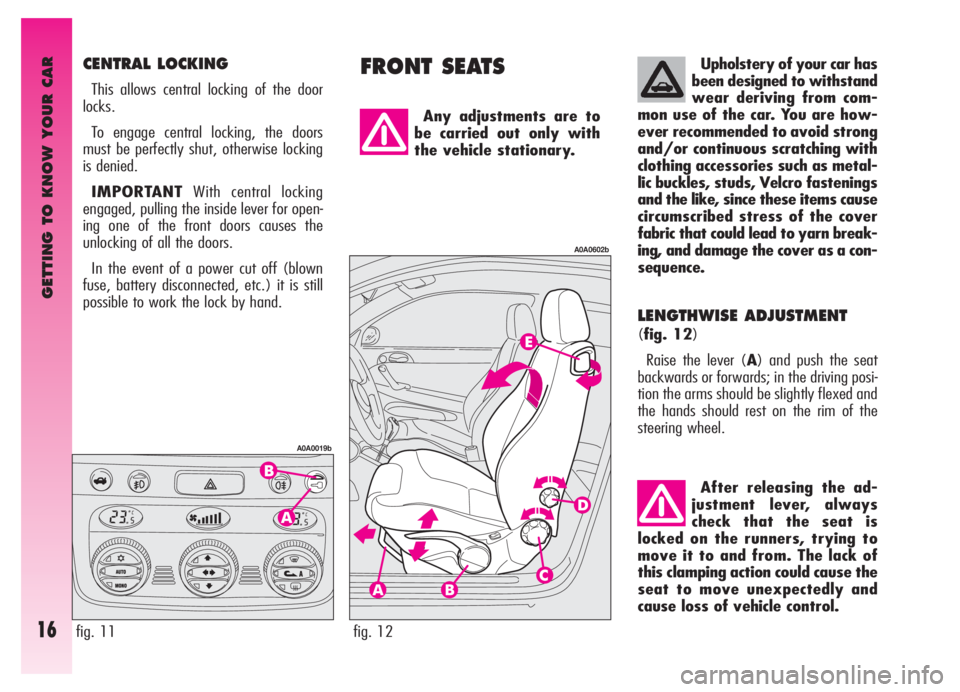
LENGTHWISE ADJUSTMENT
(fig. 12)
Raise the lever (A) and push the seat
backwards or forwards; in the driving posi-
tion the arms should be slightly flexed and
the hands should rest on the rim of the
steering wheel.
fig. 12
A0A0602b
After releasing the ad-
justment lever, always
check that the seat is
locked on the runners, trying to
move it to and from. The lack of
this clamping action could cause the
seat to move unexpectedly and
cause loss of vehicle control.
Upholstery of your car has
been designed to withstand
wear deriving from com-
mon use of the car. You are how-
ever recommended to avoid strong
and/or continuous scratching with
clothing accessories such as metal-
lic buckles, studs, Velcro fastenings
and the like, since these items cause
circumscribed stress of the cover
fabric that could lead to yarn break-
ing, and damage the cover as a con-
sequence.
Page 19 of 307
GETTING TO KNOW YOUR CAR
17
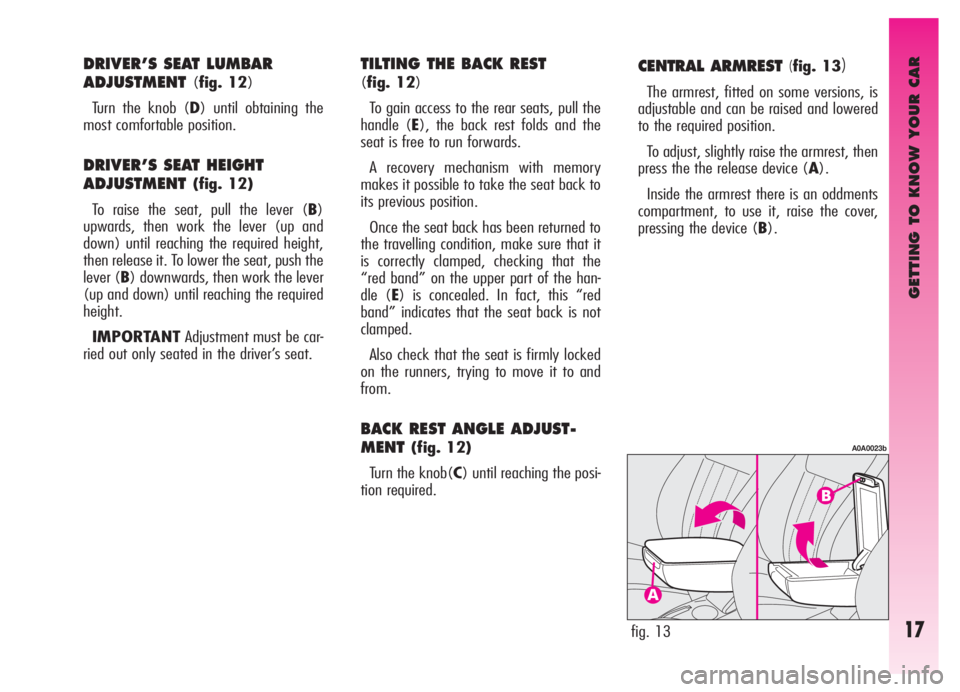
CENTRAL ARMREST (fig. 13)
The armrest, fitted on some versions, is
adjustable and can be raised and lowered
to the required position.
To adjust, slightly raise the armrest, then
press the the release device (A).
Inside the armrest there is an oddments
compartment, to use it, raise the cover,
pressing the device (B).
TILTING THE BACK REST
(fig. 12)
To gain access to the rear seats, pull the
handle (E), the back rest folds and the
seat is free to run forwards.
A recovery mechanism with memory
makes it possible to take the seat back to
its previous position.
Once the seat back has been returned to
the travelling condition, make sure that it
is correctly clamped, checking that the
“red band” on the upper part of the han-
dle (E) is concealed. In fact, this “red
band” indicates that the seat back is not
clamped.
Also check that the seat is firmly locked
on the runners, trying to move it to and
from.
BACK REST ANGLE ADJUST-
MENT
(fig. 12)
Turn the knob(C) until reaching the posi-
tion required.
fig. 13
A0A0023b
DRIVER’S SEAT LUMBAR
ADJUSTMENT
(fig. 12)
Turn the knob (D) until obtaining the
most comfortable position.
DRIVER’S SEAT HEIGHT
ADJUSTMENT
(fig. 12)
To raise the seat, pull the lever (B)
upwards, then work the lever (up and
down) until reaching the required height,
then release it. To lower the seat, push the
lever (B) downwards, then work the lever
(up and down) until reaching the required
height.
IMPORTANTAdjustment must be car-
ried out only seated in the driver’s seat.
Page 20 of 307
GETTING TO KNOW YOUR CAR
18
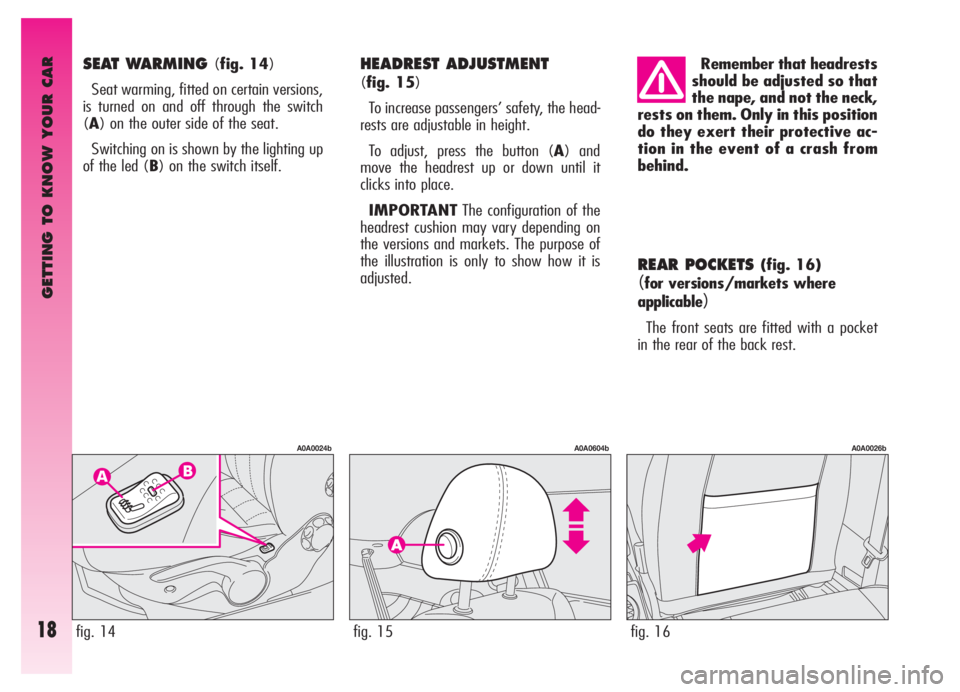
REAR POCKETS (fig. 16)
(for versions/markets where
applicable
)
The front seats are fitted with a pocket
in the rear of the back rest.
HEADREST ADJUSTMENT
(fig. 15)
To increase passengers’ safety, the head-
rests are adjustable in height.
To adjust, press the button (A) and
move the headrest up or down until it
clicks into place.
IMPORTANTThe configuration of the
headrest cushion may vary depending on
the versions and markets. The purpose of
the illustration is only to show how it is
adjusted.
fig. 15
A0A0604b
Remember that headrests
should be adjusted so that
the nape, and not the neck,
rests on them. Only in this position
do they exert their protective ac-
tion in the event of a crash from
behind.
fig. 16
A0A0026b
SEAT WARMING (fig. 14)
Seat warming, fitted on certain versions,
is turned on and off through the switch
(A) on the outer side of the seat.
Switching on is shown by the lighting up
of the led (B) on the switch itself.
fig. 14
A0A0024b
Page 21 of 307
GETTING TO KNOW YOUR CAR
19
REAR SEATSTILTING THE FRONT SEAT
BACK REST
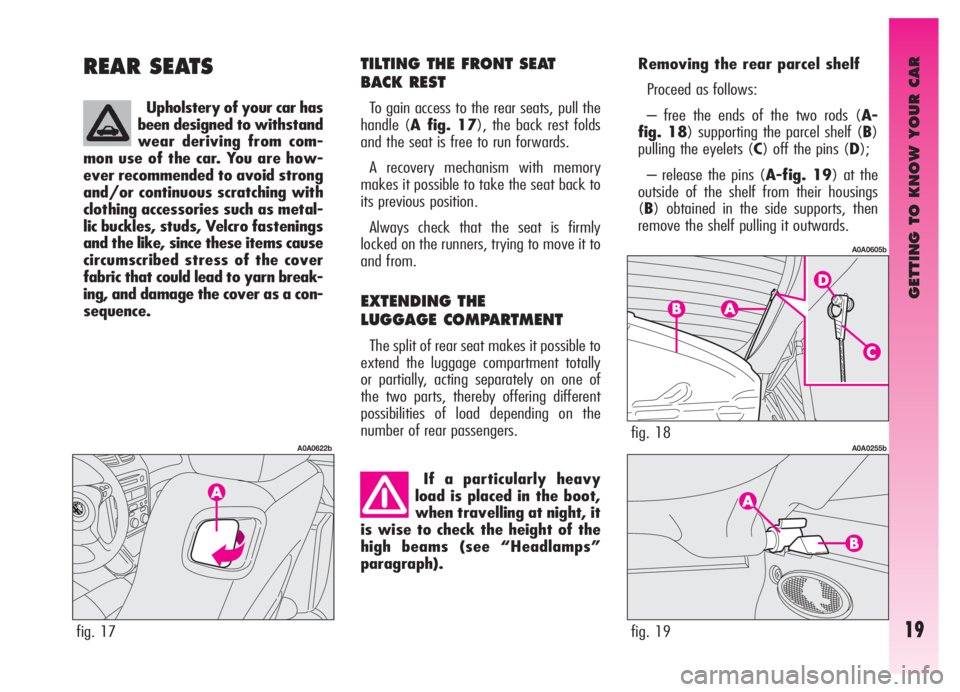
To gain access to the rear seats, pull the
handle (A fig. 17), the back rest folds
and the seat is free to run forwards.
A recovery mechanism with memory
makes it possible to take the seat back to
its previous position.
Always check that the seat is firmly
locked on the runners, trying to move it to
and from.
EXTENDING THE
LUGGAGE COMPARTMENT
The split of rear seat makes it possible to
extend the luggage compartment totally
or partially, acting separately on one of
the two parts, thereby offering different
possibilities of load depending on the
number of rear passengers.
fig. 17
A0A0622b
If a particularly heavy
load is placed in the boot,
when travelling at night, it
is wise to check the height of the
high beams (see “Headlamps”
paragraph).
fig. 18
A0A0605b
Removing the rear parcel shelf
Proceed as follows:
– free the ends of the two rods (A-
fig. 18) supporting the parcel shelf (B)
pulling the eyelets (C) off the pins (D);
– release the pins (A-fig. 19) at the
outside of the shelf from their housings
(B) obtained in the side supports, then
remove the shelf pulling it outwards.
fig. 19
A0A0255b
Upholstery of your car has
been designed to withstand
wear deriving from com-
mon use of the car. You are how-
ever recommended to avoid strong
and/or continuous scratching with
clothing accessories such as metal-
lic buckles, studs, Velcro fastenings
and the like, since these items cause
circumscribed stress of the cover
fabric that could lead to yarn break-
ing, and damage the cover as a con-
sequence.
Page 23 of 307
Remember that headrests
should be adjusted so that
the nape, and not the neck,
rests on them. Only in this position
do they exert their protective ac-
tion in the event of a crash from
behind.
GETTING TO KNOW YOUR CAR
21
Partial extension
For partial extension, proceed as fol-
lows:
– tilt the cushion required pulling the
handle at the centre of the cushion, then
tilting the actual cushion;
– move the seat belt to one side extend-
ing it correctly without twisting;
– raise the lever retaining the back rest
and tilt it forwards.
To bring the seat back to its
normal position
Proceed as follows:
– move the seat belts to one side
extending them correctly without twisting;
– raise the seat backs, pushing them
backwards until hearing both clamping
devices click into place;
– set the cushions to the horizontal posi-
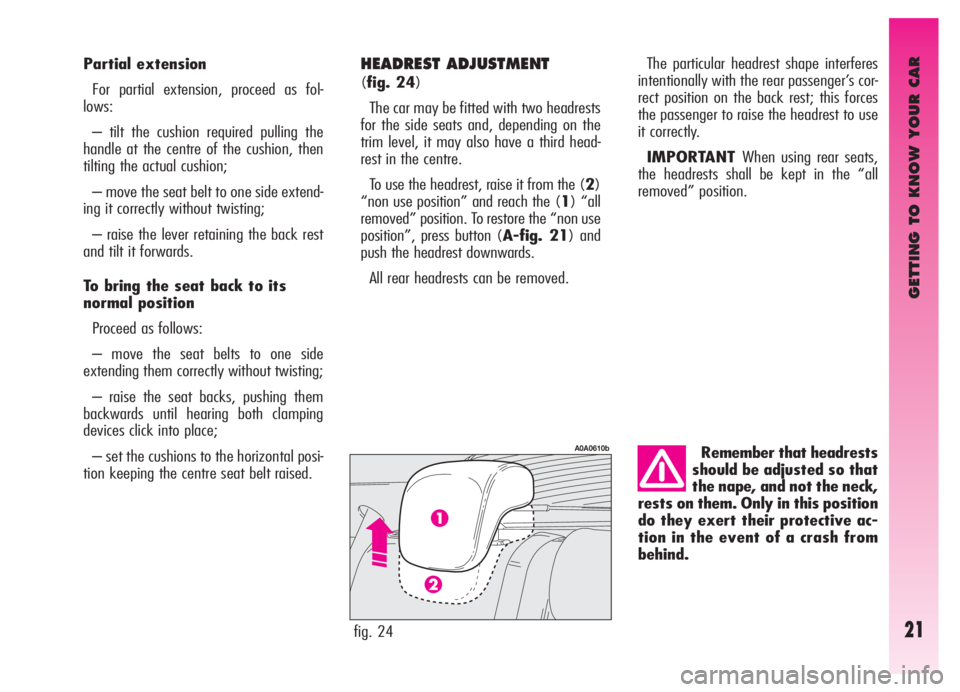
tion keeping the centre seat belt raised.HEADREST ADJUSTMENT
(fig. 24)
The car may be fitted with two headrests
for the side seats and, depending on the
trim level, it may also have a third head-
rest in the centre.
To use the headrest, raise it from the (2)
“non use position” and reach the (1) “all
removed” position. To restore the “non use
position”, press button (A-fig. 21) and
push the headrest downwards.
All rear headrests can be removed.
fig. 24
A0A0610b
The particular headrest shape interferes
intentionally with the rear passenger’s cor-
rect position on the back rest; this forces
the passenger to raise the headrest to use
it correctly.
IMPORTANT When using rear seats,
the headrests shall be kept in the “all
removed” position.
Page 30 of 307

GETTING TO KNOW YOUR CAR
28
Rear seat belts shall be worn according
to the diagram illustrated in (fig. 38).
(Fig. 39) shows the incorrect seat belt
fastening operation. To tilt the back rest,
see the paragraph “Extending the luggage
compartment”.
IMPORTANTRemember that, in the
event of an accident, any passengers
occupying the rear seats who are not
wearing a seat belt not only subject them-
selves to great personal risk, but consti-
tute a danger to the occupants of the front
seats.PRE-TENSIONING DEVICES
To increase the efficiency of the front
seat belts, the car is fitted with pre-ten-
sioning devices. These devices “feel” that
the car is being subject to a violent impact
by way of a sensor and rewind the seat
belts a few centimetres. In this way they
ensure that the seat belt adheres to the
wearer before the restraining action
begins.
The seat belt locks to indicate that the
device has intervened; the seat belt can-
not be drawn back up even when guiding
it manually.
IMPORTANTThe pretensioner will
give maximum protection when the seat
belt adheres snugly to wearer’s chest and
hips.
fig. 39
A0A0387b
fig. 38
A0A0386b
Front seat pretensioners activate only if
front seat belts are properly fitted into the
buckles.
A small amount of smoke may be pro-
duced. This smoke is in no way toxic and
presents no fire hazard.
The emergency tensioning retractor
needs no maintenance or lubrication. Any
modification to its original features will
nullify the retractor effectiveness. If, due
to unusual natural events (floods, high
waves, etc.), the device has been affect-
ed by water and mud, it must be replaced.
Page 34 of 307
GETTING TO KNOW YOUR CAR
32
CARRYING CHILDREN
SAFELY
For the best level of protection in the
event of a crash, all occupants must trav-
el seated and secured by suitable restraint
systems. This is even more important for
children.
According to 2003/20/EC Directive,
this prescription is compulsory for all
European Community countries.
Compared with adults, a child’s head is
proportionately larger and heavier than
the rest of the body, while muscles and
bone structure are not completely devel-
oped. Therefore, in order to restrain them
correctly in the event of a crash, different
systems are needed than adult seat belts.
The results of research on the best pro-
tection for a child are summarised in
European Standard ECE- R44, which in
addition to making them compulsory, sub-
divides restraint systems into five groups:
Group 0 - until 10 kg in weight
Group 0+ - until 13 kg in weight
Group 1 9 - 18 kg in weight
Group 2 15 - 25 kg in weight
Group 3 22 - 36 kg in weightAs it may be noted, the groups overlap
partly and in fact, in commerce it is possible
to find devices that cover more than one
weight group.
All the restraint devices must bear the
homologation data, together with the con-
trol brand, on a solidly fixed label which
must absolutely not be removed.
Over 1,50 m in height, from the point of
view of restraint systems, children are con-
sidered as adults and wear belt normally.
The Lineaccessori Alfa Romeo includes
seats for each weight group, which are the
recommended choice because they have
been designed and specifically experi-
mented for Alfa Romeo cars.
With passenger’s air bag
active, never place child’s
seats with the cradle fac-
ing backwards since the air bag ac-
tivation could cause to the child se-
rious injuries, even mortal, re-
gardless of the seriousness of the
crash that triggered it. You are ad-
vised to carry children always with
proper restraint systems on the
rear seats, as this is the most pro-
tected position in the case of a
crash.SERIOUS DANGER
If it is absolutely
necessary to carry a
child on the front passenger seat
with the cradle child’s seat facing
backwards, the front passenger’s
air bag must be deactivated using
the key switch. In this case it is ab-
solutely necessary to check the
warning light Fon the instru-
ment panel (see paragraph “Pas-
senger’s front air bag”) to make
sure that deactivation has actual-
ly taken place. Moreover, the front
passenger’s seat shall be adjust-
ed in the most backward position
to prevent any contact between
the child’s seat and the dashboard.
Page 35 of 307

GETTING TO KNOW YOUR CAR
33
GROUP 0 AND 0+ (fig. 43)
Babies up to 13 kg must be carried fac-
ing behind on a cradle seat which, sup-
porting the head, does not induce strain
on the neck in the event of a sharp decel-
eration.
The cradle is restrained by the car safety
belts, as illustrated, and it should in turn
restrain the child with the belts incorporat-
ed on it.
GROUP 1 (fig. 44)
Starting from 9 to 18 kg in weight, chil-
dren may be carried facing forwards with
seats fitted with front cushion, through
which the car seat belt restrains both child
and seat.The illustration is indica-
tive only for assembly.
Assemble the seat accord-
ing to the compulsory instructions
provided with it.
Seats exist which are
suitable for covering
weight groups 0 and 1
with a rear connection to the car
belts and its own belts to
restrain the child. Because of
their mass, they can be danger-
ous if installed incorrectly fas-
tened to the car belts with a
cushion. Strictly adhere to the
assembly instructions provided.
fig. 43
A0A0659b
fig. 44
A0A0660b
Page 36 of 307
GETTING TO KNOW YOUR CAR
34
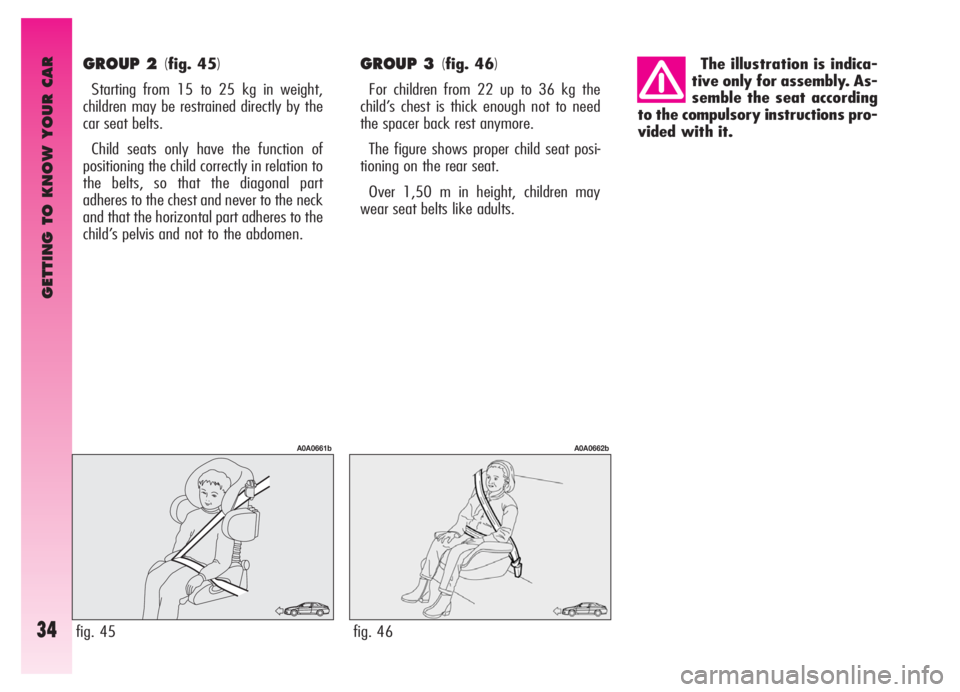
GROUP 2 (fig. 45)
Starting from 15 to 25 kg in weight,
children may be restrained directly by the
car seat belts.
Child seats only have the function of
positioning the child correctly in relation to
the belts, so that the diagonal part
adheres to the chest and never to the neck
and that the horizontal part adheres to the
child’s pelvis and not to the abdomen.
GROUP 3 (fig. 46)
For children from 22 up to 36 kg the
child’s chest is thick enough not to need
the spacer back rest anymore.
The figure shows proper child seat posi-
tioning on the rear seat.
Over 1,50 m in height, children may
wear seat belts like adults.The illustration is indica-
tive only for assembly. As-
semble the seat according
to the compulsory instructions pro-
vided with it.
fig. 45
A0A0661b
fig. 46
A0A0662b
Page 37 of 307

GETTING TO KNOW YOUR CAR
35
PASSENGER SEAT COMPLIANCE WITH REGULATIONS ON CHILD’S SEAT USE
The car omplies with the new EC Directive 2000/3 regulating child’s seat assembling on the different car seats according to the follow-
ing table:
Key:
U= suitable for child restraint systems of the “Universal category”, according to European Standard ECE-R44 for the specified “Group”.
Group
Group 0, 0+
Group 1
Group 2
Group 3
Range of weight
until 13 kg
9-18 kg
15-25 kg
22-36 kgFront
passenger
U
U
U
URear
passengers
U
U
U
UCentral
passenger
U
U
U
U