check engine light Alfa Romeo MiTo 2014 User Guide
[x] Cancel search | Manufacturer: ALFA ROMEO, Model Year: 2014, Model line: MiTo, Model: Alfa Romeo MiTo 2014Pages: 280, PDF Size: 8.79 MB
Page 145 of 280
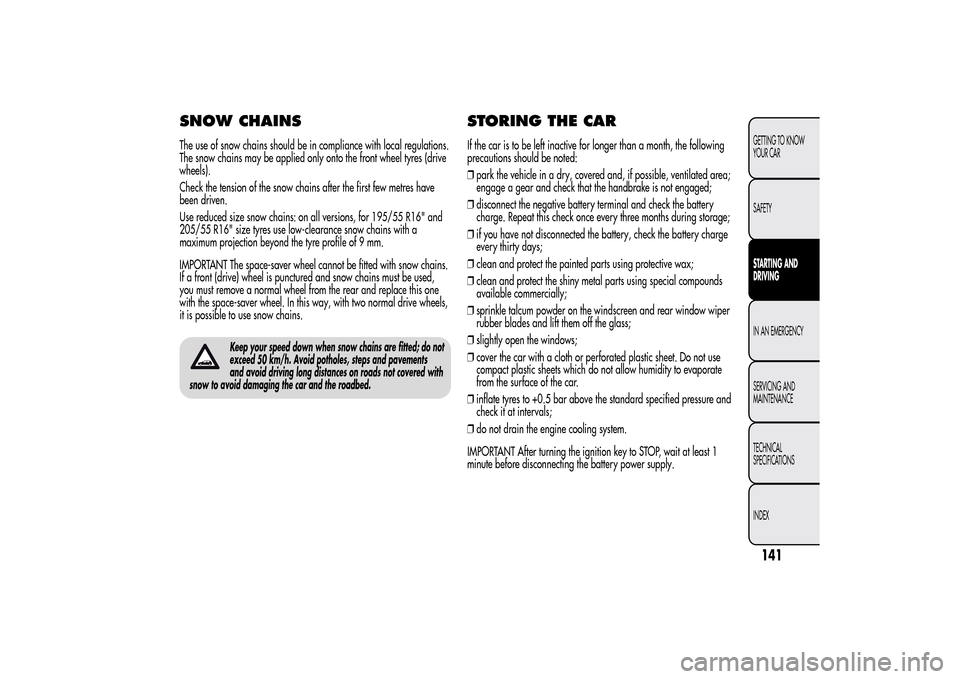
SNOW CHAINSThe use of snow chains should be in compliance with local regulations.
The snow chains may be applied only onto the front wheel tyres (drive
wheels).
Check the tension of the snow chains after the first few metres have
been driven.
Use reduced size snow chains: on all versions, for 195/55 R16" and
205/55 R16" size tyres use low-clearance snow chains with a
maximum projection beyond the tyre profile of 9 mm.
IMPORTANT The space-saver wheel cannot be fitted with snow chains.
If a front (drive) wheel is punctured and snow chains must be used,
you must remove a normal wheel from the rear and replace this one
with the space-saver wheel. In this way, with two normal drive wheels,
it is possible to use snow chains.
Keep your speed down when snow chains are fitted; do not
exceed 50 km/h. Avoid potholes, steps and pavements
and avoid driving long distances on roads not covered with
snow to avoid damaging the car and the roadbed.
STORING THE CARIf the car is to be left inactive for longer than a month, the following
precautions should be noted:
❒park the vehicle in a dry, covered and, if possible, ventilated area;
engage a gear and check that the handbrake is not engaged;
❒disconnect the negative battery terminal and check the battery
charge. Repeat this check once every three months during storage;
❒if you have not disconnected the battery, check the battery charge
every thirty days;
❒clean and protect the painted parts using protective wax;
❒clean and protect the shiny metal parts using special compounds
available commercially;
❒sprinkle talcum powder on the windscreen and rear window wiper
rubber blades and lift them off the glass;
❒slightly open the windows;
❒cover the car with a cloth or perforated plastic sheet. Do not use
compact plastic sheets which do not allow humidity to evaporate
from the surface of the car.
❒inflate tyres to +0.5 bar above the standard specified pressure and
check it at intervals;
❒do not drain the engine cooling system.
IMPORTANT After turning the ignition key to STOP, wait at least 1
minute before disconnecting the battery power supply.
141GETTING TO KNOW
YOUR CAR
SAFETYSTARTING AND
DRIVINGIN AN EMERGENCY
SERVICING AND
MAINTENANCE
TECHNICAL
SPECIFICATIONS
INDEX
Page 178 of 280
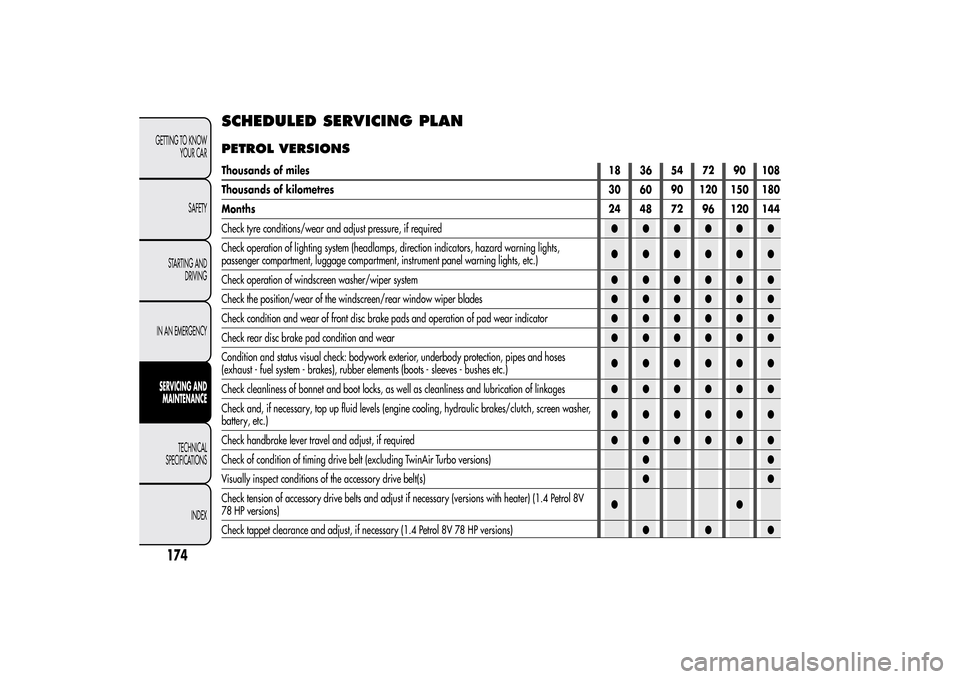
SCHEDULED SERVICING PLANPETROL VERSIONSThousands of miles18 36 54 72 90 108
Thousands of kilometres 30 60 90 120 150 180
Months24 48 72 96 120 144
Check tyre conditions/wear and adjust pressure, if required●●●●●●
Check operation of lighting system (headlamps, direction indicators, hazard warning lights,
passenger compartment, luggage compartment, instrument panel warning lights, etc.)●●●●●●
Check operation of windscreen washer/wiper system●●●●●●
Check the position/wear of the windscreen/rear window wiper blades●●●●●●
Check condition and wear of front disc brake pads and operation of pad wear indicator●●●●●●
Check rear disc brake pad condition and wear●●●●●●
Condition and status visual check: bodywork exterior, underbody protection, pipes and hoses
(exhaust - fuel system - brakes), rubber elements (boots - sleeves - bushes etc.)●●●●●●
Check cleanliness of bonnet and boot locks, as well as cleanliness and lubrication of linkages●●●●●●
Check and, if necessary, top up fluid levels (engine cooling, hydraulic brakes/clutch, screen washer,
battery, etc.)●●●●●●
Check handbrake lever travel and adjust, if required●●●●●●
Check of condition of timing drive belt (excluding TwinAir Turbo versions)●●
Visually inspect conditions of the accessory drive belt(s)●●
Check tension of accessory drive belts and adjust if necessary (versions with heater) (1.4 Petrol 8V
78 HP versions)●●
Check tappet clearance and adjust, if necessary (1.4 Petrol 8V 78 HP versions)●●●
174GETTING TO KNOW
YOUR CAR
SAFETY
STARTING AND
DRIVING
IN AN EMERGENCYSERVICING AND
MAINTENANCE
TECHNICAL
SPECIFICATIONS
INDEX
Page 180 of 280
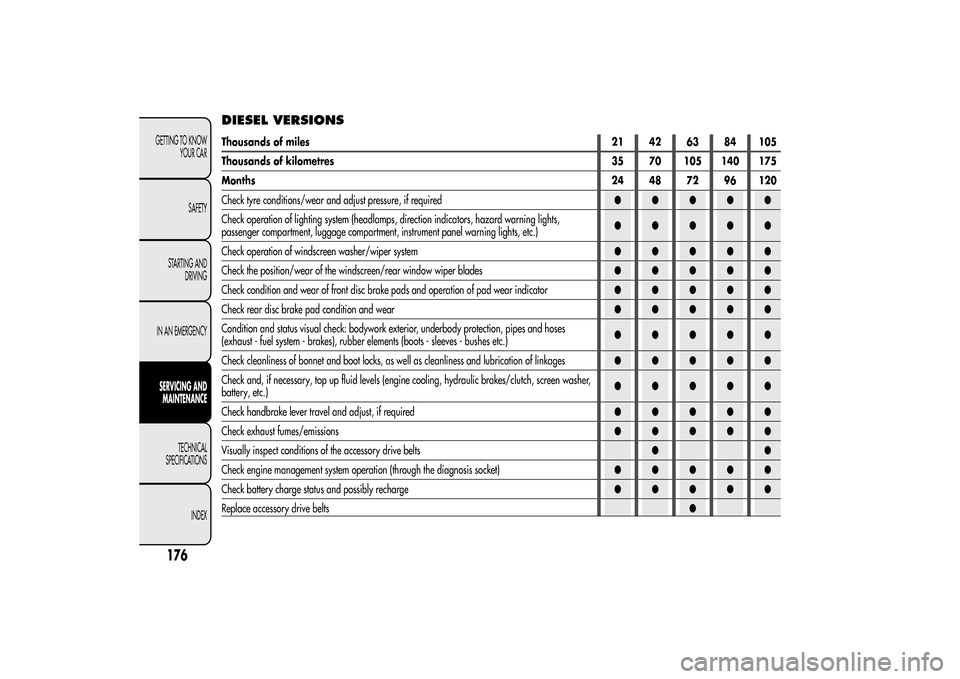
DIESEL VERSIONSThousands of miles21 42 63 84 105
Thousands of kilometres 35 70 105 140 175
Months24 48 72 96 120
Check tyre conditions/wear and adjust pressure, if required●●●●●
Check operation of lighting system (headlamps, direction indicators, hazard warning lights,
passenger compartment, luggage compartment, instrument panel warning lights, etc.)●●●●●
Check operation of windscreen washer/wiper system●●●●●
Check the position/wear of the windscreen/rear window wiper blades●●●●●
Check condition and wear of front disc brake pads and operation of pad wear indicator●●●●●
Check rear disc brake pad condition and wear●●●●●
Condition and status visual check: bodywork exterior, underbody protection, pipes and hoses
(exhaust - fuel system - brakes), rubber elements (boots - sleeves - bushes etc.)●●●●●
Check cleanliness of bonnet and boot locks, as well as cleanliness and lubrication of linkages●●●●●
Check and, if necessary, top up fluid levels (engine cooling, hydraulic brakes/clutch, screen washer,
battery, etc.)●●●●●
Check handbrake lever travel and adjust, if required●●●●●
Check exhaust fumes/emissions●●●●●
Visually inspect conditions of the accessory drive belts●●
Check engine management system operation (through the diagnosis socket)●●●●●
Check battery charge status and possibly recharge●●●●●
Replace accessory drive belts●
176GETTING TO KNOW
YOUR CAR
SAFETY
STARTING AND
DRIVING
IN AN EMERGENCYSERVICING AND
MAINTENANCE
TECHNICAL
SPECIFICATIONS
INDEX
Page 182 of 280
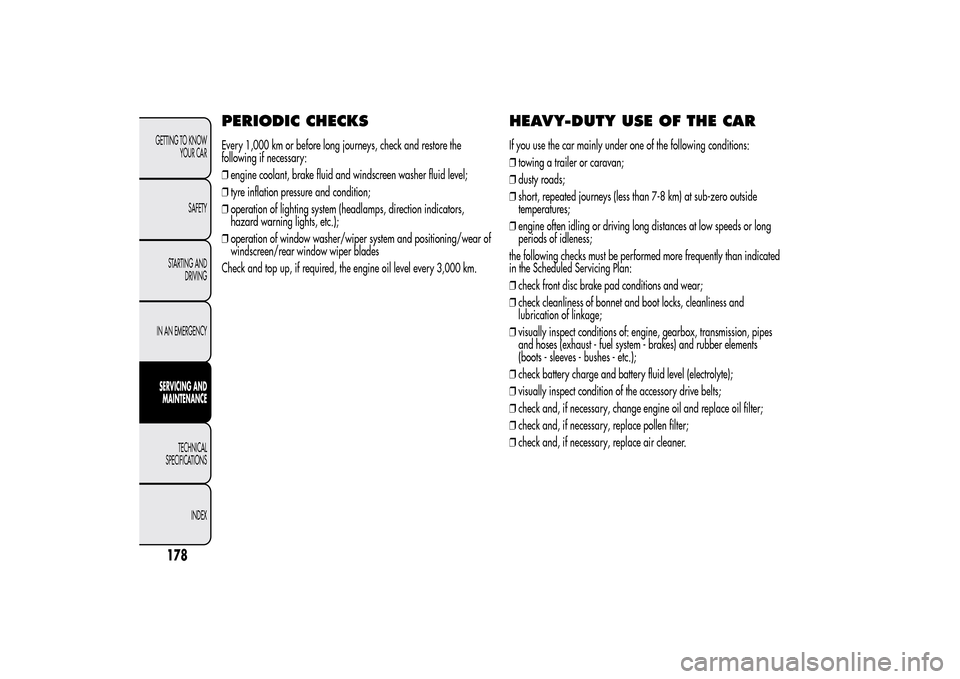
PERIODIC CHECKSEvery 1,000 km or before long journeys, check and restore the
following if necessary:
❒engine coolant, brake fluid and windscreen washer fluid level;
❒tyre inflation pressure and condition;
❒operation of lighting system (headlamps, direction indicators,
hazard warning lights, etc.);
❒operation of window washer/wiper system and positioning/wear of
windscreen/rear window wiper blades
Check and top up, if required, the engine oil level every 3,000 km.
HEAVY-DUTY USE OF THE CARIf you use the car mainly under one of the following conditions:
❒towing a trailer or caravan;
❒dusty roads;
❒short, repeated journeys (less than 7-8 km) at sub-zero outside
temperatures;
❒engine often idling or driving long distances at low speeds or long
periods of idleness;
the following checks must be performed more frequently than indicated
in the Scheduled Servicing Plan:
❒check front disc brake pad conditions and wear;
❒check cleanliness of bonnet and boot locks, cleanliness and
lubrication of linkage;
❒visually inspect conditions of: engine, gearbox, transmission, pipes
and hoses (exhaust - fuel system - brakes) and rubber elements
(boots - sleeves - bushes - etc.);
❒check battery charge and battery fluid level (electrolyte);
❒visually inspect condition of the accessory drive belts;
❒check and, if necessary, change engine oil and replace oil filter;
❒check and, if necessary, replace pollen filter;
❒check and, if necessary, replace air cleaner.
178GETTING TO KNOW
YOUR CAR
SAFETY
STARTING AND
DRIVING
IN AN EMERGENCYSERVICING AND
MAINTENANCE
TECHNICAL
SPECIFICATIONS
INDEX
Page 191 of 280
AIR CLEANER/POLLEN
FILTER/DIESEL FILTERContact Alfa Romeo Authorized Services to replace the filters.
BATTERYBattery F (see previous pages) does not require the electrolyte to be
topped up with distilled water. A periodic check carried out at Alfa
Romeo Authorized Services is, however, necessary to check efficiency.REPLACING THE BATTERYIf necessary, replace the battery with another genuine battery with the
same specifications. Follow the battery manufacturer's instructions
for maintenance.USEFUL ADVICE FOR EXTENDING THE
LIFE OF YOUR BATTERYTo avoid draining your battery rapidly and maintain its efficiency over
time, carefully observe the following instructions:
❒when you park the car, ensure that the doors, bonnet and flaps are
closed correctly, to prevent any roof lights from remaining on inside
the passenger compartment;
❒switch off all roof lights inside the car: the car is however equipped
with a system which switches all internal lights off automatically;
❒do not keep accessories (e.g. sound system, hazard lights, etc.)
switched on for a long time when the engine is not running;
❒before performing any operation on the electrical system, disconnect
the negative battery pole;
IMPORTANT If the charge level remains under 50% for a long time, the
battery is damaged by sulphation, reducing its capacity and
efficiency at start-up.
The battery will also be more at risk of freezing (this can happen as
early as –10°C). Refer to “Storing the car” in “Starting and driving” if
the car is left parked for a long time.
187GETTING TO KNOW
YOUR CAR
SAFETY
STARTING AND
DRIVING
IN AN EMERGENCYSERVICING AND
MAINTENANCETECHNICAL
SPECIFICATIONS
INDEX
Page 198 of 280
IMPORTANT
Avoid parking under trees; the resin dropped by trees makes the
paintwork go opaque and increases the possibility of corrosion.
Bird droppings must be washed off immediately and thoroughly as the
acid they contain is particularly aggressive.
Windows
Use specific detergents and clean cloths to prevent scratching or
altering the transparency.
IMPORTANT Wipe the inside surface of the rear window gently with a
cloth in the direction of the filaments to avoid damaging the heating
device.
Front headlights
Use a soft, damp cloth soaked in water and detergent for washing
cars.
IMPORTANT Never use aromatic substances (e.g. petrol) or ketenes
(e.g. acetone) for cleaning the plastic lenses of the front headlights.
IMPORTANT When cleaning the car with a pressure washer, keep the
water jet at least 20 cm away from the headlights.
Engine compartment
At the end of every winter, wash the engine compartment thoroughly,
taking care not to aim the jet of water directly at the electronic control
units or at the windscreen wiper motors. Have this operation
performed at a specialised workshop.
IMPORTANT The washing should take place with the engine cold and
the ignition key in the STOP position. After washing, make sure that the
various protective devices (e.g. rubber caps and guards) have not
been removed or damaged.
INTERIORSPeriodically check for water puddles under the mats that could cause
the panels to rust.
Never use flammable products, such as petrol ether or
rectified petrol to clean the inside of the car. The
electrostatic charges which are generated by rubbing
during the cleaning operation may cause a fire.Do not keep aerosol cans in the car: they might
explode. Aerosol cans must not be exposed to a
temperature exceeding 50°C. When the car is exposed
to sunlight, the internal temperature can greatly exceed this
value.
SEATS AND FABRIC PARTSRemove dust with a soft brush or a vacuum cleaner. It is advisable to
use a moist brush on velvet upholstery. Rub the seats with a sponge
soaked in a solution of neutral detergent and water.
194GETTING TO KNOW
YOUR CAR
SAFETY
STARTING AND
DRIVING
IN AN EMERGENCYSERVICING AND
MAINTENANCE
TECHNICAL
SPECIFICATIONS
INDEX
Page 274 of 280
Diesel filter .......................................... 187
Diesel particulate filter (DPF) ................. 111
Dimensions .......................................... 216
Dipped headlights
– bulb replacement............................. 156
Direction indicators ......................... 63-158
– bulb replacement............................. 157
– “Lane change” function .................... 63
Display................................................ 20
Doors .................................................. 80
– Door central locking/unlocking ........ 80
DPF (particulate filter) ........................... 111
Driver side knee bag ............................ 129
DST system (Dynamic Steering
Torque) .............................................. 94
Dusk sensor ......................................... 62
Dynamic Suspension (active shock
absorber system) ................................ 102Electric power steering ........................ 103
Electric sun roof ................................... 77
Electric windows .................................. 81
– Controls .......................................... 81"Electronic Q2" system ("E-Q2") .......... 94Engine codes ...................................... 198
Engine compartment– checking levels ................................ 179
– washing ......................................... 194
Engine coolant temperature gauge ........ 6
Engine................................................. 200
– engine cooling system fluid level ....... 185
– marking.......................................... 197
Engine oil
– consumption ................................... 185
– level check ...................................... 185
EOBD system ....................................... 103
ESC (Electronic Stability Control)
system ............................................... 92
Exterior lights ....................................... 61
– Left stalk ......................................... 61
External courtesy lights ......................... 64
Extinguisher ......................................... 76
Fitting "Universal" child seat ................ 120
Fix&Go Automatic Kit ........................... 149
Flashing .............................................. 63
Fluids and lubricants (specifications) ...... 224
Fog lights........................................ 72-158"Follow Me Home" device ................... 63Front airbags...................................... 127
Front armrest ....................................... 74
Front driver side airbag ........................ 127Front passenger airbag ......................... 128
Front roof light
– bulb replacement............................. 160
Fuel consumption.................................. 227
Fuel cut-off system ................................ 72
Fuel level gauge ................................... 6
Fuel supply .......................................... 206
Fuel tank cap ....................................... 110
Fuses (if a fuse blows) ........................... 163
G
ear Shift Indicator ............................ 22
Glove compartment .............................. 73
Glove compartment light
– bulb replacement............................. 161
H
andbrake ........................................ 135
Hazard warning lights .......................... 71
Headlights ........................................... 90
– Adjusting headlights abroad ............ 91
– bulb replacement............................. 156
– Headlight alignment corrector .......... 90
– Light beam direction ........................ 90
Headlight washers................................ 192
Head restraints..................................... 47
– "Anti-Whiplash" device ................... 47
– Front headrests ................................ 47
– Rear head restraints......................... 48
270GETTING TO KNOW
YOUR CAR
SAFETY
STARTING AND
DRIVING
IN AN EMERGENCY
SERVICING AND
MAINTENANCE
TECHNICAL
SPECIFICATIONS
INDEX
Page 275 of 280

Hill Holder system ................................ 93Identification data
– bodywork paint plate....................... 197
– Chassis marking .............................. 197
– engine marking ............................... 197
– identification data plate ................... 196
Ignition device ..................................... 43
– Steering lock ................................... 43
Installation of electrical/electronic
devices .............................................. 104
Installing a Universal Isofix child seat ..... 124
Interior fittings ...................................... 73
Interiors (cleaning)................................ 194Jack................................................... 144Light clusters
– front light clusters
(changing a bulb)............................ 156
– rear light clusters
(changing a bulb)............................ 158
Lubricants (features).............................. 224
Luggage compartment .......................... 84
– Closing the luggage compartment..... 84
– Emergency luggage compartment
opening .......................................... 84
– Extending the luggage
compartment................................... 85– Luggage compartment
initialisation .................................... 85
– Opening the luggage
compartment................................... 84
Luggage compartment roof light
– bulb replacement............................. 160
M
ain beam headlights ....................... 63
– bulb replacement............................. 156
Maintenance and care
– heavy-duty use of the car ................. 178
– periodic checks ............................... 178
– scheduled servicing ......................... 173
– scheduled servicing plan .................. 174
Menu options ....................................... 24
MSR system ......................................... 94
Multifunction display ............................ 20
N
umber plate lights
– bulb replacement............................. 159
Parking ............................................. 135
– Handbrake ..................................... 135
Parking lights ....................................... 62
Parking sensors .................................... 105
Performance ........................................ 217
Pollen filter........................................... 187
Power sockets....................................... 74Preparation for "Isofix" child seat .......... 123
Pretensioners........................................ 116
– Load limiters ................................... 116
Protecting the environment .................... 111
Puddle light
– bulb replacement............................. 162
Radio transmitters and mobile
phones.............................................. 104
Rain sensor .......................................... 65
Raising the car ..................................... 171
Rear fog light ....................................... 72
Rear fog light/reversing light................. 159
Rear view mirrors ................................. 49
– Door mirrors ................................... 50
– Internal mirror ................................. 49
Rear window washer jets ...................... 192
Rear window washer
– rear window washer fluid level ......... 186
Rear window washer/wiper .................. 66
Rear Window Wiper
– blade replacement ........................... 191
– blades ............................................ 190
Reconfigurable multifunction display ...... 21
Refuelling ............................................ 221
Refuelling the car ................................. 110
2GETTING TO KNOW
YOUR CAR
SAFETY
STARTING AND
DRIVING
IN AN EMERGENCY
SERVICING AND
MAINTENANCE
TECHNICAL
SPECIFICATIONSINDEX
71