climate control Alfa Romeo MiTo 2014 User Guide
[x] Cancel search | Manufacturer: ALFA ROMEO, Model Year: 2014, Model line: MiTo, Model: Alfa Romeo MiTo 2014Pages: 280, PDF Size: 8.79 MB
Page 64 of 280
RAPID WINDOW DEMISTING/
DEFROSTING (MAX-DEF function)Press button F to activate windscreen and side window demisting/
defrosting. The climate control system carries out the following
operations:
❒switches on the air conditioning compressor when climatic
conditions are suitable;
❒deactivates air recirculation;
❒sets maximum air temperature (HI) in both zones;
❒sets fan speed according to the engine coolant temperature;
❒directs air flow to windscreen and front side windows diffusers;
❒activates the heated rear window.
IMPORTANT The MAX-DEF function remains on for about 3 minutes
from when the engine coolant reaches the appropriate temperature.
When the function is active the words FULL AUTO disappear from the
display. With the function active the only possible manual adjustments
are adjusting the fan speed and turning the heated rear window off.
Pressing buttons B, C, F or AUTO switches off the MAX-DEF function
and restores the settings that were present before the function was
activated.HEATED REAR WINDOW
DEMISTING/DEFROSTINGPress the
button to activate heated rear windscreen demisting/
defrosting. This function switches off automatically after about 20
minutes or when the engine is turned off. It is not switched on
automatically the next time the engine is started.For versions/markets where provided, press the
button to activate
demisting/defrosting of door mirrors, heated windscreen (for
versions/markets, where provided) and heated nozzles (for versions/
markets, where provided).
IMPORTANT Do not affix stickers to the inside of the heated rear
window over the heating filaments, to avoid damage that might cause
them to stop working properly.
TURNING THE CLIMATE CONTROL
SYSTEM OFFPress the OFF button.
With climate control off:
❒air recirculation is on, thus isolating the passenger compartment
from the outside;
❒the compressor is off;
❒the fan is off;
❒the heated rear window can be switched on or off;
IMPORTANT The climate control system control unit stores the
temperatures set before the system was switched off and restores them
when any button of the system is pressed (except for button G). If the
function of the pressed button was not active before switching off, that
function will also be activated. If it was active, it will be restored.
To restart the climate control system in fully automatic mode press the
AUTO button.
60GETTING TO
KNOW YOUR CAR
SAFETY
STARTING AND
DRIVING
IN AN EMERGENCY
SERVICING AND
MAINTENANCE
TECHNICAL
SPECIFICATIONS
INDEX
Page 65 of 280
ADDITIONAL HEATER(only diesel versions)
(for versions/markets, where provided)
This allows the passenger compartment to be heated more quickly in
cold weather conditions. The additional heater turns off automatically
after the required comfort conditions are achieved.
Automatic dual zone climate control system
(for versions/markets, where provided)
The additional heater activates automatically when the ignition key is
turned to MAR-ON.
Manual heater and manual climate control
The additional heater activates automatically when knob N is turned to
the end of the red section and the fan is set to at least 1
stspeed.
IMPORTANT The heater only works if the outside temperature and
engine coolant temperature are low. The heater will not activate if the
battery voltage is too low.
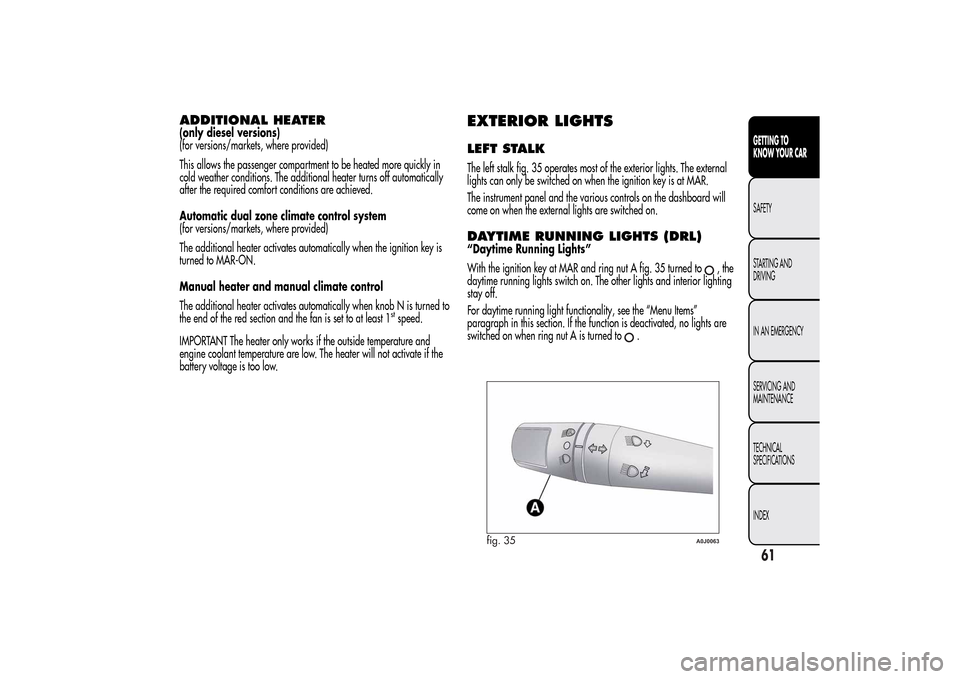
EXTERIOR LIGHTSLEFT STALKThe left stalk fig. 35 operates most of the exterior lights. The external
lights can only be switched on when the ignition key is at MAR.
The instrument panel and the various controls on the dashboard will
come on when the external lights are switched on.DAYTIME RUNNING LIGHTS (DRL)“Daytime Running Lights”
With the ignition key at MAR and ring nut A fig. 35 turned to
,the
daytime running lights switch on. The other lights and interior lighting
stay off.
For daytime running light functionality, see the “Menu Items”
paragraph in this section. If the function is deactivated, no lights are
switched on when ring nut A is turned to
.
fig. 35
A0J0063
61GETTING TO
KNOW YOUR CARSAFETY
STARTING AND
DRIVING
IN AN EMERGENCY
SERVICING AND
MAINTENANCE
TECHNICAL
SPECIFICATIONS
INDEX
Page 103 of 280
Restarting the engine
Press the clutch pedal to restart the engine.SYSTEM MANUAL ACTIVATION/
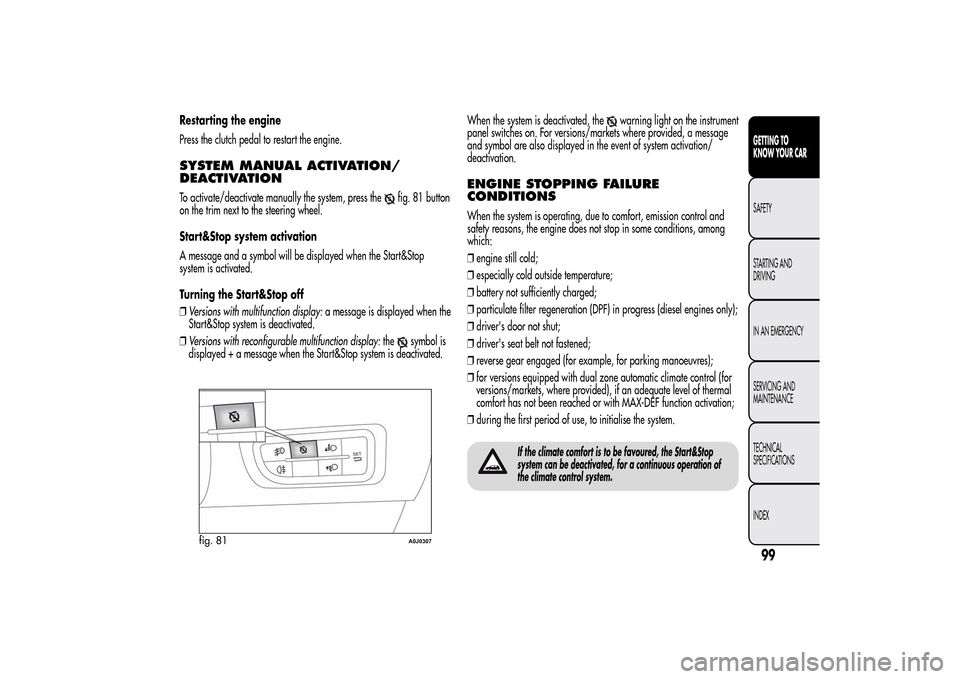
DEACTIVATIONTo activate/deactivate manually the system, press the
fig. 81 button
on the trim next to the steering wheel.
Start&Stop system activation
A message and a symbol will be displayed when the Start&Stop
system is activated.
Turning the Start&Stop off
❒Versions with multifunction display:a message is displayed when the
Start&Stop system is deactivated.
❒Versions with reconfigurable multifunction display:the
symbol is
displayed + a message when the Start&Stop system is deactivated.When the system is deactivated, the
warning light on the instrument
panel switches on. For versions/markets where provided, a message
and symbol are also displayed in the event of system activation/
deactivation.
ENGINE STOPPING FAILURE
CONDITIONSWhen the system is operating, due to comfort, emission control and
safety reasons, the engine does not stop in some conditions, among
which:
❒engine still cold;
❒especially cold outside temperature;
❒battery not sufficiently charged;
❒particulate filter regeneration (DPF) in progress (diesel engines only);
❒driver's door not shut;
❒driver's seat belt not fastened;
❒reverse gear engaged (for example, for parking manoeuvres);
❒for versions equipped with dual zone automatic climate control (for
versions/markets, where provided), if an adequate level of thermal
comfort has not been reached or with MAX-DEF function activation;
❒during the first period of use, to initialise the system.
If the climate comfort is to be favoured, the Start&Stop
system can be deactivated, for a continuous operation of
the climate control system.
fig. 81
A0J0307
99GETTING TO
KNOW YOUR CARSAFETY
STARTING AND
DRIVING
IN AN EMERGENCY
SERVICING AND
MAINTENANCE
TECHNICAL
SPECIFICATIONS
INDEX
Page 104 of 280
ENGINE RESTARTING CONDITIONSDue to comfort, emission control and safety reasons, the engine can
restart automatically without any action by the driver, under special
conditions, such as:
❒battery not sufficiently charged;
❒reduced braking system vacuum (e.g. if the brake pedal is pressed
repeatedly);
❒car moving (e.g. when driving on roads with a gradient);
❒engine stopping by Start&Stop system for over 3 minutes;
❒for versions equipped with dual zone automatic climate control
system (for versions/markets, where provided), if an adequate level
of thermal comfort has not been reached or MAX-DEF function
activation.
With gear engaged, automatic engine restarting is possible only by
fully depressing the clutch pedal. The driver is informed by the
displaying of a message on the display and - for versions/markets,
where provided - by the flashing of the symbol
.
Notes
If the clutch is not pressed, about 3 minutes after the engine stops, the
engine can be restarted only using the ignition key.
In cases when the engine stops and this is not desired, due for example
to the clutch pedal being released sharply with a gear engaged, if the
Start&Stop system is activated, the engine can be restarted by fully
depressing the clutch pedal or by placing the gear lever in neutral.
SAFETY FUNCTIONSWhen the engine is stopped by the Start&Stop system, if the driver
releases his/her seat belt and opens the driver's or passenger's door,
the engine can be restarted only using the ignition key.
The driver is informed by a buzzer and by the flashing of the symbol
on the display; on some versions, a message is displayed as well.
"ENERGY SAVING" FUNCTION(for versions/markets, where provided)
If, following automatic engine restarting, the driver does not carry out
any action on the car for over 3 minutes, the Start&Stop system stops
the engine once and for all, to prevent fuel consumption. In these
cases, the engine can be restarted only using the ignition key.
NOTE In any case, it is possible to keep the engine running by
deactivating the Start&Stop system.IRREGULAR OPERATIONIn the event of malfunction, the Start&Stop system is deactivated.
The driver is informed of the fault by the
warning light switching
on in the instrument panel and, for versions/markets where provided,
a message and symbol on the display.
In this case, contact Alfa Romeo Authorized Services.
100GETTING TO
KNOW YOUR CAR
SAFETY
STARTING AND
DRIVING
IN AN EMERGENCY
SERVICING AND
MAINTENANCE
TECHNICAL
SPECIFICATIONS
INDEX
Page 142 of 280
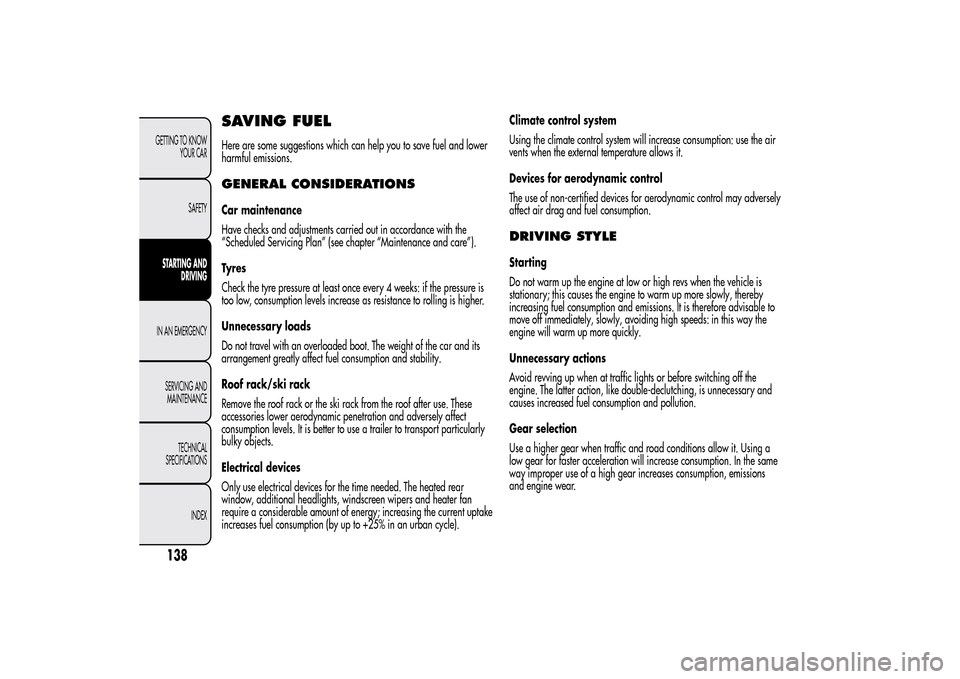
SAVING FUELHere are some suggestions which can help you to save fuel and lower
harmful emissions.GENERAL CONSIDERATIONSCar maintenance
Have checks and adjustments carried out in accordance with the
“Scheduled Servicing Plan” (see chapter “Maintenance and care”).
Ty r e s
Check the tyre pressure at least once every 4 weeks: if the pressure is
too low, consumption levels increase as resistance to rolling is higher.
Unnecessary loads
Do not travel with an overloaded boot. The weight of the car and its
arrangement greatly affect fuel consumption and stability.
Roof rack/ski rack
Remove the roof rack or the ski rack from the roof after use. These
accessories lower aerodynamic penetration and adversely affect
consumption levels. It is better to use a trailer to transport particularly
bulky objects.
Electrical devices
Only use electrical devices for the time needed. The heated rear
window, additional headlights, windscreen wipers and heater fan
require a considerable amount of energy; increasing the current uptake
increases fuel consumption (by up to +25% in an urban cycle).Climate control system
Using the climate control system will increase consumption: use the air
vents when the external temperature allows it.
Devices for aerodynamic control
The use of non-certified devices for aerodynamic control may adversely
affect air drag and fuel consumption.
DRIVING STYLEStarting
Do not warm up the engine at low or high revs when the vehicle is
stationary; this causes the engine to warm up more slowly, thereby
increasing fuel consumption and emissions. It is therefore advisable to
move off immediately, slowly, avoiding high speeds: in this way the
engine will warm up more quickly.
Unnecessary actions
Avoid revving up when at traffic lights or before switching off the
engine. The latter action, like double-declutching, is unnecessary and
causes increased fuel consumption and pollution.
Gear selection
Use a higher gear when traffic and road conditions allow it. Using a
low gear for faster acceleration will increase consumption. In the same
way improper use of a high gear increases consumption, emissions
and engine wear.
138GETTING TO KNOW
YOUR CAR
SAFETYSTARTING AND
DRIVINGIN AN EMERGENCY
SERVICING AND
MAINTENANCE
TECHNICAL
SPECIFICATIONS
INDEX
Page 172 of 280
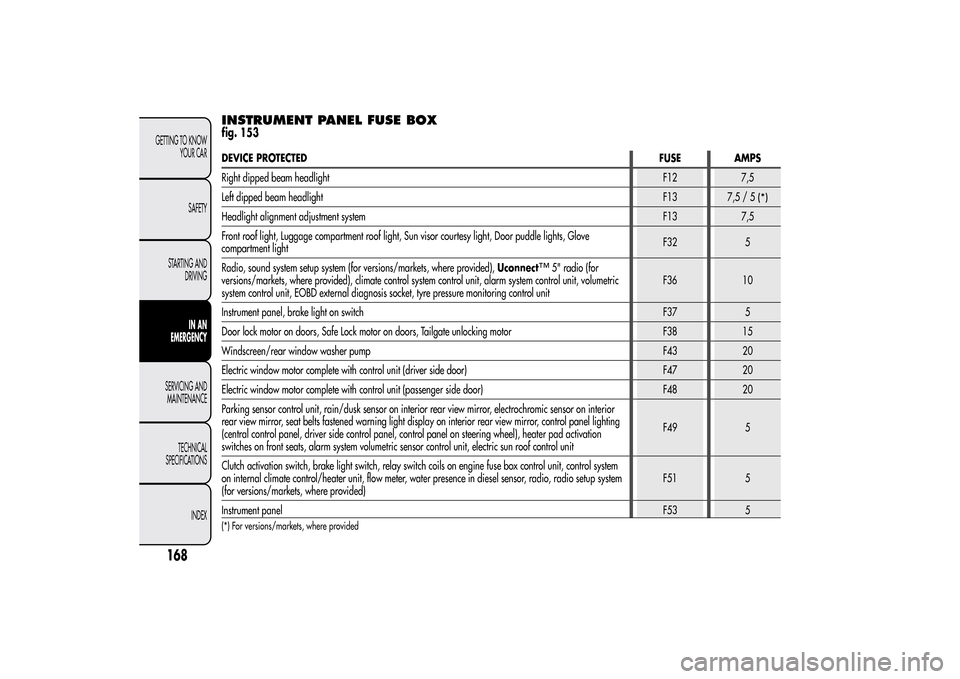
INSTRUMENT PANEL FUSE BOXfig. 153DEVICE PROTECTEDFUSE AMPS
Right dipped beam headlightF12 7,5
Left dipped beam headlightF13
7,5/5
(*)
Headlight alignment adjustment systemF13 7,5
Front roof light, Luggage compartment roof light, Sun visor courtesy light, Door puddle lights, Glove
compartment lightF32 5
Radio, sound system setup system (for versions/markets, where provided),Uconnect
™
5" radio (for
versions/markets, where provided), climate control system control unit, alarm system control unit, volumetric
system control unit, EOBD external diagnosis socket, tyre pressure monitoring control unitF36 10
Instrument panel, brake light on switchF37 5
Door lock motor on doors, Safe Lock motor on doors, Tailgate unlocking motor F38 15
Windscreen/rear window washer pumpF43 20
Electric window motor complete with control unit (driver side door) F47 20
Electric window motor complete with control unit (passenger side door) F48 20
Parking sensor control unit, rain/dusk sensor on interior rear view mirror, electrochromic sensor on interior
rear view mirror, seat belts fastened warning light display on interior rear view mirror, control panel lighting
(central control panel, driver side control panel, control panel on steering wheel), heater pad activation
switches on front seats, alarm system volumetric sensor control unit, electric sun roof control unitF49 5
Clutch activation switch, brake light switch, relay switch coils on engine fuse box control unit, control system
on internal climate control/heater unit, flow meter, water presence in diesel sensor, radio, radio setup system
(for versions/markets, where provided)F51 5
Instrument panelF53 5
(*) For versions/markets, where provided
168GETTING TO KNOW
YOUR CAR
SAFETY
STARTING AND
DRIVING
IN AN
EMERGENCY
SERVICING AND
MAINTENANCE
TECHNICAL
SPECIFICATIONS
INDEX
Page 225 of 280
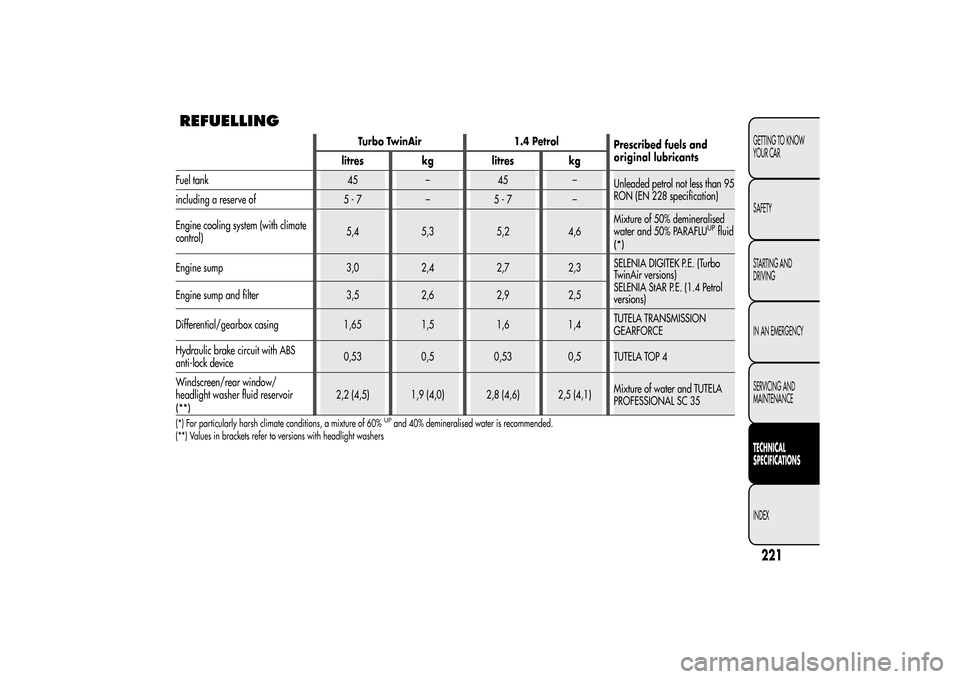
REFUELLING
221GETTING TO KNOW
YOUR CAR
SAFETY
STARTING AND
DRIVING
IN AN EMERGENCY
SERVICING AND
MAINTENANCETECHNICAL
SPECIFICATIONSINDEX
Turbo TwinAir 1.4 Petrol
Prescribed fuels and
litres kg litres kg
Fuel tank 45 – 45 –
Unleaded petrol not less than 95
RON (EN 228 specification)
including a reserve of 5 - 7 – 5 - 7 –
Engine cooling system (with climate
control)5,4 5,3 5,2 4,6Mixture of 50% demineralised
water and 50% PARAFLU
UPfluid
(*)
Engine sump 3,0 2,4 2,7 2,3SELENIA DIGITEK P.E. (Turbo
TwinAir versions)
SELENIA StAR P.E. (1.4 Petrol
versions) Engine sump and filter 3,5 2,6 2,9 2,5
Differential/gearbox casing 1,65 1,5 1,6 1,4TUTELA TRANSMISSION
GEARFORCE
Hydraulic brake circuit with ABS
anti-lock device0,53 0,5 0,53 0,5 TUTELA TOP 4
Windscreen/rear window/
headlight washer fluid reservoir(**)
2,2 (4,5) 1,9 (4,0) 2,8 (4,6) 2,5 (4,1)Mixture of water and TUTELA
PROFESSIONAL SC 35
(*) For particularly harsh climate conditions, a mixture of 60%
UPand 40% demineralised water is recommended.
(**) Values in brackets refer to versions with headlight washers
originallubricants
Page 226 of 280
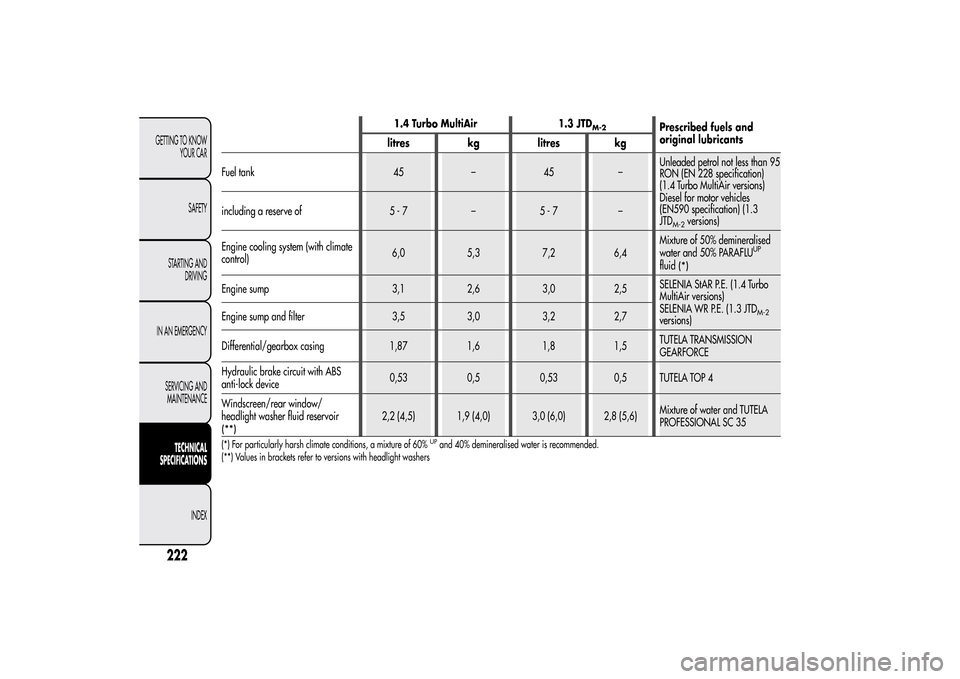
1.4 Turbo MultiAir 1.3 JTD
M-2
Prescribed fuels and
original lubricants
litres kg litres kg
Fuel tank 45 – 45 –Unleaded petrol not less than 95
RON (EN 228 specification)
(1.4 Turbo MultiAir versions)
Diesel for motor vehicles
(EN590 specification) (1.3
JTD
M-2
versions) including a reserve of 5 - 7 – 5 - 7 –
Engine cooling system (with climate
control)6,0 5,3 7,2 6,4Mixture of 50% demineralised
water and 50% PARAFLU
UP
fluid
(*)
Engine sump 3,1 2,6 3,0 2,5SELENIA StAR P.E. (1.4 Turbo
MultiAir versions)
SELENIA WR P.E. (1.3 JTD
M-2
versions) Engine sump and filter 3,5 3,0 3,2 2,7
Differential/gearbox casing 1,87 1,6 1,8 1,5TUTELA TRANSMISSION
GEARFORCE
Hydraulic brake circuit with ABS
anti-lock device0,53 0,5 0,53 0,5 TUTELA TOP 4
Windscreen/rear window/
headlight washer fluid reservoir
(**)
2,2 (4,5) 1,9 (4,0) 3,0 (6,0) 2,8 (5,6)Mixture of water and TUTELA
PROFESSIONAL SC 35
(*) For particularly harsh climate conditions, a mixture of 60%
UPand 40% demineralised water is recommended.
(**) Values in brackets refer to versions with headlight washers
222GETTING TO KNOW
YOUR CAR
SAFETY
STARTING AND
DRIVING
IN AN EMERGENCY
SERVICING AND
MAINTENANCE
TECHNICAL
SPECIFICATIONS
INDEX
Page 227 of 280
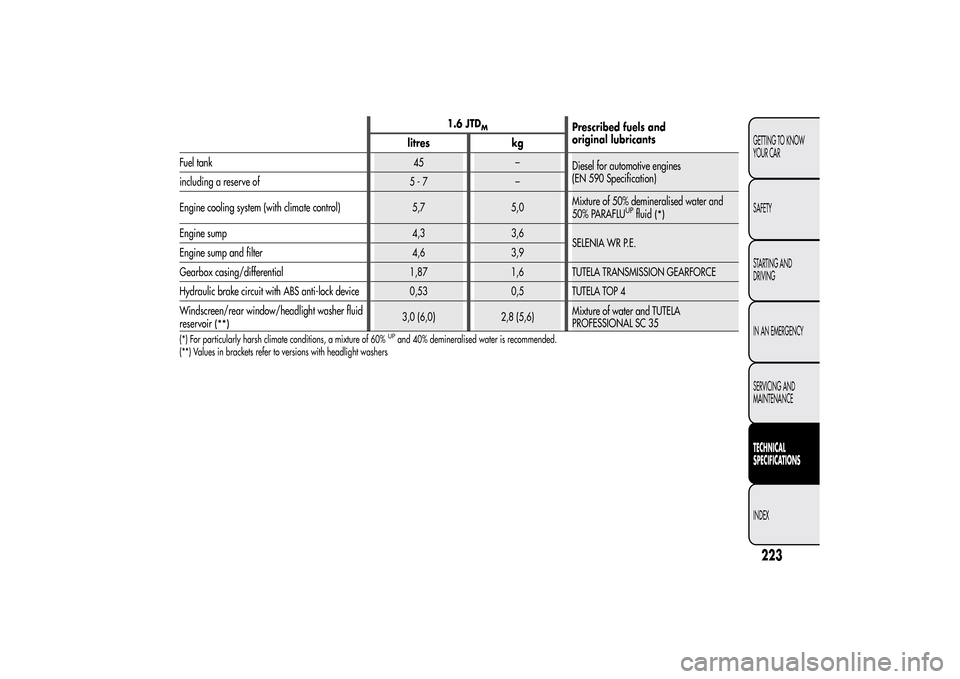
1.6 JTD
M
Prescribed fuels and
original lubricants
litres kg
Fuel tank 45 –
Diesel for automotive engines
(EN 590 Specification)
including a reserve of 5 - 7 –
Engine cooling system (with climate control) 5,7 5,0Mixture of 50% demineralised water and
50% PARAFLU
UPfluid
(*)
Engine sump 4,3 3,6
SELENIA WR P.E.
Engine sump and filter 4,6 3,9
Gearbox casing/differential 1,87 1,6 TUTELA TRANSMISSION GEARFORCE
Hydraulic brake circuit with ABS anti-lock device 0,53 0,5 TUTELA TOP 4
Windscreen/rear window/headlight washer fluid
reservoir
(**)
3,0 (6,0) 2,8 (5,6)Mixture of water and TUTELA
PROFESSIONAL SC 35
(*) For particularly harsh climate conditions, a mixture of 60%
UPand 40% demineralised water is recommended.
(**) Values in brackets refer to versions with headlight washers
223GETTING TO KNOW
YOUR CAR
SAFETY
STARTING AND
DRIVING
IN AN EMERGENCY
SERVICING AND
MAINTENANCETECHNICAL
SPECIFICATIONSINDEX
Page 231 of 280
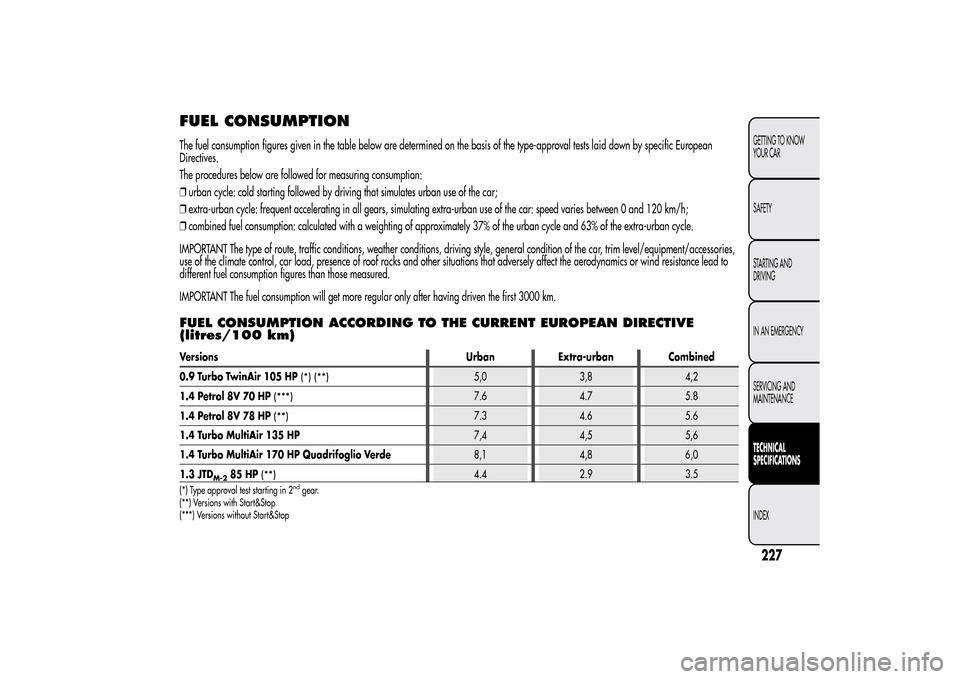
FUEL CONSUMPTIONThe fuel consumption figures given in the table below are determined on the basis of the type-approval tests laid down by specific European
Directives.
The procedures below are followed for measuring consumption:
❒urban cycle: cold starting followed by driving that simulates urban use of the car;
❒extra-urban cycle: frequent accelerating in all gears, simulating extra-urban use of the car: speed varies between 0 and 120 km/h;
❒combined fuel consumption: calculated with a weighting of approximately 37% of the urban cycle and 63% of the extra-urban cycle.
IMPORTANT The type of route, traffic conditions, weather conditions, driving style, general condition of the car, trim level/equipment/accessories,
use of the climate control, car load, presence of roof racks and other situations that adversely affect the aerodynamics or wind resistance lead to
different fuel consumption figures than those measured.
IMPORTANT The fuel consumption will get more regular only after having driven the first 3000 km.FUEL CONSUMPTION ACCORDING TO THE CURRENT EUROPEAN DIRECTIVE
(litres/100 km)Versions Urban Extra-urban Combined
0.9 Turbo TwinAir 105 HP
(*) (**)
5,0 3,8 4,2
1.4 Petrol 8V 70 HP
(***)
7.6 4.7 5.8
1.4 Petrol 8V 78 HP
(**)
7.3 4.6 5.6
1.4 Turbo MultiAir 135 HP7,4 4,5 5,6
1.4 Turbo MultiAir 170 HP Quadrifoglio Verde8,1 4,8 6,0
1.3 JTD
M-2
85 HP
(**)
4.4 2.9 3.5
(*) Type approval test starting in 2
ndgear.
(**) Versions with Start&Stop
(***) Versions without Start&Stop
227GETTING TO KNOW
YOUR CAR
SAFETY
STARTING AND
DRIVING
IN AN EMERGENCY
SERVICING AND
MAINTENANCETECHNICAL
SPECIFICATIONSINDEX