heating Alfa Romeo MiTo 2014 User Guide
[x] Cancel search | Manufacturer: ALFA ROMEO, Model Year: 2014, Model line: MiTo, Model: Alfa Romeo MiTo 2014Pages: 280, PDF Size: 8.79 MB
Page 63 of 280
AIR RECIRCULATIONThe air recirculation is managed according to the following operating
logics:
❒automatic activation: press one of the AUTO buttons. Activation is
indicated by the word AUTO appearing on the display;
❒override on (inside air recirculation always on): indicated by the LED
on button C and the
symbol on the display;
❒override off (air recirculation constantly off, air intake from the
outside): signalled by the LED on button C switching off and by the
symbol in the display disappearing. Forced activation/
deactivation can be selected by pressing button C.
IMPORTANT The activation of recirculation makes it possible to reach
the required passenger compartment heating/cooling conditions faster.
It is, however, inadvisable to use it on rainy/cold days as it would
considerably increase the possibility of the windows misting up inside
(especially if the climate control system is off).
When the outside temperature is low, recirculation is forced off (air
drawn in from the outside) to prevent the windows from misting up. In
automatic operation, air recirculation will be managed automatically
by the system according to external environmental conditions.
When manual recirculation control is set, the word FULL disappears
from the display and AUTO disappears from the icon.
It is advisable not to use the air recirculation function
when the outside temperature is low to prevent the
windows from rapidly misting up.
CLIMATE CONTROL COMPRESSORPress button B to activate/deactivate the compressor. The system
remembers that the compressor has been switched off, even after the
engine has stopped.
When the compressor is switched off the system deactivates air
recirculation to prevent the windows from misting up. In this case,
although the system is capable of maintaining the required
temperature, the word FULL will disappear from the display.
If, however, the system is unable to maintain the requested
temperature, the temperature indications flash and the word AUTO
disappears.
To restore automatic control of compressor engagement, press button B
again or press the AUTO button.
With compressor off:
❒if the outside temperature is higher than the set one, the system will
not be able to satisfy the request. The temperature value will then
flash on the display for a few seconds and the word AUTO will
disappear;
❒the fan speed can be reset manually.
With the compressor on and the engine running, the fan speed cannot
be lower than one bar on the display.
IMPORTANT With the climate control compressor off, air cannot be
introduced to the passenger compartment with a temperature lower
than the outside temperature; moreover, under certain environmental
conditions, windows could mist rapidly since the air is not
dehumidified.
59GETTING TO
KNOW YOUR CARSAFETY
STARTING AND
DRIVING
IN AN EMERGENCY
SERVICING AND
MAINTENANCE
TECHNICAL
SPECIFICATIONS
INDEX
Page 64 of 280
RAPID WINDOW DEMISTING/
DEFROSTING (MAX-DEF function)Press button F to activate windscreen and side window demisting/
defrosting. The climate control system carries out the following
operations:
❒switches on the air conditioning compressor when climatic
conditions are suitable;
❒deactivates air recirculation;
❒sets maximum air temperature (HI) in both zones;
❒sets fan speed according to the engine coolant temperature;
❒directs air flow to windscreen and front side windows diffusers;
❒activates the heated rear window.
IMPORTANT The MAX-DEF function remains on for about 3 minutes
from when the engine coolant reaches the appropriate temperature.
When the function is active the words FULL AUTO disappear from the
display. With the function active the only possible manual adjustments
are adjusting the fan speed and turning the heated rear window off.
Pressing buttons B, C, F or AUTO switches off the MAX-DEF function
and restores the settings that were present before the function was
activated.HEATED REAR WINDOW
DEMISTING/DEFROSTINGPress the
button to activate heated rear windscreen demisting/
defrosting. This function switches off automatically after about 20
minutes or when the engine is turned off. It is not switched on
automatically the next time the engine is started.For versions/markets where provided, press the
button to activate
demisting/defrosting of door mirrors, heated windscreen (for
versions/markets, where provided) and heated nozzles (for versions/
markets, where provided).
IMPORTANT Do not affix stickers to the inside of the heated rear
window over the heating filaments, to avoid damage that might cause
them to stop working properly.
TURNING THE CLIMATE CONTROL
SYSTEM OFFPress the OFF button.
With climate control off:
❒air recirculation is on, thus isolating the passenger compartment
from the outside;
❒the compressor is off;
❒the fan is off;
❒the heated rear window can be switched on or off;
IMPORTANT The climate control system control unit stores the
temperatures set before the system was switched off and restores them
when any button of the system is pressed (except for button G). If the
function of the pressed button was not active before switching off, that
function will also be activated. If it was active, it will be restored.
To restart the climate control system in fully automatic mode press the
AUTO button.
60GETTING TO
KNOW YOUR CAR
SAFETY
STARTING AND
DRIVING
IN AN EMERGENCY
SERVICING AND
MAINTENANCE
TECHNICAL
SPECIFICATIONS
INDEX
Page 120 of 280
PRETENSIONERSThe car is equipped with front seat belt pretensioners, which draw
back the seat belts by several centimetres in the event of a violent
frontal impact. This guarantees the perfect adherence of the seat belts
to the occupants’ bodies before the restraining action begins.
It is evident that the pretensioners have been activated when the belt
withdraws towards the reel.
The car is also equipped with a second pretensioner (in the kick plate
area). Its activation is signalled by the shortening of the metal cable.
A slight discharge of smoke may be produced during the activation of
the pretensioner. This is not harmful and does not indicate the start
of a fire.
IMPORTANT To obtain the highest degree of protection from the action
of the pretensioner, wear the seat belt tight to the chest and pelvis.
The pretensioner does not require any maintenance or lubrication: any
changes to its original conditions will invalidate its efficiency. If, due
to exceptional natural events (floods, sea storms, etc.), the device
has been affected by water and mud, it must be replaced.
The pretensioner may be used only once. Once it has
been activated, contact Alfa Romeo Authorised
Workshops to have it replaced. Consult the plate in the
glove compartment to check the status of the device. Contact Alfa
Romeo Authorised Workshops to have the device replaced as
this date approaches.
Operations which lead to knocks, vibrations or localised
heating (over 100°C for a maximum of 6 hours) in the area
around the pretensioners may cause damage or trigger
them. These devices are not affected by vibrations caused by
irregularities of the road surface or low obstacles such as kerbs, etc.
Contact Alfa Romeo Authorized Services for any assistance necessary.
LOAD LIMITERSTo increase protection, the front seat belt reels contain a load limiter
which controls the force acting on the chest and shoulders during
the belt restraining action in the event of a head-on collision.GENERAL INSTRUCTIONS FOR USING
THE SEAT BELTSComply with (and ensure that all the other occupants of the car comply
with) the local laws in force regarding the use of seat belts. Always
fasten the seat belts before starting off.
Seat belts must also be worn by pregnant women: the risk of injury in
the event of an accident is reduced for them and the unborn child if
they are wearing a seat belt.
116GETTING TO KNOW
YOUR CAR
SAFETY
STARTING AND
DRIVING
IN AN EMERGENCY
SERVICING AND
MAINTENANCE
TECHNICAL
SPECIFICATIONS
INDEX
Page 138 of 280
PROCEDURE FOR DIESEL VERSIONSProceed as follows:
❒engage the handbrake and place the gearbox lever in neutral;
❒turn the ignition key to MAR-ON: the warning lights
and
(or the symbol on the display) on the instrument panel will
switch on;
❒wait for the warning lights (or the symbol on the display) to switch
off;
❒fully depress the clutch pedal, without touching the accelerator;
❒turn the ignition key to AVV;
warning light switches off.
Waiting too long will waste the heating work carried out by the
glow plugs. Release the key as soon as the engine starts.
If the
warning light flashes for about 1 minute after
starting or during prolonged cranking, this indicates a fault
in the glow plug preheating system. Use the car normally
if the engine starts and go to Alfa Romeo Authorized Services as soon
as possible.
It is dangerous to run the engine in enclosed areas. The
engine takes in oxygen and releases carbon dioxide,
carbon monoxide and other toxic gases.It is advisable not to demand maximum performance from
your car (e.g. excessive acceleration, long distances at
maximum rpm, excessively intense braking, etc.) when it is
first used.
When the engine is off, do not leave the ignition key turned
to MAR to prevent unnecessary electrical consumption from
draining the battery.Remember that the brake servo and electromechanical
power steering are not operational until the engine
has been started, therefore much more effort than
usual is required on the brake pedal and steering wheel.Never start the engine by pushing, towing or driving
downhill. These manoeuvres may damage the catalytic
converter.
WARMING UP THE ENGINE JUST
AFTER IT HAS STARTEDProceed as follows:
❒drive off slowly, letting the engine turn at medium revs and without
accelerating abruptly;
❒do not demand maximum performance for the first few kilometres. It
is advisable to wait until the engine coolant temperature indicator
starts moving.
134GETTING TO KNOW
YOUR CAR
SAFETYSTARTING AND
DRIVINGIN AN EMERGENCY
SERVICING AND
MAINTENANCE
TECHNICAL
SPECIFICATIONS
INDEX
Page 154 of 280
Never operate the compressor for longer than 20
consecutive minutes. Risk of overheating. The kit is not
suitable for definitive repairs, so the repaired tyres
may only be used temporarily.Dispose of the bottle and the sealant liquid properly. Have
the sealing fluid and the cylinder disposed of in compliance
with national and local regulations.The bottle contains ethylene glycol and latex: it may
cause an allergic reaction. It is harmful if swallowed. It
is irritant for the eyes in case of contact. There could
be a reaction in the event of inhalation or contact. Avoid contact
with the eyes, skin and clothes. In the event of contact, rinse
immediately with plenty of water. If ingested, do not induce
vomiting. Rinse out your mouth, drink large quantities of water
and seek immediate medical attention. Keep out of the reach
of children. The product must not be used by asthmatics. Do not
inhale the vapours during insertion and suction. Call a doctor
immediately if allergic reactions are noted. Store the bottle in the
specific compartment, away from sources of heat. The sealant
fluid has an expiry date. Replace the bottle containing out-of-
date sealant fluid.
INFLATION PROCEDURE
Wear the protective gloves provided with the kit.
Proceed as follows:
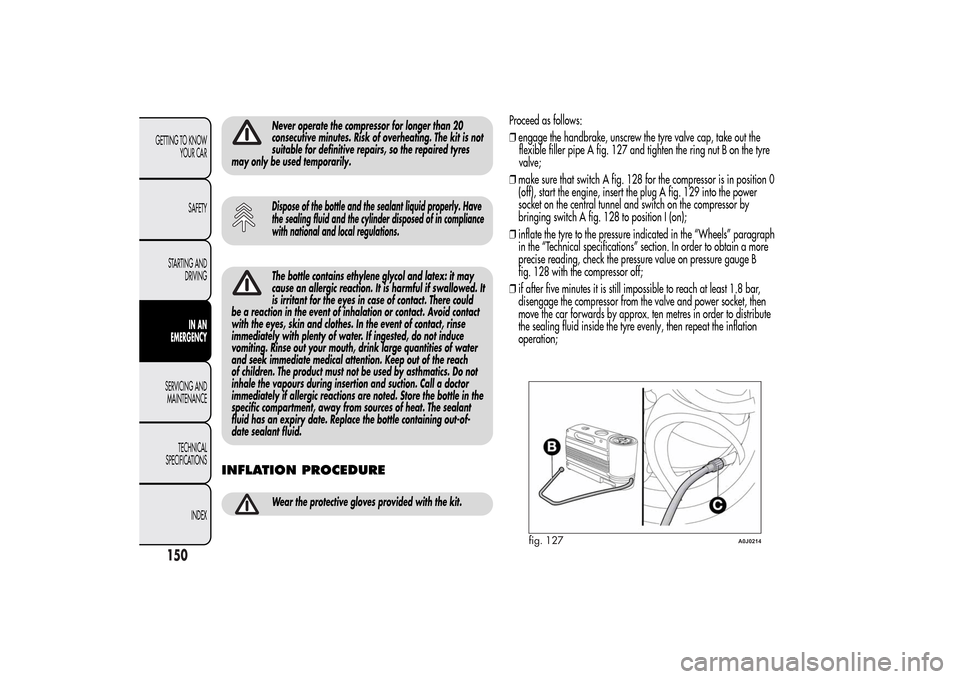
❒engage the handbrake, unscrew the tyre valve cap, take out the
flexible filler pipe A fig. 127 and tighten the ring nut B on the tyre
valve;
❒make sure that switch A fig. 128 for the compressor is in position 0
(off), start the engine, insert the plug A fig. 129 into the power
socket on the central tunnel and switch on the compressor by
bringing switch A fig. 128 to position I (on);
❒inflate the tyre to the pressure indicated in the “Wheels” paragraph
in the “Technical specifications” section. In order to obtain a more
precise reading, check the pressure value on pressure gauge B
fig. 128 with the compressor off;
❒if after five minutes it is still impossible to reach at least 1.8 bar,
disengage the compressor from the valve and power socket, then
move the car forwards by approx. ten metres in order to distribute
the sealing fluid inside the tyre evenly, then repeat the inflation
operation;
fig. 127
A0J0214
150GETTING TO KNOW
YOUR CAR
SAFETY
STARTING AND
DRIVING
IN AN
EMERGENCY
SERVICING AND
MAINTENANCE
TECHNICAL
SPECIFICATIONS
INDEX
Page 198 of 280
IMPORTANT
Avoid parking under trees; the resin dropped by trees makes the
paintwork go opaque and increases the possibility of corrosion.
Bird droppings must be washed off immediately and thoroughly as the
acid they contain is particularly aggressive.
Windows
Use specific detergents and clean cloths to prevent scratching or
altering the transparency.
IMPORTANT Wipe the inside surface of the rear window gently with a
cloth in the direction of the filaments to avoid damaging the heating
device.
Front headlights
Use a soft, damp cloth soaked in water and detergent for washing
cars.
IMPORTANT Never use aromatic substances (e.g. petrol) or ketenes
(e.g. acetone) for cleaning the plastic lenses of the front headlights.
IMPORTANT When cleaning the car with a pressure washer, keep the
water jet at least 20 cm away from the headlights.
Engine compartment
At the end of every winter, wash the engine compartment thoroughly,
taking care not to aim the jet of water directly at the electronic control
units or at the windscreen wiper motors. Have this operation
performed at a specialised workshop.
IMPORTANT The washing should take place with the engine cold and
the ignition key in the STOP position. After washing, make sure that the
various protective devices (e.g. rubber caps and guards) have not
been removed or damaged.
INTERIORSPeriodically check for water puddles under the mats that could cause
the panels to rust.
Never use flammable products, such as petrol ether or
rectified petrol to clean the inside of the car. The
electrostatic charges which are generated by rubbing
during the cleaning operation may cause a fire.Do not keep aerosol cans in the car: they might
explode. Aerosol cans must not be exposed to a
temperature exceeding 50°C. When the car is exposed
to sunlight, the internal temperature can greatly exceed this
value.
SEATS AND FABRIC PARTSRemove dust with a soft brush or a vacuum cleaner. It is advisable to
use a moist brush on velvet upholstery. Rub the seats with a sponge
soaked in a solution of neutral detergent and water.
194GETTING TO KNOW
YOUR CAR
SAFETY
STARTING AND
DRIVING
IN AN EMERGENCYSERVICING AND
MAINTENANCE
TECHNICAL
SPECIFICATIONS
INDEX
Page 235 of 280
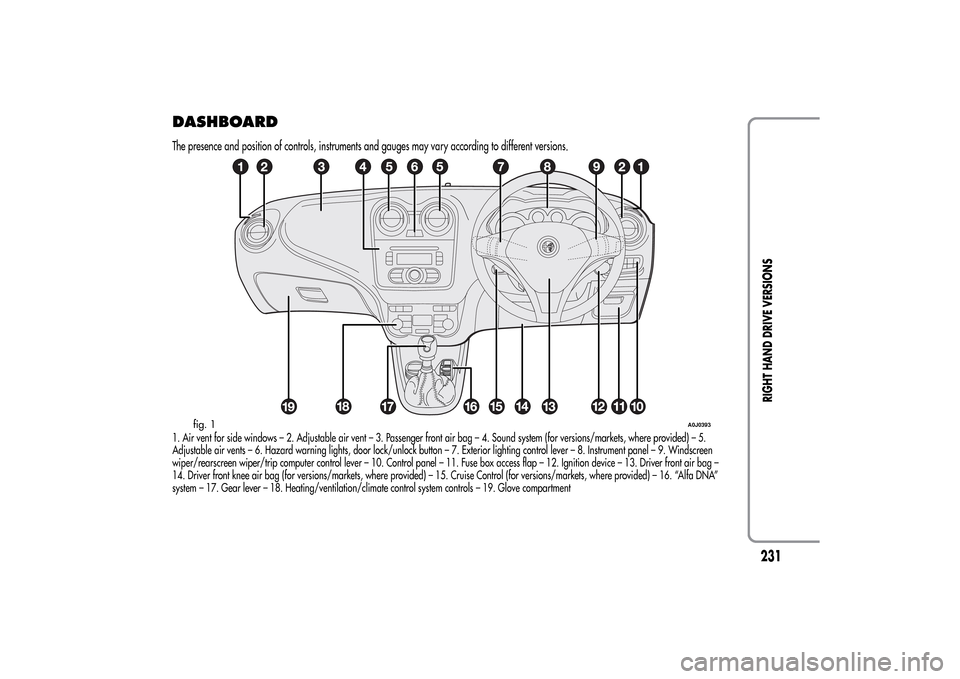
DASHBOARDThe presence and position of controls, instruments and gauges may vary according to different versions.1. Air vent for side windows – 2. Adjustable air vent – 3. Passenger front air bag – 4. Sound system (for versions/markets, where provided) – 5.
Adjustable air vents – 6. Hazard warning lights, door lock/unlock button – 7. Exterior lighting control lever – 8. Instrument panel – 9. Windscreen
wiper/rearscreen wiper/trip computer control lever – 10. Control panel – 11. Fuse box access flap – 12. Ignition device – 13. Driver front air bag –
14. Driver front knee air bag (for versions/markets, where provided) – 15. Cruise Control (for versions/markets, where provided) – 16. “Alfa DNA”
system – 17. Gear lever – 18. Heating/ventilation/climate control system controls – 19. Glove compartment
fig. 1
A0J0393
231
RIGHT HAND DRIVE VERSIONS
Page 273 of 280
INDEX
A
BS system ........................................ 91
– Mechanical Brake Assist................... 91
– System intervention.......................... 91
Additional heater ................................. 61
Air cleaner .......................................... 187
Alarm ................................................. 41
“Alfa DNA” system ............................. 95
– Driving modes................................. 95
– Engagement/disengagement of
"All Weather" mode ........................ 97
– Engagement/disengagement of
"Dynamic" mode............................. 96
– "Natural" Mode .............................. 95A
lfa Romeo Code system .................... 35
Ashtray ............................................... 75
ASR system (AntiSlip Regulation) ........... 93
Automatic dual zone climate control ...... 55
Battery .............................................. 187
– advice for extending lifetime............. 187
– replacement .................................... 187
Battery (recharging).............................. 170
Body versions....................................... 198
Bodywork
– body codes ..................................... 198– maintenance ................................... 193
– protection against atmospheric
agents ............................................ 193
– warranty......................................... 193
Bonnet................................................. 87
– Closing ........................................... 88
– Opening ......................................... 87
Brake Assist ......................................... 94
Brakes ................................................. 207
– brake fluid level............................... 186
bulb replacement .......................... 158-159
– interior lights................................... 160
Bulb replacement
– exterior lights .................................. 156
Bulbs
– types of bulbs.................................. 154
Carrying children safely ...................... 118
CBC (Cornering Brake Control) system ... 94
Central locking..................................... 72
Changing a bulb .................................. 153
– General instructions ......................... 153
Changing a wheel ................................ 143
Cigar lighter ........................................ 75
Cleaning and maintenance
– bodywork ....................................... 193– car interior...................................... 194
– engine compartment ........................ 194
– front headlights ............................... 194
– leather parts ................................... 195
– leather seats.................................... 195
– plastic and coated parts ................... 195
– seats and fabric parts ...................... 194
– windows ......................................... 194
Climate control/heating system ............. 52
Climatic comfort ................................... 51
– Diffusers ......................................... 51
Clutch ................................................. 206
CO2 emissions..................................... 229
Code Card........................................... 36
Control buttons..................................... 23
Control panel and instruments ............... 4
– Multifunction display........................ 4
– Reconfigurable multifunction
display ........................................... 5
Controls............................................... 71
Courtesy light
– bulb replacement............................. 161
Cruise Control ...................................... 67
Dashboard ........................................ 3
Daytime running lights (DRL) ................. 61
269GETTING TO KNOW
YOUR CAR
SAFETY
STARTING AND
DRIVING
IN AN EMERGENCY
SERVICING AND
MAINTENANCE
TECHNICAL
SPECIFICATIONSINDEX