tow Alfa Romeo MiTo 2014 User Guide
[x] Cancel search | Manufacturer: ALFA ROMEO, Model Year: 2014, Model line: MiTo, Model: Alfa Romeo MiTo 2014Pages: 280, PDF Size: 8.79 MB
Page 69 of 280
Move the stalk upwards (unstable position) to limit operation to the
time for which the stalk is held in this position. When released, the
stalk will return to its default position and the wiper will be
automatically stopped.
Do not use the windscreen wiper to remove layers of
snow or ice from the windscreen. In such conditions,
the windscreen wiper may be subjected to excessive
stress and the motor protection, which prevents operation for a
few seconds, may intervene. If operation is not restored, even
after turning the key and restarting the engine, contact Alfa
Romeo Authorized Services.Do not operate the windscreen wiper with the blades
lifted from the windscreen.
"Smart washing" function
Pull the lever towards the steering wheel (unstable position) to operate
the windscreen washer. Keep the stalk pulled for more than half a
second, with just one movement, to operate windscreen washer/wiper
jet at the same time.
The wiper stops working three strokes after the stalk is released. A
further stroke after approximately 6 seconds completes the cycle.RAIN SENSOR(for versions/markets, where provided)
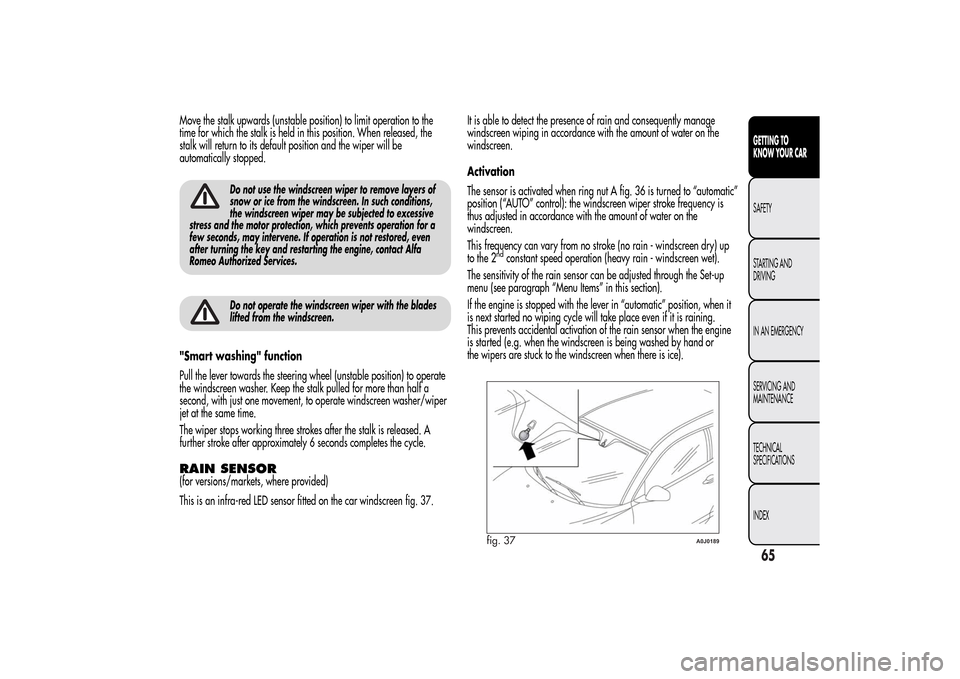
This is an infra-red LED sensor fitted on the car windscreen fig. 37.It is able to detect the presence of rain and consequently manage
windscreen wiping in accordance with the amount of water on the
windscreen.
Activation
The sensor is activated when ring nut A fig. 36 is turned to “automatic”
position (“AUTO” control): the windscreen wiper stroke frequency is
thus adjusted in accordance with the amount of water on the
windscreen.
This frequency can vary from no stroke (no rain - windscreen dry) up
to the 2
ndconstant speed operation (heavy rain - windscreen wet).
The sensitivity of the rain sensor can be adjusted through the Set-up
menu (see paragraph “Menu Items” in this section).
If the engine is stopped with the lever in “automatic” position, when it
is next started no wiping cycle will take place even if it is raining.
This prevents accidental activation of the rain sensor when the engine
is started (e.g. when the windscreen is being washed by hand or
the wipers are stuck to the windscreen when there is ice).
fig. 37
A0J0189
65GETTING TO
KNOW YOUR CARSAFETY
STARTING AND
DRIVING
IN AN EMERGENCY
SERVICING AND
MAINTENANCE
TECHNICAL
SPECIFICATIONS
INDEX
Page 70 of 280
Carry out any of the following manoeuvres to restore automatic
operation of the system:
❒movement of left stalk from the automatic position to any other
position and then back to automatic;
❒sensitivity adjustment (by turning ring nut A to increase or decrease).
When the rain sensor is reactivated using any of the manoeuvres
described above, reactivation is indicated by a single stroke of the
windscreen wipers, regardless of the condition of the windscreen.
If the sensitivity is changed whilst the rain sensor is operating, a
windscreen wiper stroke is carried out to confirm the change.
In the event of malfunction of the rain sensor whilst it is active, the
windscreen wiper operates intermittently at a speed consistent with the
sensitivity setting of the rain sensor, regardless of whether there is
rain on the glass (sensor failure is indicated on the display).
The sensor continues to operate and it is possible to set the windscreen
wiper to continuous mode (1
stor 2
ndspeed). The failure indication
remains for as long as the sensor is active.
REAR WINDOW WASHER/WIPER(for versions/markets, where provided)
Activation
This operates only with the ignition key turned to MAR.
Turn ring nut B fig. 36 from positionOto position
to operate the
rear window wiper as follows:
❒in intermittent mode when the windscreen wiper is not operating;
❒in synchronous mode (at half the speed of the windscreen wiper)
when the windscreen wiper is operating;
❒in continuous mode with reverse gear engaged and the control
active.
With reverse gear engaged and windscreen wiper on, the rear
window wiper is activated in continuous mode. Pushing the stalk
towards the dashboard (unstable position) will activate the rear
window washer jet.
Keep the stalk pushed for more than half a second to activate the rear
window wiper as well. Releasing the stalk will activate the smart
washing function, as described for the windscreen wiper.
66GETTING TO
KNOW YOUR CAR
SAFETY
STARTING AND
DRIVING
IN AN EMERGENCY
SERVICING AND
MAINTENANCE
TECHNICAL
SPECIFICATIONS
INDEX
Page 71 of 280
CRUISE CONTROL(for versions/markets, where provided)GENERAL INFORMATIONThis is an electronically controlled driving assistance device which
allows driving at a chosen speed above 30 km/h on long stretches of
dry, straight roads with few variations (e.g. motorways), without
having to depress the accelerator pedal.
The use of this device on extra-urban roads with traffic is not therefore
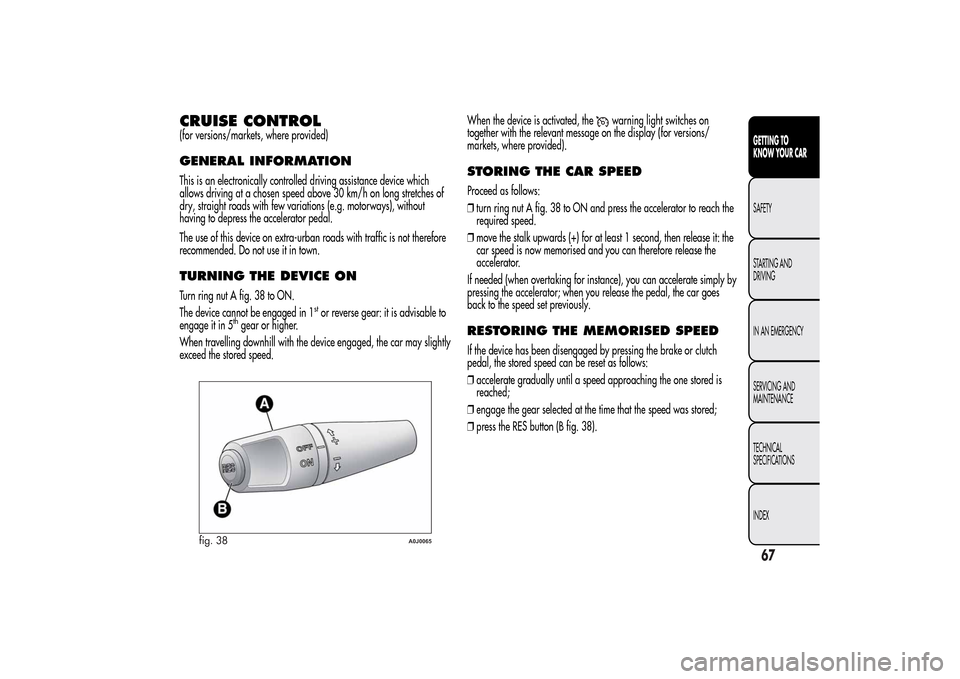
recommended. Do not use it in town.TURNING THE DEVICE ONTurn ring nut A fig. 38 to ON.
The device cannot be engaged in 1
stor reverse gear: it is advisable to
engage it in 5
thgear or higher.
When travelling downhill with the device engaged, the car may slightly
exceed the stored speed.When the device is activated, the
warning light switches on
together with the relevant message on the display (for versions/
markets, where provided).
STORING THE CAR SPEEDProceed as follows:
❒turn ring nut A fig. 38 to ON and press the accelerator to reach the
required speed.
❒move the stalk upwards (+) for at least 1 second, then release it: the
car speed is now memorised and you can therefore release the
accelerator.
If needed (when overtaking for instance), you can accelerate simply by
pressing the accelerator; when you release the pedal, the car goes
back to the speed set previously.RESTORING THE MEMORISED SPEEDIf the device has been disengaged by pressing the brake or clutch
pedal, the stored speed can be reset as follows:
❒accelerate gradually until a speed approaching the one stored is
reached;
❒engage the gear selected at the time that the speed was stored;
❒press the RES button (B fig. 38).
fig. 38
A0J0065
67GETTING TO
KNOW YOUR CARSAFETY
STARTING AND
DRIVING
IN AN EMERGENCY
SERVICING AND
MAINTENANCE
TECHNICAL
SPECIFICATIONS
INDEX
Page 87 of 280
Incorrect use of the electric windows may be
dangerous. Before and during operation, always check
that no passenger is at risk of being injured directly
by the moving window or by objects getting caught in or
dragged by the window. When leaving the car, always remove
the key from the ignition to prevent accidental operation of the
electric windows from being a hazard for those still on board.
Electric window system initialisation
The system must be re-initialised after disconnecting the battery or if
the relevant protection fuse is blown.
Initialisation procedure:
❒fully close the window to initialise with manual operation;
❒after the window has reached the upper end of travel, hold down
the closing control for at least 1 second.
For versions/markets where provided, after a break in power supply
for the control units (battery replaced or disconnected or protective
fuses for the electric window control units replaced), the automatic
operation of the windows must be restored.
The restoration procedure must be performed as described below with
the doors closed:
❒completely open the driver's door window, holding the operating
button down for at least three seconds after the (lower) end of travel
position;
❒completely raise the driver side window and hold the button down
for at least 3 seconds once the (upper) end of travel position has
been reached;❒proceed in the same way as described in points 1 and 2 for the
passenger side door;
❒make sure that the initialisation is correct by checking that the
windows work automatically.
IMPORTANT With the central locking on, pulling the internal opening
lever for one of the doors switches the locking off for all the doors.
In the absence of electrical power supply (blown fuse, battery
disconnected, etc.) it is still possible to lock the doors manually. In this
case, the automatic lowering function of the windows is not available.
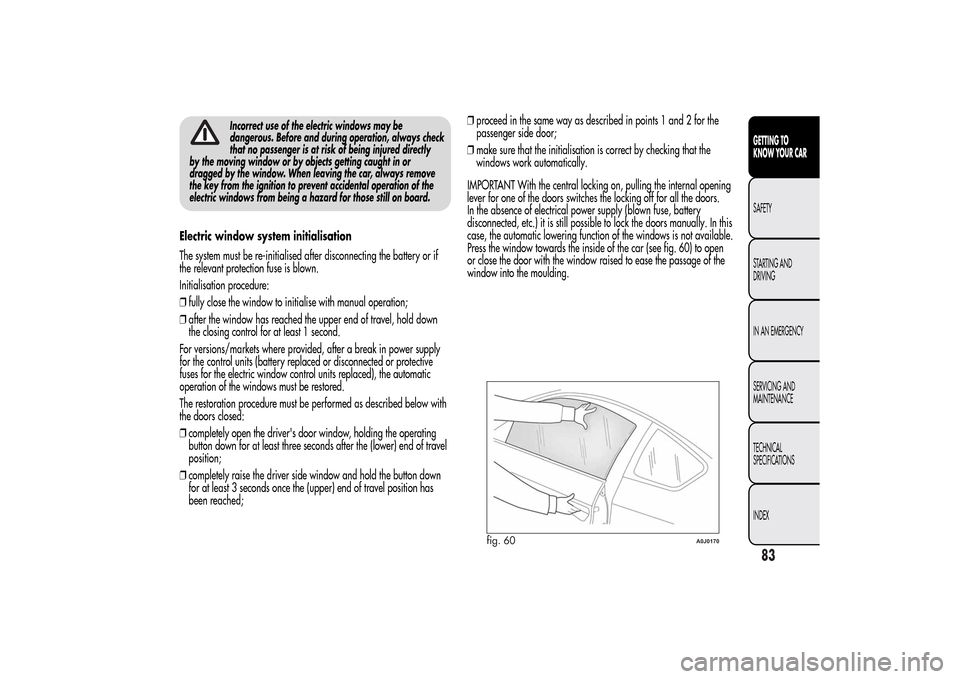
Press the window towards the inside of the car (see fig. 60) to open
or close the door with the window raised to ease the passage of the
window into the moulding.
fig. 60
A0J0170
83GETTING TO
KNOW YOUR CARSAFETY
STARTING AND
DRIVING
IN AN EMERGENCY
SERVICING AND
MAINTENANCE
TECHNICAL
SPECIFICATIONS
INDEX
Page 94 of 280
HEADLIGHTSLIGHT BEAM DIRECTIONThe correct orientation of the headlights is important for the driver's
comfort and safety as well as for all other road users. This is also
covered by a specific rule of the highway code.
The headlights must be correctly aligned to ensure the best visibility
conditions for yourself and others when driving with lights on. To check
and, if necessary, adjust, contact Alfa Romeo Authorized Services.HEADLIGHT ALIGNMENT CORRECTORThis device works with the ignition key in the MAR position and the
dipped headlights on.
Headlight alignment adjustment
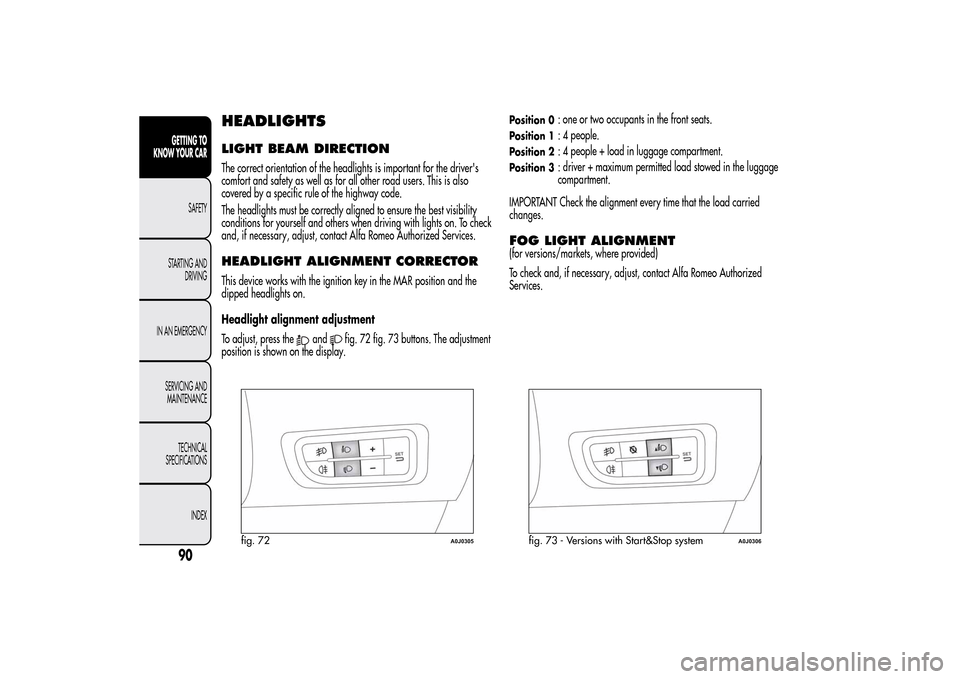
To adjust, press the
and
fig. 72 fig. 73 buttons. The adjustment
position is shown on the display.
Position 0
: one or two occupants in the front seats.
Position 1
: 4 people.
Position 2
: 4 people + load in luggage compartment.
Position 3
: driver + maximum permitted load stowed in the luggage
compartment.
IMPORTANT Check the alignment every time that the load carried
changes.
FOG LIGHT ALIGNMENT(for versions/markets, where provided)
To check and, if necessary, adjust, contact Alfa Romeo Authorized
Services.
fig. 72
A0J0305
fig. 73 - Versions with Start&Stop system
A0J0306
90GETTING TO
KNOW YOUR CAR
SAFETY
STARTING AND
DRIVING
IN AN EMERGENCY
SERVICING AND
MAINTENANCE
TECHNICAL
SPECIFICATIONS
INDEX
Page 110 of 280

Detection distances
❒Central operating range: 140 cm
❒Side operating range: 60 cm
If several obstacles are detected by the sensors, only the nearest one is
considered.OPERATION WITH TRAILERParking sensor operation is deactivated automatically when the trailer
electric cable plug is fitted into the car tow hook socket. The sensors
are automatically enabled again when the trailer's cable plug is
removed.
The sensor must be free of mud, dirt, snow or ice in order
for the system to work. Be careful not to scratch or damage
the sensors while cleaning them. Avoid using dry, rough
or hard cloths. The sensors should be washed using clean water with
the addition of car shampoo if necessary. When using special washing
equipment such as high pressure jets or steam cleaning, clean the
sensors very quickly keeping the jet more than 10 cm away.When repainting the bumpers or touching up paint in
the sensor area, contact Alfa Romeo Authorized
Services only. Incorrect paint application could affect
the operation of the parking sensors.
Parking manoeuvres however are always the driver’s
responsibility. When carrying out such manoeuvres,
always ensure that the manoeuvring area is free of
people (particularly children) and animals. The parking sensor is
designed to assist drivers, who must still never allow their
attention to lapse during potentially dangerous manoeuvres even
if performed at low speed.
GENERAL WARNINGSDuring parking manoeuvres, pay the utmost attention to any obstacles
that could be located above or below the sensors.
Objects located near the rear of the car are not detected under certain
circumstances and could therefore cause damage to the car or be
damaged.
The following conditions may influence the performance of the parking
sensor system:
❒reduced sensor sensitivity and a reduction in the parking assistance
system performance could be due to the presence on the surface of
the sensor of: ice, snow, mud, thick paint
❒the sensors may detect a non-existent obstacle (echo interference)
due to mechanical interference, for example when washing the
car, in rain (strong wind), hail;
❒The signals sent by the sensors can also be altered by the presence
of ultrasonic systems (e.g. pneumatic brake systems or pneumatic
drills) near the vehicle.
106GETTING TO
KNOW YOUR CAR
SAFETY
STARTING AND
DRIVING
IN AN EMERGENCY
SERVICING AND
MAINTENANCE
TECHNICAL
SPECIFICATIONS
INDEX
Page 120 of 280
PRETENSIONERSThe car is equipped with front seat belt pretensioners, which draw
back the seat belts by several centimetres in the event of a violent
frontal impact. This guarantees the perfect adherence of the seat belts
to the occupants’ bodies before the restraining action begins.
It is evident that the pretensioners have been activated when the belt
withdraws towards the reel.
The car is also equipped with a second pretensioner (in the kick plate
area). Its activation is signalled by the shortening of the metal cable.
A slight discharge of smoke may be produced during the activation of
the pretensioner. This is not harmful and does not indicate the start
of a fire.
IMPORTANT To obtain the highest degree of protection from the action
of the pretensioner, wear the seat belt tight to the chest and pelvis.
The pretensioner does not require any maintenance or lubrication: any
changes to its original conditions will invalidate its efficiency. If, due
to exceptional natural events (floods, sea storms, etc.), the device
has been affected by water and mud, it must be replaced.
The pretensioner may be used only once. Once it has
been activated, contact Alfa Romeo Authorised
Workshops to have it replaced. Consult the plate in the
glove compartment to check the status of the device. Contact Alfa
Romeo Authorised Workshops to have the device replaced as
this date approaches.
Operations which lead to knocks, vibrations or localised
heating (over 100°C for a maximum of 6 hours) in the area
around the pretensioners may cause damage or trigger
them. These devices are not affected by vibrations caused by
irregularities of the road surface or low obstacles such as kerbs, etc.
Contact Alfa Romeo Authorized Services for any assistance necessary.
LOAD LIMITERSTo increase protection, the front seat belt reels contain a load limiter
which controls the force acting on the chest and shoulders during
the belt restraining action in the event of a head-on collision.GENERAL INSTRUCTIONS FOR USING
THE SEAT BELTSComply with (and ensure that all the other occupants of the car comply
with) the local laws in force regarding the use of seat belts. Always
fasten the seat belts before starting off.
Seat belts must also be worn by pregnant women: the risk of injury in
the event of an accident is reduced for them and the unborn child if
they are wearing a seat belt.
116GETTING TO KNOW
YOUR CAR
SAFETY
STARTING AND
DRIVING
IN AN EMERGENCY
SERVICING AND
MAINTENANCE
TECHNICAL
SPECIFICATIONS
INDEX
Page 138 of 280
PROCEDURE FOR DIESEL VERSIONSProceed as follows:
❒engage the handbrake and place the gearbox lever in neutral;
❒turn the ignition key to MAR-ON: the warning lights
and
(or the symbol on the display) on the instrument panel will
switch on;
❒wait for the warning lights (or the symbol on the display) to switch
off;
❒fully depress the clutch pedal, without touching the accelerator;
❒turn the ignition key to AVV;
warning light switches off.
Waiting too long will waste the heating work carried out by the
glow plugs. Release the key as soon as the engine starts.
If the
warning light flashes for about 1 minute after
starting or during prolonged cranking, this indicates a fault
in the glow plug preheating system. Use the car normally
if the engine starts and go to Alfa Romeo Authorized Services as soon
as possible.
It is dangerous to run the engine in enclosed areas. The
engine takes in oxygen and releases carbon dioxide,
carbon monoxide and other toxic gases.It is advisable not to demand maximum performance from
your car (e.g. excessive acceleration, long distances at
maximum rpm, excessively intense braking, etc.) when it is
first used.
When the engine is off, do not leave the ignition key turned
to MAR to prevent unnecessary electrical consumption from
draining the battery.Remember that the brake servo and electromechanical
power steering are not operational until the engine
has been started, therefore much more effort than
usual is required on the brake pedal and steering wheel.Never start the engine by pushing, towing or driving
downhill. These manoeuvres may damage the catalytic
converter.
WARMING UP THE ENGINE JUST
AFTER IT HAS STARTEDProceed as follows:
❒drive off slowly, letting the engine turn at medium revs and without
accelerating abruptly;
❒do not demand maximum performance for the first few kilometres. It
is advisable to wait until the engine coolant temperature indicator
starts moving.
134GETTING TO KNOW
YOUR CAR
SAFETYSTARTING AND
DRIVINGIN AN EMERGENCY
SERVICING AND
MAINTENANCE
TECHNICAL
SPECIFICATIONS
INDEX
Page 143 of 280
Maximum speed
Fuel consumption considerably increases as speed increases. Keep
your speed as even as possible, avoiding unnecessary braking and
acceleration which cause excessive fuel consumption and increased
emissions.
Acceleration
Accelerating violently severely affects consumption and emissions:
acceleration should be gradual and should not exceed the maximum
torque.CONDITIONS OF USECold starting
Short distances and frequent cold start-ups will prevent the engine from
reaching optimal running temperature. This results in a significant
increase in consumption levels (from +15 to +30% on the urban cycle)
and emissions.
Traffic and road conditions
High fuel consumption is caused by heavy traffic, for instance when
travelling in a queue with frequent use of low gears or in large towns
with many traffic lights. Winding mountain roads and rough road
surfaces also adversely affect consumption.
Stops in traffic
During prolonged stops (e.g. level crossings) switch the engine off.
TOWING TRAILERSIMPORTANT
The vehicle must be provided with a type-approved tow hook and
adequate electrical system to tow caravans or trailers. Installation must
be carried out by a specialist.
Fit any specific and/or additional rear view mirrors as specified by the
Highway Code.
Remember that, when towing a trailer, steep hills are harder to climb,
braking distances increase and overtaking takes longer relative to
the overall weight of the trailer.
Engage a low gear when driving downhill, rather than constantly using
the brake.
The weight of the trailer reduces the load capacity of the car by the
same amount. Consider the weight at full load, including accessories
and luggage, to make sure you do not exceed the maximum towable
weight (shown in the registration document).
Respect the speed limits specific to each country for vehicles towing
trailers. In any case do not exceed 100 km/h.
139GETTING TO KNOW
YOUR CAR
SAFETYSTARTING AND
DRIVINGIN AN EMERGENCY
SERVICING AND
MAINTENANCE
TECHNICAL
SPECIFICATIONS
INDEX
Page 144 of 280
INSTALLING A TOW HOOKContact Alfa Romeo Authorised Services to install a tow hook.
The ABS with which the car is equipped will not control
the braking system of the trailer. Particular caution is
therefore required on slippery roads.Do not, under any circumstances, modify the vehicle's
braking system to control the trailer breaking system.
The towing breaking system must be completely
independent of the vehicle's hydraulic system.
SNOW TYRESUse snow tyres of the same size as the normal tyres provided with the
car: Alfa Romeo Authorized Services will be able to advise you on
the most appropriate tyre to use.
Only use these tyres in the event of ice or snow on the roads.
For the type of snow tyre to be used, inflation pressures and the
specifications, strictly follow the instructions given in the "Wheels"
paragraph in the "Technical specifications" section.
The winter performance of these tyres is considerably reduced when
the tread thickness is less than 4 mm. Replace them in this case.
Due to their specific features, the performance of snow tyres is much
lower than that of normal types in normal conditions or long motorway
stretches. Their usage should therefore be restricted in accordance
with their type approval.
All four tyres should be the same (brand and track) to ensure greater
safety when driving and braking and good driveability. Remember
that it is inadvisable to change the rotation direction of tyres.
The maximum speed for snow tyres marked “Q” is
160 km/h, while it is 190 km/h for “T” tyres and 210
km/h for "H" tyres. The highway code speed limits
must however always be complied with.
140GETTING TO KNOW
YOUR CAR
SAFETYSTARTING AND
DRIVINGIN AN EMERGENCY
SERVICING AND
MAINTENANCE
TECHNICAL
SPECIFICATIONS
INDEX