instrument panel Alfa Romeo MiTo 2014 Owner's Guide
[x] Cancel search | Manufacturer: ALFA ROMEO, Model Year: 2014, Model line: MiTo, Model: Alfa Romeo MiTo 2014Pages: 280, PDF Size: 8.79 MB
Page 111 of 280
❒sensor performance can also be influenced by the position of the
sensors. For example by a change in the ride setting (caused by
the wear of the shock absorbers, suspension), overloading the
vehicle and carrying out specific tuning operations that require the
vehicle to be lowered;
❒The detection of obstacles at the top part of the car may not be
guaranteed because the system detects obstacles that could cause an
impact with the car in the bottom part.
TPMS (Tyre Pressure
Monitoring System)(for versions/markets, where provided)
The car may be fitted with a tyre pressure monitoring system (TPMS),
which informs the driver of the tyre inflation status via the "Check
tyre pressure" and "Low tyre pressure" messages on the display.
This system comprises a radio frequency transmitter fitted to each
wheel (on the wheel rim inside the tyre), which is able to send
information on the tyre inflation pressure of each wheel to the control
unit.IMPORTANT INFORMATION ABOUT
THE TPMSThe fault indications are not stored and will therefore not be displayed
after the engine has been switched off and then on again.
If the fault conditions persist, the control unit will send the relative
indications to the instrument panel only after the car has been in
motion for a short time.
The presence of the TPMS does not permit the driver to
neglect regular checks of the tyre pressure, including
for the spare wheel.Tyre pressure must be checked with tyres rested and
cold. Should it become necessary for whatever reason
to check pressure with warm tyres, do not reduce
pressure even though it is higher than the prescribed value, but
repeat the check when tyres are cold.
107GETTING TO
KNOW YOUR CARSAFETY
STARTING AND
DRIVING
IN AN EMERGENCY
SERVICING AND
MAINTENANCE
TECHNICAL
SPECIFICATIONS
INDEX
Page 130 of 280
Fit the child seat according to the instructions, which
must be included.
Main recommendations to carry children safely
❒Install the child seats on the rear seat, which is the most protected
position in the event of an accident.
❒Keep children in rear facing seats for as long as possible, until 2
years old.
❒Should a rear facing child seat be installed on the rear seats, it is
advisable to position it as far forward as the position of the front
seat allows.
❒If the passenger's front airbag is deactivated always check the
permanent switching on of the dedicated warning light on the
instrument panel to make sure that it has actually been deactivated.
❒Carefully follow the instructions supplied with the child seat itself.
Keep the instructions in the car along with the other documents
and this handbook. Do not use second-hand child seats without
instructions.
❒Only one child is to be strapped into each restraint system; never
carry two children simultaneously.
❒Always check that the seat belts do not interfere with the child's
throat.
❒Always check that the seat belt is well fastened by pulling on it.❒While travelling, do not let the child sit incorrectly or unfasten the
belts.
❒Never allow a child to put the belt's diagonal section under an arm
or behind their back.
❒Never carry children on your lap, even newborns. No-one can
restrain a child in the event of an accident.
❒In the event of an accident, replace the child seat with a new one.
126GETTING TO KNOW
YOUR CAR
SAFETY
STARTING AND
DRIVING
IN AN EMERGENCY
SERVICING AND
MAINTENANCE
TECHNICAL
SPECIFICATIONS
INDEX
Page 137 of 280
STARTING AND DRIVING
STARTING THE ENGINEPROCEDURE FOR PETROL VERSIONS(excluding Turbo TwinAir versions)
Proceed as follows:
❒engage the handbrake and place the gearbox lever in neutral;
❒fully depress the clutch pedal, without touching the accelerator;
❒turn the ignition key to AVV and release it as soon as the engine
starts.
IMPORTANT
❒If the engine does not start at the first attempt, return the ignition key
to STOP before repeating the starting procedure.
❒If, when the ignition key is at MAR, the instrument panel warning
light
(or the symbol on the display) remains on together with
warning light
, turn the key to STOP and then back to MAR. If
the warning light remains on, try the other keys provided. If you are
still unable to start the engine contact an Alfa Romeo Authorised
Service Provider.
❒Never leave the ignition key at MAR when the engine is stopped.Engine starting for Turbo TwinAir versions
Proceed as follows:
❒Engage the handbrake and place the gear lever in neutral or fully
press the clutch pedal if a gear other than neutral is engaged;
❒turn the ignition key to AVV and release it as soon as the engine
starts.
NoteIf the vehicle does not start at the first attempt, return the ignition
key to STOP and repeat the starting procedure placing the gear lever
in neutral and fully pressing the clutch pedal.
IMPORTANT
❒If, when the ignition key is at MAR, the instrument panel warning
light
(or the symbol on the display) remains on together with
warning light
, turn the key to STOP and then back to MAR. If
the warning light remains on, try the other keys provided. If you are
still unable to start the engine contact an Alfa Romeo Authorised
Service Provider.
❒Never leave the ignition key at MAR when the engine is stopped.
133GETTING TO KNOW
YOUR CAR
SAFETYSTARTING AND
DRIVINGIN AN EMERGENCY
SERVICING AND
MAINTENANCE
TECHNICAL
SPECIFICATIONS
INDEX
Page 138 of 280
PROCEDURE FOR DIESEL VERSIONSProceed as follows:
❒engage the handbrake and place the gearbox lever in neutral;
❒turn the ignition key to MAR-ON: the warning lights
and
(or the symbol on the display) on the instrument panel will
switch on;
❒wait for the warning lights (or the symbol on the display) to switch
off;
❒fully depress the clutch pedal, without touching the accelerator;
❒turn the ignition key to AVV;
warning light switches off.
Waiting too long will waste the heating work carried out by the
glow plugs. Release the key as soon as the engine starts.
If the
warning light flashes for about 1 minute after
starting or during prolonged cranking, this indicates a fault
in the glow plug preheating system. Use the car normally
if the engine starts and go to Alfa Romeo Authorized Services as soon
as possible.
It is dangerous to run the engine in enclosed areas. The
engine takes in oxygen and releases carbon dioxide,
carbon monoxide and other toxic gases.It is advisable not to demand maximum performance from
your car (e.g. excessive acceleration, long distances at
maximum rpm, excessively intense braking, etc.) when it is
first used.
When the engine is off, do not leave the ignition key turned
to MAR to prevent unnecessary electrical consumption from
draining the battery.Remember that the brake servo and electromechanical
power steering are not operational until the engine
has been started, therefore much more effort than
usual is required on the brake pedal and steering wheel.Never start the engine by pushing, towing or driving
downhill. These manoeuvres may damage the catalytic
converter.
WARMING UP THE ENGINE JUST
AFTER IT HAS STARTEDProceed as follows:
❒drive off slowly, letting the engine turn at medium revs and without
accelerating abruptly;
❒do not demand maximum performance for the first few kilometres. It
is advisable to wait until the engine coolant temperature indicator
starts moving.
134GETTING TO KNOW
YOUR CAR
SAFETYSTARTING AND
DRIVINGIN AN EMERGENCY
SERVICING AND
MAINTENANCE
TECHNICAL
SPECIFICATIONS
INDEX
Page 146 of 280
IN AN EMERGENCY
In an emergency we recommend that you call the freephone number found in the Warranty Booklet. You can also
consult www.alfaromeo.com to find your nearest Alfa Romeo Authorized Services.STARTING THE ENGINEIf the
warning light on the instrument panel remains on constantly,
contact Alfa Romeo Authorized Services immediately.
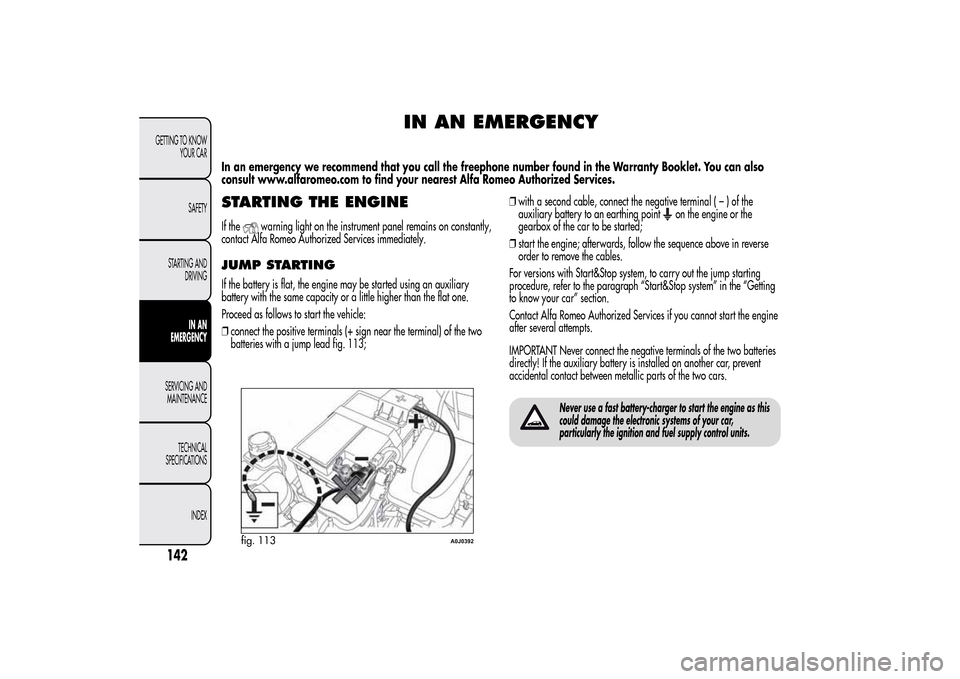
JUMP STARTINGIf the battery is flat, the engine may be started using an auxiliary
battery with the same capacity or a little higher than the flat one.
Proceed as follows to start the vehicle:
❒connect the positive terminals (+ sign near the terminal) of the two
batteries with a jump lead fig. 113;❒with a second cable, connect the negative terminal(–)ofthe
auxiliary battery to an earthing point
on the engine or the
gearbox of the car to be started;
❒start the engine; afterwards, follow the sequence above in reverse
order to remove the cables.
For versions with Start&Stop system, to carry out the jump starting
procedure, refer to the paragraph “Start&Stop system” in the “Getting
to know your car” section.
Contact Alfa Romeo Authorized Services if you cannot start the engine
after several attempts.
IMPORTANT Never connect the negative terminals of the two batteries
directly! If the auxiliary battery is installed on another car, prevent
accidental contact between metallic parts of the two cars.
Never use a fast battery-charger to start the engine as this
could damage the electronic systems of your car,
particularly the ignition and fuel supply control units.
fig. 113
A0J0392
142GETTING TO KNOW
YOUR CAR
SAFETY
STARTING AND
DRIVING
IN AN
EMERGENCY
SERVICING AND
MAINTENANCE
TECHNICAL
SPECIFICATIONS
INDEX
Page 172 of 280
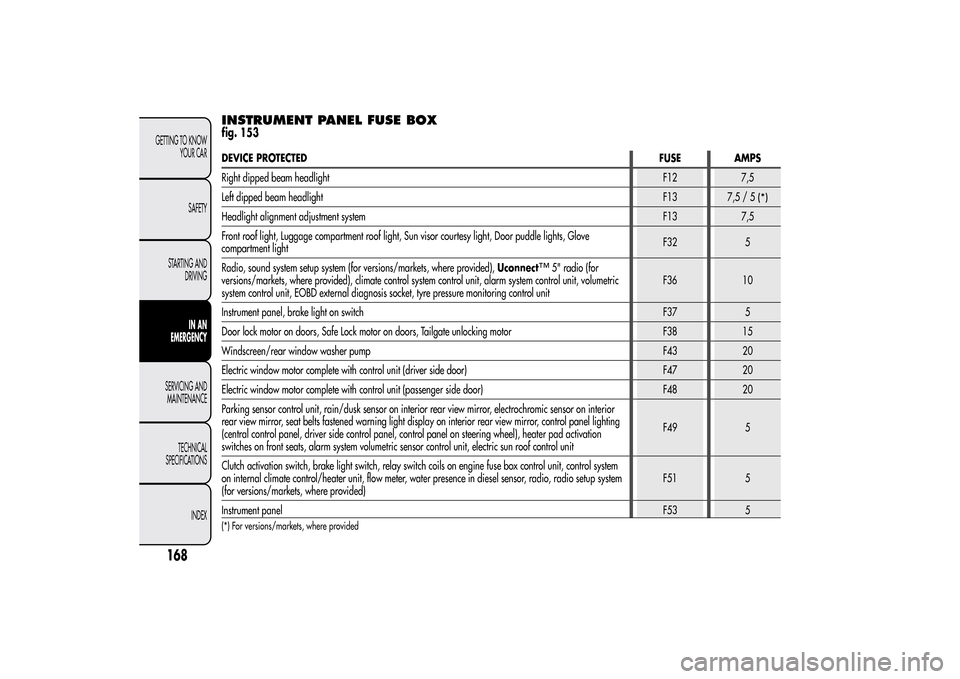
INSTRUMENT PANEL FUSE BOXfig. 153DEVICE PROTECTEDFUSE AMPS
Right dipped beam headlightF12 7,5
Left dipped beam headlightF13
7,5/5
(*)
Headlight alignment adjustment systemF13 7,5
Front roof light, Luggage compartment roof light, Sun visor courtesy light, Door puddle lights, Glove
compartment lightF32 5
Radio, sound system setup system (for versions/markets, where provided),Uconnect
™
5" radio (for
versions/markets, where provided), climate control system control unit, alarm system control unit, volumetric
system control unit, EOBD external diagnosis socket, tyre pressure monitoring control unitF36 10
Instrument panel, brake light on switchF37 5
Door lock motor on doors, Safe Lock motor on doors, Tailgate unlocking motor F38 15
Windscreen/rear window washer pumpF43 20
Electric window motor complete with control unit (driver side door) F47 20
Electric window motor complete with control unit (passenger side door) F48 20
Parking sensor control unit, rain/dusk sensor on interior rear view mirror, electrochromic sensor on interior
rear view mirror, seat belts fastened warning light display on interior rear view mirror, control panel lighting
(central control panel, driver side control panel, control panel on steering wheel), heater pad activation
switches on front seats, alarm system volumetric sensor control unit, electric sun roof control unitF49 5
Clutch activation switch, brake light switch, relay switch coils on engine fuse box control unit, control system
on internal climate control/heater unit, flow meter, water presence in diesel sensor, radio, radio setup system
(for versions/markets, where provided)F51 5
Instrument panelF53 5
(*) For versions/markets, where provided
168GETTING TO KNOW
YOUR CAR
SAFETY
STARTING AND
DRIVING
IN AN
EMERGENCY
SERVICING AND
MAINTENANCE
TECHNICAL
SPECIFICATIONS
INDEX
Page 178 of 280
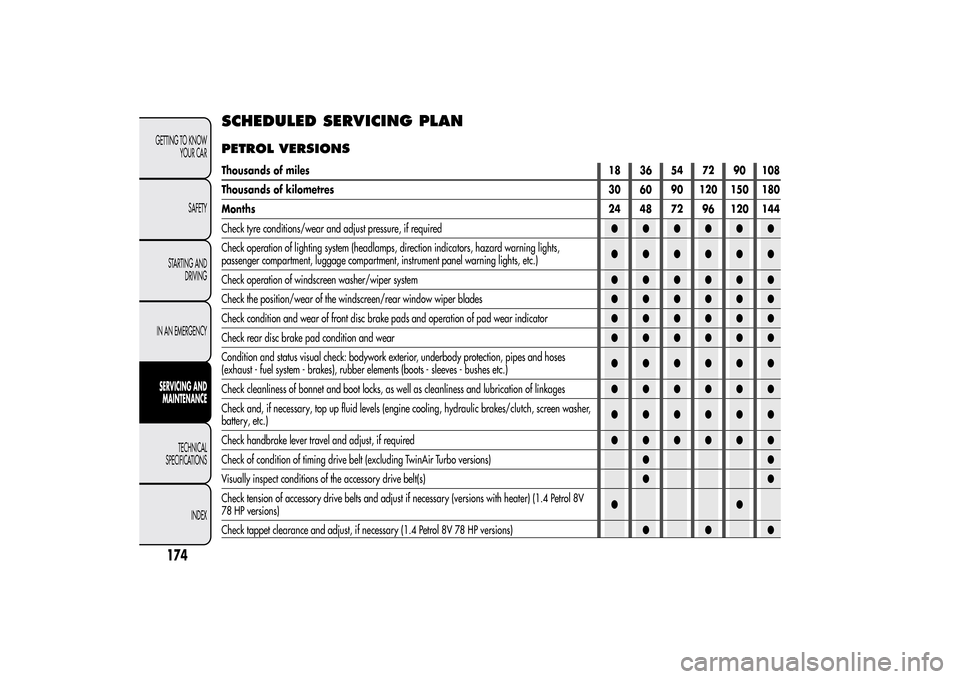
SCHEDULED SERVICING PLANPETROL VERSIONSThousands of miles18 36 54 72 90 108
Thousands of kilometres 30 60 90 120 150 180
Months24 48 72 96 120 144
Check tyre conditions/wear and adjust pressure, if required●●●●●●
Check operation of lighting system (headlamps, direction indicators, hazard warning lights,
passenger compartment, luggage compartment, instrument panel warning lights, etc.)●●●●●●
Check operation of windscreen washer/wiper system●●●●●●
Check the position/wear of the windscreen/rear window wiper blades●●●●●●
Check condition and wear of front disc brake pads and operation of pad wear indicator●●●●●●
Check rear disc brake pad condition and wear●●●●●●
Condition and status visual check: bodywork exterior, underbody protection, pipes and hoses
(exhaust - fuel system - brakes), rubber elements (boots - sleeves - bushes etc.)●●●●●●
Check cleanliness of bonnet and boot locks, as well as cleanliness and lubrication of linkages●●●●●●
Check and, if necessary, top up fluid levels (engine cooling, hydraulic brakes/clutch, screen washer,
battery, etc.)●●●●●●
Check handbrake lever travel and adjust, if required●●●●●●
Check of condition of timing drive belt (excluding TwinAir Turbo versions)●●
Visually inspect conditions of the accessory drive belt(s)●●
Check tension of accessory drive belts and adjust if necessary (versions with heater) (1.4 Petrol 8V
78 HP versions)●●
Check tappet clearance and adjust, if necessary (1.4 Petrol 8V 78 HP versions)●●●
174GETTING TO KNOW
YOUR CAR
SAFETY
STARTING AND
DRIVING
IN AN EMERGENCYSERVICING AND
MAINTENANCE
TECHNICAL
SPECIFICATIONS
INDEX
Page 180 of 280
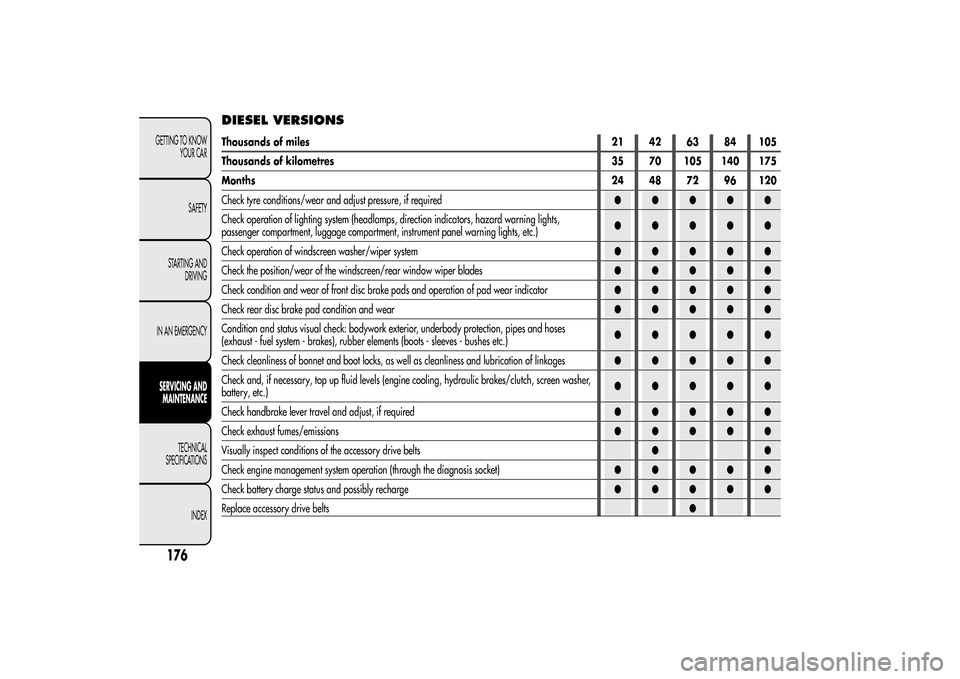
DIESEL VERSIONSThousands of miles21 42 63 84 105
Thousands of kilometres 35 70 105 140 175
Months24 48 72 96 120
Check tyre conditions/wear and adjust pressure, if required●●●●●
Check operation of lighting system (headlamps, direction indicators, hazard warning lights,
passenger compartment, luggage compartment, instrument panel warning lights, etc.)●●●●●
Check operation of windscreen washer/wiper system●●●●●
Check the position/wear of the windscreen/rear window wiper blades●●●●●
Check condition and wear of front disc brake pads and operation of pad wear indicator●●●●●
Check rear disc brake pad condition and wear●●●●●
Condition and status visual check: bodywork exterior, underbody protection, pipes and hoses
(exhaust - fuel system - brakes), rubber elements (boots - sleeves - bushes etc.)●●●●●
Check cleanliness of bonnet and boot locks, as well as cleanliness and lubrication of linkages●●●●●
Check and, if necessary, top up fluid levels (engine cooling, hydraulic brakes/clutch, screen washer,
battery, etc.)●●●●●
Check handbrake lever travel and adjust, if required●●●●●
Check exhaust fumes/emissions●●●●●
Visually inspect conditions of the accessory drive belts●●
Check engine management system operation (through the diagnosis socket)●●●●●
Check battery charge status and possibly recharge●●●●●
Replace accessory drive belts●
176GETTING TO KNOW
YOUR CAR
SAFETY
STARTING AND
DRIVING
IN AN EMERGENCYSERVICING AND
MAINTENANCE
TECHNICAL
SPECIFICATIONS
INDEX
Page 181 of 280
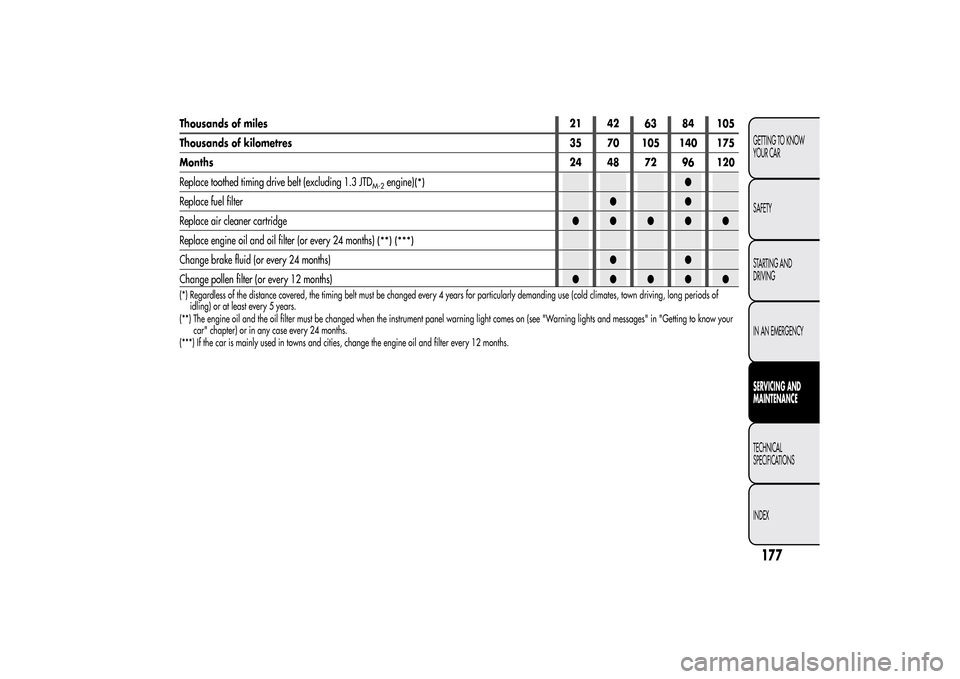
Thousands of miles21 42 63 84 105
Thousands of kilometres 35 70 105 140 175
Months24 48 72 96 120
Replace toothed timing drive belt (excluding 1.3 JTD
M-2
engine)
(*)
●
Replace fuel filter●●
Replace air cleaner cartridge●●●●●
Replace engine oil and oil filter (or every 24 months)
(**) (***)
Change brake fluid (or every 24 months)●●
Change pollen filter (or every 12 months)●●●●●(*) Regardless of the distance covered, the timing belt must be changed every 4 years for particularly demanding use (cold climates, town driving, long periods of
idling) or at least every 5 years.
(**) The engine oil and the oil filter must be changed when the instrument panel warning light comes on (see "Warning lights and messages" in "Getting toknow your
car" chapter) or in any case every 24 months.
(***) If the car is mainly used in towns and cities, change the engine oil and filter every 12 months.
177GETTING TO KNOW
YOUR CAR
SAFETY
STARTING AND
DRIVING
IN AN EMERGENCYSERVICING AND
MAINTENANCETECHNICAL
SPECIFICATIONS
INDEX
Page 199 of 280
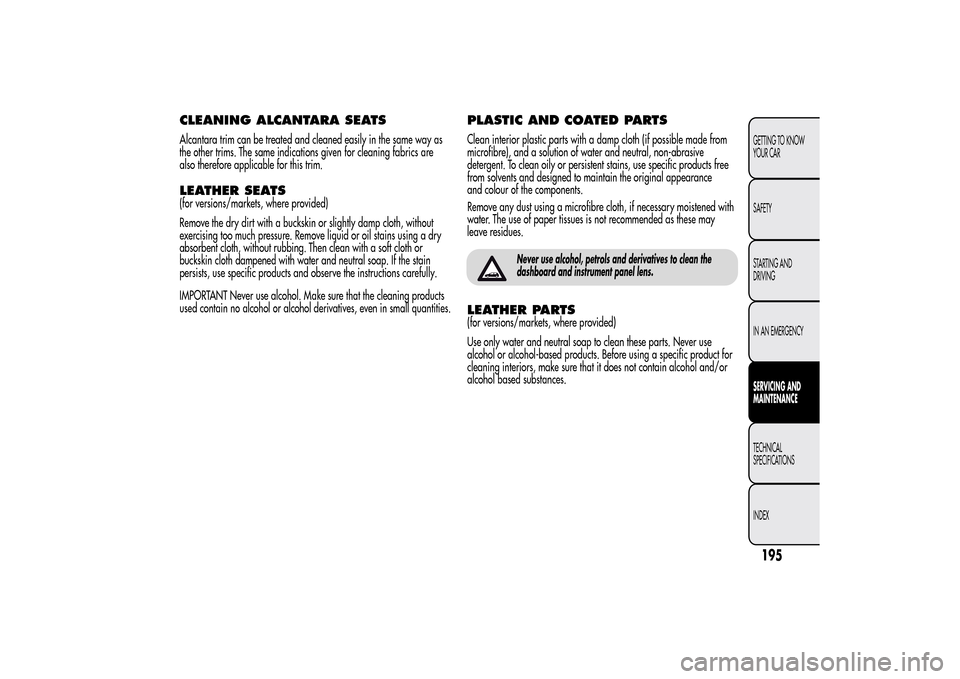
CLEANING ALCANTARA SEATSAlcantara trim can be treated and cleaned easily in the same way as
the other trims. The same indications given for cleaning fabrics are
also therefore applicable for this trim.LEATHER SEATS(for versions/markets, where provided)
Remove the dry dirt with a buckskin or slightly damp cloth, without
exercising too much pressure. Remove liquid or oil stains using a dry
absorbent cloth, without rubbing. Then clean with a soft cloth or
buckskin cloth dampened with water and neutral soap. If the stain
persists, use specific products and observe the instructions carefully.
IMPORTANT Never use alcohol. Make sure that the cleaning products
used contain no alcohol or alcohol derivatives, even in small quantities.
PLASTIC AND COATED PARTSClean interior plastic parts with a damp cloth (if possible made from
microfibre), and a solution of water and neutral, non-abrasive
detergent. To clean oily or persistent stains, use specific products free
from solvents and designed to maintain the original appearance
and colour of the components.
Remove any dust using a microfibre cloth, if necessary moistened with
water. The use of paper tissues is not recommended as these may
leave residues.LEATHER PARTS(for versions/markets, where provided)
Use only water and neutral soap to clean these parts. Never use
alcohol or alcohol-based products. Before using a specific product for
cleaning interiors, make sure that it does not contain alcohol and/or
alcohol based substances.
195GETTING TO KNOW
YOUR CAR
SAFETY
STARTING AND
DRIVING
IN AN EMERGENCYSERVICING AND
MAINTENANCETECHNICAL
SPECIFICATIONS
INDEX
Never use alcohol, petrols and derivatives to clean the
dashboard and instrument panel lens.