display Alfa Romeo MiTo 2014 Workshop Manual
[x] Cancel search | Manufacturer: ALFA ROMEO, Model Year: 2014, Model line: MiTo, Model: Alfa Romeo MiTo 2014Pages: 280, PDF Size: 8.79 MB
Page 109 of 280

PARKING SENSORS(for versions/markets, where provided)
The parking sensors are located in the car's rear bumper fig. 86 and
their function is to inform the driver, through an intermittent acoustic
signal, about the presence of obstacles behind the car.ACTIVATIONThe sensors are activated by engaging reverse gear. As the obstacle
behind the vehicle gets closer to the car, the acoustic signal becomes
more frequent.INDICATIONS ON DISPLAY(for versions/markets, where provided)
When the sensor is activated, the "Reconfigurable multifunction
display" (for versions/markets, where provided) shows the screen
illustrated in fig. 87.
Obstacle presence and distance information is therefore provided both
by the buzzer and the instrument panel display.
If there are several obstacles the closest one is indicated.
ACOUSTIC SIGNALWhen reverse gear is engaged an acoustic signal is automatically
activated if there is an obstacle within the range of operation.
The acoustic signal:
❒increases as the distance between the car and the obstacle
decreases;
❒becomes continuous when the distance between the car and the
obstacle is less than 30 cm and stops immediately if the distance
increases;
❒remains constant if the distance remains unchanged; if this situation
concerns the side sensors, the buzzer will stop after about 3 seconds
to avoid, for example, warning indications in the event of
manoeuvres along walls.
IMPORTANT The volume of the acoustic signal can be adjusted through
the option "Warning volume" of the "Set-Up menu".
fig. 86
A0J0088
fig. 87
A0J0370
105GETTING TO
KNOW YOUR CARSAFETY
STARTING AND
DRIVING
IN AN EMERGENCY
SERVICING AND
MAINTENANCE
TECHNICAL
SPECIFICATIONS
INDEX
Page 111 of 280
❒sensor performance can also be influenced by the position of the
sensors. For example by a change in the ride setting (caused by
the wear of the shock absorbers, suspension), overloading the
vehicle and carrying out specific tuning operations that require the
vehicle to be lowered;
❒The detection of obstacles at the top part of the car may not be
guaranteed because the system detects obstacles that could cause an
impact with the car in the bottom part.
TPMS (Tyre Pressure
Monitoring System)(for versions/markets, where provided)
The car may be fitted with a tyre pressure monitoring system (TPMS),
which informs the driver of the tyre inflation status via the "Check
tyre pressure" and "Low tyre pressure" messages on the display.
This system comprises a radio frequency transmitter fitted to each
wheel (on the wheel rim inside the tyre), which is able to send
information on the tyre inflation pressure of each wheel to the control
unit.IMPORTANT INFORMATION ABOUT
THE TPMSThe fault indications are not stored and will therefore not be displayed
after the engine has been switched off and then on again.
If the fault conditions persist, the control unit will send the relative
indications to the instrument panel only after the car has been in
motion for a short time.
The presence of the TPMS does not permit the driver to
neglect regular checks of the tyre pressure, including
for the spare wheel.Tyre pressure must be checked with tyres rested and
cold. Should it become necessary for whatever reason
to check pressure with warm tyres, do not reduce
pressure even though it is higher than the prescribed value, but
repeat the check when tyres are cold.
107GETTING TO
KNOW YOUR CARSAFETY
STARTING AND
DRIVING
IN AN EMERGENCY
SERVICING AND
MAINTENANCE
TECHNICAL
SPECIFICATIONS
INDEX
Page 112 of 280
Should one or more wheels be fitted without sensors,
the system will no longer be available and a warning
message will be shown on the display, until 4 wheels
with sensors are fitted again.The TPMS cannot warn of sudden decreases in tyre
pressure (for example when a tyre bursts). In this case,
stop the car, braking with caution and avoiding
abrupt steering.Replacing standard tyres with winter tyres and vice
versa requires TPMS system adjustment that must only
be performed by Alfa Romeo Authorised Services.Variations in outside temperature may cause tyre
pressures to vary. The TPMS may temporarily indicate
insufficient pressure. In this case, check the tyre
pressure when cold and, if necessary, restore the inflation values.
When a tyre is removed, it is advisable to replace the
rubber valve seal as well: contact Alfa Romeo
Authorised Services. Tyre and rim fitting/removal
operations require specific precautions; to avoid damaging or
fitting the sensors incorrectly, tyre and wheel fitting/removal
operations should only be carried out by specialised staff.
Contact Alfa Romeo Authorised Services.Intense radio-frequency interference may prevent the
correct operation of the TPMS. This condition will be
indicated by a message on the display. The message
will disappear automatically as soon as the interference ceases to
affect the system.
108GETTING TO
KNOW YOUR CAR
SAFETY
STARTING AND
DRIVING
IN AN EMERGENCY
SERVICING AND
MAINTENANCE
TECHNICAL
SPECIFICATIONS
INDEX
Page 116 of 280
The regeneration procedure is controlled automatically by the engine
management control unit according to the filter conditions and vehicle
use conditions.
During the regeneration there may be a limited increase in the engine
idle speed, fan activation, a limited increase in fumes and high
temperatures at the exhaust.
These are not faults; they do not impair normal car performance or
damage the environment. If the dedicated message is displayed, see
contents of "Warning lights and messages" paragraph.
The catalytic converter and particulate filter (DPF) reach
very high temperatures during operation. Therefore
do not park the car on flammable materials (grass, dry
leaves, pine needles, etc.): fire hazard.
112GETTING TO
KNOW YOUR CAR
SAFETY
STARTING AND
DRIVING
IN AN EMERGENCY
SERVICING AND
MAINTENANCE
TECHNICAL
SPECIFICATIONS
INDEX
Page 119 of 280
NOTE On versions equipped with sports front seats, the passenger side
seat belt fastened indication (warning light 1 for RHD versions or
warning light 5 for LHD versions) will never be displayed.FRONT SEATS (warning light no. 1 =
driver and no. 5 = passenger)Driver
If the driver is the only occupant and their seat belt is not fastened,
when 20 km/h is exceeded or when travelling at a speed between 10
and 20 km/h for longer than 5 seconds, an acoustic signal cycle
will be started for the front seats (continuous acoustic signal for
6 seconds followed by a 90 second beep). The warning light will flash.
The warning lights will stay on constantly at the end of the cycle until
the engine is stopped. The acoustic signal will be interrupted
immediately when the driver’s seat belt is fastened and the warning
light will turn green.
The reminder cycle (acoustic and visual) will be repeated as described
above and the red warning light will flash if the seat belt is unfastened
again while travelling.
Passenger
A similar situation applies to the front passenger, with the difference
that the warning light turns green and the indication is also interrupted
when the passenger leaves the car.
If both front seat belts are unfastened a few seconds apart while the
car is travelling, the acoustic signal will refer to the most recent event
and the two warning lights will proceed with the visual indication
independently.
REAR SEATS (warning light no. 2, no.
3 and no. 4)For the rear seats, the reminder cycle is only activated when any seat
belt is unfastened (flashing red).
In this condition, the warning light for the seat belt which has been
unfastened will flash (red) for approximately 30 seconds. An acoustic
signal is also emitted.
The visual indication (flashing red) will start and stop independently for
each warning light if several seat belts are unfastened. The warning
light will become green when the relevant seat belt is fastened again.
The rear seat warning lights will switch off, regardless of the state
of the belt (red or green) approximately 30 seconds after the last
signal.
IMPORTANT
The warning lights are all off if all seat belts (front and rear) are
already fastened when the ignition key is turned to MAR.
All warning lights switch on when at least one belt changes from
fastened to unfastened or vice versa.
115GETTING TO KNOW
YOUR CARSAFETYSTARTING AND
DRIVING
IN AN EMERGENCY
SERVICING AND
MAINTENANCE
TECHNICAL
SPECIFICATIONS
INDEX
Page 135 of 280
IMPORTANT
Do not wash the seats with water or pressurised steam (by hand or at
automatic seat washing stations).
The front airbags and/or side bags may be deployed if the car is
subject to violent impacts involving the underbody area (e.g. violent
impacts against steps or kerbs, big holes or dips in the road etc.).
When the airbag deploys it emits a small amount of dust: the dust is
harmless and does not indicate the beginning of a fire. The dust may
irritate the skin and eyes however: in this case, wash with neutral soap
and water.
All operations on airbags (inspection, repair and replacement) must be
carried out by Alfa Romeo Authorized Services.
If the car is to be scrapped, contact Alfa Romeo Authorized Services to
have the airbag system deactivated.
Pretensioners and airbags are deployed in different ways, according to
the type of impact. Failure to deploy of one of the devices does not
necessarily indicate a system malfunction.
If the
warning light does not switch on when the
key is turned to MAR-ON, or stays on while driving (on
some versions together with a message on the
display) there may be a fault in the restraint systems. In this
case, airbags or pretensioners may not be activated in the case
of an accident or (in a lesser number of cases) they may be
activated incorrectly. Before proceeding, contact Alfa Romeo
Authorised Services to have the system checked immediately.
The expiry dates of the explosive charge and the clock
spring are shown on a specific label contained in the
glove compartment. As these dates approach, contact
Alfa Romeo Authorised Workshops.Do not travel carrying objects in your lap, in front of
your chest or between your lips (pipe, pencils, etc.):
they could cause severe injury if the airbag is
deployed.If the car has been subject to theft, attempted theft,
vandalism, or flooding, have the airbag system
inspected at Alfa Romeo Authorised Services.
131GETTING TO KNOW
YOUR CARSAFETYSTARTING AND
DRIVING
IN AN EMERGENCY
SERVICING AND
MAINTENANCE
TECHNICAL
SPECIFICATIONS
INDEX
Page 137 of 280
STARTING AND DRIVING
STARTING THE ENGINEPROCEDURE FOR PETROL VERSIONS(excluding Turbo TwinAir versions)
Proceed as follows:
❒engage the handbrake and place the gearbox lever in neutral;
❒fully depress the clutch pedal, without touching the accelerator;
❒turn the ignition key to AVV and release it as soon as the engine
starts.
IMPORTANT
❒If the engine does not start at the first attempt, return the ignition key
to STOP before repeating the starting procedure.
❒If, when the ignition key is at MAR, the instrument panel warning
light
(or the symbol on the display) remains on together with
warning light
, turn the key to STOP and then back to MAR. If
the warning light remains on, try the other keys provided. If you are
still unable to start the engine contact an Alfa Romeo Authorised
Service Provider.
❒Never leave the ignition key at MAR when the engine is stopped.Engine starting for Turbo TwinAir versions
Proceed as follows:
❒Engage the handbrake and place the gear lever in neutral or fully
press the clutch pedal if a gear other than neutral is engaged;
❒turn the ignition key to AVV and release it as soon as the engine
starts.
NoteIf the vehicle does not start at the first attempt, return the ignition
key to STOP and repeat the starting procedure placing the gear lever
in neutral and fully pressing the clutch pedal.
IMPORTANT
❒If, when the ignition key is at MAR, the instrument panel warning
light
(or the symbol on the display) remains on together with
warning light
, turn the key to STOP and then back to MAR. If
the warning light remains on, try the other keys provided. If you are
still unable to start the engine contact an Alfa Romeo Authorised
Service Provider.
❒Never leave the ignition key at MAR when the engine is stopped.
133GETTING TO KNOW
YOUR CAR
SAFETYSTARTING AND
DRIVINGIN AN EMERGENCY
SERVICING AND
MAINTENANCE
TECHNICAL
SPECIFICATIONS
INDEX
Page 138 of 280
PROCEDURE FOR DIESEL VERSIONSProceed as follows:
❒engage the handbrake and place the gearbox lever in neutral;
❒turn the ignition key to MAR-ON: the warning lights
and
(or the symbol on the display) on the instrument panel will
switch on;
❒wait for the warning lights (or the symbol on the display) to switch
off;
❒fully depress the clutch pedal, without touching the accelerator;
❒turn the ignition key to AVV;
warning light switches off.
Waiting too long will waste the heating work carried out by the
glow plugs. Release the key as soon as the engine starts.
If the
warning light flashes for about 1 minute after
starting or during prolonged cranking, this indicates a fault
in the glow plug preheating system. Use the car normally
if the engine starts and go to Alfa Romeo Authorized Services as soon
as possible.
It is dangerous to run the engine in enclosed areas. The
engine takes in oxygen and releases carbon dioxide,
carbon monoxide and other toxic gases.It is advisable not to demand maximum performance from
your car (e.g. excessive acceleration, long distances at
maximum rpm, excessively intense braking, etc.) when it is
first used.
When the engine is off, do not leave the ignition key turned
to MAR to prevent unnecessary electrical consumption from
draining the battery.Remember that the brake servo and electromechanical
power steering are not operational until the engine
has been started, therefore much more effort than
usual is required on the brake pedal and steering wheel.Never start the engine by pushing, towing or driving
downhill. These manoeuvres may damage the catalytic
converter.
WARMING UP THE ENGINE JUST
AFTER IT HAS STARTEDProceed as follows:
❒drive off slowly, letting the engine turn at medium revs and without
accelerating abruptly;
❒do not demand maximum performance for the first few kilometres. It
is advisable to wait until the engine coolant temperature indicator
starts moving.
134GETTING TO KNOW
YOUR CAR
SAFETYSTARTING AND
DRIVINGIN AN EMERGENCY
SERVICING AND
MAINTENANCE
TECHNICAL
SPECIFICATIONS
INDEX
Page 172 of 280
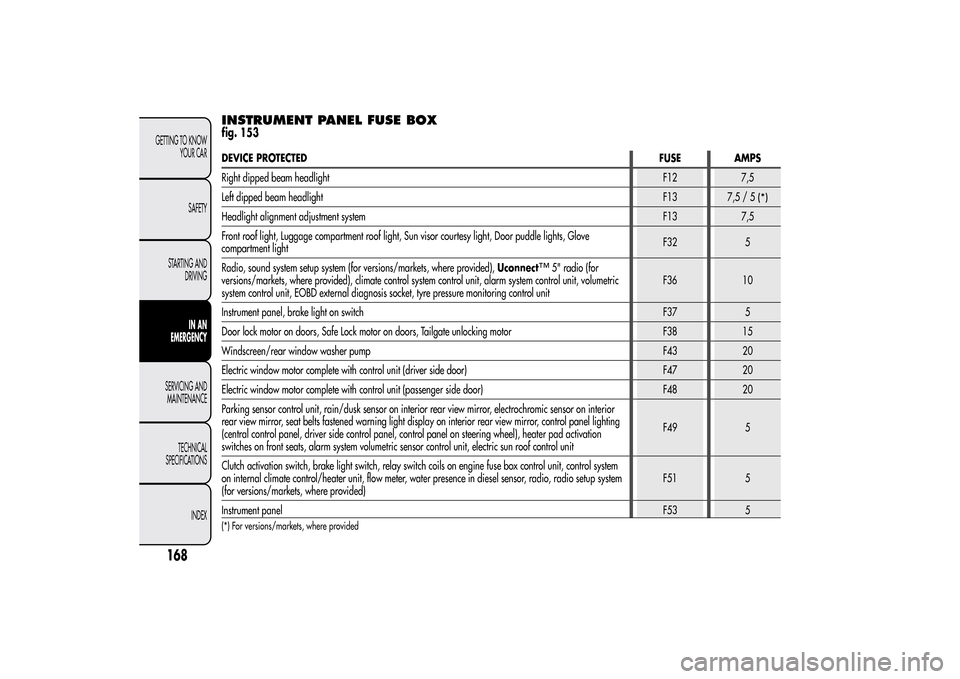
INSTRUMENT PANEL FUSE BOXfig. 153DEVICE PROTECTEDFUSE AMPS
Right dipped beam headlightF12 7,5
Left dipped beam headlightF13
7,5/5
(*)
Headlight alignment adjustment systemF13 7,5
Front roof light, Luggage compartment roof light, Sun visor courtesy light, Door puddle lights, Glove
compartment lightF32 5
Radio, sound system setup system (for versions/markets, where provided),Uconnect
™
5" radio (for
versions/markets, where provided), climate control system control unit, alarm system control unit, volumetric
system control unit, EOBD external diagnosis socket, tyre pressure monitoring control unitF36 10
Instrument panel, brake light on switchF37 5
Door lock motor on doors, Safe Lock motor on doors, Tailgate unlocking motor F38 15
Windscreen/rear window washer pumpF43 20
Electric window motor complete with control unit (driver side door) F47 20
Electric window motor complete with control unit (passenger side door) F48 20
Parking sensor control unit, rain/dusk sensor on interior rear view mirror, electrochromic sensor on interior
rear view mirror, seat belts fastened warning light display on interior rear view mirror, control panel lighting
(central control panel, driver side control panel, control panel on steering wheel), heater pad activation
switches on front seats, alarm system volumetric sensor control unit, electric sun roof control unitF49 5
Clutch activation switch, brake light switch, relay switch coils on engine fuse box control unit, control system
on internal climate control/heater unit, flow meter, water presence in diesel sensor, radio, radio setup system
(for versions/markets, where provided)F51 5
Instrument panelF53 5
(*) For versions/markets, where provided
168GETTING TO KNOW
YOUR CAR
SAFETY
STARTING AND
DRIVING
IN AN
EMERGENCY
SERVICING AND
MAINTENANCE
TECHNICAL
SPECIFICATIONS
INDEX
Page 177 of 280
SERVICING AND MAINTENANCE
SCHEDULED SERVICINGCorrect servicing is essential in guaranteeing a long life for the car
under the best conditions.
That’s why Alfa Romeo has prepared a series of checks and service
operations to be carried out every 30,000 kilometres (petrol versions)
or every 35,000 kilometres (diesel versions).
Check the items on the Scheduled Servicing Plan (e.g. periodically
check level of liquids, tyre pressure, etc.) before 30,000/35,000 km
and between these services deadlines.
Scheduled Servicing is carried out at Alfa Romeo Authorized Services
according to a set time schedule. If, during each operation, in addition
to the ones scheduled, the need arises for further replacements or
repairs, these may be carried out only with the explicit agreement of
the Customer. If your car is used frequently for towing, the interval
between one service operation and the next should be reduced.WARNING
At 2,000 km from the next service operation the display will show a
message.
The Scheduled Services intervals are set out by the Manufacturer.
Failure to comply with the schedule may invalidate the warranty.
It is advisable to inform Alfa Romeo Authorized Services of any small
faults without waiting for the next scheduled service.
173GETTING TO KNOW
YOUR CAR
SAFETY
STARTING AND
DRIVING
IN AN EMERGENCYSERVICING AND
MAINTENANCETECHNICAL
SPECIFICATIONS
INDEX