tyre pressure Alfa Romeo MiTo 2015 User Guide
[x] Cancel search | Manufacturer: ALFA ROMEO, Model Year: 2015, Model line: MiTo, Model: Alfa Romeo MiTo 2015Pages: 280, PDF Size: 8.52 MB
Page 150 of 280

REFITTING THE WHEEL
Following the procedure described previously, raise the car and
remove the small spare wheel.
Proceed as follows:
❒make sure the contact surfaces between standard wheel and hub are
clean so that the fastening bolts will not come loose;
❒for versions with steel rims: fix the hub cap on the rim,
aligning the crescent hole with the bolt you have fitted, then insert
the other 4 bolts;
❒tighten the retaining bolts using wrench A fig. 120;
❒lower the car and remove the jack;
❒use wrench A fig. 120 to fully tighten the bolts, following the
sequence illustrated in
❒for versions with alloy rims with hub cap: align the pin on
the cap with the housing on the rim.
At the end of operation
❒stow the space-saver spare wheel in the compartment provided in
the boot;
❒insert the jack and the other tools in the container;
❒arrange the container and tools on the space-saver wheel;
❒correctly reposition the boot mat.
"Fix&Go Automatic" kit
This is located in the luggage compartment.
The kit container also contains a screwdriver and the tow hook.
The kit also contains:
❒a bottle fig. 127 containing sealer and fitted with: filling tube B and
adhesive label C with the wording “max. 80 km/h” to be placed in
a clearly visible position (e.g. on the dashboard) after repairing
the tyre;
❒a compressor D complete with pressure gauge and connectors;
❒an information leaflet fig. 128, providing instructions for using the
kit correctly. This booklet should be given to the persons charged
with handling the tyre treated with this kit;
❒a pair of gloves located in the side compartment of the compressor;
❒adapters for inflating different elements.
IMPORTANT The sealing liquid is suitable for use at temperatures in the
range from –20°C to +50°C. The sealant has an expiry date.
fig. 127A0J0112
146
GETTING TO KNOW
YOUR CAR
SAFETY
STARTING AND
DRIVING
IN AN
EMERGENCY
SERVICING AND
MAINTENANCE
TECHNICAL
SPECIFICATIONS
INDEX
Page 152 of 280

INFLATION PROCEDURE
Wear the protective gloves provided with the kit.
Proceed as follows:
❒engage the handbrake, unscrew the tyre valve cap, take out the
flexible filler pipe A fig. 129 and tighten the ring nut B on the tyre
valve;
❒make sure that switch A fig. 130 for the compressor is in position 0
(off), start the engine, insert the plug A fig. 131 into the power
socket on the central tunnel and switch on the compressor by
bringing switch A fig. 130 to position I (on);❒inflate the tyre to the pressure indicated in the “Wheels” paragraph
in the “Technical specifications” section. In order to obtain a more
precise reading, check the pressure value on pressure gauge B
fig. 130 with the compressor off;
fig. 129A0J0214
fig. 130A0J0114
fig. 131A0J0116
148
GETTING TO KNOW
YOUR CAR
SAFETY
STARTING AND
DRIVING
IN AN
EMERGENCY
SERVICING AND
MAINTENANCE
TECHNICAL
SPECIFICATIONS
INDEX
Page 153 of 280

❒if after five minutes it is still impossible to reach at least 1.8 bar,
disengage the compressor from the valve and power socket, then
move the car forwards by approx. ten metres in order to distribute
the sealing fluid inside the tyre evenly, then repeat the inflation
operation;
❒if you still cannot obtain a pressure of at least 1.8 bar within 5
minutes from the compressor switching on, do not drive off and
contact Alfa Romeo Authorized Services;
❒after driving for about 10 minutes, stop and check the tyre pressure
again; remember to put the handbrake on;
❒if a pressure value of at least 1.8 bar is detected, restore the correct
pressure (with the engine running and the handbrake engaged),
resume driving and drive with great care to Alfa Romeo Authorized
Services.
Apply the adhesive label where it can be easily seen
by the driver as a reminder that the tyre has been
treated with the quick repair kit. Drive carefully,
particularly on bends. Do not exceed 80 km/h. Do not accelerate
or brake suddenly.
If the pressure has fallen below 1.8 bar, do not drive
any further: the Fix&Go Automatic quick tyre repair kit
cannot guarantee the correct hold because the tyre is
too damaged. Contact Alfa Romeo Authorized Services.
Inform the dealership that the tyre has been repaired
using the quick tyre repair kit. Give the leaflet to the
technicians who will be handling the tyre that was
repaired using the quick repair kit.
149
GETTING TO KNOW
YOUR CAR
SAFETY
STARTING AND
DRIVING
IN AN
EMERGENCY
SERVICING AND
MAINTENANCE
TECHNICAL
SPECIFICATIONS
INDEX
Page 154 of 280

CHECKING AND RESTORING TYRE
PRESSURE
The compressor can also be used to check and, if necessary, adjust the
tyre pressure.
Release quick connector A fig. 132 and connect it directly to the valve
of the tyre to be inflated.
REPLACING THE BOTTLE
Proceed as follows:
❒release connector A fig. 133 and disconnect tube B;
❒turn the bottle to be replaced anticlockwise and raise it;
❒fit the new bottle and turn it clockwise;
❒insert connector A and tube B in their housings.
fig. 132A0J0225fig. 133A0J0115
150
GETTING TO KNOW
YOUR CAR
SAFETY
STARTING AND
DRIVING
IN AN
EMERGENCY
SERVICING AND
MAINTENANCE
TECHNICAL
SPECIFICATIONS
INDEX
Page 175 of 280

SERVICING AND MAINTENANCE
SCHEDULED SERVICING
Correct servicing is essential in guaranteeing a long life for the car
under the best conditions.
For this reason, Alfa Romeo has planned a series of checks and
services at fixed distance intervals and, for versions/markets, where
provided, at fixed time intervals, as described in the Scheduled
Servicing Plan.
Regardless of the above, it is always necessary to carefully follow the
instructions in the Scheduled Servicing Plan (e.g. periodically check
level of liquids, tyre pressure, etc.).
Scheduled Servicing is carried out at Alfa Romeo Authorised Services
according to a set time schedule or kilometres/miles intervals. If,
during each operation, in addition to the ones scheduled, the need
arises for further replacements or repairs, these may be carried out
only with your explicit agreement. If your car is used frequently for
towing, the interval between one service operation and the next should
be reduced.WARNING
The Scheduled Services intervals are set out by the Manufacturer.
Failure to comply with the schedule may invalidate the warranty.
It is advisable to inform Alfa Romeo Authorized Services of any small
faults without waiting for the next scheduled service.
For versions equipped with specific supply (e.g. LPG, Alfa TCT) and/or
trim level, in addition to what is described in the following Scheduled
Servicing Plan, refer to the relevant additional items in the dedicated
supplements.
171
GETTING TO KNOW
YOUR CAR
SAFETY
STARTING AND
DRIVING
IN AN EMERGENCY
SERVICING AND
MAINTENANCE
TECHNICAL
SPECIFICATIONS
INDEX
Page 176 of 280
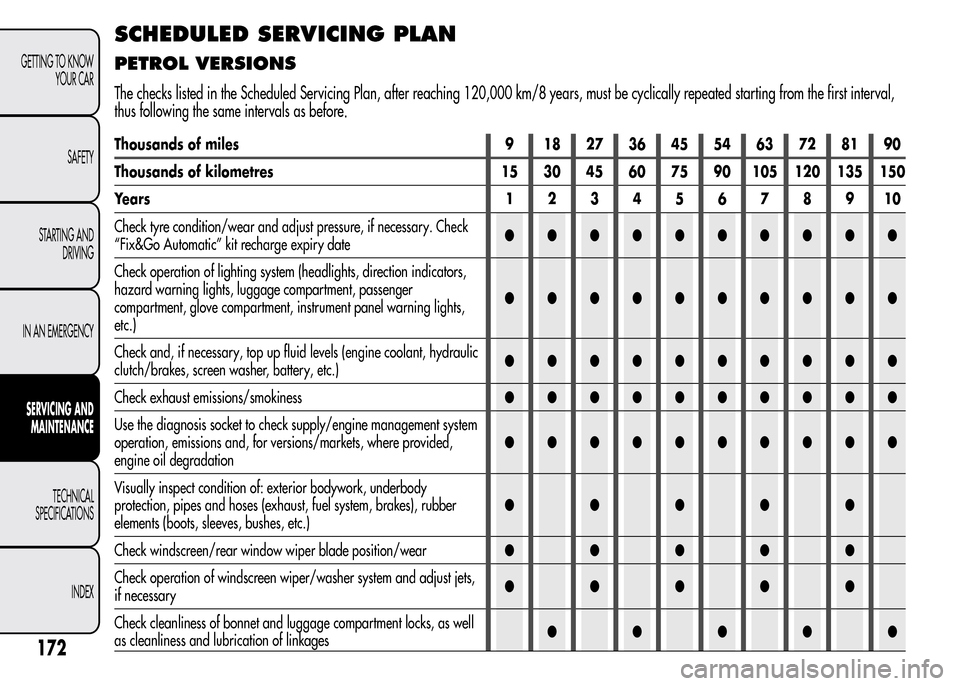
SCHEDULED SERVICING PLAN
PETROL VERSIONS
Thousands of miles 9 18 27 36 45 54 63 72 81 90
Thousands of kilometres 15 30 45 60 75 90 105 120 135 150
Years12345678910
Check tyre condition/wear and adjust pressure, if necessary. Check
“Fix&Go Automatic” kit recharge expiry date●●●●●●●●●●
Check operation of lighting system (headlights, direction indicators,
hazard warning lights, luggage compartment, passenger
compartment, glove compartment, instrument panel warning lights,
etc.)●●●●●●●●●●
Check and, if necessary, top up fluid levels (engine coolant, hydraulic
clutch/brakes, screen washer, battery, etc.)●●●●●●●●●●
Check exhaust emissions/smokiness●●●●●●●●●●
Use the diagnosis socket to check supply/engine management system
operation, emissions and, for versions/markets, where provided,
engine oil degradation●●●●●●●●●●
Visually inspect condition of: exterior bodywork, underbody
protection, pipes and hoses (exhaust, fuel system, brakes), rubber
elements (boots, sleeves, bushes, etc.)●●●●●
Check windscreen/rear window wiper blade position/wear●●●●●
Check operation of windscreen wiper/washer system and adjust jets,
if necessary●●●●●
Check cleanliness of bonnet and luggage compartment locks, as well
as cleanliness and lubrication of linkages●●●●●
172
GETTING TO KNOW
YOUR CAR
SAFETY
STARTING AND
DRIVING
IN AN EMERGENCY
SERVICING AND
MAINTENANCE
TECHNICAL
SPECIFICATIONS
INDEX
The checks listed in the Scheduled Servicing Plan, after reaching 120,000 km/8 years, must be cyclically repeated starting from the first interval,
thus following the same intervals as before.
Page 179 of 280
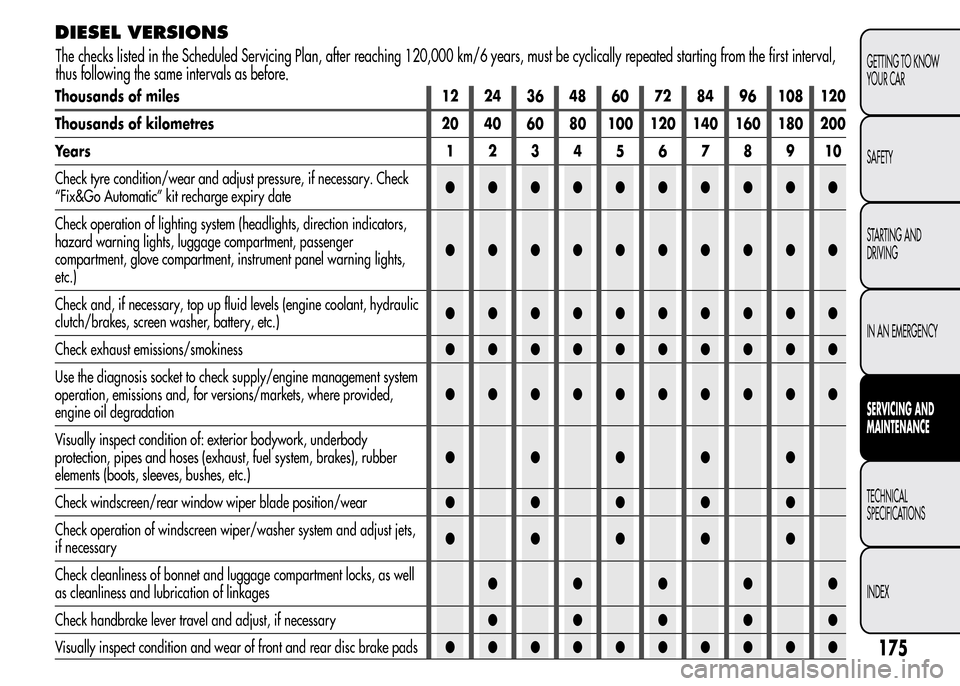
DIESEL VERSIONS
Thousands of miles 12 24 36 48 60 72 84 96 108 120
Thousands of kilometres 20 40 60 80 100 120 140 160 180 200
Years12345678910
Check tyre condition/wear and adjust pressure, if necessary. Check
“Fix&Go Automatic” kit recharge expiry date●●●●●●●●●●
Check operation of lighting system (headlights, direction indicators,
hazard warning lights, luggage compartment, passenger
compartment, glove compartment, instrument panel warning lights,
etc.)●●●●●●●●●●
Check and, if necessary, top up fluid levels (engine coolant, hydraulic
clutch/brakes, screen washer, battery, etc.)●●●●●●●●●●
Check exhaust emissions/smokiness●●●●●●●●●●
Use the diagnosis socket to check supply/engine management system
operation, emissions and, for versions/markets, where provided,
engine oil degradation●●●●●●●●●●
Visually inspect condition of: exterior bodywork, underbody
protection, pipes and hoses (exhaust, fuel system, brakes), rubber
elements (boots, sleeves, bushes, etc.)●●●●●
Check windscreen/rear window wiper blade position/wear●●●●●
Check operation of windscreen wiper/washer system and adjust jets,
if necessary●●●●●
Check cleanliness of bonnet and luggage compartment locks, as well
as cleanliness and lubrication of linkages●●●●●
Check handbrake lever travel and adjust, if necessary●●●●●
Visually inspect condition and wear of front and rear disc brake pads●●●●●●●●●●
175
GETTING TO KNOW
YOUR CAR
SAFETY
STARTING AND
DRIVING
IN AN EMERGENCY
SERVICING AND
MAINTENANCE
TECHNICAL
SPECIFICATIONS
INDEX
The checks listed in the Scheduled Servicing Plan, after reaching 120,000 km/6 years, must be cyclically repeated starting from the first interval,
thus following the same intervals as before.
Page 181 of 280
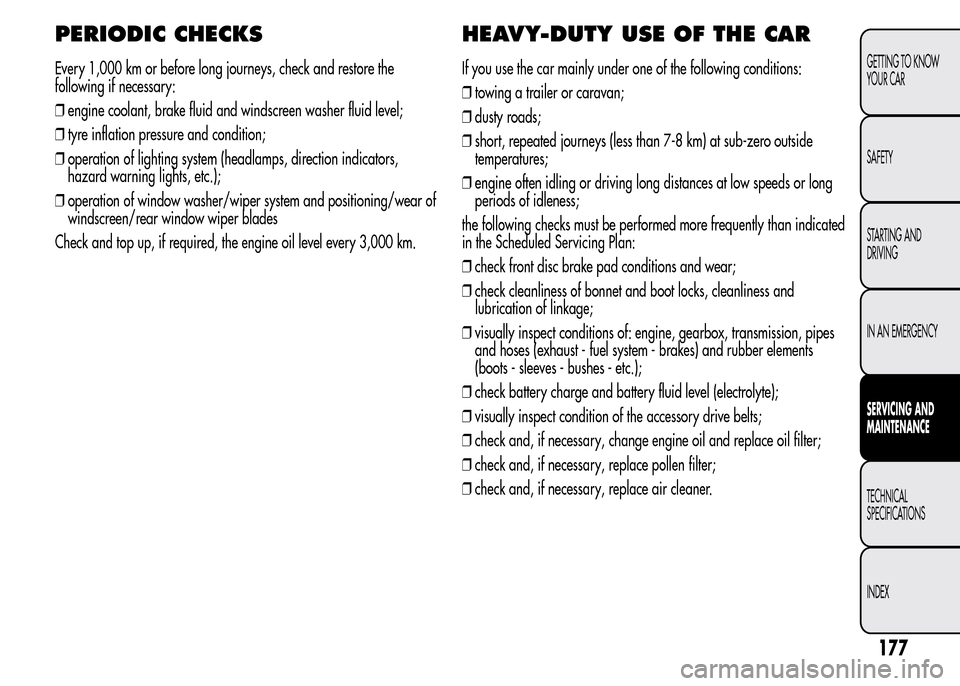
PERIODIC CHECKS
Every 1,000 km or before long journeys, check and restore the
following if necessary:
❒engine coolant, brake fluid and windscreen washer fluid level;
❒tyre inflation pressure and condition;
❒operation of lighting system (headlamps, direction indicators,
hazard warning lights, etc.);
❒operation of window washer/wiper system and positioning/wear of
windscreen/rear window wiper blades
Check and top up, if required, the engine oil level every 3,000 km.
HEAVY-DUTY USE OF THE CAR
If you use the car mainly under one of the following conditions:
❒towing a trailer or caravan;
❒dusty roads;
❒short, repeated journeys (less than 7-8 km) at sub-zero outside
temperatures;
❒engine often idling or driving long distances at low speeds or long
periods of idleness;
the following checks must be performed more frequently than indicated
in the Scheduled Servicing Plan:
❒check front disc brake pad conditions and wear;
❒check cleanliness of bonnet and boot locks, cleanliness and
lubrication of linkage;
❒visually inspect conditions of: engine, gearbox, transmission, pipes
and hoses (exhaust - fuel system - brakes) and rubber elements
(boots - sleeves - bushes - etc.);
❒check battery charge and battery fluid level (electrolyte);
❒visually inspect condition of the accessory drive belts;
❒check and, if necessary, change engine oil and replace oil filter;
❒check and, if necessary, replace pollen filter;
❒check and, if necessary, replace air cleaner.
177
GETTING TO KNOW
YOUR CAR
SAFETY
STARTING AND
DRIVING
IN AN EMERGENCY
SERVICING AND
MAINTENANCE
TECHNICAL
SPECIFICATIONS
INDEX
Page 192 of 280

WHEELS AND TYRES
Before embarking on a long trip, and every two weeks, check the tyre
inflation pressure and space-saver wheel. Check the tyres when cold.
While driving the car, the pressure increases under standard
conditions: for the correct tyre inflation pressure, see "Wheels"
paragraph in the "Technical specifications" chapter.
Incorrect pressure causes abnormal tyre wear fig. 166:
A normal pressure: tread evenly worn;
B low pressure: tread particularly worn at the edges;
C high pressure: tread particularly worn in the centre.
The tyres must be replaced when the tread is less than 1.6 mm thick.IMPORTANT
Take the following precautions to prevent damage to the tyres:
❒avoid braking suddenly, racing starts and violent impact against the
curb, potholes or other obstacles and driving for extended periods
on uneven road surfaces;
❒periodically check that the tyres have no cuts in the side wall,
abnormal swelling or irregular tyre wear;
❒avoid travelling with the car overloaded. If you puncture a tyre, stop
immediately and replace it;
❒change the position of the tyres every 10-15 thousand kilometres,
keeping them on the same side of the car to avoid inverting the
direction of rotation;
❒tyres age even if they are not used much. Cracks in the tread and on
the sidewalls are a sign of ageing. Have the tyres checked by
specialised personnel if they have been fitted for longer than 6
years. Remember to check the space-saver wheel very carefully;
❒In the case of replacement, always fit new tyres, avoiding those of
dubious origin;
❒if a tyre is replaced, also replace the inflation valve.
fig. 166A0J0136
188
GETTING TO KNOW
YOUR CAR
SAFETY
STARTING AND
DRIVING
IN AN EMERGENCY
SERVICING AND
MAINTENANCE
TECHNICAL
SPECIFICATIONS
INDEX
Page 193 of 280

Remember that the road holding qualities of your car
also depend on the correct inflation pressure of the
tyres.
If the pressure is too low the tyre overheats and can be
seriously damaged.
Do not cross switch the tyres, moving them from the
right of the car to the left and vice versa.
Never submit alloy rims to repainting treatments
requiring the use of temperatures exceeding 150°C.
The mechanical properties of the wheels could be
impaired.
WINDSCREEN/REAR WINDOW
WIPER
BLADES
We recommend replacing the blades once a year.
A few simple precautions can reduce the possibility of damage to the
blades:
❒if the temperature falls below zero, make sure that ice has not frozen
the rubber against the glass. Use a de-icing product to release it if
required;
❒remove any snow from the window;
❒do not operate the windscreen/rear window wipers on dry glass.
Driving with worn windscreen/rear window wiper
blades is a serious hazard, because visibility is reduced
in bad weather.
189
GETTING TO KNOW
YOUR CAR
SAFETY
STARTING AND
DRIVING
IN AN EMERGENCY
SERVICING AND
MAINTENANCE
TECHNICAL
SPECIFICATIONS
INDEX