ECO mode Alfa Romeo MiTo 2016 User Guide
[x] Cancel search | Manufacturer: ALFA ROMEO, Model Year: 2016, Model line: MiTo, Model: Alfa Romeo MiTo 2016Pages: 280, PDF Size: 8.52 MB
Page 71 of 280
ROOF LIGHTS
FRONT ROOF LIGHT
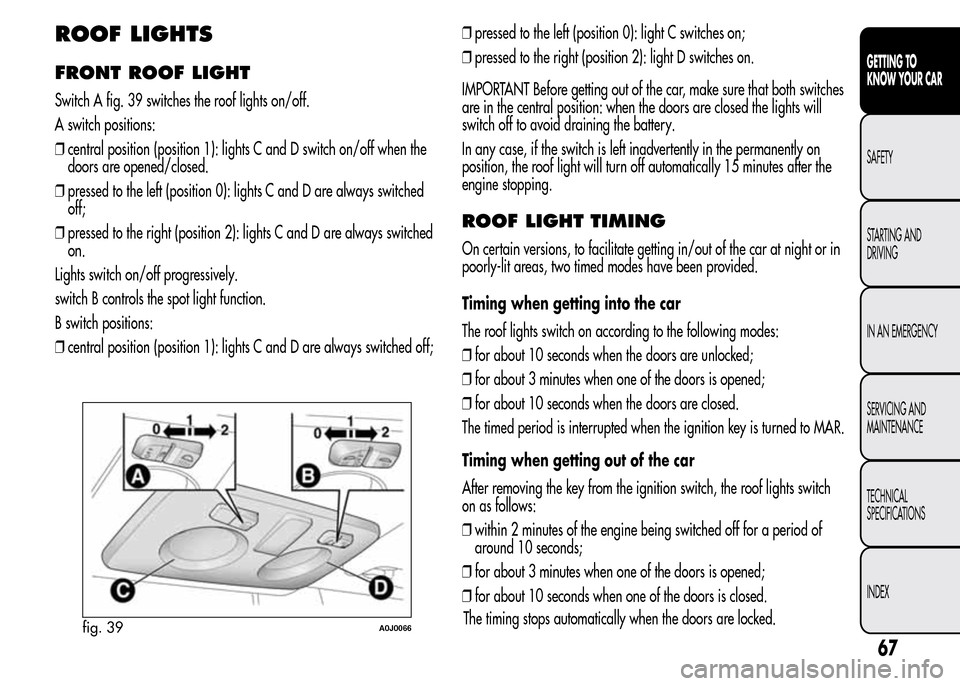
Switch A fig. 39 switches the roof lights on/off.
A switch positions:
❒central position (position 1): lights C and D switch on/off when the
doors are opened/closed.
❒pressed to the left (position 0): lights C and D are always switched
off;
❒pressed to the right (position 2): lights C and D are always switched
on.
Lights switch on/off progressively.
switch B controls the spot light function.
B switch positions:
❒central position (position 1): lights C and D are always switched off;❒pressed to the left (position 0): light C switches on;
❒pressed to the right (position 2): light D switches on.
IMPORTANT Before getting out of the car, make sure that both switches
are in the central position: when the doors are closed the lights will
switch off to avoid draining the battery.
In any case, if the switch is left inadvertently in the permanently on
position, the roof light will turn off automatically 15 minutes after the
engine stopping.
ROOF LIGHT TIMING
On certain versions, to facilitate getting in/out of the car at night or in
poorly-lit areas, two timed modes have been provided.
Timing when getting into the car
The roof lights switch on according to the following modes:
❒for about 10 seconds when the doors are unlocked;
❒for about 3 minutes when one of the doors is opened;
❒for about 10 seconds when the doors are closed.
The timed period is interrupted when the ignition key is turned to MAR.
Timing when getting out of the car
After removing the key from the ignition switch, the roof lights switch
on as follows:
❒within 2 minutes of the engine being switched off for a period of
around 10 seconds;
❒for about 3 minutes when one of the doors is opened;
❒for about 10 seconds when one of the doors is closed.
fig. 39A0J0066
67
GETTING TO
KNOW YOUR CAR
SAFETY
STARTING AND
DRIVING
IN AN EMERGENCY
SERVICING AND
MAINTENANCE
TECHNICAL
SPECIFICATIONS
INDEX
The timing stops automatically when the doors are locked.
Page 96 of 280
DRIVING MODES
Lever A is monostable type. In other words, it always remains in a
central position.
The selected driving mode is indicated by the corresponding LED
coming on in the panel and by an indication on the reconfigurable
multifunction display, as illustrated below:
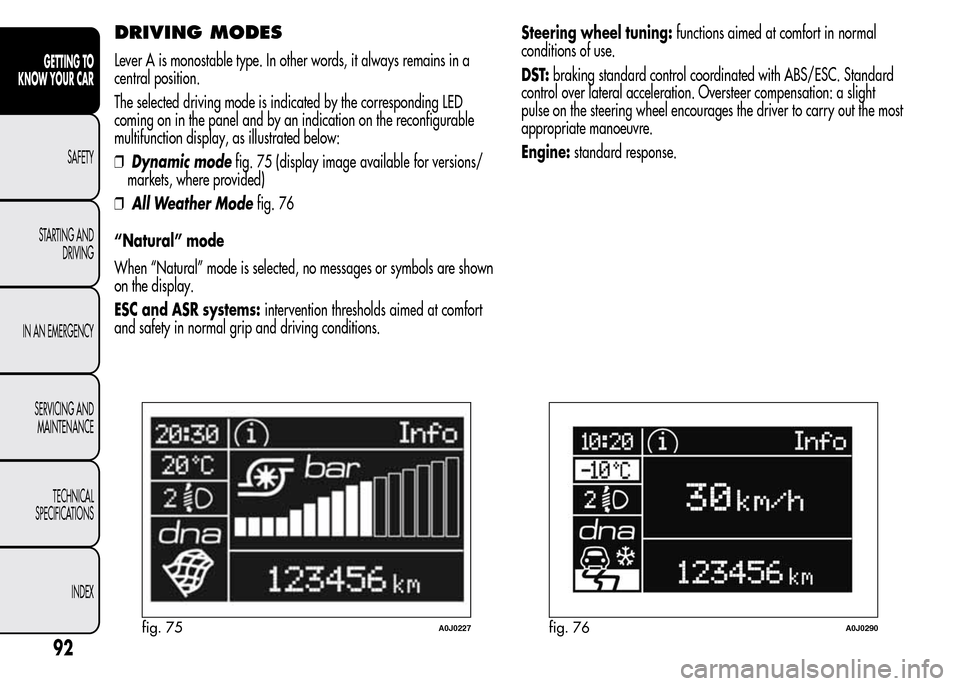
❒Dynamic modefig. 75 (display image available for versions/
markets, where provided)
❒All Weather Modefig. 76
“Natural” mode
When “Natural” mode is selected, no messages or symbols are shown
on the display.
ESC and ASR systems:intervention thresholds aimed at comfort
and safety in normal grip and driving conditions.Steering wheel tuning:functions aimed at comfort in normal
conditions of use.
DST:braking standard control coordinated with ABS/ESC. Standard
control over lateral acceleration. Oversteer compensation: a slight
pulse on the steering wheel encourages the driver to carry out the most
appropriate manoeuvre.
Engine:standard response.
fig. 75A0J0227fig. 76A0J0290
92
GETTING TO
KNOW YOUR CAR
SAFETY
STARTING AND
DRIVING
IN AN EMERGENCY
SERVICING AND
MAINTENANCE
TECHNICAL
SPECIFICATIONS
INDEX
Page 97 of 280
ENGAGEMENT/DISENGAGEMENT OF
“Dynamic” MODE
Engagement
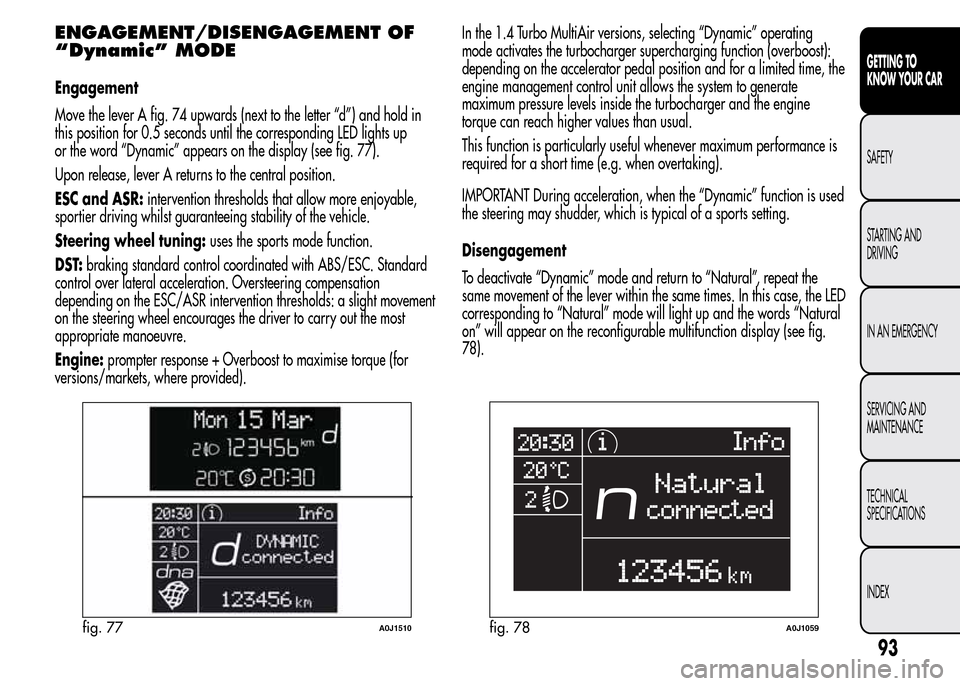
Move the lever A fig. 74 upwards (next to the letter “d”) and hold in
this position for 0.5 seconds until the corresponding LED lights up
or the word “Dynamic” appears on the display (see fig. 77).
Upon release, lever A returns to the central position.
ESC and ASR:intervention thresholds that allow more enjoyable,
sportier driving whilst guaranteeing stability of the vehicle.
Steering wheel tuning:uses the sports mode function.
DST:braking standard control coordinated with ABS/ESC. Standard
control over lateral acceleration. Oversteering compensation
depending on the ESC/ASR intervention thresholds: a slight movement
on the steering wheel encourages the driver to carry out the most
appropriate manoeuvre.
Engine:prompter response + Overboost to maximise torque (for
versions/markets, where provided).In the 1.4 Turbo MultiAir versions, selecting “Dynamic” operating
mode activates the turbocharger supercharging function (overboost):
depending on the accelerator pedal position and for a limited time, the
engine management control unit allows the system to generate
maximum pressure levels inside the turbocharger and the engine
torque can reach higher values than usual.
This function is particularly useful whenever maximum performance is
required for a short time (e.g. when overtaking).
IMPORTANT During acceleration, when the “Dynamic” function is used
the steering may shudder, which is typical of a sports setting.
Disengagement
To deactivate “Dynamic” mode and return to “Natural”, repeat the
same movement of the lever within the same times. In this case, the LED
corresponding to “Natural” mode will light up and the words “Natural
on” will appear on the reconfigurable multifunction display (see fig.
78).
fig. 77A0J1510fig. 78A0J1059
93
GETTING TO
KNOW YOUR CAR
SAFETY
STARTING AND
DRIVING
IN AN EMERGENCY
SERVICING AND
MAINTENANCE
TECHNICAL
SPECIFICATIONS
INDEX
Page 98 of 280
ENGAGEMENT/DISENGAGEMENT OF
“All Weather” MODE
Engagement
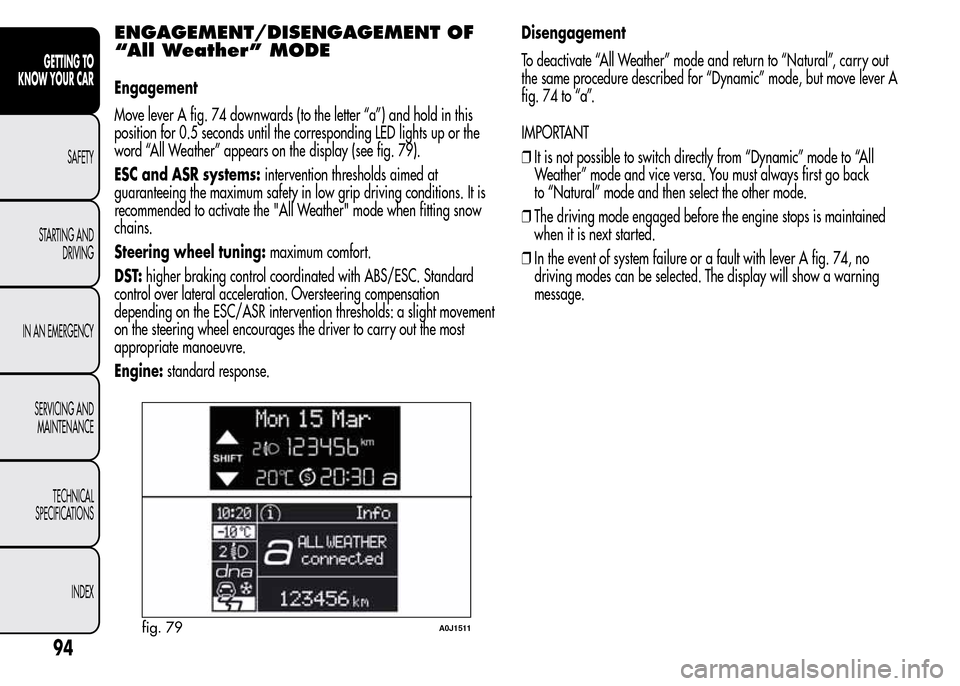
Move lever A fig. 74 downwards (to the letter “a”) and hold in this
position for 0.5 seconds until the corresponding LED lights up or the
word “All Weather” appears on the display (see fig. 79).
ESC and ASR systems:intervention thresholds aimed at
guaranteeing the maximum safety in low grip driving conditions. It is
recommended to activate the "All Weather" mode when fitting snow
chains.
Steering wheel tuning:maximum comfort.
DST:higher braking control coordinated with ABS/ESC. Standard
control over lateral acceleration. Oversteering compensation
depending on the ESC/ASR intervention thresholds: a slight movement
on the steering wheel encourages the driver to carry out the most
appropriate manoeuvre.
Engine:standard response.Disengagement
To deactivate “All Weather” mode and return to “Natural”, carry out
the same procedure described for “Dynamic” mode, but move lever A
fig. 74 to “a”.
IMPORTANT
❒It is not possible to switch directly from “Dynamic” mode to “All
Weather” mode and vice versa. You must always first go back
to “Natural” mode and then select the other mode.
❒The driving mode engaged before the engine stops is maintained
when it is next started.
❒In the event of system failure or a fault with lever A fig. 74, no
driving modes can be selected. The display will show a warning
message.
fig. 79A0J1511
94
GETTING TO
KNOW YOUR CAR
SAFETY
STARTING AND
DRIVING
IN AN EMERGENCY
SERVICING AND
MAINTENANCE
TECHNICAL
SPECIFICATIONS
INDEX
Page 99 of 280
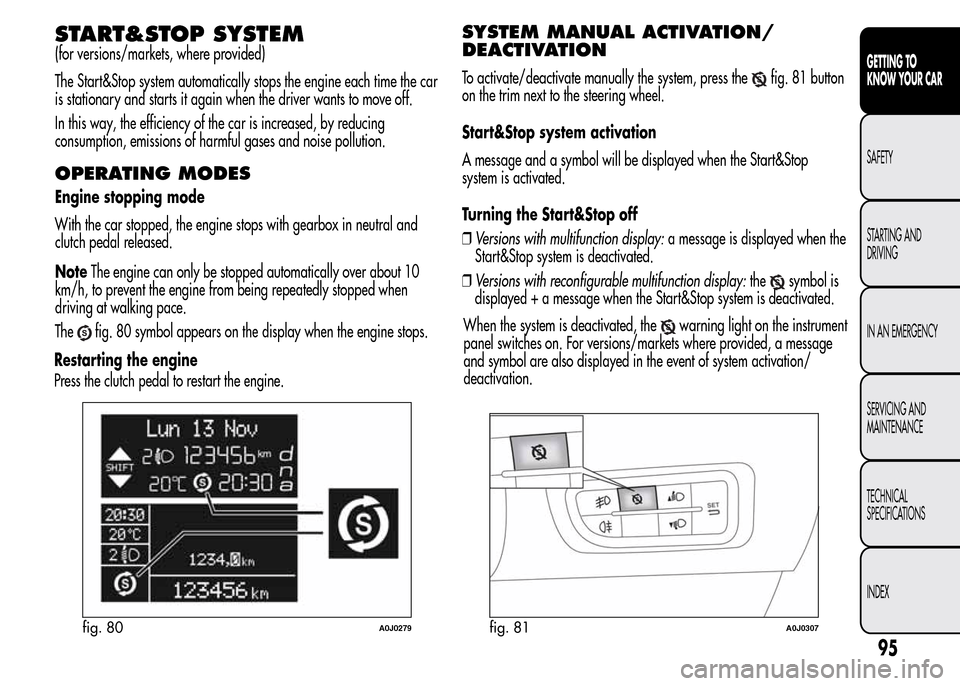
START&STOP SYSTEM
(for versions/markets, where provided)
The Start&Stop system automatically stops the engine each time the car
is stationary and starts it again when the driver wants to move off.
In this way, the efficiency of the car is increased, by reducing
consumption, emissions of harmful gases and noise pollution.
OPERATING MODES
Engine stopping mode
With the car stopped, the engine stops with gearbox in neutral and
clutch pedal released.
NoteThe engine can only be stopped automatically over about 10
km/h, to prevent the engine from being repeatedly stopped when
driving at walking pace.
The
fig. 80 symbol appears on the display when the engine stops.
Restarting the engine
Press the clutch pedal to restart the engine.
SYSTEM MANUAL ACTIVATION/
DEACTIVATION
To activate/deactivate manually the system, press thefig. 81 button
on the trim next to the steering wheel.
Start&Stop system activation
A message and a symbol will be displayed when the Start&Stop
system is activated.
Turning the Start&Stop off
❒Versions with multifunction display:a message is displayed when the
Start&Stop system is deactivated.
❒Versions with reconfigurable multifunction display:the
symbol is
displayed + a message when the Start&Stop system is deactivated.
fig. 80A0J0279fig. 81A0J0307
95
GETTING TO
KNOW YOUR CAR
SAFETY
STARTING AND
DRIVING
IN AN EMERGENCY
SERVICING AND
MAINTENANCE
TECHNICAL
SPECIFICATIONS
INDEX
When the system is deactivated, thewarning light on the instrument
panel switches on. For versions/markets where provided, a message
and symbol are also displayed in the event of system activation/
deactivation.
Page 104 of 280
ELECTRIC POWER STEERING
This only operates with the key turned to MAR-ON and the engine
started. Power steering allows the force required at the steering wheel
to be adapted to driving conditions.
The different power assistance modes can be selected via the "d,n,a"
positions of the “Alfa DNA System” lever (see “Alfa DNA System”
paragraph).
It is absolutely forbidden to carry out any after-market
operation involving steering system or steering column
modifications (e.g.: installation of anti-theft device)
that could badly affect performance and safety, invalidate the
warranty and also result in non-compliance of the car with
type-approval requirements.
Before performing any maintenance operations,
always turn off the engine and remove the key from
the ignition to lock the steering column, especially
when the car’s wheels are not touching the ground.
INSTALLING ELECTRICAL/
ELECTRONIC DEVICES
Electrical and electronic devices installed after buying the car in the
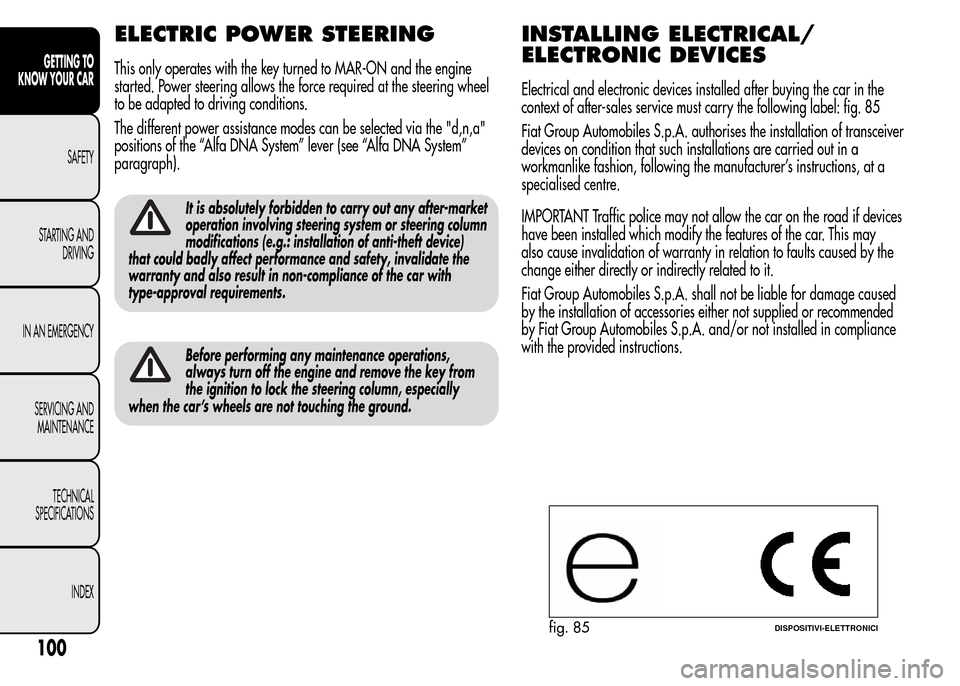
context of after-sales service must carry the following label: fig. 85
Fiat Group Automobiles S.p.A. authorises the installation of transceiver
devices on condition that such installations are carried out in a
workmanlike fashion, following the manufacturer’s instructions, at a
specialised centre.
IMPORTANT Traffic police may not allow the car on the road if devices
have been installed which modify the features of the car. This may
also cause invalidation of warranty in relation to faults caused by the
change either directly or indirectly related to it.
Fiat Group Automobiles S.p.A. shall not be liable for damage caused
by the installation of accessories either not supplied or recommended
by Fiat Group Automobiles S.p.A. and/or not installed in compliance
with the provided instructions.
fig. 85DISPOSITIVI-ELETTRONICI
100
GETTING TO
KNOW YOUR CAR
SAFETY
STARTING AND
DRIVING
IN AN EMERGENCY
SERVICING AND
MAINTENANCE
TECHNICAL
SPECIFICATIONS
INDEX
Page 253 of 280
Select the value “0” to set the same level for the front and
rear audio outputs.
LOUDNESS FUNCTION
The Loudness function improves the volume of the sound whilst
listening at low volumes, increasing the bass and treble.
To activate/deactivate the function, select the Loudness setting of
the AUDIO menu using the
orbuttons.
The condition of the function (on or off) is shown on the display for
a few seconds by the wording “Loudness On” or “Loudness Off”.
PRESET/USER/CLASSIC/ROCK/JAZZ
FUNCTIONS
(equaliser activation/deactivation)
The built-in equaliser can be activated/deactivated. When the
equaliser function is off, the audio settings can only be changed by
adjusting the “Bass” and “Treble” settings, whereas when the
function is on, the acoustic curves can be adjusted.
To deactivate the equaliser, select the “EQ Preset” function using the
buttons
or.
To activate the equaliser, use the
orbuttons to select one of
the adjustments:
❒“FM/AM/CD...EQ User” (adjustment of 7 equaliser bands that
can be changed by the user);
❒“Classic” (equaliser preset for optimal classical music sound);
❒“Rock” (equaliser preset for optimal rock and pop music sound);
❒“Jazz” (equaliser preset for optimal jazz music sound).
When one of the equaliser settings is activated the letters “EQ”
light up.
USER EQ SETTINGS FUNCTION
(equaliser settings only if the USER setting is selected)
To set a personalised equaliser adjustment, set to “User” using the
orbutton and press the MENU button.
A 7-bar graph appears on the display, in which each bar
represents a frequency.
Select the bar to adjust using the
orbuttons; the selected bar
will start to flash and it can be adjusted using the
orbuttons.
To store the setting, press the AUDIO button again. The display will
show the active source at that time followed by the word “USER”. If
the mode is “FM”, for example, the display will show the text “FM
EQ User”.
MENU
MENU button functions
Press the MENU button briefly to activate the Menu function. The
display will show the first menu item that can be adjusted (AF) (“AF
Switching On” on the display).
Use the
orbuttons to scroll through the menu functions. To
change the setting of the function selected use the
orbuttons.
The current status of the function selected will be shown on the
display.
The functions managed by the Menu are:
❒AF SWITCHING (ON/OFF);
❒TRAFFIC INFORMATION (ON/OFF);
❒REGIONAL MODE regional programmes (ON/OFF);
❒MP3 DISPLAY (CD MP3 display settings);
249
SOUND-SYSTEM
Page 262 of 280
CD PLAYER
INTRODUCTION
This section describes the variants regarding the operation of the
CD player: as far as the operation of the radio is concerned, refer
to the description in the “Functions and Adjustments” chapter.
SELECTING THE CD PLAYER
To activate the CD player built into the equipment, proceed as
follows:
❒insert a CD with the equipment switched on: the first track will
start to play;
or
❒if a CD has already been loaded, switch on the radio and then
briefly press the CD button to select the “CD” operating mode:
the last track listened to will start to play.
It is advisable to use original CDs to ensure optimum playback. If
CD-R/RWs are used, we recommend using good quality media
mastered at the slowest speed possible.
LOADING/EJECTING A CD
To load the CD, insert it gently into the slot to activate the motorised
loading system, which will position it correctly.
The CD can be loaded with radio off and the ignition key turned to
MAR: in this case the radio will remain off. When the radio is
turned on, the last source listened to prior to switching off will be
activated.When a CD is inserted the display will show the symbol “CD-IN”
and the text “CD Reading”. They will remain displayed for the
entire time required for the radio to read the CD tracks. When this
time has elapsed the radio will automatically start to play the first
track.
Press the
button with the radio on to activate the motorised
ejection of the CD. After ejection, the last audio source listened to
before playing the CD will be heard.
If the CD is not removed from the radio, it will automatically be
reloaded about 20 seconds later and the Tuner mode will be
activated (Radio).
The CD cannot be ejected if the radio is off.
If the ejected CD is reloaded without having removed it completely
from the slot, the radio will not switch to the CD source.
Possible error messages
If the CD loaded cannot be read (e.g. a CD ROM has been
inserted or the CD is inserted upside down or there is reading
error) the display will show the text “CD Disc error”.
The CD will then be ejected and the audio source activated prior to
the CD mode selection will be heard.
With an external audio source activated (“TA”, “ALARM” or
“Phone”), the CD that cannot be read will not be ejected until these
functions have ended. At the end, with the CD mode activated, the
display will show the text “CD Disc error” for a few seconds and
then the CD will be ejected.
258
SOUND-SYSTEM
Page 264 of 280
MP3 CD PLAYER
INTRODUCTION
This section only describes the variants regarding the operation of
the CD MP3 player: as far as the operation of the radio is
concerned, refer to the description in the “Radio” and “CD MP3
Player” sections.
NOTE MPEG Layer-3 audio decoding technology licensed from
Fraunhofer IIS and Thomson multimedia.
MP3 MODE
In addition to playing regular audio CDs, the radio is also able to
play CD-ROMs on which audio files have been stored using the
MP3 compression format. The radio operates as described in the
“CD Player” section when an ordinary audio CD is inserted.
To guarantee optimal playback quality it is advisable to use good
quality CDs mastered at the lowest speed possible.
The files on an MP3 CD are structured by folder, creating lists of all
the folders containing MP3 tracks (folders and subfolders are all
displayed on the same level); the folders that do not contain MP3
tracks cannot be selected.The operating conditions and specifications for playing MP3 files
are as follows:
❒the CD-ROMs used should be burnt according to the ISO 9660
standard;
❒the music files must have an “.mp3” extension: files with a
different extension cannot be played;
❒the following sampling frequencies can be played: 44.1 kHz,
stereo (96 to 320 kbit/s) - 22.05 kHz, mono or stereo (32 to 80
kbit/s);
❒tracks with a variable bit-rate can be reproduced.
NoteThe names of tracks must not contain the following
characters: spaces, ' (apostrophes), ( and ) (open and close
brackets). When burning an MP3 CD, make sure that the names of
the files do not contain these characters; if they do, the radio will
not be able to play the tracks involved.
SELECTING MP3 SESSIONS
ON HYBRID DISCS
If a hybrid disc is inserted (Mixed Mode, Enhanced, CD-Extra) also
containing MP3 files, the radio automatically starts playing the
audio session. It is possible to switch to the MP3 session whilst
playing by holding the MEDIA button down for more than 2
seconds.
NoteWhen the function is activated the radio may take a few
seconds to start playing. Whilst checking the disc the display will
show “CD READING”. If no MP3 files are detected, the radio will
resume playing the audio session from the point where it was
interrupted.
260
SOUND-SYSTEM
Page 267 of 280
TROUBLESHOOTING
GENERAL
Low volume
The Fader function should be adjusted only to the values “F” (front)
to prevent a reduction in radio output power and the muting of the
volume if the Fader level adjustment is equal to R+9.
Source cannot be selected
Nothing has been inserted.
Insert the CD or CD MP3 to be played.
CD PLAYER
The CD does not play
The CD is dirty. Clean the CD.
The CD is scratched. Try and use another CD.
The CD cannot be loaded
A CD is already loaded. Press the
button and remove the CD.
MP3 FILE READING
Track skips during MP3 file playback
The CD is scratched or dirty. Clean the CD, referring to the contents
of the “CD” paragraph in the “Introduction” section.
The duration of the MP3 tracks is not shown correctly
In some cases (due to the recording mode) the duration of the MP3
tracks may be displayed incorrectly.
263
SOUND-SYSTEM