air condition Alfa Romeo MiTo 2016 User Guide
[x] Cancel search | Manufacturer: ALFA ROMEO, Model Year: 2016, Model line: MiTo, Model: Alfa Romeo MiTo 2016Pages: 280, PDF Size: 8.52 MB
Page 112 of 280
PROTECTING THE ENVIRONMENT
The following devices are used for reducing petrol fuel engine
emissions: catalytic converter, oxygen sensors and evaporation control
system
The following devices are used for reducing diesel fuel engine
emissions: oxidising catalytic converter, exhaust gas recirculation
system (EGR) and particulate filter (DPF).
DIESEL PARTICULATE FILTER (DPF)
(Diesel Particulate Filter)
(for versions/markets, where provided)
The Diesel Particulate Filter is a mechanical filter, integral to the
exhaust system, that physically traps carbon particles present in the
exhaust gases of diesel engines.
The diesel particulate filter is needed to eliminate almost all carbon
particle emissions in compliance with current/future regulations and
standards.
During standard use of the vehicle, the engine control unit records a set
of data (e.g.: travel time, type of route, temperatures, etc.) and it will
then calculate how much particulate has been trapped by the filter.Since this filter physically traps particulate, it should be periodically
regenerated (cleaned) at regular intervals by burning carbon particles.
The regeneration procedure is controlled automatically by the engine
management control unit according to the filter conditions and vehicle
use conditions.
During the regeneration there may be a limited increase in the engine
idle speed, fan activation, a limited increase in fumes and high
temperatures at the exhaust.
These are not faults; they do not impair normal car performance or
damage the environment. If the dedicated message is displayed, see
contents of "Warning lights and messages" paragraph.
The catalytic converter and particulate filter (DPF) reach
very high temperatures during operation. Therefore
do not park the car on flammable materials (grass, dry
leaves, pine needles, etc.): fire hazard.
108
GETTING TO
KNOW YOUR CAR
SAFETY
STARTING AND
DRIVING
IN AN EMERGENCY
SERVICING AND
MAINTENANCE
TECHNICAL
SPECIFICATIONS
INDEX
Page 139 of 280
SAVING FUEL
Here are some suggestions which can help you to save fuel and lower
harmful emissions.
GENERAL CONSIDERATIONS
Car maintenance
Have checks and adjustments carried out in accordance with the
“Scheduled Servicing Plan” (see chapter “Maintenance and care”).
Ty r e s
Check the tyre pressure at least once every 4 weeks: if the pressure is
too low, consumption levels increase as resistance to rolling is higher.
Unnecessary loads
Do not travel with an overloaded boot. The weight of the car and its
arrangement greatly affect fuel consumption and stability.
Roof rack/ski rack
Remove the roof rack or the ski rack from the roof after use. These
accessories lower aerodynamic penetration and adversely affect
consumption levels. It is better to use a trailer to transport particularly
bulky objects.
Electrical devices
Only use electrical devices for the time needed. The heated rear
window, additional headlights, windscreen wipers and heater fan
require a considerable amount of energy; increasing the current uptake
increases fuel consumption (by up to +25% in an urban cycle).Climate control system
Using the climate control system will increase consumption: use the air
vents when the external temperature allows it.
Devices for aerodynamic control
The use of non-certified devices for aerodynamic control may adversely
affect air drag and fuel consumption.
DRIVING STYLE
Starting
Do not warm up the engine at low or high revs when the vehicle is
stationary; this causes the engine to warm up more slowly, thereby
increasing fuel consumption and emissions. It is therefore advisable to
move off immediately, slowly, avoiding high speeds: in this way the
engine will warm up more quickly.
Unnecessary actions
Avoid revving up when at traffic lights or before switching off the
engine. The latter action, like double-declutching, is unnecessary and
causes increased fuel consumption and pollution.
Gear selection
Use a higher gear when traffic and road conditions allow it. Using a
low gear for faster acceleration will increase consumption. In the same
way improper use of a high gear increases consumption, emissions
and engine wear.
135
GETTING TO KNOW
YOUR CAR
SAFETY
STARTING AND
DRIVING
IN AN EMERGENCY
SERVICING AND
MAINTENANCE
TECHNICAL
SPECIFICATIONS
INDEX
Page 165 of 280
REPLACING FUSES
GENERAL INFORMATION
Fuses protect the electrical system: they intervene (blow) in the event of
a failure or improper intervention on the system.
When a device does not work, check the condition of its protection
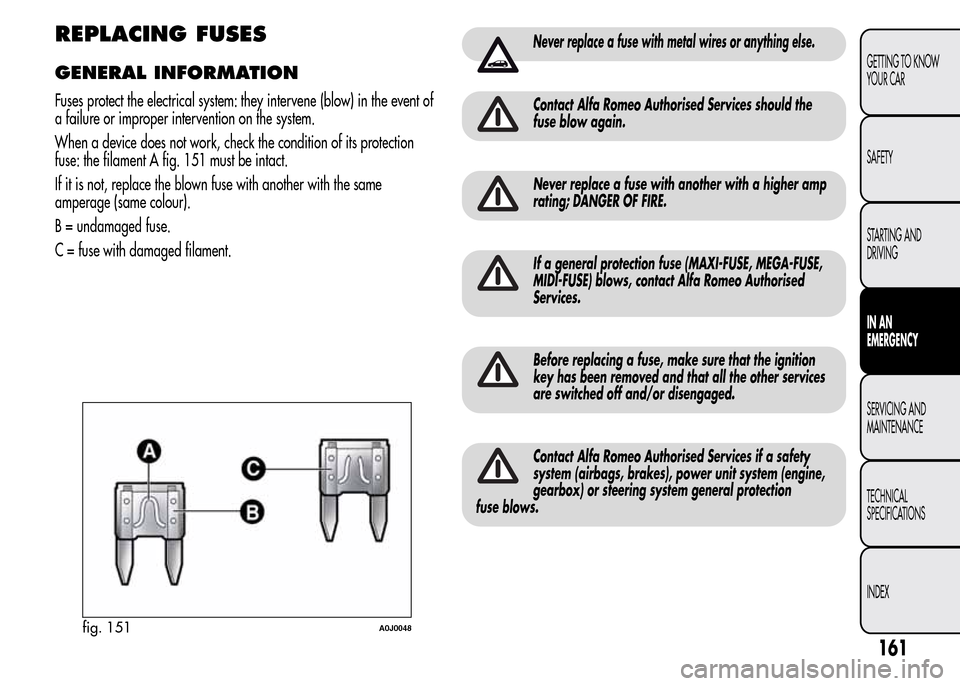
fuse: the filament A fig. 151 must be intact.
If it is not, replace the blown fuse with another with the same
amperage (same colour).
B = undamaged fuse.
C = fuse with damaged filament.
Never replace a fuse with metal wires or anything else.
Contact Alfa Romeo Authorised Services should the
fuse blow again.
Never replace a fuse with another with a higher amp
rating; DANGER OF FIRE.
If a general protection fuse (MAXI-FUSE, MEGA-FUSE,
MIDI-FUSE) blows, contact Alfa Romeo Authorised
Services.
Before replacing a fuse, make sure that the ignition
key has been removed and that all the other services
are switched off and/or disengaged.
Contact Alfa Romeo Authorised Services if a safety
system (airbags, brakes), power unit system (engine,
gearbox) or steering system general protection
fuse blows.
fig. 151A0J0048
161
GETTING TO KNOW
YOUR CAR
SAFETY
STARTING AND
DRIVING
IN AN
EMERGENCY
SERVICING AND
MAINTENANCE
TECHNICAL
SPECIFICATIONS
INDEX
Page 169 of 280
ENGINE COMPARTMENT FUSE BOX
fig. 153
DEVICE PROTECTEDFUSE AMPS
StarterF03 20
Passenger compartment electric fan F08 40
Additional heater (Turbo TwinAir 105 HP and 1.3 JTD
M-285 HP versions) F09 5
Two-tone hornsF10 15
Main beam headlightsF14 15
Additional heater (PTC 1)F15 30
Air conditioning compressorF19 7,5
Heated rear windscreen, defrosting system F20 30
Electric fuel pump in tankF21 15
Fog lightsF30 15
Additional heater (PTC2)F81 60
Additional heater (PTC1)F82 40
Additional heater (PTC2)F82 50
FreeF83 –
HI-FI sound system (control units, Bassbox speaker) mechanical gearbox setup F84 20
Power socket on tunnelF85 15
Electric door mirror demisters, demisters on windscreen jets, relay switch coil for heated
windscreenF87 7,5
165
GETTING TO KNOW
YOUR CAR
SAFETY
STARTING AND
DRIVING
IN AN
EMERGENCY
SERVICING AND
MAINTENANCE
TECHNICAL
SPECIFICATIONS
INDEX
Page 175 of 280
SERVICING AND MAINTENANCE
SCHEDULED SERVICING
Correct servicing is essential in guaranteeing a long life for the car
under the best conditions.
For this reason, Alfa Romeo has planned a series of checks and
services at fixed distance intervals and, for versions/markets, where
provided, at fixed time intervals, as described in the Scheduled
Servicing Plan.
Regardless of the above, it is always necessary to carefully follow the
instructions in the Scheduled Servicing Plan (e.g. periodically check
level of liquids, tyre pressure, etc.).
Scheduled Servicing is carried out at Alfa Romeo Authorised Services
according to a set time schedule or kilometres/miles intervals. If,
during each operation, in addition to the ones scheduled, the need
arises for further replacements or repairs, these may be carried out
only with your explicit agreement. If your car is used frequently for
towing, the interval between one service operation and the next should
be reduced.WARNING
The Scheduled Services intervals are set out by the Manufacturer.
Failure to comply with the schedule may invalidate the warranty.
It is advisable to inform Alfa Romeo Authorized Services of any small
faults without waiting for the next scheduled service.
For versions equipped with specific supply (e.g. LPG, Alfa TCT) and/or
trim level, in addition to what is described in the following Scheduled
Servicing Plan, refer to the relevant additional items in the dedicated
supplements.
171
GETTING TO KNOW
YOUR CAR
SAFETY
STARTING AND
DRIVING
IN AN EMERGENCY
SERVICING AND
MAINTENANCE
TECHNICAL
SPECIFICATIONS
INDEX
Page 177 of 280
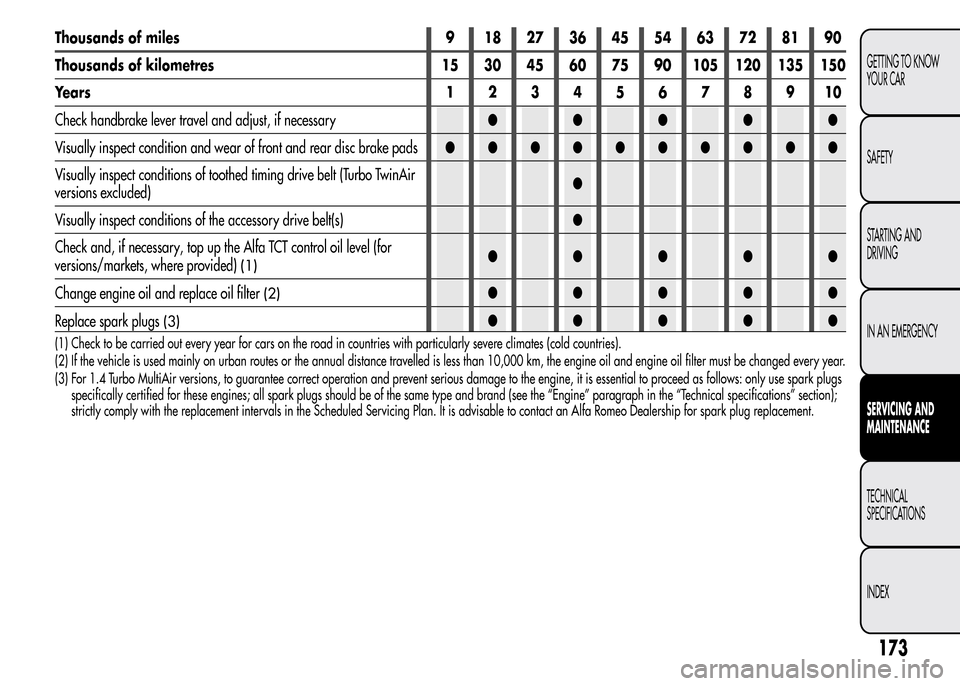
Thousands of miles 9 18 27 36 45 54 63 72 81 90
Thousands of kilometres 15 30 45 60 75 90 105 120 135 150
Years12345678910
Check handbrake lever travel and adjust, if necessary●●●●●
Visually inspect condition and wear of front and rear disc brake pads●●●●●●●●●●
Visually inspect conditions of toothed timing drive belt (Turbo TwinAir
versions excluded)●
Visually inspect conditions of the accessory drive belt(s)●
Check and, if necessary, top up the Alfa TCT control oil level (for
versions/markets, where provided)
(1)●●●●●
Change engine oil and replace oil filter
(2)●●●●●
Replace spark plugs
(3)●●●●●
(1) Check to be carried out every year for cars on the road in countries with particularly severe climates (cold countries).
(2) If the vehicle is used mainly on urban routes or the annual distance travelled is less than 10,000 km, the engine oil and engine oil filter must be changed every year.
(3) For 1.4 Turbo MultiAir versions, to guarantee correct operation and prevent serious damage to the engine, it is essential to proceed as follows: only use spark plugs
specifically certified for these engines; all spark plugs should be of the same type and brand (see the “Engine” paragraph in the “Technical specifications” section);
strictly comply with the replacement intervals in the Scheduled Servicing Plan. It is advisable to contact an Alfa Romeo Dealership for spark plug replacement.
173
GETTING TO KNOW
YOUR CAR
SAFETY
STARTING AND
DRIVING
IN AN EMERGENCY
SERVICING AND
MAINTENANCE
TECHNICAL
SPECIFICATIONS
INDEX
Page 180 of 280
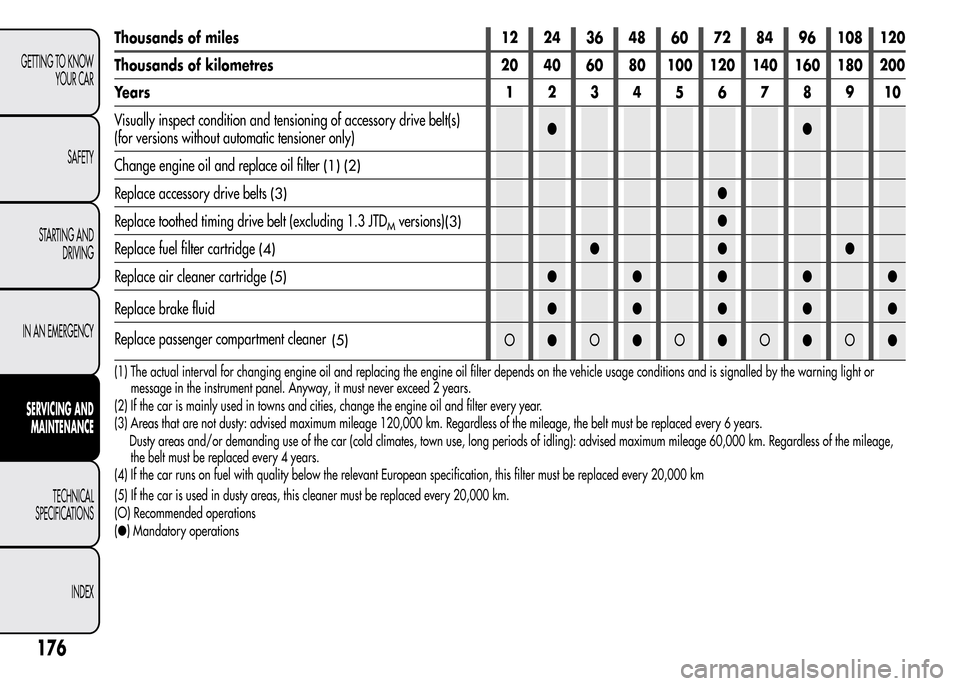
Thousands of miles 12 24 36 48 60 72 84 96 108 120
Thousands of kilometres 20 40 60 80 100 120 140 160 180 200
Years12345678910
Visually inspect condition and tensioning of accessory drive belt(s)
(for versions without automatic tensioner only)●●
Change engine oil and replace oil filter
(1) (2)
Replace accessory drive belts(3)●
Replace toothed timing drive belt (excluding 1.3 JTD
Mversions)(3)●
Replace fuel filter cartridge
(4)●●●
Replace air cleaner cartridge
(5)●●●●●
Replace brake fluid●●●●●
Replace passenger compartment cleaner
(5)O●O●O●O●O●
(1) The actual interval for changing engine oil and replacing the engine oil filter depends on the vehicle usage conditions and is signalled by the warning light or
message in the instrument panel. Anyway, it must never exceed 2 years.
(2) If the car is mainly used in towns and cities, change the engine oil and filter every year.
(3) Areas that are not dusty: advised maximum mileage 120,000 km. Regardless of the mileage, the belt must be replaced every 6 years.
Dusty areas and/or demanding use of the car (cold climates, town use, long periods of idling): advised maximum mileage 60,000 km. Regardless of the mileage,
the belt must be replaced every 4 years.
(4) If the car runs on fuel with quality below the relevant European specification, this filter must be replaced every 20,000 km
176
GETTING TO KNOW
YOUR CAR
SAFETY
STARTING AND
DRIVING
IN AN EMERGENCY
SERVICING AND
MAINTENANCE
TECHNICAL
SPECIFICATIONS
INDEX(5) If the car is used in dusty areas, this cleaner must be replaced every 20,000 km.
(O) Recommended operations
(●) Mandatory operations
Page 181 of 280
PERIODIC CHECKS
Every 1,000 km or before long journeys, check and restore the
following if necessary:
❒engine coolant, brake fluid and windscreen washer fluid level;
❒tyre inflation pressure and condition;
❒operation of lighting system (headlamps, direction indicators,
hazard warning lights, etc.);
❒operation of window washer/wiper system and positioning/wear of
windscreen/rear window wiper blades
Check and top up, if required, the engine oil level every 3,000 km.
HEAVY-DUTY USE OF THE CAR
If you use the car mainly under one of the following conditions:
❒towing a trailer or caravan;
❒dusty roads;
❒short, repeated journeys (less than 7-8 km) at sub-zero outside
temperatures;
❒engine often idling or driving long distances at low speeds or long
periods of idleness;
the following checks must be performed more frequently than indicated
in the Scheduled Servicing Plan:
❒check front disc brake pad conditions and wear;
❒check cleanliness of bonnet and boot locks, cleanliness and
lubrication of linkage;
❒visually inspect conditions of: engine, gearbox, transmission, pipes
and hoses (exhaust - fuel system - brakes) and rubber elements
(boots - sleeves - bushes - etc.);
❒check battery charge and battery fluid level (electrolyte);
❒visually inspect condition of the accessory drive belts;
❒check and, if necessary, change engine oil and replace oil filter;
❒check and, if necessary, replace pollen filter;
❒check and, if necessary, replace air cleaner.
177
GETTING TO KNOW
YOUR CAR
SAFETY
STARTING AND
DRIVING
IN AN EMERGENCY
SERVICING AND
MAINTENANCE
TECHNICAL
SPECIFICATIONS
INDEX
Page 197 of 280
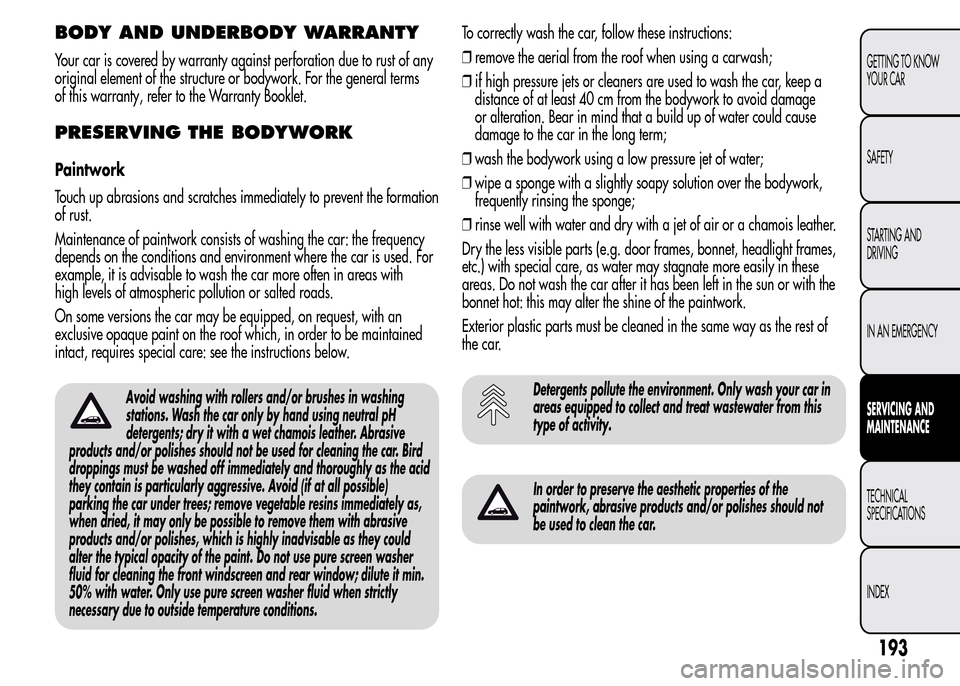
BODY AND UNDERBODY WARRANTY
Your car is covered by warranty against perforation due to rust of any
original element of the structure or bodywork. For the general terms
of this warranty, refer to the Warranty Booklet.
PRESERVING THE BODYWORK
Paintwork
Touch up abrasions and scratches immediately to prevent the formation
of rust.
Maintenance of paintwork consists of washing the car: the frequency
depends on the conditions and environment where the car is used. For
example, it is advisable to wash the car more often in areas with
high levels of atmospheric pollution or salted roads.
On some versions the car may be equipped, on request, with an
exclusive opaque paint on the roof which, in order to be maintained
intact, requires special care: see the instructions below.
Avoid washing with rollers and/or brushes in washing
stations. Wash the car only by hand using neutral pH
detergents; dry it with a wet chamois leather. Abrasive
products and/or polishes should not be used for cleaning the car. Bird
droppings must be washed off immediately and thoroughly as the acid
they contain is particularly aggressive. Avoid (if at all possible)
parking the car under trees; remove vegetable resins immediately as,
when dried, it may only be possible to remove them with abrasive
products and/or polishes, which is highly inadvisable as they could
alter the typical opacity of the paint. Do not use pure screen washer
fluid for cleaning the front windscreen and rear window; dilute it min.
50% with water. Only use pure screen washer fluid when strictly
necessary due to outside temperature conditions.
To correctly wash the car, follow these instructions:
❒remove the aerial from the roof when using a carwash;
❒if high pressure jets or cleaners are used to wash the car, keep a
distance of at least 40 cm from the bodywork to avoid damage
or alteration. Bear in mind that a build up of water could cause
damage to the car in the long term;
❒wash the bodywork using a low pressure jet of water;
❒wipe a sponge with a slightly soapy solution over the bodywork,
frequently rinsing the sponge;
❒rinse well with water and dry with a jet of air or a chamois leather.
Dry the less visible parts (e.g. door frames, bonnet, headlight frames,
etc.) with special care, as water may stagnate more easily in these
areas. Do not wash the car after it has been left in the sun or with the
bonnet hot: this may alter the shine of the paintwork.
Exterior plastic parts must be cleaned in the same way as the rest of
the car.
Detergents pollute the environment. Only wash your car in
areas equipped to collect and treat wastewater from this
type of activity.
In order to preserve the aesthetic properties of the
paintwork, abrasive products and/or polishes should not
be used to clean the car.
193
GETTING TO KNOW
YOUR CAR
SAFETY
STARTING AND
DRIVING
IN AN EMERGENCY
SERVICING AND
MAINTENANCE
TECHNICAL
SPECIFICATIONS
INDEX
Page 225 of 280
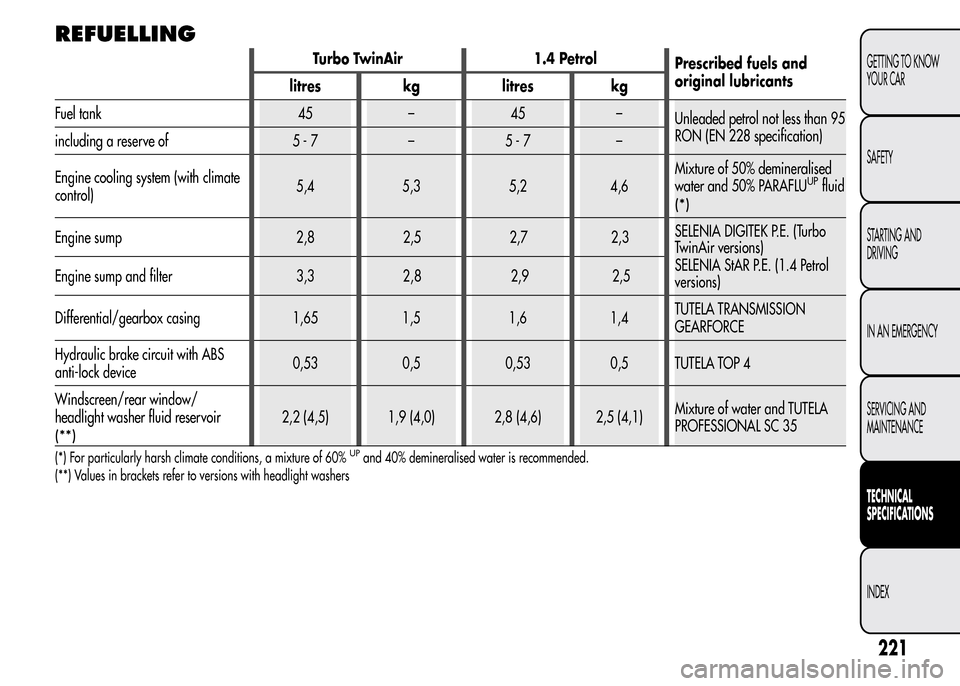
REFUELLING
Turbo TwinAir 1.4 Petrol
Prescribed fuels and
original lubricants
litres kg litres kg
Fuel tank 45 – 45 –
Unleaded petrol not less than 95
RON (EN 228 specification)
including a reserve of 5 - 7 – 5 - 7 –
Engine cooling system (with climate
control)5,4 5,3 5,2 4,6Mixture of 50% demineralised
water and 50% PARAFLU
UPfluid
(*)
Engine sump 2,8 2,5 2,7 2,3SELENIA DIGITEK P.E. (Turbo
TwinAir versions)
SELENIA StAR P.E. (1.4 Petrol
versions) Engine sump and filter 3,3 , 2,9 2,5
Differential/gearbox casing 1,65 1,5 1,6 1,4TUTELA TRANSMISSION
GEARFORCE
Hydraulic brake circuit with ABS
anti-lock device0,53 0,5 0,53 0,5 TUTELA TOP 4
Windscreen/rear window/
headlight washer fluid reservoir
(**)
2,2 (4,5) 1,9 (4,0) 2,8 (4,6) 2,5 (4,1)Mixture of water and TUTELA
PROFESSIONAL SC 35
(*) For particularly harsh climate conditions, a mixture of 60%UPand 40% demineralised water is recommended.
(**) Values in brackets refer to versions with headlight washers
221
GETTING TO KNOW
YOUR CAR
SAFETY
STARTING AND
DRIVING
IN AN EMERGENCY
SERVICING AND
MAINTENANCE
TECHNICAL
SPECIFICATIONS
INDEX
28