belt Alfa Romeo MiTo 2016 User Guide
[x] Cancel search | Manufacturer: ALFA ROMEO, Model Year: 2016, Model line: MiTo, Model: Alfa Romeo MiTo 2016Pages: 280, PDF Size: 8.52 MB
Page 116 of 280
PRETENSIONERS
The car is equipped with front seat belt pretensioners, which draw
back the seat belts by several centimetres in the event of a violent
frontal impact. This guarantees the perfect adherence of the seat belts
to the occupants’ bodies before the restraining action begins.
It is evident that the pretensioners have been activated when the belt
withdraws towards the reel.
The car is also equipped with a second pretensioner (in the kick plate
area). Its activation is signalled by the shortening of the metal cable.
A slight discharge of smoke may be produced during the activation of
the pretensioner. This is not harmful and does not indicate the start
of a fire.
IMPORTANT To obtain the highest degree of protection from the action
of the pretensioner, wear the seat belt tight to the chest and pelvis.
The pretensioner does not require any maintenance or lubrication: any
changes to its original conditions will invalidate its efficiency. If, due
to unusual natural events (floods, sea storms, etc.), the device has been
affected by water and/or mud, contact Alfa Romeo Authorised
Services to have it replaced.
The pretensioner may be used only once. Once it has
been activated, contact Alfa Romeo Authorised Services
to have it replaced.
Operations which lead to impacts, vibrations or localised
heating (over 100°C for a maximum of six hours) in the
area around the pretensioner may damage or deploy it.
Contact Alfa Romeo Authorised Services should intervention be
necessary on these components.
LOAD LIMITERS
To increase protection, the front seat belt reels contain a load limiter
which controls the force acting on the chest and shoulders during
the belt restraining action in the event of a head-on collision.
GENERAL INSTRUCTIONS FOR USING
THE SEAT BELTS
Respect and ensure that all the other occupants of the car respect the
local laws in force regarding the use of seat belts. Always fasten the
seat belts before starting off.
Seat belts must also be worn by pregnant women: the risk of injury in
the event of an accident is reduced for them and the unborn child if
they are wearing a seat belt.
Pregnant women must position the lower part of the belt very low
down so that it passes over the pelvis and under the abdomen fig. 93.
The belt must not be twisted. The upper part must pass over the
shoulder and cross the chest diagonally. The lower part must adhere to
the pelvis fig. 94, not to the abdomen of the occupant. Never use
devices (clips, clamps, etc.) to hold the seat belt away from your body.
112
GETTING TO KNOW
YOUR CAR
SAFETY
STARTING AND
DRIVING
IN AN EMERGENCY
SERVICING AND
MAINTENANCE
TECHNICAL
SPECIFICATIONS
INDEX
Page 117 of 280
For maximum protection, keep the backrest upright,
lean back into it and make sure the seat belt fits
closely across your chest and pelvis. Always fasten the
seat belts for both the front and rear seats! Travelling without
wearing seat belts will increase the risk of serious injury and
even death in the event of an accident.Each seat belt must be used by only one person. Never travel with a
child sitting on a passenger’s lap and a single belt to protect them both
fig. 95. In general, do not place any objects between the person and
belt.
Removing or otherwise tampering with safety belt and
pretensioner components is strictly prohibited. Any
operations on these components must be performed by
qualified and authorised technicians. Always contact Alfa Romeo
Authorized Services.
If the belt has been subjected to high levels of stress,
for example after an accident, it should be changed
completely together with the attachments, attachment
fixing screws and the pretensioner. In fact, even if the belt has no
visible defects, it may have lost its resilience.
fig. 93A0J0401
fig. 94A0J0095fig. 95A0J0096
113
GETTING TO KNOW
YOUR CAR
SAFETY
STARTING AND
DRIVING
IN AN EMERGENCY
SERVICING AND
MAINTENANCE
TECHNICAL
SPECIFICATIONS
INDEX
Page 118 of 280
SEAT BELT MAINTENANCE
❒Always use the seat belt well stretched and never twisted; make sure
that it is free to run without obstructions;
❒replace the belt after an accident of a certain severity even if it does
not appear to be damaged. Always replace the belt if the
pretensioners were deployed;
❒hand wash the seat belts with water and neutral soap, rinse and
leave to dry in the shade. Never use strong detergents, bleach,
paints or any other substance which could damage the belt fibres;
❒prevent the retractors from getting wet: their correct operation is only
guaranteed if water does not get inside;
❒replace the seat belt when there is wear or cuts.
CARRYING CHILDREN SAFELY
For optimal protection in the event of an impact, all occupants must be
seated and wearing adequate restraint systems, including newborn
and other children!
This prescription is compulsory in all EC countries according to EC
Directive 2003/20/EC.
Compared with an adult, a child's head is larger and heavier in
proportion to his/her body and the child's muscular and bone
structures are not fully developed. Therefore, correct restraint systems
other than adult seat belts are necessary to reduce as much as possible
the risk of injuries in case of accident, braking or sudden manoeuvre.
Children must be seated safely and comfortably. As far as the
characteristics of the child restraint systems used allow, you are
advised to keep children in rear facing restraint systems for as long as
possible (at least until 3–4 years old), since this is the most protected
position in the event of an impact.
The choice of the most suitable child restraint device depends on the
weight of the child; there are various types of child restraint systems
and you are advised always to choose the one that is most suitable for
the child.
When over 1.50 m in height, from the point of view of restraint
systems, children are considered as adults and wear seat belts
normally.
114
GETTING TO KNOW
YOUR CAR
SAFETY
STARTING AND
DRIVING
IN AN EMERGENCY
SERVICING AND
MAINTENANCE
TECHNICAL
SPECIFICATIONS
INDEX
Page 120 of 280
FITTING “UNIVERSAL” CHILD
SEAT (with seat belts)
GROUP 0 and 0+
The diagram is indicative and for assembly purposes
only. Fit the child seat according to the instructions,
which must be included.
Infants up to 13 kg must be carried with a child seat facing backwards
of a type as shown in fig. 96 which, supporting the head, does not
induce stress on the neck in the event of sudden decelerations.
The child seat is secured by the car seat belts, as shown in fig. 96 and
it must restrain the child in turn with its own belts.
GROUP 1
The diagram is indicative and for assembly purposes
only. Fit the child seat according to the instructions,
which must be included.
Children of weight from 9 to 18 kg may be carried in child seats
facing forwards fig. 97.
Child seats with Isofix attachments are available,
which allow them to be secured to the seat safely
without using the car seat belts.
fig. 96A0J0097fig. 97A0J0371
116
GETTING TO KNOW
YOUR CAR
SAFETY
STARTING AND
DRIVING
IN AN EMERGENCY
SERVICING AND
MAINTENANCE
TECHNICAL
SPECIFICATIONS
INDEX
Page 121 of 280
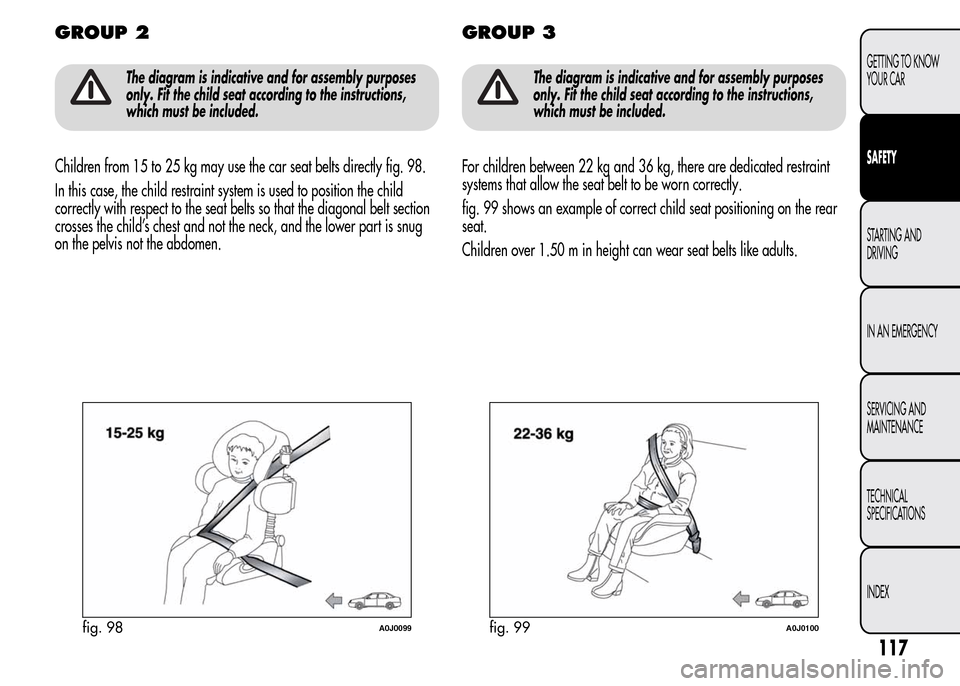
GROUP 2
The diagram is indicative and for assembly purposes
only. Fit the child seat according to the instructions,
which must be included.
Children from 15 to 25 kg may use the car seat belts directly fig. 98.
In this case, the child restraint system is used to position the child
correctly with respect to the seat belts so that the diagonal belt section
crosses the child’s chest and not the neck, and the lower part is snug
on the pelvis not the abdomen.
GROUP 3
The diagram is indicative and for assembly purposes
only. Fit the child seat according to the instructions,
which must be included.
For children between 22 kg and 36 kg, there are dedicated restraint
systems that allow the seat belt to be worn correctly.
fig. 99 shows an example of correct child seat positioning on the rear
seat.
Children over 1.50 m in height can wear seat belts like adults.
fig. 98A0J0099fig. 99A0J0100
117
GETTING TO KNOW
YOUR CAR
SAFETY
STARTING AND
DRIVING
IN AN EMERGENCY
SERVICING AND
MAINTENANCE
TECHNICAL
SPECIFICATIONS
INDEX
Page 124 of 280
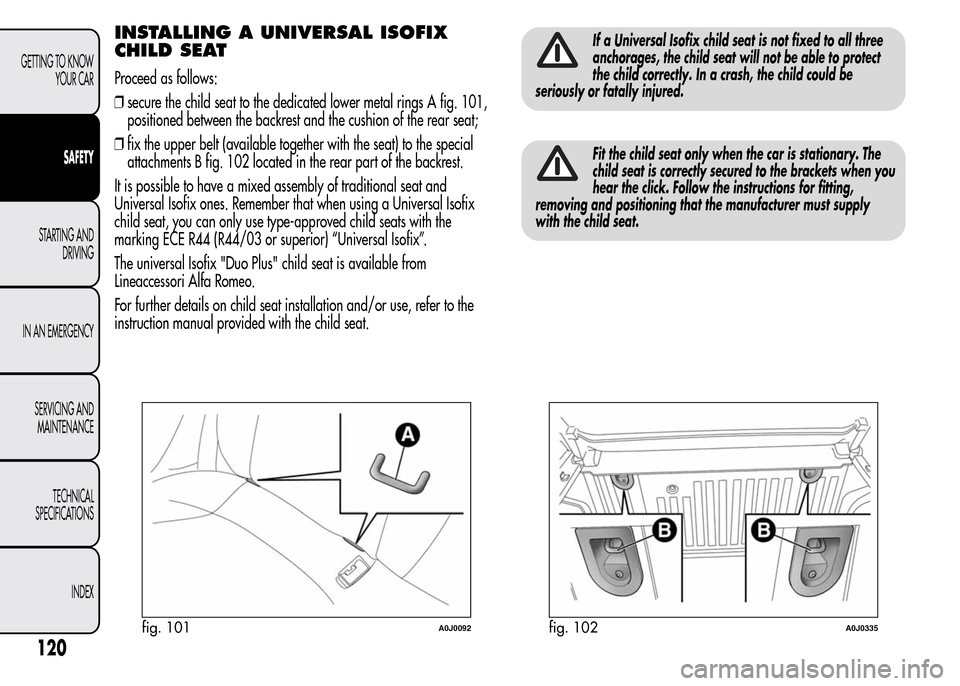
INSTALLING A UNIVERSAL ISOFIX
CHILD SEAT
Proceed as follows:
❒secure the child seat to the dedicated lower metal rings A fig. 101,
positioned between the backrest and the cushion of the rear seat;
❒fix the upper belt (available together with the seat) to the special
attachments B fig. 102 located in the rear part of the backrest.
It is possible to have a mixed assembly of traditional seat and
Universal Isofix ones. Remember that when using a Universal Isofix
child seat, you can only use type-approved child seats with the
marking ECE R44 (R44/03 or superior) “Universal Isofix”.
The universal Isofix "Duo Plus" child seat is available from
Lineaccessori Alfa Romeo.
For further details on child seat installation and/or use, refer to the
instruction manual provided with the child seat.
If a Universal Isofix child seat is not fixed to all three
anchorages, the child seat will not be able to protect
the child correctly. In a crash, the child could be
seriously or fatally injured.
Fit the child seat only when the car is stationary. The
child seat is correctly secured to the brackets when you
hear the click. Follow the instructions for fitting,
removing and positioning that the manufacturer must supply
with the child seat.
fig. 101A0J0092fig. 102A0J0335
120
GETTING TO KNOW
YOUR CAR
SAFETY
STARTING AND
DRIVING
IN AN EMERGENCY
SERVICING AND
MAINTENANCE
TECHNICAL
SPECIFICATIONS
INDEX
Page 126 of 280
Fit the child seat according to the instructions, which
must be included.
Main recommendations to carry children safely
❒Install the child seats on the rear seat, which is the most protected
position in the event of an accident.
❒Keep children in rear facing seats for as long as possible, until 2
years old.
❒Should a rear facing child seat be installed on the rear seats, it is
advisable to position it as far forward as the position of the front
seat allows.
❒If the passenger's front airbag is deactivated always check the
permanent switching on of the dedicated warning light on the
instrument panel to make sure that it has actually been deactivated.
❒Carefully follow the instructions supplied with the child seat itself.
Keep the instructions in the car along with the other documents
and this handbook. Do not use second-hand child seats without
instructions.
❒Only one child is to be strapped into each restraint system; never
carry two children simultaneously.
❒Always check that the seat belts do not interfere with the child's
throat.❒Always check that the seat belt is well fastened by pulling on it.
❒While travelling, do not let the child sit incorrectly or unfasten the
belts.
❒Never allow a child to put the belt's diagonal section under an arm
or behind their back.
❒Never carry children on your lap, even newborns. No-one can
restrain a child in the event of an accident.
❒In the event of an accident, replace the child seat with a new one.
122
GETTING TO KNOW
YOUR CAR
SAFETY
STARTING AND
DRIVING
IN AN EMERGENCY
SERVICING AND
MAINTENANCE
TECHNICAL
SPECIFICATIONS
INDEX
Page 127 of 280
FRONT AIRBAGS
“SMART BAG” SYSTEM (MULTISTAGE
FRONT AIRBAGS)
The car is equipped with multi-stage front airbags (“Smart bags”) for
the driver and passenger and knee bags for the driver.
The front airbags (driver's and passenger's) and the driver's knee bag
have been designed to protect the occupants in the event of head-on
crashes of medium-high severity, by placing cushions between the
occupant and the steering wheel or dashboard.
Therefore non-deployment in other types of impacts (side impacts, rear
shunts, roll-overs, etc.) does not indicate a system malfunction.
Airbags are not a replacement of but complementary to the seat belts,
which you are recommended to always wear. In the event of impact,
those not wearing a seat belt are projected forwards and may come
into contact with the bag which is still inflating. The protection offered
by the bag is compromised in these circumstances.
Front airbags may not activate in the following situations:
❒frontal impacts against highly deformable objects not involving the
front surface of the car (e.g. wing collision against guard rail, etc.);
❒jamming of the car underneath other vehicles or protective barriers
(e.g. underneath a truck or a guard rail) as, in this case, the bags
would offer no additional protection with respect to the seat belt and
their deployment would be inappropriate. In these cases, non-
deployment does not indicate a system malfunction.
Do not apply stickers or other objects on the steering
wheel, on the dashboard in the passenger side airbag
area, on side upholstery on the roof or on the seats.
Never put objects (e.g. mobile phones) on the passenger's side
dashboard since they could interfere with correct inflation of the
airbag and also cause serious injury to the passengers.
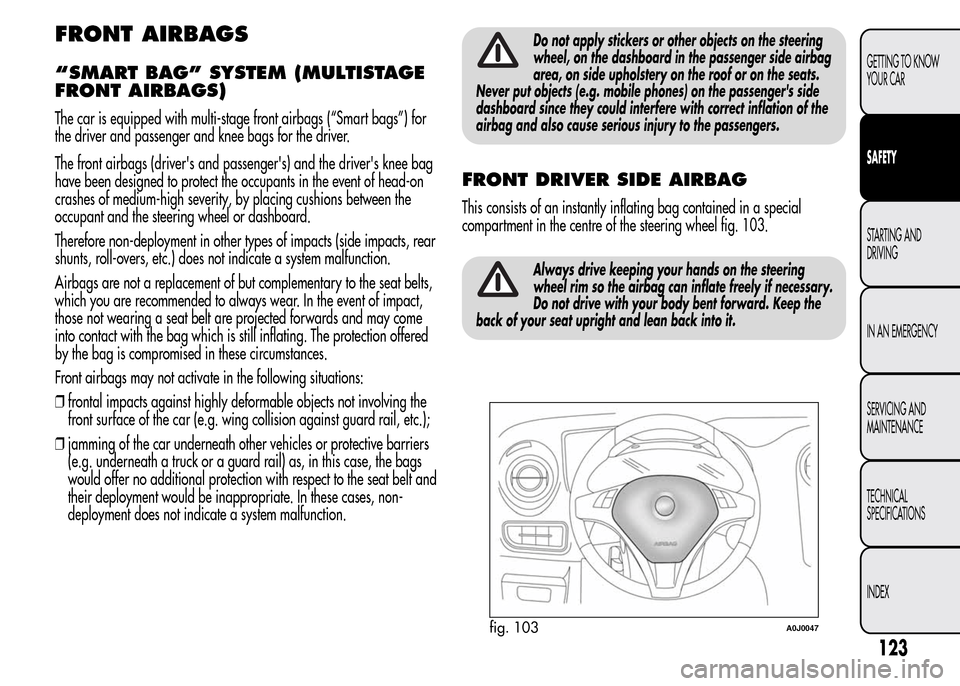
FRONT DRIVER SIDE AIRBAG
This consists of an instantly inflating bag contained in a special
compartment in the centre of the steering wheel fig. 103.
Always drive keeping your hands on the steering
wheel rim so the airbag can inflate freely if necessary.
Do not drive with your body bent forward. Keep the
back of your seat upright and lean back into it.
fig. 103A0J0047
123
GETTING TO KNOW
YOUR CAR
SAFETY
STARTING AND
DRIVING
IN AN EMERGENCY
SERVICING AND
MAINTENANCE
TECHNICAL
SPECIFICATIONS
INDEX
Page 131 of 280
FRONT SIDE AIRBAGS (SIDE BAGS)
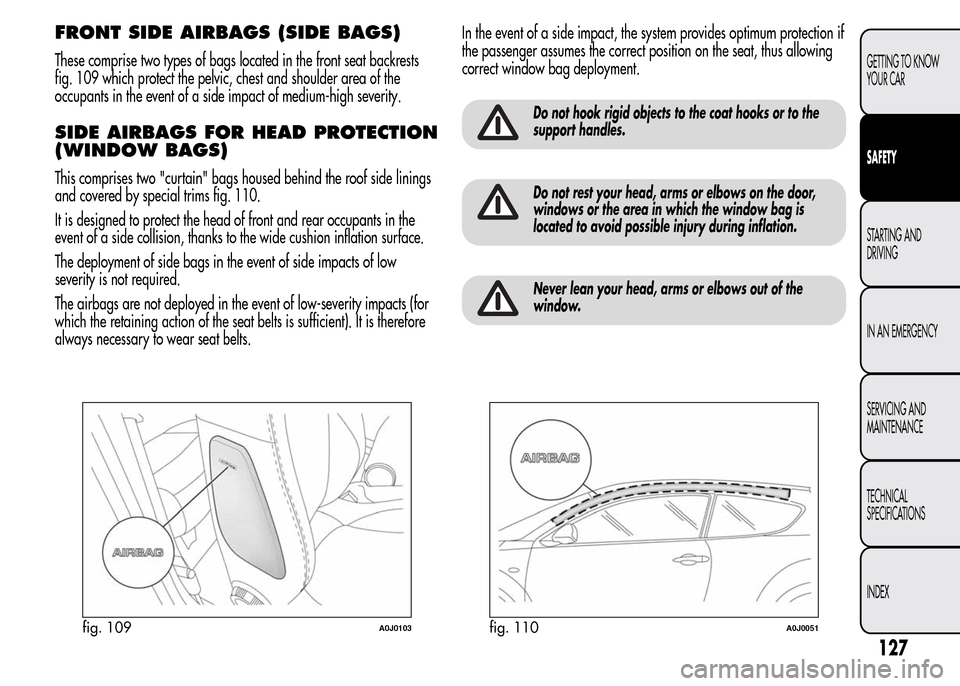
These comprise two types of bags located in the front seat backrests
fig. 109 which protect the pelvic, chest and shoulder area of the
occupants in the event of a side impact of medium-high severity.
SIDE AIRBAGS FOR HEAD PROTECTION
(WINDOW BAGS)
This comprises two "curtain" bags housed behind the roof side linings
and covered by special trims fig. 110.
It is designed to protect the head of front and rear occupants in the
event of a side collision, thanks to the wide cushion inflation surface.
The deployment of side bags in the event of side impacts of low
severity is not required.
The airbags are not deployed in the event of low-severity impacts (for
which the retaining action of the seat belts is sufficient). It is therefore
always necessary to wear seat belts.In the event of a side impact, the system provides optimum protection if
the passenger assumes the correct position on the seat, thus allowing
correct window bag deployment.
Do not hook rigid objects to the coat hooks or to the
support handles.
Do not rest your head, arms or elbows on the door,
windows or the area in which the window bag is
located to avoid possible injury during inflation.
Never lean your head, arms or elbows out of the
window.
fig. 109A0J0103fig. 110A0J0051
127
GETTING TO KNOW
YOUR CAR
SAFETY
STARTING AND
DRIVING
IN AN EMERGENCY
SERVICING AND
MAINTENANCE
TECHNICAL
SPECIFICATIONS
INDEX
Page 133 of 280
When the ignition key is turned to MAR, the
warning light (with passenger side front airbag
activated) switches on and flashes for a few seconds to
remind you that the passenger airbag will be deployed in a
crash, after which it should switch off.
The front airbag is designed to be deployed for
impacts of a greater intensity than for the
pretensioners. For impacts whose intensity falls
between the two levels, it is normal for only the pretensioners to
be activated.
The airbag does not replace seat belts but increases
their effectiveness. Because front airbags are not
deployed for low-speed crashes, side collisions,
rear-end shunts or rollovers, occupants are protected, in addition
to any side bags, only by their seat belts, which must therefore
always be fastened.
129
GETTING TO KNOW
YOUR CAR
SAFETY
STARTING AND
DRIVING
IN AN EMERGENCY
SERVICING AND
MAINTENANCE
TECHNICAL
SPECIFICATIONS
INDEX