buttons Alfa Romeo MiTo 2016 User Guide
[x] Cancel search | Manufacturer: ALFA ROMEO, Model Year: 2016, Model line: MiTo, Model: Alfa Romeo MiTo 2016Pages: 280, PDF Size: 8.52 MB
Page 61 of 280
AIR RECIRCULATION
The air recirculation is managed according to the following operating
logics:
❒automatic activation: press one of the AUTO buttons. Activation is
indicated by the word AUTO appearing on the display;
❒override on (inside air recirculation always on): indicated by the LED
on button C and the
symbol on the display;
❒override off (air recirculation constantly off, air intake from the
outside): signalled by the LED on button C switching off and by the
symbol in the display disappearing. Forced activation/
deactivation can be selected by pressing button C.
IMPORTANT The activation of recirculation makes it possible to reach
the required passenger compartment heating/cooling conditions faster.
It is, however, inadvisable to use it on rainy/cold days as it would
considerably increase the possibility of the windows misting up inside
(especially if the climate control system is off).
When the outside temperature is low, recirculation is forced off (air
drawn in from the outside) to prevent the windows from misting up. In
automatic operation, air recirculation will be managed automatically
by the system according to external environmental conditions.
When manual recirculation control is set, the word FULL disappears
from the display and AUTO disappears from the icon.
It is advisable not to use the air recirculation function
when the outside temperature is low to prevent the
windows from rapidly misting up.
CLIMATE CONTROL COMPRESSOR
Press button B to activate/deactivate the compressor. The system
remembers that the compressor has been switched off, even after the
engine has stopped.
When the compressor is switched off the system deactivates air
recirculation to prevent the windows from misting up. In this case,
although the system is capable of maintaining the required
temperature, the word FULL will disappear from the display.
If, however, the system is unable to maintain the requested
temperature, the temperature indications flash and the word AUTO
disappears.
To restore automatic control of compressor engagement, press button B
again or press the AUTO button.
With compressor off:
❒if the outside temperature is higher than the set one, the system will
not be able to satisfy the request. The temperature value will then
flash on the display for a few seconds and the word AUTO will
disappear;
❒the fan speed can be reset manually.
With the compressor on and the engine running, the fan speed cannot
be lower than one bar on the display.
IMPORTANT With the climate control compressor off, air cannot be
introduced to the passenger compartment with a temperature lower
than the outside temperature; moreover, under certain environmental
conditions, windows could mist rapidly since the air is not
dehumidified.
57
GETTING TO
KNOW YOUR CAR
SAFETY
STARTING AND
DRIVING
IN AN EMERGENCY
SERVICING AND
MAINTENANCE
TECHNICAL
SPECIFICATIONS
INDEX
Page 62 of 280
RAPID WINDOW DEMISTING/
DEFROSTING (MAX-DEF function)
Press button F to activate windscreen and side window demisting/
defrosting. The climate control system carries out the following
operations:
❒switches on the air conditioning compressor when climatic
conditions are suitable;
❒deactivates air recirculation;
❒sets maximum air temperature (HI) in both zones;
❒sets fan speed according to the engine coolant temperature;
❒directs air flow to windscreen and front side windows diffusers;
❒activates the heated rear window.
IMPORTANT The MAX-DEF function remains on for about 3 minutes
from when the engine coolant reaches the appropriate temperature.
When the function is active the words FULL AUTO disappear from the
display. With the function active the only possible manual adjustments
are adjusting the fan speed and turning the heated rear window off.
Pressing buttons B, C, F or AUTO switches off the MAX-DEF function
and restores the settings that were present before the function was
activated.
HEATED REAR WINDOW
DEMISTING/DEFROSTING
Press thebutton to activate heated rear windscreen demisting/
defrosting. This function switches off automatically after about 20
minutes or when the engine is turned off. It is not switched on
automatically the next time the engine is started.For versions/markets where provided, press the
button to activate
demisting/defrosting of door mirrors, heated windscreen (for
versions/markets, where provided) and heated nozzles (for versions/
markets, where provided).
IMPORTANT Do not affix stickers to the inside of the heated rear
window over the heating filaments, to avoid damage that might cause
them to stop working properly.
TURNING THE CLIMATE CONTROL
SYSTEM OFF
Press the OFF button.
With climate control off:
❒air recirculation is on, thus isolating the passenger compartment
from the outside;
❒the compressor is off;
❒the fan is off;
❒the heated rear window can be switched on or off;
IMPORTANT The climate control system control unit stores the
temperatures set before the system was switched off and restores them
when any button of the system is pressed (except for button G). If the
function of the pressed button was not active before switching off, that
function will also be activated. If it was active, it will be restored.
To restart the climate control system in fully automatic mode press the
AUTO button.
58
GETTING TO
KNOW YOUR CAR
SAFETY
STARTING AND
DRIVING
IN AN EMERGENCY
SERVICING AND
MAINTENANCE
TECHNICAL
SPECIFICATIONS
INDEX
Page 83 of 280
ELECTRIC WINDOWS
These are equipped with an automatic function to raise and lower the
driver side front window.
CONTROLS
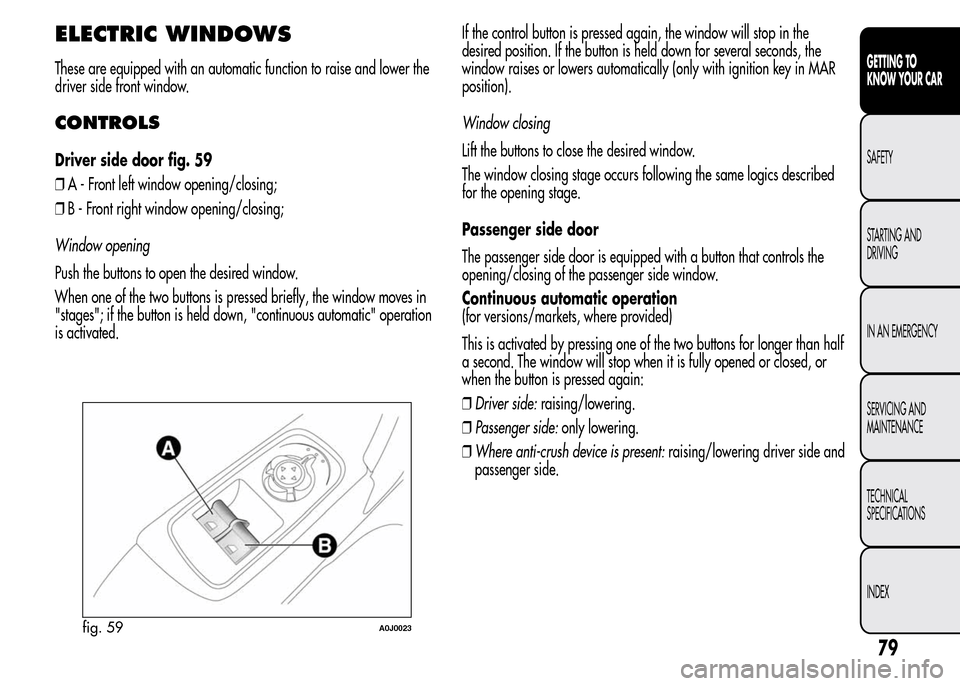
Driver side door fig. 59
❒A - Front left window opening/closing;
❒B - Front right window opening/closing;
Window opening
Push the buttons to open the desired window.
When one of the two buttons is pressed briefly, the window moves in
"stages"; if the button is held down, "continuous automatic" operation
is activated.If the control button is pressed again, the window will stop in the
desired position. If the button is held down for several seconds, the
window raises or lowers automatically (only with ignition key in MAR
position).
Window closing
Lift the buttons to close the desired window.
The window closing stage occurs following the same logics described
for the opening stage.
Passenger side door
The passenger side door is equipped with a button that controls the
opening/closing of the passenger side window.
Continuous automatic operation
(for versions/markets, where provided)
This is activated by pressing one of the two buttons for longer than half
a second. The window will stop when it is fully opened or closed, or
when the button is pressed again:
❒Driver side:raising/lowering.
❒Passenger side:only lowering.
❒Where anti-crush device is present:raising/lowering driver side and
passenger side.
fig. 59A0J0023
79
GETTING TO
KNOW YOUR CAR
SAFETY
STARTING AND
DRIVING
IN AN EMERGENCY
SERVICING AND
MAINTENANCE
TECHNICAL
SPECIFICATIONS
INDEX
Page 87 of 280
EXTENDING THE LUGGAGE
COMPARTMENT
The luggage compartment can be partially (1/3 or 2/3) or totally
extended by splitting the rear seat. See the descriptions in “Removing
the parcel shelf” and “Folding back the seats” paragraphs for how
to expand the luggage compartment.
Removing the parcel shelf
Proceed as follows:
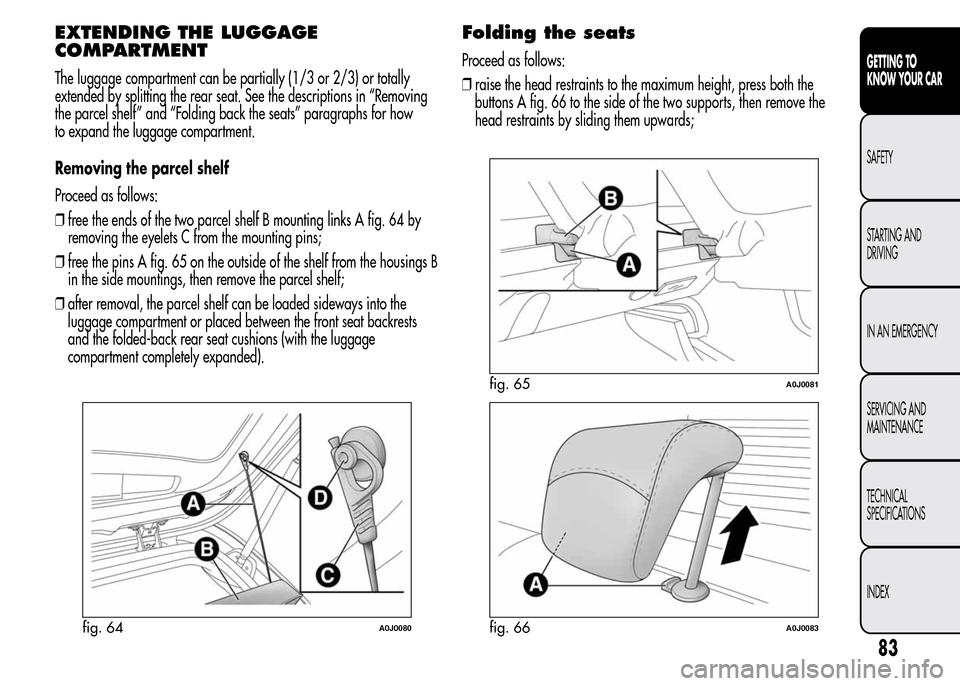
❒free the ends of the two parcel shelf B mounting links A fig. 64 by
removing the eyelets C from the mounting pins;
❒free the pins A fig. 65 on the outside of the shelf from the housings B
in the side mountings, then remove the parcel shelf;
❒after removal, the parcel shelf can be loaded sideways into the
luggage compartment or placed between the front seat backrests
and the folded-back rear seat cushions (with the luggage
compartment completely expanded).
Folding the seats
Proceed as follows:
❒raise the head restraints to the maximum height, press both the
buttons A fig. 66 to the side of the two supports, then remove the
head restraints by sliding them upwards;
fig. 64A0J0080
fig. 65A0J0081
fig. 66A0J0083
83
GETTING TO
KNOW YOUR CAR
SAFETY
STARTING AND
DRIVING
IN AN EMERGENCY
SERVICING AND
MAINTENANCE
TECHNICAL
SPECIFICATIONS
INDEX
Page 91 of 280
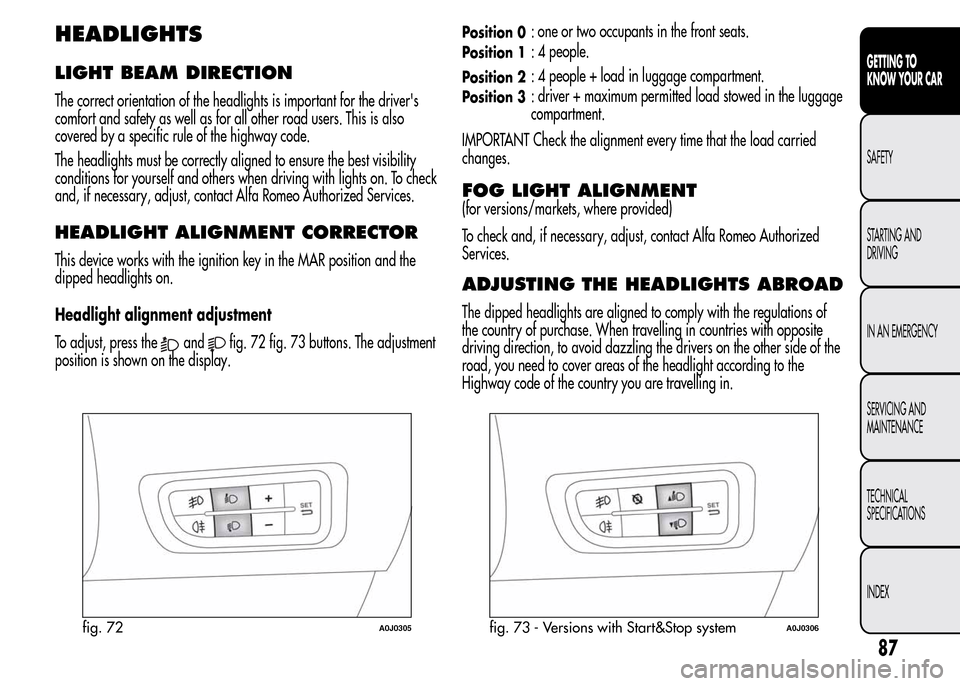
HEADLIGHTS
LIGHT BEAM DIRECTION
The correct orientation of the headlights is important for the driver's
comfort and safety as well as for all other road users. This is also
covered by a specific rule of the highway code.
The headlights must be correctly aligned to ensure the best visibility
conditions for yourself and others when driving with lights on. To check
and, if necessary, adjust, contact Alfa Romeo Authorized Services.
HEADLIGHT ALIGNMENT CORRECTOR
This device works with the ignition key in the MAR position and the
dipped headlights on.
Headlight alignment adjustment
To adjust, press the
andfig. 72 fig. 73 buttons. The adjustment
position is shown on the display.
Position 0: one or two occupants in the front seats.
Position 1: 4 people.
Position 2: 4 people + load in luggage compartment.
Position 3: driver + maximum permitted load stowed in the luggage
compartment.
IMPORTANT Check the alignment every time that the load carried
changes.
FOG LIGHT ALIGNMENT
(for versions/markets, where provided)
To check and, if necessary, adjust, contact Alfa Romeo Authorized
Services.
ADJUSTING THE HEADLIGHTS ABROAD
The dipped headlights are aligned to comply with the regulations of
the country of purchase. When travelling in countries with opposite
driving direction, to avoid dazzling the drivers on the other side of the
road, you need to cover areas of the headlight according to the
Highway code of the country you are travelling in.
fig. 72A0J0305fig. 73 - Versions with Start&Stop systemA0J0306
87
GETTING TO
KNOW YOUR CAR
SAFETY
STARTING AND
DRIVING
IN AN EMERGENCY
SERVICING AND
MAINTENANCE
TECHNICAL
SPECIFICATIONS
INDEX
Page 241 of 280
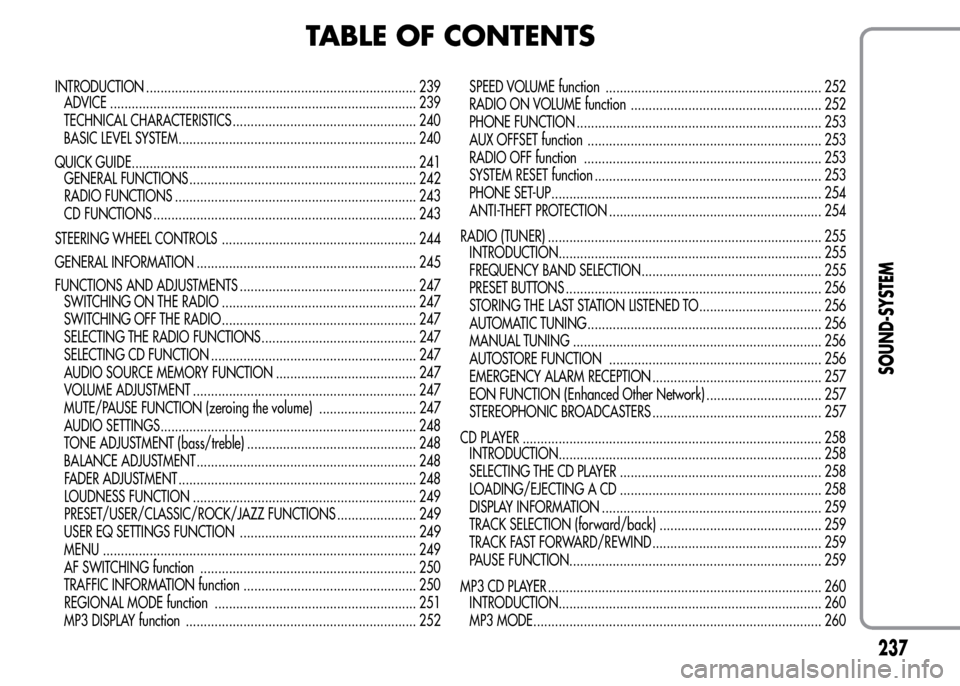
TABLE OF CONTENTS
INTRODUCTION ........................................................................... 239
ADVICE ..................................................................................... 239
TECHNICAL CHARACTERISTICS ................................................... 240
BASIC LEVEL SYSTEM.................................................................. 240
QUICK GUIDE............................................................................... 241
GENERAL FUNCTIONS ............................................................... 242
RADIO FUNCTIONS ................................................................... 243
CD FUNCTIONS ......................................................................... 243
STEERING WHEEL CONTROLS ...................................................... 244
GENERAL INFORMATION ............................................................. 245
FUNCTIONS AND ADJUSTMENTS ................................................. 247
SWITCHING ON THE RADIO ...................................................... 247
SWITCHING OFF THE RADIO ...................................................... 247
SELECTING THE RADIO FUNCTIONS ........................................... 247
SELECTING CD FUNCTION ......................................................... 247
AUDIO SOURCE MEMORY FUNCTION ....................................... 247
VOLUME ADJUSTMENT .............................................................. 247
MUTE/PAUSE FUNCTION (zeroing the volume) ........................... 247
AUDIO SETTINGS....................................................................... 248
TONE ADJUSTMENT (bass/treble) ............................................... 248
BALANCE ADJUSTMENT ............................................................. 248
FADER ADJUSTMENT .................................................................. 248
LOUDNESS FUNCTION .............................................................. 249
PRESET/USER/CLASSIC/ROCK/JAZZ FUNCTIONS ...................... 249
USER EQ SETTINGS FUNCTION ................................................. 249
MENU ....................................................................................... 249
AF SWITCHING function ............................................................ 250
TRAFFIC INFORMATION function ................................................ 250
REGIONAL MODE function ........................................................ 251
MP3 DISPLAY function ................................................................ 252SPEED VOLUME function ............................................................ 252
RADIO ON VOLUME function ..................................................... 252
PHONE FUNCTION .................................................................... 253
AUX OFFSET function ................................................................. 253
RADIO OFF function .................................................................. 253
SYSTEM RESET function ............................................................... 253
PHONE SET-UP........................................................................... 254
ANTI-THEFT PROTECTION ........................................................... 254
RADIO (TUNER) ............................................................................ 255
INTRODUCTION......................................................................... 255
FREQUENCY BAND SELECTION.................................................. 255
PRESET BUTTONS ....................................................................... 256
STORING THE LAST STATION LISTENED TO.................................. 256
AUTOMATIC TUNING................................................................. 256
MANUAL TUNING ..................................................................... 256
AUTOSTORE FUNCTION ........................................................... 256
EMERGENCY ALARM RECEPTION ............................................... 257
EON FUNCTION (Enhanced Other Network) ................................ 257
STEREOPHONIC BROADCASTERS ............................................... 257
CD PLAYER ................................................................................... 258
INTRODUCTION......................................................................... 258
SELECTING THE CD PLAYER ........................................................ 258
LOADING/EJECTING A CD ........................................................ 258
DISPLAY INFORMATION ............................................................. 259
TRACK SELECTION (forward/back) ............................................. 259
TRACK FAST FORWARD/REWIND ............................................... 259
PAUSE FUNCTION...................................................................... 259
MP3 CD PLAYER ............................................................................ 260
INTRODUCTION......................................................................... 260
MP3 MODE................................................................................ 260
237
SOUND-SYSTEM
Page 246 of 280
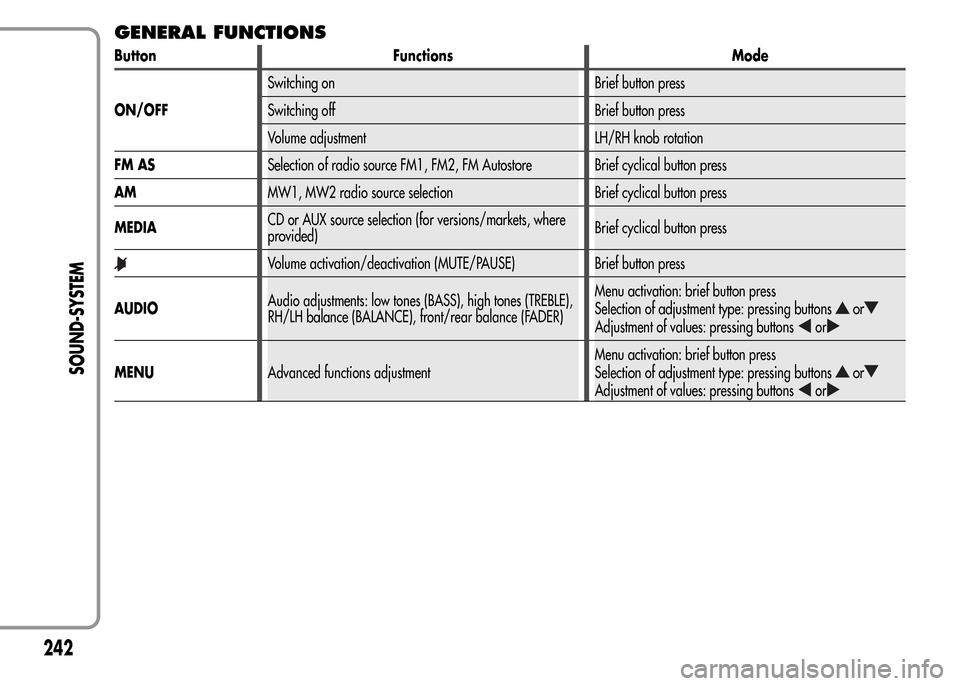
GENERAL FUNCTIONS
Button Functions Mode
ON/OFFSwitching on Brief button press
Switching off Brief button press
Volume adjustment LH/RH knob rotation
FM ASSelection of radio source FM1, FM2, FM Autostore Brief cyclical button press
AMMW1, MW2 radio source selection Brief cyclical button press
MEDIACD or AUX source selection (for versions/markets, where
provided)Brief cyclical button press
Volume activation/deactivation (MUTE/PAUSE) Brief button press
AUDIOAudio adjustments: low tones (BASS), high tones (TREBLE),
RH/LH balance (BALANCE), front/rear balance (FADER)Menu activation: brief button press
Selection of adjustment type: pressing buttons
or
Adjustment of values: pressing buttonsor
MENUAdvanced functions adjustmentMenu activation: brief button press
Selection of adjustment type: pressing buttonsor
Adjustment of values: pressing buttonsor
242
SOUND-SYSTEM
Page 247 of 280
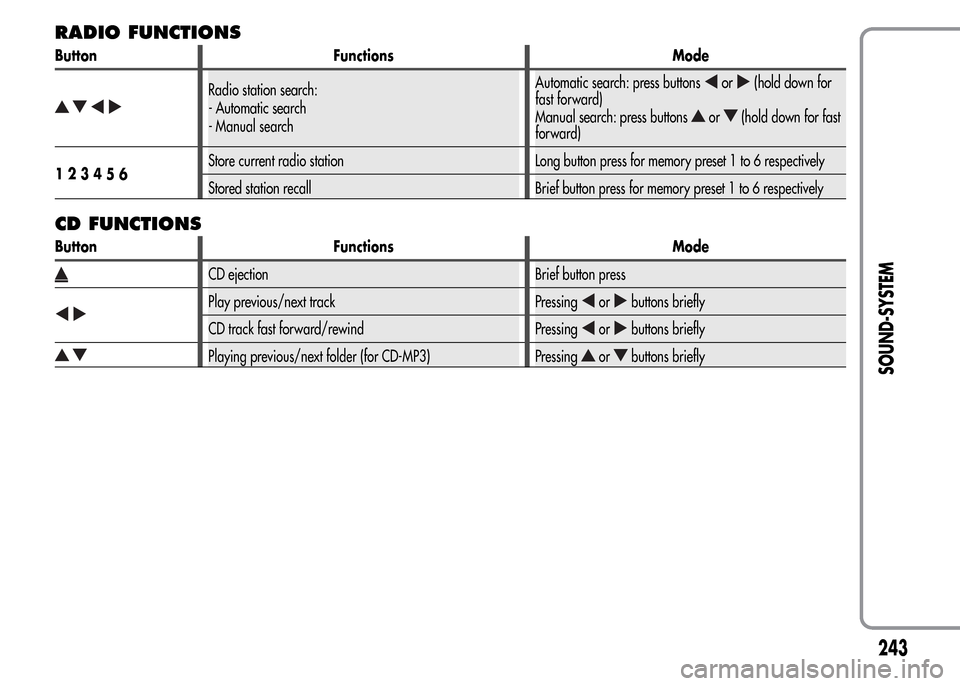
RADIO FUNCTIONS
Button Functions Mode
Radio station search:
- Automatic search
- Manual searchAutomatic search: press buttonsor(hold down for
fast forward)
Manual search: press buttons
or(hold down for fast
forward)
123456Store current radio station Long button press for memory preset 1 to 6 respectively
Stored station recall Brief button press for memory preset 1 to 6 respectively
CD FUNCTIONS
Button Functions Mode
CD ejection Brief button press
Play previous/next track Pressingorbuttons briefly
CD track fast forward/rewind Pressing
orbuttons briefly
Playing previous/next folder (for CD-MP3) Pressingorbuttons briefly
243
SOUND-SYSTEM
Page 248 of 280
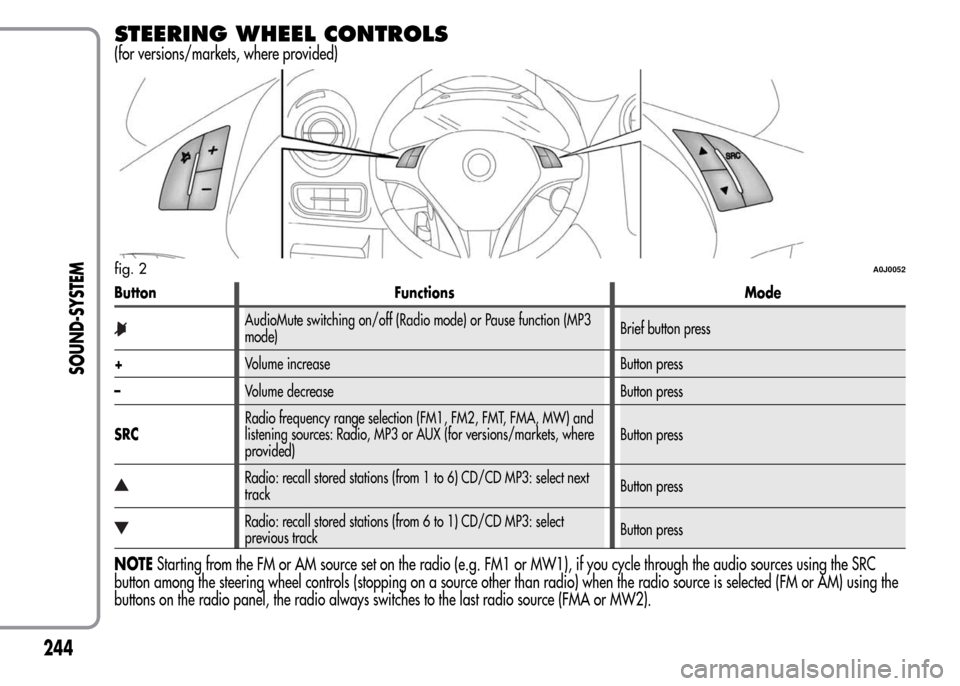
STEERING WHEEL CONTROLS
(for versions/markets, where provided)
Button Functions Mode
AudioMute switching on/off (Radio mode) or Pause function (MP3
mode)Brief button press
+Volume increase Button press
–Volume decrease Button press
SRCRadio frequency range selection (FM1, FM2, FMT, FMA, MW) and
listening sources: Radio, MP3 or AUX (for versions/markets, where
provided)Button press
Radio: recall stored stations (from 1 to 6) CD/CD MP3: select next
trackButton press
Radio: recall stored stations (from 6 to 1) CD/CD MP3: select
previous trackButton press
NOTEStarting from the FM or AM source set on the radio (e.g. FM1 or MW1), if you cycle through the audio sources using the SRC
button among the steering wheel controls (stopping on a source other than radio) when the radio source is selected (FM or AM) using the
buttons on the radio panel, the radio always switches to the last radio source (FMA or MW2).
fig. 2A0J0052
244
SOUND-SYSTEM
Page 252 of 280
With the Mute function activated, it will be ignored when there is
an incoming traffic alert (if the TA function is activated), or if an
emergency alarm is received. The function will be reactivated when
the alert is over.
AUDIO SETTINGS
The functions that can be selected from the audio menu change
depending on the context: AM/FM/CD/AUX (for
versions/markets, where provided).
Press the AUDIO button briefly to change the Audio functions.
After the AUDIO button is first pressed, the display will show the
bass level value for the source activated at that time (e.g. in FM
mode the display will show the wording “FM Bass + 2”).
Use the
orbuttons to scroll through the menu functions. To
change the setting of the function selected use the
orbuttons.
The current status of the function selected will be shown on the
display.
The functions managed by the Menu are:
❒BASS (adjustment of bass tones);
❒TREBLE (adjustment of high tones);
❒BALANCE (right/left balance adjustment);
❒FADER (front/back balance adjustment);
❒LOUDNESS (LOUDNESS function activation/deactivation);
❒EQUALISER (activation and selection of factory-set equaliser
levels);
❒USER EQUALISER (customised equaliser setting).
TONE ADJUSTMENT (bass/treble)
Proceed as follows:
❒Use
orbuttons to set the “Bass” or “Treble” in the AUDIO
menu;
❒press the
orbutton to increase/decrease the bass or
treble.
By pressing the buttons briefly, the levels will change progressively
in steps. By pressing them for longer, the levels will change quickly.
BALANCE ADJUSTMENT
Proceed as follows:
❒Select the “Balance” setting in the AUDIO menu using the
or
button;
❒press the
button to increase the volume of the right speakers
or the
button to increase the volume of the left speakers.
By pressing the buttons briefly, the levels will change progressively
in steps. By pressing them for longer, the levels will change quickly.
Select the value “
0” to set the same level for the right and
left audio outputs.
FADER ADJUSTMENT
Proceed as follows:
❒Select the “Fader” setting in the AUDIO menu using the
or
button;
❒press the
button to increase the sound from the rear speakers
or the
button to increase the sound from the front speakers.
By pressing the buttons briefly, the levels will change progressively
in steps. By pressing them for longer, the levels will change quickly.
248
SOUND-SYSTEM