battery Alfa Romeo MiTo 2016 Owner's Guide
[x] Cancel search | Manufacturer: ALFA ROMEO, Model Year: 2016, Model line: MiTo, Model: Alfa Romeo MiTo 2016Pages: 280, PDF Size: 8.52 MB
Page 144 of 280
This starting procedure must be performed by expert
personnel because incorrect actions could cause
electrical discharge of considerable intensity.
Furthermore, battery fluid is poisonous and corrosive: avoid
contact with skin and eyes. Keep naked flames and lighted
cigarettes away from the battery and do not cause sparks.
BUMP STARTING
Never start the engine by pushing, towing or coasting downhill.
REPLACING A WHEEL
GENERAL INSTRUCTIONS
The car is equipped with the “Fix&Go Automatic Kit”: see the
paragraph “Fix&Go Automatic Kit” for how to use this device.
As an alternative to the “Fix&Go Automatic Kit” the car may be
equipped with a space-saver wheel: see the instructions on the
following pages for changing the tyre.
The spare wheel is specific for your car. Do not use it
on cars of different models. Do not use spare wheels of
different models on your car. The space-saver wheel
must only be used in case of emergency. It must only be used for
the distance necessary to reach a service point and the car speed
must not exceed 80 km/h. The space-saver wheel has an orange
sticker that summarises the main cautions for use and limitations.
Never remove or cover the label. Never apply any hub cap to
the space-saver spare wheel.
Alert other drivers that the car is stationary in
compliance with local regulations: hazard warning
lights, warning triangle, etc. Any passengers on board
should leave the car, especially if it is heavily laden. Passengers
should stay away from on-coming traffic while the wheel is
being changed. In case of steep slopes or rough slopes, place
wedges or other materials suitable to stop the vehicle under the
wheels.
140
GETTING TO KNOW
YOUR CAR
SAFETY
STARTING AND
DRIVING
IN AN
EMERGENCY
SERVICING AND
MAINTENANCE
TECHNICAL
SPECIFICATIONS
INDEX
Page 166 of 280
FUSE LOCATION
Fuses are grouped together in three fuse boxes located in the engine
compartment, dashboard and luggage compartment.
Engine compartment fuse box
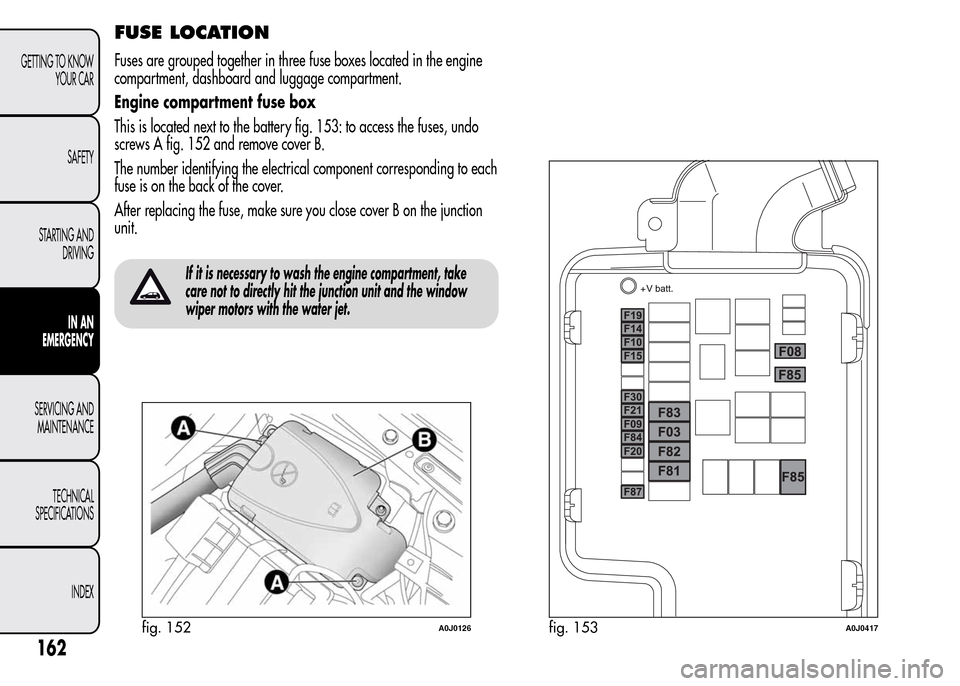
This is located next to the battery fig. 153: to access the fuses, undo
screws A fig. 152 and remove cover B.
The number identifying the electrical component corresponding to each
fuse is on the back of the cover.
After replacing the fuse, make sure you close cover B on the junction
unit.
If it is necessary to wash the engine compartment, take
care not to directly hit the junction unit and the window
wiper motors with the water jet.
fig. 152A0J0126fig. 153A0J0417
162
GETTING TO KNOW
YOUR CAR
SAFETY
STARTING AND
DRIVING
IN AN
EMERGENCY
SERVICING AND
MAINTENANCE
TECHNICAL
SPECIFICATIONS
INDEX
Page 172 of 280
BATTERY RECHARGING
IMPORTANT The battery recharging procedure is given as information
only. Contact Alfa Romeo Authorized Services to carry out this
operation.
IMPORTANT After turning the ignition key to STOP, wait at least 1
minute before disconnecting the battery power supply.
We recommend recharging the battery slowly for approximately 24
hours at low amperage. Charging for a longer time may damage the
battery.
VERSIONS WITHOUT Start&Stop
SYSTEM
(for versions/markets, where provided)
Charge the battery as follows:
❒disconnect the negative battery terminal;
❒connect the charger cables to the battery terminals, observing the
polarity;
❒turn on the battery charger;
❒when it is recharged, turn the charger off before disconnecting it
from the battery;
❒reconnect the negative battery terminal.
VERSIONS WITH Start&Stop SYSTEM
Charge the battery as follows:
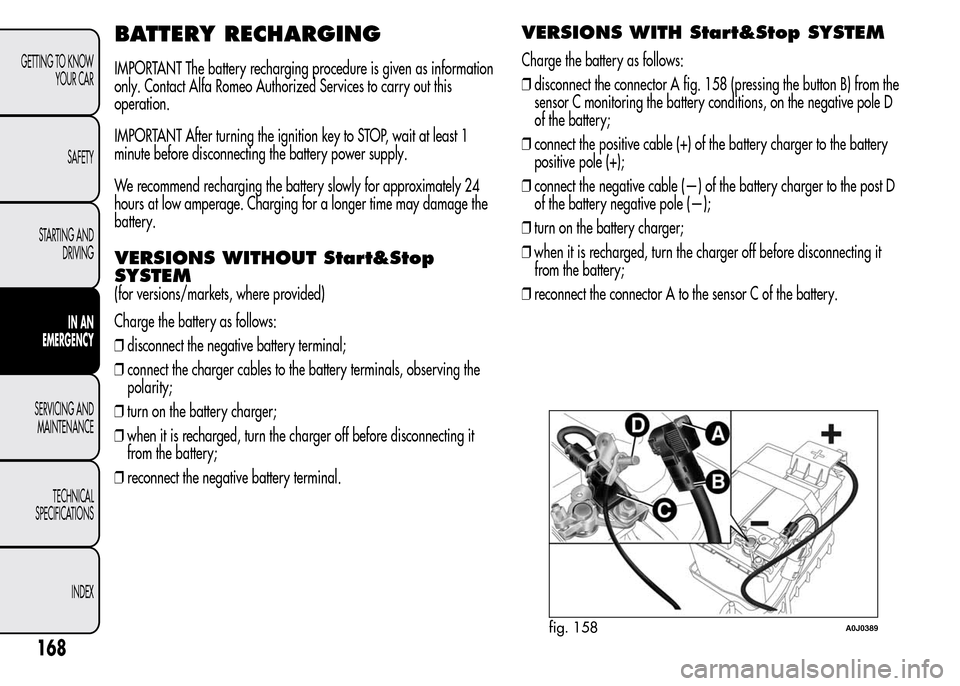
❒disconnect the connector A fig. 158 (pressing the button B) from the
sensor C monitoring the battery conditions, on the negative pole D
of the battery;
❒connect the positive cable (+) of the battery charger to the battery
positive pole (+);
❒connect the negative cable (—) of the battery charger to the post D
of the battery negative pole (—);
❒turn on the battery charger;
❒when it is recharged, turn the charger off before disconnecting it
from the battery;
❒reconnect the connector A to the sensor C of the battery.
fig. 158A0J0389
168
GETTING TO KNOW
YOUR CAR
SAFETY
STARTING AND
DRIVING
IN AN
EMERGENCY
SERVICING AND
MAINTENANCE
TECHNICAL
SPECIFICATIONS
INDEX
Page 176 of 280
SCHEDULED SERVICING PLAN
PETROL VERSIONS
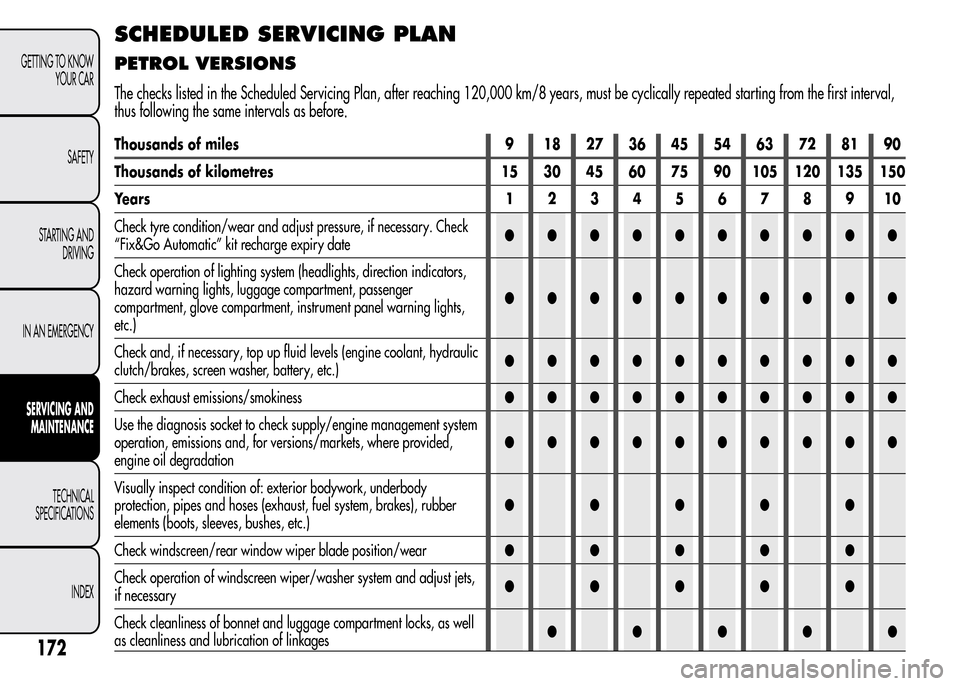
Thousands of miles 9 18 27 36 45 54 63 72 81 90
Thousands of kilometres 15 30 45 60 75 90 105 120 135 150
Years12345678910
Check tyre condition/wear and adjust pressure, if necessary. Check
“Fix&Go Automatic” kit recharge expiry date●●●●●●●●●●
Check operation of lighting system (headlights, direction indicators,
hazard warning lights, luggage compartment, passenger
compartment, glove compartment, instrument panel warning lights,
etc.)●●●●●●●●●●
Check and, if necessary, top up fluid levels (engine coolant, hydraulic
clutch/brakes, screen washer, battery, etc.)●●●●●●●●●●
Check exhaust emissions/smokiness●●●●●●●●●●
Use the diagnosis socket to check supply/engine management system
operation, emissions and, for versions/markets, where provided,
engine oil degradation●●●●●●●●●●
Visually inspect condition of: exterior bodywork, underbody
protection, pipes and hoses (exhaust, fuel system, brakes), rubber
elements (boots, sleeves, bushes, etc.)●●●●●
Check windscreen/rear window wiper blade position/wear●●●●●
Check operation of windscreen wiper/washer system and adjust jets,
if necessary●●●●●
Check cleanliness of bonnet and luggage compartment locks, as well
as cleanliness and lubrication of linkages●●●●●
172
GETTING TO KNOW
YOUR CAR
SAFETY
STARTING AND
DRIVING
IN AN EMERGENCY
SERVICING AND
MAINTENANCE
TECHNICAL
SPECIFICATIONS
INDEX
The checks listed in the Scheduled Servicing Plan, after reaching 120,000 km/8 years, must be cyclically repeated starting from the first interval,
thus following the same intervals as before.
Page 179 of 280
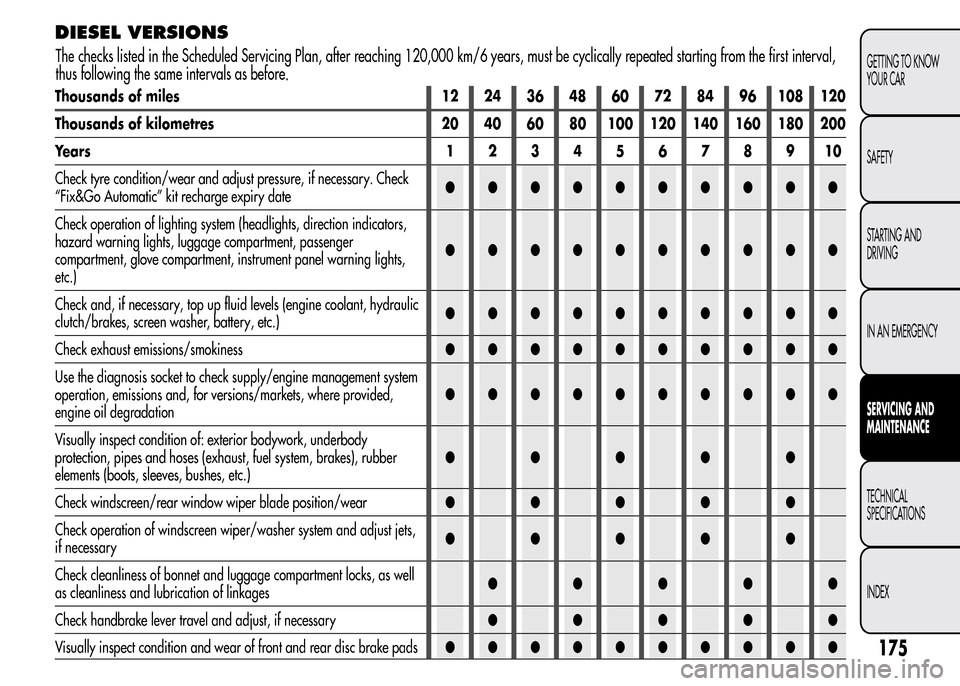
DIESEL VERSIONS
Thousands of miles 12 24 36 48 60 72 84 96 108 120
Thousands of kilometres 20 40 60 80 100 120 140 160 180 200
Years12345678910
Check tyre condition/wear and adjust pressure, if necessary. Check
“Fix&Go Automatic” kit recharge expiry date●●●●●●●●●●
Check operation of lighting system (headlights, direction indicators,
hazard warning lights, luggage compartment, passenger
compartment, glove compartment, instrument panel warning lights,
etc.)●●●●●●●●●●
Check and, if necessary, top up fluid levels (engine coolant, hydraulic
clutch/brakes, screen washer, battery, etc.)●●●●●●●●●●
Check exhaust emissions/smokiness●●●●●●●●●●
Use the diagnosis socket to check supply/engine management system
operation, emissions and, for versions/markets, where provided,
engine oil degradation●●●●●●●●●●
Visually inspect condition of: exterior bodywork, underbody
protection, pipes and hoses (exhaust, fuel system, brakes), rubber
elements (boots, sleeves, bushes, etc.)●●●●●
Check windscreen/rear window wiper blade position/wear●●●●●
Check operation of windscreen wiper/washer system and adjust jets,
if necessary●●●●●
Check cleanliness of bonnet and luggage compartment locks, as well
as cleanliness and lubrication of linkages●●●●●
Check handbrake lever travel and adjust, if necessary●●●●●
Visually inspect condition and wear of front and rear disc brake pads●●●●●●●●●●
175
GETTING TO KNOW
YOUR CAR
SAFETY
STARTING AND
DRIVING
IN AN EMERGENCY
SERVICING AND
MAINTENANCE
TECHNICAL
SPECIFICATIONS
INDEX
The checks listed in the Scheduled Servicing Plan, after reaching 120,000 km/6 years, must be cyclically repeated starting from the first interval,
thus following the same intervals as before.
Page 181 of 280
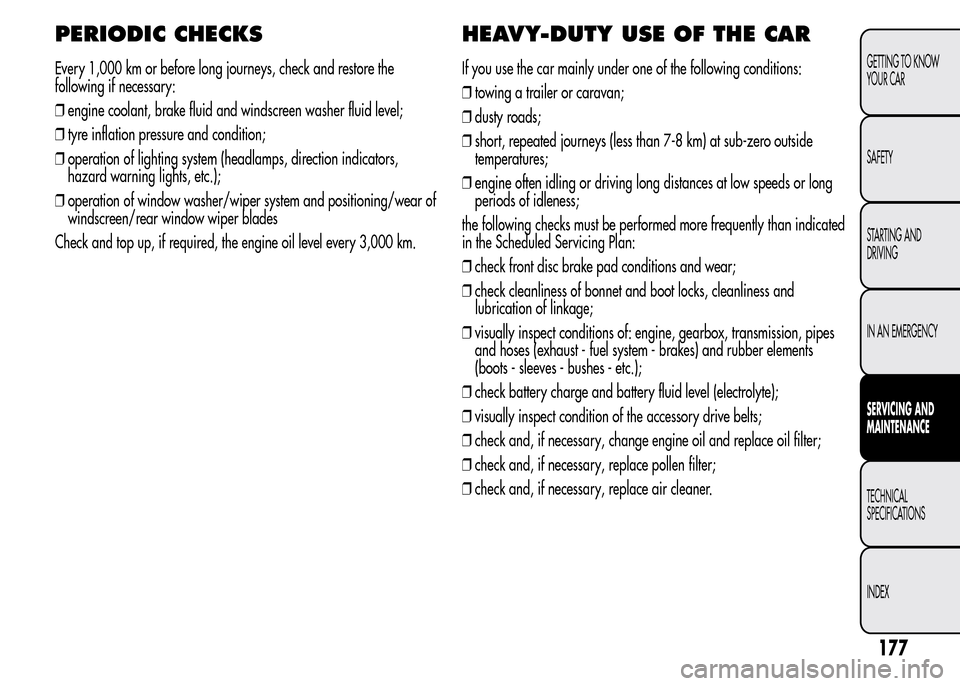
PERIODIC CHECKS
Every 1,000 km or before long journeys, check and restore the
following if necessary:
❒engine coolant, brake fluid and windscreen washer fluid level;
❒tyre inflation pressure and condition;
❒operation of lighting system (headlamps, direction indicators,
hazard warning lights, etc.);
❒operation of window washer/wiper system and positioning/wear of
windscreen/rear window wiper blades
Check and top up, if required, the engine oil level every 3,000 km.
HEAVY-DUTY USE OF THE CAR
If you use the car mainly under one of the following conditions:
❒towing a trailer or caravan;
❒dusty roads;
❒short, repeated journeys (less than 7-8 km) at sub-zero outside
temperatures;
❒engine often idling or driving long distances at low speeds or long
periods of idleness;
the following checks must be performed more frequently than indicated
in the Scheduled Servicing Plan:
❒check front disc brake pad conditions and wear;
❒check cleanliness of bonnet and boot locks, cleanliness and
lubrication of linkage;
❒visually inspect conditions of: engine, gearbox, transmission, pipes
and hoses (exhaust - fuel system - brakes) and rubber elements
(boots - sleeves - bushes - etc.);
❒check battery charge and battery fluid level (electrolyte);
❒visually inspect condition of the accessory drive belts;
❒check and, if necessary, change engine oil and replace oil filter;
❒check and, if necessary, replace pollen filter;
❒check and, if necessary, replace air cleaner.
177
GETTING TO KNOW
YOUR CAR
SAFETY
STARTING AND
DRIVING
IN AN EMERGENCY
SERVICING AND
MAINTENANCE
TECHNICAL
SPECIFICATIONS
INDEX
Page 190 of 280
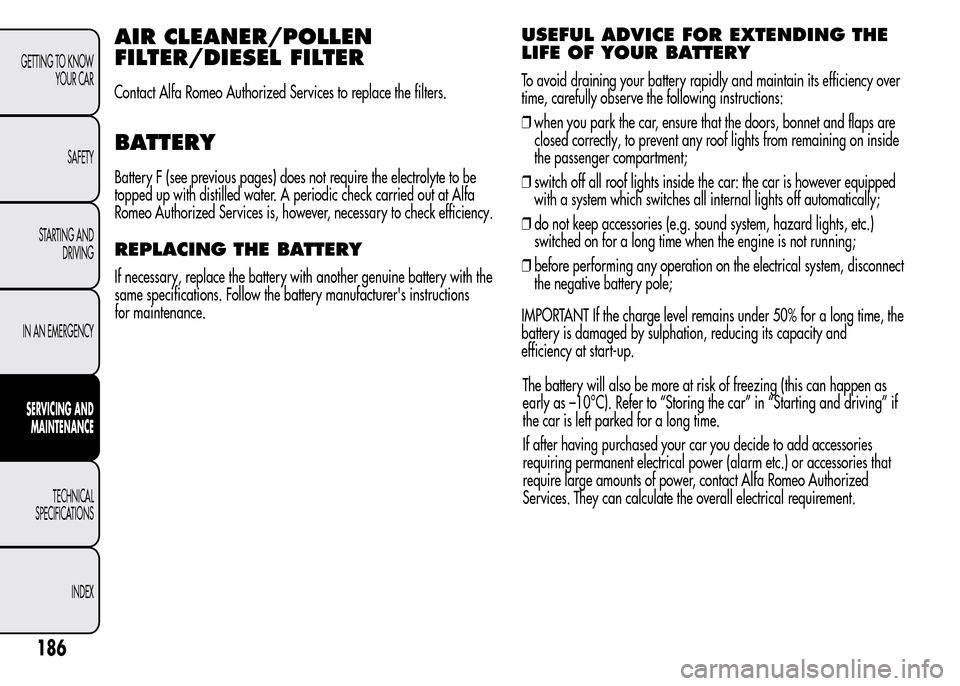
AIR CLEANER/POLLEN
FILTER/DIESEL FILTER
Contact Alfa Romeo Authorized Services to replace the filters.
BATTERY
Battery F (see previous pages) does not require the electrolyte to be
topped up with distilled water. A periodic check carried out at Alfa
Romeo Authorized Services is, however, necessary to check efficiency.
REPLACING THE BATTERY
If necessary, replace the battery with another genuine battery with the
same specifications. Follow the battery manufacturer's instructions
for maintenance.
USEFUL ADVICE FOR EXTENDING THE
LIFE OF YOUR BATTERY
To avoid draining your battery rapidly and maintain its efficiency over
time, carefully observe the following instructions:
❒when you park the car, ensure that the doors, bonnet and flaps are
closed correctly, to prevent any roof lights from remaining on inside
the passenger compartment;
❒switch off all roof lights inside the car: the car is however equipped
with a system which switches all internal lights off automatically;
❒do not keep accessories (e.g. sound system, hazard lights, etc.)
switched on for a long time when the engine is not running;
❒before performing any operation on the electrical system, disconnect
the negative battery pole;
IMPORTANT If the charge level remains under 50% for a long time, the
battery is damaged by sulphation, reducing its capacity and
efficiency at start-up.
186
GETTING TO KNOW
YOUR CAR
SAFETY
STARTING AND
DRIVING
IN AN EMERGENCY
SERVICING AND
MAINTENANCE
TECHNICAL
SPECIFICATIONS
INDEX
The battery will also be more at risk of freezing (this can happen as
early as –10°C). Refer to “Storing the car” in “Starting and driving” if
the car is left parked for a long time.
If after having purchased your car you decide to add accessories
requiring permanent electrical power (alarm etc.) or accessories that
require large amounts of power, contact Alfa Romeo Authorized
Services. They can calculate the overall electrical requirement.
Page 191 of 280
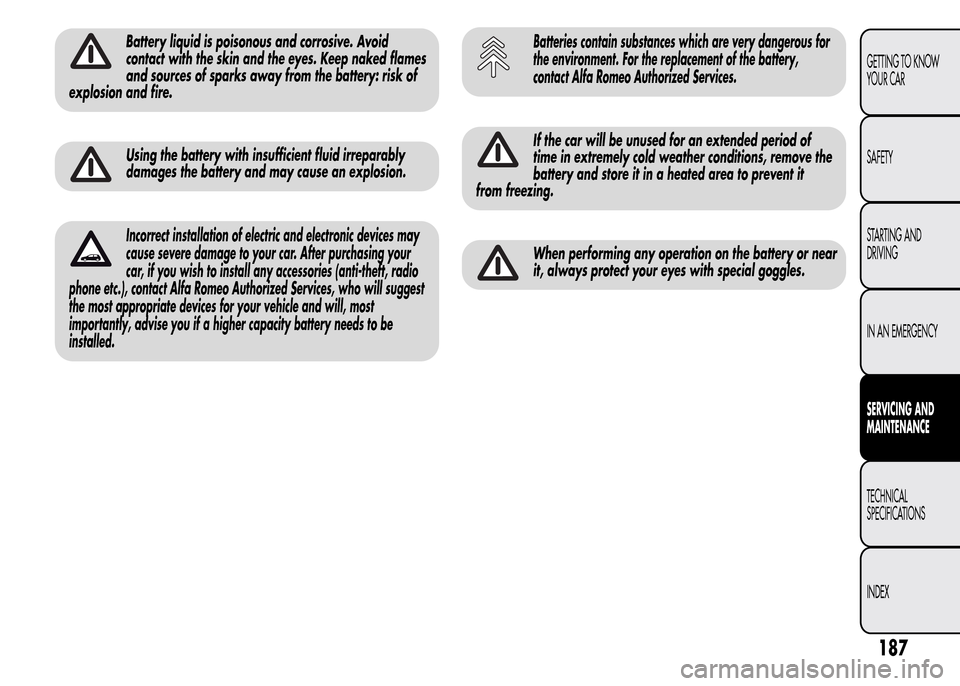
Battery liquid is poisonous and corrosive. Avoid
contact with the skin and the eyes. Keep naked flames
and sources of sparks away from the battery: risk of
explosion and fire.
Using the battery with insufficient fluid irreparably
damages the battery and may cause an explosion.
Incorrect installation of electric and electronic devices may
cause severe damage to your car. After purchasing your
car, if you wish to install any accessories (anti-theft, radio
phone etc.), contact Alfa Romeo Authorized Services, who will suggest
the most appropriate devices for your vehicle and will, most
importantly, advise you if a higher capacity battery needs to be
installed.
Batteries contain substances which are very dangerous for
the environment. For the replacement of the battery,
contact Alfa Romeo Authorized Services.
If the car will be unused for an extended period of
time in extremely cold weather conditions, remove the
battery and store it in a heated area to prevent it
from freezing.
When performing any operation on the battery or near
it, always protect your eyes with special goggles.
187
GETTING TO KNOW
YOUR CAR
SAFETY
STARTING AND
DRIVING
IN AN EMERGENCY
SERVICING AND
MAINTENANCE
TECHNICAL
SPECIFICATIONS
INDEX
Page 256 of 280
MP3 DISPLAY function
(MP3 CD data display)
This function makes it possible to select the information shown by
the display when listening to a CD containing MP3 tracks.
The function can only be selected if an MP3 CD is inserted: in this
case “MP3 Display” will appear on the display.
To change the function, use the
orbuttons.
The following settings are available:
❒“Title” (track title, if the ID3-TAG is available);
❒“Author” (track author, if the ID3-TAG is available);
❒“Album” (track album, if the ID3-TAG is available);
❒“Folder” name (name assigned to the folder);
❒“File” name (name assigned to the MP3 file).
SPEED VOLUME function
(speed-based volume change)
This function automatically adapts the volume level to the speed of
the car, increasing the volume when the speed increases to
maintain the ratio with the noise level inside the passenger
compartment.
To activate/deactivate the function, press the
/buttons. The
words “Speed volume” appear on the display, followed by the
current status of the function:
❒Off: function deactivated
❒Low: function activated (low sensitivity)
❒High: function activated (high sensitivity).
RADIO ON VOLUME function
(radio volume limit activation/deactivation)
This function makes it possible to activate/deactivate the volume
limits when the radio is turned on.
The display shows the function status:
❒“Radio on vol – Limit on”: when the radio is switched on the
volume level will be:
– if the volume level is equal to or higher than the maximum value,
the radio will switch on at the maximum volume;
– if the volume level is between the minimum and maximum values,
the radio will switch on at the same volume as before it was
switched off.
❒“Radio on vol – Limit off”: the radio will switch on at the volume
level it was at before switching off. The volume may be between
0 and 40.
To change the setting of the selected function, use the
/buttons.
NOTES
❒Using the Menu it is only possible to adjust the
activation/deactivation of the function and not the minimum or
maximum volume value.
❒If the “TA” or “TEL” functions or an external audio source are
activated when the radio is turned on, the radio will switch on at
the volume set for these sources. When the external audio source
is deactivated, the volume can be adjusted between the
minimum and maximum levels.
❒If the battery charge is low, it will not be possible to adjust the
volume between the minimum and maximum levels.
252
SOUND-SYSTEM
Page 273 of 280
INDEX
ABS system ........................................ 88
– Mechanical Brake Assist................... 88
– System intervention.......................... 88
Additional heater ................................. 59
Air cleaner .......................................... 186
Alarm ................................................. 40
“Alfa DNA” system ............................. 91
– Driving modes................................. 92
– Engagement/disengagement of
"All Weather" mode ........................ 94
– Engagement/disengagement of
"Dynamic" mode............................. 93
– "Natural" Mode .............................. 92
Alfa Romeo Code system .................... 34
Ashtray ............................................... 73
ASR system (AntiSlip Regulation) ........... 90
Automatic dual zone climate control ...... 53
Battery .............................................. 186
– advice for extending lifetime............. 186
– replacement .................................... 186
Battery (recharging).............................. 168
Bodywork
– maintenance ................................... 193– protection against atmospheric
agents ............................................ 192
– warranty......................................... 193
Bonnet................................................. 84
– Closing ........................................... 84
– Opening ......................................... 84
Brake Assist ......................................... 90
Brakes ................................................. 207
– brake fluid level............................... 185
bulb replacement .......................... 156-157
– interior lights................................... 158
Bulb replacement
– exterior lights .................................. 154
Bulbs
– types of bulbs.................................. 152
Carrying children safely ...................... 114
CBC (Cornering Brake Control) system ... 90
Central locking..................................... 70
Changing a bulb .................................. 151
– General instructions ......................... 151
Changing a wheel ................................ 140
Checking levels .................................... 178
Cigar lighter ........................................ 72
Cleaning and maintenance
– bodywork ....................................... 192– car interior...................................... 194
– front headlights ............................... 194
– leather parts ................................... 195
– leather seats.................................... 195
– plastic and coated parts ................... 195
– seats and fabric parts ...................... 194
Climate control/heating system ............. 50
Climatic comfort ................................... 49
– Diffusers ......................................... 49
Clutch ................................................. 206
CO2 emissions..................................... 229
Code Card........................................... 35
Control buttons..................................... 22
Control panel and instruments ............... 4
– Multifunction display........................ 4
– Reconfigurable multifunction
display ........................................... 5
Controls............................................... 69
Courtesy light
– bulb replacement............................. 159
Cruise Control ...................................... 65
Dashboard ........................................ 3
Daytime running lights (DRL) ................. 59
Diesel filter .......................................... 186
Diesel particulate filter (DPF) ................. 108
269
GETTING TO KNOW
YOUR CAR
SAFETY
STARTING AND
DRIVING
IN AN EMERGENCY
SERVICING AND
MAINTENANCE
TECHNICAL
SPECIFICATIONS
INDEX