battery Alfa Romeo MiTo 2016 User Guide
[x] Cancel search | Manufacturer: ALFA ROMEO, Model Year: 2016, Model line: MiTo, Model: Alfa Romeo MiTo 2016Pages: 280, PDF Size: 8.52 MB
Page 82 of 280
Door unlocking from the outside
Press the
button on the key or turn the metal insert (located inside
the key) in the driver side door lock.
Door locking/unlocking from the inside
Press fig. 57 button A. The button has an LED that indicates whether
the car doors are locked or unlocked.
LED on: doors locked. Press button
once again to centrally unlock
all doors. The LED will switch off.
LED off: doors unlocked. Press the button
again to centrally lock all
doors. The doors will be locked only if all the doors are properly
shut.
Once the doors have been locked via the remote control or the key
pawl, it will no longer be possible to unlock them by pressing button
.
IMPORTANT With the central locking system on, pull the door lever of
one of the doors to open that door only (the LED on button A will
stay on if it is the passenger door).
In the absence of electrical power supply (blown fuse, battery
disconnected, etc.) it is still possible to lock the doors manually.
PASSENGER SIDE EMERGENCY FRONT
DOOR LOCKING DEVICE
The front passenger side door has a device to lock it when there is no
current.
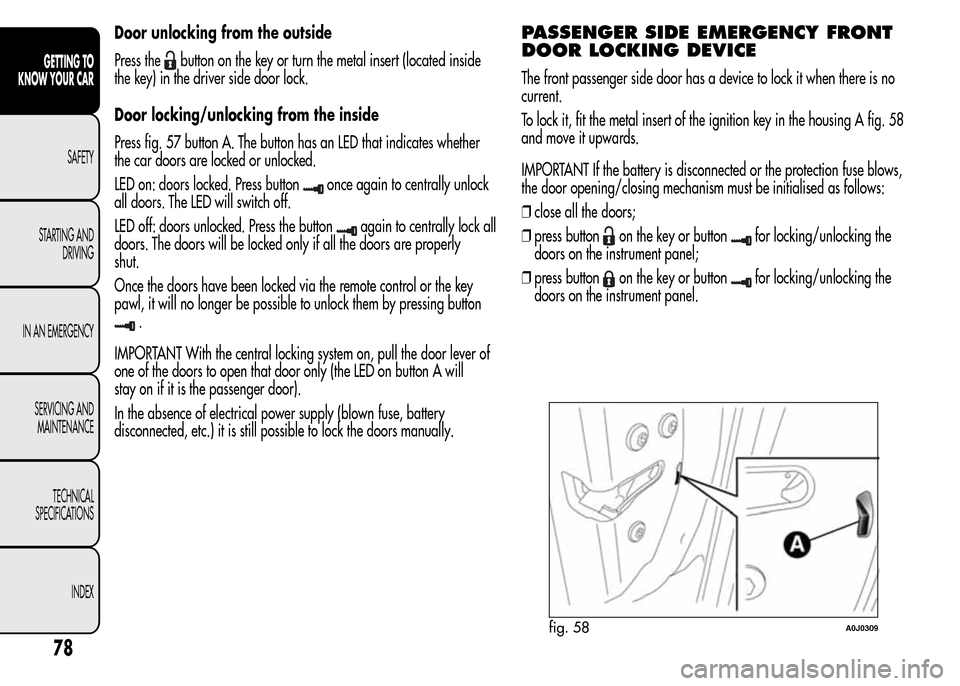
To lock it, fit the metal insert of the ignition key in the housing A fig. 58
and move it upwards.
IMPORTANT If the battery is disconnected or the protection fuse blows,
the door opening/closing mechanism must be initialised as follows:
❒close all the doors;
❒press button
on the key or buttonfor locking/unlocking the
doors on the instrument panel;
❒press button
on the key or buttonfor locking/unlocking the
doors on the instrument panel.
fig. 58A0J0309
78
GETTING TO
KNOW YOUR CAR
SAFETY
STARTING AND
DRIVING
IN AN EMERGENCY
SERVICING AND
MAINTENANCE
TECHNICAL
SPECIFICATIONS
INDEX
Page 84 of 280
Anti-crush safety device
(for versions/markets, where provided)
The car’s anti-crush function is active as the windows are being raised.
This safety system detects the presence of an obstacle during the
window closing travel and intervenes by stopping and reversing the
window travel, depending on its position. This device is also useful
if the windows are activated accidentally by children on board the car.
The anti-crush safety function is active both during the manual and
the automatic operation of the window. When the anti-crush system is
activated, the window travel is immediately interrupted and then
reversed. The window cannot be operated in any way during this time.
IMPORTANT If the anti-crush protection intervenes 5 consecutive times
within a minute or is faulty, the automatic closing operation of the
window is inhibited, only allowing it in steps of half a second with the
button released for the subsequent manoeuvre.
In order to restore the correct operation of the system, the relevant
window must be lowered.
IMPORTANT With ignition key at STOP or removed, the electric
windows remain active for about 3 minutes and are deactivated when
a door is opened.
IMPORTANT With the anti-crush system, when the
button on the
remote control is pressed for longer than 2 seconds the windows will
open, whilst if the
button is pressed for longer than 2 seconds
the windows will close.
The system conforms to the 2000/4/EC standard concerning
the safety of passengers leaning out of the passenger
compartment.
Incorrect use of the electric windows may be
dangerous. Before and during operation, always check
that no passenger is at risk of being injured directly
by the moving window or by objects getting caught in or
dragged by the window. When leaving the car, always remove
the key from the ignition to prevent accidental operation of the
electric windows from being a hazard for those still on board.
Electric window system initialisation
The system must be re-initialised after disconnecting the battery or if
the relevant protection fuse is blown.
Initialisation procedure:
❒fully close the window to initialise with manual operation;
❒after the window has reached the upper end of travel, hold down
the closing control for at least 1 second.
For versions/markets where provided, after a break in power supply
for the control units (battery replaced or disconnected or protective
fuses for the electric window control units replaced), the automatic
operation of the windows must be restored.
The restoration procedure must be performed as described below with
the doors closed:
❒completely open the driver's door window, holding the operating
button down for at least three seconds after the (lower) end of travel
position;
❒completely raise the driver side window and hold the button down
for at least 3 seconds once the (upper) end of travel position has
been reached;
80
GETTING TO
KNOW YOUR CAR
SAFETY
STARTING AND
DRIVING
IN AN EMERGENCY
SERVICING AND
MAINTENANCE
TECHNICAL
SPECIFICATIONS
INDEX
Page 85 of 280
❒proceed in the same way as described in points 1 and 2 for the
passenger side door;
❒make sure that the initialisation is correct by checking that the
windows work automatically.
IMPORTANT With the central locking on, pulling the internal opening
lever for one of the doors switches the locking off for all the doors.
In the absence of electrical power supply (blown fuse, battery
disconnected, etc.) it is still possible to lock the doors manually. In this
case, the automatic lowering function of the windows is not available.
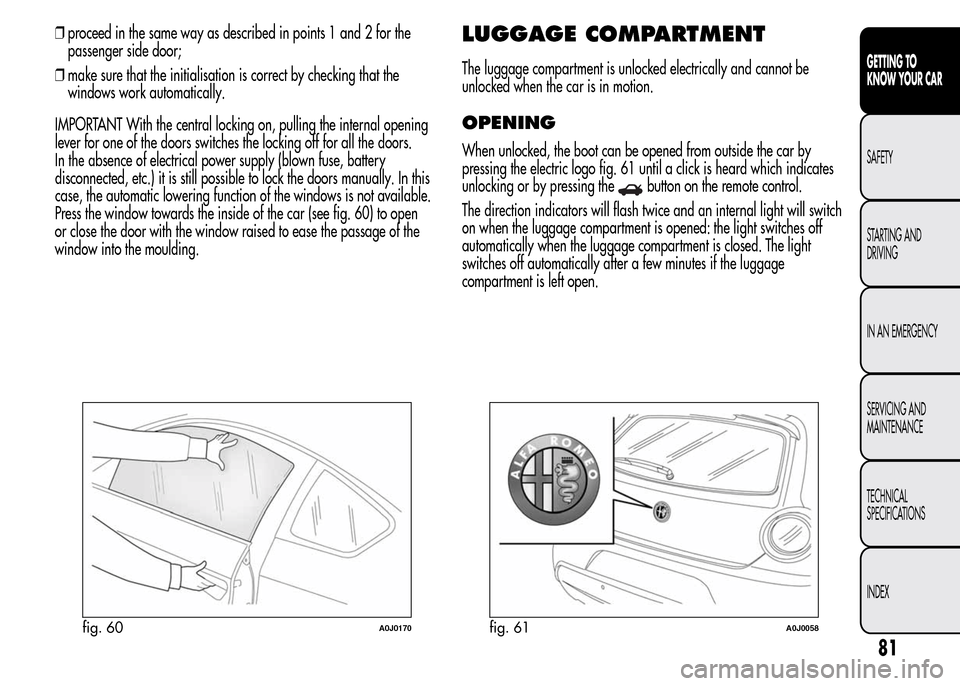
Press the window towards the inside of the car (see fig. 60) to open
or close the door with the window raised to ease the passage of the
window into the moulding.LUGGAGE COMPARTMENT
The luggage compartment is unlocked electrically and cannot be
unlocked when the car is in motion.
OPENING
When unlocked, the boot can be opened from outside the car by
pressing the electric logo fig. 61 until a click is heard which indicates
unlocking or by pressing the
button on the remote control.
The direction indicators will flash twice and an internal light will switch
on when the luggage compartment is opened: the light switches off
automatically when the luggage compartment is closed. The light
switches off automatically after a few minutes if the luggage
compartment is left open.
fig. 60A0J0170fig. 61A0J0058
81
GETTING TO
KNOW YOUR CAR
SAFETY
STARTING AND
DRIVING
IN AN EMERGENCY
SERVICING AND
MAINTENANCE
TECHNICAL
SPECIFICATIONS
INDEX
Page 86 of 280
Emergency opening from the inside
Proceed as follows:
❒remove the rear head restraints and completely fold back the seats
(see the paragraph “Expanding the luggage compartment”);
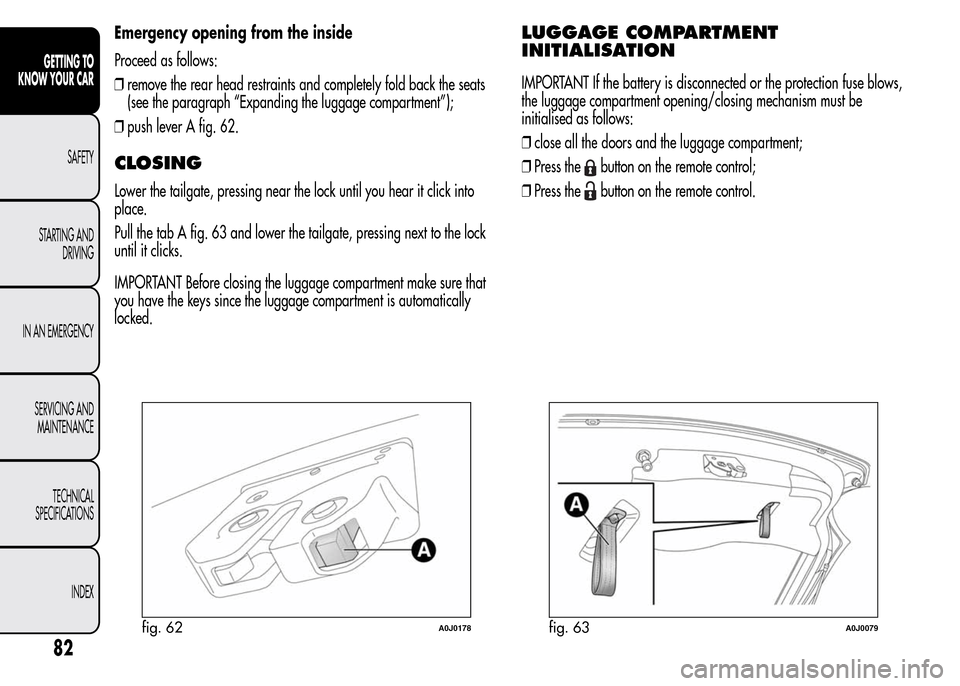
❒push lever A fig. 62.
CLOSING
Lower the tailgate, pressing near the lock until you hear it click into
place.
Pull the tab A fig. 63 and lower the tailgate, pressing next to the lock
until it clicks.
IMPORTANT Before closing the luggage compartment make sure that
you have the keys since the luggage compartment is automatically
locked.
LUGGAGE COMPARTMENT
INITIALISATION
IMPORTANT If the battery is disconnected or the protection fuse blows,
the luggage compartment opening/closing mechanism must be
initialised as follows:
❒close all the doors and the luggage compartment;
❒Press the
button on the remote control;
❒Press the
button on the remote control.
fig. 62A0J0178fig. 63A0J0079
82
GETTING TO
KNOW YOUR CAR
SAFETY
STARTING AND
DRIVING
IN AN EMERGENCY
SERVICING AND
MAINTENANCE
TECHNICAL
SPECIFICATIONS
INDEX
Page 100 of 280
ENGINE STOPPING FAILURE
CONDITIONS
When the system is operating, due to comfort, emission control and
safety reasons, the engine does not stop in some conditions, among
which:
❒engine still cold;
❒especially cold outside temperature;
❒battery not sufficiently charged;
❒particulate filter regeneration (DPF) in progress (diesel engines only);
❒driver's door not shut;
❒driver's seat belt not fastened;
❒reverse gear engaged (for example, for parking manoeuvres);
❒for versions equipped with dual zone automatic climate control (for
versions/markets, where provided), if an adequate level of thermal
comfort has not been reached or with MAX-DEF function activation;
❒during the first period of use, to initialise the system.
If the climate comfort is to be favoured, the Start&Stop
system can be deactivated, for a continuous operation of
the climate control system.
ENGINE RESTARTING CONDITIONS
Due to comfort, emission control and safety reasons, the engine can
restart automatically without any action by the driver, under special
conditions, such as:
❒battery not sufficiently charged;
❒reduced braking system vacuum (e.g. if the brake pedal is pressed
repeatedly);
❒car moving (e.g. when driving on roads with a gradient);
❒engine stopping by Start&Stop system for over 3 minutes;
❒for versions equipped with dual zone automatic climate control
system (for versions/markets, where provided), if an adequate level
of thermal comfort has not been reached or MAX-DEF function
activation.
With gear engaged, automatic engine restarting is possible only by
fully depressing the clutch pedal. The driver is informed by the
displaying of a message on the display and - for versions/markets,
where provided - by the flashing of the symbol
.
Notes
If the clutch is not pressed, about 3 minutes after the engine stops, the
engine can be restarted only using the ignition key.
In cases when the engine stops and this is not desired, due for example
to the clutch pedal being released sharply with a gear engaged, if the
Start&Stop system is activated, the engine can be restarted by fully
depressing the clutch pedal or by placing the gear lever in neutral.
96
GETTING TO
KNOW YOUR CAR
SAFETY
STARTING AND
DRIVING
IN AN EMERGENCY
SERVICING AND
MAINTENANCE
TECHNICAL
SPECIFICATIONS
INDEX
Page 101 of 280
SAFETY FUNCTIONS
When the engine is stopped by the Start&Stop system, if the driver
releases his/her seat belt and opens the driver's or passenger's door,
the engine can be restarted only using the ignition key.
The driver is informed by a buzzer and by the flashing of the symbol
on the display; on some versions, a message is displayed as well.
"ENERGY SAVING" FUNCTION
(for versions/markets, where provided)
If, following automatic engine restarting, the driver does not carry out
any action on the car for over 3 minutes, the Start&Stop system stops
the engine once and for all, to prevent fuel consumption. In these
cases, the engine can be restarted only using the ignition key.
NOTE In any case, it is possible to keep the engine running by
deactivating the Start&Stop system.
IRREGULAR OPERATION
In the event of malfunction, the Start&Stop system is deactivated.
The driver is informed of the fault by the
warning light switching
on in the instrument panel and, for versions/markets where provided,
a message and symbol on the display.
In this case, contact Alfa Romeo Authorized Services.
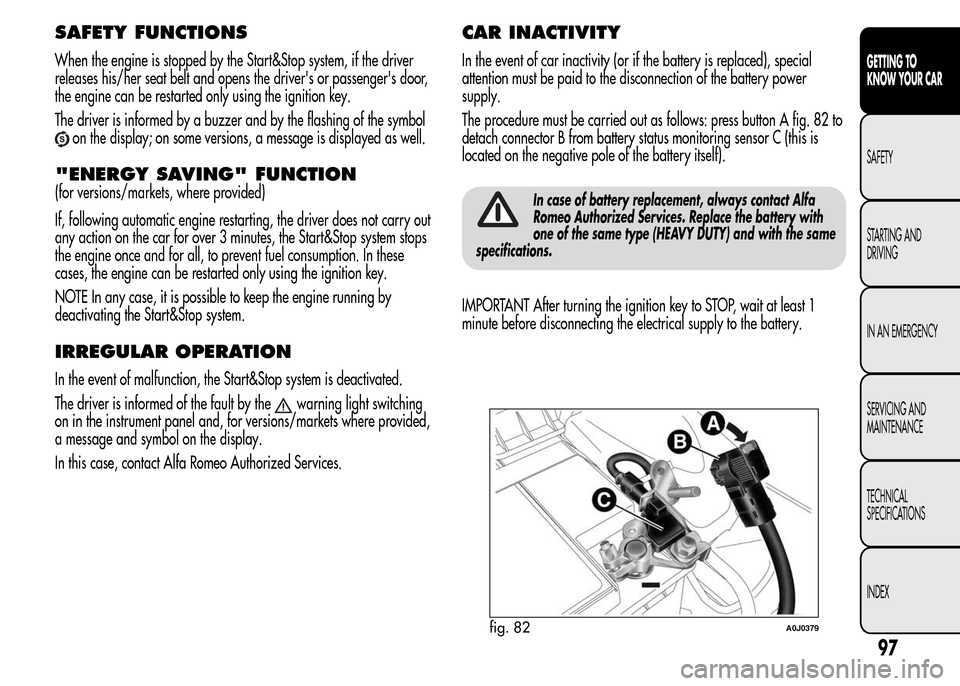
CAR INACTIVITY
In the event of car inactivity (or if the battery is replaced), special
attention must be paid to the disconnection of the battery power
supply.
The procedure must be carried out as follows: press button A fig. 82 to
detach connector B from battery status monitoring sensor C (this is
located on the negative pole of the battery itself).
In case of battery replacement, always contact Alfa
Romeo Authorized Services. Replace the battery with
one of the same type (HEAVY DUTY) and with the same
specifications.
IMPORTANT After turning the ignition key to STOP, wait at least 1
minute before disconnecting the electrical supply to the battery.
fig. 82A0J0379
97
GETTING TO
KNOW YOUR CAR
SAFETY
STARTING AND
DRIVING
IN AN EMERGENCY
SERVICING AND
MAINTENANCE
TECHNICAL
SPECIFICATIONS
INDEX
Page 102 of 280
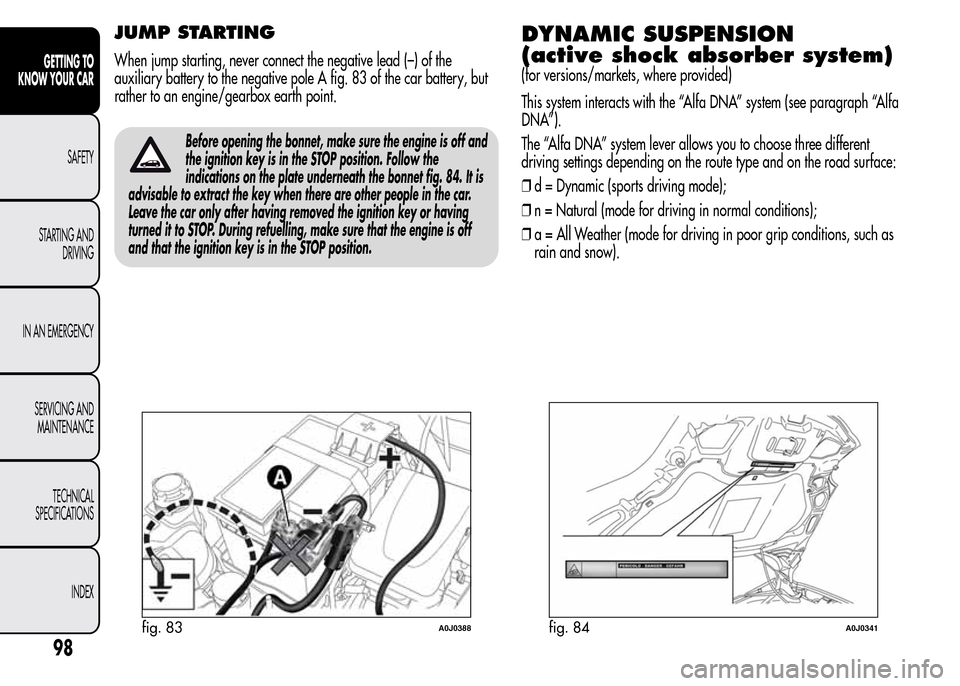
JUMP STARTING
When jump starting, never connect the negative lead (–) of the
auxiliary battery to the negative pole A fig. 83 of the car battery, but
rather to an engine/gearbox earth point.
Before opening the bonnet, make sure the engine is off and
the ignition key is in the STOP position. Follow the
indications on the plate underneath the bonnet fig. 84. It is
advisable to extract the key when there are other people in the car.
Leave the car only after having removed the ignition key or having
turned it to STOP. During refuelling, make sure that the engine is off
and that the ignition key is in the STOP position.
DYNAMIC SUSPENSION
(active shock absorber system)
(for versions/markets, where provided)
This system interacts with the “Alfa DNA” system (see paragraph “Alfa
DNA”).
The “Alfa DNA” system lever allows you to choose three different
driving settings depending on the route type and on the road surface:
❒d = Dynamic (sports driving mode);
❒n = Natural (mode for driving in normal conditions);
❒a = All Weather (mode for driving in poor grip conditions, such as
rain and snow).
fig. 83A0J0388fig. 84A0J0341
98
GETTING TO
KNOW YOUR CAR
SAFETY
STARTING AND
DRIVING
IN AN EMERGENCY
SERVICING AND
MAINTENANCE
TECHNICAL
SPECIFICATIONS
INDEX
Page 135 of 280
PROCEDURE FOR DIESEL VERSIONS
Proceed as follows:
❒engage the handbrake and place the gearbox lever in neutral;
❒turn the ignition key to MAR-ON: the warning lights
and
(or the symbol on the display) on the instrument panel will
switch on;
❒wait for the warning lights (or the symbol on the display) to switch
off;
❒fully depress the clutch pedal, without touching the accelerator;
❒turn the ignition key to AVV;
warning light switches off.
Waiting too long will waste the heating work carried out by the
glow plugs. Release the key as soon as the engine starts.
If thewarning light flashes for about 1 minute after
starting or during prolonged cranking, this indicates a fault
in the glow plug preheating system. Use the car normally
if the engine starts and go to Alfa Romeo Authorized Services as soon
as possible.
It is dangerous to run the engine in enclosed areas. The
engine takes in oxygen and releases carbon dioxide,
carbon monoxide and other toxic gases.
It is advisable not to demand maximum performance from
your car (e.g. excessive acceleration, long distances at
maximum rpm, excessively intense braking, etc.) when it is
first used.
When the engine is off, do not leave the ignition key turned
to MAR to prevent unnecessary electrical consumption from
draining the battery.
Remember that the brake servo and electromechanical
power steering are not operational until the engine
has been started, therefore much more effort than
usual is required on the brake pedal and steering wheel.
Never start the engine by pushing, towing or driving
downhill. These manoeuvres may damage the catalytic
converter.
131
GETTING TO KNOW
YOUR CAR
SAFETY
STARTING AND
DRIVING
IN AN EMERGENCY
SERVICING AND
MAINTENANCE
TECHNICAL
SPECIFICATIONS
INDEX
Page 142 of 280
SNOW CHAINS
The use of snow chains should be in compliance with local regulations.
The snow chains may be applied only onto the front wheel tyres (drive
wheels).
Check the tension of the snow chains after the first few metres have
been driven.
Use reduced size snow chains: on all versions, for 195/55 R16" and
205/55 R16" size tyres use low-clearance snow chains with a
maximum projection beyond the tyre profile of 9 mm.
IMPORTANT The space-saver wheel cannot be fitted with snow chains.
If a front (drive) wheel is punctured and snow chains must be used,
you must remove a normal wheel from the rear and replace this one
with the space-saver wheel. In this way, with two normal drive wheels,
it is possible to use snow chains.
Keep your speed down when snow chains are fitted; do not
exceed 50 km/h. Avoid potholes, steps and pavements
and avoid driving long distances on roads not covered with
snow to avoid damaging the car and the roadbed.
STORING THE CAR
If the car is to be left inactive for longer than a month, the following
precautions should be noted:
❒park the vehicle in a dry, covered and, if possible, ventilated area;
engage a gear and check that the handbrake is not engaged;
❒disconnect the negative battery terminal and check the battery
charge. Repeat this check once every three months during storage;
❒if you have not disconnected the battery, check the battery charge
every thirty days;
❒clean and protect the painted parts using protective wax;
❒clean and protect the shiny metal parts using special compounds
available commercially;
❒sprinkle talcum powder on the windscreen and rear window wiper
rubber blades and lift them off the glass;
❒slightly open the windows;
❒cover the car with a cloth or perforated plastic sheet. Do not use
compact plastic sheets which do not allow humidity to evaporate
from the surface of the car.
❒inflate tyres to +0.5 bar above the standard specified pressure and
check it at intervals;
❒do not drain the engine cooling system.
IMPORTANT After turning the ignition key to STOP, wait at least 1
minute before disconnecting the battery power supply.
138
GETTING TO KNOW
YOUR CAR
SAFETY
STARTING AND
DRIVING
IN AN EMERGENCY
SERVICING AND
MAINTENANCE
TECHNICAL
SPECIFICATIONS
INDEX
Page 143 of 280
IN AN EMERGENCY
In an emergency we recommend that you call the freephone number found in the Warranty Booklet. You can also
consult www.alfaromeo.com to find your nearest Alfa Romeo Authorized Services.
STARTING THE ENGINE
If thewarning light on the instrument panel remains on constantly,
contact Alfa Romeo Authorized Services immediately.
JUMP STARTING
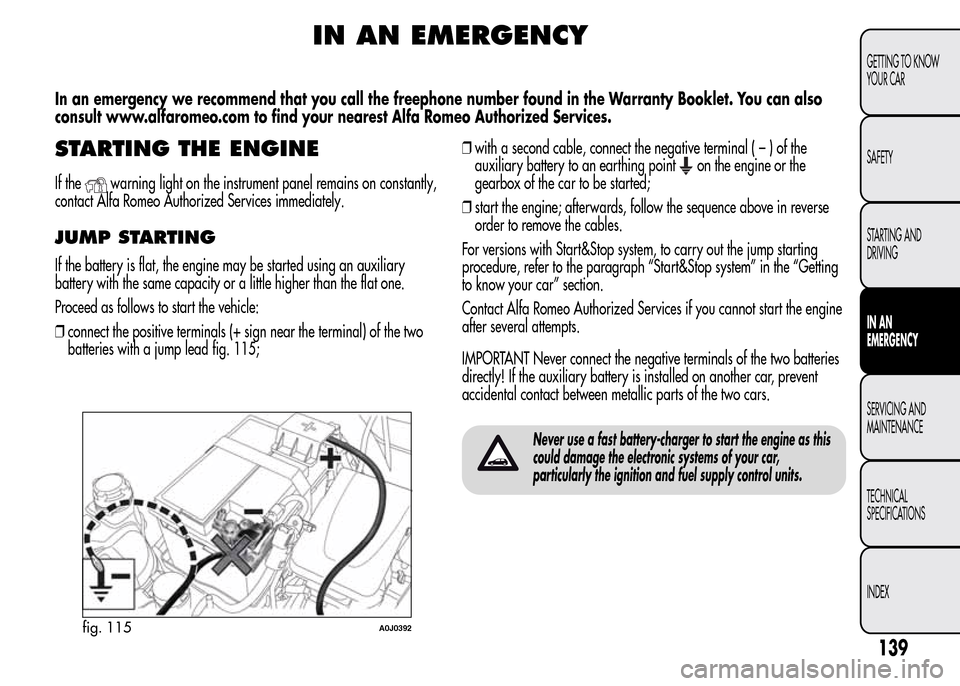
If the battery is flat, the engine may be started using an auxiliary
battery with the same capacity or a little higher than the flat one.
Proceed as follows to start the vehicle:
❒connect the positive terminals (+ sign near the terminal) of the two
batteries with a jump lead fig. 115;❒with a second cable, connect the negative terminal(–)ofthe
auxiliary battery to an earthing point
on the engine or the
gearbox of the car to be started;
❒start the engine; afterwards, follow the sequence above in reverse
order to remove the cables.
For versions with Start&Stop system, to carry out the jump starting
procedure, refer to the paragraph “Start&Stop system” in the “Getting
to know your car” section.
Contact Alfa Romeo Authorized Services if you cannot start the engine
after several attempts.
IMPORTANT Never connect the negative terminals of the two batteries
directly! If the auxiliary battery is installed on another car, prevent
accidental contact between metallic parts of the two cars.
Never use a fast battery-charger to start the engine as this
could damage the electronic systems of your car,
particularly the ignition and fuel supply control units.
fig. 115A0J0392
139
GETTING TO KNOW
YOUR CAR
SAFETY
STARTING AND
DRIVING
IN AN
EMERGENCY
SERVICING AND
MAINTENANCE
TECHNICAL
SPECIFICATIONS
INDEX