tow Alfa Romeo MiTo 2016 Owner's Guide
[x] Cancel search | Manufacturer: ALFA ROMEO, Model Year: 2016, Model line: MiTo, Model: Alfa Romeo MiTo 2016Pages: 280, PDF Size: 8.52 MB
Page 150 of 280
REFITTING THE WHEEL
Following the procedure described previously, raise the car and
remove the small spare wheel.
Proceed as follows:
❒make sure the contact surfaces between standard wheel and hub are
clean so that the fastening bolts will not come loose;
❒for versions with steel rims: fix the hub cap on the rim,
aligning the crescent hole with the bolt you have fitted, then insert
the other 4 bolts;
❒tighten the retaining bolts using wrench A fig. 120;
❒lower the car and remove the jack;
❒use wrench A fig. 120 to fully tighten the bolts, following the
sequence illustrated in
❒for versions with alloy rims with hub cap: align the pin on
the cap with the housing on the rim.
At the end of operation
❒stow the space-saver spare wheel in the compartment provided in
the boot;
❒insert the jack and the other tools in the container;
❒arrange the container and tools on the space-saver wheel;
❒correctly reposition the boot mat.
"Fix&Go Automatic" kit
This is located in the luggage compartment.
The kit container also contains a screwdriver and the tow hook.
The kit also contains:
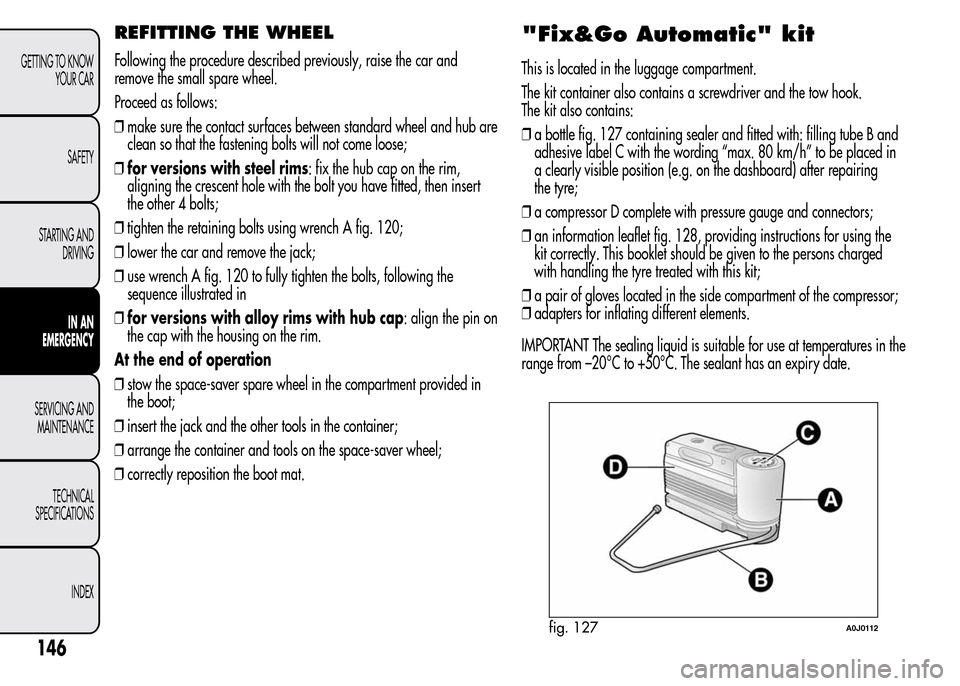
❒a bottle fig. 127 containing sealer and fitted with: filling tube B and
adhesive label C with the wording “max. 80 km/h” to be placed in
a clearly visible position (e.g. on the dashboard) after repairing
the tyre;
❒a compressor D complete with pressure gauge and connectors;
❒an information leaflet fig. 128, providing instructions for using the
kit correctly. This booklet should be given to the persons charged
with handling the tyre treated with this kit;
❒a pair of gloves located in the side compartment of the compressor;
❒adapters for inflating different elements.
IMPORTANT The sealing liquid is suitable for use at temperatures in the
range from –20°C to +50°C. The sealant has an expiry date.
fig. 127A0J0112
146
GETTING TO KNOW
YOUR CAR
SAFETY
STARTING AND
DRIVING
IN AN
EMERGENCY
SERVICING AND
MAINTENANCE
TECHNICAL
SPECIFICATIONS
INDEX
Page 155 of 280
CHANGING A BULB
GENERAL INSTRUCTIONS
❒Before changing a bulb check the contacts for oxidation;
❒blown bulbs must be replaced with others of the same type and
power;
❒after replacing a headlight bulb, always check its alignment;
❒when a light is not working, check that the corresponding fuse is
intact before changing a bulb. For the location of fuses, refer to
the paragraph “Replacing fuses” in this section.
Halogen bulbs must be handled holding the metal part
only. Touching the transparent part of the bulb with your
fingers may reduce the intensity of the emitted light and
even reduce the lifespan of the bulb. In case of accidental contact, wipe
the bulb with a cloth moistened with alcohol and let the bulb dry.
Modifications or repairs to the electric system that are
not carried out properly or do not take the system
technical specifications into account can cause
malfunctions leading to the risk of fire.
Halogen bulbs contain pressurised gas which may
cause small fragments of glass to be projected
outwards if the bulb is broken.
IMPORTANT When the weather is cold or damp or after heavy rain or
washing, the surface of headlights or rear lights, may steam up and/or
form drops of condensation on the inside. This is a natural
phenomenon due to the difference in temperature and humidity
between the inside and the outside of the glass which does not indicate
a fault and does not compromise the normal operation of lighting
devices. The mist disappears quickly when the lights are turned on,
starting from the centre of the diffuser, extending progressively towards
the edges.
151
GETTING TO KNOW
YOUR CAR
SAFETY
STARTING AND
DRIVING
IN AN
EMERGENCY
SERVICING AND
MAINTENANCE
TECHNICAL
SPECIFICATIONS
INDEX
Page 173 of 280
RAISING THE CAR
If you need to lift the car contact Alfa Romeo Authorized Services, who
will be equipped with a workshop lift.
IMPORTANT Be careful when positioning the arm of the lift for versions
with side skirts.
TOWING THE CAR
The tow ring provided with the car is housed in the tool box in the
boot.
ATTACHING THE TOW HOOK
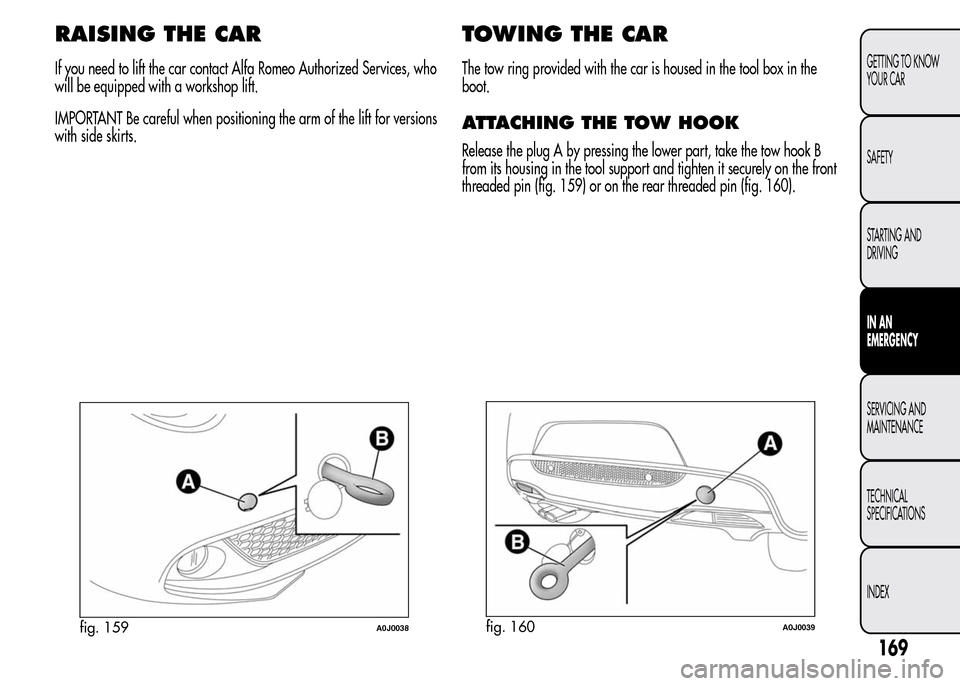
Release the plug A by pressing the lower part, take the tow hook B
from its housing in the tool support and tighten it securely on the front
threaded pin (fig. 159) or on the rear threaded pin (fig. 160).
fig. 159A0J0038
169
GETTING TO KNOW
YOUR CAR
SAFETY
STARTING AND
DRIVING
IN AN
EMERGENCY
SERVICING AND
MAINTENANCE
TECHNICAL
SPECIFICATIONS
INDEX
fig. 160A0J0039
Page 174 of 280
Before beginning to tow, turn the ignition key to MAR
and then to STOP, without extracting it The steering
column will automatically lock when the key is
removed and the wheels cannot be steered.
Remember that whilst towing it is necessary to exert a
greater force when steering and braking because the
brake servo and electro-mechanical power steering
will be inoperative. Do not use wires for towing. Do not jerk. Be
careful not to damage parts in contact with the car while towing.
When towing the vehicle, you must comply with all specific traffic
regulations and adopt an appropriate driving behaviour. Do not
start the engine while towing the car. Clean the threaded seat
carefully before fastening the hook. Make sure that the hook is
fully fastened in the housing before towing the car.
The front and rear tow hooks should be used only for
emergencies on the road. You are allowed to tow the
vehicle for short distances using an appropriate device
in accordance with the highway code (a rigid bar), to move the
vehicle on the road in readiness for towing or transport via a
breakdown vehicle. Tow hooks MUST NOT be used to tow
vehicles off the road or where there are obstacles and/or for
towing operations using cables or other non-rigid devices.
Respecting the above conditions, towing must take place with the
two vehicles (one towing, the other towed) aligned as much as
possible along the same centre line.
170
GETTING TO KNOW
YOUR CAR
SAFETY
STARTING AND
DRIVING
IN AN
EMERGENCY
SERVICING AND
MAINTENANCE
TECHNICAL
SPECIFICATIONS
INDEX
Page 175 of 280
SERVICING AND MAINTENANCE
SCHEDULED SERVICING
Correct servicing is essential in guaranteeing a long life for the car
under the best conditions.
For this reason, Alfa Romeo has planned a series of checks and
services at fixed distance intervals and, for versions/markets, where
provided, at fixed time intervals, as described in the Scheduled
Servicing Plan.
Regardless of the above, it is always necessary to carefully follow the
instructions in the Scheduled Servicing Plan (e.g. periodically check
level of liquids, tyre pressure, etc.).
Scheduled Servicing is carried out at Alfa Romeo Authorised Services
according to a set time schedule or kilometres/miles intervals. If,
during each operation, in addition to the ones scheduled, the need
arises for further replacements or repairs, these may be carried out
only with your explicit agreement. If your car is used frequently for
towing, the interval between one service operation and the next should
be reduced.WARNING
The Scheduled Services intervals are set out by the Manufacturer.
Failure to comply with the schedule may invalidate the warranty.
It is advisable to inform Alfa Romeo Authorized Services of any small
faults without waiting for the next scheduled service.
For versions equipped with specific supply (e.g. LPG, Alfa TCT) and/or
trim level, in addition to what is described in the following Scheduled
Servicing Plan, refer to the relevant additional items in the dedicated
supplements.
171
GETTING TO KNOW
YOUR CAR
SAFETY
STARTING AND
DRIVING
IN AN EMERGENCY
SERVICING AND
MAINTENANCE
TECHNICAL
SPECIFICATIONS
INDEX
Page 178 of 280
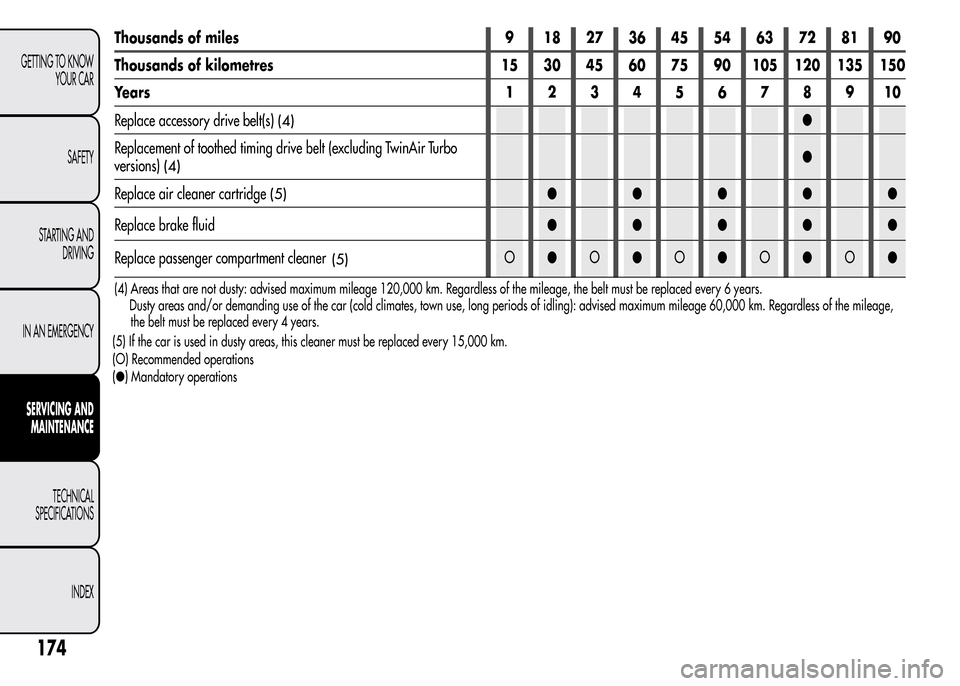
Thousands of miles 9 18 27 36 45 54 63 72 81 90
Thousands of kilometres 15 30 45 60 75 90 105 120 135 150
Years12345678910
Replace accessory drive belt(s)
(4)●
Replacement of toothed timing drive belt (excluding TwinAir Turbo
versions)
(4)●
Replace air cleaner cartridge
(5)●●●●●
Replace brake fluid●●●●●
Replace passenger compartment cleaner
(5)O●O●O●O●O●
(4) Areas that are not dusty: advised maximum mileage 120,000 km. Regardless of the mileage, the belt must be replaced every 6 years.
Dusty areas and/or demanding use of the car (cold climates, town use, long periods of idling): advised maximum mileage 60,000 km. Regardless of the mileage,
the belt must be replaced every 4 years.
174
GETTING TO KNOW
YOUR CAR
SAFETY
STARTING AND
DRIVING
IN AN EMERGENCY
SERVICING AND
MAINTENANCE
TECHNICAL
SPECIFICATIONS
INDEX
(5) If the car is used in dusty areas, this cleaner must be replaced every 15,000 km.
(O) Recommended operations
(●) Mandatory operations
Page 180 of 280
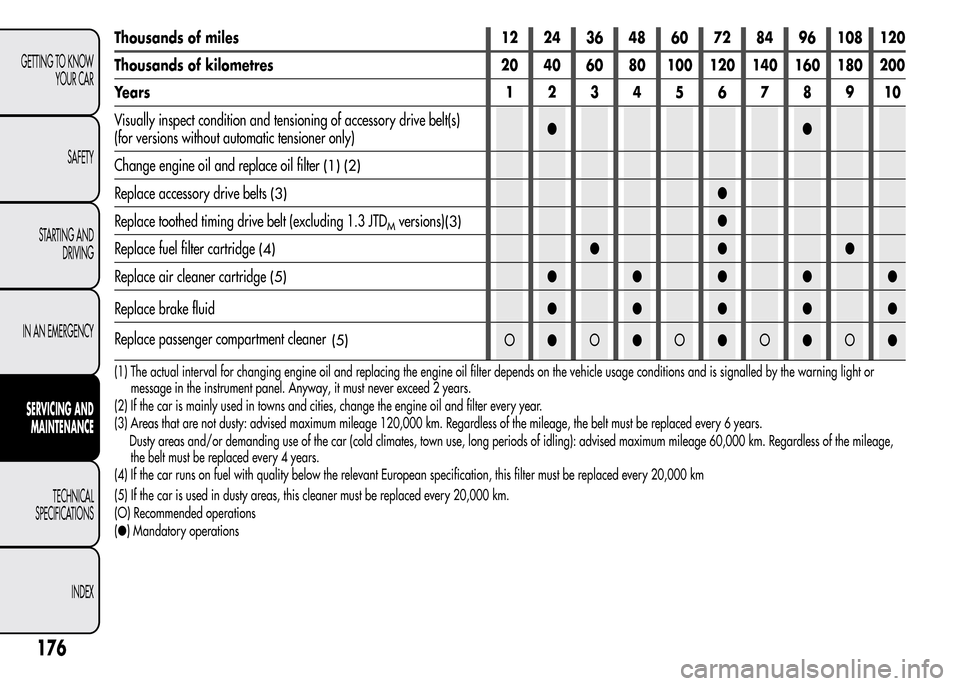
Thousands of miles 12 24 36 48 60 72 84 96 108 120
Thousands of kilometres 20 40 60 80 100 120 140 160 180 200
Years12345678910
Visually inspect condition and tensioning of accessory drive belt(s)
(for versions without automatic tensioner only)●●
Change engine oil and replace oil filter
(1) (2)
Replace accessory drive belts(3)●
Replace toothed timing drive belt (excluding 1.3 JTD
Mversions)(3)●
Replace fuel filter cartridge
(4)●●●
Replace air cleaner cartridge
(5)●●●●●
Replace brake fluid●●●●●
Replace passenger compartment cleaner
(5)O●O●O●O●O●
(1) The actual interval for changing engine oil and replacing the engine oil filter depends on the vehicle usage conditions and is signalled by the warning light or
message in the instrument panel. Anyway, it must never exceed 2 years.
(2) If the car is mainly used in towns and cities, change the engine oil and filter every year.
(3) Areas that are not dusty: advised maximum mileage 120,000 km. Regardless of the mileage, the belt must be replaced every 6 years.
Dusty areas and/or demanding use of the car (cold climates, town use, long periods of idling): advised maximum mileage 60,000 km. Regardless of the mileage,
the belt must be replaced every 4 years.
(4) If the car runs on fuel with quality below the relevant European specification, this filter must be replaced every 20,000 km
176
GETTING TO KNOW
YOUR CAR
SAFETY
STARTING AND
DRIVING
IN AN EMERGENCY
SERVICING AND
MAINTENANCE
TECHNICAL
SPECIFICATIONS
INDEX(5) If the car is used in dusty areas, this cleaner must be replaced every 20,000 km.
(O) Recommended operations
(●) Mandatory operations
Page 181 of 280
PERIODIC CHECKS
Every 1,000 km or before long journeys, check and restore the
following if necessary:
❒engine coolant, brake fluid and windscreen washer fluid level;
❒tyre inflation pressure and condition;
❒operation of lighting system (headlamps, direction indicators,
hazard warning lights, etc.);
❒operation of window washer/wiper system and positioning/wear of
windscreen/rear window wiper blades
Check and top up, if required, the engine oil level every 3,000 km.
HEAVY-DUTY USE OF THE CAR
If you use the car mainly under one of the following conditions:
❒towing a trailer or caravan;
❒dusty roads;
❒short, repeated journeys (less than 7-8 km) at sub-zero outside
temperatures;
❒engine often idling or driving long distances at low speeds or long
periods of idleness;
the following checks must be performed more frequently than indicated
in the Scheduled Servicing Plan:
❒check front disc brake pad conditions and wear;
❒check cleanliness of bonnet and boot locks, cleanliness and
lubrication of linkage;
❒visually inspect conditions of: engine, gearbox, transmission, pipes
and hoses (exhaust - fuel system - brakes) and rubber elements
(boots - sleeves - bushes - etc.);
❒check battery charge and battery fluid level (electrolyte);
❒visually inspect condition of the accessory drive belts;
❒check and, if necessary, change engine oil and replace oil filter;
❒check and, if necessary, replace pollen filter;
❒check and, if necessary, replace air cleaner.
177
GETTING TO KNOW
YOUR CAR
SAFETY
STARTING AND
DRIVING
IN AN EMERGENCY
SERVICING AND
MAINTENANCE
TECHNICAL
SPECIFICATIONS
INDEX
Page 222 of 280
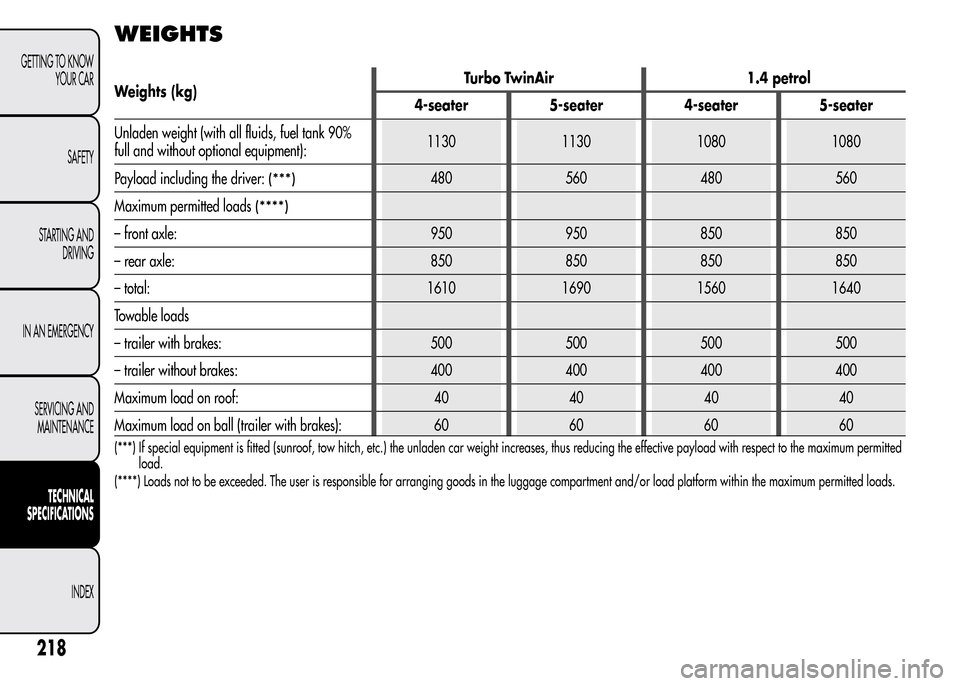
WEIGHTS
Weights (kg)Turbo TwinAir 1.4 petrol
4-seater 5-seater 4-seater 5-seater
Unladen weight (with all fluids, fuel tank 90%
full and without optional equipment):1130 1130 1080 1080
Payload including the driver:
(***)480 560 480 560
Maximum permitted loads
(****)
– front axle: 950 950 850 850
– rear axle: 850 850 850 850
– total: 1610 1690 1560 1640
Towable loads
– trailer with brakes: 500 500 500 500
– trailer without brakes: 400 400 400 400
Maximum load on roof: 40 40 40 40
Maximum load on ball (trailer with brakes): 60 60 60 60
(***) If special equipment is fitted (sunroof, tow hitch, etc.) the unladen car weight increases, thus reducing the effective payload with respect tothe maximum permitted
load.
(****) Loads not to be exceeded. The user is responsible for arranging goods in the luggage compartment and/or load platform within the maximum permitted loads.
218
GETTING TO KNOW
YOUR CAR
SAFETY
STARTING AND
DRIVING
IN AN EMERGENCY
SERVICING AND
MAINTENANCE
TECHNICAL
SPECIFICATIONS
INDEX
Page 223 of 280
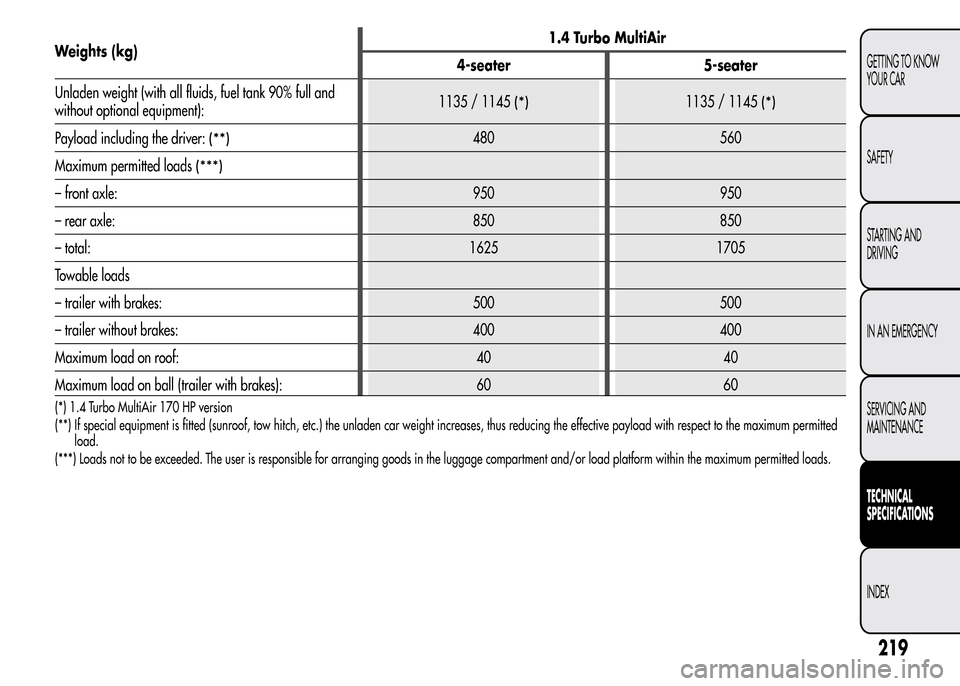
Weights (kg)1.4 Turbo MultiAir
4-seater 5-seater
Unladen weight (with all fluids, fuel tank 90% full and
without optional equipment):1135 / 1145
(*)1135 / 1145(*)
Payload including the driver:(**)480 560
Maximum permitted loads
(***)
– front axle: 950 950
– rear axle: 850 850
– total: 1625 1705
Towable loads
– trailer with brakes: 500 500
– trailer without brakes: 400 400
Maximum load on roof: 40 40
Maximum load on ball (trailer with brakes): 60 60
(*) 1.4 Turbo MultiAir 170 HP version
(**) If special equipment is fitted (sunroof, tow hitch, etc.) the unladen car weight increases, thus reducing the effective payload with respect to the maximum permitted
load.
(***) Loads not to be exceeded. The user is responsible for arranging goods in the luggage compartment and/or load platform within the maximum permitted loads.
219
GETTING TO KNOW
YOUR CAR
SAFETY
STARTING AND
DRIVING
IN AN EMERGENCY
SERVICING AND
MAINTENANCE
TECHNICAL
SPECIFICATIONS
INDEX