wheel Alfa Romeo MiTo 2016 Owner's Guide
[x] Cancel search | Manufacturer: ALFA ROMEO, Model Year: 2016, Model line: MiTo, Model: Alfa Romeo MiTo 2016Pages: 280, PDF Size: 8.52 MB
Page 108 of 280
TPMS (Tyre Pressure
Monitoring System)
(for versions/markets, where provided)
The car may be fitted with a tyre pressure monitoring system (TPMS),
which informs the driver of the tyre inflation status via the "Check
tyre pressure" and "Low tyre pressure" messages on the display.
This system comprises a radio frequency transmitter fitted to each
wheel (on the wheel rim inside the tyre), which is able to send
information on the tyre inflation pressure of each wheel to the control
unit.
IMPORTANT INFORMATION ABOUT
THE TPMS
The fault indications are not stored and will therefore not be displayed
after the engine has been switched off and then on again.
If the fault conditions persist, the control unit will send the relative
indications to the instrument panel only after the car has been in
motion for a short time.
The presence of the TPMS does not permit the driver to
neglect regular checks of the tyre pressure, including
for the spare wheel.
Tyre pressure must be checked with tyres rested and
cold. Should it become necessary for whatever reason
to check pressure with warm tyres, do not reduce
pressure even though it is higher than the prescribed value, but
repeat the check when tyres are cold.
Should one or more wheels be fitted without sensors,
the system will no longer be available and a warning
message will be shown on the display, until 4 wheels
with sensors are fitted again.
The TPMS cannot warn of sudden decreases in tyre
pressure (for example when a tyre bursts). In this case,
stop the car, braking with caution and avoiding
abrupt steering.
Replacing standard tyres with winter tyres and vice
versa requires TPMS system adjustment that must only
be performed by Alfa Romeo Authorised Services.
Variations in outside temperature may cause tyre
pressures to vary. The TPMS may temporarily indicate
insufficient pressure. In this case, check the tyre
pressure when cold and, if necessary, restore the inflation values.
When a tyre is removed, it is advisable to replace the
rubber valve seal as well: contact Alfa Romeo
Authorised Services. Tyre and rim fitting/removal
operations require specific precautions; to avoid damaging or
fitting the sensors incorrectly, tyre and wheel fitting/removal
operations should only be carried out by specialised staff.
Contact Alfa Romeo Authorised Services.
104
GETTING TO
KNOW YOUR CAR
SAFETY
STARTING AND
DRIVING
IN AN EMERGENCY
SERVICING AND
MAINTENANCE
TECHNICAL
SPECIFICATIONS
INDEX
Page 110 of 280
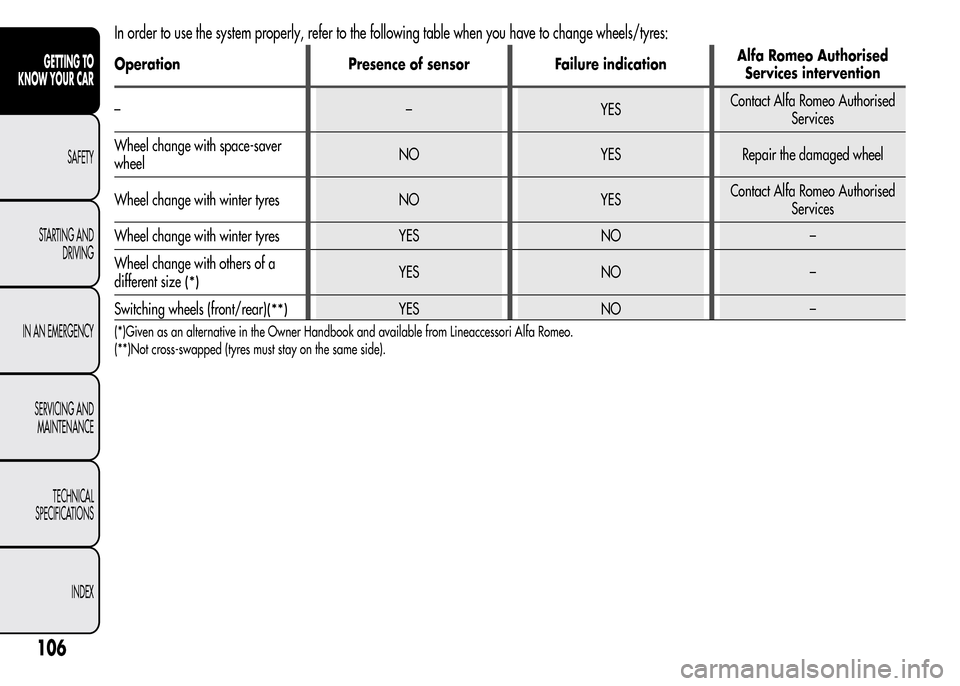
In order to use the system properly, refer to the following table when you have to change wheels/tyres:
Operation Presence of sensor Failure indicationAlfa Romeo Authorised
Services intervention
– – YESContact Alfa Romeo Authorised
Services
Wheel change with space-saver
wheelNO YES Repair the damaged wheel
Wheel change with winter tyres NO YESContact Alfa Romeo Authorised
Services
Wheel change with winter tyres YES NO –
Wheel change with others of a
different size
(*)YES NO –
Switching wheels (front/rear)
(**)YES NO –
(*)Given as an alternative in the Owner Handbook and available from Lineaccessori Alfa Romeo.
(**)Not cross-swapped (tyres must stay on the same side).
106
GETTING TO
KNOW YOUR CAR
SAFETY
STARTING AND
DRIVING
IN AN EMERGENCY
SERVICING AND
MAINTENANCE
TECHNICAL
SPECIFICATIONS
INDEX
Page 127 of 280
FRONT AIRBAGS
“SMART BAG” SYSTEM (MULTISTAGE
FRONT AIRBAGS)
The car is equipped with multi-stage front airbags (“Smart bags”) for
the driver and passenger and knee bags for the driver.
The front airbags (driver's and passenger's) and the driver's knee bag
have been designed to protect the occupants in the event of head-on
crashes of medium-high severity, by placing cushions between the
occupant and the steering wheel or dashboard.
Therefore non-deployment in other types of impacts (side impacts, rear
shunts, roll-overs, etc.) does not indicate a system malfunction.
Airbags are not a replacement of but complementary to the seat belts,
which you are recommended to always wear. In the event of impact,
those not wearing a seat belt are projected forwards and may come
into contact with the bag which is still inflating. The protection offered
by the bag is compromised in these circumstances.
Front airbags may not activate in the following situations:
❒frontal impacts against highly deformable objects not involving the
front surface of the car (e.g. wing collision against guard rail, etc.);
❒jamming of the car underneath other vehicles or protective barriers
(e.g. underneath a truck or a guard rail) as, in this case, the bags
would offer no additional protection with respect to the seat belt and
their deployment would be inappropriate. In these cases, non-
deployment does not indicate a system malfunction.
Do not apply stickers or other objects on the steering
wheel, on the dashboard in the passenger side airbag
area, on side upholstery on the roof or on the seats.
Never put objects (e.g. mobile phones) on the passenger's side
dashboard since they could interfere with correct inflation of the
airbag and also cause serious injury to the passengers.
FRONT DRIVER SIDE AIRBAG
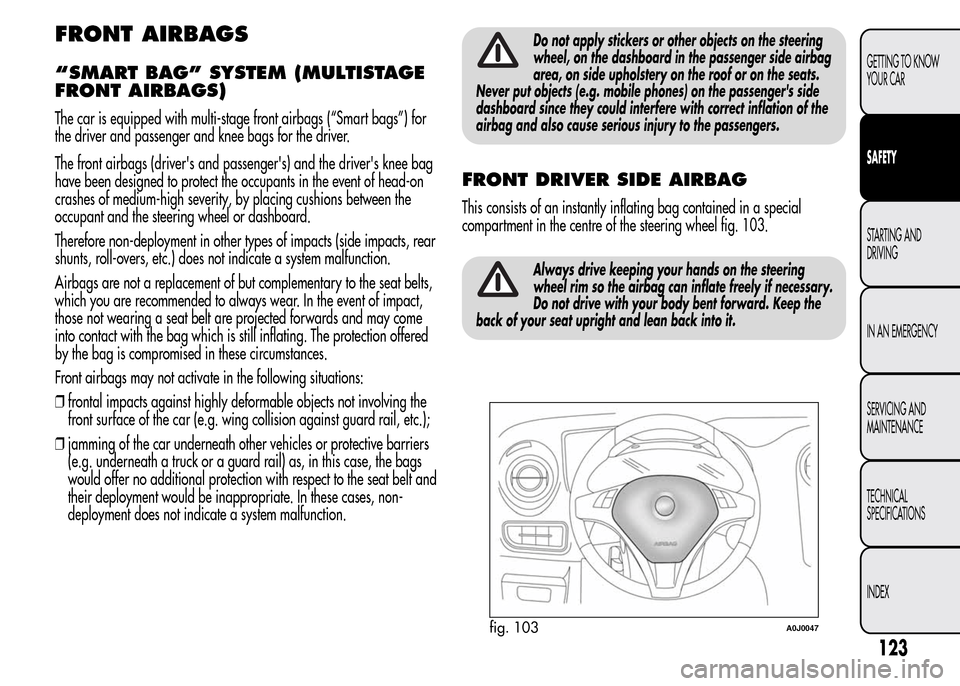
This consists of an instantly inflating bag contained in a special
compartment in the centre of the steering wheel fig. 103.
Always drive keeping your hands on the steering
wheel rim so the airbag can inflate freely if necessary.
Do not drive with your body bent forward. Keep the
back of your seat upright and lean back into it.
fig. 103A0J0047
123
GETTING TO KNOW
YOUR CAR
SAFETY
STARTING AND
DRIVING
IN AN EMERGENCY
SERVICING AND
MAINTENANCE
TECHNICAL
SPECIFICATIONS
INDEX
Page 130 of 280
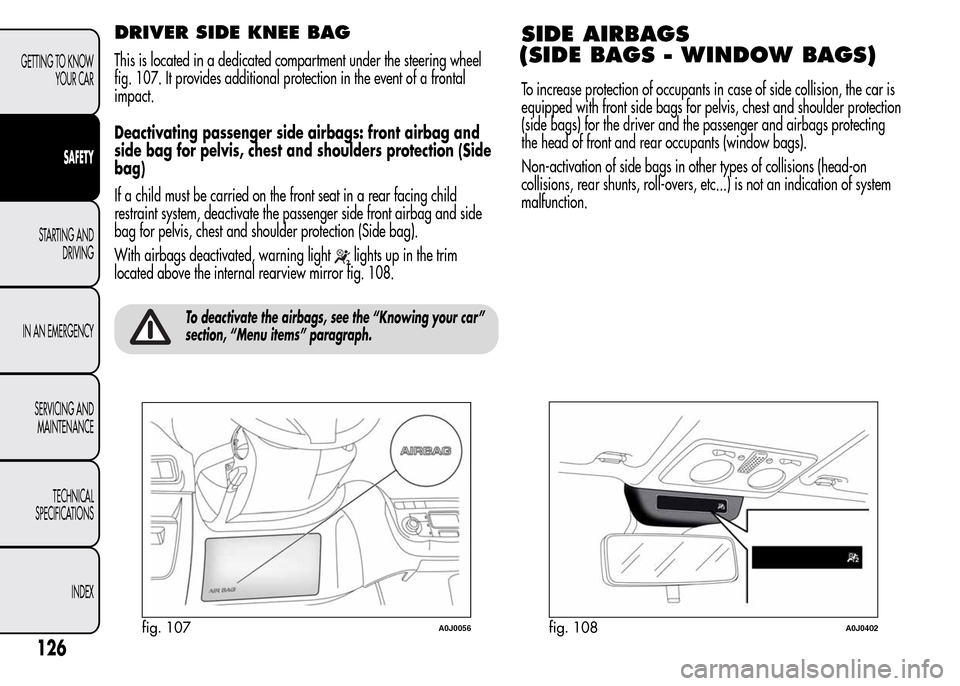
DRIVER SIDE KNEE BAG
This is located in a dedicated compartment under the steering wheel
fig. 107. It provides additional protection in the event of a frontal
impact.
Deactivating passenger side airbags: front airbag and
side bag for pelvis, chest and shoulders protection (Side
bag)
If a child must be carried on the front seat in a rear facing child
restraint system, deactivate the passenger side front airbag and side
bag for pelvis, chest and shoulder protection (Side bag).
With airbags deactivated, warning light
lights up in the trim
located above the internal rearview mirror fig. 108.
To deactivate the airbags, see the “Knowing your car”
section, “Menu items” paragraph.
SIDE AIRBAGS
(SIDE BAGS - WINDOW BAGS)
To increase protection of occupants in case of side collision, the car is
equipped with front side bags for pelvis, chest and shoulder protection
(side bags) for the driver and the passenger and airbags protecting
the head of front and rear occupants (window bags).
Non-activation of side bags in other types of collisions (head-on
collisions, rear shunts, roll-overs, etc...) is not an indication of system
malfunction.
fig. 107A0J0056fig. 108A0J0402
126
GETTING TO KNOW
YOUR CAR
SAFETY
STARTING AND
DRIVING
IN AN EMERGENCY
SERVICING AND
MAINTENANCE
TECHNICAL
SPECIFICATIONS
INDEX
Page 135 of 280
PROCEDURE FOR DIESEL VERSIONS
Proceed as follows:
❒engage the handbrake and place the gearbox lever in neutral;
❒turn the ignition key to MAR-ON: the warning lights
and
(or the symbol on the display) on the instrument panel will
switch on;
❒wait for the warning lights (or the symbol on the display) to switch
off;
❒fully depress the clutch pedal, without touching the accelerator;
❒turn the ignition key to AVV;
warning light switches off.
Waiting too long will waste the heating work carried out by the
glow plugs. Release the key as soon as the engine starts.
If thewarning light flashes for about 1 minute after
starting or during prolonged cranking, this indicates a fault
in the glow plug preheating system. Use the car normally
if the engine starts and go to Alfa Romeo Authorized Services as soon
as possible.
It is dangerous to run the engine in enclosed areas. The
engine takes in oxygen and releases carbon dioxide,
carbon monoxide and other toxic gases.
It is advisable not to demand maximum performance from
your car (e.g. excessive acceleration, long distances at
maximum rpm, excessively intense braking, etc.) when it is
first used.
When the engine is off, do not leave the ignition key turned
to MAR to prevent unnecessary electrical consumption from
draining the battery.
Remember that the brake servo and electromechanical
power steering are not operational until the engine
has been started, therefore much more effort than
usual is required on the brake pedal and steering wheel.
Never start the engine by pushing, towing or driving
downhill. These manoeuvres may damage the catalytic
converter.
131
GETTING TO KNOW
YOUR CAR
SAFETY
STARTING AND
DRIVING
IN AN EMERGENCY
SERVICING AND
MAINTENANCE
TECHNICAL
SPECIFICATIONS
INDEX
Page 136 of 280
WARMING UP THE ENGINE JUST
AFTER IT HAS STARTED
Proceed as follows:
❒drive off slowly, letting the engine turn at medium revs and without
accelerating abruptly;
❒do not demand maximum performance for the first few kilometres. It
is advisable to wait until the engine coolant temperature indicator
starts moving.
STOPPING THE ENGINE
Turn the ignition key to STOP while the engine is idling.
IMPORTANT After a demanding drive, before turning the engine off
you should allow it to idle to allow the temperature in the engine
compartment to decrease.
A quick burst on the accelerator before stopping the engine
serves absolutely no practical purpose. It wastes fuel and
is especially damaging to turbocharged engines.
PARKING
Switch off the engine and pull up the handbrake. Engage a gear (1stif
the car is facing uphill or reverse if it is facing downhill) and leave
the wheels steered to one side.
If the car is parked on a steep slope block the wheels with a wedge or
stone. Always remove the ignition key when leaving the car.
Never leave children unattended in the car. Always
remove the key from the ignition when leaving the car
and take it with you.
132
GETTING TO KNOW
YOUR CAR
SAFETY
STARTING AND
DRIVING
IN AN EMERGENCY
SERVICING AND
MAINTENANCE
TECHNICAL
SPECIFICATIONS
INDEX
Page 141 of 280
INSTALLING A TOW HOOK
Contact Alfa Romeo Authorised Services to install a tow hook.
The ABS with which the car is equipped will not control
the braking system of the trailer. Particular caution is
therefore required on slippery roads.
Do not, under any circumstances, modify the vehicle's
braking system to control the trailer breaking system.
The towing breaking system must be completely
independent of the vehicle's hydraulic system.
SNOW TYRES
Use snow tyres of the same size as the normal tyres provided with the
car: Alfa Romeo Authorized Services will be able to advise you on
the most appropriate tyre to use.
Only use these tyres in the event of ice or snow on the roads.
For the type of snow tyre to be used, inflation pressures and the
specifications, strictly follow the instructions given in the "Wheels"
paragraph in the "Technical specifications" section.
The winter performance of these tyres is considerably reduced when
the tread thickness is less than 4 mm. Replace them in this case.
Due to their specific features, the performance of snow tyres is much
lower than that of normal types in normal conditions or long motorway
stretches. Their usage should therefore be restricted in accordance
with their type approval.
All four tyres should be the same (brand and track) to ensure greater
safety when driving and braking and good driveability. Remember
that it is inadvisable to change the rotation direction of tyres.
The maximum speed for snow tyres marked “Q” is
160 km/h, while it is 190 km/h for “T” tyres and 210
km/h for "H" tyres. The highway code speed limits
must however always be complied with.
137
GETTING TO KNOW
YOUR CAR
SAFETY
STARTING AND
DRIVING
IN AN EMERGENCY
SERVICING AND
MAINTENANCE
TECHNICAL
SPECIFICATIONS
INDEX
Page 142 of 280
SNOW CHAINS
The use of snow chains should be in compliance with local regulations.
The snow chains may be applied only onto the front wheel tyres (drive
wheels).
Check the tension of the snow chains after the first few metres have
been driven.
Use reduced size snow chains: on all versions, for 195/55 R16" and
205/55 R16" size tyres use low-clearance snow chains with a
maximum projection beyond the tyre profile of 9 mm.
IMPORTANT The space-saver wheel cannot be fitted with snow chains.
If a front (drive) wheel is punctured and snow chains must be used,
you must remove a normal wheel from the rear and replace this one
with the space-saver wheel. In this way, with two normal drive wheels,
it is possible to use snow chains.
Keep your speed down when snow chains are fitted; do not
exceed 50 km/h. Avoid potholes, steps and pavements
and avoid driving long distances on roads not covered with
snow to avoid damaging the car and the roadbed.
STORING THE CAR
If the car is to be left inactive for longer than a month, the following
precautions should be noted:
❒park the vehicle in a dry, covered and, if possible, ventilated area;
engage a gear and check that the handbrake is not engaged;
❒disconnect the negative battery terminal and check the battery
charge. Repeat this check once every three months during storage;
❒if you have not disconnected the battery, check the battery charge
every thirty days;
❒clean and protect the painted parts using protective wax;
❒clean and protect the shiny metal parts using special compounds
available commercially;
❒sprinkle talcum powder on the windscreen and rear window wiper
rubber blades and lift them off the glass;
❒slightly open the windows;
❒cover the car with a cloth or perforated plastic sheet. Do not use
compact plastic sheets which do not allow humidity to evaporate
from the surface of the car.
❒inflate tyres to +0.5 bar above the standard specified pressure and
check it at intervals;
❒do not drain the engine cooling system.
IMPORTANT After turning the ignition key to STOP, wait at least 1
minute before disconnecting the battery power supply.
138
GETTING TO KNOW
YOUR CAR
SAFETY
STARTING AND
DRIVING
IN AN EMERGENCY
SERVICING AND
MAINTENANCE
TECHNICAL
SPECIFICATIONS
INDEX
Page 144 of 280
This starting procedure must be performed by expert
personnel because incorrect actions could cause
electrical discharge of considerable intensity.
Furthermore, battery fluid is poisonous and corrosive: avoid
contact with skin and eyes. Keep naked flames and lighted
cigarettes away from the battery and do not cause sparks.
BUMP STARTING
Never start the engine by pushing, towing or coasting downhill.
REPLACING A WHEEL
GENERAL INSTRUCTIONS
The car is equipped with the “Fix&Go Automatic Kit”: see the
paragraph “Fix&Go Automatic Kit” for how to use this device.
As an alternative to the “Fix&Go Automatic Kit” the car may be
equipped with a space-saver wheel: see the instructions on the
following pages for changing the tyre.
The spare wheel is specific for your car. Do not use it
on cars of different models. Do not use spare wheels of
different models on your car. The space-saver wheel
must only be used in case of emergency. It must only be used for
the distance necessary to reach a service point and the car speed
must not exceed 80 km/h. The space-saver wheel has an orange
sticker that summarises the main cautions for use and limitations.
Never remove or cover the label. Never apply any hub cap to
the space-saver spare wheel.
Alert other drivers that the car is stationary in
compliance with local regulations: hazard warning
lights, warning triangle, etc. Any passengers on board
should leave the car, especially if it is heavily laden. Passengers
should stay away from on-coming traffic while the wheel is
being changed. In case of steep slopes or rough slopes, place
wedges or other materials suitable to stop the vehicle under the
wheels.
140
GETTING TO KNOW
YOUR CAR
SAFETY
STARTING AND
DRIVING
IN AN
EMERGENCY
SERVICING AND
MAINTENANCE
TECHNICAL
SPECIFICATIONS
INDEX
Page 145 of 280
The vehicle's driving characteristics will be modified
with the space-saver wheel fitted. Avoid violent
acceleration and braking, sharp steering and fast
cornering. The total life of a space-saver wheel is approximately
3,000 km, after which it must be replaced by another wheel of
the same type. Never attempt to fit a conventional tyre on a rim
designed for use as a space-saver wheel. Repair and refit the
standard wheel as soon as possible. Two or more space-saver
wheels should never be used together. Do not grease the threads
of bolts before fitting them: they might slip out.
The jack provided is only intended to be used for
replacing tyres on the vehicle with which it is supplied,
or on same-model vehicles. Never use the jack for
other purposes, such as lifting other car models. Never use it for
repair operations under the vehicle. Incorrect positioning of the
jack may cause the car to fall. Do not use the jack for loads
higher than those shown on the label. Never install snow chains
on the small spare wheel; if a front tyre (driving wheel) is
punctured and you need to use snow chains, use a standard
wheel from the rear axle and install the small spare wheel on the
rear axle. In this way, with two normal front drive wheels, it is
possible to use snow chains.
Incorrectly fitting the hubcap may cause it to fall off
when the vehicle is in motion. Never tamper with the
inflating valve. Never introduce tools of any kind
between rim and tyre. Regularly check the inflation pressure of
the tyres and space-saver wheel (see chapter "Technical
specifications").
JACK
Please note that:
❒the jack weight is 1.76 kg;
❒the jack requires no adjustment;
❒the jack cannot be repaired and in the event of a fault it must be
replaced by another original one;
❒no tool other than its cranking device may be fitted on the jack.
To change a wheel proceed as follows:
❒stop the car in a position that is not dangerous for oncoming traffic
where you can change the wheel safely. The ground must be flat
and sufficiently compact;
❒switch off the engine, pull up the handbrake and engage 1
agear or
reverse; put on the high visibility jacket (required by law) before
leaving the vehicle;
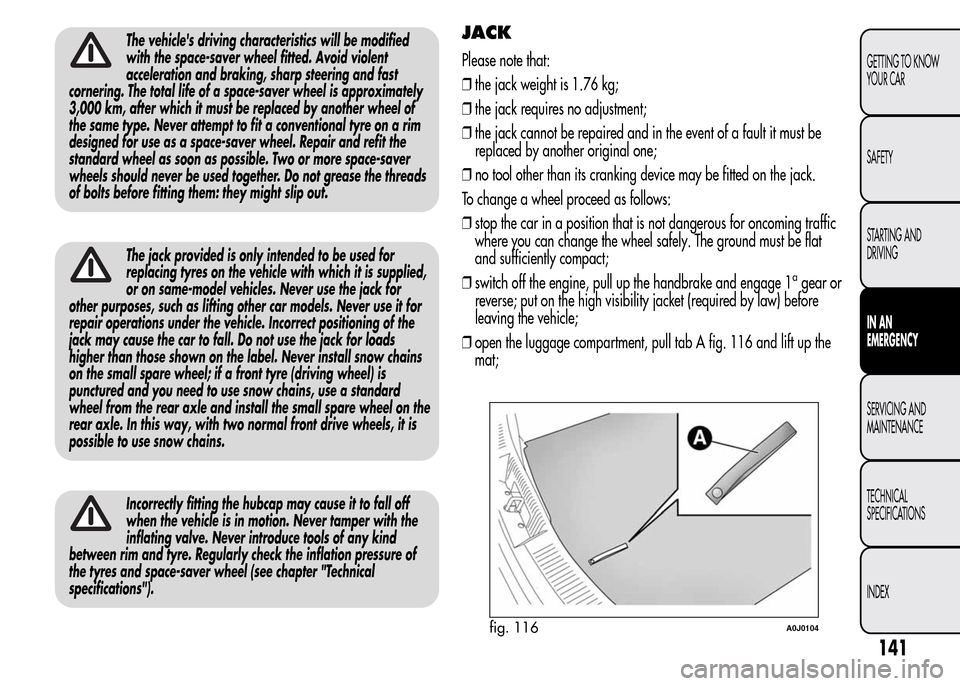
❒open the luggage compartment, pull tab A fig. 116 and lift up the
mat;
fig. 116A0J0104
141
GETTING TO KNOW
YOUR CAR
SAFETY
STARTING AND
DRIVING
IN AN
EMERGENCY
SERVICING AND
MAINTENANCE
TECHNICAL
SPECIFICATIONS
INDEX