Wheel Alfa Romeo MiTo 2017 Owner's Guide
[x] Cancel search | Manufacturer: ALFA ROMEO, Model Year: 2017, Model line: MiTo, Model: Alfa Romeo MiTo 2017Pages: 212, PDF Size: 4.36 MB
Page 83 of 212
Main recommendations to carry
children safely
Install the child restraint systems on
the rear seat, which is the most protected
position in the event of an impact.
Keep children in rearward facing child
restraint systems for as long as possible,
at least until 3–4 years old.
Should a rearward facing child
restraint system be installed on the rear
seats, it is advisable to position it as far
forward as the position of the front seat
allows.
If the passenger side front airbag is
deactivated always check the permanent
switching on of the warning light
in
the trim above the interior rear view
mirror to make sure that it has actually
been deactivated.
Carefully follow the instructions
supplied with the child restraint system
itself. Keep the instructions in the vehicle
along with the other documents and this
handbook. Do not use second-hand child
restraint systems without instructions.
Only one child is to be strapped into
each restraint system; never carry two
children simultaneously.
Always check that the seat belts do
not rest on the child’s neck.
Always check that the seat belt is well
fastened by pulling on it.
While travelling, do not let the child sit
incorrectly or unfasten the belts.
Never allow a child to put the belt's
diagonal section under an arm or behind
their back.
Never carry children on your lap, even
newborns. No one can hold a child in the
case of an accident.
In the event of an accident, replace the
child restraint system with a new one. In
addition, and depending on the type of
child restraint system installed, replace
the seat belt with which the child
restraint system was connected.
WARNING
73)The diagram is indicative and for fitting
purposes only. Fit the child restraint system
according to the instructions, which must be
included.
74)If a Universal ISOFIX child seat system
is not fixed to all three anchorages, it will not
be able to protect the child correctly. In a
crash, the child could be seriously or fatally
injured.
75)Fit the child restraint system when the
car is stationary. The child restraint system
is correctly secured to the brackets when
you hear the click. Follow the instructions for
assembly, disassembly and positioning that
the Manufacturer must supply with the child
restraint system.
76)Do not use the same lower anchorage to
install more than one child restraint system.
FRONT AIRBAGS
77) 78) 79) 80) 81)
“SMART BAG”SYSTEM (MULTISTAGE
FRONT AIRBAGS)
The car features multistage front airbags
(“Smart bag”) for driver and passenger.
The front driver/passenger airbags are
designed to protect occupants in the
event of frontal impacts of medium-high
severity, by placing the bag between the
occupant and the steering wheel or
dashboard.
Therefore non-activation in other types
of collisions (side collisions, rear shunts,
roll-overs, etc.) is not a system
malfunction.
Airbags are not a replacement of but
complementary to the seat belts, which
you are recommended to always wear. In
the event of impact, those not wearing a
seat belt are projected forwards and may
come into contact with the bag which is
still inflating. The protection offered by
the bag is compromised in these
circumstances.
Front airbags may not activate in the
following situations:
frontal impacts against highly
deformable objects not involving the
front surface of the car (e.g. wing collision
against guard rail, etc.);
81
Page 84 of 212
jamming of the car underneath other
vehicles or protective barriers (e.g.
underneath a truck or a guard rail) as, in
this case, the bags would offer no
additional protection with respect to the
seat belt and their deployment would be
inappropriate. Failure to activate in the
conditions described above is due to the
fact that they may not provide any
additional protection compared with seat
belts, so their activation would be
inappropriate. In these cases,
non-deployment does not indicate a
system malfunction.
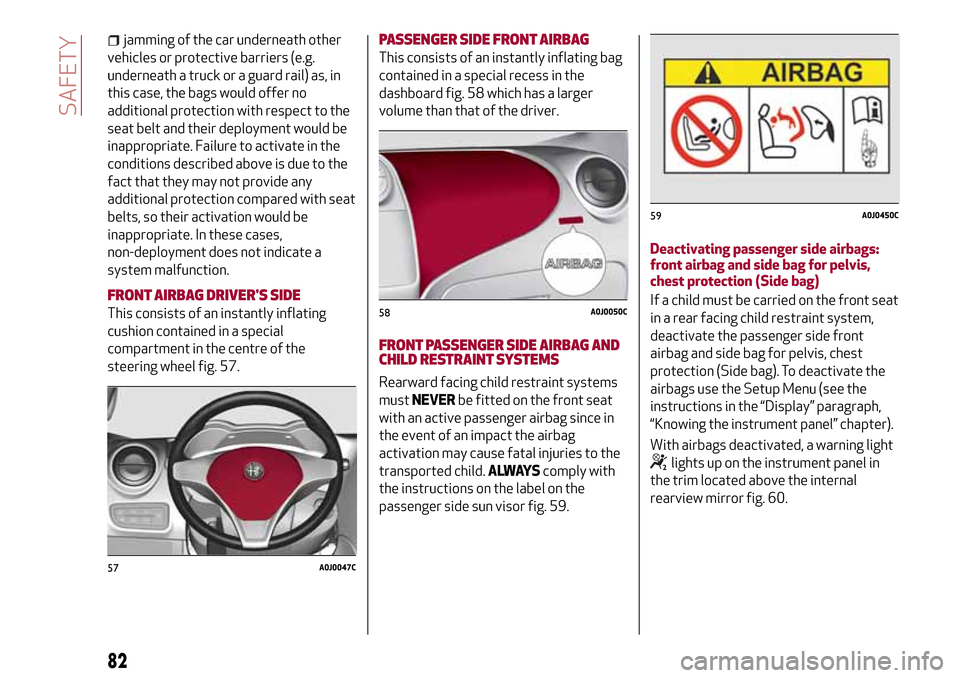
FRONT AIRBAG DRIVER'S SIDE
This consists of an instantly inflating
cushion contained in a special
compartment in the centre of the
steering wheel fig. 57.
PASSENGER SIDE FRONT AIRBAG
This consists of an instantly inflating bag
contained in a special recess in the
dashboard fig. 58 which has a larger
volume than that of the driver.
FRONT PASSENGER SIDE AIRBAG AND
CHILD RESTRAINTSYSTEMS
Rearward facing child restraint systems
mustNEVERbe fitted on the front seat
with an active passenger airbag since in
the event of an impact the airbag
activation may cause fatal injuries to the
transported child.ALWAYScomply with
the instructions on the label on the
passenger side sun visor fig. 59.Deactivating passenger side airbags:
front airbag and side bag for pelvis,
chest protection (Side bag)
If a child must be carried on the front seat
in a rear facing child restraint system,
deactivate the passenger side front
airbag and side bag for pelvis, chest
protection (Side bag). To deactivate the
airbags use the Setup Menu (see the
instructions in the “Display” paragraph,
“Knowing the instrument panel” chapter).
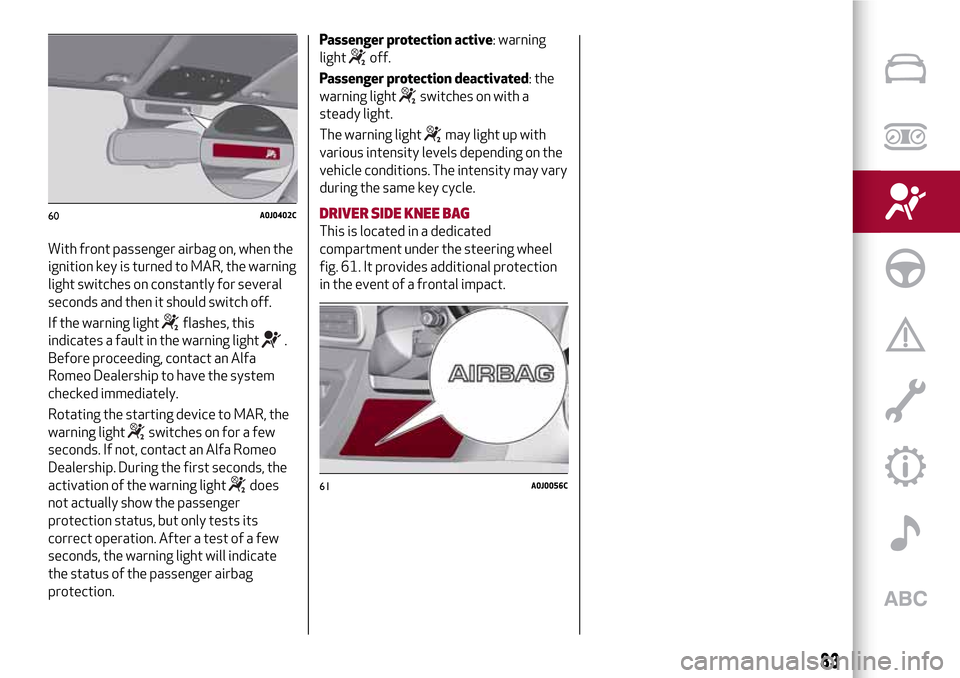
With airbags deactivated, a warning light
lights up on the instrument panel in
the trim located above the internal
rearview mirror fig. 60.
57A0J0047C
58A0J0050C
59A0J0450C
82
SAFETY
Page 85 of 212
With front passenger airbag on, when the
ignition key is turned to MAR, the warning
light switches on constantly for several
seconds and then it should switch off.
If the warning light
flashes, this
indicates a fault in the warning light
.
Before proceeding, contact an Alfa
Romeo Dealership to have the system
checked immediately.
Rotating the starting device to MAR, the
warning light
switches on for a few
seconds. If not, contact an Alfa Romeo
Dealership. During the first seconds, the
activation of the warning light
does
not actually show the passenger
protection status, but only tests its
correct operation. After a test of a few
seconds, the warning light will indicate
the status of the passenger airbag
protection.Passenger protection active: warning
light
off.
Passenger protection deactivated: the
warning light
switches on with a
steady light.
The warning light
may light up with
various intensity levels depending on the
vehicle conditions. The intensity may vary
during the same key cycle.
DRIVER SIDE KNEE BAG
This is located in a dedicated
compartment under the steering wheel
fig. 61. It provides additional protection
in the event of a frontal impact.
60A0J0402C
61A0J0056C
83
Page 87 of 212
WARNING
77)Do not apply stickers or other objects on the steering wheel, on the dashboard in the passenger side airbag area, on side upholstery on the roof
or on the seats. Never put objects (e.g. mobile phones) on the passenger's side dashboard since they could interfere with correct inflation of the
airbag and also cause serious injury to the passengers.
78)Always drive keeping your hands on the steering wheel rim so the airbag can inflate freely if necessary. Do not drive with your body bent
forward. Keep the back of your seat upright and lean back into it.
79)When there is an active passenger airbag, DO NOT install rearward facing child restraint systems on the front seat. Deployment of the airbag
in an accident could cause fatal injuries to the child regardless of the severity of the impact. Therefore, always deactivate the passenger side
airbag when a rearward facing child restraint system is installed on the front passenger seat. The front passenger seat must also be positioned
back as far as possible in order to prevent the child restraint system from coming into contact with the dashboard. Immediately reactivate the
passenger airbag as soon as the child restraint system has been removed.
80)To deactivate the airbags, see the “Knowing your car” section, “Menu items” paragraph.
81)A failure of the
warning light is indicated by thewarning light switching on. In addition, the airbag system automatically disables the
passenger side airbag (where provided). Before proceeding, contact an Alfa Romeo Dealership to have the system checked immediately.
85
Page 93 of 212
IMPORTANT
17)We recommend that during the initial
period, or during the first 1600 km
(1000 miles), you do not drive to full car
performance (e.g. excessive acceleration,
long journeys at top speed, sharp braking,
etc.).
18)When the engine is switched off never
leave the ignition device in the MAR position
to prevent useless current absorption from
draining the battery.
19)A quick burst on the accelerator before
turning off the engine serves absolutely no
practical purpose; it wastes fuel and is
damaging for the engine.
20)Warning light
will flash after starting
or during prolonged cranking to indicate a
fault with the glow plug heating system. If
the engine starts, the vehicle can be regularly
used, but an Alfa Romeo Dealership must be
contacted as soon as possible.
PARKING THE VEHICLE
96) 97)
Always remove the ignition key when
leaving the car.
When parking and leaving the car,
proceed as follows:
engage a gear (1stgear if facing uphill
or reverse if facing downhill) and leave
the wheels turned;
stop the engine and engage the
handbrake.
Block the wheels with a wedge or a stone
if the car is parked on a steep slope.
On versions equipped with Alfa TCT
transmission, before releasing the brake
pedal, wait for letter P to be displayed.
IMPORTANTNEVERleave the car with
the gearbox in neutral (or, on versions
equipped with Alfa TCT transmission,
before placing the gear lever at P).
HANDBRAKE
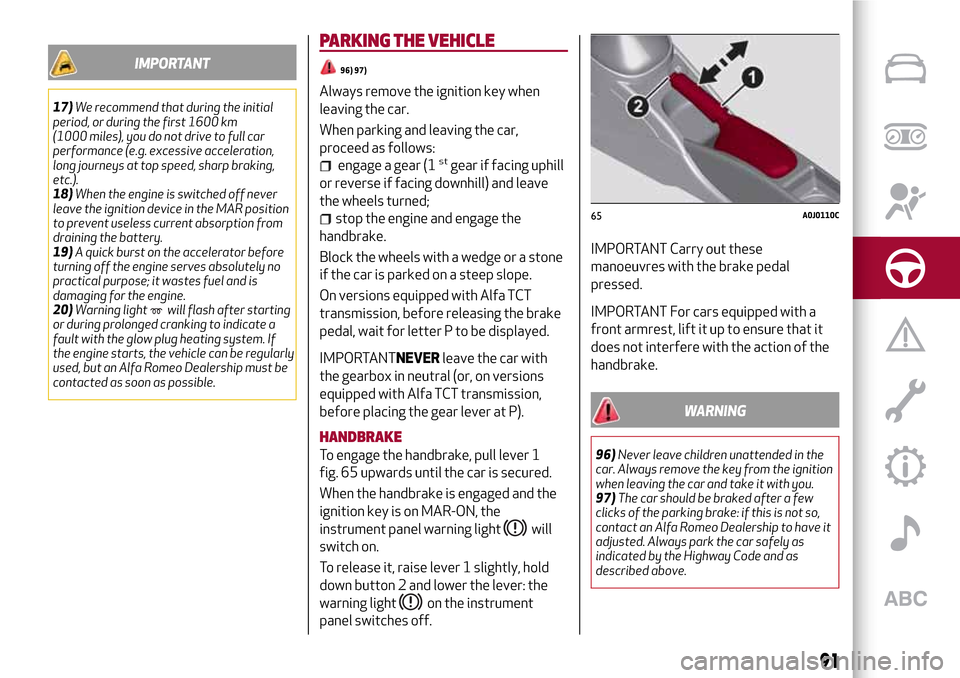
To engage the handbrake, pull lever 1
fig. 65 upwards until the car is secured.
When the handbrake is engaged and the
ignition key is on MAR-ON, the
instrument panel warning light
will
switch on.
To release it, raise lever 1 slightly, hold
down button 2 and lower the lever: the
warning light
on the instrument
panel switches off.
IMPORTANT Carry out these
manoeuvres with the brake pedal
pressed.
IMPORTANT For cars equipped with a
front armrest, lift it up to ensure that it
does not interfere with the action of the
handbrake.
WARNING
96)Never leave children unattended in the
car. Always remove the key from the ignition
when leaving the car and take it with you.
97)The car should be braked after a few
clicks of the parking brake: if this is not so,
contact an Alfa Romeo Dealership to have it
adjusted. Always park the car safely as
indicated by the Highway Code and as
described above.
65A0J0110C
91
Page 95 of 212
USING ALFA TCT
TRANSMISSION
(where provided)
SELECTOR LEVER
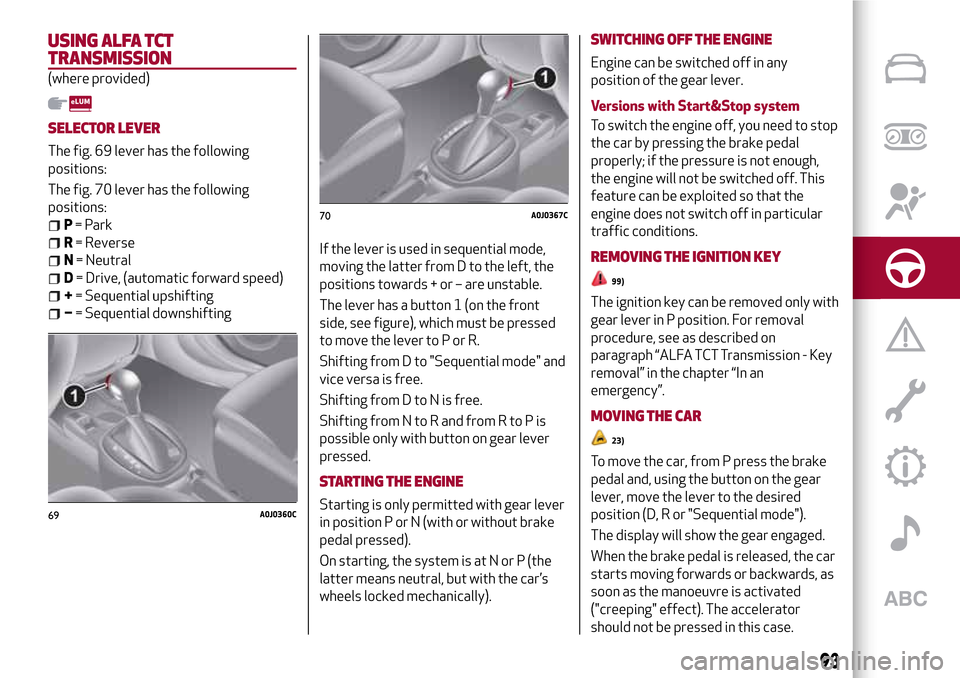
The fig. 69 lever has the following
positions:
The fig. 70 lever has the following
positions:
P= Park
R= Reverse
N= Neutral
D= Drive, (automatic forward speed)
+= Sequential upshifting
−= Sequential downshiftingIf the lever is used in sequential mode,
moving the latter from D to the left, the
positions towards + or – are unstable.
The lever has a button 1 (on the front
side, see figure), which must be pressed
to move the lever to P or R.
Shifting from D to "Sequential mode" and
vice versa is free.
Shifting from D to N is free.
Shifting from N to R and from R to P is
possible only with button on gear lever
pressed.
STARTING THE ENGINE
Starting is only permitted with gear lever
in position P or N (with or without brake
pedal pressed).
On starting, the system is at N or P (the
latter means neutral, but with the car’s
wheels locked mechanically).
SWITCHING OFF THE ENGINE
Engine can be switched off in any
position of the gear lever.
Versions with Start&Stop system
To switch the engine off, you need to stop
the car by pressing the brake pedal
properly; if the pressure is not enough,
the engine will not be switched off. This
feature can be exploited so that the
engine does not switch off in particular
traffic conditions.
REMOVING THE IGNITION KEY
99)
The ignition key can be removed only with
gear lever in P position. For removal
procedure, see as described on
paragraph “ALFA TCT Transmission - Key
removal” in the chapter “In an
emergency”.
MOVING THE CAR
23)
To move the car, from P press the brake
pedal and, using the button on the gear
lever, move the lever to the desired
position (D, R or "Sequential mode").
The display will show the gear engaged.
When the brake pedal is released, the car
starts moving forwards or backwards, as
soon as the manoeuvre is activated
("creeping" effect). The accelerator
should not be pressed in this case.
69A0J0360C
70A0J0367C
93
Page 96 of 212
IMPORTANT The inconsistency between
the speed actually engaged (shown on
the display) and the position of the gear
lever is indicated by the letter
corresponding to the position of the lever
flashing on the trim (also accompanied by
an acoustic signal). This condition should
not be interpreted as an operational
fault, but simply as a request by the
system to repeat the manoeuvre.
IMPORTANT With handbrake released
and brake pedal released, engine at idling
speed and gear lever in position D, R or
sequential, pay the utmost care because
the car can move even without the
operation of the accelerator pedal. This
condition can be used with the car on a
level surface during tight parking
manoeuvres using the brake pedal only.
AUTOMATIC DRIVING MODE
D can be selected from sequential
operation in any driving conditions.
In automatic driving mode, the best ratio
is selected by the electronic transmission
control unit depending on speed, engine
load (accelerator pedal position) and
gradient of the road.
“Kick-Down” function
To resume speed quickly, when the
accelerator pedal is pressed fully, the
transmission control system downshifts
("Kick-down" function).
IMPORTANT When driving on roads with
poor grip conditions (snow, ice, etc.) avoid
activating the kick-down function.
Gearshifting suggestion
With the transmission in automatic mode
(selector lever in position D), when
gearshifting is required by the paddles on
the steering wheel (where provided), the
system shifts to "Sequential mode",
displaying the engaged gear for about
5 seconds.
When this time has elapsed, if the
paddles are not operated anymore, the
system goes back to the automatic mode
(D), with following displaying.
SEQUENTIAL DRIVING MODE
In sequential driving mode, the
transmission works like a manual
gearbox.
Gearshifting through selector lever
Move the lever sideways (to the left)
from position D to the sequential
position:
lever towards "+": engage higher gear;
lever towards "-": engage lower gear.
The lever correct position in “Sequential
Mode” is signalled when the symbols “+”
and “−” come on and, simultaneously, the
symbol D comes off on the display.
The gear engaged is shown on the display.Gearshifting through steering wheel
paddles
(where provided)
24)
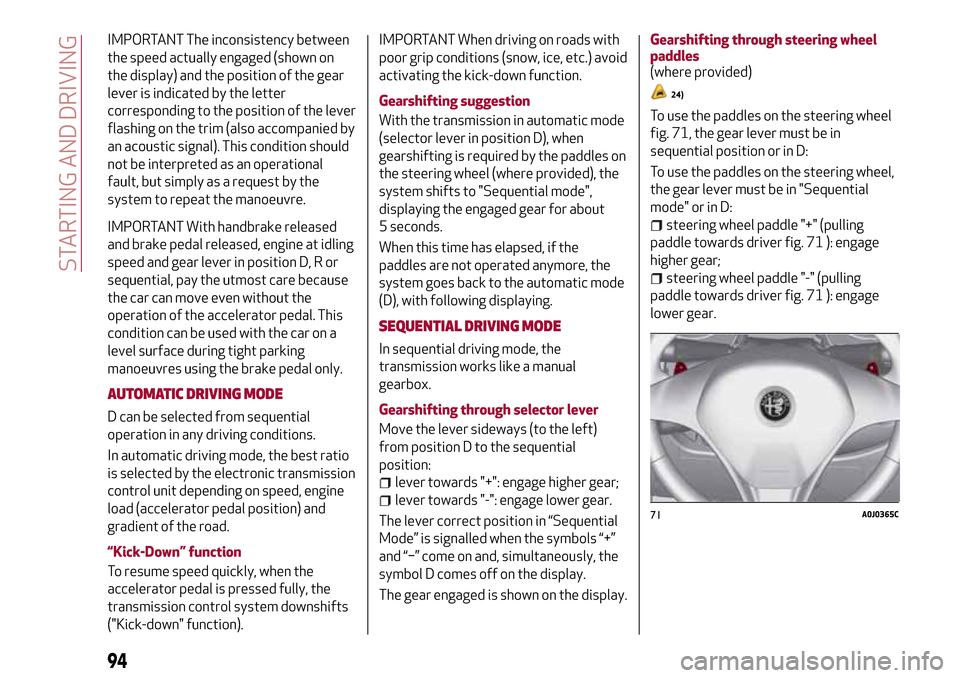
To use the paddles on the steering wheel
fig. 71, the gear lever must be in
sequential position or in D:
To use the paddles on the steering wheel,
the gear lever must be in "Sequential
mode" or in D:
steering wheel paddle "+" (pulling
paddle towards driver fig. 71 ): engage
higher gear;
steering wheel paddle "-" (pulling
paddle towards driver fig. 71 ): engage
lower gear.
71A0J0365C
94
STARTING AND DRIVING
Page 98 of 212
SYSTEM MANUAL ACTIVATION /
DEACTIVATION
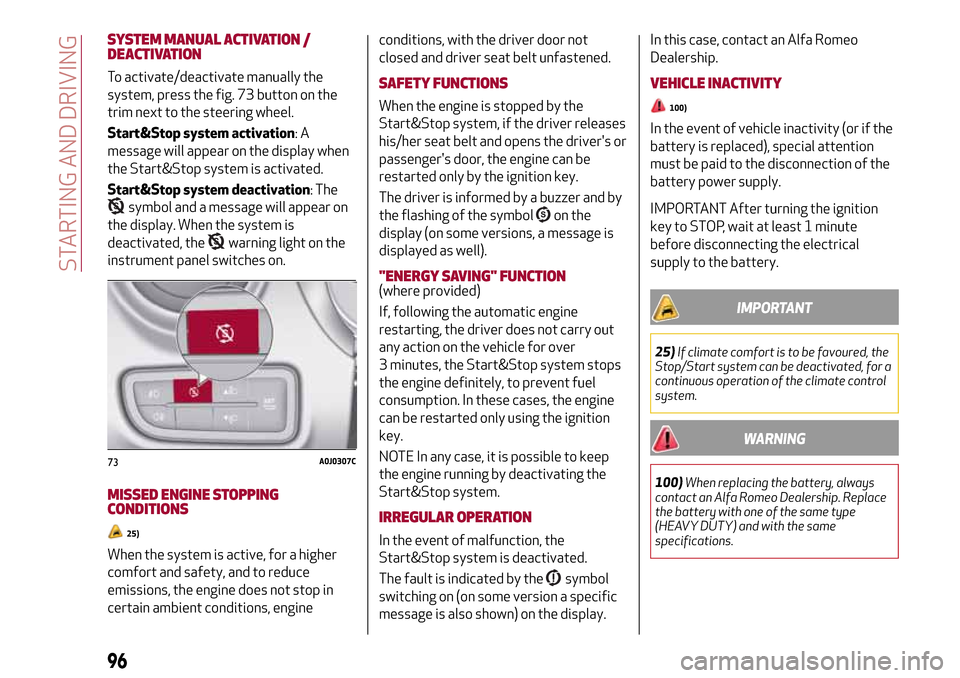
To activate/deactivate manually the
system, press the fig. 73 button on the
trim next to the steering wheel.
Start&Stop system activation:A
message will appear on the display when
the Start&Stop system is activated.
Start&Stop system deactivation: The
symbol and a message will appear on
the display. When the system is
deactivated, the
warning light on the
instrument panel switches on.
MISSED ENGINE STOPPING
CONDITIONS
25)
When the system is active, for a higher
comfort and safety, and to reduce
emissions, the engine does not stop in
certain ambient conditions, engineconditions, with the driver door not
closed and driver seat belt unfastened.
SAFETY FUNCTIONS
When the engine is stopped by the
Start&Stop system, if the driver releases
his/her seat belt and opens the driver's or
passenger's door, the engine can be
restarted only by the ignition key.
The driver is informed by a buzzer and by
the flashing of the symbol
on the
display (on some versions, a message is
displayed as well).
"ENERGY SAVING" FUNCTION(where provided)
If, following the automatic engine
restarting, the driver does not carry out
any action on the vehicle for over
3 minutes, the Start&Stop system stops
the engine definitely, to prevent fuel
consumption. In these cases, the engine
can be restarted only using the ignition
key.
NOTE In any case, it is possible to keep
the engine running by deactivating the
Start&Stop system.
IRREGULAR OPERATION
In the event of malfunction, the
Start&Stop system is deactivated.
The fault is indicated by the
symbol
switching on (on some version a specific
message is also shown) on the display.In this case, contact an Alfa Romeo
Dealership.
VEHICLE INACTIVITY
100)
In the event of vehicle inactivity (or if the
battery is replaced), special attention
must be paid to the disconnection of the
battery power supply.
IMPORTANT After turning the ignition
key to STOP, wait at least 1 minute
before disconnecting the electrical
supply to the battery.
IMPORTANT
25)If climate comfort is to be favoured, the
Stop/Start system can be deactivated, for a
continuous operation of the climate control
system.
WARNING
100)When replacing the battery, always
contact an Alfa Romeo Dealership. Replace
the battery with one of the same type
(HEAVY DUTY) and with the same
specifications.
73A0J0307C
96
STARTING AND DRIVING
Page 105 of 212
A punctured tyre or a burnt-out bulb?
At times, a problem may interfere with our journey.
The pages on emergencies can help you to deal with critical
situations independently and with calm. In an emergency we
recommend that you call the freephone number found in the
Warranty Booklet. You can also use the universal, national or
international freephone number to find your nearest Authorised
Alfa Romeo Dealership.
IN AN EMERGENCY
HAZARD WARNING LIGHTS . . . . . . .................104
REPLACING A BULB . . . . ........................104
REPLACING AN EXTERIOR BULB....................108
REPLACING FUSES . ...........................110
CHANGING A WHEEL ...........................116
"Fix&Go Automatic" KIT. . . . ......................120
JUMP STARTING . . . . ..........................122
FUEL CUT-OFF SYSTEM . ........................123
ALFA TCT TRANSMISSION - KEY REMOVAL . . . ..........124
TOWING THE VEHICLE ..........................125
Page 118 of 212
CHANGING A WHEEL
JACK
117) 118) 119) 120) 121) 122)
30) 31)
Please note that:
the jack weight is 1.76 kg;
the jack requires no adjustment;
the jack cannot be repaired and in the
event of a fault it must be replaced by
another genuine one;
no tool other than its cranking device
may be fitted on the jack.
Jack maintenance
prevent any dirt from depositing on
the "worm screw";
keep the "worm screw" lubricated;
never modify the jack.
Conditions in which not to use the jack
temperature below -40°C
o sandy or muddy ground
on uneven ground
on steep roads
in extreme weather conditions:
thunderstorms, typhoons, hurricanes,
blizzards, storms, etc.
in direct contact with the engine or for
repairs under the vehicle
on boats.Wheel replacement procedure
To change a wheel, proceed as follows:
stop the car in a position that is not
dangerous for oncoming traffic where
you can change the wheel safely. The
ground must be flat and sufficiently
compact;
switch off the engine, pull up the
handbrake and engage the 1stgear or
reverse. Wear the reflective safety jacket
(compulsory by law) before getting out of
the vehicle;
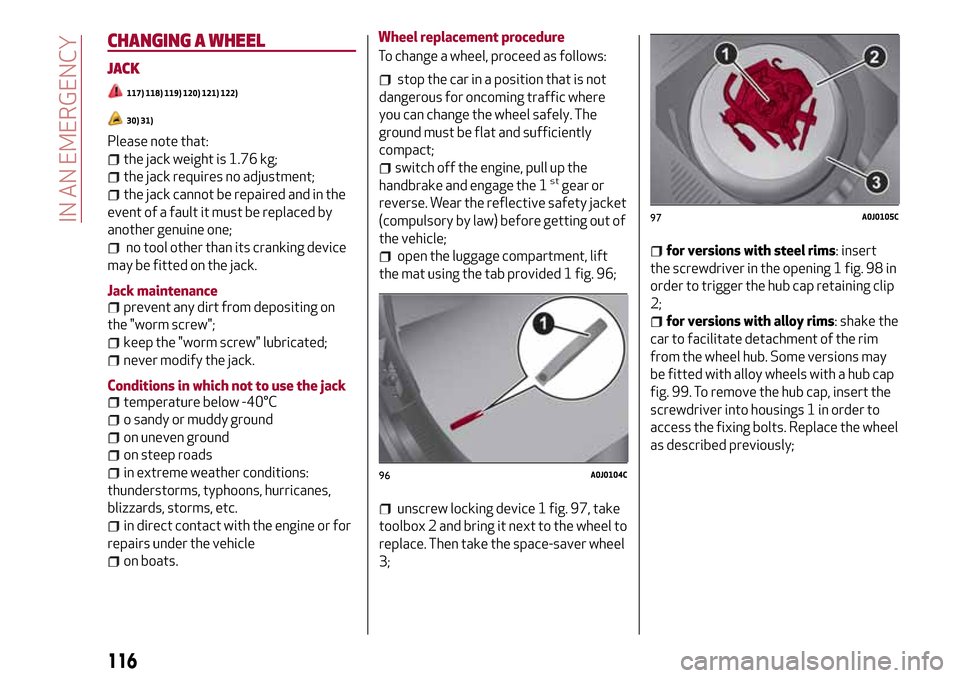
open the luggage compartment, lift
the mat using the tab provided 1 fig. 96;
unscrew locking device 1 fig. 97, take
toolbox 2 and bring it next to the wheel to
replace. Then take the space-saver wheel
3;
for versions with steel rims: insert
the screwdriver in the opening 1 fig. 98 in
order to trigger the hub cap retaining clip
2;
for versions with alloy rims: shake the
car to facilitate detachment of the rim
from the wheel hub. Some versions may
be fitted with alloy wheels with a hub cap
fig. 99. To remove the hub cap, insert the
screwdriver into housings 1 in order to
access the fixing bolts. Replace the wheel
as described previously;
96A0J0104C
97A0J0105C
116
IN AN EMERGENCY