lock Alfa Romeo MiTo 2017 Owner's Guide
[x] Cancel search | Manufacturer: ALFA ROMEO, Model Year: 2017, Model line: MiTo, Model: Alfa Romeo MiTo 2017Pages: 212, PDF Size: 4.36 MB
Page 69 of 212
The ESC system corrects the car’s
understeer and oversteer, distributing
the brake force on the appropriate
wheels. The torque supplied by the
engine can also be reduced in order to
maintain control of the vehicle.
The ESC system comprises the active
safety systems such as: ABS, EBD, ASR,
HILL HOLDER, BRAKE ASSIST, MSR,
CBC, “ELECTRONIC Q2”, DST.
The ESC system switches on
automatically when the engine is started
and cannot be switched off.
System intervention
This is indicated by the flashing of the
warning light
on the instrument panel,
to inform the driver that the car is in
critical stability and grip conditions.
CBC (Cornering Brake Control)SYSTEM
This system acts when braking on
corners, optimising the distribution of
brake pressure on the four wheels: the
system prevents the wheels on the inside
of the corner (less affected by the weight
of the car) from locking, ensuring better
stability and direction for the car.
HILL HOLDERSYSTEM
This is an integral part of the ESC system
and facilitates starting on uphill or
downhill slopes by operating the brakes:
IMPORTANT The Hill Holder system is
not a parking brake; therefore, never
leave the car without having engaged the
handbrake, turned the engine off and
engaged first gear, so that it is parked in
safe conditions (for further information
read the "Parking" paragraph in the
"Starting and driving" chapter).
IMPORTANT There may be situations on
small gradients (less than 5%), with car
laden, in which the Hill Holder system
may not activate, causing a slight
reversing motion and increasing the risk
of collision with another vehicle or object.
The driver is, in any case, responsible for
safe driving.
“ELECTRONIC Q2”SYSTEM (“E-Q2”)
The "Electronic Q2" system intervenes
during acceleration on corners, braking
the inner drive wheel and thus increasing
the traction of the outer wheel (which
bears more of the car’s weight): the
torque is thus distributed optimally
between the drive wheels in accordance
with the driving conditions and road
surface, permitting particularly effective,
sporty driving.
WARNING
28)The ESC system cannot alter the natural
laws of physics, and cannot increase grip,
which depends on the condition of the road.
29)The ESC system cannot prevent
accidents, including those due to excessive
speed on corners, driving on low-grip
surfaces or aquaplaning.
30)The capability of the ESC system must
never be tested irresponsibly and
dangerously, in such a way as to compromise
personal safety and the safety of others.
31)For the correct operation of the ASR
system, the tyres must of necessity be the
same make and type on all wheels, in perfect
condition and, above all, of the prescribed
type and dimensions.
32)Do not take unnecessary risks, even if
your vehicle is fitted with the ESC and ASR
systems. Your driving style must always be
suited to the road conditions, visibility and
traffic. The driver is always responsible for
road safety.
33)When the ABS intervenes and you feel
the brake pedal pulsating, do not reduce the
pressure, but hold it down firmly and
confidently; in doing so you will brake in the
shortest distance possible, depending on the
current road conditions.
34)To obtain the maximum efficiency of the
braking system, a bedding-in period of about
500 km is needed: during this period it is
better to avoid sharp, repeated and
prolonged braking.
35)If the ABS intervenes, this indicates that
the grip of the tyres on the road is nearing its
limit: you must slow down to a speed
compatible with the available grip.
67
Page 72 of 212
WARNING
47)The presence of the TPMS does not
permit the driver to neglect regular checks
of the tyre pressure, including for the spare
wheel.
48)Tyre pressure must be checked with
tyres cold. Should it become necessary for
whatever reason to check pressure with
warm tyres, do not reduce pressure even
though it is higher than the prescribed value,
but repeat the check when tyres are cold.
49)Should one or more wheels be fitted
without sensors, the system will no longer be
available and, in addition to the TPMS
warning light flashing for less than one
minute before becoming constant, a warning
message will be shown on the display, until
4 wheels with sensors are fitted again.
50)The TPMS cannot warn of sudden
decreases in tyre pressure (for example
when a tyre bursts). In this case, stop the car,
braking with caution and avoiding abrupt
steering.
51)Replacing standard tyres with winter
tyres (and vice versa) requires TPMS
adjustment that must only be performed by
a dedicated Alfa Romeo Dealership.
52)Changes in outside temperature may
cause tyre pressures to vary. The TPMS
system may temporarily indicate
insufficient pressure. In this case, check the
tyre pressure when cold and, if necessary,
restore the inflation values.53)When a tyre is removed, it is advisable
to replace the rubber valve seal as well:
contact a dedicated Alfa Romeo Dealership.
Tyre and/or rim fitting/removal operations
require specific precautions; to avoid
damaging or fitting the sensors incorrectly,
tyre and/or rim fitting/removal operations
should only be carried out by specialised
staff. Contact a dedicated Alfa Romeo
Dealership.
54)Intense radio-frequency interference
may prevent the correct operation of the
TPMS. This condition will be indicated by a
message on the display. The message will
disappear automatically as soon as the
radio-frequency interference ceases to
affect the system.
55)The tyre repair kit (Fix&Go) provided
with the vehicle (for versions/markets,
where provided) is compatible with the
TPMS sensors; using sealants not equivalent
with that in the original kit may adversely
affect its operation. If sealants not
equivalent with the original one are used, it is
recommended to have the TPMS sensors
checked by a qualified repair centre.
SEAT BELTS
USING THE SEAT BELTS
56) 57) 58)
All vehicle seats are equipped with seat
belts with three anchor points and a
retractor.
The retractor mechanism operates
locking the belt in the event of sharp
braking or strong deceleration due to an
impact. This allows the belt strap to slide
freely and to adapt to the body of the
occupant. In the event of an accident, the
belt will lock reducing the risk of impact
inside the passenger compartment and
of being projected outside the vehicle.
The driver is responsible for respecting,
and ensuring that all the other occupants
of the vehicle also respect, the local laws
in force in relation to the use of the seat
belts.
Always fasten the seat belts before
setting off.
Using the seat belts
The belt should be worn keeping the
torso straight and rested against the
backrest.
To fasten the safety belts, hold the
tongue 1 fig. 43 and insert it into the
buckle 2, until it clicks into place. If the
seat belt jams during removal, let it
rewind for a short stretch, then pull it out
70
SAFETY
again without jerking.
Page 73 of 212
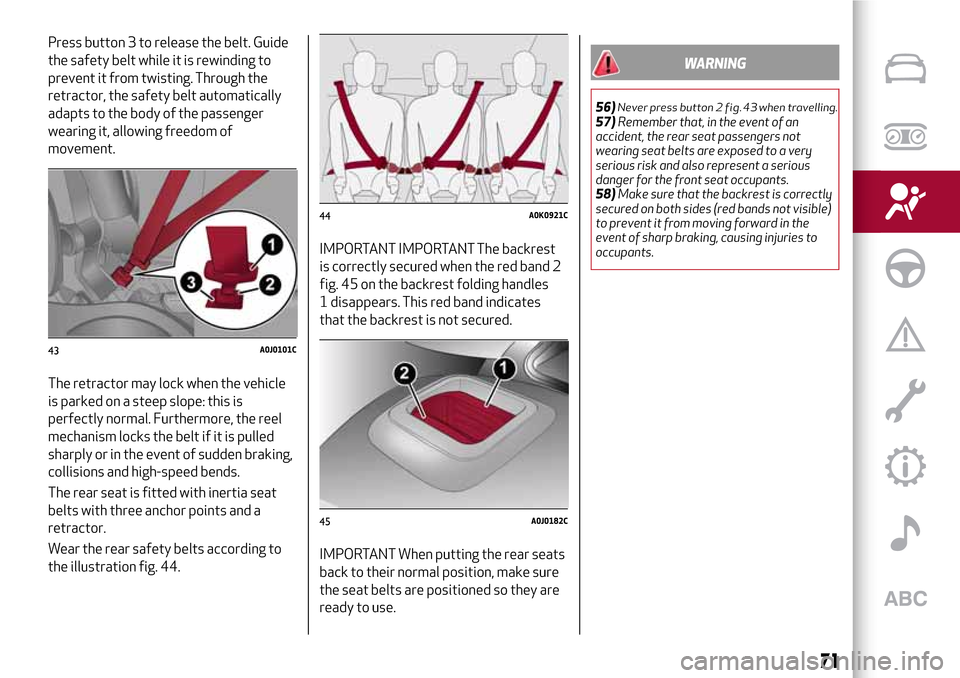
Press button 3 to release the belt. Guide
the safety belt while it is rewinding to
prevent it from twisting. Through the
retractor, the safety belt automatically
adapts to the body of the passenger
wearing it, allowing freedom of
movement.
The retractor may lock when the vehicle
is parked on a steep slope: this is
perfectly normal. Furthermore, the reel
mechanism locks the belt if it is pulled
sharply or in the event of sudden braking,
collisions and high-speed bends.
The rear seat is fitted with inertia seat
belts with three anchor points and a
retractor.
Wear the rear safety belts according to
the illustration fig. 44.
IMPORTANT IMPORTANT The backrest
is correctly secured when the red band 2
fig. 45 on the backrest folding handles
1 disappears. This red band indicates
that the backrest is not secured.
IMPORTANT When putting the rear seats
back to their normal position, make sure
the seat belts are positioned so they are
ready to use.
WARNING
56)Never press button 2 fig. 43 when travelling.57)Remember that, in the event of an
accident, the rear seat passengers not
wearing seat belts are exposed to a very
serious risk and also represent a serious
danger for the front seat occupants.
58)Make sure that the backrest is correctly
secured on both sides (red bands not visible)
to prevent it from moving forward in the
event of sharp braking, causing injuries to
occupants.
43A0J0101C
44A0K0921C
45A0J0182C
71
Page 93 of 212
IMPORTANT
17)We recommend that during the initial
period, or during the first 1600 km
(1000 miles), you do not drive to full car
performance (e.g. excessive acceleration,
long journeys at top speed, sharp braking,
etc.).
18)When the engine is switched off never
leave the ignition device in the MAR position
to prevent useless current absorption from
draining the battery.
19)A quick burst on the accelerator before
turning off the engine serves absolutely no
practical purpose; it wastes fuel and is
damaging for the engine.
20)Warning light
will flash after starting
or during prolonged cranking to indicate a
fault with the glow plug heating system. If
the engine starts, the vehicle can be regularly
used, but an Alfa Romeo Dealership must be
contacted as soon as possible.
PARKING THE VEHICLE
96) 97)
Always remove the ignition key when
leaving the car.
When parking and leaving the car,
proceed as follows:
engage a gear (1stgear if facing uphill
or reverse if facing downhill) and leave
the wheels turned;
stop the engine and engage the
handbrake.
Block the wheels with a wedge or a stone
if the car is parked on a steep slope.
On versions equipped with Alfa TCT
transmission, before releasing the brake
pedal, wait for letter P to be displayed.
IMPORTANTNEVERleave the car with
the gearbox in neutral (or, on versions
equipped with Alfa TCT transmission,
before placing the gear lever at P).
HANDBRAKE
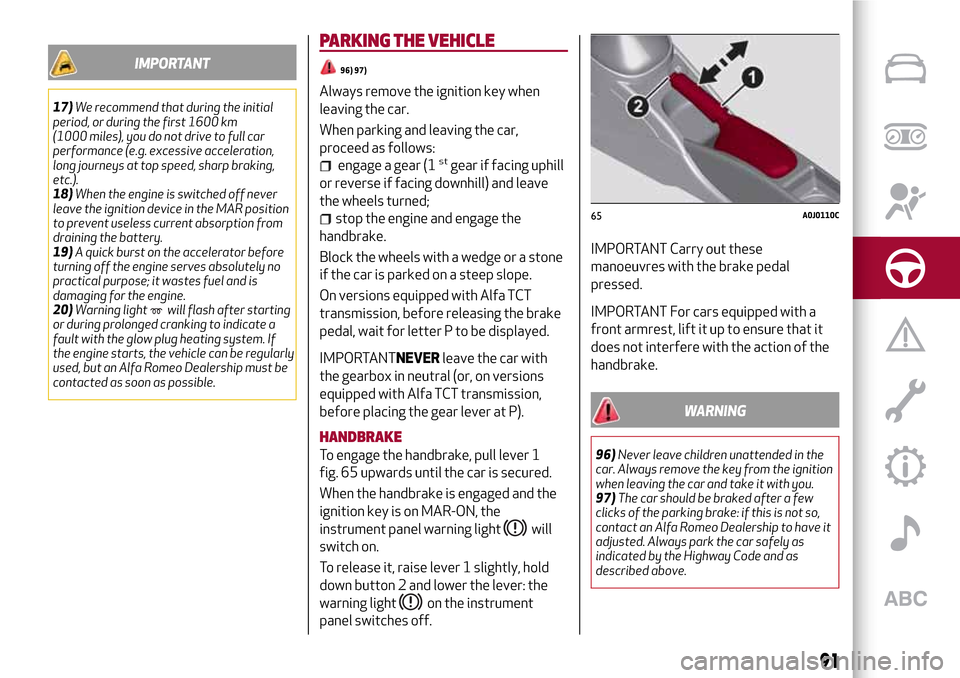
To engage the handbrake, pull lever 1
fig. 65 upwards until the car is secured.
When the handbrake is engaged and the
ignition key is on MAR-ON, the
instrument panel warning light
will
switch on.
To release it, raise lever 1 slightly, hold
down button 2 and lower the lever: the
warning light
on the instrument
panel switches off.
IMPORTANT Carry out these
manoeuvres with the brake pedal
pressed.
IMPORTANT For cars equipped with a
front armrest, lift it up to ensure that it
does not interfere with the action of the
handbrake.
WARNING
96)Never leave children unattended in the
car. Always remove the key from the ignition
when leaving the car and take it with you.
97)The car should be braked after a few
clicks of the parking brake: if this is not so,
contact an Alfa Romeo Dealership to have it
adjusted. Always park the car safely as
indicated by the Highway Code and as
described above.
65A0J0110C
91
Page 95 of 212
USING ALFA TCT
TRANSMISSION
(where provided)
SELECTOR LEVER
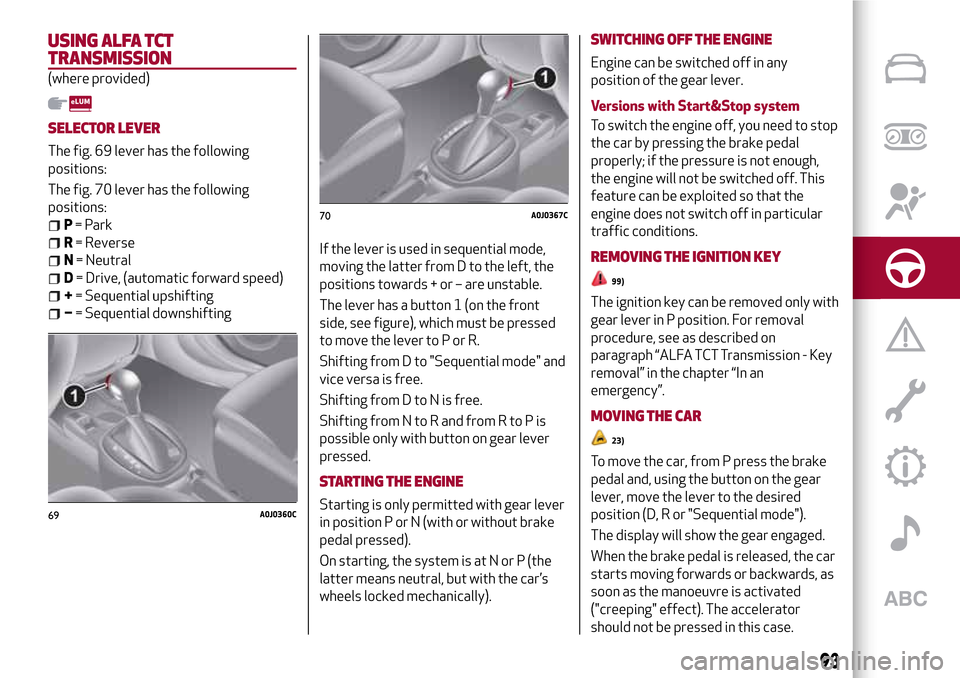
The fig. 69 lever has the following
positions:
The fig. 70 lever has the following
positions:
P= Park
R= Reverse
N= Neutral
D= Drive, (automatic forward speed)
+= Sequential upshifting
−= Sequential downshiftingIf the lever is used in sequential mode,
moving the latter from D to the left, the
positions towards + or – are unstable.
The lever has a button 1 (on the front
side, see figure), which must be pressed
to move the lever to P or R.
Shifting from D to "Sequential mode" and
vice versa is free.
Shifting from D to N is free.
Shifting from N to R and from R to P is
possible only with button on gear lever
pressed.
STARTING THE ENGINE
Starting is only permitted with gear lever
in position P or N (with or without brake
pedal pressed).
On starting, the system is at N or P (the
latter means neutral, but with the car’s
wheels locked mechanically).
SWITCHING OFF THE ENGINE
Engine can be switched off in any
position of the gear lever.
Versions with Start&Stop system
To switch the engine off, you need to stop
the car by pressing the brake pedal
properly; if the pressure is not enough,
the engine will not be switched off. This
feature can be exploited so that the
engine does not switch off in particular
traffic conditions.
REMOVING THE IGNITION KEY
99)
The ignition key can be removed only with
gear lever in P position. For removal
procedure, see as described on
paragraph “ALFA TCT Transmission - Key
removal” in the chapter “In an
emergency”.
MOVING THE CAR
23)
To move the car, from P press the brake
pedal and, using the button on the gear
lever, move the lever to the desired
position (D, R or "Sequential mode").
The display will show the gear engaged.
When the brake pedal is released, the car
starts moving forwards or backwards, as
soon as the manoeuvre is activated
("creeping" effect). The accelerator
should not be pressed in this case.
69A0J0360C
70A0J0367C
93
Page 102 of 212
INSTALLING A TOW HOOK
Contact an Alfa Romeo Dealership to
install a tow hook.
WARNING
105)The ABS with which the car is equipped
will not control the braking system of the
trailer. Particular caution is therefore
required on slippery roads.
106)Do not, under any circumstances,
modify the vehicle's braking system to
control the trailer breaking system. The
towing braking system must be completely
independent of the vehicle's hydraulic
system.
REFUELLING THE VEHICLE
During refuelling procedure, switch off
the engine, engage handbrake, rotate the
ignition key to STOP and do not smoke.
PETROL ENGINES
Only use unleaded petrol. The petrol
octane rating (RON) must not be lower
than 95. In order to prevent damage to
the catalytic converter never introduce
even the smallest amount of leaded
petrol, even in the event of an emergency.
DIESEL ENGINES
Only use diesel fuel compliant with
European specification EN590. The use
of other products or mixtures may
damage the engine beyond repair and
consequently invalidate the warranty,
due to the damage caused.
When using or parking the vehicle for a
long time in the mountains or cold areas,
it is advisable to refuel using locally
available Diesel. In this case, it is also
advisable to keep the tank over 50% full.
FUEL TANK CAP
107)
Opening
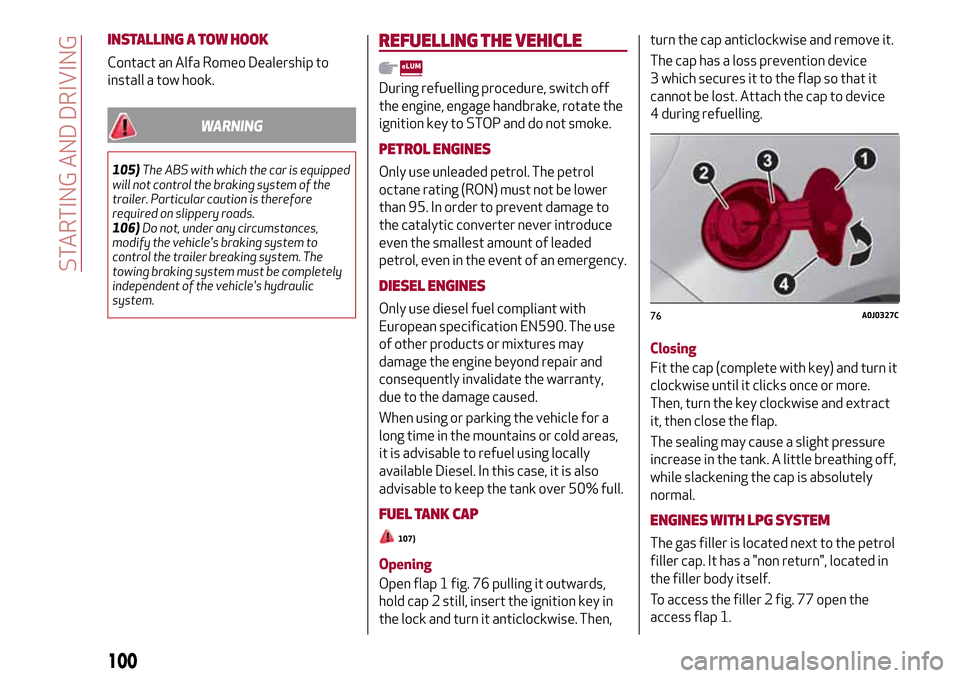
Open flap 1 fig. 76 pulling it outwards,
hold cap 2 still, insert the ignition key in
the lock and turn it anticlockwise. Then,turn the cap anticlockwise and remove it.
The cap has a loss prevention device
3 which secures it to the flap so that it
cannot be lost. Attach the cap to device
4 during refuelling.
Closing
Fit the cap (complete with key) and turn it
clockwise until it clicks once or more.
Then, turn the key clockwise and extract
it, then close the flap.
The sealing may cause a slight pressure
increase in the tank. A little breathing off,
while slackening the cap is absolutely
normal.
ENGINES WITH LPGSYSTEM
The gas filler is located next to the petrol
filler cap. It has a "non return", located in
the filler body itself.
To access the filler 2 fig. 77 open the
access flap 1.
76A0J0327C
100
STARTING AND DRIVING
Page 107 of 212
TYPES OF BULBS
The car has the following bulbs:
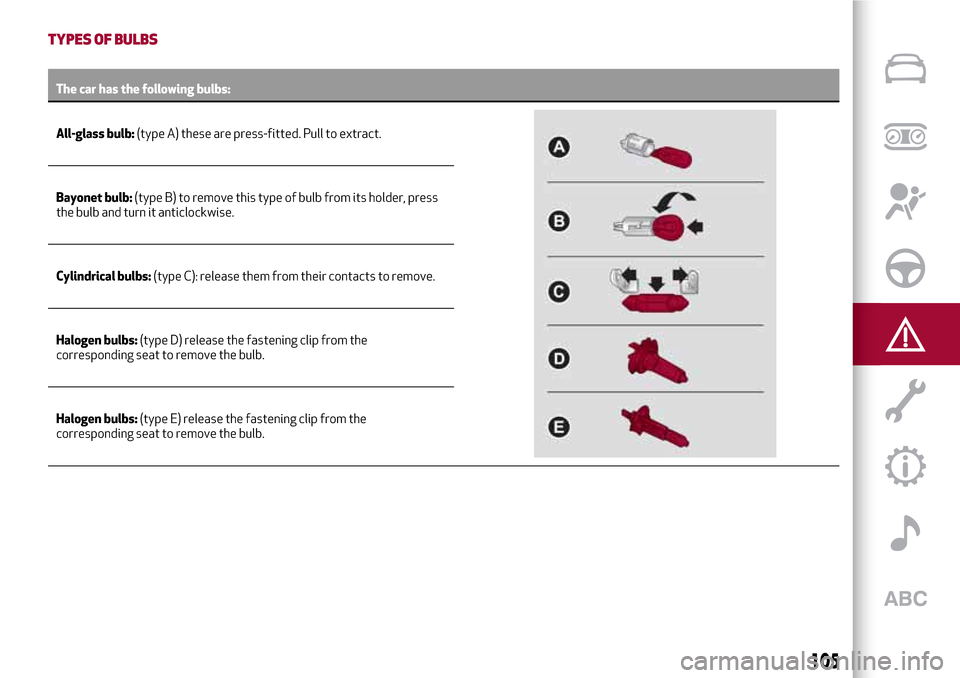
All-glass bulb:(type A) these are press-fitted. Pull to extract.
Bayonet bulb:(type B) to remove this type of bulb from its holder, press
the bulb and turn it anticlockwise.
Cylindrical bulbs:(type C): release them from their contacts to remove.
Halogen bulbs:(type D) release the fastening clip from the
corresponding seat to remove the bulb.
Halogen bulbs:(type E) release the fastening clip from the
corresponding seat to remove the bulb.
105
Page 110 of 212
REPLACING AN EXTERIOR BULB
FRONT LIGHT CLUSTERS
These contain the bulbs for the side
lights/daytime running lights (DRL),
dipped beams, main beams and direction
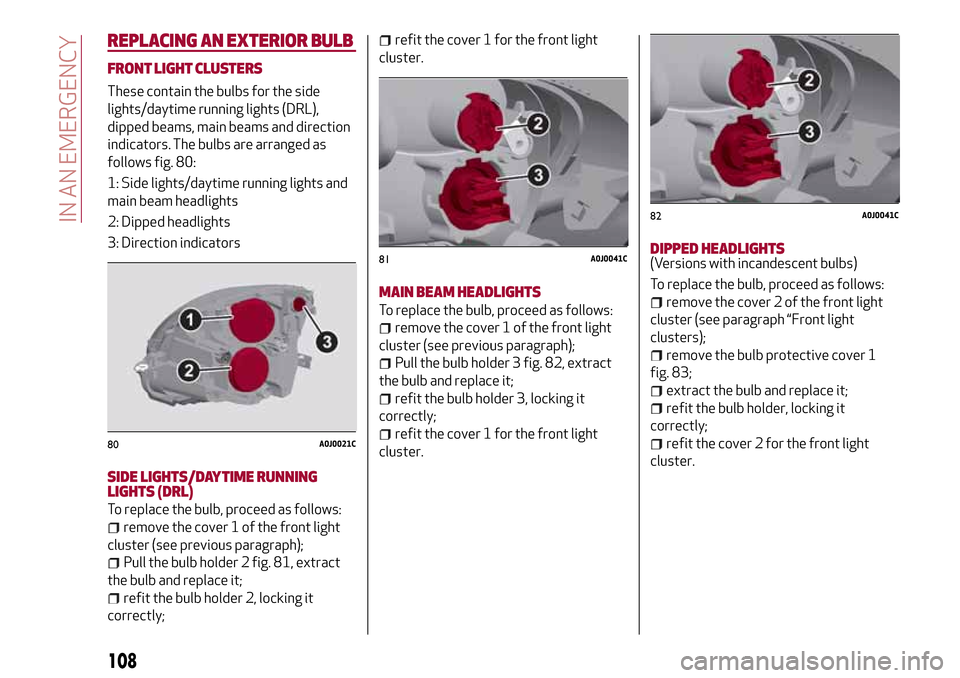
indicators. The bulbs are arranged as
follows fig. 80:
1: Side lights/daytime running lights and
main beam headlights
2: Dipped headlights
3: Direction indicators
SIDE LIGHTS/DAYTIME RUNNING
LIGHTS (DRL)
To replace the bulb, proceed as follows:
remove the cover 1 of the front light
cluster (see previous paragraph);
Pull the bulb holder 2 fig. 81, extract
the bulb and replace it;
refit the bulb holder 2, locking it
correctly;
refit the cover 1 for the front light
cluster.
MAIN BEAM HEADLIGHTS
To replace the bulb, proceed as follows:
remove the cover 1 of the front light
cluster (see previous paragraph);
Pull the bulb holder 3 fig. 82, extract
the bulb and replace it;
refit the bulb holder 3, locking it
correctly;
refit the cover 1 for the front light
cluster.
DIPPED HEADLIGHTS(Versions with incandescent bulbs)
To replace the bulb, proceed as follows:
remove the cover 2 of the front light
cluster (see paragraph “Front light
clusters);
remove the bulb protective cover 1
fig. 83;
extract the bulb and replace it;
refit the bulb holder, locking it
correctly;
refit the cover 2 for the front light
cluster.80A0J0021C
81A0J0041C
82A0J0041C
108
IN AN EMERGENCY
Page 111 of 212
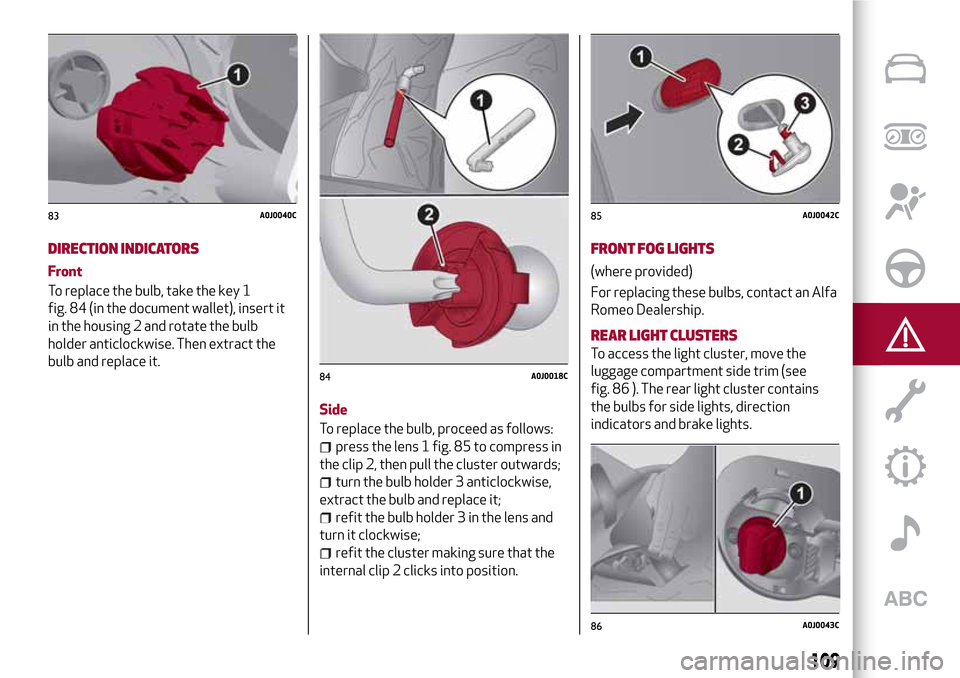
DIRECTION INDICATORS
Front
To replace the bulb, take the key 1
fig. 84 (in the document wallet), insert it
in the housing 2 and rotate the bulb
holder anticlockwise. Then extract the
bulb and replace it.
Side
To replace the bulb, proceed as follows:
press the lens 1 fig. 85 to compress in
the clip 2, then pull the cluster outwards;
turn the bulb holder 3 anticlockwise,
extract the bulb and replace it;
refit the bulb holder 3 in the lens and
turn it clockwise;
refit the cluster making sure that the
internal clip 2 clicks into position.
FRONT FOG LIGHTS
(where provided)
For replacing these bulbs, contact an Alfa
Romeo Dealership.
REAR LIGHT CLUSTERS
To access the light cluster, move the
luggage compartment side trim (see
fig. 86 ). The rear light cluster contains
the bulbs for side lights, direction
indicators and brake lights.
83A0J0040C
84A0J0018C
85A0J0042C
86A0J0043C
109
Page 112 of 212
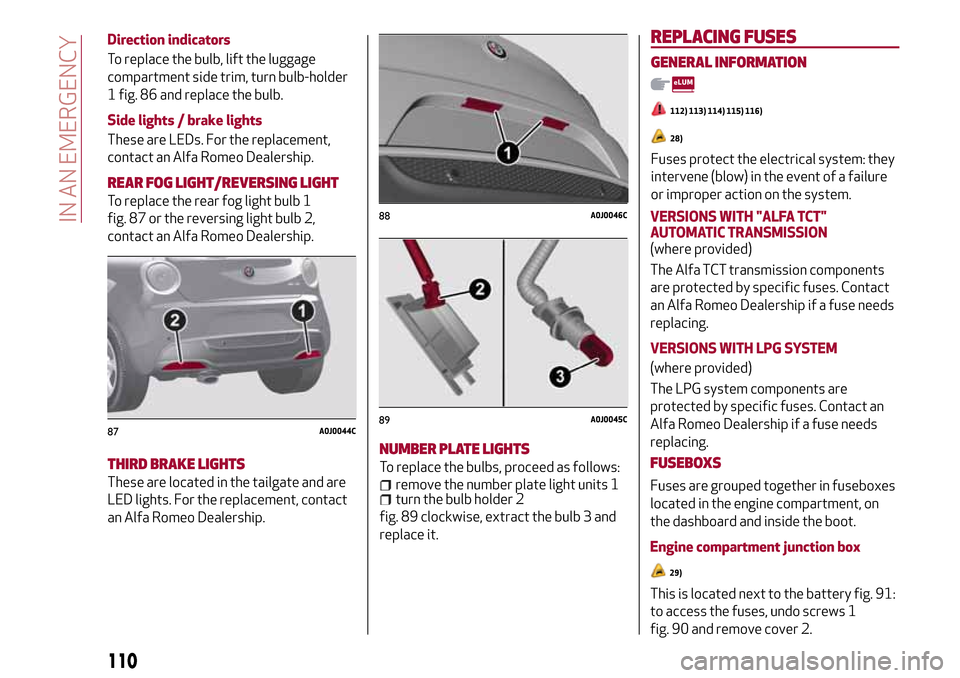
Direction indicators
To replace the bulb, lift the luggage
compartment side trim, turn bulb-holder
1 fig. 86 and replace the bulb.
Side lights / brake lights
These are LEDs. For the replacement,
contact an Alfa Romeo Dealership.
REAR FOG LIGHT/REVERSING LIGHT
To replace the rear fog light bulb 1
fig. 87 or the reversing light bulb 2,
contact an Alfa Romeo Dealership.
THIRD BRAKE LIGHTS
These are located in the tailgate and are
LED lights. For the replacement, contact
an Alfa Romeo Dealership.
NUMBER PLATE LIGHTS
To replace the bulbs, proceed as follows:
remove the number plate light units 1turn the bulb holder 2
fig. 89 clockwise, extract the bulb 3 and
replace it.
REPLACING FUSES
GENERAL INFORMATION
112) 113) 114) 115) 116)
28)
Fuses protect the electrical system: they
intervene (blow) in the event of a failure
or improper action on the system.
VERSIONS WITH "ALFA TCT"
AUTOMATIC TRANSMISSION
(where provided)
The Alfa TCT transmission components
are protected by specific fuses. Contact
an Alfa Romeo Dealership if a fuse needs
replacing.
VERSIONS WITH LPGSYSTEM
(where provided)
The LPG system components are
protected by specific fuses. Contact an
Alfa Romeo Dealership if a fuse needs
replacing.
FUSEBOXS
Fuses are grouped together in fuseboxes
located in the engine compartment, on
the dashboard and inside the boot.
Engine compartment junction box
29)
This is located next to the battery fig. 91:
to access the fuses, undo screws 1
fig. 90 and remove cover 2.
87A0J0044C
88A0J0046C
89A0J0045C
110
IN AN EMERGENCY