cooling Alfa Romeo Stelvio 2018 User Guide
[x] Cancel search | Manufacturer: ALFA ROMEO, Model Year: 2018, Model line: Stelvio, Model: Alfa Romeo Stelvio 2018Pages: 276, PDF Size: 5.79 MB
Page 226 of 276
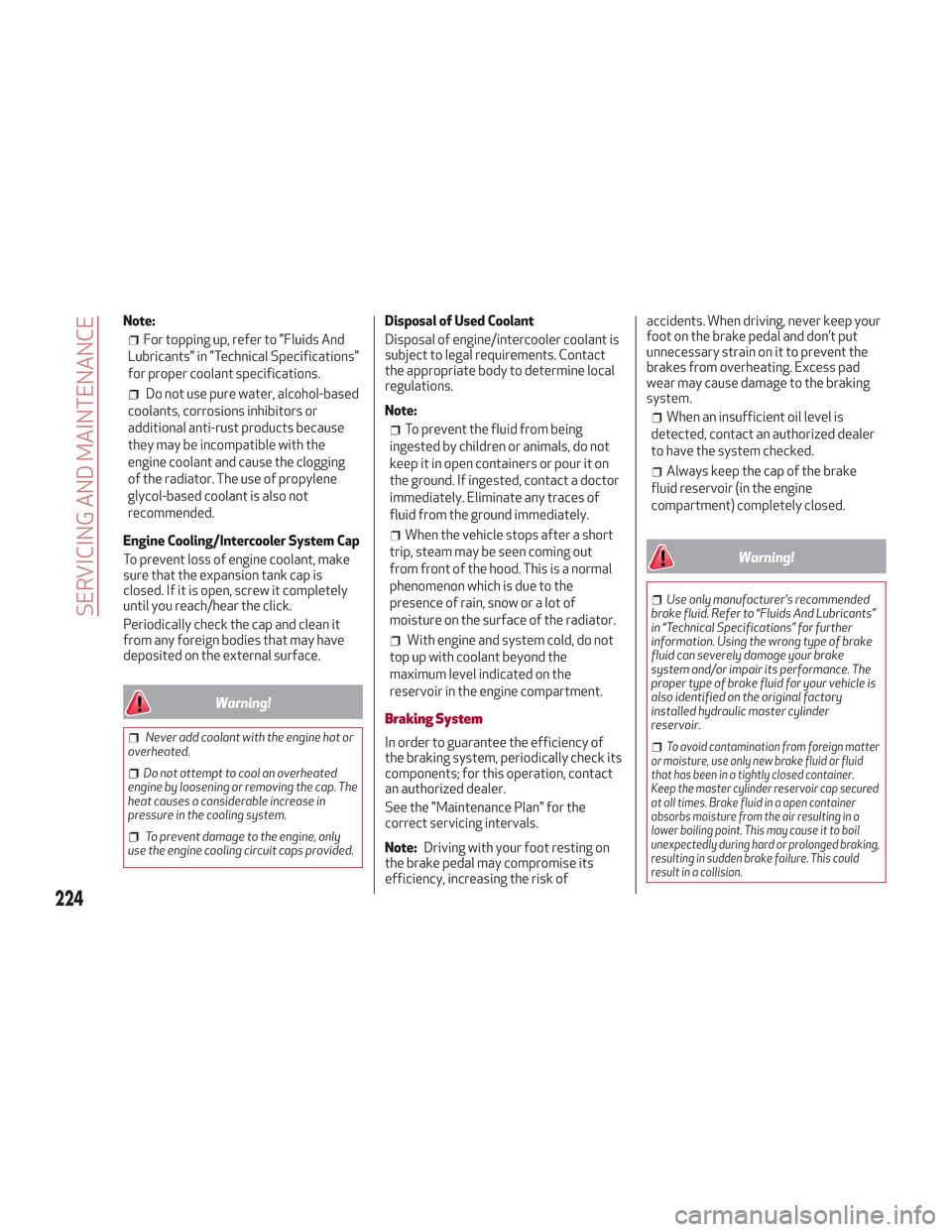
Note:
For topping up, refer to "Fluids And
Lubricants" in "Technical Specifications"
for proper coolant specifications.
Do not use pure water, alcohol-based
coolants, corrosions inhibitors or
additional anti-rust products because
they may be incompatible with the
engine coolant and cause the clogging
of the radiator. The use of propylene
glycol-based coolant is also not
recommended.
Engine Cooling/Intercooler System Cap
To prevent loss of engine coolant, make
sure that the expansion tank cap is
closed. If it is open, screw it completely
until you reach/hear the click.
Periodically check the cap and clean it
from any foreign bodies that may have
deposited on the external surface.
Warning!
Never add coolant with the engine hot or
overheated.
Do not attempt to cool an overheated
engine by loosening or removing the cap. The
heat causes a considerable increase in
pressure in the cooling system.
To prevent damage to the engine, only
use the engine cooling circuit caps provided.
Disposal of Used Coolant
Disposal of engine/intercooler coolant is
subject to legal requirements. Contact
the appropriate body to determine local
regulations.
Note:
To prevent the fluid from being
ingested by children or animals, do not
keep it in open containers or pour it on
the ground. If ingested, contact a doctor
immediately. Eliminate any traces of
fluid from the ground immediately.
When the vehicle stops after a short
trip, steam may be seen coming out
from front of the hood. This is a normal
phenomenon which is due to the
presence of rain, snow or a lot of
moisture on the surface of the radiator.
With engine and system cold, do not
top up with coolant beyond the
maximum level indicated on the
reservoir in the engine compartment.
Braking System
In order to guarantee the efficiency of
the braking system, periodically check its
components; for this operation, contact
an authorized dealer.
See the "Maintenance Plan" for the
correct servicing intervals.
Note: Driving with your foot resting on
the brake pedal may compromise its
efficiency, increasing the risk of accidents. When driving, never keep your
foot on the brake pedal and don’t put
unnecessary strain on it to prevent the
brakes from overheating. Excess pad
wear may cause damage to the braking
system.
When an insufficient oil level is
detected, contact an authorized dealer
to have the system checked.
Always keep the cap of the brake
fluid reservoir (in the engine
compartment) completely closed.
Warning!
Use only manufacturer's recommended
brake fluid. Refer to “Fluids And Lubricants”
in “Technical Specifications” for further
information. Using the wrong type of brake
fluid can severely damage your brake
system and/or impair its performance. The
proper type of brake fluid for your vehicle is
also identified on the original factory
installed hydraulic master cylinder
reservoir.
To avoid contamination from foreign matter
or moisture, use only new brake fluid or fluid
that has been in a tightly closed container.
Keep the master cylinder reservoir cap secured
at all times. Brake fluid in a open container
absorbs moisture from the air resulting in a
lower boiling point. This may cause it to boil
unexpectedly during hard or prolonged braking,
resulting in sudden brake failure. This could
result in a collision.
224
SERVICING AND MAINTENANCE
Page 244 of 276
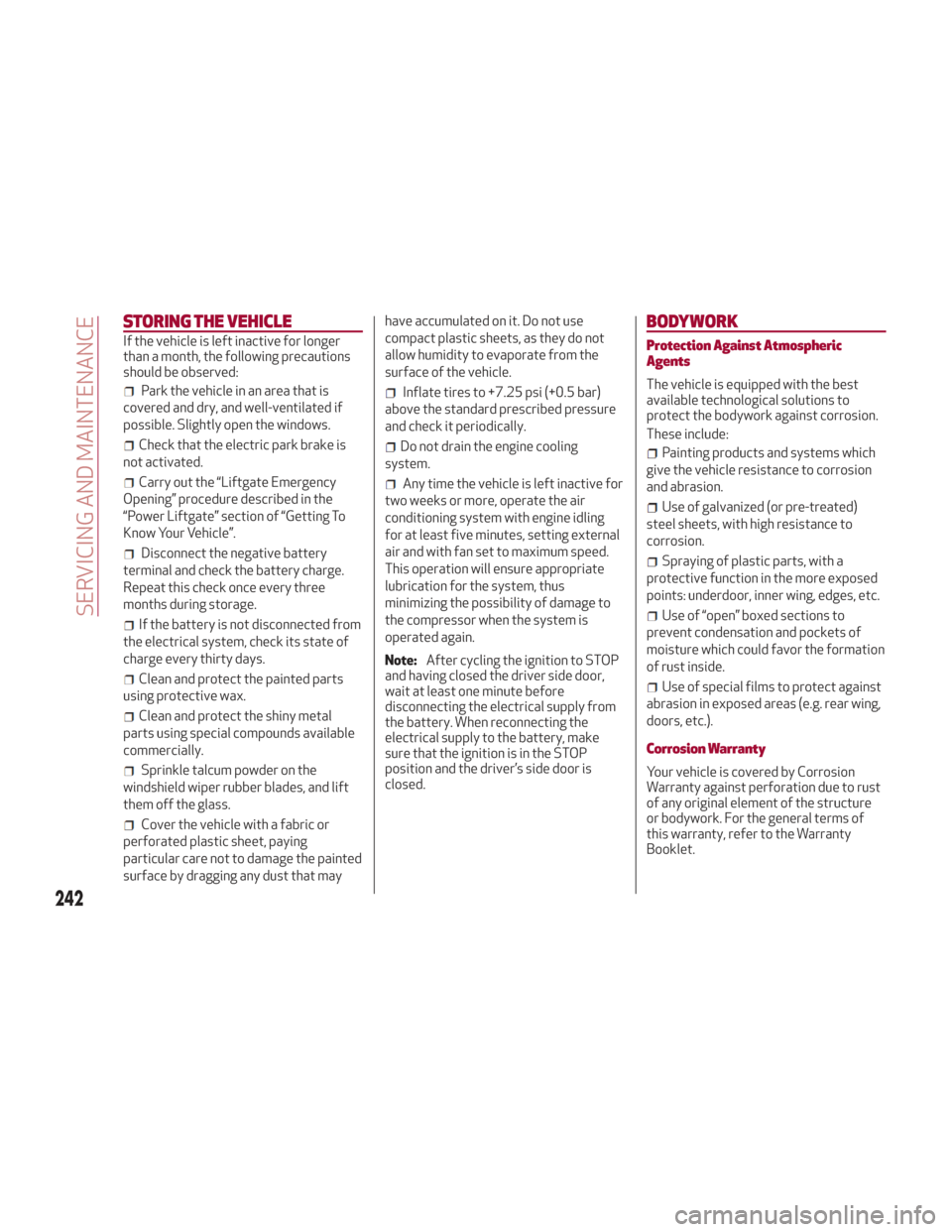
STORING THE VEHICLE
If the vehicle is left inactive for longer
than a month, the following precautions
should be observed:
Park the vehicle in an area that is
covered and dry, and well-ventilated if
possible. Slightly open the windows.
Check that the electric park brake is
not activated.
Carry out the “Liftgate Emergency
Opening” procedure described in the
“Power Liftgate” section of “Getting To
Know Your Vehicle”.
Disconnect the negative battery
terminal and check the battery charge.
Repeat this check once every three
months during storage.
If the battery is not disconnected from
the electrical system, check its state of
charge every thirty days.
Clean and protect the painted parts
using protective wax.
Clean and protect the shiny metal
parts using special compounds available
commercially.
Sprinkle talcum powder on the
windshield wiper rubber blades, and lift
them off the glass.
Cover the vehicle with a fabric or
perforated plastic sheet, paying
particular care not to damage the painted
surface by dragging any dust that may have accumulated on it. Do not use
compact plastic sheets, as they do not
allow humidity to evaporate from the
surface of the vehicle.
Inflate tires to +7.25 psi (+0.5 bar)
above the standard prescribed pressure
and check it periodically.
Do not drain the engine cooling
system.
Any time the vehicle is left inactive for
two weeks or more, operate the air
conditioning system with engine idling
for at least five minutes, setting external
air and with fan set to maximum speed.
This operation will ensure appropriate
lubrication for the system, thus
minimizing the possibility of damage to
the compressor when the system is
operated again.
Note: After cycling the ignition to STOP
and having closed the driver side door,
wait at least one minute before
disconnecting the electrical supply from
the battery. When reconnecting the
electrical supply to the battery, make
sure that the ignition is in the STOP
position and the driver’s side door is
closed.
BODYWORK
Protection Against Atmospheric
Agents
The vehicle is equipped with the best
available technological solutions to
protect the bodywork against corrosion.
These include:
Painting products and systems which
give the vehicle resistance to corrosion
and abrasion.
Use of galvanized (or pre-treated)
steel sheets, with high resistance to
corrosion.
Spraying of plastic parts, with a
protective function in the more exposed
points: underdoor, inner wing, edges, etc.
Use of “open” boxed sections to
prevent condensation and pockets of
moisture which could favor the formation
of rust inside.
Use of special films to protect against
abrasion in exposed areas (e.g. rear wing,
doors, etc.).
Corrosion Warranty
Your vehicle is covered by Corrosion
Warranty against perforation due to rust
of any original element of the structure
or bodywork. For the general terms of
this warranty, refer to the Warranty
Booklet.
242
SERVICING AND MAINTENANCE
Page 259 of 276
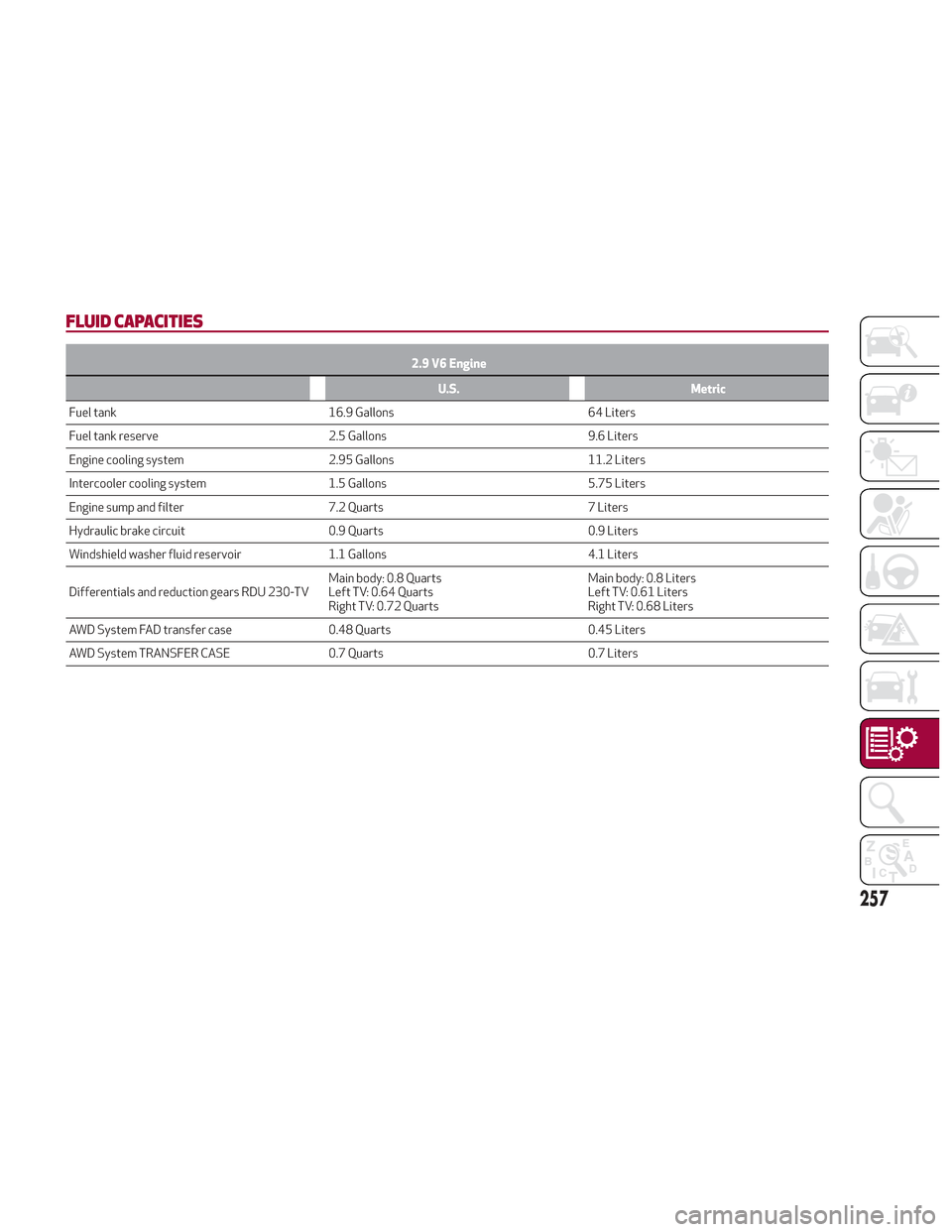
FLUID CAPACITIES
2.9 V6 EngineU.S. Metric
Fuel tank 16.9 Gallons64 Liters
Fuel
tank reserve 2.5 Gallons 9.6 Liters
Engine cooling system 2.95 Gallons11.2 Liters
Intercooler cooling system 1.5 Gallons5.75 Liters
Engine sump and filter 7.2 Quarts7 Liters
Hydraulic brake circuit 0.9 Quarts0.9 Liters
Windshield washer fluid reservoir 1.1 Gallons4.1 Liters
Differentials and reduction gears RDU 230-TV Main body: 0.8 Quarts
Left TV: 0.64 Quarts
Right TV: 0.72 QuartsMain body: 0.8 Liters
Left TV: 0.61 Liters
Right TV: 0.68 Liters
AWD System FAD transfer case 0.48 Quarts0.45 Liters
AWD System TRANSFER CASE 0.7 Quarts0.7 Liters
257
Page 270 of 276
Cooling SystemCoolant Capacity ...........257
Selection Of Coolant (Antifreeze) ..................... .257
Courtesy Mirror Light (Bulb Replacement) .............191
Cruise Control (Speed Control) . . . .166
Cupholder ..................67
Cupholders .................67
Customer Assistance ..........262
Daytime Running Lights ..........39
Daytime Running Lights (DRL) ......39
Defroster, Windshield ..........142
Dimensions ............... .253
Direction Indicators (Changing A Bulb) .................. .191
Disabled Vehicle Towing .........204
Door Light ..................43
Door Locks Child-Protection Door Lock —
Rear Doors ................27
Power Door Locks ...........27
Doors .....................23
Drive Train Control (DTC) System . . .104
Driving Modes ............. .158
Dynamic Steering Torque (DST) System ................ .107
Electric Park Brake ............149
Electric Remote Mirrors .........37Electric Steering Wheel Heating
.....37
Electronic Speed Control ........164
Electronic Speed Control (Cruise Control) ............. .164,166
Electronic Stability Control (ESC) System ................ .105
Emergency, In Case Of ..........198
Hazard Warning Flasher .......188
Jacking ................ .225
Jump Starting .............201
Overheating ............. .203
Towing ..............204,206
Emission Control System Maintenance ............. .101
Engine .................. .247
Block Heater ............. .149
Engine Coolant Level ........
.216
Exhaust
Gas Caution .........141
Fuel Requirements ..........255
Jump Starting .............201
Oil................... .257
Oil Selection ............. .257
Overheating ............. .203
Starting ............... .203
Engine Compartment ..........215
Engine Compartment (Washing) . . . .244
Engine Oil Level Check ............. .216
Engine Overheating ...........203 Enhanced Accident Response
Feature ..............129,207
Ethanol .................. .255
Exhaust Gas Caution ...........141
Exhaust System .............141
Exterior Lighting ............38,40
Exterior Lights ............38,143
Flashers Hazard Warning ............188
Turn Signal ............41,143
Fluid Capacities ..............257
Fluid Leaks ............... .143
Fluids And Lubricants ..........258
Forward Collision Warning (System) .110
Front Light Cluster With Main Beam Xenon Gas Discharge Headlights
(Bulb Replacement) ..........191
Front Seat Electric Heating .......31
Front Seats (Power Adjustment) ....29
Front Wipers Wiper Operation ............45
Fuel Additives ............... .256
Clean Air ............... .255
Ethanol ................ .255
Materials Added ...........256
Methanol ............... .255
Tank Capacity .............257
INDEX