Fuel System Alfa Romeo Stelvio 2018 Owner's Guide
[x] Cancel search | Manufacturer: ALFA ROMEO, Model Year: 2018, Model line: Stelvio, Model: Alfa Romeo Stelvio 2018Pages: 276, PDF Size: 5.79 MB
Page 164 of 276
System Activation
The activation of the system is indicated
by the
symbol lighting up on the
display. In this condition, the light on the
button is off.
System Deactivation
A message will appear on the display
when the system is deactivated. In this
condition, the light on the button is on.
Note: Each time the engine is started,
the system is activated regardless of
where was when it was previously
switched off.
Possible Reasons The Engine Does Not
Autostop
For higher comfort and increased safety,
and to reduce emissions, there are
certain conditions where the engine will
not autostop despite the system being
active, such as:
Engine still cold.
Especially cold outside temperature.
Battery not sufficiently charged.
Driver's door not shut.
Driver's seat belt not fastened.
Reverse gear engaged (e.g. for parking
maneuvers).
With the automatic climate control
active, an adequate cabin heating or
cooling comfort has not been reached or
with MAX-DEF function active.
During the first period of use, to
initialize the system.
Steering angle beyond threshold.
Engine Restarting Conditions
Due to comfort, emission control, and
safety reasons, the engine can restart
automatically without any action by the
driver, under special conditions, such as:
Battery not sufficiently charged.
Reduced braking system vacuum (e.g.
if the brake pedal is pressed repeatedly).
Vehicle moving (e.g. when driving on
roads with a grade).
Engine stopping by the Stop/Start
system for more than approx. three
minutes.
With the automatic climate control
active, an adjustment in cabin heating or
cooling is made or with MAX-DEF
function active.
Safety Functions
When the engine is stopped through the
Stop/Start system, if the driver releases
their seat belt, opens the driver's or
passenger's door, or opens the hood from
inside the vehicle, the engine can be
restarted only by using the ignition.
This condition is indicated to the driver
both through a buzzer and a message on
the instrument cluster display.
Energy Saving Function
If the driver does not carry out any action
for more than three minutes after the
automatic engine restart, the Start/Stop
system will switch off the engine in order
to prevent fuel consumption.
In this situation, the engine can only be
restarted using the ignition device.
Note: It is possible to keep the engine
running by deactivating the system.
Irregular Operation
In the event of malfunction, the
Stop/Start system is deactivated.
For failure indications, refer to "Warning
Lights and Messages" paragraph in
"Getting To Know Your Instrument Panel".
Vehicle Inactivity
In the event of vehicle inactivity (or if the
battery is replaced), special attention
must be paid to the disconnection of the
battery power supply.
Proceed as follows:
Remove connector from socket to
disconnect sensor (battery status
monitoring) installed on the negative pole
of the battery. This sensor should never
be disconnected from the pole except if
the battery is replaced.
162
STARTING AND OPERATING
Page 182 of 276
The table below shows the approximate
distances for each area:
AreaDistance From The
Rear Of The Vehicle
Red 0–11.8
inches
(0–30 cm)
Yellow 11.8 inches to 3.3 feet
(30cm–1m)
Green 3.3feetormore(1m
or more)
Messages On The Display
If the liftgate is opened, the camera will
not detect any obstacle behind the
vehicle. The display will show a dedicated
warning message.
Make sure the liftgate is closed by
pushing next to the lock until it clicks.
Important Notes
Ice, snow or mud on the surface of the
camera may reduce its sensitivity. It is
important to keep the camera surface
clean, and free from debris.
When parking, be aware of obstacles
that may be above or below the camera
range.
REFUELING THE VEHICLE
Refueling The Vehicle
Before refueling, make sure that the fuel
type is correct.
Also, stop the engine before refueling.
Note: An inefficient catalytic converter
leads to harmful exhaust emissions, thus
contributing to air pollution.
Caution!
Never introduce leaded fuel to the tank,
even in small amounts in an emergency, as
this would damage the catalytic converter
beyond repair.
Refueling Capacity
To ensure that you fill the tank
completely, top off twice after the first
click of the fuel nozzle.
Further top-off could cause faults in the
fuel feeding system.
Refueling Procedure
The fuel filler door is unlocked when the
central door locking system is unlocked.
It is automatically locked when the
central locking system is applied. Opening The Fuel Filler Door
To refuel proceed as follows:
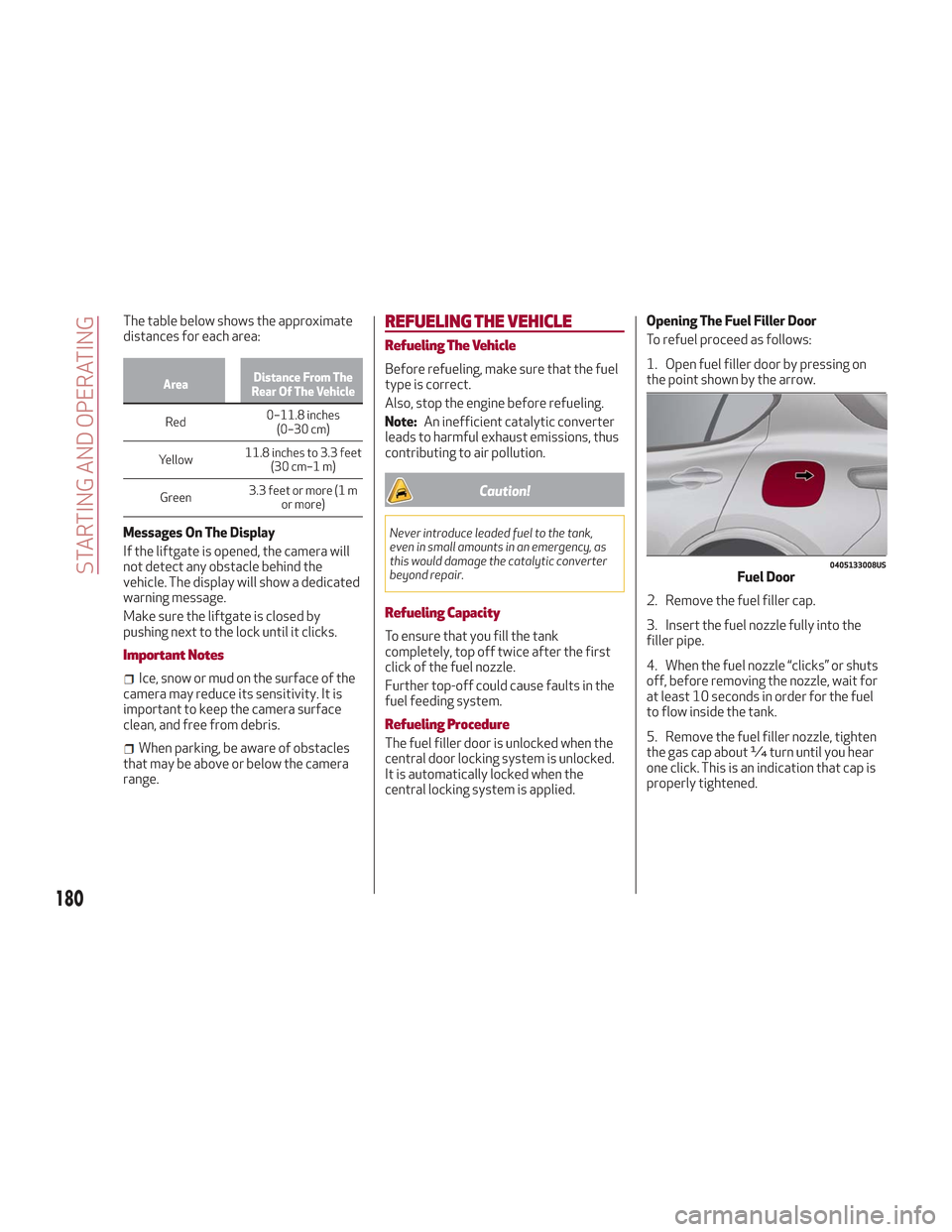
1. Open fuel filler door by pressing on
the point shown by the arrow.
2. Remove the fuel filler cap.
3. Insert the fuel nozzle fully into the
filler pipe.
4. When the fuel nozzle “clicks” or shuts
off, before removing the nozzle, wait for
at least 10 seconds in order for the fuel
to flow inside the tank.
5. Remove the fuel filler nozzle, tighten
the gas cap about ¼ turn until you hear
one click. This is an indication that cap is
properly tightened.
0405133008USFuel Door
180
STARTING AND OPERATING
Page 184 of 276
Warning!
Never have any smoking materials lit in or
near the vehicle when the fuel door is open
or the tank is being filled.
Never add fuel when the engine is running.
This is in violation of most state and federal
fire regulations and may cause the MIL to
turn on.
A fire may result if gasoline is pumped
into a portable container that is inside of a
vehicle. You could be burned. Always place
gas containers on the ground while filling.
Note: If the filler compartment is
washed with a pressure washer, keep it at
a distance of at least 8 inches (20 cm).
VEHICLE LOADING
Certification Label
As required by National Highway Traffic
Safety Administration regulations, your
vehicle has a certification label affixed to
the driver's side door or pillar.
This label contains the month and year of
manufacture, Gross Vehicle Weight
Rating (GVWR), Gross Axle Weight Rating
(GAWR) front and rear, and Vehicle
Identification Number (VIN). A
Month-Day-Hour (MDH) number is
included on this label and indicates the
Month, Day and Hour of manufacture. The
bar code that appears on the bottom of
the label is your VIN.
Gross Vehicle Weight Rating
(GVWR)
The GVWR is the total permissible
weight of your vehicle including driver,
passengers, vehicle, options and cargo.
The label also specifies maximum
capacities of front and rear axle systems
(GAWR). Total load must be limited so
GVWR and front and rear GAWR are not
exceeded.
Payload
The payload of a vehicle is defined as the
allowable load weight a truck can carry,
including the weight of the driver, all
passengers, options and cargo.
Gross Axle Weight Rating (GAWR)
The GAWR is the maximum permissible
load on the front and rear axles. The load
must be distributed in the cargo area so
that the GAWR of each axle is not
exceeded.
Each axle GAWR is determined by the
components in the system with the
lowest load carrying capacity (axle,
springs, tires or wheels). Heavier axles or
suspension components sometimes
specified by purchasers for increased
durability does not necessarily increase
the vehicle's GVWR.
Tire Size
The tire size on the Vehicle Certification
Label represents the actual tire size on
your vehicle. Replacement tires must be
equal to the load capacity of this tire size.
Rim Size
This is the rim size that is appropriate for
the tire size listed.
Inflation Pressure
This is the cold tire inflation pressure for
your vehicle for all loading conditions up
to full GAWR.
182
STARTING AND OPERATING
Page 186 of 276
Electric Devices
Use electrical systems only for the
amount of time needed. The rear window
defroster, additional headlights,
windshield wipers and heater blower fan
require a considerable amount of energy;
increasing the current uptake increases
fuel consumption (by up to +25% when
city driving).
Climate Control System
Using the climate control system will
increase consumption: use standard
ventilation when the temperature
outside permits.
Devices For Aerodynamic Control
The use of non-certified devices for
aerodynamic control may adversely
affect air drag and consumption levels.
Driving Style
Starting
Do not warm up the engine at low or high
revs when the vehicle is stationary; this
causes the engine to warm up more
slowly, thereby increasing fuel
consumption and emissions. It is
therefore advisable to drive off
immediately, slowly, avoiding high
speeds: by doing this the engine will
warm up more quickly.Unnecessary Actions
Avoid revving up when starting at traffic
lights or before stopping the engine. This
action is unnecessary and causes
increased fuel consumption and
pollution.
Gear Selection
Use a high gear when traffic and road
conditions allow it. Using a low gear for
faster acceleration will increase fuel
consumption. Improper use of a high gear
increases consumption, emissions and
engine wear.
Max. Speed
Fuel consumption considerably increases
as speed increases. Maintain a constant
speed, avoiding unnecessary braking and
acceleration, which cost in terms of both
fuel consumption and emissions.
Acceleration
Accelerating violently severely affects
consumption and emissions: acceleration
should be gradual and should not exceed
the maximum torque.
Conditions Of Use
Cold Starting
Short trips and frequent cold starts will
not allow the engine to reach optimum
operating temperature. This results in a
significant increase in consumption
levels (from +15 to +30% in city driving)
and emissions.Traffic And Road Conditions
High fuel consumption is caused by heavy
traffic, for instance when travelling in
traffic with frequent use of low gears or
in cities with many traffic lights. Winding
mountain roads and rough road surfaces
also adversely affect consumption.
Stops In Traffic
During prolonged stops (e.g. railway
crossings), turn off the engine.
Performance
This vehicle is equipped with an engine
capable of delivering exceptionally fast
acceleration and speed:
Peak power: 505 HP at 6500 rpm.
Peak torque: 443 ft-lbs at
2500–5000 rpm.
Top speed: 177 mph (285 km/h).
Acceleration from 0 to 60 mph (0 to
100 km/h): 3.9 seconds.
For safe driving, it is essential,
particularly during the first days of use,
to get to know the car by driving carefully
and gradually discovering its
performance.
184
STARTING AND OPERATING
Page 213 of 276
Heavy Usage Of The Vehicle
If the vehicle is used under one of the following conditions:
Dusty roads.
Short, repeated journeys less than 4 miles (7-8 km) at sub-zero outside temperatures.
Engine often idling or driving long distances at low speeds or long periods of inactivity.
In the event of a long period of inactivity.
The following checks must be carried out more often than indicated in the Scheduled Servicing Plan:
Check cleanliness of hood and liftgate locks, cleanliness and lubrication of linkage.
Visually inspect conditions of: engine, transmission, pipes and hoses (exhaust/fuel system/brakes) and rubber elements
(sleeves/bushes, etc.).
Check battery charge and battery fluid level (electrolyte).
Visually inspect conditions of the accessory drive belts.
Check and, if necessary, change engine oil and replace oil filter.
Check and, if necessary, replace cabin air filter.
Check and, if necessary, replace air cleaner.
Severe Duty All Models
Change Engine Oil at 4,000 miles (6,500 km) if the vehicle is operated in a dusty and off-road environment or is operated
predominately at idle or only very low engine RPM’s. This type of vehicle use is considered Severe Duty.
211
Page 214 of 276
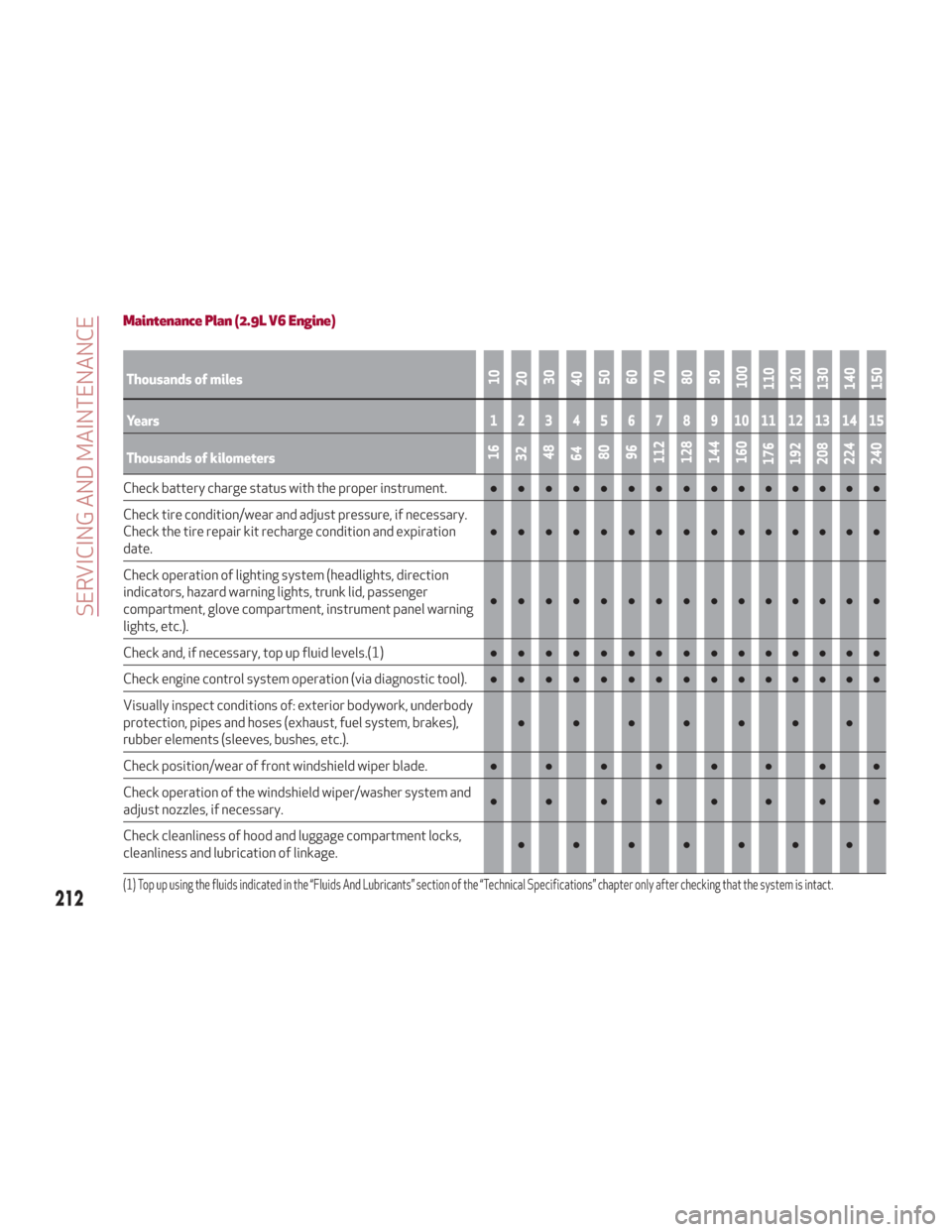
Maintenance Plan (2.9L V6 Engine)
Thousands of miles10
20 30
40 50
60
70
80
90
100
110
120
130
140
150
Years123456789101112131415
Thousands of kilometers16
32 48
64 80
96
112
128
144
160
176
192
208
224
240
Check battery charge status with the proper instrument. ●●●●●●●●●●●●●●●
Check tire condition/wear and adjust pressure, if necessary.
Check the tire repair kit recharge condition and expiration
date. ●●●●●●●●●
●●●●●●
Check operation of lighting system (headlights, direction
indicators, hazard warning lights, trunk lid, passenger
compartment, glove compartment, instrument panel warning
lights, etc.). ●●●●●●●●●
●●●●●●
Check and, if necessary, top up fluid levels.
(1)●●●●●●●●● ●●●●●●
Check engine control system operation (via diagnostic tool). ●●●●●●●●●●●●●●●
Visually inspect conditions of: exterior bodywork, underbody
protection, pipes and hoses (exhaust, fuel system, brakes),
rubber elements (sleeves, bushes, etc.). ●●●●●●●
Check position/wear of front windshield wiper blade. ●●●●●●●●
Check operation of the windshield wiper/washer system and
adjust nozzles, if necessary. ●●●●●●●●
Check cleanliness of hood and luggage compartment locks,
cleanliness and lubrication of linkage. ●●●●●●●
(1) Top up using the fluids indicated in the “Fluids And Lubricants” section of the “Technical Specifications” chapter only after checking that the system is intact.
212
SERVICING AND MAINTENANCE
Page 257 of 276
FUEL REQUIREMENTS
This engine is designed
to meet all emission
regulations, and
provide satisfactory
fuel economy and
performance when
using high-quality
unleaded “Regular”
gasoline having a posted octane number
of 87 as specified by the (R+M)/
2 method. For optimal performance the
use of 91 or higher octane “Premium”
gasoline is recommended in these
engines.
While operating on gasoline with the
required octane number, hearing a light
knocking sound from the engine is not a
cause for concern. However, if the engine
is heard making a heavy knocking sound,
see your authorized dealer immediately.
Use of gasoline with a lower than
recommended octane number can cause
engine failure and may void or not be
covered by the New Vehicle Limited
Warranty.
Poor quality gasoline can cause problems
such as hard starting, stalling, and
hesitations. If you experience these
symptoms, try another brand of gasoline
before considering service for the
vehicle.
Reformulated Gasoline
Many areas of the country require the
use of cleaner burning gasoline referred
to as “Reformulated Gasoline”.
Reformulated gasoline contains
oxygenates and are specifically blended
to reduce vehicle emissions and improve
air quality.
The use of reformulated gasoline is
recommended. Properly blended
reformulated gasoline will provide
improved performance and durability of
engine and fuel system components.
Gasoline/Oxygenate Blends
Some fuel suppliers blend unleaded
gasoline with oxygenates such as
ethanol.
Caution!
DO NOT use E-85, gasoline containing
methanol, or gasoline containing more than
15% ethanol (E-15). Use of these blends
may result in starting and drivability
problems, damage critical fuel system
components, cause emissions to exceed the
applicable standard, and/or cause the
“Malfunction Indicator Light” to illuminate.
Please observe pump labels as they should
clearly communicate if a fuel contains
greater than 15% ethanol (E-15).
Problems that result from using gasoline
containing more than 15% ethanol (E-15)
or gasoline containing methanol are not the responsibility of the manufacturer
and may void or not be covered under
New Vehicle Limited Warranty.
CNG And LP Fuel System Modifications
Modifications that allow the engine to
run on compressed natural gas (CNG) or
liquid propane (LP) may result in damage
to the engine, emissions, and fuel system
components. Problems that result from
running CNG or LP are not the
responsibility of the manufacturer and
may void or not be covered under the
New Vehicle Limited Warranty.
MMT In Gasoline
Methylcyclopentadienyl Manganese
Tricarbonyl (MMT) is a manganese-
containing metallic additive that is
blended into some gasoline to increase
octane. Gasoline blended with MMT
provides no performance advantage
beyond gasoline of the same octane
number without MMT. Gasoline blended
with MMT reduces spark plug life and
reduces emissions system performance
in some vehicles. The manufacturer
recommends that gasoline without MMT
be used in your vehicle. The MMT content
of gasoline may not be indicated on the
gasoline pump; therefore, you should ask
your gasoline retailer whether the
gasoline contains MMT. MMT is
prohibited in Federal and California
reformulated gasoline.
255
Page 258 of 276
Materials Added To Fuel
Besides using unleaded gasoline with the
proper octane rating, gasolines that
contain detergents, corrosion and
stability additives are recommended.
Using gasolines that have these additives
will help improve fuel economy, reduce
emissions, and maintain vehicle
performance.Designated TOP TIER
Detergent Gasoline
contains a higher level
of detergents to
further aide in
minimizing engine and
fuel system deposits.
When available, the usage of TOP TIER
Detergent gasoline is recommended.
Visit www.toptiergas.com for a list of
TOP TIER Detergent Gasoline Retailers.
Indiscriminate use of fuel system
cleaning agents should be avoided. Many
of these materials intended for gum and
varnish removal may contain active
solvents or similar ingredients. These can
harm fuel system gasket and diaphragm
materials.
Fuel System Cautions
Caution!
Follow these guidelines to maintain your
vehicle’s performance:
The use of leaded gasoline is prohibited
by Federal law. Using leaded gasoline can
impair engine performance and damage the
emissions control system.
An out-of-tune engine or certain fuel or
ignition malfunctions can cause the
catalytic converter to overheat. If you
notice a pungent burning odor or some light
smoke, your engine may be out of tune or
malfunctioning and may require immediate
service. Contact an authorized dealer for
service assistance.
The use of fuel additives, which are now
being sold as octane enhancers, is not
recommended. Most of these products
contain high concentrations of methanol.
Fuel system damage or vehicle
performance problems resulting from the
use of such fuels or additives is not the
responsibility of the manufacturer and may
void or not be covered under the New
Vehicle Limited Warranty.
Note: Intentional tampering with the
emissions control system can result in
civil penalties being assessed against
you.
256
TECHNICAL SPECIFICATIONS
Page 259 of 276
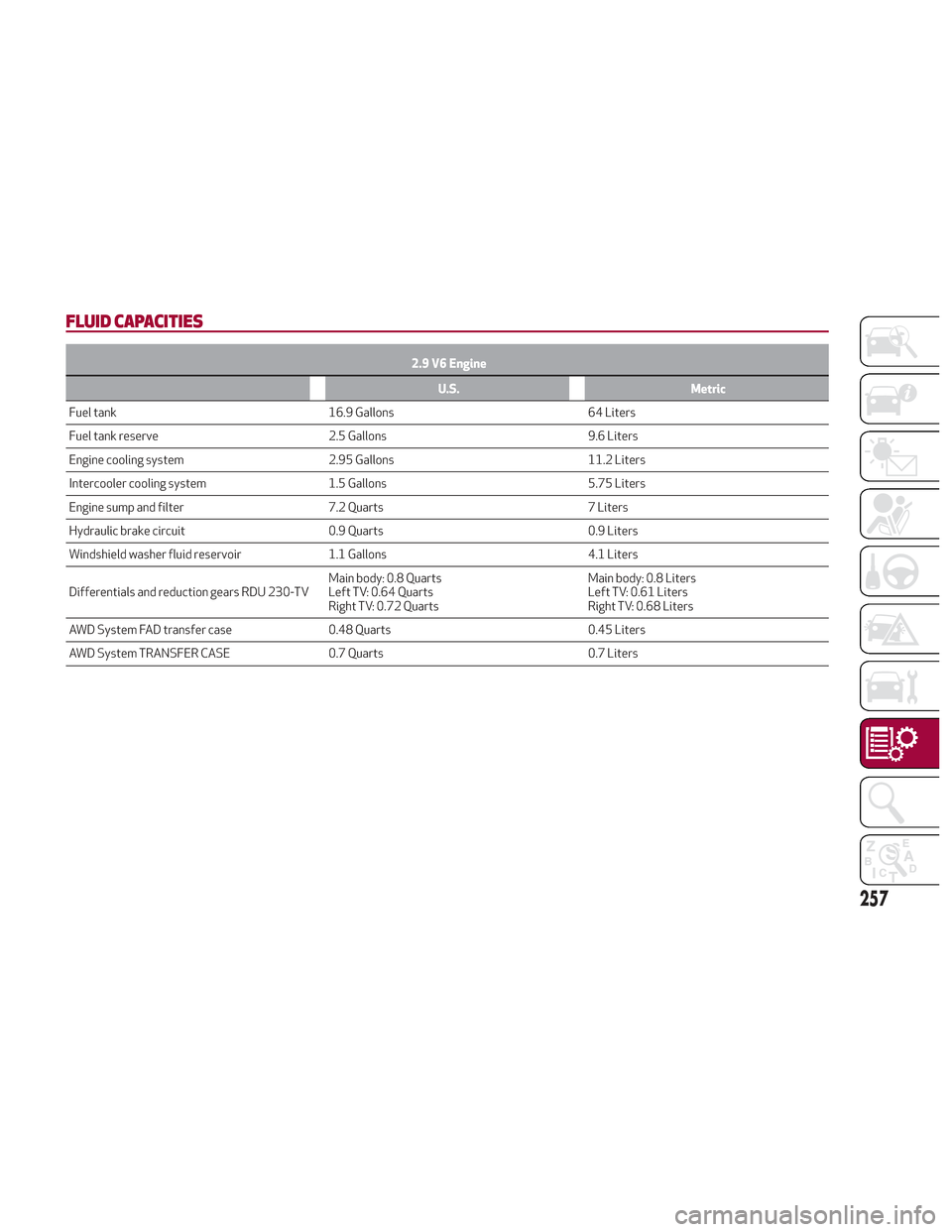
FLUID CAPACITIES
2.9 V6 EngineU.S. Metric
Fuel tank 16.9 Gallons64 Liters
Fuel
tank reserve 2.5 Gallons 9.6 Liters
Engine cooling system 2.95 Gallons11.2 Liters
Intercooler cooling system 1.5 Gallons5.75 Liters
Engine sump and filter 7.2 Quarts7 Liters
Hydraulic brake circuit 0.9 Quarts0.9 Liters
Windshield washer fluid reservoir 1.1 Gallons4.1 Liters
Differentials and reduction gears RDU 230-TV Main body: 0.8 Quarts
Left TV: 0.64 Quarts
Right TV: 0.72 QuartsMain body: 0.8 Liters
Left TV: 0.61 Liters
Right TV: 0.68 Liters
AWD System FAD transfer case 0.48 Quarts0.45 Liters
AWD System TRANSFER CASE 0.7 Quarts0.7 Liters
257
Page 269 of 276
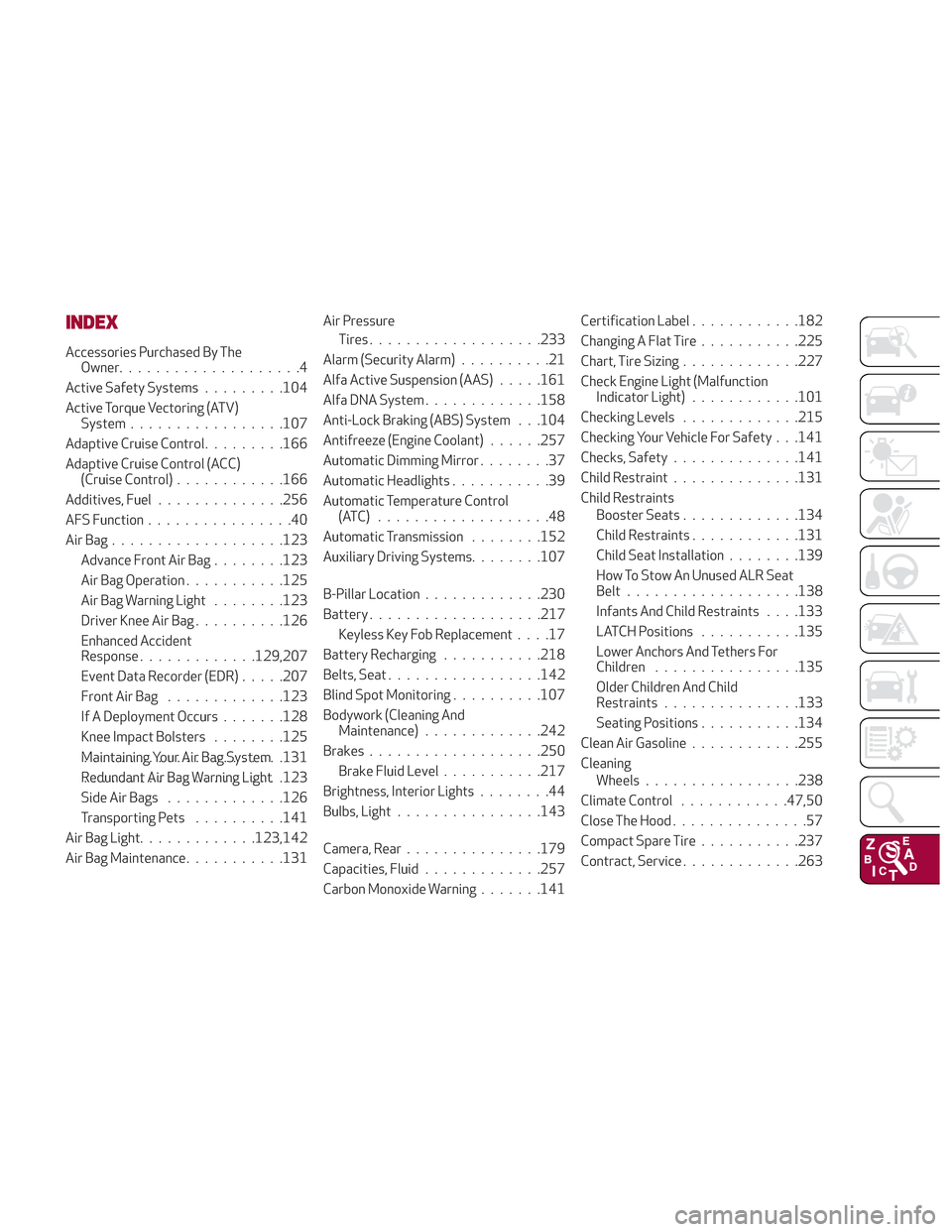
INDEX
Accessories Purchased By TheOwner....................4
Active Safety Systems .........104
Active Torque Vectoring (ATV) System ................ .107
Adaptive Cruise Control .........166
Adaptive Cruise Control (ACC) (Cruise Control) ............166
Additives, Fuel ............. .256
AFS Function ................40
AirBag.................. .123
Advance Front Air Bag ........123
Air Bag Operation ...........125
Air Bag Warning Light ........123
Driver Knee Air Bag ..........126
Enhanced Accident
Response .............129,207
Event Data Recorder (EDR) .....207
Front Air Bag .............123
If A Deployment Occurs .......128
Knee Impact Bolsters ........125
Maintaining Your Air Bag System ..................... .131
Redundant Air Bag Warning Light ..................... .123
Side Air Bags .............126
Transporting Pets ..........141
Air Bag Light .............123,142
Air Bag Maintenance ...........131 Air Pressure
Tires .................. .233
Alarm (Security Alarm) ..........21
Alfa Active Suspension (AAS) .....161
Alfa DNA System .............158
Anti-Lock Braking (ABS) System . . .104
Antifreeze (Engine Coolant) ......257
Automatic Dimming Mirror ........37
Automatic Headlights ...........39
Automatic Temperature Control (ATC) ...................48
Automatic Transmission ........152
Auxiliary Driving Systems ........107
B-Pillar Location .............230
Battery ..................
.217
K
eyless Key Fob Replacement ....17
Battery Recharging ...........218
Belts, Seat ................ .142
Blind Spot Monitoring ..........107
Bodywork (Cleaning And Maintenance) .............242
Brakes .................. .250
Brake Fluid Level ...........217
Brightness, Interior Lights ........44
Bulbs, Light ............... .143
Camera, Rear .............. .179
Capacities, Fluid .............257
Carbon Monoxide Warning .......141Certification Label
............182
Changing A Flat Tire ...........225
Chart, Tire Sizing .............227
Check Engine Light (Malfunction Indicator Light) ............101
Checking Levels .............215
Checking Your Vehicle For Safety . . .141
Checks, Safety ..............141
Child Restraint ..............131
Child Restraints Booster Seats .............134
Child Restraints ............131
Child Seat Installation ........139
How To Stow An Unused ALR Seat
Belt .................. .138
Infants And Child Restraints . . . .133
LATCH Positions ...........135
Lower Anchors And Tethers For
Children ............... .135
Older Children And Child
Restraints .............. .133
Seating Positions ...........134
Clean Air Gasoline ............255
Cleaning Wheels ................ .238
Climate Control ............47,50
Close The Hood ...............57
Compact Spare Tire ...........237
Contract,
Service .............263