Body Alfa Romeo Stelvio 2019 User Guide
[x] Cancel search | Manufacturer: ALFA ROMEO, Model Year: 2019, Model line: Stelvio, Model: Alfa Romeo Stelvio 2019Pages: 244, PDF Size: 4.95 MB
Page 171 of 244
Correct servicing permits the performance of the vehicle to be
maintained over time, as well as limiting running costs and
safeguarding the efficiency of the safety systems.
This chapter explains how.
SERVICING AND CARE
SCHEDULED SERVICING.........................170
ENGINE COMPARTMENT.........................177
BATTERY RECHARGING .........................184
SERVICING PROCEDURES . . ......................185
LIFTING THE VEHICLE..........................187
WHEELS AND TYRES...........................188
BODYWORK.................................189
Page 174 of 244
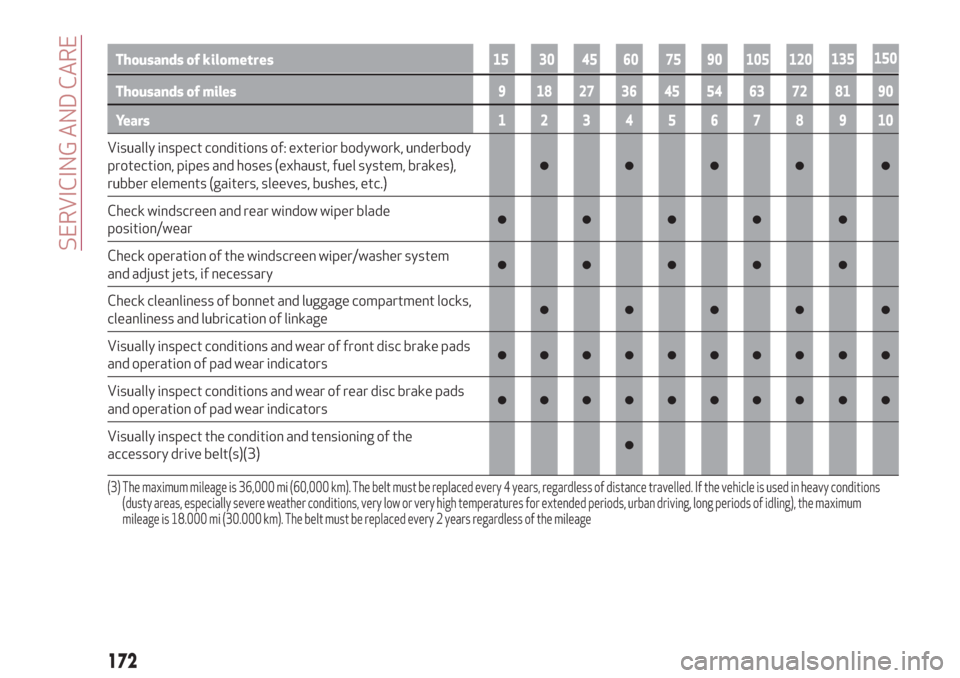
Thousands of miles9 18273645546372 8190
Years12345678 910
Visually inspect conditions of: exterior bodywork, underbody
protection, pipes and hoses (exhaust, fuel system, brakes),
rubber elements (gaiters, sleeves, bushes, etc.)
●●●●●
Check windscreen and rear window wiper blade
position/wear●●●● ●
Check operation of the windscreen wiper/washer system
and adjust jets, if necessary●●●● ●
Check cleanliness of bonnet and luggage compartment locks,
cleanliness and lubrication of linkage●●●●●
Visually inspect conditions and wear of front disc brake pads
and operation of pad wear indicators●●●●●●●●●●
Visually inspect conditions and wear of rear disc brake pads
and operation of pad wear indicators●●●●●●●●●●
Visually inspect the condition and tensioning of the
accessory drive belt(s)(3)●
(3) The maximum mileage is 36,000 mi (60,000 km). The belt must be replaced every 4 years, regardless of distance travelled. If the vehicle is used in heavy conditions
(dusty areas, especially severe weather conditions, very low or very high temperatures for extended periods, urban driving, long periods of idling), the maximum
mileage is 18.000 mi (30.000 km). The belt must be replaced every 2 years regardless of the mileage
172
SERVICING AND CARE
Thousands ofkilometres15 30 45 60 75 90 105 120135150
Page 177 of 244
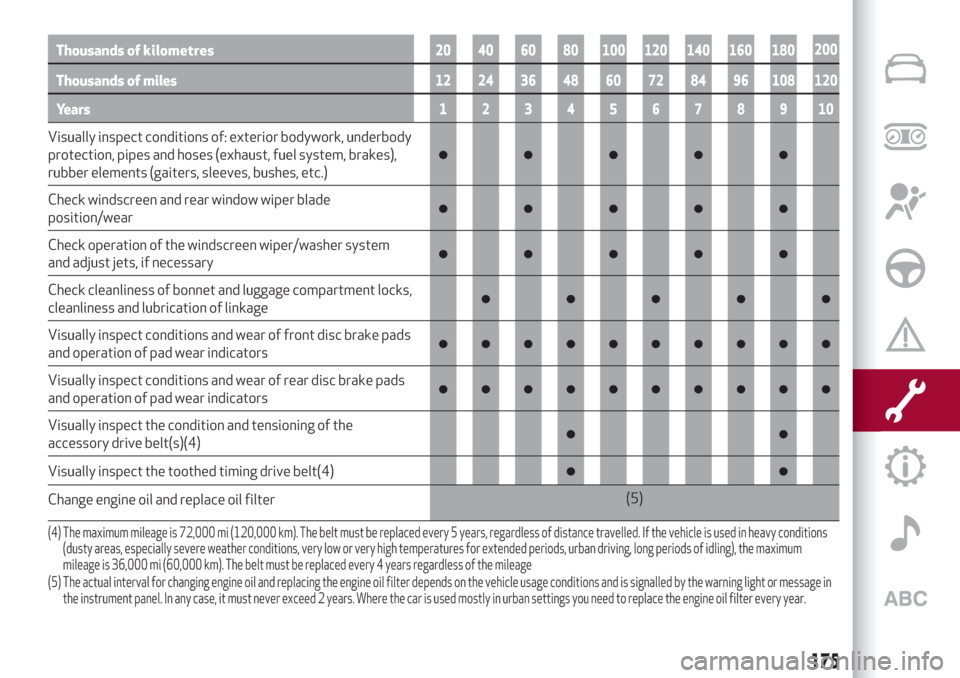
Thousands of miles12 24 36 48 60 72 84 96 108 120
Years12345678910
Visually inspect conditions of: exterior bodywork, underbody
protection, pipes and hoses (exhaust, fuel system, brakes),
rubber elements (gaiters, sleeves, bushes, etc.)
●●●●●
Check windscreen and rear window wiper blade
position/wear●●●●●
Check operation of the windscreen wiper/washer system
and adjust jets, if necessary●●●●●
Check cleanliness of bonnet and luggage compartment locks,
cleanliness and lubrication of linkage●●●●●
Visually inspect conditions and wear of front disc brake pads
and operation of pad wear indicators●●●●●●●●●●
Visually inspect conditions and wear of rear disc brake pads
and operation of pad wear indicators●●●●●●●●●●
Visually inspect the condition and tensioning of the
accessory drive belt(s)(4)●●
Visually inspect the toothed timing drive belt(4)●●
Change engine oil and replace oil filter(5)
(4) The maximum mileage is 72,000 mi (120,000 km). The belt must be replaced every 5 years, regardless of distance travelled. If the vehicle is used in heavy conditions
(dusty areas, especially severe weather conditions, very low or very high temperatures for extended periods, urban driving, long periods of idling), the maximum
mileage is 36,000 mi (60,000 km). The belt must be replaced every 4 years regardless of the mileage
(5) The actual interval for changing engine oil and replacing the engine oil filter depends on the vehicle usage conditions and is signalled by the warning light or message in
the instrument panel. In any case, it must never exceed 2 years. Where the car is used mostly in urban settings you need to replace the engine oil filter every year.
175
Thousands ofkilometres20 40 60 80 100 120 140 160 180200
Page 191 of 244
BODYWORK
PRESERVING THE BODYWORK
Paintwork
77)7)
Touch up abrasions and scratches
immediately to prevent the formation of
rust.
Some parts of the car may be covered
with a matt paint which, in order to be
maintained intact, requires special care:
see the instructions in the warning at the
end of this paragraph.
78)
To correctly wash the vehicle, follow
these instructions:
if high pressure jets or cleaners are
used to wash the vehicle, hold at least
16 in [40 cm] away from the bodywork to
avoid damage or alteration. Build up of
water could cause damage to the car in
the long term;
to make it easier to remove any dirt
deposits in the area where the blades are
normally located it is recommended to
position the windscreen wipers vertically
(service position), for more information
consult the “Maintenance procedures”
paragraph in this chapter.If you want to wash a car with automatic
transmission in a car wash that moves it,
you must do the following:
make sure that the car is on a flat
surface and that automatic engagement
of the parking brake when the engine is
switched off is disabled (for how to
disable it, refer to the “Electric parking
brake” section in the “Starting and
driving” chapter);
with the car stationary, the gear in N
(Neutral) and the brake pedal up: press
the start button. The car will remain in N
(Neutral) for 15 minutes, after which P
(Park) mode will be activated.
IMPORTANT
77)In order to preserve the aesthetic
appearance of the paint abrasive products
and/or polishes should not be used for
cleaning the vehicle.78)Avoid washing with rollers and/or
brushes in washing stations. Wash the car
only by hand using neutral pH detergents; dry
it with a wet chamois leather. Abrasive
products and/or polishes should not be used
for cleaning the car. Bird droppings must be
washed off immediately and thoroughly as
the acid they contain is particularly
aggressive. Avoid (if at all possible) parking
the vehicle under trees; remove vegetable
resins immediately as, when dried, it may
only be possible to remove them with
abrasive products and/or polishes, which is
highly inadvisable as they could alter the
typical opaqueness of the paint. Do not use
pure windscreen washer fluid for cleaning
the front windscreen and rear window; dilute
it min. 50% with water. Only use pure screen
washer fluid when strictly necessary due to
outside temperature conditions.IMPORTANT
7)Detergents pollute the environment. Only
wash your vehicle in areas equipped to
collect and treat wastewater from this type
of activity.
189
Page 215 of 244
ANTITHEFT PROTECTION
The system is equipped with an anti-theft
protection system based on the
exchange of information with the
electronic control unit (Body Computer)
on the vehicle.
This guarantees maximum security and
prevents the system from being used on
other cars in the event of theft. If
necessary contact an Alfa Romeo
Dealership.
IMPORTANT NOTES
Look at the screen only and when it is
necessary and safe. If you need to look at
the screen for a long time, pull over to a
safe place so as not to be distracted
while driving.
Immediately stop using the system in the
event of a fault. Otherwise the system
might be damaged. Contact an Alfa
Romeo Dealership as soon as possible to
have the system repaired.WARNING
184)Follow the safety rules here below:
otherwise serious injuries may occur to the
occupants or the system may be damaged.
185)If the volume is too loud this can be
dangerous. Adjust the volume so that you
can still hear background noises (e.g. horns,
ambulances, police vehicles, etc.).
IMPORTANT
83)Only clean the front panel and the
display with a soft, clean, dry, anti-static
cloth. Cleaning and polishing products may
damage the surface. Do not use alcohol or
similar products to clean the panel or the
display.
84)Do not use the display as a base for
supports with suction pads or adhesives for
external navigators or smartphones or
similar devices.
213
Page 239 of 244
INDEX
ABS (system)................72
Active Cruise Control..........120
Active safety systems...........72
Additive for diesel emissions
AdBlue (UREA)............136
AFS function................28
Airbag
Front airbags.............103
Side airbags..............107
Airbag (SRS supplementary
restraint system)...........103
Alarm.....................15
Alfa Connect...............228
Alfa DNA system.............116
Automatic dual-zone climate
control system.............33
Automatic high beam headlights....29
Automatic transmission.........114
Automatic transmission gear lever
unlocking................165
Battery..................182
Battery recharging............184
Bodywork (cleaning and
maintenance).............189
Bonnet....................38
Brakes
Brake fluid level............182
Broken-down vehicle towing......166
BSM (Blind Spot Monitoring).......76
Carrying children safely.........91
Changing a bulb..............146
Checking levels..............177
Child protection systems.........91
Child safety device.............17
Climate control system..........33
CO2 emissions..............209
Control panel and on-board
instruments...............44
Controls..................214
Controls on steering wheel
summary table............217
Tunnel control summary table . . .214
Cruise Control...............119
Cybersecurity devices...........3
Daytime running lights (DRL)......27
Dimensions................199
Dipped headlights.............27
Dipped headlights (changing a bulb)......................149
Direction indicators (changing a
bulb)...................150
Display....................46
Doors.....................15
Driving assistance systems.......76
DTC (system)................72
Dusk sensor.................27
Electric parking brake..........111
Electric steering wheel heating.....24
Electric sunroof..............36Electric windows..............35
Engine...................193
Engine coolant level .........182
Engine compartment..........177
Engine Immobilizer (system).......14
Engine oil
Consumption.............181
Level check..............181
ESC (Electronic Stability Control)
system..................72
External lights...............26
Fluids and lubricants..........205
Fog lights (bulb replacement).....150
Forward Collision Warning (system).......................78
Front ceiling light..............31
Front fog lights . . .............27
Front light cluster with main
beam/dipped beam halogen
headlights (bulb replacement) . . .149
Front light cluster with main
beam/dipped beam Xenon gas
discharge headlights (bulb
replacement). .............150
Front seats (electric adjustment)....20
Front seats (manual adjustments)....19
Fuel consumption............209
Fuel cut-off system . ..........165
Fuse boxes................151
Fuses (replacement) . ..........151
Hazard warning lights..........146