Body Alfa Romeo Stelvio 2019 Owner's Manual
[x] Cancel search | Manufacturer: ALFA ROMEO, Model Year: 2019, Model line: Stelvio, Model: Alfa Romeo Stelvio 2019Pages: 244, PDF Size: 4.95 MB
Page 7 of 244
SYMBOLS
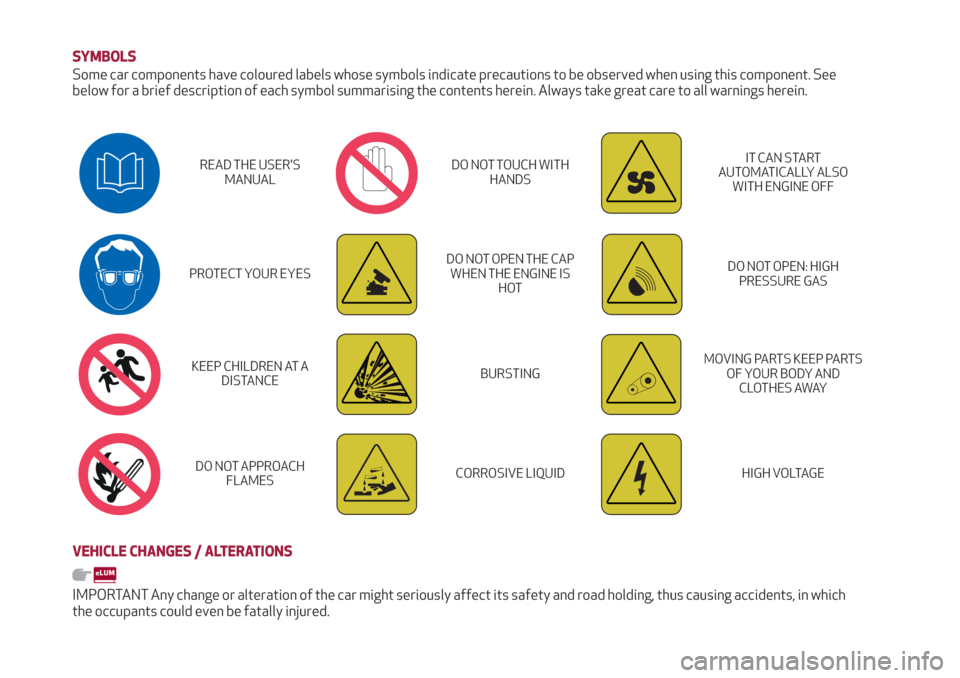
Some car components have coloured labels whose symbols indicate precautions to be observed when using this component. See
below for a brief description of each symbol summarising the contents herein. Always take great care to all warnings herein.
READ THE USER'S
MANUALDO NOT TOUCH WITH
HANDSIT CAN START
AUTOMATICALLY ALSO
WITH ENGINE OFF
PROTECT YOUR EYESDO NOT OPEN THE CAP
WHEN THE ENGINE IS
HOTDO NOT OPEN: HIGH
PRESSURE GAS
KEEP CHILDREN AT A
DISTANCEBURSTINGMOVING PARTS KEEP PARTS
OF YOUR BODY AND
CLOTHES AWAY
DO NOT APPROACH
FLAMESCORROSIVE LIQUIDHIGH VOLTAGE
VEHICLE CHANGES / ALTERATIONS
IMPORTANT Any change or alteration of the car might seriously affect its safety and road holding, thus causing accidents, in which
the occupants could even be fatally injured.
Page 38 of 244
WARNING
20)Incorrect use of the electric windows
may be dangerous. Before and during
operation, always check that nobody is
exposed to the risk of being injured either
directly by the moving window or through
objects getting caught or hit by it.
ELECTRIC SUNROOF
(where provided)
21)
The electric sunroof comprises two glass
panels (the front one is mobile and the
rear one fixed) and is fitted with an
electrically operated sun blind.
Operation of the sunroof is only possible
with the ignition device at AVV.
The sun roof has three preset positions:
fully closed; comfort (intermediate
opening)l fully open.
IMPORTANT You cannot have the blind
closed when the roof is open.
OPENING
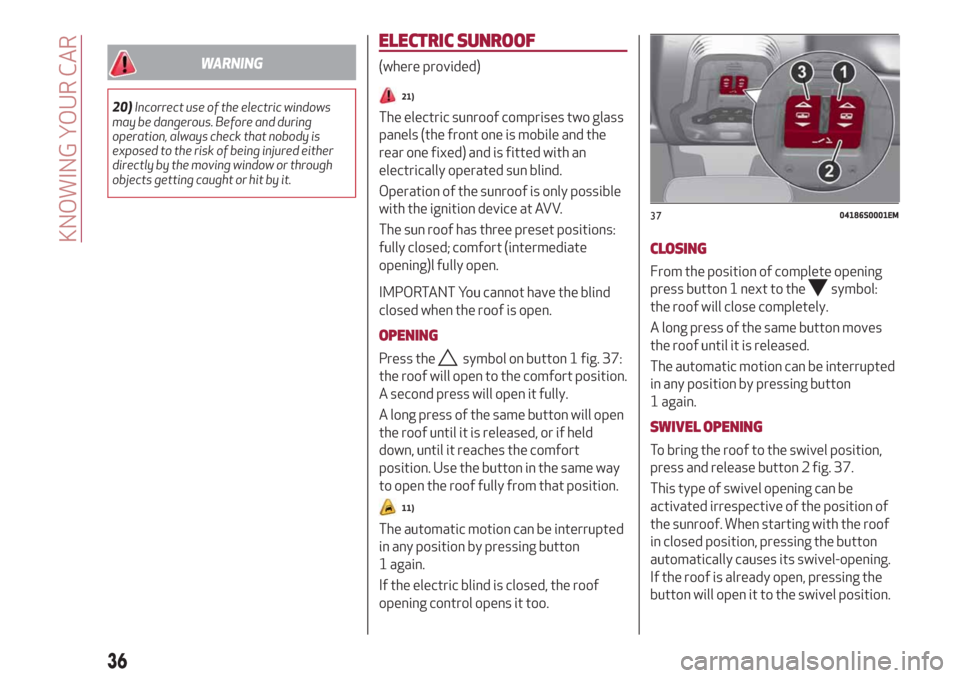
Press thesymbol on button 1 fig. 37:
the roof will open to the comfort position.
A second press will open it fully.
A long press of the same button will open
the roof until it is released, or if held
down, until it reaches the comfort
position. Use the button in the same way
to open the roof fully from that position.
11)
The automatic motion can be interrupted
in any position by pressing button
1 again.
If the electric blind is closed, the roof
opening control opens it too.
CLOSING
From the position of complete opening
press button 1 next to the
symbol:
the roof will close completely.
A long press of the same button moves
the roof until it is released.
The automatic motion can be interrupted
in any position by pressing button
1 again.
SWIVEL OPENING
To bring the roof to the swivel position,
press and release button 2 fig. 37.
This type of swivel opening can be
activated irrespective of the position of
the sunroof. When starting with the roof
in closed position, pressing the button
automatically causes its swivel-opening.
If the roof is already open, pressing the
button will open it to the swivel position.
3704186S0001EM
36
KNOWING YOUR CAR
Page 88 of 244
OCCUPANT PROTECTION
SYSTEMS
The following protection systems are
among the vehicle’s most important
safety equipment:
seat belts;
SBA (Seat Belt Alert) system;
head restraints;
child restraint systems;
Front airbags and side bags.
Read the information given the following
pages with the utmost care. It is of
fundamental importance that the
protection systems are used in the
correct way to guarantee the maximum
possible safety level for the driver and
the passengers.
For the description of the head restraint
adjustment see the "Head restraints"
paragraph in the "Knowing your vehicle"
chapter.
SEAT BELTS
All the seat belts have three anchor
points and a retractor.
The retractor mechanism operates
locking the belt in the event of sharp
braking or strong deceleration due to an
impact. This allows the belt strap to slide
freely and to adapt to the body of the
occupant. In the event of an accident, the
belt will lock reducing the risk of impact
inside the passenger compartment and
of being projected outside the vehicle.
The driver is responsible for respecting,
and ensuring that all the other occupants
of the vehicle also respect, the local laws
in force in relation to the use of the seat
belts.
Always fasten the seat belts before
setting off.
USING THE SEAT BELTS
The seat belt should be worn keeping the
chest straight and rested against the
backrest.
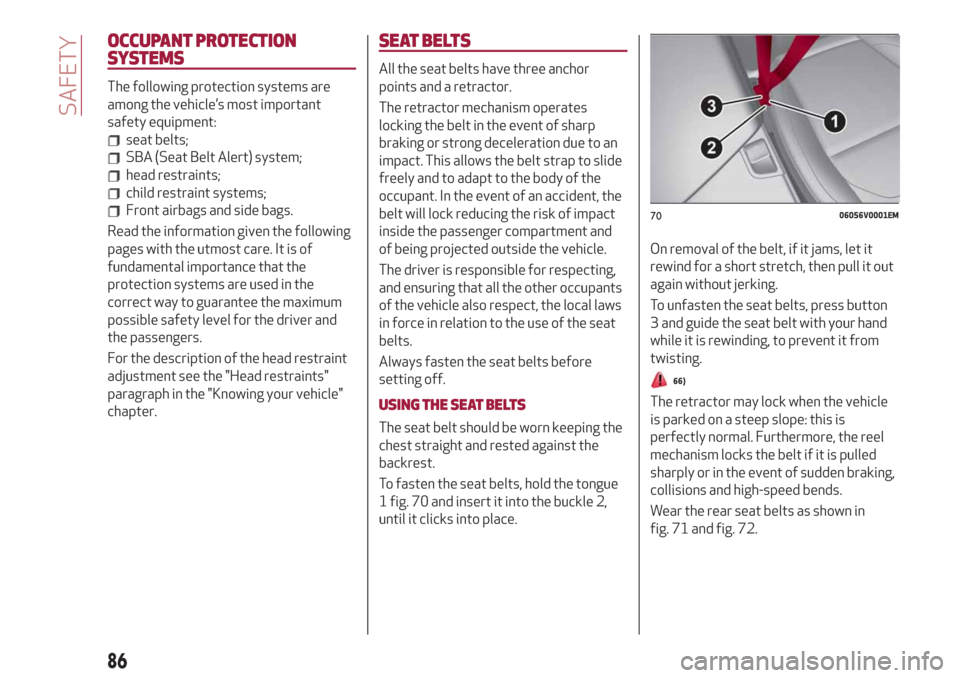
To fasten the seat belts, hold the tongue
1 fig. 70 and insert it into the buckle 2,
until it clicks into place.On removal of the belt, if it jams, let it
rewind for a short stretch, then pull it out
again without jerking.
To unfasten the seat belts, press button
3 and guide the seat belt with your hand
while it is rewinding, to prevent it from
twisting.
66)
The retractor may lock when the vehicle
is parked on a steep slope: this is
perfectly normal. Furthermore, the reel
mechanism locks the belt if it is pulled
sharply or in the event of sudden braking,
collisions and high-speed bends.
Wear the rear seat belts as shown in
fig. 71 and fig. 72.
7006056V0001EM
86
SAFETY
Page 92 of 244
steering wheel must be easy to access).
The maximum clearance should be kept
between the abdomen and the steering
wheel.
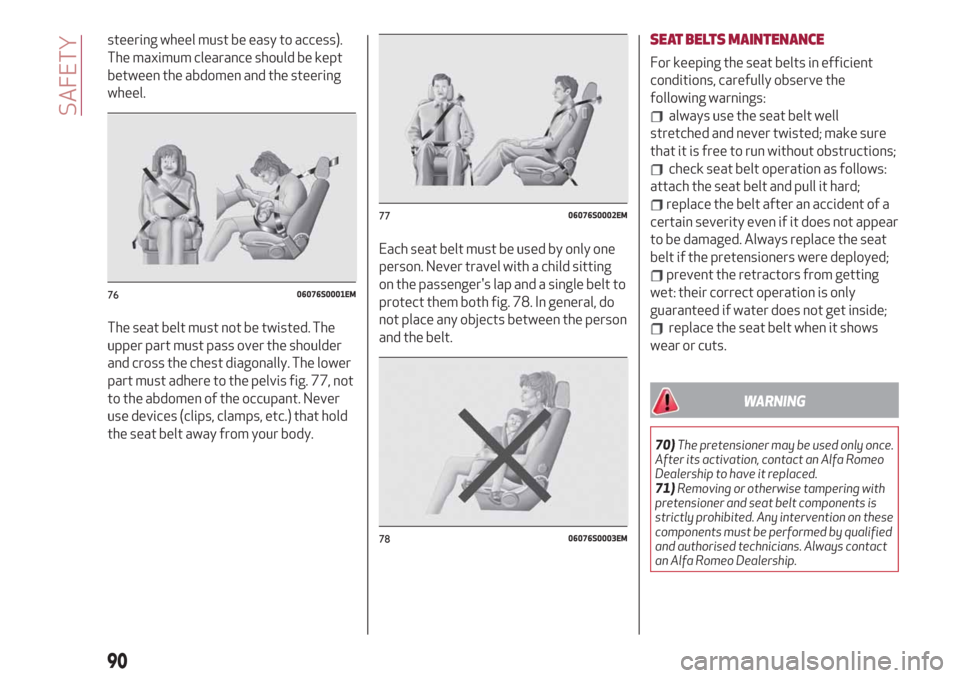
The seat belt must not be twisted. The
upper part must pass over the shoulder
and cross the chest diagonally. The lower
part must adhere to the pelvis fig. 77, not
to the abdomen of the occupant. Never
use devices (clips, clamps, etc.) that hold
the seat belt away from your body.Each seat belt must be used by only one
person. Never travel with a child sitting
on the passenger's lap and a single belt to
protect them both fig. 78. In general, do
not place any objects between the person
and the belt.SEAT BELTS MAINTENANCE
For keeping the seat belts in efficient
conditions, carefully observe the
following warnings:
always use the seat belt well
stretched and never twisted; make sure
that it is free to run without obstructions;
check seat belt operation as follows:
attach the seat belt and pull it hard;
replace the belt after an accident of a
certain severity even if it does not appear
to be damaged. Always replace the seat
belt if the pretensioners were deployed;
prevent the retractors from getting
wet: their correct operation is only
guaranteed if water does not get inside;
replace the seat belt when it shows
wear or cuts.
WARNING
70)The pretensioner may be used only once.
After its activation, contact an Alfa Romeo
Dealership to have it replaced.
71)Removing or otherwise tampering with
pretensioner and seat belt components is
strictly prohibited. Any intervention on these
components must be performed by qualified
and authorised technicians. Always contact
an Alfa Romeo Dealership.
7606076S0001EM
7706076S0002EM
7806076S0003EM
90
SAFETY
Page 93 of 244
72)For maximum safety, keep the backrest
upright, lean back into it and make sure the
seat belt fits closely across your chest and
pelvis. Always fasten the seat belts for both
the front and rear seats! Travelling without
wearing seat belts will increase the risk of
serious injury and even death in the event of
an accident.
73)If the belt has been subjected to high
levels of stress, for example after an
accident, it should be changed completely
together with the attachments, attachment
fixing screws and the pretensioner. In fact,
even if the belt has no visible defects, it may
have lost its resilience.
IMPORTANT
29)Operations which lead to impacts,
vibrations or localised heating (over 100°C
for a maximum of six hours) in the area
around the pretensioner may cause damage
or make it deploy. Contact an Alfa Romeo
Dealership should intervention be necessary
on these components.
CHILD PROTECTIONSYSTEMS
CARRYING CHILDREN SAFELY
74) 75) 76) 77)
For optimal protection in the event of an
impact, all occupants must be seated and
wearing adequate restraint systems,
including newborn and other children!
This prescription is compulsory in all EC
countries according to EC Directive
2003/20/EC.
Children below the height of 4.9 ft
(1.50 metres) and up to 12 years must be
protected with suitable restraint
systems and be seated on the rear seats.
Statistics on accidents indicate that the
rear seats offer greater safety for
children.
Compared with an adult, a child's head is
larger and heavier in proportion to their
body and the child's muscular and bone
structures are not fully developed.
Therefore, correct restraint systems
other than adult seat belts are necessary,
to reduce as much as possible the risk of
injuries in the event of an accident,
braking or sudden manoeuvre.
Children must be seated safely and
comfortably. As far as the characteristics
of the child seats used allow, you are
advised to keep children in rear facing
child seats for as long as possible (atleast until 3–4 years old), since this is the
most protected position in the event of
an impact.
The choice of the most suitable child
restraint system depends on the weight
and size of the child. There are various
types of child restraint systems, which
can be secured to the car by means of the
seat belts or with the ISOFIX/i-Size
anchorages.
It is recommended to always choose the
restraint system most suitable for the
child; for this reason always refer to the
Owner Handbook provided with the child
restraint system, to be sure that it is of
the right type for the children it is
intended for.
In Europe the characteristics of child
restraint systems are ruled by the
regulation ECE-R44, dividing them into
five weight groups:
Group Weight range
Group 0upto 22 lb (10 kg) in
weight
Group 0+up to 28.7 lb (13 kg)
in weight
Group 120-40lb(9-18kg)
in weight
Group 233-55lb(15-25kg)
in weight
91
Page 109 of 244
SIDE AIRBAGS
To help increase occupants protection in
the event of side impact collisions, the
vehicle is equipped with front side bags
and window bags.
Side bag
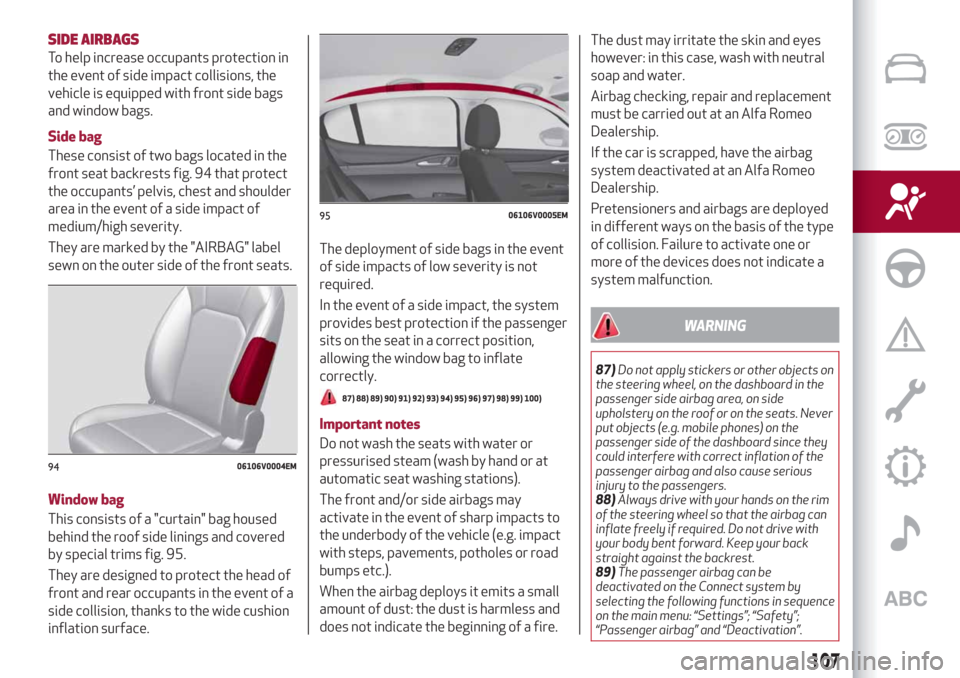
These consist of two bags located in the
front seat backrests fig. 94 that protect
the occupants’ pelvis, chest and shoulder
area in the event of a side impact of
medium/high severity.
They are marked by the "AIRBAG" label
sewn on the outer side of the front seats.
Window bag
This consists of a "curtain" bag housed
behind the roof side linings and covered
by special trims fig. 95.
They are designed to protect the head of
front and rear occupants in the event of a
side collision, thanks to the wide cushion
inflation surface.The deployment of side bags in the event
of side impacts of low severity is not
required.
In the event of a side impact, the system
provides best protection if the passenger
sits on the seat in a correct position,
allowing the window bag to inflate
correctly.
87) 88) 89) 90) 91) 92) 93) 94) 95) 96) 97) 98) 99) 100)
Important notes
Do not wash the seats with water or
pressurised steam (wash by hand or at
automatic seat washing stations).
The front and/or side airbags may
activate in the event of sharp impacts to
the underbody of the vehicle (e.g. impact
with steps, pavements, potholes or road
bumps etc.).
When the airbag deploys it emits a small
amount of dust: the dust is harmless and
does not indicate the beginning of a fire.The dust may irritate the skin and eyes
however: in this case, wash with neutral
soap and water.
Airbag checking, repair and replacement
must be carried out at an Alfa Romeo
Dealership.
If the car is scrapped, have the airbag
system deactivated at an Alfa Romeo
Dealership.
Pretensioners and airbags are deployed
in different ways on the basis of the type
of collision. Failure to activate one or
more of the devices does not indicate a
system malfunction.
WARNING
87)Do not apply stickers or other objects on
the steering wheel, on the dashboard in the
passenger side airbag area, on side
upholstery on the roof or on the seats. Never
put objects (e.g. mobile phones) on the
passenger side of the dashboard since they
could interfere with correct inflation of the
passenger airbag and also cause serious
injury to the passengers.
88)Always drive with your hands on the rim
of the steering wheel so that the airbag can
inflate freely if required. Do not drive with
your body bent forward. Keep your back
straight against the backrest.
89)The passenger airbag can be
deactivated on the Connect system by
selecting the following functions in sequence
on the main menu: “Settings”; “Safety”;
“Passenger airbag” and “Deactivation”.
9406106V0004EM
9506106V0005EM
107
Page 144 of 244
ASSEMBLY SCHEDULE
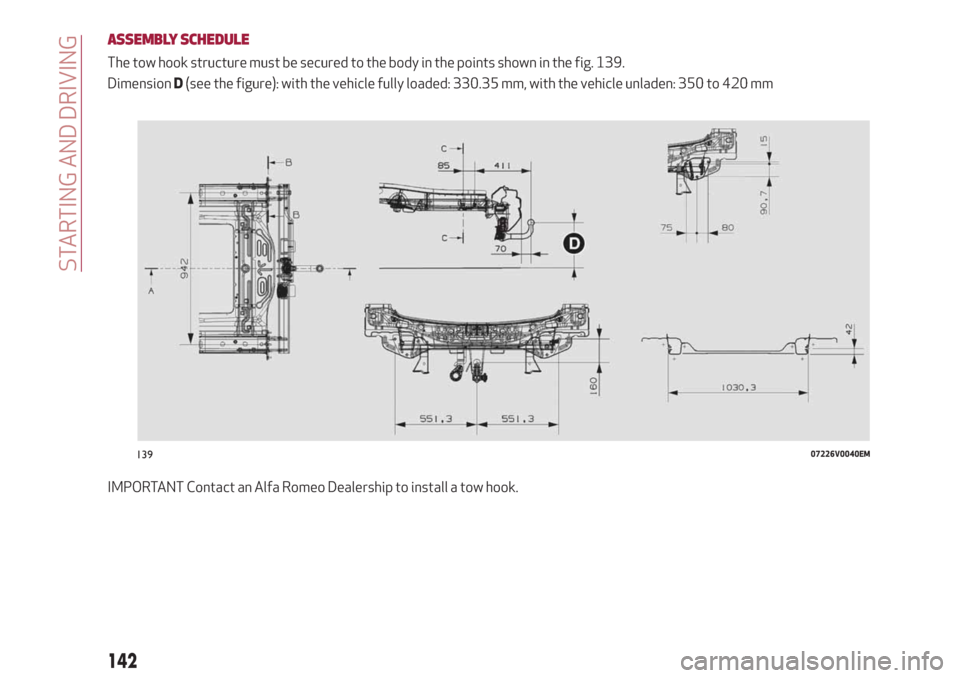
The tow hook structure must be secured to the body in the points shown in the fig. 139.
DimensionD(see the figure): with the vehicle fully loaded: 330.35 mm, with the vehicle unladen: 350 to 420 mm
IMPORTANT Contact an Alfa Romeo Dealership to install a tow hook.
13907226V0040EM
142
STARTING AND DRIVING
Page 151 of 244
REPLACING AN EXTERNAL BULB
Front light cluster with main
beam/dipped beam halogen headlights
Dipped beam headlights
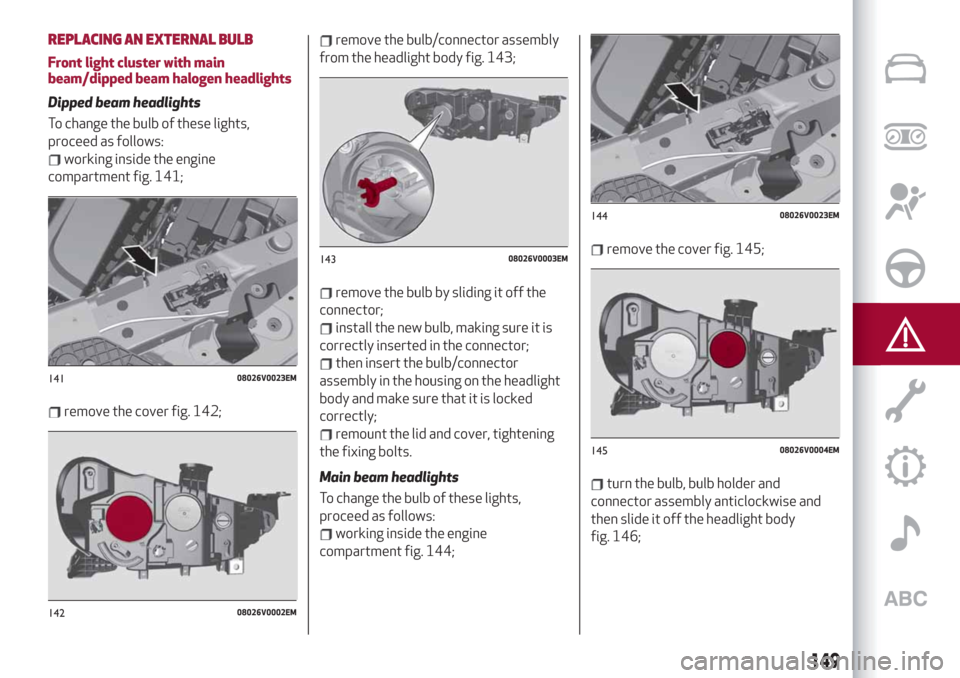
To change the bulb of these lights,
proceed as follows:
working inside the engine
compartment fig. 141;
remove the cover fig. 142;
remove the bulb/connector assembly
from the headlight body fig. 143;
remove the bulb by sliding it off the
connector;
install the new bulb, making sure it is
correctly inserted in the connector;
then insert the bulb/connector
assembly in the housing on the headlight
body and make sure that it is locked
correctly;
remount the lid and cover, tightening
the fixing bolts.
Main beam headlights
To change the bulb of these lights,
proceed as follows:
working inside the engine
compartment fig. 144;
remove the cover fig. 145;
turn the bulb, bulb holder and
connector assembly anticlockwise and
then slide it off the headlight body
fig. 146;
14108026V0023EM
14208026V0002EM
14308026V0003EM
14408026V0023EM
14508026V0004EM
149
Page 152 of 244
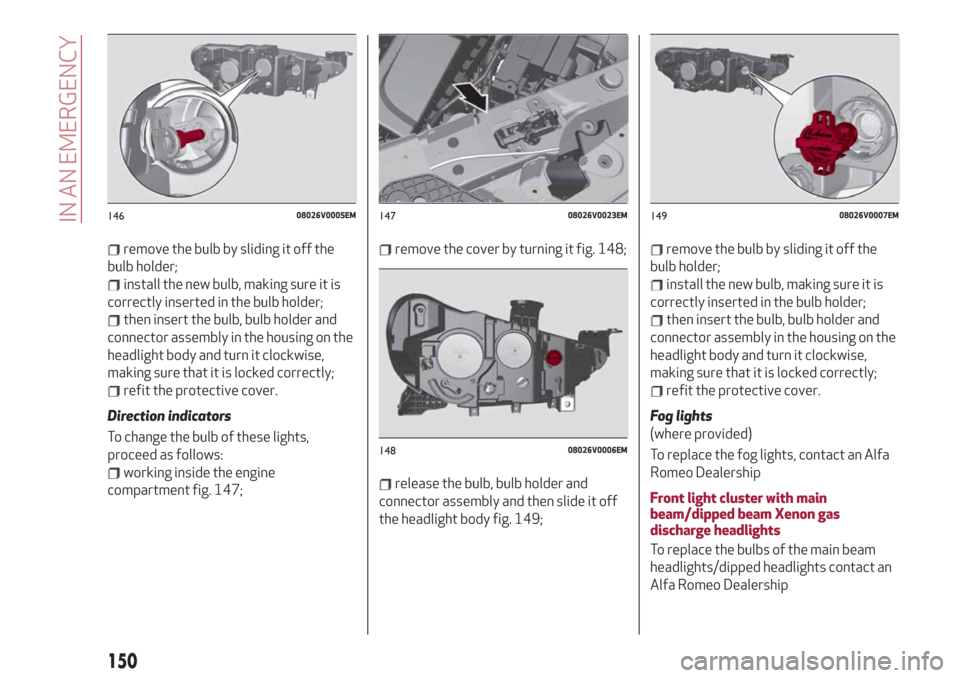
remove the bulb by sliding it off the
bulb holder;
install the new bulb, making sure it is
correctly inserted in the bulb holder;
then insert the bulb, bulb holder and
connector assembly in the housing on the
headlight body and turn it clockwise,
making sure that it is locked correctly;
refit the protective cover.
Direction indicators
To change the bulb of these lights,
proceed as follows:
working inside the engine
compartment fig. 147;
remove the cover by turning it fig. 148;
release the bulb, bulb holder and
connector assembly and then slide it off
the headlight body fig. 149;
remove the bulb by sliding it off the
bulb holder;
install the new bulb, making sure it is
correctly inserted in the bulb holder;
then insert the bulb, bulb holder and
connector assembly in the housing on the
headlight body and turn it clockwise,
making sure that it is locked correctly;
refit the protective cover.
Fog lights
(where provided)
To replace the fog lights, contact an Alfa
Romeo Dealership
Front light cluster with main
beam/dipped beam Xenon gas
discharge headlights
To replace the bulbs of the main beam
headlights/dipped headlights contact an
Alfa Romeo Dealership
14608026V0005EM14708026V0023EM
14808026V0006EM
14908026V0007EM
150
IN AN EMERGENCY
Page 160 of 244
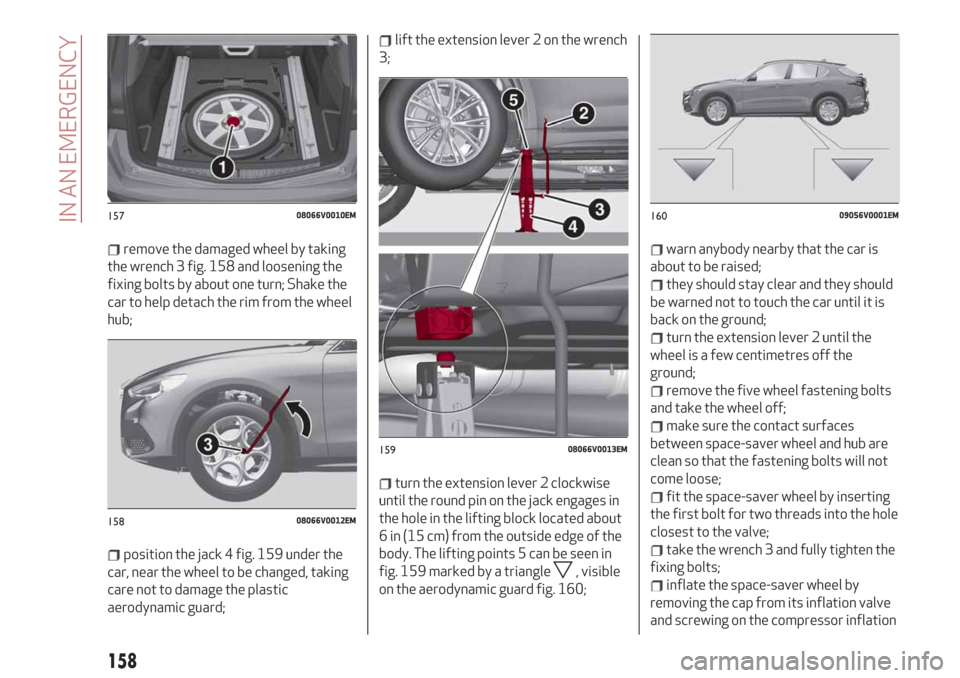
remove the damaged wheel by taking
the wrench 3 fig. 158 and loosening the
fixing bolts by about one turn; Shake the
car to help detach the rim from the wheel
hub;
position the jack 4 fig. 159 under the
car, near the wheel to be changed, taking
care not to damage the plastic
aerodynamic guard;
lift the extension lever 2 on the wrench
3;
turn the extension lever 2 clockwise
until the round pin on the jack engages in
the hole in the lifting block located about
6 in (15 cm) from the outside edge of the
body. The lifting points 5 can be seen in
fig. 159 marked by a triangle
, visible
on the aerodynamic guard fig. 160;
warn anybody nearby that the car is
about to be raised;
they should stay clear and they should
be warned not to touch the car until it is
back on the ground;
turn the extension lever 2 until the
wheel is a few centimetres off the
ground;
remove the five wheel fastening bolts
and take the wheel off;
make sure the contact surfaces
between space-saver wheel and hub are
clean so that the fastening bolts will not
come loose;
fit the space-saver wheel by inserting
the first bolt for two threads into the hole
closest to the valve;
take the wrench 3 and fully tighten the
fixing bolts;
inflate the space-saver wheel by
removing the cap from its inflation valve
and screwing on the compressor inflation
15708066V0010EM
15808066V0012EM
15908066V0013EM
16009056V0001EM
158
IN AN EMERGENCY