fuse Alfa Romeo Stelvio 2019 User Guide
[x] Cancel search | Manufacturer: ALFA ROMEO, Model Year: 2019, Model line: Stelvio, Model: Alfa Romeo Stelvio 2019Pages: 244, PDF Size: 4.95 MB
Page 156 of 244
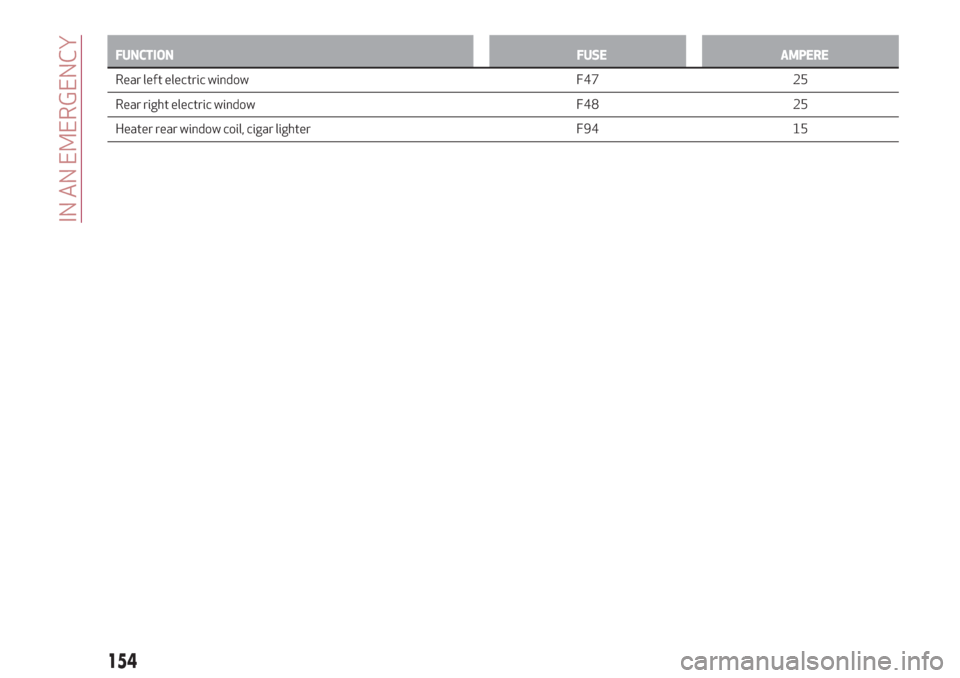
FUNCTION FUSE AMPERE
Rear left electric window F47 25
Rear
right electric window F48 25
Heater rear window coil, cigar lighter F94 15
154
IN AN EMERGENCY
Page 157 of 244
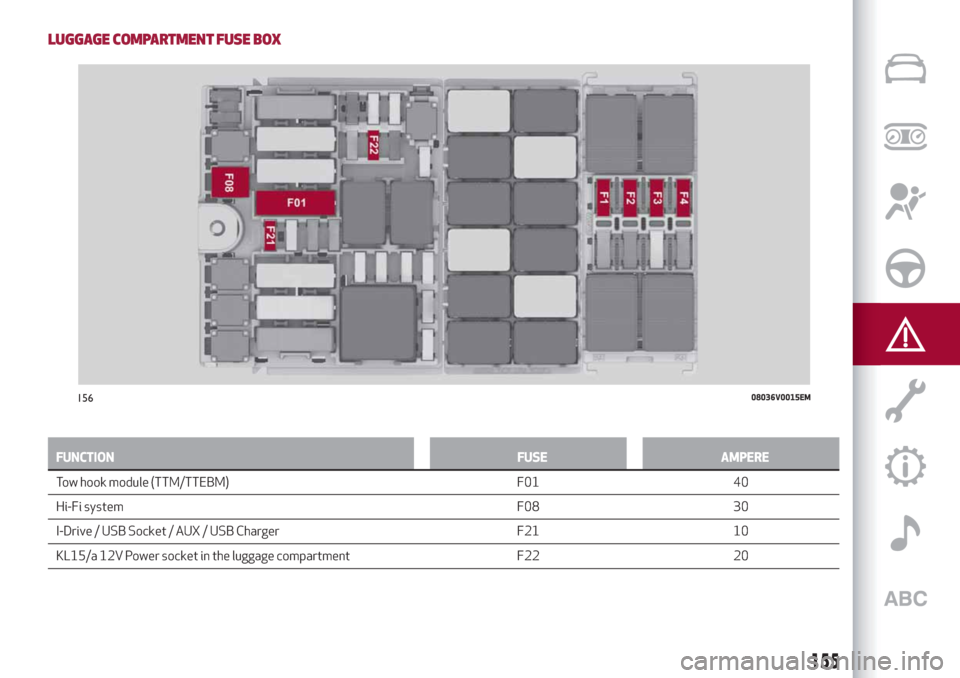
LUGGAGE COMPARTMENT FUSE BOX
FUNCTION FUSE AMPERE
Tow hook module (TTM/TTEBM) F01 40
Hi-Fi
system F08 30
I-Drive / USB Socket / AUX / USB Charger F21 10
KL15/a 12V Power socket in the luggage compartment F22 20
15608036V0015EM
155
Page 158 of 244

FUNCTION FUSE AMPERE
Trailer light control unit power supply (+30) F1 20
T
railer light control unit power supply (+30) F2 15
Trailer socket (only EMEA) (+30) F3 10
Tow bar (+15) F4 10
156
IN AN EMERGENCY
Page 159 of 244
WARNING
133)Never replace a fuse with another with
a higher amp rating; DANGER OF FIRE.
134)Before replacing a fuse, make sure
that the ignition device is at STOP and that
all devices are switched off and/or
disconnected.
135)Contact an Alfa Romeo Dealership if a
safety system (airbags, brakes),
transmission system (engine, gearbox) or
steering system general protection fuse
blows.
136)If a fuse blows again, contact an Alfa
Romeo Dealership.
137)If a general protective fuse
(MAXI-FUSE, MEGA-FUSE, MIDI-FUSE)
blows, contact an Alfa Romeo Dealership.
IMPORTANT
56)Never replace a fuse with metal wires or
anything else.
57)If it is necessary to wash the engine
compartment, take care not to directly hit
the fuse box and the window wiper motors
with the water jet.
CHANGING A WHEEL
GENERAL INSTRUCTIONS
The car is equipped with the "Tire Repair
Kit": see the “Tire Repair Kit” paragraph
for how to use this device.
As an alternative to the “Tire Repair Kit”,
the car may be requested with a
space-saver wheel: see the instructions
on the following pages for changing the
wheel.
JACK
138) 139)
Please note that:
the jack weighs about 4.4 lb (2 kg);
the jack requires no adjustment;
the jack cannot be repaired and in the
event of a fault it must be replaced by
another genuine one;
no tool other than its cranking device
may be fitted on the jack.
Jack maintenance:
prevent any dirt from depositing on
the "worm screw";
keep the "worm screw" lubricated;
never modify the jack.
Conditions in which not to use the jack:
temperatures below −40°F (-40°C);
on sandy or muddy ground;
on uneven ground;
on steep slopes in extreme weather
conditions: thunderstorms, typhoons,hurricanes, blizzards, storms, etc.;
in direct contact with the engine or for
repairs under the car;
on boats.
CHANGING PROCEDURE
140) 141) 142) 143) 144) 145) 146)
58) 59)
Proceed as follows:
stop the car in a position that is not
dangerous for oncoming traffic where
you can change the wheel safely.
The ground must be flat and
sufficiently compact;
stop the engine, engage the hazard
warning lights and the parking brake;
engage P (Park) mode;
wear the reflective safety jacket
(compulsory by law) before getting out of
the car;
open the luggage compartment and lift
up the mat using the handle;
when the situation dictates it (for your
own safety and to comply with the
regulations in force in the country where
you are), take the warning triangle and
position it at a suitable distance from the
car;
unscrew the locking device 1 fig. 157,
take out the space-saver wheel and the
inflation compressor;
157
Page 167 of 244
161)Remove any metal objects (e.g. rings,
watches, bracelets), that might cause an
accidental electrical contact and cause
serious injury.
162)The batteries contain acid that can
burn skin or eyes. Batteries produce
hydrogen, which is easily flammable and
explosive. Thus keep away flames or devices
which may cause sparks.
IMPORTANT
61)Never use a fast battery-charger to
start the engine as this could damage the
electronic systems of your vehicle,
particularly the ignition and engine fuel
supply control units.
62)Do not connect the cable to the negative
terminal (–) of the flat battery. The following
spark could lead to battery explosion and
cause serious harm. Only use the specific
earth point; do not use any other exposed
metallic part.
FUEL CUT-OFFSYSTEM
DESCRIPTION
Depending on the type and violence of
the impact, the control unit of the ORC
occupant protection systems determines
whether to activate the airbags and the
front seat belt pretensioners and
whether to immediately interrupt the
current from the batteries to the supply
pumps and to the devices that operate
the engine. The power from the battery is
interrupted by "skipping" the pyrotechnic
fuse placed on the fusebox next to the
positive pole of the battery.
When the fuse is "skipped", only some
services, necessary for the safety of the
car (eg: door locks, anti-theft device, etc.),
remain powered.
IMPORTANT After the impact, carefully
check the car for fuel leaks, for instance
in the engine compartment, under the car
or near the tank area.
IMPORTANT Contact an Alfa Romeo
Dealership to have the system checked.
AUTOMATIC TRANSMISSION
GEAR LEVER UNLOCKING
To release the automatic transmission
lever, contact an Alfa Romeo Dealership.
165
Page 185 of 244
do not keep accessories (e.g. Connect
system, hazard warning lights, etc.)
switched on for a long time when the
engine is not running;
before performing any operation on
the electrical system, disconnect the
cable from the negative battery terminal.
If, after purchasing the car, you wish to
install electrical accessories which
require permanent electrical supply (e.g.
alarm, etc.) or accessories which
influence the electrical supply
requirements, contact an Alfa Romeo
Dealership, whose qualified staff will
evaluate the overall electrical
consumption.
IMPORTANT If the battery was
disconnected, do not start the engine
immediately after reconnecting the
terminals, but press the start button,
without operating the pedals, to turn on
the instrument panel and then start the
engine.
IMPORTANT If the charge level remains
under 50% for a long time, the battery is
damaged by sulphation, reducing its
capacity and efficiency at start-up. The
battery is also more prone to the risk of
freezing (already at 14 °F / -10°C).
Replacing the battery
If necessary, replace the battery with
another original battery with the samespecifications. Follow the battery
Manufacturer’s instructions for
maintenance.
WARNING
165)Never smoke while working in the
engine compartment: gas and inflammable
vapours may be present, with the risk of fire.
166)Be very careful when working in the
engine compartment when the engine is hot:
you may get burned. Do not get too close to
the radiator cooling fan: the electric fan may
start; danger of injury. Scarves, ties and
other loose clothing might be pulled by
moving parts.
167)If the engine oil is being topped up, wait
for the engine to cool down before loosening
the filler cap, particularly for vehicles with
aluminium cap (where provided). WARNING:
risk of burns!
168)The cooling system is pressurised. If
necessary, only replace the plug with
another original or the operation of the
system may be adversely affected. Do not
remove the reservoir plug when the engine is
hot: you risk scalding yourself.
169)Do not travel with the windscreen
washer fluid reservoir empty: the
windscreen washer is essential for
improving visibility. Repeated operation of
the system without fluid could damage or
cause rapid deterioration of some system
components.
170)Some commercial additives for
windscreen washer fluid are flammable. The
engine compartment contains hot
components which may start a fire.171)Battery fluid is poisonous and
corrosive. Avoid contact with the skin and
eyes. Keep open flames away from the
battery and do not use objects that might
create sparks: risk of explosion and fire.
172)Using the battery with insufficient
fluid irreparably damages the battery and
may cause an explosion.
173)If the vehicle must remain unused for a
long time at a very low temperature, remove
the battery and take it to a warm place, to
avoid freezing.
174)When performing any operation on the
battery or near it, always protect your eyes
with special goggles.
IMPORTANT
63)Be careful not to confuse the various
types of fluids while topping up: they are not
compatible with each other! Topping up with
an unsuitable fluid could severely damage
your vehicle.
64)The oil level must never exceed the MAX
mark.
65)If the MAX mark is exceeded (last notch
on the right turns red) after the top-up, go to
an Alfa Romeo Dealership as soon as
possible to have the oil in excess removed.
66)Do not add oil with specifications other
than those of the oil already in the engine.
67)Use a fluid of the same type as that
already present in the reservoir for any
topping up of the engine cooling system. The
fluid cannot be mixed with other types of
antifreeze fluids. In the event of topping up
with an unsuitable product, under no
circumstances start the engine and contact
an Alfa Romeo Dealership.
183
Page 239 of 244
INDEX
ABS (system)................72
Active Cruise Control..........120
Active safety systems...........72
Additive for diesel emissions
AdBlue (UREA)............136
AFS function................28
Airbag
Front airbags.............103
Side airbags..............107
Airbag (SRS supplementary
restraint system)...........103
Alarm.....................15
Alfa Connect...............228
Alfa DNA system.............116
Automatic dual-zone climate
control system.............33
Automatic high beam headlights....29
Automatic transmission.........114
Automatic transmission gear lever
unlocking................165
Battery..................182
Battery recharging............184
Bodywork (cleaning and
maintenance).............189
Bonnet....................38
Brakes
Brake fluid level............182
Broken-down vehicle towing......166
BSM (Blind Spot Monitoring).......76
Carrying children safely.........91
Changing a bulb..............146
Checking levels..............177
Child protection systems.........91
Child safety device.............17
Climate control system..........33
CO2 emissions..............209
Control panel and on-board
instruments...............44
Controls..................214
Controls on steering wheel
summary table............217
Tunnel control summary table . . .214
Cruise Control...............119
Cybersecurity devices...........3
Daytime running lights (DRL)......27
Dimensions................199
Dipped headlights.............27
Dipped headlights (changing a bulb)......................149
Direction indicators (changing a
bulb)...................150
Display....................46
Doors.....................15
Driving assistance systems.......76
DTC (system)................72
Dusk sensor.................27
Electric parking brake..........111
Electric steering wheel heating.....24
Electric sunroof..............36Electric windows..............35
Engine...................193
Engine coolant level .........182
Engine compartment..........177
Engine Immobilizer (system).......14
Engine oil
Consumption.............181
Level check..............181
ESC (Electronic Stability Control)
system..................72
External lights...............26
Fluids and lubricants..........205
Fog lights (bulb replacement).....150
Forward Collision Warning (system).......................78
Front ceiling light..............31
Front fog lights . . .............27
Front light cluster with main
beam/dipped beam halogen
headlights (bulb replacement) . . .149
Front light cluster with main
beam/dipped beam Xenon gas
discharge headlights (bulb
replacement). .............150
Front seats (electric adjustment)....20
Front seats (manual adjustments)....19
Fuel consumption............209
Fuel cut-off system . ..........165
Fuse boxes................151
Fuses (replacement) . ..........151
Hazard warning lights..........146