lock Alfa Romeo Stelvio 2019 User Guide
[x] Cancel search | Manufacturer: ALFA ROMEO, Model Year: 2019, Model line: Stelvio, Model: Alfa Romeo Stelvio 2019Pages: 244, PDF Size: 4.95 MB
Page 28 of 244
mirror folding (from closed to open
position and vice versa), their movement
direction is reversed.
Automatic activation
Activating the central door locking
system from outside the car
automatically folds the mirrors, they
return to the driving position when the
ignition switch is turned to the ON
position.
If the external mirrors were folded
operating on the device 1, they could be
returned to the driving position only
operating a new control on the device.
Activation/deactivation of the function
The electric mirror folding function can
be activated/deactivated using the
Connect system menu (the default
setting of the function is “Off”).
Alternatively, you can choose to
open/close the mirrors automatically
when opening/closing the doors (using
the electronic key or the Passive Entry
system, where provided).
IMPORTANT The mirrors must always be
open while driving and should never be
folded.ELECTROCHROMIC EXTERIOR
MIRRORS
(where provided)
As well as an inside mirror, an
electrochromic mirror is also available on
some versions, which automatically
modifies its reflecting properties to
prevent dazzling the driver. The
anti-glare electrochromic enable/disable
button fig. 25 is the same for all rear view
mirrors.
WARNING
16)As door mirrors are curved, and
therefore they may slightly alter the
perception of distance.
EXTERNAL LIGHTS
LIGHT SWITCH
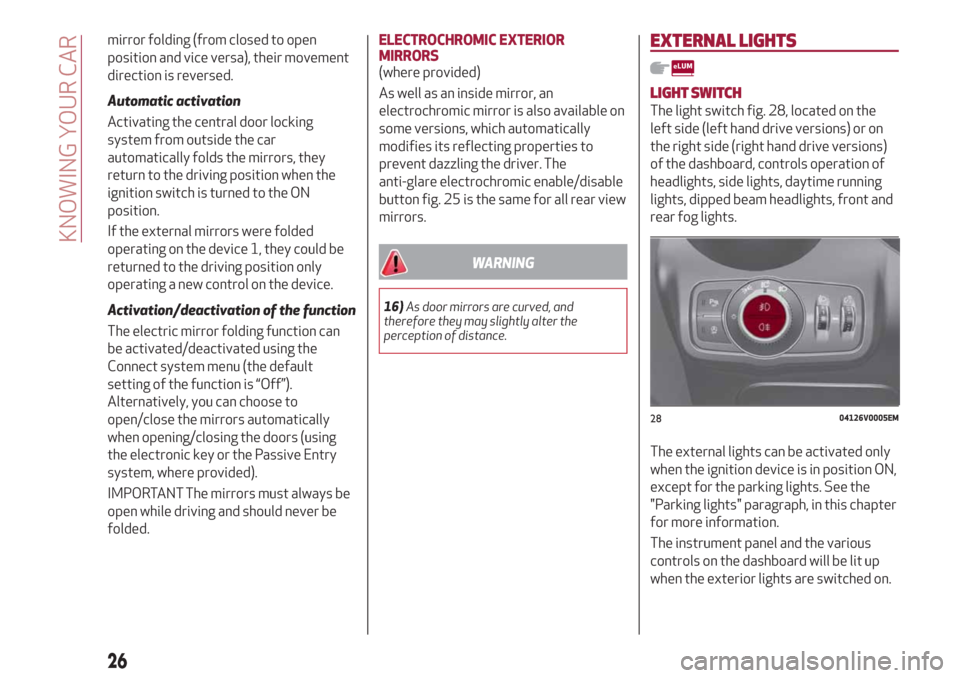
The light switch fig. 28, located on the
left side (left hand drive versions) or on
the right side (right hand drive versions)
of the dashboard, controls operation of
headlights, side lights, daytime running
lights, dipped beam headlights, front and
rear fog lights.
The external lights can be activated only
when the ignition device is in position ON,
except for the parking lights. See the
"Parking lights" paragraph, in this chapter
for more information.
The instrument panel and the various
controls on the dashboard will be lit up
when the exterior lights are switched on.
2804126V0005EM
26
KNOWING YOUR CAR
Page 40 of 244
BONNET
OPENING
22) 23)
Proceed as follows:
inside the passenger compartment
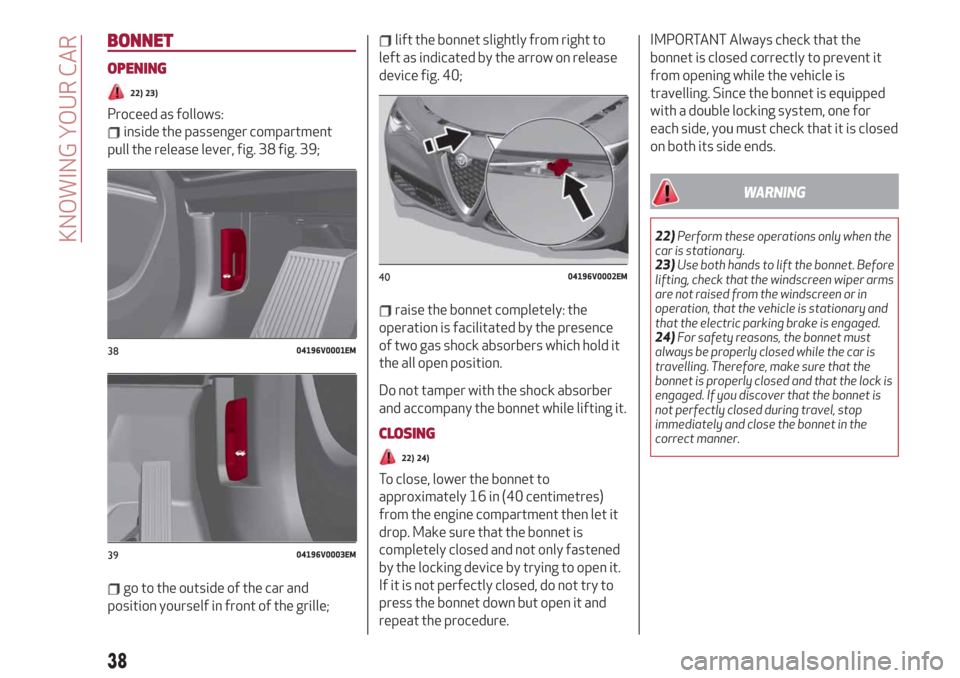
pull the release lever, fig. 38 fig. 39;
go to the outside of the car and
position yourself in front of the grille;
lift the bonnet slightly from right to
left as indicated by the arrow on release
device fig. 40;
raise the bonnet completely: the
operation is facilitated by the presence
of two gas shock absorbers which hold it
the all open position.
Do not tamper with the shock absorber
and accompany the bonnet while lifting it.
CLOSING
22) 24)
To close, lower the bonnet to
approximately 16 in (40 centimetres)
from the engine compartment then let it
drop. Make sure that the bonnet is
completely closed and not only fastened
by the locking device by trying to open it.
If it is not perfectly closed, do not try to
press the bonnet down but open it and
repeat the procedure.
IMPORTANT Always check that the
bonnet is closed correctly to prevent it
from opening while the vehicle is
travelling. Since the bonnet is equipped
with a double locking system, one for
each side, you must check that it is closed
on both its side ends.
WARNING
22)Perform these operations only when the
car is stationary.
23)Use both hands to lift the bonnet. Before
lifting, check that the windscreen wiper arms
are not raised from the windscreen or in
operation, that the vehicle is stationary and
that the electric parking brake is engaged.
24)For safety reasons, the bonnet must
always be properly closed while the car is
travelling. Therefore, make sure that the
bonnet is properly closed and that the lock is
engaged. If you discover that the bonnet is
not perfectly closed during travel, stop
immediately and close the bonnet in the
correct manner.
3804196V0001EM
3904196V0003EM
4004196V0002EM
38
KNOWING YOUR CAR
Page 41 of 244
LUGGAGE COMPARTMENT
TAILGATE
The tailgate is operated electrically, so
pay the utmost attention before
activating its movement.
Safe opening and closing of the tailgate is
guaranteed by a protection system that
can automatically stop its movement
when it encounters an obstacle while
opening or closing.
When the car is moving, tailgate
unlocking and movement are disabled.
To avoid difficulties in tight spaces, you
can set the height at which to block the
tailgate open.
Customising the tailgate opening height
To customise the tailgate opening
position, proceed as described below:
open the tailgate;
manually move it to the position that
you want to store;
press one of the closing buttons 2 or 3
fig. 47 for at least 5 seconds (successful
acquisition is indicated by the direction
indicators flashing three times).
The tailgate is now programmed to open
to the set position.
This function can be selected on the
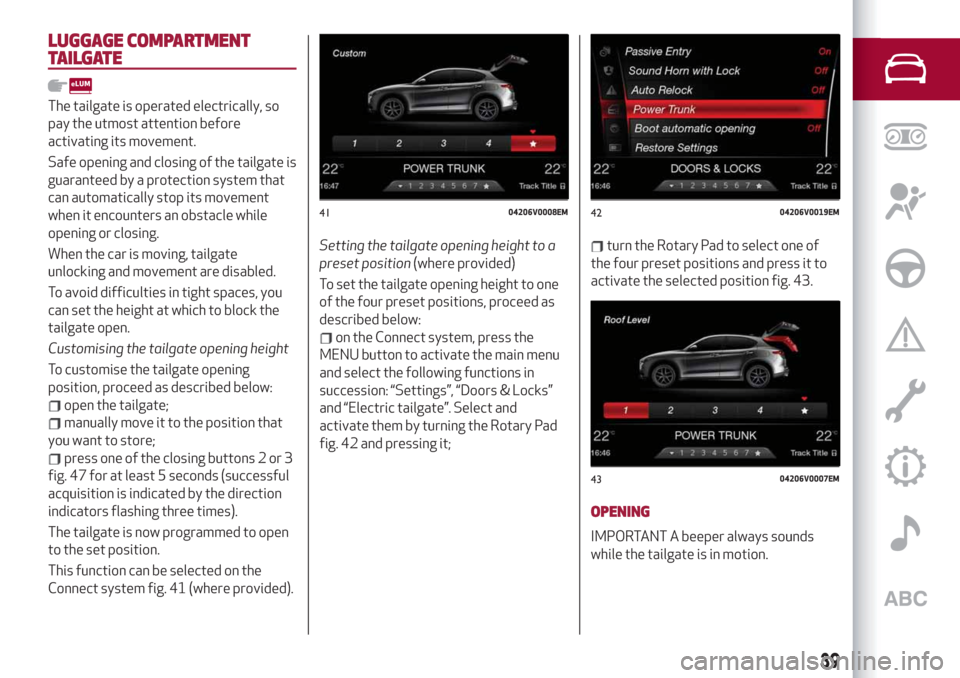
Connect system fig. 41 (where provided).Setting the tailgate opening height to a
preset position(where provided)
To set the tailgate opening height to one
of the four preset positions, proceed as
described below:
on the Connect system, press the
MENU button to activate the main menu
and select the following functions in
succession: “Settings”, “Doors & Locks”
and “Electric tailgate”. Select and
activate them by turning the Rotary Pad
fig. 42 and pressing it;
turn the Rotary Pad to select one of
the four preset positions and press it to
activate the selected position fig. 43.
OPENING
IMPORTANT A beeper always sounds
while the tailgate is in motion.
4104206V0008EM4204206V0019EM
4304206V0007EM
39
Page 42 of 244
Opening from the outside
When unlocked, the tailgate can be
opened from outside the vehicle by
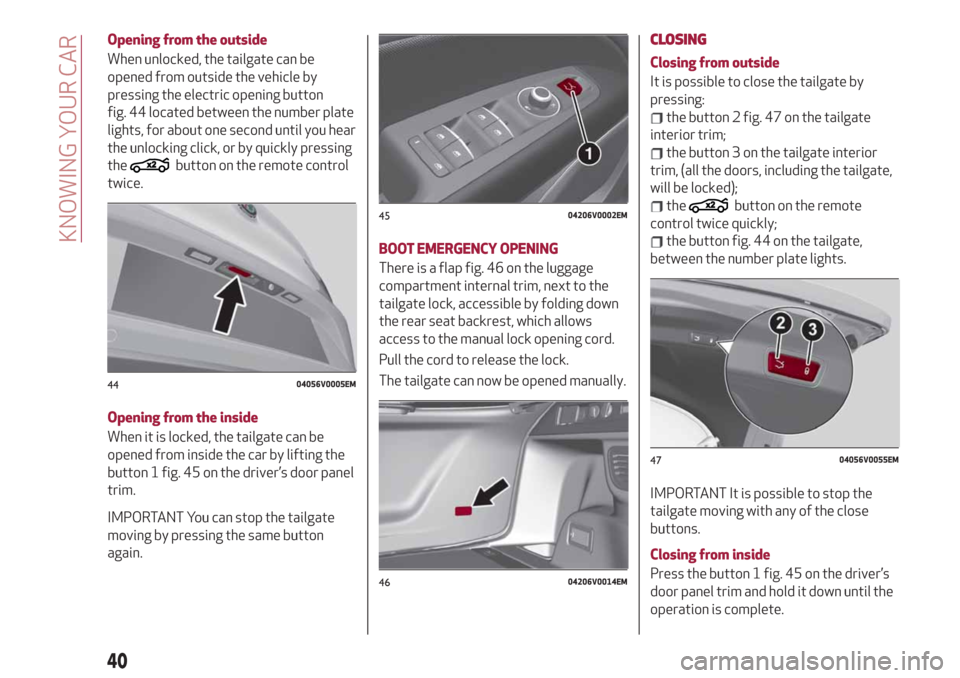
pressing the electric opening button
fig. 44 located between the number plate
lights, for about one second until you hear
the unlocking click, or by quickly pressing
the
button on the remote control
twice.
Opening from the inside
When it is locked, the tailgate can be
opened from inside the car by lifting the
button 1 fig. 45 on the driver’s door panel
trim.
IMPORTANT You can stop the tailgate
moving by pressing the same button
again.
BOOT EMERGENCY OPENING
There is a flap fig. 46 on the luggage
compartment internal trim, next to the
tailgate lock, accessible by folding down
the rear seat backrest, which allows
access to the manual lock opening cord.
Pull the cord to release the lock.
The tailgate can now be opened manually.
CLOSING
Closing from outside
It is possible to close the tailgate by
pressing:
the button 2 fig. 47 on the tailgate
interior trim;
the button 3 on the tailgate interior
trim, (all the doors, including the tailgate,
will be locked);
thebutton on the remote
control twice quickly;
the button fig. 44 on the tailgate,
between the number plate lights.
IMPORTANT It is possible to stop the
tailgate moving with any of the close
buttons.
Closing from inside
Press the button 1 fig. 45 on the driver’s
door panel trim and hold it down until the
operation is complete.
4404056V0005EM
4504206V0002EM
4604206V0014EM
4704056V0055EM
40
KNOWING YOUR CAR
Page 43 of 244
IMPORTANT It is possible to stop the
tailgate moving by releasing the button.
AUTOMATICALLY OPENING AND
CLOSING THE ELECTRICALLY
OPERATED TAILGATE IN “HANDS FREE”
MODE
(where provided)
To operate the system in “Hands free”
mode, proceed as follows:
if the doors are locked or unlocked, the
system must recognize the electronic key
fob near the tailgate;
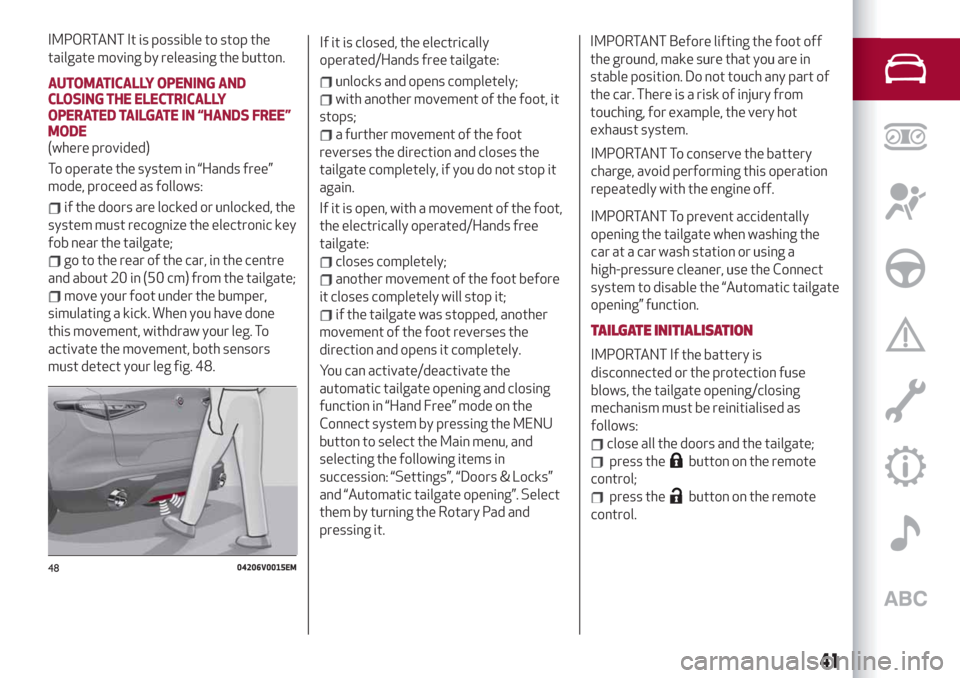
go to the rear of the car, in the centre
and about 20 in (50 cm) from the tailgate;
move your foot under the bumper,
simulating a kick. When you have done
this movement, withdraw your leg. To
activate the movement, both sensors
must detect your leg fig. 48.If it is closed, the electrically
operated/Hands free tailgate:
unlocks and opens completely;
with another movement of the foot, it
stops;
a further movement of the foot
reverses the direction and closes the
tailgate completely, if you do not stop it
again.
If it is open, with a movement of the foot,
the electrically operated/Hands free
tailgate:
closes completely;
another movement of the foot before
it closes completely will stop it;
if the tailgate was stopped, another
movement of the foot reverses the
direction and opens it completely.
You can activate/deactivate the
automatic tailgate opening and closing
function in “Hand Free” mode on the
Connect system by pressing the MENU
button to select the Main menu, and
selecting the following items in
succession: “Settings”, “Doors & Locks”
and “Automatic tailgate opening”. Select
them by turning the Rotary Pad and
pressing it.
IMPORTANT Before lifting the foot off
the ground, make sure that you are in
stable position. Do not touch any part of
the car. There is a risk of injury from
touching, for example, the very hot
exhaust system.
IMPORTANT To conserve the battery
charge, avoid performing this operation
repeatedly with the engine off.
IMPORTANT To prevent accidentally
opening the tailgate when washing the
car at a car wash station or using a
high-pressure cleaner, use the Connect
system to disable the “Automatic tailgate
opening” function.
TAILGATE INITIALISATION
IMPORTANT If the battery is
disconnected or the protection fuse
blows, the tailgate opening/closing
mechanism must be reinitialised as
follows:
close all the doors and the tailgate;
press thebutton on the remote
control;
press thebutton on the remote
control.
4804206V0015EM
41
Page 51 of 244
Units & Language
The following settings can be modified
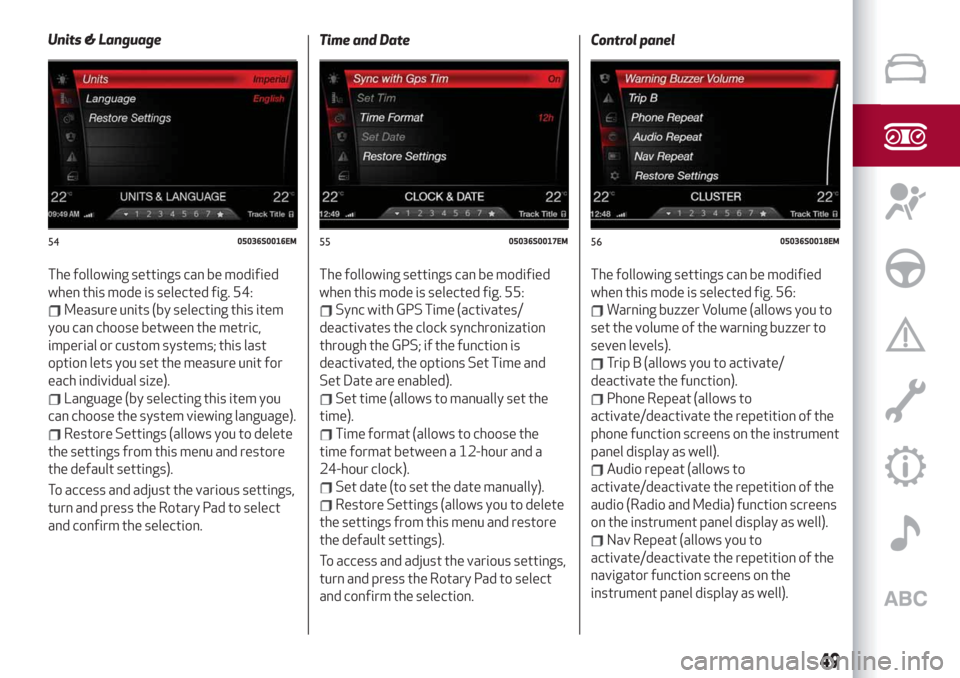
when this mode is selected fig. 54:
Measure units (by selecting this item
you can choose between the metric,
imperial or custom systems; this last
option lets you set the measure unit for
each individual size).
Language (by selecting this item you
can choose the system viewing language).
Restore Settings (allows you to delete
the settings from this menu and restore
the default settings).
To access and adjust the various settings,
turn and press the Rotary Pad to select
and confirm the selection.Time and Date
The following settings can be modified
when this mode is selected fig. 55:
Sync with GPS Time (activates/
deactivates the clock synchronization
through the GPS; if the function is
deactivated, the options Set Time and
Set Date are enabled).
Set time (allows to manually set the
time).
Time format (allows to choose the
time format between a 12-hour and a
24-hour clock).
Set date (to set the date manually).
Restore Settings (allows you to delete
the settings from this menu and restore
the default settings).
To access and adjust the various settings,
turn and press the Rotary Pad to select
and confirm the selection.Control panel
The following settings can be modified
when this mode is selected fig. 56:
Warning buzzer Volume (allows you to
set the volume of the warning buzzer to
seven levels).
Trip B (allows you to activate/
deactivate the function).
Phone Repeat (allows to
activate/deactivate the repetition of the
phone function screens on the instrument
panel display as well).
Audio repeat (allows to
activate/deactivate the repetition of the
audio (Radio and Media) function screens
on the instrument panel display as well).
Nav Repeat (allows you to
activate/deactivate the repetition of the
navigator function screens on the
instrument panel display as well).
5405036S0016EM5505036S0017EM5605036S0018EM
49
Page 54 of 244
WARNING LIGHTS ON INSTRUMENT PANEL
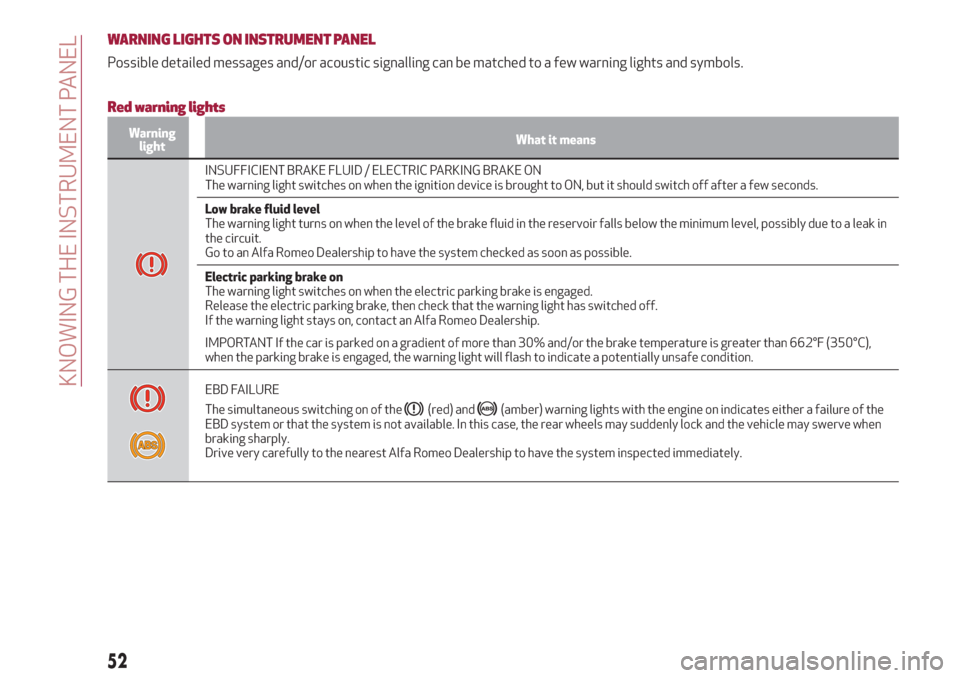
Possible detailed messages and/or acoustic signalling can be matched to a few warning lights and symbols.
Red warning lights
Warning
lightWhat it means
INSUFFICIENT BRAKE FLUID / ELECTRIC PARKING BRAKE ON
The warning light switches on when the ignition device is brought to ON, but it should switch off after a few seconds.
Low brake fluid level
The warning light turns on when the level of the brake fluid in the reservoir falls below the minimum level, possibly due to a leak in
the circuit.
Go to an Alfa Romeo Dealership to have the system checked as soon as possible.
Electric parking brake on
The warning light switches on when the electric parking brake is engaged.
Release the electric parking brake, then check that the warning light has switched off.
If the warning light stays on, contact an Alfa Romeo Dealership.
IMPORTANT If the car is parked on a gradient of more than 30% and/or the brake temperature is greater than 662°F (350°C),
when the parking brake is engaged, the warning light will flash to indicate a potentially unsafe condition.
EBD FAILURE
The simultaneous switching on of the
(red) and(amber) warning lights with the engine on indicates either a failure of the
EBD system or that the system is not available. In this case, the rear wheels may suddenly lock and the vehicle may swerve when
braking sharply.
Drive very carefully to the nearest Alfa Romeo Dealership to have the system inspected immediately.
52
KNOWING THE INSTRUMENT PANEL
Page 67 of 244
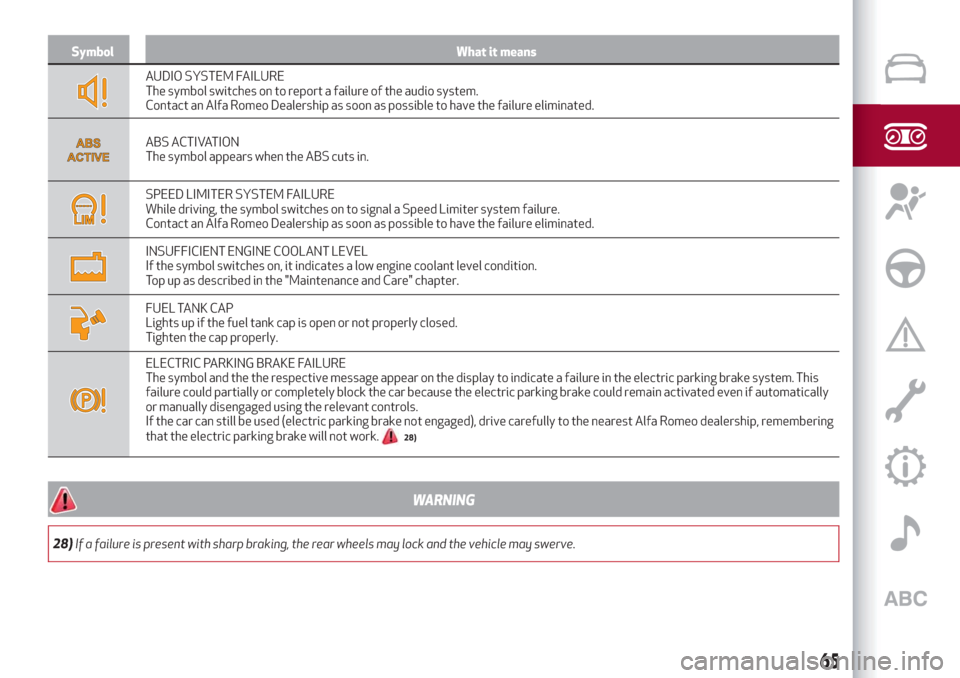
Symbol What it means
AUDIO SYSTEM FAILURE
The symbol switches on to report a failure of the audio system.
Contact an Alfa Romeo Dealership as soon as possible to have the failure eliminated.
ABS ACTIVATION
The symbol appears when the ABS cuts in.
SPEED LIMITER SYSTEM FAILURE
While driving, the symbol switches on to signal a Speed Limiter system failure.
Contact an Alfa Romeo Dealership as soon as possible to have the failure eliminated.
INSUFFICIENT ENGINE COOLANT LEVEL
If the symbol switches on, it indicates a low engine coolant level condition.
Top up as described in the "Maintenance and Care" chapter.
FUEL TANK CAP
Lights up if the fuel tank cap is open or not properly closed.
Tighten the cap properly.
ELECTRIC PARKING BRAKE FAILURE
The symbol and the the respective message appear on the display to indicate a failure in the electric parking brake system. This
failure could partially or completely block the car because the electric parking brake could remain activated even if automatically
or manually disengaged using the relevant controls.
If the car can still be used (electric parking brake not engaged), drive carefully to the nearest Alfa Romeo dealership, remembering
that the electric parking brake will not work.
28)
WARNING
28)If a failure is present with sharp braking, the rear wheels may lock and the vehicle may swerve.
65
Page 74 of 244
ACTIVE SAFETYSYSTEMS
The vehicle may be equipped with the
following active safety devices:
ABS (Anti-Lock Brakes);
DTC (Drive Train Control);
ESC (Electronic Stability Control);
TC (Traction Control);
PBA (Panic Brake Assist);
HSA (Hill Start Assist);
AST (Alfa™ Steering Torque);
HDC (Hill Discent Control)
For the operation of the systems, see the
following pages.
ABS (Anti-lock Braking System)
This system, which is an integral part of
the braking system, prevents one or more
wheels from locking and slipping in all
road surface conditions, irrespective of
the intensity of the braking action,
ensuring that the vehicle can be
controlled even during emergency
braking and optimising stopping
distances.
The system intervenes during braking
when the wheels are about to lock,
typically in emergency braking or
low-grip conditions, when locking may be
more frequent.
The system also improves control and
stability of the vehicle when braking on a
surface where the grip of the left and
right wheels varies, or on corners.The Electronic Braking Force Distribution
(EBD) system completes the system
allowing the brake force to be distributed
between the front and rear wheels.
System intervention
The ABS equipped on this vehicle is
provided with the "Brake by wire"
(Integrated Brake System - IBS) function.
With this system, the brake pedal
command given by pressing the brake
pedal is not transmitted hydraulically but
electronically, therefore, the light
pulsation that could be felt on the pedal
with the traditional system is no longer
perceptible.29) 30) 31) 32) 33) 34)
DTC (Drive Train Control)SYSTEM(where provided)
Some versions of this vehicle are
equipped with a four-wheel drive system
(AWD), activated on request, which offers
an optimal drive for countless driving
conditions and road surfaces. The system
reduces the slipping of the tyres to a
minimum, automatically redistributing
the torque to the front and rear wheels,
as needed.
To maximize fuel savings, the car with
AWD automatically passes to rear-wheel
drive (RWD) when the road and
environmental conditions are such that
they would not cause the tyres to slip.When the road and environmental
conditions require better traction, the
vehicle automatically goes to AWD mode.
35)
IMPORTANT If the system failure symbol
switches on, after starting the engine or
while driving, it means that the AWD
system is not working properly. If the
warning message activates frequently, it
is recommended to carry out the
maintenance operations.
36)
ESC (Electronic Stability Control)
SYSTEM
The ESC system improves the directional
control and stability of the car in various
driving conditions.
The ESC system corrects the car’s
understeer and oversteer, distributing
the brake force on the appropriate
wheels. The torque supplied by the
engine can also be reduced in order to
maintain control of the vehicle.
The ESC system uses sensors installed
on the car to determine the trajectory
that the driver intends to follow and
compares it with the car’s effective
trajectory. When the real trajectory
deviates from the desired trajectory, the
ESC system intervenes to counter the
vehicle’s understeer or oversteer.
Oversteer: occurs when the car is
72
SAFETY
Page 75 of 244
turning more than it should according to
the angle of the steering wheel.
Understeer: occurs when the vehicle is
turning less than it should according to
the angle of the steering wheel.
System intervention
The intervention of the system is
indicated by the flashing of the ESC
warning light on the instrument panel, to
inform the driver that the vehicle
stability and grip are critical.
37) 38) 39) 40) 41)
TC (Traction Control)SYSTEM
The system automatically operates in the
event of slipping, loss of grip on wet
roads (aquaplaning) and acceleration on
slippery, snowy or icy roads, etc. on one
or both drive wheels. Depending on the
slipping conditions, two different control
systems are activated:
if the slipping involves both drive
wheels, the system intervenes, reducing
the power transmitted by the engine;
if the slipping only involves one of the
drive wheels, the BLD (Brake Limited
Differential) function is activated,
automatically braking the wheel which is
slipping (the behaviour of a self-locking
differential is simulated). This will
increase the engine torque transferred to
the wheel which isn't slipping.System intervention
The intervention of the system is
indicated by the flashing of the ESC
warning light on the instrument panel, to
inform the driver that the vehicle
stability and grip are critical.
42) 43) 44) 45) 46)
PBA (Panic Brake Assist)SYSTEM
The PBA system is designed to improve
the vehicle’s braking capacity during
emergency braking.
The system detects emergency braking
by monitoring the speed and force with
which the brake pedal is pressed, and
consequently applies the optimal brake
pressure. This can reduce the braking
distance: the PBA system therefore
complements the ABS.
Maximum assistance from the PBA
system is obtained by pressing the brake
pedal very quickly. In addition, the brake
pedal should be pressed continuously
during braking, avoiding intermittent
presses, to get the most out of the
system. Do not reduce pressure on the
brake pedal until braking is no longer
necessary.
The PBA system is deactivated when the
brake pedal is released.
47) 48) 49)
HSA (Hill Start Assist)SYSTEM
This is an integral part of the ESC system
and facilitates starting on slopes,
activating automatically in the following
cases:
uphill: vehicle stationary on a road
with a gradient higher than 5%, engine
running, brake pressed and transmission
in neutral or gear other than reverse
engaged;
downhill: vehicle stationary on a road
with a gradient higher than 5%, engine
running, brake pressed and reverse gear
engaged.
When setting off, the ESC system control
unit maintains the braking pressure on
the wheels until the engine torque
necessary for starting is reached, or in
any case for a maximum of 2 seconds,
allowing your right foot to be moved
easily from the brake pedal to the
accelerator.
When two seconds have elapsed, without
starting, the system is automatically
deactivated, gradually releasing the
braking pressure. During this release
stage it is possible to hear a typical
mechanical brake release noise,
indicating the imminent movement of the
car.
50) 51)
73