lock Alfa Romeo Stelvio 2019 Owner's Guide
[x] Cancel search | Manufacturer: ALFA ROMEO, Model Year: 2019, Model line: Stelvio, Model: Alfa Romeo Stelvio 2019Pages: 244, PDF Size: 4.95 MB
Page 137 of 244
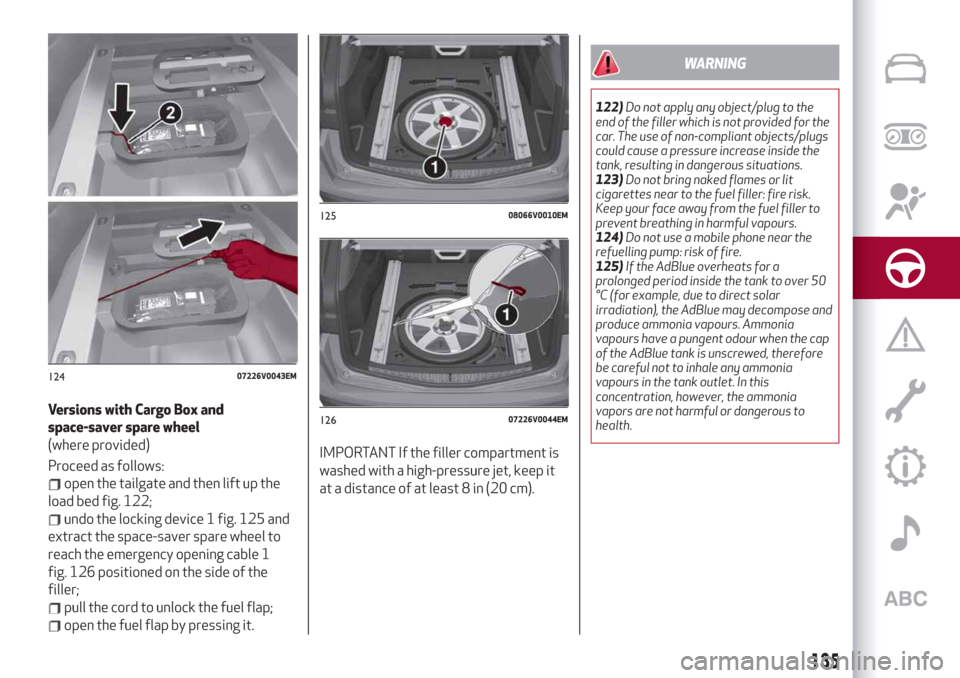
Versions with Cargo Box and
space-saver spare wheel
(where provided)
Proceed as follows:
open the tailgate and then lift up the
load bed fig. 122;
undo the locking device 1 fig. 125 and
extract the space-saver spare wheel to
reach the emergency opening cable 1
fig. 126 positioned on the side of the
filler;
pull the cord to unlock the fuel flap;
open the fuel flap by pressing it.
IMPORTANT If the filler compartment is
washed with a high-pressure jet, keep it
at a distance of at least 8 in (20 cm).
WARNING
122)Do not apply any object/plug to the
end of the filler which is not provided for the
car. The use of non-compliant objects/plugs
could cause a pressure increase inside the
tank, resulting in dangerous situations.
123)Do not bring naked flames or lit
cigarettes near to the fuel filler: fire risk.
Keep your face away from the fuel filler to
prevent breathing in harmful vapours.
124)Do not use a mobile phone near the
refuelling pump: risk of fire.
125)If the AdBlue overheats for a
prolonged period inside the tank to over 50
°C (for example, due to direct solar
irradiation), the AdBlue may decompose and
produce ammonia vapours. Ammonia
vapours have a pungent odour when the cap
of the AdBlue tank is unscrewed, therefore
be careful not to inhale any ammonia
vapours in the tank outlet. In this
concentration, however, the ammonia
vapors are not harmful or dangerous to
health.
12407226V0043EM
12508066V0010EM
12607226V0044EM
135
Page 139 of 244
consumption. In the same way, improper
use of a high gear increases consumption,
emissions and engine wear.
Max. speed
Fuel consumption considerably increases
as speed increases. Maintain a constant
speed, avoiding unnecessary braking and
acceleration, which cost in terms of both
fuel consumption and emissions.
Acceleration
Accelerating violently severely affects
consumption and emissions: acceleration
should be gradual and should not exceed
the maximum torque.CONDITIONS OF USE
Cold starting
Short journeys and frequent cold starts
do not allow the engine to reach optimum
operating temperature. This results in a
significant increase in consumption
levels (from +15 to +30% on the urban
cycle) and emissions.
Traffic and road conditions
High fuel consumption is caused by heavy
traffic, for instance when travelling in a
queue with frequent use of low gears or
in cities with many traffic lights. Winding
mountain roads and rough road surfaces
also adversely affect consumption.
Stops in traffic
During prolonged hold-ups (e.g. level
crossings) switch off the engine.
TOWING TRAILERS
126) 127)
TOW HOOK SETUP
Instructions for using the removable
ball head tow hook
IMPORTANT NOTE Before setting off,
checkthat the removable ball head tow
hook islockedcorrectly. To do this, check
the following conditions:
the green mark on the knob must
coincide with the green mark on the tow
hook fixing bracket;
the knob must be at the end of its
travel, resting on the tow hook fixing
bracket (no crack);
the lock on the knob must be locked
with the key removed. The knob cannot
be removed;
the tow hook fixing bracket must be
firmly attached to the mounting pipe on
the car. Check by shaking with a hand.
The installation procedure must be
repeated if any of these requirements is
NOT met.
If even only one of the requirements is
not met the tow hookmust notbe used,
since there is risk of causing accidents.
Contact an Alfa Romeo Dealership.
The ball head tow hook can be
fitted/removed manually without the
need for specific tools.
137
Page 140 of 244
IMPORTANT Never use cars or work
tools: the mechanism may be damaged.
IMPORTANT NOTE Do not release the
tow hook when it is attached to a trailer
or cargo-carrier.
IMPORTANT NOTE When driving without
trailer (or without a cargo-carrier), the
ball head tow hook must be removed and
the closing cap must always be inserted
in the hook mounting pipe. This applies
particularly if the tow hook reduces
visibility of the number plate or the
lighting system.
For the electrical connection, a 13 pin
12 V DC connection is to be used
(CUNA/UNI and ISO/DIN Standards).
Follow the instructions provided by the
vehicle Manufacturer and/or the tow
hook Manufacturer.
Installing the tow hook
Before inserting the tow hook, you must
remove the access cover to the tow hook
fixing position under the rear bumper.
Remove the protection cap from the
tow hook mounting pipe fig. 127;
get the tow hook from the luggage
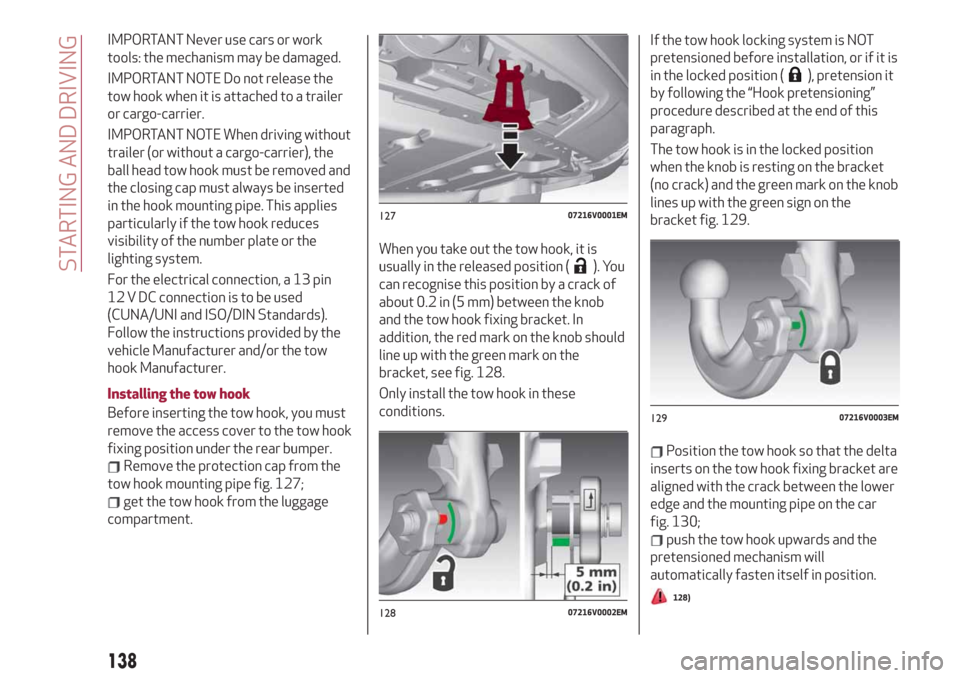
compartment.When you take out the tow hook, it is
usually in the released position (
). You
can recognise this position by a crack of
about 0.2 in (5 mm) between the knob
and the tow hook fixing bracket. In
addition, the red mark on the knob should
line up with the green mark on the
bracket, see fig. 128.
Only install the tow hook in these
conditions.If the tow hook locking system is NOT
pretensioned before installation, or if it is
in the locked position (
), pretension it
by following the “Hook pretensioning”
procedure described at the end of this
paragraph.
The tow hook is in the locked position
when the knob is resting on the bracket
(no crack) and the green mark on the knob
lines up with the green sign on the
bracket fig. 129.
Position the tow hook so that the delta
inserts on the tow hook fixing bracket are
aligned with the crack between the lower
edge and the mounting pipe on the car
fig. 130;
push the tow hook upwards and the
pretensioned mechanism will
automatically fasten itself in position.
128)
12707216V0001EM
12807216V0002EM
12907216V0003EM
138
STARTING AND DRIVING
Page 141 of 244
Use the supplied key to close the
mechanism:
insert the key into the lock on the
knob, turn it fully anticlockwise and
remove it;
fasten the protection cap onto the
lock.
IMPORTANT The key can only be
removed when the locking mechanism is
closed (
).
IMPORTANT To prevent losing the key
while towing, DO NOT leave it in the lock.
Remove the ball protection cover from
the tow hook and attach the trailer.
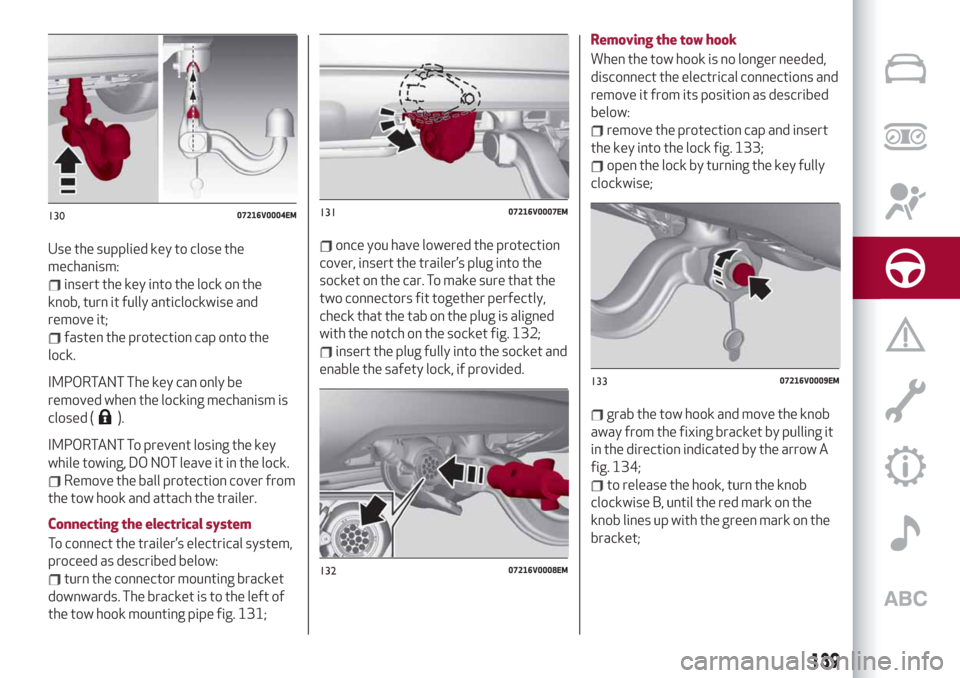
Connecting the electrical system
To connect the trailer’s electrical system,
proceed as described below:
turn the connector mounting bracket
downwards. The bracket is to the left of
the tow hook mounting pipe fig. 131;
once you have lowered the protection
cover, insert the trailer’s plug into the
socket on the car. To make sure that the
two connectors fit together perfectly,
check that the tab on the plug is aligned
with the notch on the socket fig. 132;
insert the plug fully into the socket and
enable the safety lock, if provided.Removing the tow hook
When the tow hook is no longer needed,
disconnect the electrical connections and
remove it from its position as described
below:
remove the protection cap and insert
the key into the lock fig. 133;
open the lock by turning the key fully
clockwise;
grab the tow hook and move the knob
away from the fixing bracket by pulling it
in the direction indicated by the arrow A
fig. 134;
to release the hook, turn the knob
clockwise B, until the red mark on the
knob lines up with the green mark on the
bracket;
13007216V0004EM13107216V0007EM
13207216V0008EM
13307216V0009EM
139
Page 142 of 244
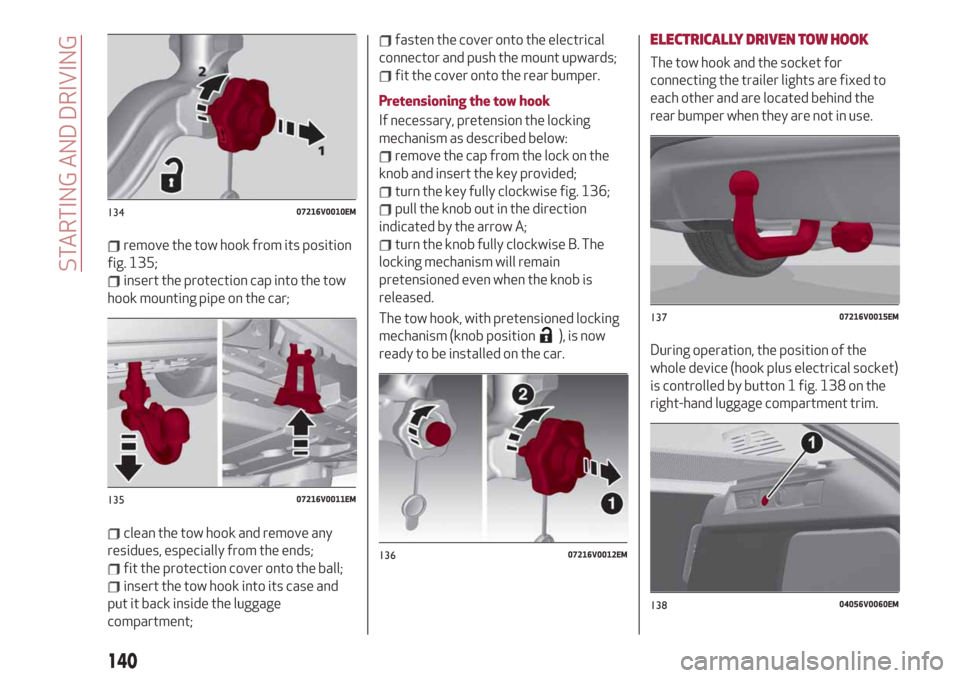
remove the tow hook from its position
fig. 135;
insert the protection cap into the tow
hook mounting pipe on the car;
clean the tow hook and remove any
residues, especially from the ends;
fit the protection cover onto the ball;
insert the tow hook into its case and
put it back inside the luggage
compartment;
fasten the cover onto the electrical
connector and push the mount upwards;
fit the cover onto the rear bumper.
Pretensioning the tow hook
If necessary, pretension the locking
mechanism as described below:
remove the cap from the lock on the
knob and insert the key provided;
turn the key fully clockwise fig. 136;
pull the knob out in the direction
indicated by the arrow A;
turn the knob fully clockwise B. The
locking mechanism will remain
pretensioned even when the knob is
released.
The tow hook, with pretensioned locking
mechanism (knob position
), is now
ready to be installed on the car.
ELECTRICALLY DRIVEN TOW HOOK
The tow hook and the socket for
connecting the trailer lights are fixed to
each other and are located behind the
rear bumper when they are not in use.
During operation, the position of the
whole device (hook plus electrical socket)
is controlled by button 1 fig. 138 on the
right-hand luggage compartment trim.
13407216V0010EM
13507216V0011EM
13607216V0012EM
13707216V0015EM
13804056V0060EM
140
STARTING AND DRIVING
Page 143 of 244
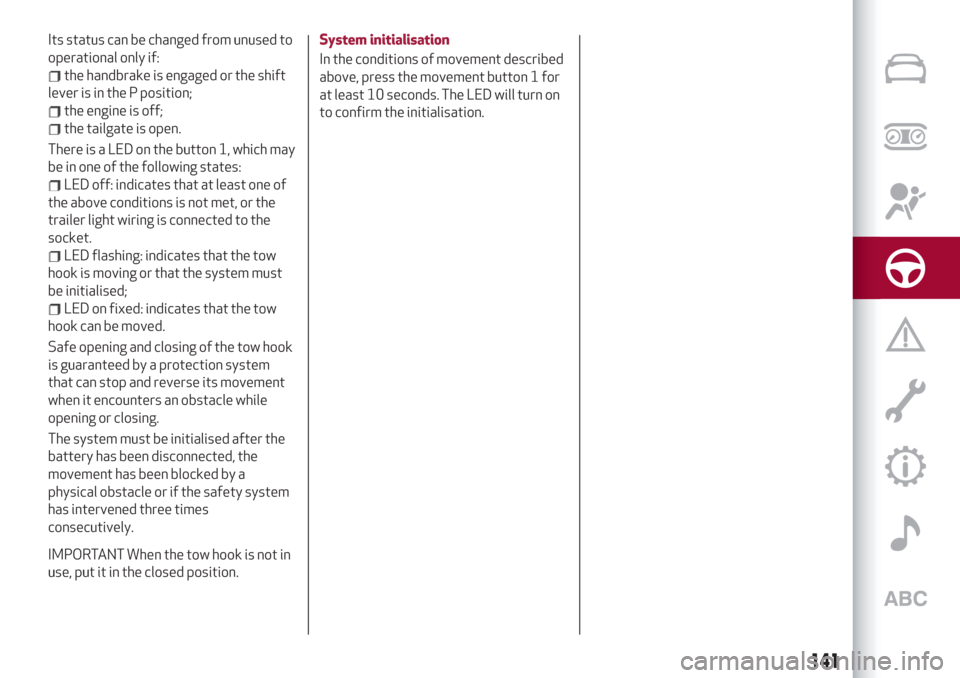
Its status can be changed from unused to
operational only if:
the handbrake is engaged or the shift
lever is in the P position;
the engine is off;
the tailgate is open.
There is a LED on the button 1, which may
be in one of the following states:
LED off: indicates that at least one of
the above conditions is not met, or the
trailer light wiring is connected to the
socket.
LED flashing: indicates that the tow
hook is moving or that the system must
be initialised;
LED on fixed: indicates that the tow
hook can be moved.
Safe opening and closing of the tow hook
is guaranteed by a protection system
that can stop and reverse its movement
when it encounters an obstacle while
opening or closing.
The system must be initialised after the
battery has been disconnected, the
movement has been blocked by a
physical obstacle or if the safety system
has intervened three times
consecutively.
IMPORTANT When the tow hook is not in
use, put it in the closed position.
System initialisation
In the conditions of movement described
above, press the movement button 1 for
at least 10 seconds. The LED will turn on
to confirm the initialisation.
141
Page 147 of 244
A punctured tyre or a burnt-out bulb?
At times, a problem may interfere with our journey.
The pages on emergencies can help you to deal with critical
situations independently and with calm.
In an emergency we recommend that you call the freephone
number found in the Warranty Booklet.
You can also use the universal, national or international freephone
number to find your nearest Alfa Romeo Dealership.
IN AN EMERGENCY
HAZARD WARNING LIGHTS.......................146
CHANGING A BULB............................146
REPLACING FUSES . ...........................151
CHANGING A WHEEL ...........................157
TIRE REPAIR KIT . .............................160
RUN FLAT TYRES.............................163
JUMP STARTING..............................163
FUEL CUT-OFF SYSTEM . ........................165
AUTOMATIC TRANSMISSION GEAR LEVER UNLOCKING.....165
BROKEN-DOWN VEHICLE TOWING..................166
TOWING THE VEHICLE..........................166
Page 149 of 244
TYPES OF BULBS
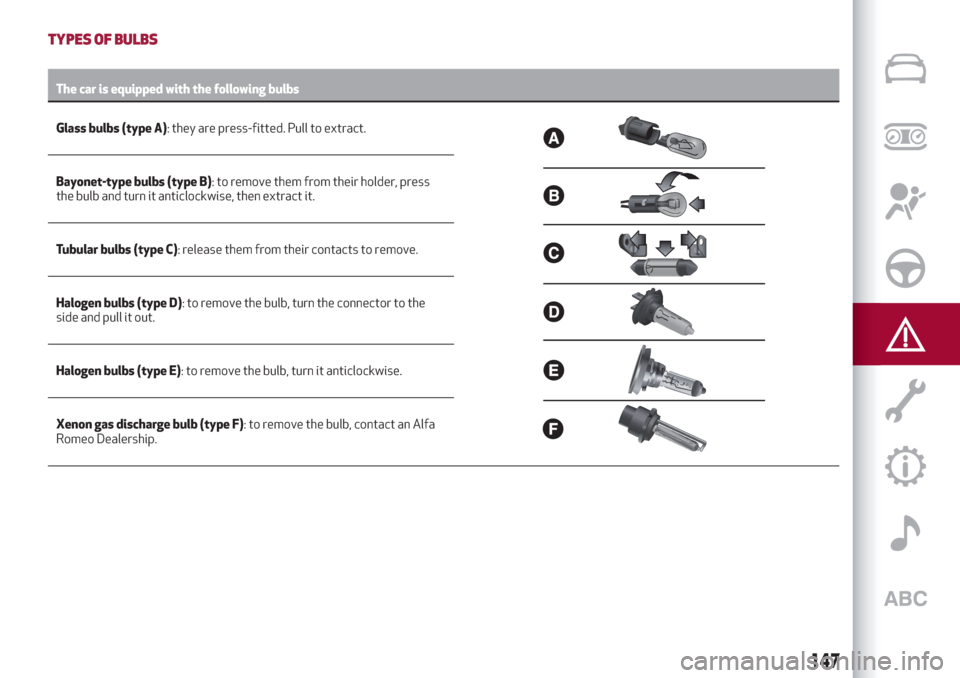
The car is equipped with the following bulbs
Glass bulbs (type A): they are press-fitted. Pull to extract.
Bayonet-type bulbs (type B): to remove them from their holder, press
the bulb and turn it anticlockwise, then extract it.
Tubular bulbs (type C): release them from their contacts to remove.
Halogen bulbs (type D): to remove the bulb, turn the connector to the
side and pull it out.
Halogen bulbs (type E): to remove the bulb, turn it anticlockwise.
Xenon gas discharge bulb (type F): to remove the bulb, contact an Alfa
Romeo Dealership.
147
Page 151 of 244
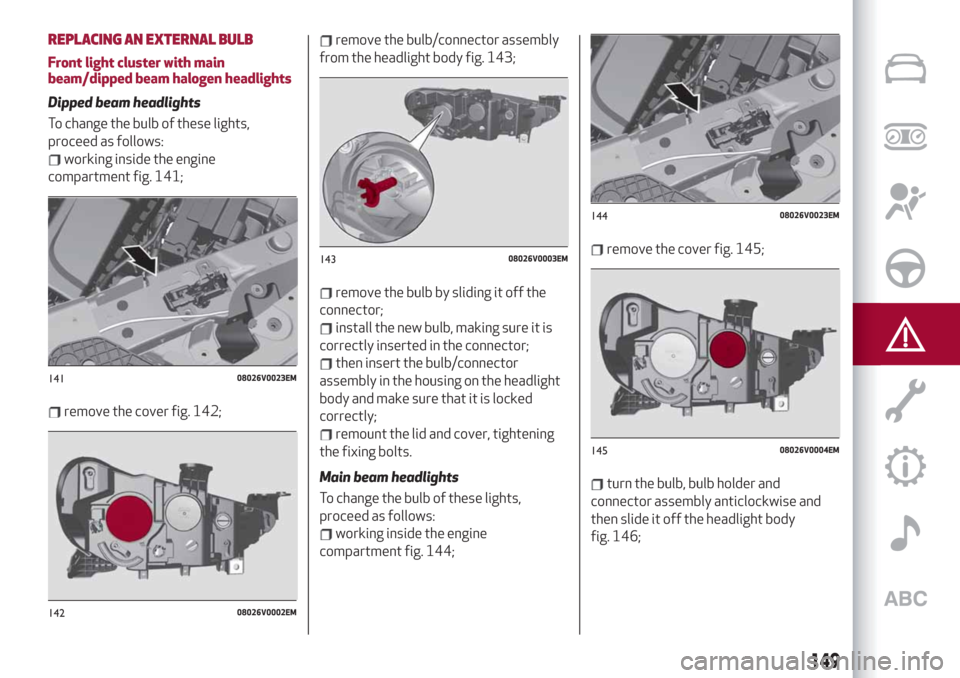
REPLACING AN EXTERNAL BULB
Front light cluster with main
beam/dipped beam halogen headlights
Dipped beam headlights
To change the bulb of these lights,
proceed as follows:
working inside the engine
compartment fig. 141;
remove the cover fig. 142;
remove the bulb/connector assembly
from the headlight body fig. 143;
remove the bulb by sliding it off the
connector;
install the new bulb, making sure it is
correctly inserted in the connector;
then insert the bulb/connector
assembly in the housing on the headlight
body and make sure that it is locked
correctly;
remount the lid and cover, tightening
the fixing bolts.
Main beam headlights
To change the bulb of these lights,
proceed as follows:
working inside the engine
compartment fig. 144;
remove the cover fig. 145;
turn the bulb, bulb holder and
connector assembly anticlockwise and
then slide it off the headlight body
fig. 146;
14108026V0023EM
14208026V0002EM
14308026V0003EM
14408026V0023EM
14508026V0004EM
149
Page 152 of 244
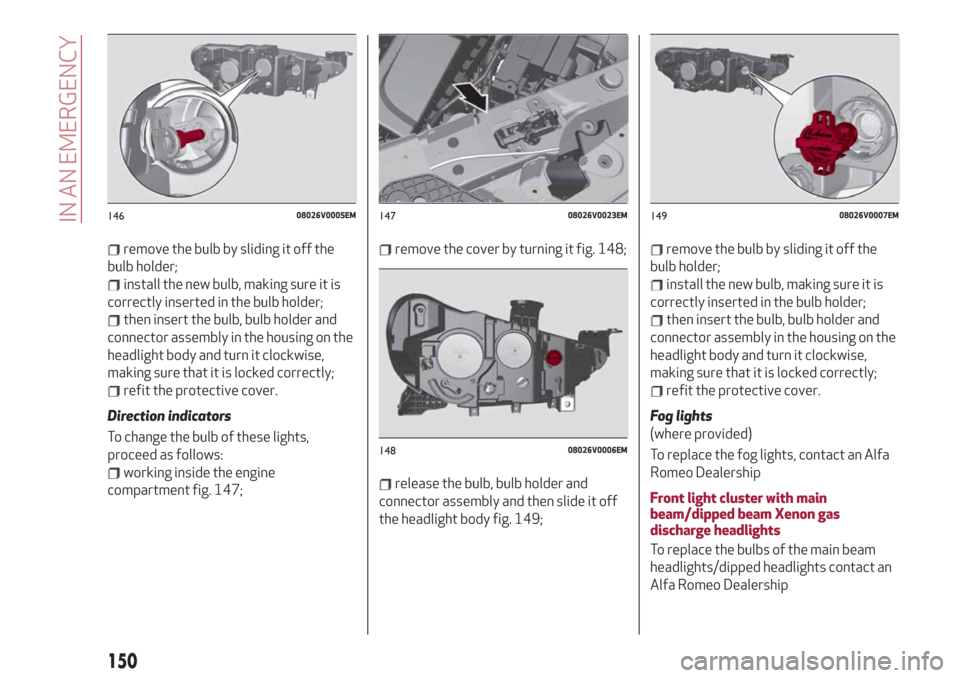
remove the bulb by sliding it off the
bulb holder;
install the new bulb, making sure it is
correctly inserted in the bulb holder;
then insert the bulb, bulb holder and
connector assembly in the housing on the
headlight body and turn it clockwise,
making sure that it is locked correctly;
refit the protective cover.
Direction indicators
To change the bulb of these lights,
proceed as follows:
working inside the engine
compartment fig. 147;
remove the cover by turning it fig. 148;
release the bulb, bulb holder and
connector assembly and then slide it off
the headlight body fig. 149;
remove the bulb by sliding it off the
bulb holder;
install the new bulb, making sure it is
correctly inserted in the bulb holder;
then insert the bulb, bulb holder and
connector assembly in the housing on the
headlight body and turn it clockwise,
making sure that it is locked correctly;
refit the protective cover.
Fog lights
(where provided)
To replace the fog lights, contact an Alfa
Romeo Dealership
Front light cluster with main
beam/dipped beam Xenon gas
discharge headlights
To replace the bulbs of the main beam
headlights/dipped headlights contact an
Alfa Romeo Dealership
14608026V0005EM14708026V0023EM
14808026V0006EM
14908026V0007EM
150
IN AN EMERGENCY