display Alfa Romeo Stelvio 2019 Owner's Guide
[x] Cancel search | Manufacturer: ALFA ROMEO, Model Year: 2019, Model line: Stelvio, Model: Alfa Romeo Stelvio 2019Pages: 244, PDF Size: 4.95 MB
Page 66 of 244
Symbol What it means
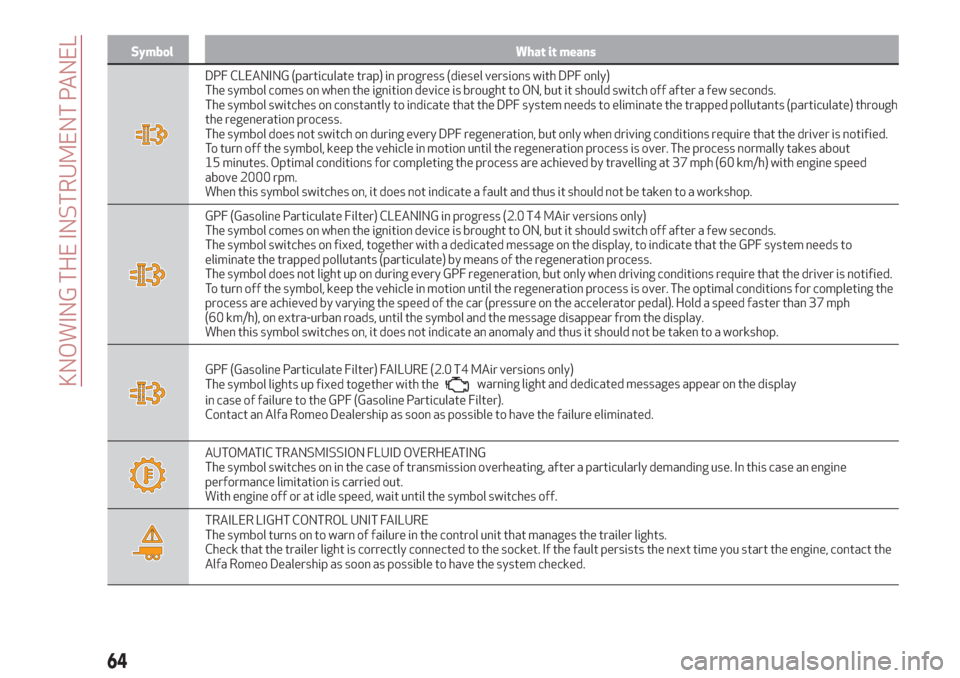
DPF CLEANING (particulate trap) in progress (diesel versions with DPF only)
The symbol comes on when the ignition device is brought to ON, but it should switch off after a few seconds.
The symbol switches on constantly to indicate that the DPF system needs to eliminate the trapped pollutants (particulate) through
the regeneration process.
The symbol does not switch on during every DPF regeneration, but only when driving conditions require that the driver is notified.
To turn off the symbol, keep the vehicle in motion until the regeneration process is over. The process normally takes about
15 minutes. Optimal conditions for completing the process are achieved by travelling at 37 mph (60 km/h) with engine speed
above 2000 rpm.
When this symbol switches on, it does not indicate a fault and thus it should not be taken to a workshop.
GPF (Gasoline Particulate Filter) CLEANING in progress (2.0 T4 MAir versions only)
The symbol comes on when the ignition device is brought to ON, but it should switch off after a few seconds.
The symbol switches on fixed, together with a dedicated message on the display, to indicate that the GPF system needs to
eliminate the trapped pollutants (particulate) by means of the regeneration process.
The symbol does not light up on during every GPF regeneration, but only when driving conditions require that the driver is notified.
To turn off the symbol, keep the vehicle in motion until the regeneration process is over. The optimal conditions for completing the
process are achieved by varying the speed of the car (pressure on the accelerator pedal). Hold a speed faster than 37 mph
(60 km/h), on extra-urban roads, until the symbol and the message disappear from the display.
When this symbol switches on, it does not indicate an anomaly and thus it should not be taken to a workshop.
GPF (Gasoline Particulate Filter) FAILURE (2.0 T4 MAir versions only)
The symbol lights up fixed together with the
in case of failure to the GPF (Gasoline Particulate Filter).
Contact an Alfa Romeo Dealership as soon as possible to have the failure eliminated.
AUTOMATIC TRANSMISSION FLUID OVERHEATING
The symbol switches on in the case of transmission overheating, after a particularly demanding use. In this case an engine
performance limitation is carried out.
With engine off or at idle speed, wait until the symbol switches off.
TRAILER LIGHT CONTROL UNIT FAILURE
The symbol turns on to warn of failure in the control unit that manages the trailer lights.
Check that the trailer light is correctly connected to the socket. If the fault persists the next time you start the engine, contact the
Alfa Romeo Dealership as soon as possible to have the system checked.
64
KNOWING THE INSTRUMENT PANELwarning light and dedicated messages appear on the display
Page 67 of 244
Symbol What it means
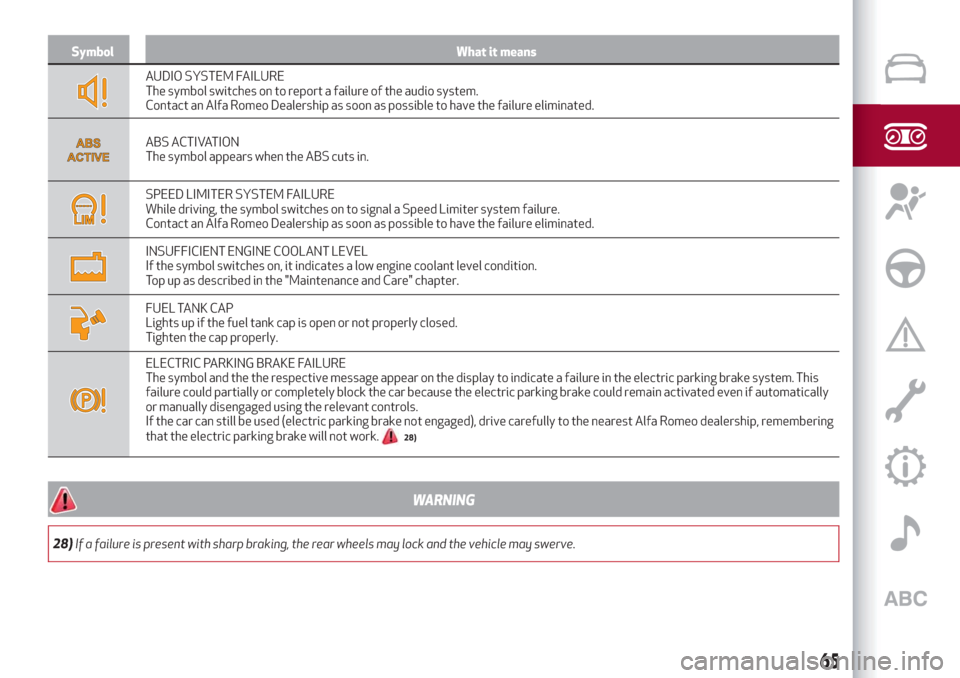
AUDIO SYSTEM FAILURE
The symbol switches on to report a failure of the audio system.
Contact an Alfa Romeo Dealership as soon as possible to have the failure eliminated.
ABS ACTIVATION
The symbol appears when the ABS cuts in.
SPEED LIMITER SYSTEM FAILURE
While driving, the symbol switches on to signal a Speed Limiter system failure.
Contact an Alfa Romeo Dealership as soon as possible to have the failure eliminated.
INSUFFICIENT ENGINE COOLANT LEVEL
If the symbol switches on, it indicates a low engine coolant level condition.
Top up as described in the "Maintenance and Care" chapter.
FUEL TANK CAP
Lights up if the fuel tank cap is open or not properly closed.
Tighten the cap properly.
ELECTRIC PARKING BRAKE FAILURE
The symbol and the the respective message appear on the display to indicate a failure in the electric parking brake system. This
failure could partially or completely block the car because the electric parking brake could remain activated even if automatically
or manually disengaged using the relevant controls.
If the car can still be used (electric parking brake not engaged), drive carefully to the nearest Alfa Romeo dealership, remembering
that the electric parking brake will not work.
28)
WARNING
28)If a failure is present with sharp braking, the rear wheels may lock and the vehicle may swerve.
65
Page 68 of 244
Symbol What it means
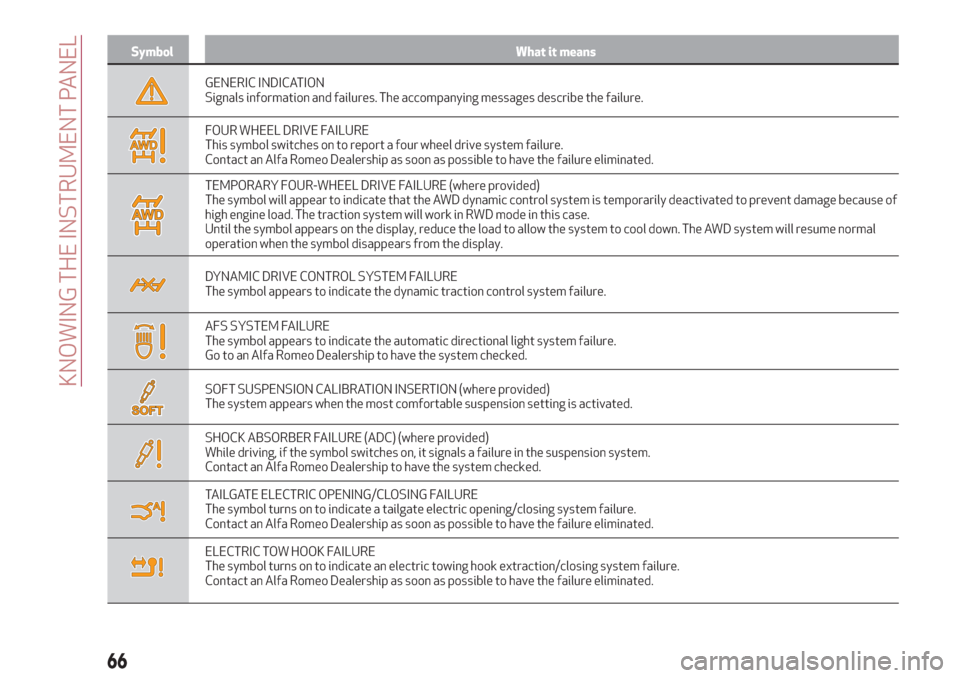
GENERIC INDICATION
Signals information and failures. The accompanying messages describe the failure.
FOUR WHEEL DRIVE FAILURE
This symbol switches on to report a four wheel drive system failure.
Contact an Alfa Romeo Dealership as soon as possible to have the failure eliminated.
TEMPORARY FOUR-WHEEL DRIVE FAILURE (where provided)
The symbol will appear to indicate that the AWD dynamic control system is temporarily deactivated to prevent damage because of
high engine load. The traction system will work in RWD mode in this case.
Until the symbol appears on the display, reduce the load to allow the system to cool down. The AWD system will resume normal
operation when the symbol disappears from the display.
DYNAMIC DRIVE CONTROL SYSTEM FAILURE
The symbol appears to indicate the dynamic traction control system failure.
AFS SYSTEM FAILURE
The symbol appears to indicate the automatic directional light system failure.
Go to an Alfa Romeo Dealership to have the system checked.
SOFT SUSPENSION CALIBRATION INSERTION (where provided)
The system appears when the most comfortable suspension setting is activated.
SHOCK ABSORBER FAILURE (ADC) (where provided)
While driving, if the symbol switches on, it signals a failure in the suspension system.
Contact an Alfa Romeo Dealership to have the system checked.
TAILGATE ELECTRIC OPENING/CLOSING FAILURE
The symbol turns on to indicate a tailgate electric opening/closing system failure.
Contact an Alfa Romeo Dealership as soon as possible to have the failure eliminated.
ELECTRIC TOW HOOK FAILURE
The symbol turns on to indicate an electric towing hook extraction/closing system failure.
Contact an Alfa Romeo Dealership as soon as possible to have the failure eliminated.
66
KNOWING THE INSTRUMENT PANEL
Page 69 of 244
Symbol What it means
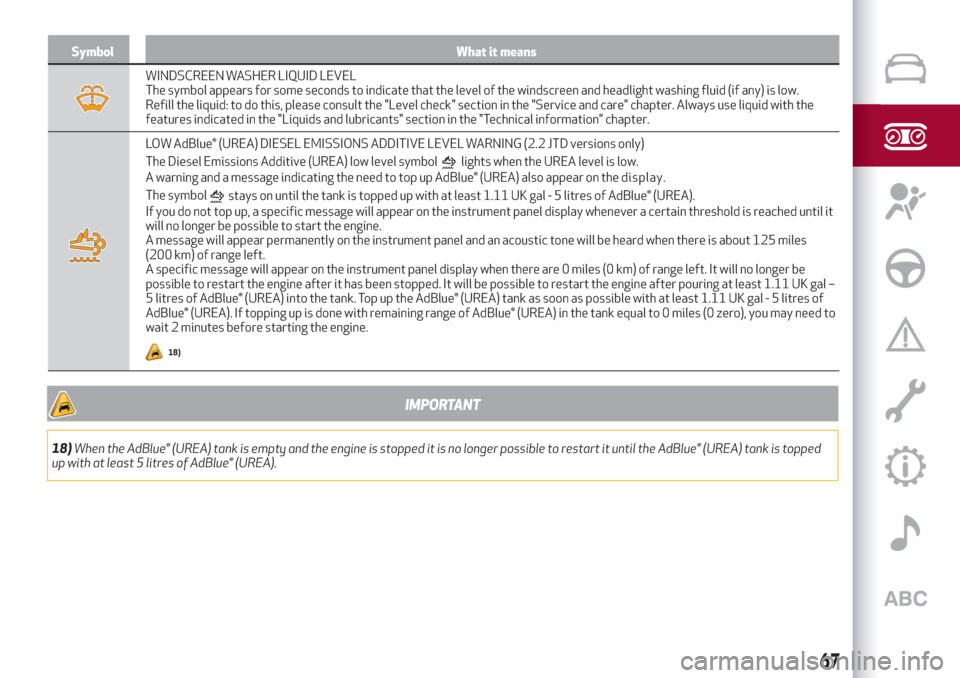
WINDSCREEN WASHER LIQUID LEVEL
The symbol appears for some seconds to indicate that the level of the windscreen and headlight washing fluid (if any) is low.
Refill the liquid: to do this, please consult the "Level check" section in the "Service and care" chapter. Always use liquid with the
features indicated in the "Liquids and lubricants" section in the "Technical information" chapter.
LOW AdBlue® (UREA) DIESEL EMISSIONS ADDITIVE LEVEL WARNING (2.2 JTD versions only)
The Diesel Emissions Additive (UREA) low level symbol
A warning and a message indicating the need to top up AdBlue® (UREA) also appear on the display.
The symbol
stays on until the tank is topped up with at least 1.11 UK gal - 5 litres of AdBlue® (UREA).
If you do not top up, a specific message will appear on the instrument panel display whenever a certain threshold is reached until it
will no longer be possible to start the engine.
A message will appear permanently on the instrument panel and an acoustic tone will be heard when there is about 125 miles
(200 km) of range left.
A specific message will appear on the instrument panel display when there are 0 miles (0 km) of range left. It will no longer be
possible to restart the engine after it has been stopped. It will be possible to restart the engine after pouring at least 1.11 UK gal –
5 litres of AdBlue® (UREA) into the tank. Top up the AdBlue® (UREA) tank as soon as possible with at least 1.11 UK gal - 5 litres of
AdBlue® (UREA). If topping up is done with remaining range of AdBlue® (UREA) in the tank equal to 0 miles (0 zero), you may need to
wait 2 minutes before starting the engine.
18)
67
lights when the UREA level is low.
IMPORTANT
18)When the AdBlue® (UREA) tank is empty and the engine is stopped it is no longer possible to restart it until the AdBlue® (UREA) tank is topped
up with at least 5 litres of AdBlue® (UREA).
Page 71 of 244
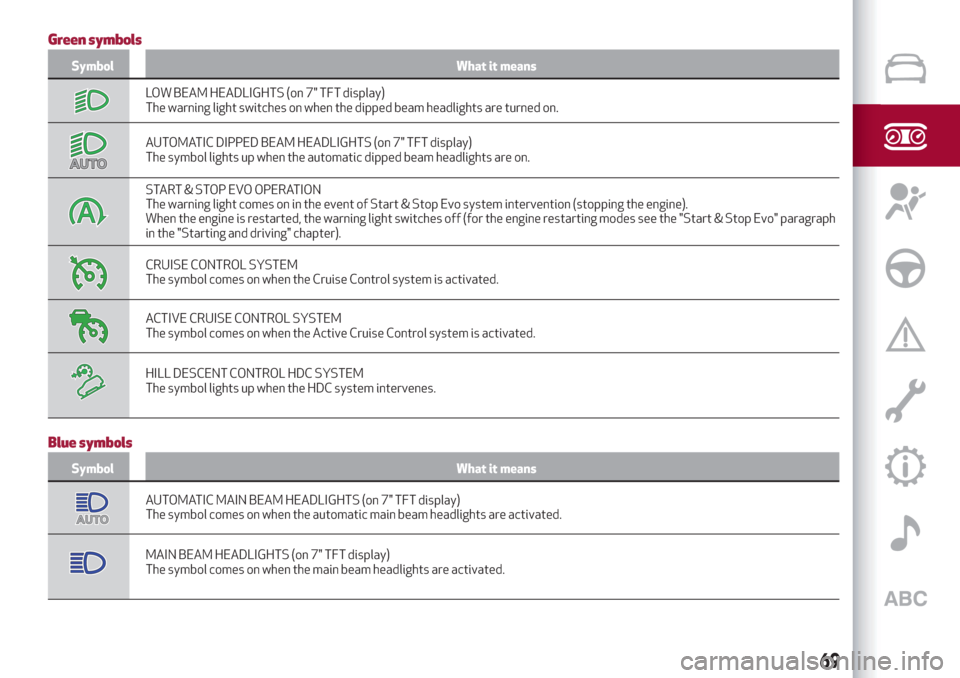
Green symbols
Symbol What it means
LOW BEAM HEADLIGHTS (on 7" TFT display)
The warning light switches on when the dipped beam headlights are turned on.
AUTOMATIC DIPPED BEAM HEADLIGHTS (on 7" TFT display)
The symbol lights up when the automatic dipped beam headlights are on.
START & STOP EVO OPERATION
The warning light comes on in the event of Start & Stop Evo system intervention (stopping the engine).
When the engine is restarted, the warning light switches off (for the engine restarting modes see the "Start & Stop Evo" paragraph
in the "Starting and driving" chapter).
CRUISE CONTROL SYSTEM
The symbol comes on when the Cruise Control system is activated.
ACTIVE CRUISE CONTROL SYSTEM
The symbol comes on when the Active Cruise Control system is activated.
HILL DESCENT CONTROL HDC SYSTEM
The symbol lights up when the HDC system intervenes.
Blue symbols
Symbol What it means
AUTOMATIC MAIN BEAM HEADLIGHTS (on 7" TFT display)
The symbol comes on when the automatic main beam headlights are activated.
MAIN BEAM HEADLIGHTS (on 7" TFT display)
The symbol comes on when the main beam headlights are activated.
69
Page 76 of 244
AST (Alfa™ Steering Torque)SYSTEM
52)
The AST function integrates the ESC
system with the electric power steering
to increase the safety level of the whole
vehicle.
In critical situations (braking on surfaces
with different grip conditions), through
the AST function, the ESC system
controls the steering to implement an
additional torque contribution on the
steering wheel, to suggest the most
correct manoeuvre to the driver.
The coordinated action of the brakes and
steering increases the sensation of
safety and control of the vehicle.
HDC (Hill Descent Control)SYSTEM(where provided)
On vehicles equipped in this way, this
function is an integral part of the ESC
system and is aimed at keeping the
vehicle at a constant speed during a
descent, operating autonomously and in
different ways on the brakes.
In this way the vehicle stability and
completely safe driving are guaranteed,
above all in poor grip conditions and
steep descents.The system has three different modes:
Off: the system is deactivated;
Enabled: the system is enabled and
ready to intervene when the activation
conditions are met;
Active: the system actively controls
the car speed.
Enabling the system
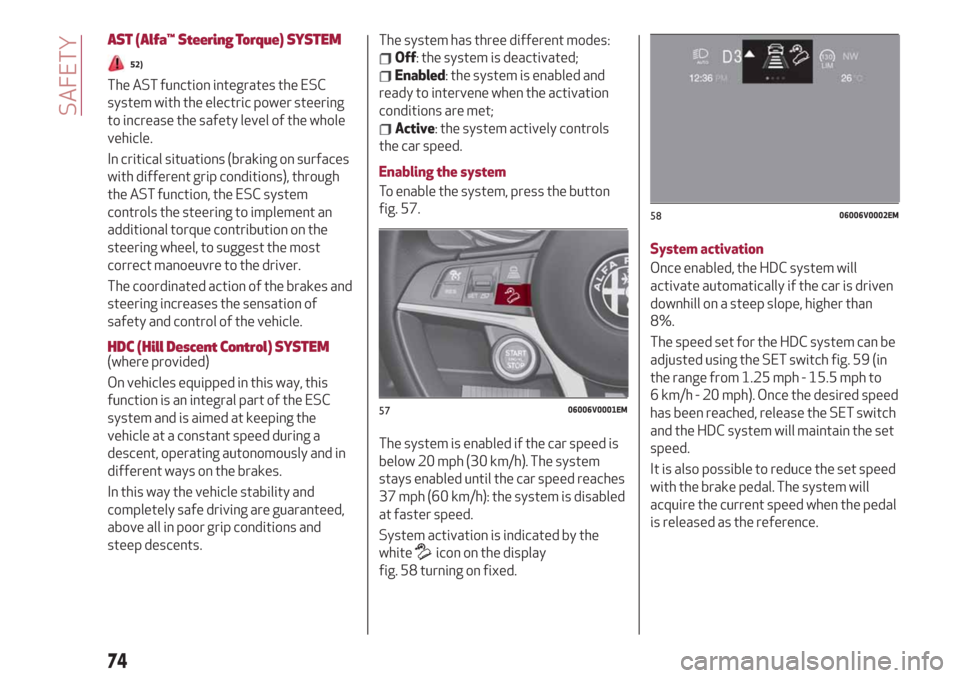
To enable the system, press the button
fig. 57.
The system is enabled if the car speed is
below 20 mph (30 km/h). The system
stays enabled until the car speed reaches
37 mph (60 km/h): the system is disabled
at faster speed.
System activation is indicated by the
white
icon on the display
fig. 58 turning on fixed.System activation
Once enabled, the HDC system will
activate automatically if the car is driven
downhill on a steep slope, higher than
8%.
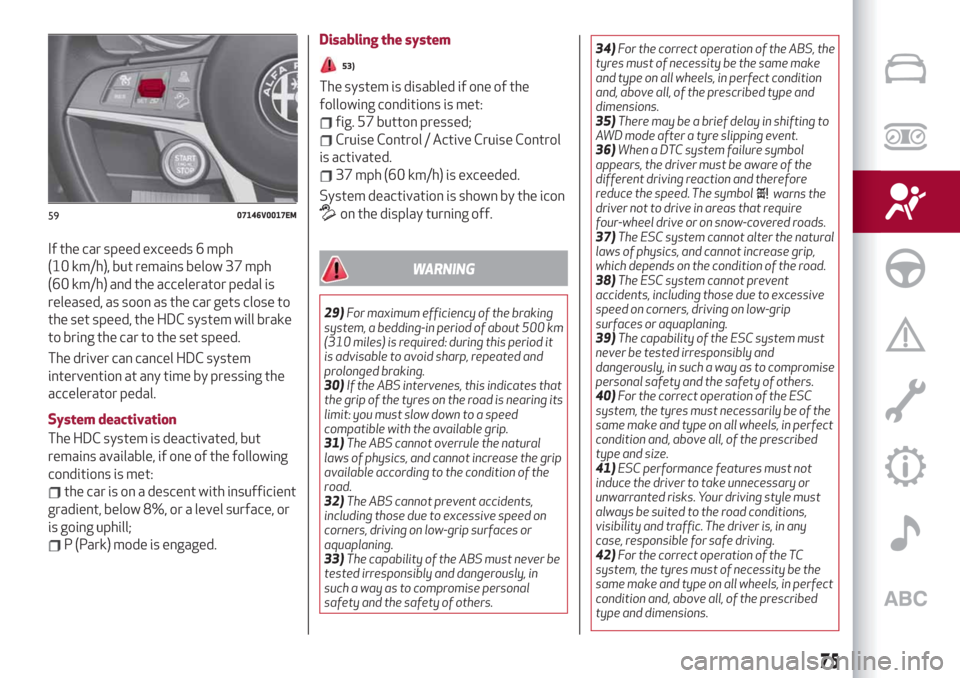
The speed set for the HDC system can be
adjusted using the SET switch fig. 59 (in
the range from 1.25 mph - 15.5 mph to
6 km/h - 20 mph). Once the desired speed
has been reached, release the SET switch
and the HDC system will maintain the set
speed.
It is also possible to reduce the set speed
with the brake pedal. The system will
acquire the current speed when the pedal
is released as the reference.
5706006V0001EM
5806006V0002EM
74
SAFETY
Page 77 of 244
If the car speed exceeds 6 mph
(10 km/h), but remains below 37 mph
(60 km/h) and the accelerator pedal is
released, as soon as the car gets close to
the set speed, the HDC system will brake
to bring the car to the set speed.
The driver can cancel HDC system
intervention at any time by pressing the
accelerator pedal.
System deactivation
The HDC system is deactivated, but
remains available, if one of the following
conditions is met:
the car is on a descent with insufficient
gradient, below 8%, or a level surface, or
is going uphill;
P (Park) mode is engaged.Disabling the system
53)
The system is disabled if one of the
following conditions is met:
fig. 57 button pressed;
Cruise Control / Active Cruise Control
is activated.
37 mph (60 km/h) is exceeded.
System deactivation is shown by the icon
on the display turning off.
WARNING
29)For maximum efficiency of the braking
system, a bedding-in period of about 500 km
(310 miles) is required: during this period it
is advisable to avoid sharp, repeated and
prolonged braking.
30)If the ABS intervenes, this indicates that
the grip of the tyres on the road is nearing its
limit: you must slow down to a speed
compatible with the available grip.
31)The ABS cannot overrule the natural
laws of physics, and cannot increase the grip
available according to the condition of the
road.
32)The ABS cannot prevent accidents,
including those due to excessive speed on
corners, driving on low-grip surfaces or
aquaplaning.
33)The capability of the ABS must never be
tested irresponsibly and dangerously, in
such a way as to compromise personal
safety and the safety of others.34)For the correct operation of the ABS, the
tyres must of necessity be the same make
and type on all wheels, in perfect condition
and, above all, of the prescribed type and
dimensions.
35)There may be a brief delay in shifting to
AWD mode after a tyre slipping event.
36)When a DTC system failure symbol
appears, the driver must be aware of the
different driving reaction and therefore
reduce the speed. The symbol
warns the
driver not to drive in areas that require
four-wheel drive or on snow-covered roads.
37)The ESC system cannot alter the natural
laws of physics, and cannot increase grip,
which depends on the condition of the road.
38)The ESC system cannot prevent
accidents, including those due to excessive
speed on corners, driving on low-grip
surfaces or aquaplaning.
39)The capability of the ESC system must
never be tested irresponsibly and
dangerously, in such a way as to compromise
personal safety and the safety of others.
40)For the correct operation of the ESC
system, the tyres must necessarily be of the
same make and type on all wheels, in perfect
condition and, above all, of the prescribed
type and size.
41)ESC performance features must not
induce the driver to take unnecessary or
unwarranted risks. Your driving style must
always be suited to the road conditions,
visibility and traffic. The driver is, in any
case, responsible for safe driving.
42)For the correct operation of the TC
system, the tyres must of necessity be the
same make and type on all wheels, in perfect
condition and, above all, of the prescribed
type and dimensions.
5907146V0017EM
75
Page 79 of 244
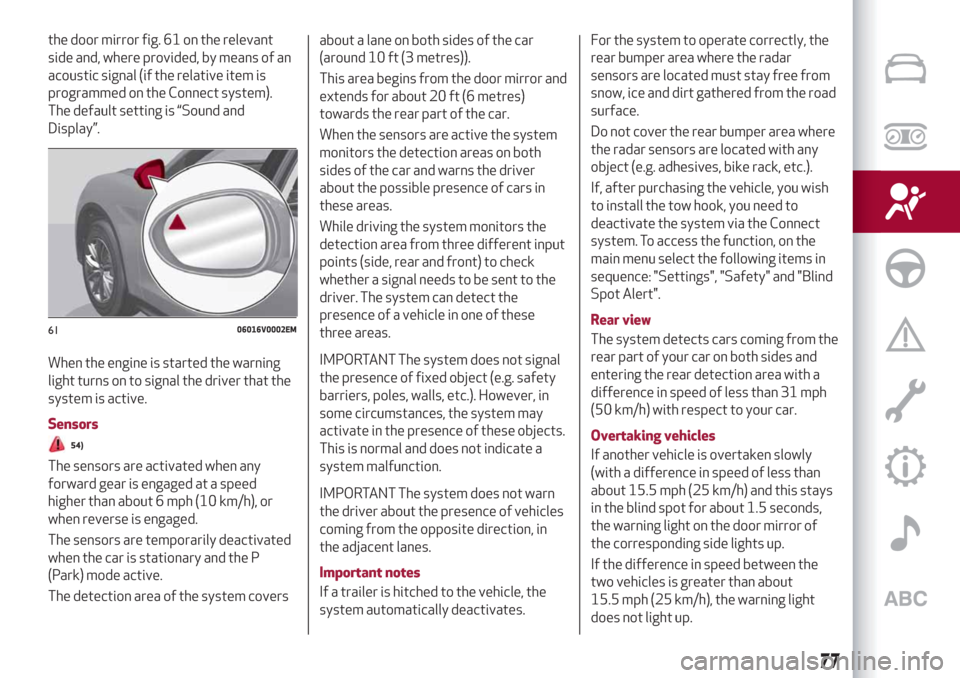
the door mirror fig. 61 on the relevant
side and, where provided, by means of an
acoustic signal (if the relative item is
programmed on the Connect system).
The default setting is “Sound and
Display”.
When the engine is started the warning
light turns on to signal the driver that the
system is active.
Sensors
54)
The sensors are activated when any
forward gear is engaged at a speed
higher than about 6 mph (10 km/h), or
when reverse is engaged.
The sensors are temporarily deactivated
when the car is stationary and the P
(Park) mode active.
The detection area of the system coversabout a lane on both sides of the car
(around 10 ft (3 metres)).
This area begins from the door mirror and
extends for about 20 ft (6 metres)
towards the rear part of the car.
When the sensors are active the system
monitors the detection areas on both
sides of the car and warns the driver
about the possible presence of cars in
these areas.
While driving the system monitors the
detection area from three different input
points (side, rear and front) to check
whether a signal needs to be sent to the
driver. The system can detect the
presence of a vehicle in one of these
three areas.
IMPORTANT The system does not signal
the presence of fixed object (e.g. safety
barriers, poles, walls, etc.). However, in
some circumstances, the system may
activate in the presence of these objects.
This is normal and does not indicate a
system malfunction.
IMPORTANT The system does not warn
the driver about the presence of vehicles
coming from the opposite direction, in
the adjacent lanes.
Important notes
If a trailer is hitched to the vehicle, the
system automatically deactivates.For the system to operate correctly, the
rear bumper area where the radar
sensors are located must stay free from
snow, ice and dirt gathered from the road
surface.
Do not cover the rear bumper area where
the radar sensors are located with any
object (e.g. adhesives, bike rack, etc.).
If, after purchasing the vehicle, you wish
to install the tow hook, you need to
deactivate the system via the Connect
system. To access the function, on the
main menu select the following items in
sequence: "Settings", "Safety" and "Blind
Spot Alert".
Rear view
The system detects cars coming from the
rear part of your car on both sides and
entering the rear detection area with a
difference in speed of less than 31 mph
(50 km/h) with respect to your car.
Overtaking vehicles
If another vehicle is overtaken slowly
(with a difference in speed of less than
about 15.5 mph (25 km/h) and this stays
in the blind spot for about 1.5 seconds,
the warning light on the door mirror of
the corresponding side lights up.
If the difference in speed between the
two vehicles is greater than about
15.5 mph (25 km/h), the warning light
does not light up.
6106016V0002EM
77
Page 80 of 244
RCP (Rear Cross Path detection) system
This system helps the driver during
reverse manoeuvres in the case of
reduced visibility.
The RCP system monitors the rear
detection areas on both sides of the car,
to detect objects moving towards the
sides of the car at a minimum speed
between about 0.6 mph and 2 mph
(1 km/h and 3 km/h) and objects moving
at a maximum speed of 22 mph
(35 km/h), as generally happens in
parking areas.
The system activation is signalled to the
driver by means of a visual and acoustic
warning.
IMPORTANT If the sensors are covered
by objects or vehicles, the system will not
warn the driver.
Operating mode
The system may be activated/
deactivated via the Connect system. To
access the function, on the main menu
select the following items in sequence:
"Settings", "Safety" and "Blind Spot
Alert"."Blind spot alert", "Visual" mode
When the system is enabled, a visual
warning is sent to the door mirror on the
side of the detected object.
The visual warning on the mirror will blink
if the driver switches on the direction
indicators, thus indicating the intention
to change lane.
The warning will be fixed if the driver
stays on the same lane.
"Blind spot alert" function deactivation
When the system is deactivated ("Blind
Spot Alert" mode at "OFF"), the BSM or
RCP systems will not emit neither
acoustic warnings.
The BSM system will store the operating
mode running when the engine was
stopped. Each time the engine is started,
the operating mode stored previously will
be recalled and used.
FORWARD COLLISION WARNING (FCW)
SYSTEM
54) 55) 56) 57) 58)
19) 20) 21) 22) 23) 24) 25) 26) 27)
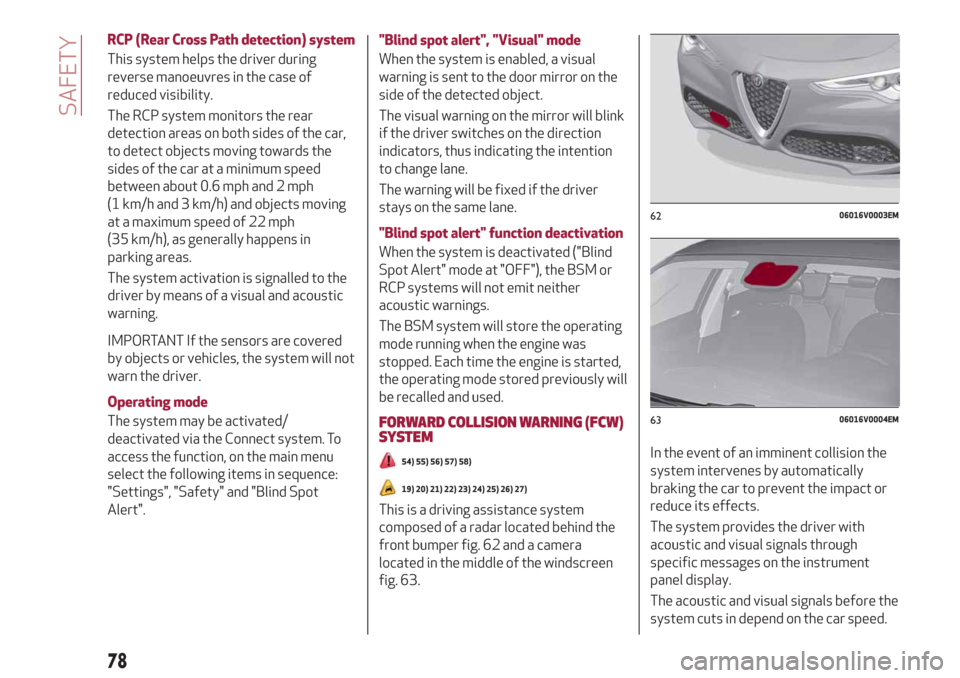
This is a driving assistance system
composed of a radar located behind the
front bumper fig. 62 and a camera
located in the middle of the windscreen
fig. 63.In the event of an imminent collision the
system intervenes by automatically
braking the car to prevent the impact or
reduce its effects.
The system provides the driver with
acoustic and visual signals through
specific messages on the instrument
panel display.
The acoustic and visual signals before the
system cuts in depend on the car speed.
6206016V0003EM
6306016V0004EM
78
SAFETY
Page 82 of 244
"Med" and "Far" settings, in the event of a
potential accident, but permits more
dynamic driving of the car.
The system sensitivity setting is kept in
the memory when the engine is switched
off.
System limited operation warning
If the dedicated message is displayed, a
condition limiting the system operation
may have occurred. The possible reasons
of this limitation are something blocking
the camera view or a fault.
In this condition it will still be possible to
drive the car normally, but automatic
braking will not be available in the event
of an impending collision.
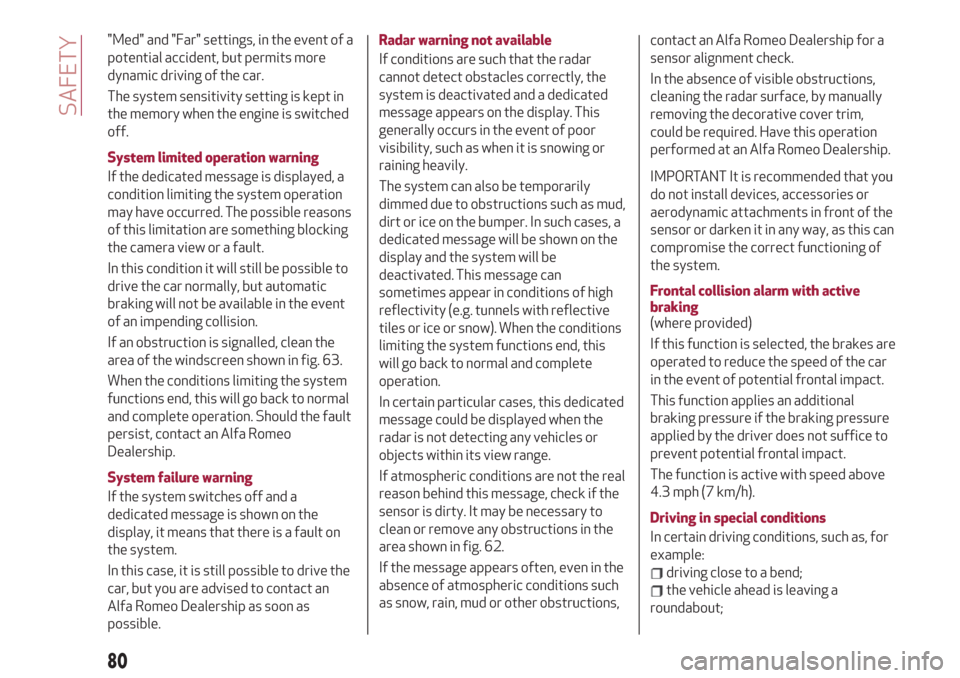
If an obstruction is signalled, clean the
area of the windscreen shown in fig. 63.
When the conditions limiting the system
functions end, this will go back to normal
and complete operation. Should the fault
persist, contact an Alfa Romeo
Dealership.
System failure warning
If the system switches off and a
dedicated message is shown on the
display, it means that there is a fault on
the system.
In this case, it is still possible to drive the
car, but you are advised to contact an
Alfa Romeo Dealership as soon as
possible.Radar warning not available
If conditions are such that the radar
cannot detect obstacles correctly, the
system is deactivated and a dedicated
message appears on the display. This
generally occurs in the event of poor
visibility, such as when it is snowing or
raining heavily.
The system can also be temporarily
dimmed due to obstructions such as mud,
dirt or ice on the bumper. In such cases, a
dedicated message will be shown on the
display and the system will be
deactivated. This message can
sometimes appear in conditions of high
reflectivity (e.g. tunnels with reflective
tiles or ice or snow). When the conditions
limiting the system functions end, this
will go back to normal and complete
operation.
In certain particular cases, this dedicated
message could be displayed when the
radar is not detecting any vehicles or
objects within its view range.
If atmospheric conditions are not the real
reason behind this message, check if the
sensor is dirty. It may be necessary to
clean or remove any obstructions in the
area shown in fig. 62.
If the message appears often, even in the
absence of atmospheric conditions such
as snow, rain, mud or other obstructions,contact an Alfa Romeo Dealership for a
sensor alignment check.
In the absence of visible obstructions,
cleaning the radar surface, by manually
removing the decorative cover trim,
could be required. Have this operation
performed at an Alfa Romeo Dealership.
IMPORTANT It is recommended that you
do not install devices, accessories or
aerodynamic attachments in front of the
sensor or darken it in any way, as this can
compromise the correct functioning of
the system.
Frontal collision alarm with active
braking
(where provided)
If this function is selected, the brakes are
operated to reduce the speed of the car
in the event of potential frontal impact.
This function applies an additional
braking pressure if the braking pressure
applied by the driver does not suffice to
prevent potential frontal impact.
The function is active with speed above
4.3 mph (7 km/h).
Driving in special conditions
In certain driving conditions, such as, for
example:
driving close to a bend;
the vehicle ahead is leaving a
roundabout;
80
SAFETY