heating Alfa Romeo Stelvio 2019 Owner's Manual
[x] Cancel search | Manufacturer: ALFA ROMEO, Model Year: 2019, Model line: Stelvio, Model: Alfa Romeo Stelvio 2019Pages: 244, PDF Size: 4.95 MB
Page 26 of 244
To adjust the position bring the lever 1
fig. 22 down to position A, after which the
steering wheel can be adjusted to the
most suitable position and subsequently
locked in this position by bringing lever
1 to position B again.
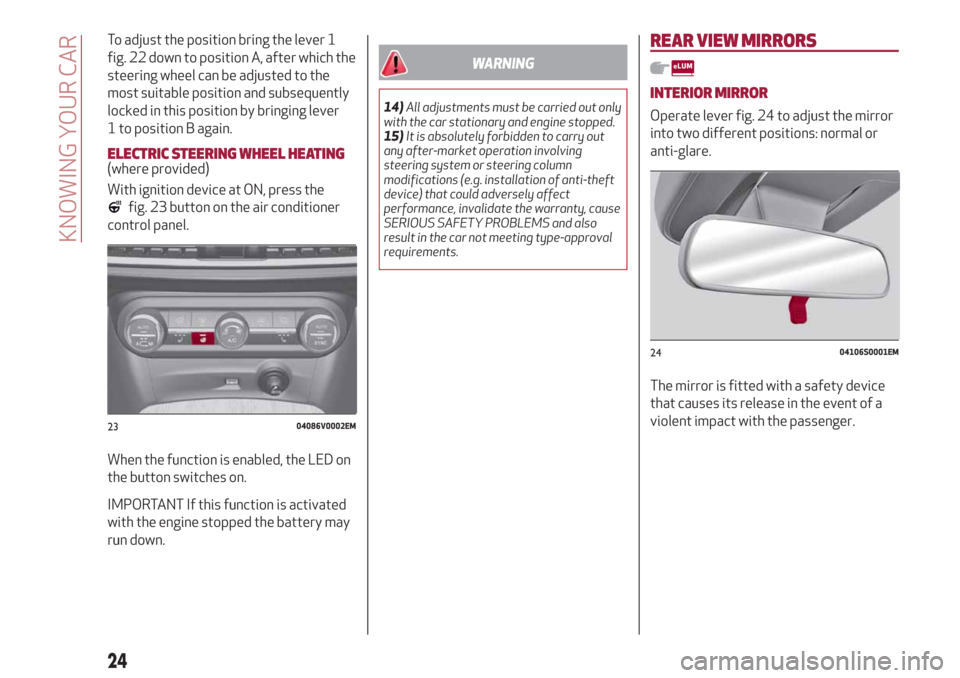
ELECTRIC STEERING WHEEL HEATING(where provided)
With ignition device at ON, press the
fig. 23 button on the air conditioner
control panel.
When the function is enabled, the LED on
the button switches on.
IMPORTANT If this function is activated
with the engine stopped the battery may
run down.
WARNING
14)All adjustments must be carried out only
with the car stationary and engine stopped.
15)It is absolutely forbidden to carry out
any after-market operation involving
steering system or steering column
modifications (e.g. installation of anti-theft
device) that could adversely affect
performance, invalidate the warranty, cause
SERIOUS SAFETY PROBLEMS and also
result in the car not meeting type-approval
requirements.
REAR VIEW MIRRORS
INTERIOR MIRROR
Operate lever fig. 24 to adjust the mirror
into two different positions: normal or
anti-glare.
The mirror is fitted with a safety device
that causes its release in the event of a
violent impact with the passenger.
2304086V0002EM
2404106S0001EM
24
KNOWING YOUR CAR
Page 36 of 244
Air flow to the windscreen and front
side window vents to
demist/defrost them.
Air flow at central and side
dashboard vents to ventilate the
chest and the face during the hot
season.
Air flow to the front and rear
footwell vents. This air distribution
setting heats the passenger
compartment most quickly, giving a
prompt sensation of warmth.
Air flow distributed between
footwell vents (hotter air) and
central and side dashboard vents
(cooler air). This air distribution
setting is useful in spring and
autumn on sunny days.
Air flow distributed between
footwell vents and windscreen and
front side window defrosting/
demisting vents. This distribution
setting allows the passenger
compartment to be warmed
effectively and prevents the
windows from misting.
Air flow distribution between
windscreen demisting/defrosting
vents and side and central
dashboard vents. This allows air to
be sent to the windscreen in
conditions of strong sunlight.
Air flow distribution to all diffusers
on the vehicle.
In AUTO mode, the air conditioner
automatically manages the air
distribution. When set manually, the air
distribution is indicated by the respective
symbols on the Connect system display
switching on.
START & STOP EVO
The automatic dual zone climate control
system manages the Start&Stop Evo
(engine off when the vehicle speed is
0 mph (0 km/h) to ensure adequate
comfort inside the vehicle.In particular, the climate control system
turns off the Stop & Start Evo if:
the climate control system is in AUTO
mode (LED on the button switched on)
and the temperature conditions inside
the car are far from a comfort
temperature;
the climate control system is in LO
maximum cooling;
the climate control system is in HI
maximum heating;
the climate control system is in the
MAX-DEF status.
With Stop & Start Evo on (engine off and
vehicle speed equal to 0 mph (0 km/h)),
the flow is reduced as much as possible,
to maintain the passenger compartment
comfort conditions for longer.
IMPORTANT
2)The system uses R1234yf coolant gas,
which does not pollute the environment in the
event of accidental leakage. Under no
circumstances use R134a and R12 fluids,
which are incompatible with the components
of the system.
34
KNOWING YOUR CAR
Page 46 of 244
CONTROL PANEL AND ON-BOARD INSTRUMENTS
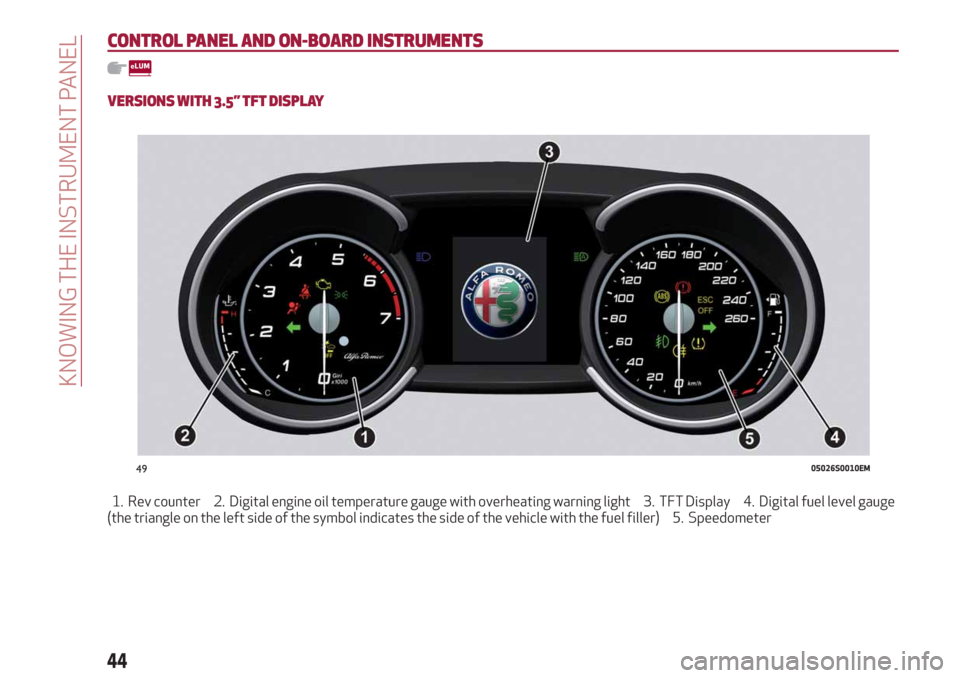
VERSIONS WITH 3.5” TFT DISPLAY
1. Rev counter 2. Digital engine oil temperature gauge with overheating warning light 3. TFT Display 4. Digital fuel level gauge
(the triangle on the left side of the symbol indicates the side of the vehicle with the fuel filler) 5. Speedometer
4905026S0010EM
44
KNOWING THE INSTRUMENT PANEL
Page 47 of 244
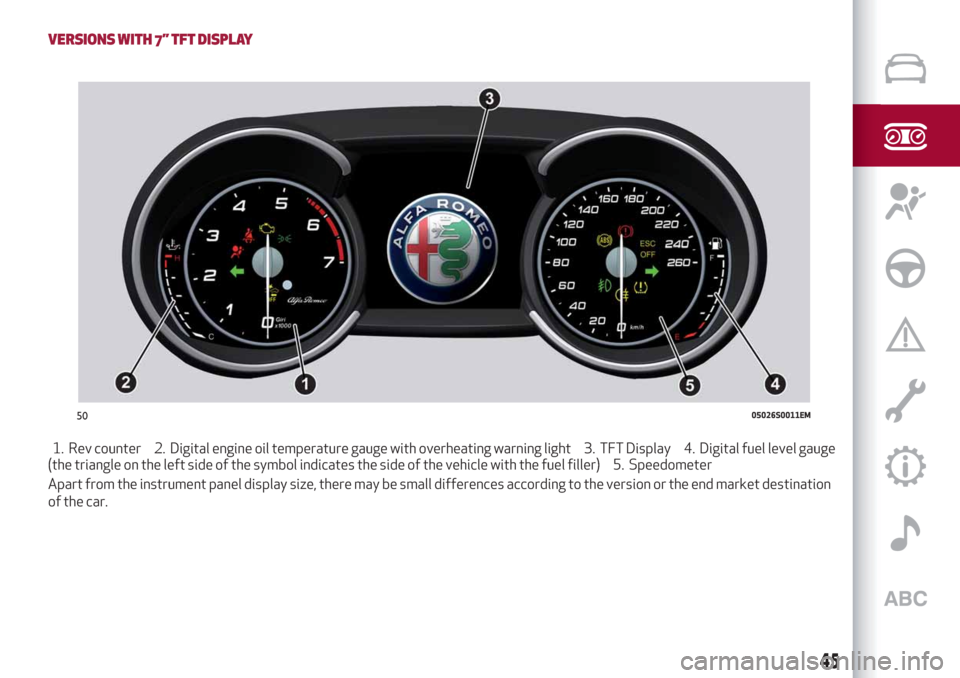
VERSIONS WITH 7” TFT DISPLAY
1. Rev counter 2. Digital engine oil temperature gauge with overheating warning light 3. TFT Display 4. Digital fuel level gauge
(the triangle on the left side of the symbol indicates the side of the vehicle with the fuel filler) 5. Speedometer
Apart from the instrument panel display size, there may be small differences according to the version or the end market destination
of the car.
5005026S0011EM
45
Page 55 of 244
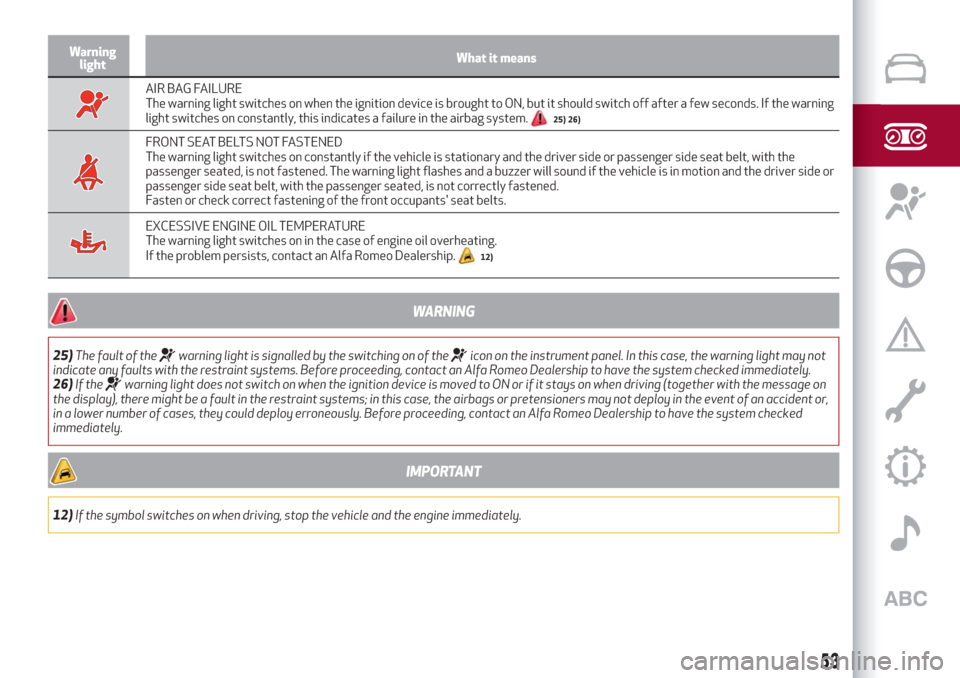
Warning
lightWhat it means
AIR BAG FAILURE
The warning light switches on when the ignition device is brought to ON, but it should switch off after a few seconds. If the warning
light switches on constantly, this indicates a failure in the airbag system.
25) 26)
FRONT SEAT BELTS NOT FASTENED
The warning light switches on constantly if the vehicle is stationary and the driver side or passenger side seat belt, with the
passenger seated, is not fastened. The warning light flashes and a buzzer will sound if the vehicle is in motion and the driver side or
passenger side seat belt, with the passenger seated, is not correctly fastened.
Fasten or check correct fastening of the front occupants' seat belts.
EXCESSIVE ENGINE OIL TEMPERATURE
The warning light switches on in the case of engine oil overheating.
If the problem persists, contact an Alfa Romeo Dealership.
12)
WARNING
25)The fault of thewarning light is signalled by the switching on of theicon on the instrument panel. In this case, the warning light may not
indicate any faults with the restraint systems. Before proceeding, contact an Alfa Romeo Dealership to have the system checked immediately.
26)If the
warning light does not switch on when the ignition device is moved to ON or if it stays on when driving (together with the message on
the display), there might be a fault in the restraint systems; in this case, the airbags or pretensioners may not deploy in the event of an accident or,
in a lower number of cases, they could deploy erroneously. Before proceeding, contact an Alfa Romeo Dealership to have the system checked
immediately.
IMPORTANT
12)If the symbol switches on when driving, stop the vehicle and the engine immediately.
53
Page 64 of 244
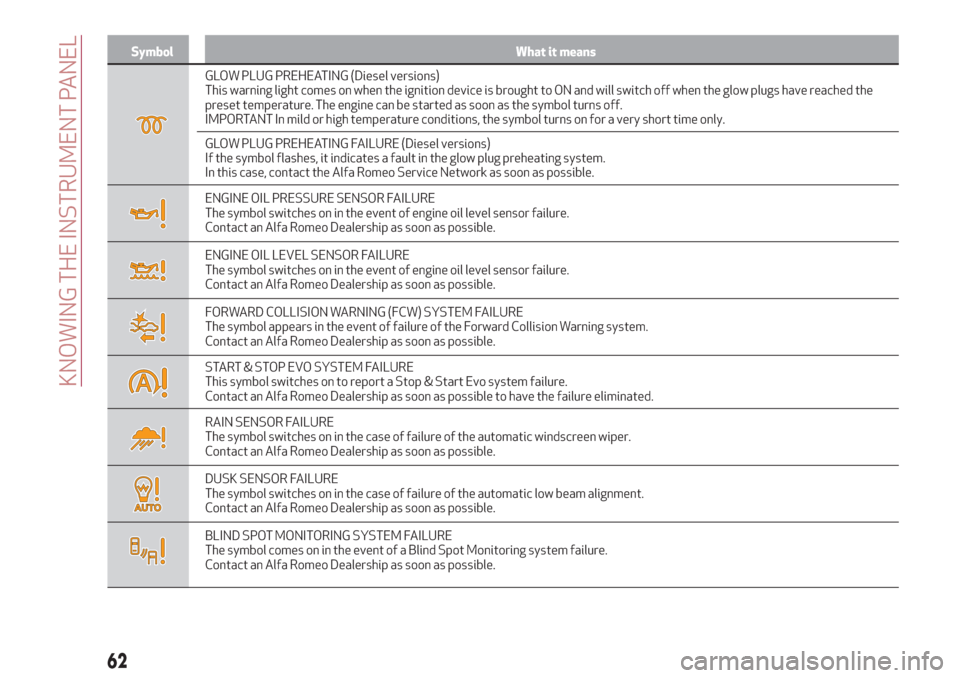
Symbol What it means
GLOW PLUG PREHEATING (Diesel versions)
This warning light comes on when the ignition device is brought to ON and will switch off when the glow plugs have reached the
preset temperature. The engine can be started as soon as the symbol turns off.
IMPORTANT In mild or high temperature conditions, the symbol turns on for a very short time only.
GLOW PLUG PREHEATING FAILURE (Diesel versions)
If the symbol flashes, it indicates a fault in the glow plug preheating system.
In this case, contact the Alfa Romeo Service Network as soon as possible.
ENGINE OIL PRESSURE SENSOR FAILURE
The symbol switches on in the event of engine oil level sensor failure.
Contact an Alfa Romeo Dealership as soon as possible.
ENGINE OIL LEVEL SENSOR FAILURE
The symbol switches on in the event of engine oil level sensor failure.
Contact an Alfa Romeo Dealership as soon as possible.
FORWARD COLLISION WARNING (FCW) SYSTEM FAILURE
The symbol appears in the event of failure of the Forward Collision Warning system.
Contact an Alfa Romeo Dealership as soon as possible.
START & STOP EVO SYSTEM FAILURE
This symbol switches on to report a Stop & Start Evo system failure.
Contact an Alfa Romeo Dealership as soon as possible to have the failure eliminated.
RAIN SENSOR FAILURE
The symbol switches on in the case of failure of the automatic windscreen wiper.
Contact an Alfa Romeo Dealership as soon as possible.
DUSK SENSOR FAILURE
The symbol switches on in the case of failure of the automatic low beam alignment.
Contact an Alfa Romeo Dealership as soon as possible.
BLIND SPOT MONITORING SYSTEM FAILURE
The symbol comes on in the event of a Blind Spot Monitoring system failure.
Contact an Alfa Romeo Dealership as soon as possible.
62
KNOWING THE INSTRUMENT PANEL
Page 66 of 244
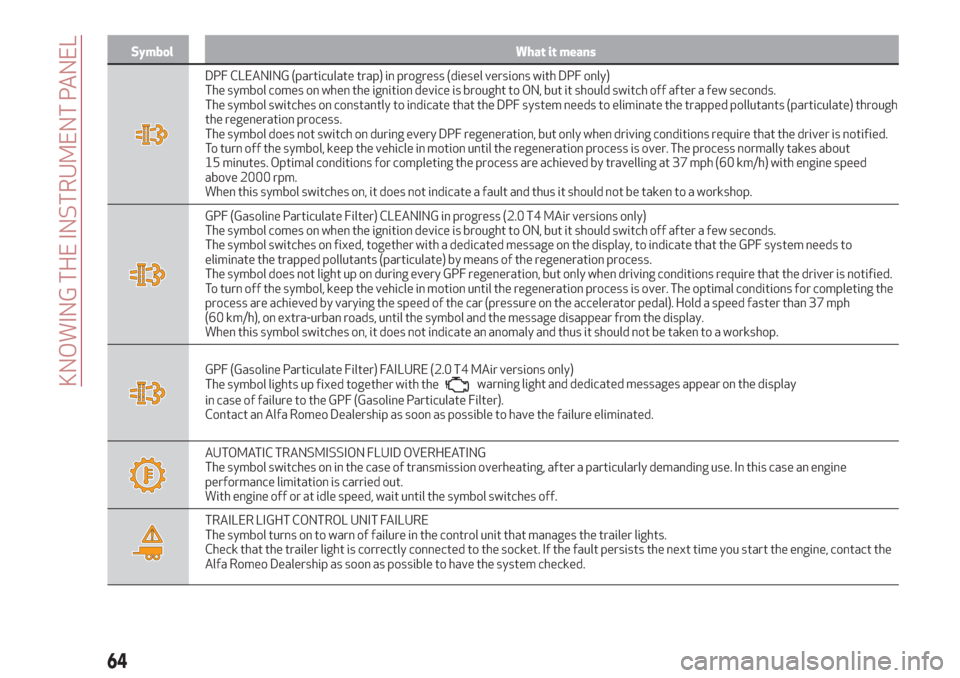
Symbol What it means
DPF CLEANING (particulate trap) in progress (diesel versions with DPF only)
The symbol comes on when the ignition device is brought to ON, but it should switch off after a few seconds.
The symbol switches on constantly to indicate that the DPF system needs to eliminate the trapped pollutants (particulate) through
the regeneration process.
The symbol does not switch on during every DPF regeneration, but only when driving conditions require that the driver is notified.
To turn off the symbol, keep the vehicle in motion until the regeneration process is over. The process normally takes about
15 minutes. Optimal conditions for completing the process are achieved by travelling at 37 mph (60 km/h) with engine speed
above 2000 rpm.
When this symbol switches on, it does not indicate a fault and thus it should not be taken to a workshop.
GPF (Gasoline Particulate Filter) CLEANING in progress (2.0 T4 MAir versions only)
The symbol comes on when the ignition device is brought to ON, but it should switch off after a few seconds.
The symbol switches on fixed, together with a dedicated message on the display, to indicate that the GPF system needs to
eliminate the trapped pollutants (particulate) by means of the regeneration process.
The symbol does not light up on during every GPF regeneration, but only when driving conditions require that the driver is notified.
To turn off the symbol, keep the vehicle in motion until the regeneration process is over. The optimal conditions for completing the
process are achieved by varying the speed of the car (pressure on the accelerator pedal). Hold a speed faster than 37 mph
(60 km/h), on extra-urban roads, until the symbol and the message disappear from the display.
When this symbol switches on, it does not indicate an anomaly and thus it should not be taken to a workshop.
GPF (Gasoline Particulate Filter) FAILURE (2.0 T4 MAir versions only)
The symbol lights up fixed together with the
in case of failure to the GPF (Gasoline Particulate Filter).
Contact an Alfa Romeo Dealership as soon as possible to have the failure eliminated.
AUTOMATIC TRANSMISSION FLUID OVERHEATING
The symbol switches on in the case of transmission overheating, after a particularly demanding use. In this case an engine
performance limitation is carried out.
With engine off or at idle speed, wait until the symbol switches off.
TRAILER LIGHT CONTROL UNIT FAILURE
The symbol turns on to warn of failure in the control unit that manages the trailer lights.
Check that the trailer light is correctly connected to the socket. If the fault persists the next time you start the engine, contact the
Alfa Romeo Dealership as soon as possible to have the system checked.
64
KNOWING THE INSTRUMENT PANELwarning light and dedicated messages appear on the display
Page 85 of 244
the warning limit for any reason, including
the effects of low temperature and
normal loss of pressure from the tyre.
The TPMS will stop indicating insufficient
tyre pressure when it is equal to or
greater than the prescribed cold inflation
pressure. Therefore, if insufficient tyre
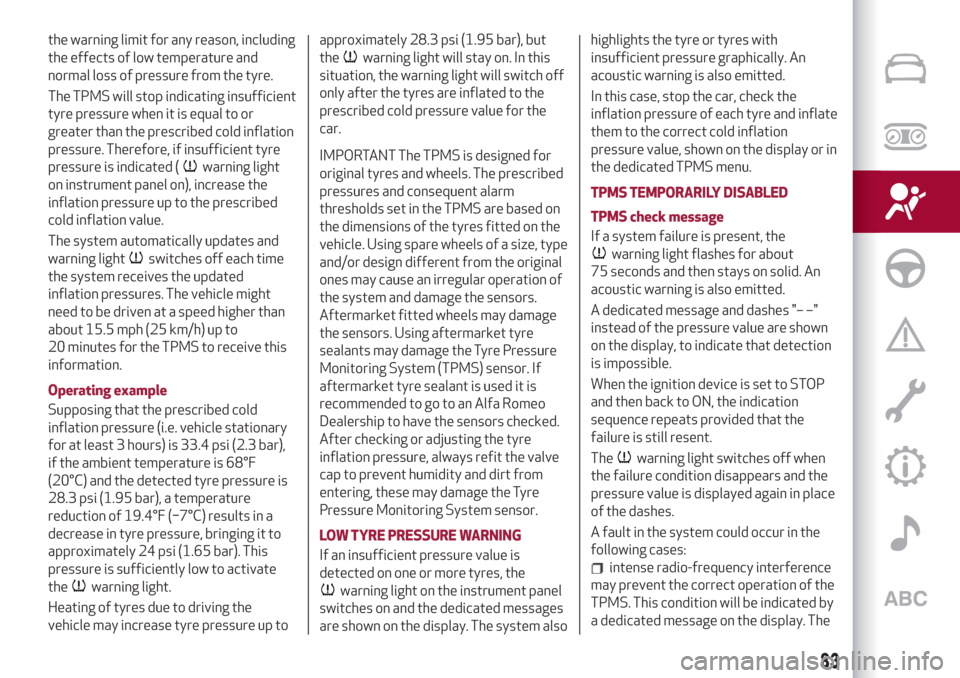
pressure is indicated (
warning light
on instrument panel on), increase the
inflation pressure up to the prescribed
cold inflation value.
The system automatically updates and
warning light
switches off each time
the system receives the updated
inflation pressures. The vehicle might
need to be driven at a speed higher than
about 15.5 mph (25 km/h) up to
20 minutes for the TPMS to receive this
information.
Operating example
Supposing that the prescribed cold
inflation pressure (i.e. vehicle stationary
for at least 3 hours) is 33.4 psi (2.3 bar),
if the ambient temperature is 68°F
(20°C) and the detected tyre pressure is
28.3 psi (1.95 bar), a temperature
reduction of 19.4°F (−7°C) results in a
decrease in tyre pressure, bringing it to
approximately 24 psi (1.65 bar). This
pressure is sufficiently low to activate
the
warning light.
Heating of tyres due to driving the
vehicle may increase tyre pressure up toapproximately 28.3 psi (1.95 bar), but
the
warning light will stay on. In this
situation, the warning light will switch off
only after the tyres are inflated to the
prescribed cold pressure value for the
car.
IMPORTANT The TPMS is designed for
original tyres and wheels. The prescribed
pressures and consequent alarm
thresholds set in the TPMS are based on
the dimensions of the tyres fitted on the
vehicle. Using spare wheels of a size, type
and/or design different from the original
ones may cause an irregular operation of
the system and damage the sensors.
Aftermarket fitted wheels may damage
the sensors. Using aftermarket tyre
sealants may damage the Tyre Pressure
Monitoring System (TPMS) sensor. If
aftermarket tyre sealant is used it is
recommended to go to an Alfa Romeo
Dealership to have the sensors checked.
After checking or adjusting the tyre
inflation pressure, always refit the valve
cap to prevent humidity and dirt from
entering, these may damage the Tyre
Pressure Monitoring System sensor.
LOW TYRE PRESSURE WARNING
If an insufficient pressure value is
detected on one or more tyres, the
warning light on the instrument panel
switches on and the dedicated messages
are shown on the display. The system alsohighlights the tyre or tyres with
insufficient pressure graphically. An
acoustic warning is also emitted.
In this case, stop the car, check the
inflation pressure of each tyre and inflate
them to the correct cold inflation
pressure value, shown on the display or in
the dedicated TPMS menu.
TPMS TEMPORARILY DISABLED
TPMS check message
If a system failure is present, the
warning light flashes for about
75 seconds and then stays on solid. An
acoustic warning is also emitted.
A dedicated message and dashes "– –"
instead of the pressure value are shown
on the display, to indicate that detection
is impossible.
When the ignition device is set to STOP
and then back to ON, the indication
sequence repeats provided that the
failure is still resent.
The
warning light switches off when
the failure condition disappears and the
pressure value is displayed again in place
of the dashes.
A fault in the system could occur in the
following cases:
intense radio-frequency interference
may prevent the correct operation of the
TPMS. This condition will be indicated by
a dedicated message on the display. The
83
Page 93 of 244
72)For maximum safety, keep the backrest
upright, lean back into it and make sure the
seat belt fits closely across your chest and
pelvis. Always fasten the seat belts for both
the front and rear seats! Travelling without
wearing seat belts will increase the risk of
serious injury and even death in the event of
an accident.
73)If the belt has been subjected to high
levels of stress, for example after an
accident, it should be changed completely
together with the attachments, attachment
fixing screws and the pretensioner. In fact,
even if the belt has no visible defects, it may
have lost its resilience.
IMPORTANT
29)Operations which lead to impacts,
vibrations or localised heating (over 100°C
for a maximum of six hours) in the area
around the pretensioner may cause damage
or make it deploy. Contact an Alfa Romeo
Dealership should intervention be necessary
on these components.
CHILD PROTECTIONSYSTEMS
CARRYING CHILDREN SAFELY
74) 75) 76) 77)
For optimal protection in the event of an
impact, all occupants must be seated and
wearing adequate restraint systems,
including newborn and other children!
This prescription is compulsory in all EC
countries according to EC Directive
2003/20/EC.
Children below the height of 4.9 ft
(1.50 metres) and up to 12 years must be
protected with suitable restraint
systems and be seated on the rear seats.
Statistics on accidents indicate that the
rear seats offer greater safety for
children.
Compared with an adult, a child's head is
larger and heavier in proportion to their
body and the child's muscular and bone
structures are not fully developed.
Therefore, correct restraint systems
other than adult seat belts are necessary,
to reduce as much as possible the risk of
injuries in the event of an accident,
braking or sudden manoeuvre.
Children must be seated safely and
comfortably. As far as the characteristics
of the child seats used allow, you are
advised to keep children in rear facing
child seats for as long as possible (atleast until 3–4 years old), since this is the
most protected position in the event of
an impact.
The choice of the most suitable child
restraint system depends on the weight
and size of the child. There are various
types of child restraint systems, which
can be secured to the car by means of the
seat belts or with the ISOFIX/i-Size
anchorages.
It is recommended to always choose the
restraint system most suitable for the
child; for this reason always refer to the
Owner Handbook provided with the child
restraint system, to be sure that it is of
the right type for the children it is
intended for.
In Europe the characteristics of child
restraint systems are ruled by the
regulation ECE-R44, dividing them into
five weight groups:
Group Weight range
Group 0upto 22 lb (10 kg) in
weight
Group 0+up to 28.7 lb (13 kg)
in weight
Group 120-40lb(9-18kg)
in weight
Group 233-55lb(15-25kg)
in weight
91
Page 113 of 244
IMPORTANT
30)We recommend that during the initial
period, or during the first 1600 km
(1000 miles), you do not drive to full car
performance (e.g. excessive acceleration,
long journeys at top speed, sharp braking,
etc.).
31)When the engine stopped never leave
the ignition device in the ON position to
prevent useless current draw from draining
the battery.
32)Warning light
will flash after starting
or during prolonged cranking to indicate a
fault with the glow plug heating system. If
the engine starts, the vehicle can be regularly
used, but an Alfa Romeo Dealership must be
contacted as soon as possible.
33)A quick burst on the accelerator before
turning off the engine serves absolutely no
practical purpose; it wastes fuel and is
damaging for the engine.
PARKING THE VEHICLE
104) 105) 106)
IMPORTANT In addition to parking the
vehicle with the parking brake always
engaged, the wheels turned, chocks or
stones positioned in front of the wheels
(when on a steep slope), you must always:
engage P (Park) mode;
always take the key with you when
leaving the vehicle.
IMPORTANT Always engage the electric
parking brake before leaving the vehicle.
ELECTRIC PARKING BRAKE
The car is equipped with electric parking
brake to guarantee better use and
optimal performance compared to a
manually operated parking brake.
The electric parking brake features a
switch, located on the central tunnel
fig. 96, a motor with caliper for each rear
wheel and an electronic control module.The electric parking brake can be
engaged in two ways:
manually, by pulling the switch on the
central tunnel;
automaticallyin "Safe Hold" or "Auto
Park Brake" conditions.
IMPORTANT Normally, the electric
parking brake is engaged automatically
when the engine is stopped. This function
can be deactivated/activated on the
Connect system by selecting the
following items in sequence on the main
menu: "Settings", "Driver assistance" and
"Automatic parking brake".
IMPORTANT Should the vehicle battery
be faulty, to unlock the electric parking
brake the battery must be replaced.
9607046V0001EM
111