rims Alfa Romeo Stelvio 2019 Owner's Manual
[x] Cancel search | Manufacturer: ALFA ROMEO, Model Year: 2019, Model line: Stelvio, Model: Alfa Romeo Stelvio 2019Pages: 244, PDF Size: 4.95 MB
Page 17 of 244
ALARM
(where provided)
Activation of the alarm triggers the
acoustic warning and the direction
indicators.
IMPORTANT The alarm is adapted to
meet requirements in various countries.
SWITCHING ON THE ALARM
With the doors, bonnet and tailgate
closed and the ignition device turned to
STOP, point the electronic key towards
the vehicle and press and release button
.
Except on some versions for specific
markets, the system produces a visual
and acoustic warning and enables door
locking.
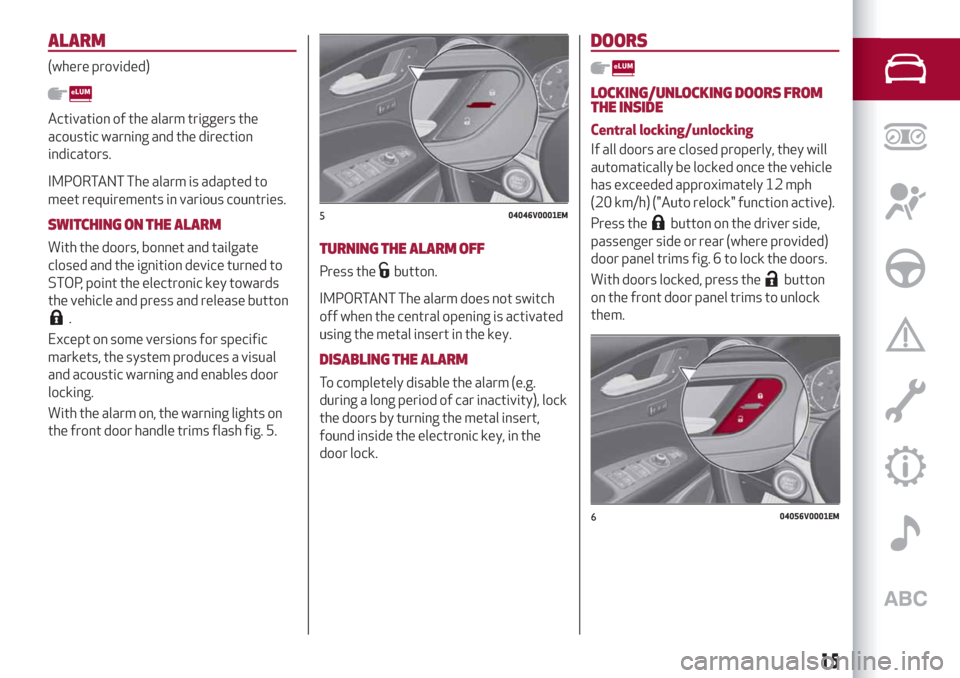
With the alarm on, the warning lights on
the front door handle trims flash fig. 5.
TURNING THE ALARM OFF
Press thebutton.
IMPORTANT The alarm does not switch
off when the central opening is activated
using the metal insert in the key.
DISABLING THE ALARM
To completely disable the alarm (e.g.
during a long period of car inactivity), lock
the doors by turning the metal insert,
found inside the electronic key, in the
door lock.
DOORS
LOCKING/UNLOCKING DOORS FROM
THE INSIDE
Central locking/unlocking
If all doors are closed properly, they will
automatically be locked once the vehicle
has exceeded approximately 12 mph
(20 km/h) ("Auto relock" function active).
Press the
button on the driver side,
passenger side or rear (where provided)
door panel trims fig. 6 to lock the doors.
With doors locked, press the
button
on the front door panel trims to unlock
them.
504046V0001EM
604056V0001EM
15
Page 56 of 244
Amber warning lights
Warning
lightWhat it means
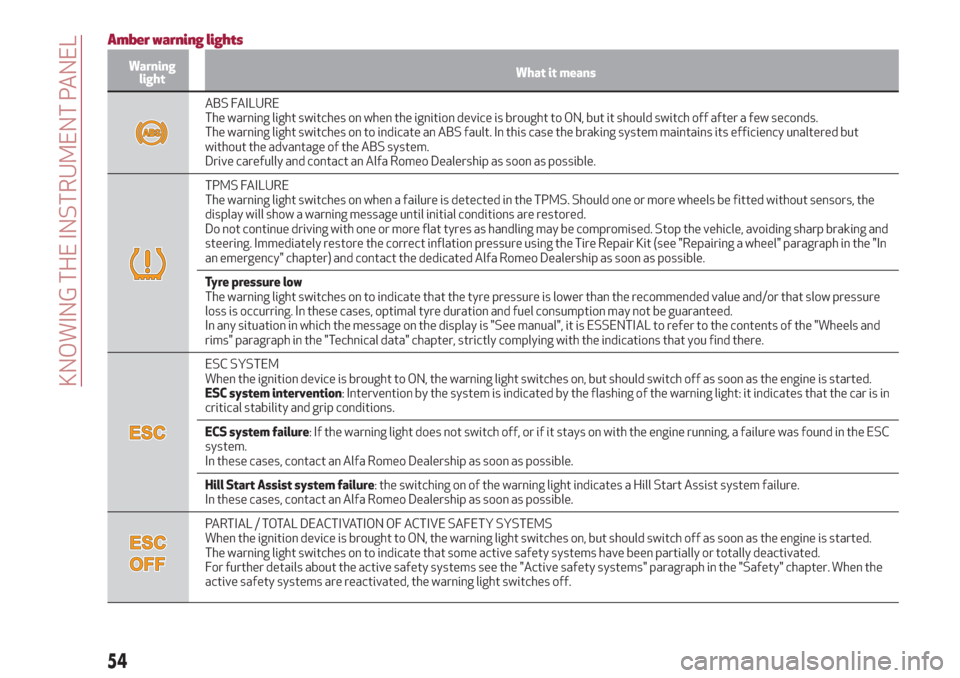
ABS FAILURE
The warning light switches on when the ignition device is brought to ON, but it should switch off after a few seconds.
The warning light switches on to indicate an ABS fault. In this case the braking system maintains its efficiency unaltered but
without the advantage of the ABS system.
Drive carefully and contact an Alfa Romeo Dealership as soon as possible.
TPMS FAILURE
The warning light switches on when a failure is detected in the TPMS. Should one or more wheels be fitted without sensors, the
display will show a warning message until initial conditions are restored.
Do not continue driving with one or more flat tyres as handling may be compromised. Stop the vehicle, avoiding sharp braking and
steering. Immediately restore the correct inflation pressure using the Tire Repair Kit (see "Repairing a wheel" paragraph in the "In
an emergency" chapter) and contact the dedicated Alfa Romeo Dealership as soon as possible.
Tyre pressure low
The warning light switches on to indicate that the tyre pressure is lower than the recommended value and/or that slow pressure
loss is occurring. In these cases, optimal tyre duration and fuel consumption may not be guaranteed.
In any situation in which the message on the display is "See manual", it is ESSENTIAL to refer to the contents of the "Wheels and
rims" paragraph in the "Technical data" chapter, strictly complying with the indications that you find there.
ESC SYSTEM
When the ignition device is brought to ON, the warning light switches on, but should switch off as soon as the engine is started.
ESC system intervention: Intervention by the system is indicated by the flashing of the warning light: it indicates that the car is in
critical stability and grip conditions.
ECS system failure: If the warning light does not switch off, or if it stays on with the engine running, a failure was found in the ESC
system.
In these cases, contact an Alfa Romeo Dealership as soon as possible.
Hill Start Assist system failure: the switching on of the warning light indicates a Hill Start Assist system failure.
In these cases, contact an Alfa Romeo Dealership as soon as possible.
PARTIAL / TOTAL DEACTIVATION OF ACTIVE SAFETY SYSTEMS
When the ignition device is brought to ON, the warning light switches on, but should switch off as soon as the engine is started.
The warning light switches on to indicate that some active safety systems have been partially or totally deactivated.
For further details about the active safety systems see the "Active safety systems" paragraph in the "Safety" chapter. When the
active safety systems are reactivated, the warning light switches off.
54
KNOWING THE INSTRUMENT PANEL
Page 84 of 244
Vehicles travelling at right angles to
the vehicle
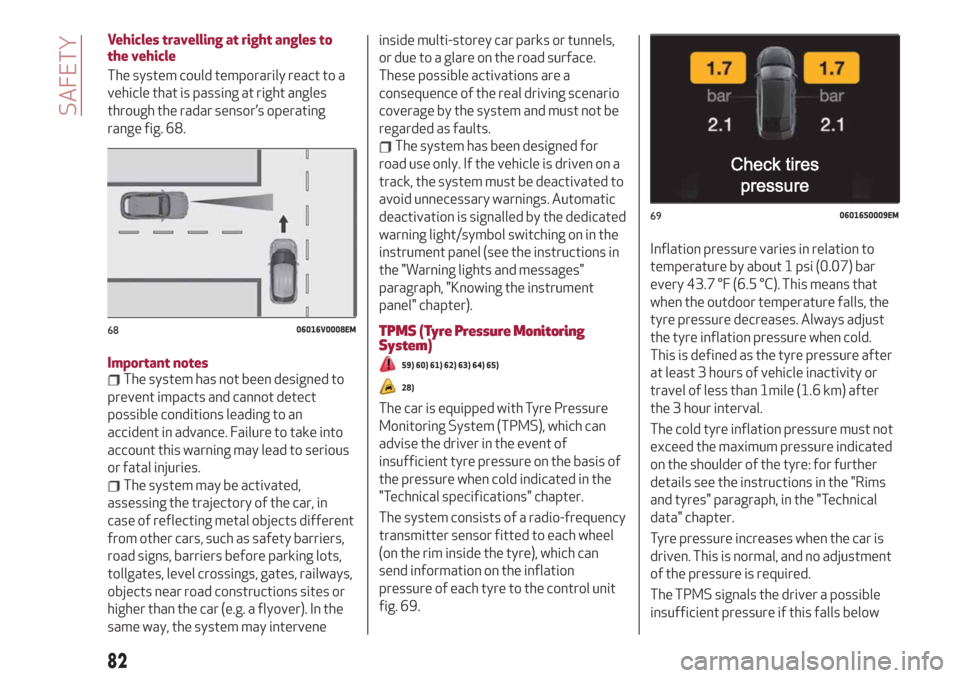
The system could temporarily react to a
vehicle that is passing at right angles
through the radar sensor’s operating
range fig. 68.
Important notes
The system has not been designed to
prevent impacts and cannot detect
possible conditions leading to an
accident in advance. Failure to take into
account this warning may lead to serious
or fatal injuries.
The system may be activated,
assessing the trajectory of the car, in
case of reflecting metal objects different
from other cars, such as safety barriers,
road signs, barriers before parking lots,
tollgates, level crossings, gates, railways,
objects near road constructions sites or
higher than the car (e.g. a flyover). In the
same way, the system may interveneinside multi-storey car parks or tunnels,
or due to a glare on the road surface.
These possible activations are a
consequence of the real driving scenario
coverage by the system and must not be
regarded as faults.
The system has been designed for
road use only. If the vehicle is driven on a
track, the system must be deactivated to
avoid unnecessary warnings. Automatic
deactivation is signalled by the dedicated
warning light/symbol switching on in the
instrument panel (see the instructions in
the "Warning lights and messages"
paragraph, "Knowing the instrument
panel" chapter).
TPMS (Tyre Pressure Monitoring
System)
59) 60) 61) 62) 63) 64) 65)
28)
The car is equipped with Tyre Pressure
Monitoring System (TPMS), which can
advise the driver in the event of
insufficient tyre pressure on the basis of
the pressure when cold indicated in the
"Technical specifications" chapter.
The system consists of a radio-frequency
transmitter sensor fitted to each wheel
(on the rim inside the tyre), which can
send information on the inflation
pressure of each tyre to the control unit
fig. 69.Inflation pressure varies in relation to
temperature by about 1 psi (0.07) bar
every 43.7 °F (6.5 °C). This means that
when the outdoor temperature falls, the
tyre pressure decreases. Always adjust
the tyre inflation pressure when cold.
This is defined as the tyre pressure after
at least 3 hours of vehicle inactivity or
travel of less than 1mile (1.6 km) after
the 3 hour interval.
The cold tyre inflation pressure must not
exceed the maximum pressure indicated
on the shoulder of the tyre: for further
details see the instructions in the "Rims
and tyres" paragraph, in the "Technical
data" chapter.
Tyre pressure increases when the car is
driven. This is normal, and no adjustment
of the pressure is required.
The TPMS signals the driver a possible
insufficient pressure if this falls below
6806016V0008EM
6906016S0009EM
82
SAFETY
Page 87 of 244
61)Should one or more wheels be fitted
without sensors, the system will no longer be
available and a warning message will be
shown on the display, until wheels with
sensors are fitted again.
62)The TPMS cannot indicate sudden tyre
pressure drops (e.g. if a tyre bursts). In this
case, stop the vehicle, braking with caution
and avoiding abrupt steering.
63)Changes in outside temperature may
cause tyre pressures to vary. The system
may temporarily indicate insufficient
pressure. In this case, check the tyre
pressure when cold and, if necessary,
restore the inflation values.
64)Replacing standard tyres with winter
tyres and vice versa requires TPMS system
adjustment that must only be performed by
Alfa Romeo Dealerships.
65)When a tyre is removed, it is advisable
to replace the rubber valve seal as well:
contact an Alfa Romeo Dealership. The
fitting/removal of the tyres and/or rims
require special care. To avoid damaging or
fitting the sensors incorrectly, tyre and/or
rim fitting/removal operations should only
be carried out by specialised staff. Contact
an Alfa Romeo Dealership.
IMPORTANT
19)The system may have limited or absent
operation due to weather conditions such as:
heavy rain, hail, thick fog, heavy snow.
20)The section of the bumper before the
sensor must not be covered with adhesives,
auxiliary headlights or any other object.21)System intervention might be
unexpected or delayed when other vehicles
transport loads projecting from the side,
above or from the rear, with respect to the
normal size of the vehicle.
22)Operation can be adversely affected by
any structural change made to the vehicle,
such as a modification to the front geometry,
tyre change, or a heavier load than the
standard load of the vehicle.
23)Incorrect repairs made on the front part
of the vehicle (e.g. bumper, chassis) may alter
the position of the radar sensor, and
adversely affect its operation. Go to an Alfa
Romeo Dealership for any operation of this
type.
24)Do not tamper with nor carry out any
intervention on the radar sensor or on the
camera on the windscreen. In the event of a
sensor failure, contact an Alfa Romeo
Dealership.
25)Do not wash with high-pressure jets in
the bumper lower area: in particular do not
operate on the system's electrical connector.
26)Be careful in the case of repairs and new
paintings in the area around the sensor
(panel covering the sensor on the left side of
the bumper). In the event of a frontal impact
the sensor may automatically deactivate
and display a warning to indicate that the
sensor needs to be repaired. Even without a
malfunction warning, deactivate the system
operation if you think that the position of the
radar sensor has changed (e.g. due to
low-speed frontal impact as during parking
manoeuvres). In these cases, go to an Alfa
Romeo Dealership to have the radar sensor
realigned or replaced.27)When towing a trailer, a vehicle or during
loading manoeuvres on a vehicle transporter
(or in vehicle for transport), the system must
be deactivated via the Connect system.
28)The Tire Repair Kit, provided with the
vehicle, is compatible with the TPMS
sensors. Using sealants different from that
in the original kit may compromise its
operation. If sealants not equivalent with the
original ones are used, it is recommended to
have the TPMS sensor operation checked by
a qualified repair centre.
85
Page 109 of 244
SIDE AIRBAGS
To help increase occupants protection in
the event of side impact collisions, the
vehicle is equipped with front side bags
and window bags.
Side bag
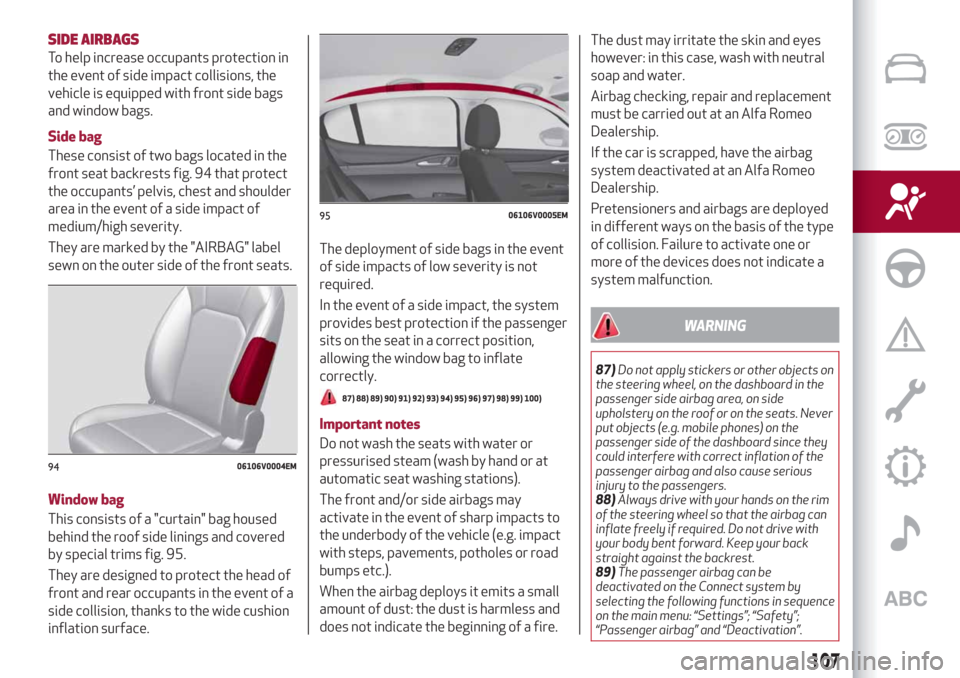
These consist of two bags located in the
front seat backrests fig. 94 that protect
the occupants’ pelvis, chest and shoulder
area in the event of a side impact of
medium/high severity.
They are marked by the "AIRBAG" label
sewn on the outer side of the front seats.
Window bag
This consists of a "curtain" bag housed
behind the roof side linings and covered
by special trims fig. 95.
They are designed to protect the head of
front and rear occupants in the event of a
side collision, thanks to the wide cushion
inflation surface.The deployment of side bags in the event
of side impacts of low severity is not
required.
In the event of a side impact, the system
provides best protection if the passenger
sits on the seat in a correct position,
allowing the window bag to inflate
correctly.
87) 88) 89) 90) 91) 92) 93) 94) 95) 96) 97) 98) 99) 100)
Important notes
Do not wash the seats with water or
pressurised steam (wash by hand or at
automatic seat washing stations).
The front and/or side airbags may
activate in the event of sharp impacts to
the underbody of the vehicle (e.g. impact
with steps, pavements, potholes or road
bumps etc.).
When the airbag deploys it emits a small
amount of dust: the dust is harmless and
does not indicate the beginning of a fire.The dust may irritate the skin and eyes
however: in this case, wash with neutral
soap and water.
Airbag checking, repair and replacement
must be carried out at an Alfa Romeo
Dealership.
If the car is scrapped, have the airbag
system deactivated at an Alfa Romeo
Dealership.
Pretensioners and airbags are deployed
in different ways on the basis of the type
of collision. Failure to activate one or
more of the devices does not indicate a
system malfunction.
WARNING
87)Do not apply stickers or other objects on
the steering wheel, on the dashboard in the
passenger side airbag area, on side
upholstery on the roof or on the seats. Never
put objects (e.g. mobile phones) on the
passenger side of the dashboard since they
could interfere with correct inflation of the
passenger airbag and also cause serious
injury to the passengers.
88)Always drive with your hands on the rim
of the steering wheel so that the airbag can
inflate freely if required. Do not drive with
your body bent forward. Keep your back
straight against the backrest.
89)The passenger airbag can be
deactivated on the Connect system by
selecting the following functions in sequence
on the main menu: “Settings”; “Safety”;
“Passenger airbag” and “Deactivation”.
9406106V0004EM
9506106V0005EM
107
Page 190 of 244
WHEELS AND TYRES
180) 181) 182)
Before embarking on a long trip, and
every two weeks, check the tyre inflation
pressure. Check the tyres when cold.
SNOW CHAINS
76)
Rear Wheel Drive and All-wheel drive
versions
It is possible to fit 0.5 in (13 mm) chains
on all the tyres except for R20.
Important notes
The use of snow chains should be in
compliance with local regulations of each
country. In certain countries, tyres
marked with code M+S (Mud and Snow)
are considered as winter equipment;
therefore their use is equivalent to that
of the snow chains.
IMPORTANT The snow chains may be
applied only to the rear wheel tyres.
Installing them on the rear wheel tyres
could damage the suspension and
transmission.
Check the tension of the snow chains
after the first few metres have been
driven.
IMPORTANT Using snow chains with
tyres with non-original dimensions may
damage the vehicle.
IMPORTANT Using different size or type
(M+S, snow, etc.) tyres between front and
rear axle may adversely affect car
driveability, with the risk of losing control
of the car and resulting accidents.
SUGGESTIONS ABOUT THE ROTATION
OF THE TYRES
The front and rear tyres are subject to
different loads and stress due to
steering, manoeuvres and braking. For
this reason they are subject to uneven
wear.
To resolve this problem, tyres should be
rotated at the appropriate time (6200 /
9300 miles (10000 / 15000 km)).
Inverting the tyres means moving them
to different positions on the same side of
the car (front to back and vice versa).
IMPORTANT Crossing the tyres is not
advised, so placing a tyre on a different
axle on the other side of the car is
impossible.
Tyre rotation contributes to the
preservation of the grip and traction
performance on wet, muddy or snowy
roads, guaranteeing optimal driveability
of the car.In the case of irregular wear of the tyres
identify the cause and correct it as soon
as possible, by contacting an Alfa Romeo
Dealership.
WARNING
180)The road holding qualities of the car
also depend on the correct inflation pressure
of the tyres.
181)If tyre pressure is too low, it may
overheat and be severely damaged as a
result.
182)Never submit alloy rims to repainting
treatments requiring the use of
temperatures exceeding 150°C. The
mechanical properties of the wheels could
be impaired.
IMPORTANT
76)Keep your speed down when snow chains
are fitted; do not exceed 50 km/h (or the
equivalent in miles). Avoid potholes, do not
drive over steps or pavements and do not
drive long distances over roads without
snow, to avoid damaging both your vehicle
and the road surface.
188
SERVICING AND CARE
Page 193 of 244
Everything you may find useful for understanding how your vehicle
is made and works is contained in this chapter and illustrated with
data, tables and graphics.
For the enthusiasts and the technician, but also just for those who
want to know every detail of their vehicle.
TECHNICAL DATA
IDENTIFICATION DATA..........................192
ENGINE...................................193
RIMS AND TYRES.............................195
DIMENSIONS . . ..............................199
WEIGHTS..................................200
REFUELLING................................202
FLUIDS AND LUBRICANTS........................205
PERFORMANCE..............................208
FUEL CONSUMPTION AND CO2 EMISSIONS . . ..........209
PRESCRIPTIONS FOR HANDLING THE VEHICLE
AT THE END OF ITS LIFE.........................210
Page 197 of 244
RIMS AND TYRES
Alloy rims. Tubeless radial carcass tyres.
All approved tyres are listed in the
registration document.
IMPORTANT If there are any
discrepancies between the Owner
Handbook and the Registration
Document, take the information from the
latter. For safe driving, the car must be
fitted with tyres of the same make and
type on all wheels.
IMPORTANT Do not use air chambers
with tubeless tyres.IMPORTANT Using tyres of a different
size, type, brand or design at the front
and rear may adversely affect car
driveability. We recommend using tyres
approved by the manufacturer. The
manufacturer cannot determine if
unapproved tyres are suitable for use
and therefore cannot guarantee vehicle
safety in those conditions.
195
Page 198 of 244
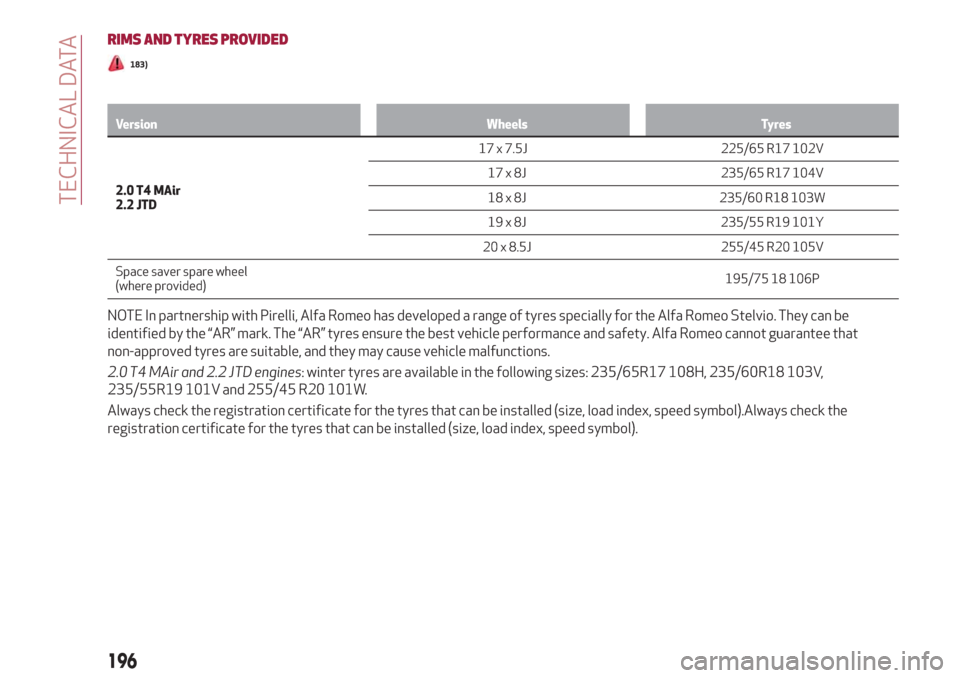
RIMS AND TYRES PROVIDED
183)
Version Wheels Tyres
2.0 T4 MAir
2.2 JTD17 x 7.5J 225/65 R17 102V
17 x 8J 235/65 R17 104V
18 x 8J 235/60 R18 103W
19 x 8J 235/55 R19 101Y
20 x 8.5J 255/45 R20 105V
Space saver spare wheel
(where provided)195/75 18 106P
NOTE In partnership with Pirelli, Alfa Romeo has developed a range of tyres specially for the Alfa Romeo Stelvio. They can be
identified by the “AR” mark. The “AR” tyres ensure the best vehicle performance and safety. Alfa Romeo cannot guarantee that
non-approved tyres are suitable, and they may cause vehicle malfunctions.
2.0 T4 MAir and 2.2 JTD engines: winter tyres are available in the following sizes: 235/65R17 108H, 235/60R18 103V,
235/55R19 101V and 255/45 R20 101W.
Always check the registration certificate for the tyres that can be installed (size, load index, speed symbol).Always check the
registration certificate for the tyres that can be installed (size, load index, speed symbol).
196
TECHNICAL DATA
Page 201 of 244
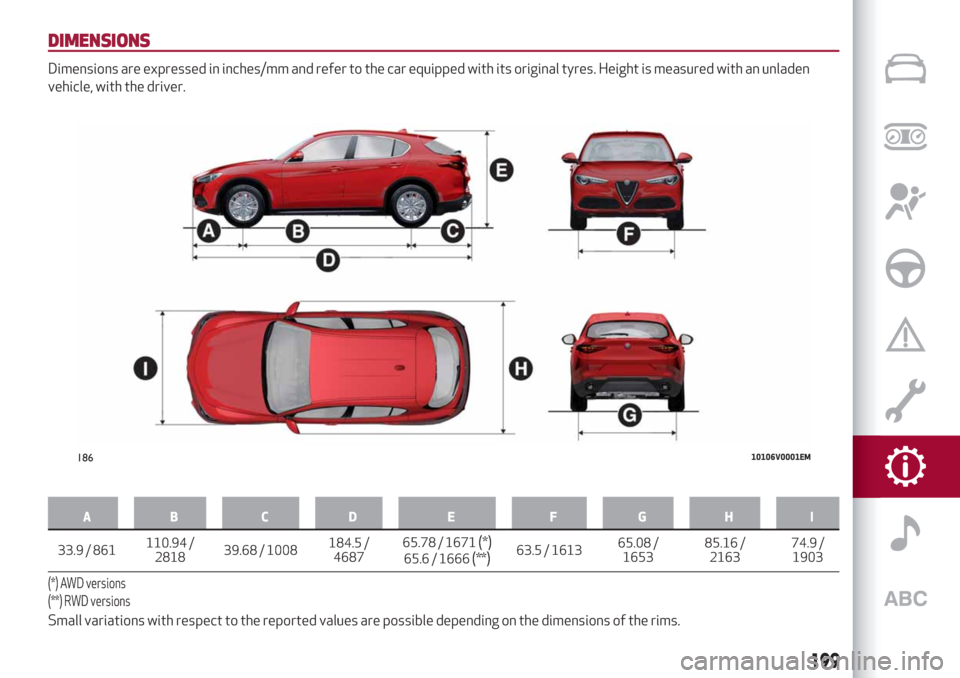
DIMENSIONS
Dimensions are expressed in inches/mm and refer to the car equipped with its original tyres. Height is measured with an unladen
vehicle, with the driver.
AB C D E F GHI
33.9 / 861110.94
/
281839.68 / 1008184.5 /
468765.78 / 1671(*)65.6 / 1666(**)63.5 / 161365.08 /
165385.16 /
216374.9 /
1903
(*) AWD versions
(**) RWD versions
Small variations with respect to the reported values are possible depending on the dimensions of the rims.
18610106V0001EM
199