warning ALFA ROMEO STELVIO 2021 Owners Manual
[x] Cancel search | Manufacturer: ALFA ROMEO, Model Year: 2021, Model line: STELVIO, Model: ALFA ROMEO STELVIO 2021Pages: 280, PDF Size: 10.02 MB
Page 245 of 280
243
Run Flat Tires — If Equipped
Run Flat tires allow you the capability to drive
50 miles (80 km) at 50 mph (80 km/h) after a
rapid loss of inflation pressure. This rapid loss
of inflation is referred to as the Run Flat mode.
A Run Flat mode occurs when the tire inflation
pressure is of/or below 14 psi (96 kPa). Once
a Run Flat tire reaches the run flat mode it has
limited driving capabilities and needs to be
replaced immediately. A Run Flat tire is not
repairable. When a run flat tire is changed
after driving with underinflated tire condition,
please replace the TPM sensor as it is not
designed to be reused when driven under run
flat mode 14 psi (96 kPa) condition.
NOTE:
TPM Sensor must be replaced after driving the
vehicle on a flat tire condition.
It is not recommended driving a vehicle loaded
at full capacity or to tow a trailer while a tire is
in the run flat mode.
For more information
Ú
page 161.
Tire Spinning
When stuck in mud, sand, snow, or ice condi -
tions, do not spin your vehicle's wheels above
30 mph (48 km/h) or for longer than 30 seconds
continuously without stopping.
Tread Wear Indicators
Tread wear indicators are in the original equip -
ment tires to help you in determining when
your tires should be replaced.
Tire Tread These indicators are molded into the bottom of
the tread grooves. They will appear as bands
when the tread depth becomes a 1/16 of an
inch (1.6 mm). When the tread is worn to the
tread wear indicators, the tire should be
replaced.
Life Of Tire
The service life of a tire is dependent upon
varying factors including, but not limited to:
Driving style.
Tire pressure - Improper cold tire inflation
pressures can cause uneven wear patterns
to develop across the tire tread. These
abnormal wear patterns will reduce tread
life, resulting in the need for earlier tire
replacement.
Distance driven.
Performance tires, tires with a speed rating
of V or higher, and Summer tires typically
have a reduced tread life. Rotation of these
tires per the vehicle scheduled mainte
-
nance is highly recommended.
WARNING!
Fast spinning tires can be dangerous. Forces
generated by excessive wheel speeds may
cause tire damage or failure. A tire could
explode and injure someone. Do not spin
your vehicle's wheels faster than 30 mph
(48 km/h) for more than 30 seconds
continuously when you are stuck, and do not
let anyone near a spinning wheel, no matter
what the speed.
1 — Worn Tire
2 — New Tire
WARNING!
Tires and the spare tire should be replaced
after six years, regardless of the remaining
tread. Failure to follow this warning can
result in sudden tire failure. You could lose
control and have a collision resulting in
serious injury or death.
21_GU_OM_EN_USC_t.book Page 243
Page 246 of 280
SERVICING AND MAINTENANCE
244
NOTE:
Wheel valve stem must be replaced as well
when installing new tires due to wear and tear
in existing tires.
Keep dismounted tires in a cool, dry place with
as little exposure to light as possible. Protect
tires from contact with oil, grease, and gaso-
line.
Replacement Tires
The tires on your new vehicle provide a
balance of many characteristics. They should
be inspected regularly for wear and correct
cold tire inflation pressures. The manufacturer
strongly recommends that you use tires equiv -
alent to the originals in size, quality and perfor -
mance when replacement is needed
Ú
page 243. Refer to the Tire and Loading
Information placard or the Vehicle Certifica -
tion Label for the size designation of your tire.
The Load Index and Speed Symbol for your tire
will be found on the original equipment tire
sidewall.
See the Tire Sizing Chart example for more
information relating to the Load Index and
Speed Symbol of a tire
Ú
page 233.
It is recommended to replace the two front
tires or two rear tires as a pair. Replacing just
one tire can seriously affect your vehicle’s
handling. If you ever replace a wheel, make
sure that the wheel’s specifications match
those of the original wheels. It is recommended you contact an authorized
tire dealer or original equipment dealer with
any questions you may have on tire specifica
-
tions or capability. Failure to use equivalent
replacement tires may adversely affect the
safety, handling, and ride of your vehicle.
Spare Tires — If Equipped
NOTE:
For vehicles equipped with Tire Service Kit
instead of a spare tire
Ú
page 198.
Spare Tire Matching Original Equipped Tire
And Wheel — If Equipped
Your vehicle may be equipped with a spare tire
and wheel equivalent in look and function to
the original equipment tire and wheel found on
the front or rear axle of your vehicle. This spare
tire may be used in the tire rotation for your
vehicle. If your vehicle has this option, refer to
an authorized tire dealer for the recom -
mended tire rotation pattern.
WARNING!
Do not use a tire, wheel size, load rating,
or speed rating other than that specified
for your vehicle. Some combinations of
unapproved tires and wheels may change
suspension dimensions and performance
characteristics, resulting in changes to
steering, handling, and braking of your
vehicle. This can cause unpredictable
handling and stress to steering and
suspension components. You could lose
control and have a collision resulting in
serious injury or death. Use only the tire
and wheel sizes with load ratings
approved for your vehicle.
Never use a tire with a smaller load index
or capacity, other than what was originally
equipped on your vehicle. Using a tire with
a smaller load index could result in tire
overloading and failure. You could lose
control and have a collision.
Failure to equip your vehicle with tires
having adequate speed capability can
result in sudden tire failure and loss of
vehicle control.
CAUTION!
Replacing original tires with tires of a
different size may result in false
speedometer and odometer readings.
CAUTION!
Because of the reduced ground clearance,
do not take your vehicle through an
automatic car wash with a compact or
limited use temporary spare installed.
Damage to the vehicle may result.
21_GU_OM_EN_USC_t.book Page 244
Page 247 of 280
245
Compact Spare Tire — If Equipped
The compact spare is for temporary emer-
gency use only. You can identify if your vehicle
is equipped with a compact spare by looking at
the spare tire description on the Tire and
Loading Information Placard located on the
driver’s side door opening or on the sidewall of
the tire. Compact spare tire descriptions begin
with the letter “T” or “S” preceding the size
designation. Example: T145/80D18 103M.
T, S = Temporary Spare Tire
Since this tire has limited tread life, the orig -
inal equipment tire should be repaired (or
replaced) and reinstalled on your vehicle at
the first opportunity.
Do not install a wheel cover or attempt to
mount a conventional tire on the compact
spare wheel, since the wheel is designed
specifically for the compact spare tire. Do not
install more than one compact spare tire and
wheel on the vehicle at any given time.
Full Size Spare — If Equipped
The full size spare is for temporary emergency
use only. This tire may look like the originally
equipped tire on the front or rear axle of your
vehicle, but it is not. This spare tire may have
limited tread life. When the tread is worn to the
tread wear indicators, the temporary use full
size spare tire needs to be replaced. Since it is
not the same as your original equipment tire,
replace (or repair) the original equipment tire
and reinstall on the vehicle at the first oppor -
tunity.
Limited Use Spare — If Equipped
The limited use spare tire is for temporary
emergency use only. This tire is identified by a
label located on the limited use spare wheel.
This label contains the driving limitations for
this spare. This tire may look like the original
equipped tire on the front or rear axle of your
vehicle, but it is not. Installation of this limited
use spare tire affects vehicle handling. Since it
is not the same as your original equipment
tire, replace (or repair) the original equipment
tire and reinstall on the vehicle at the first
opportunity.
Wheel And Wheel Trim Care
All wheels and wheel trim, especially
aluminum and chrome plated wheels, should
be cleaned regularly using mild (neutral Ph)
soap and water to maintain their luster and to
prevent corrosion. Wash wheels with the same
soap solution recommended for the body of
the vehicle and remember to always wash
when the surfaces are not hot to the touch.
Your wheels are susceptible to deterioration
caused by salt, sodium chloride, magnesium
chloride, calcium chloride, etc., and other road
chemicals used to melt ice or control dust on
dirt roads. Use a soft cloth or sponge and mild
soap to wipe away promptly. Do not use harsh
chemicals or a stiff brush. They can damage
WARNING!
Compact and collapsible spares are for
temporary emergency use only. With these
spares, do not drive more than 50 mph
(80 km/h). Temporary use spares have
limited tread life. When the tread is worn to
the tread wear indicators, the temporary
use spare tire needs to be replaced. Be
sure to follow the warnings, which apply to
your spare. Failure to do so could result in
spare tire failure and loss of vehicle control.
WARNING!
Limited use spares are for emergency use
only. Installation of this limited use spare
tire affects vehicle handling. With this tire,
do not drive more than the speed listed on
the limited use spare wheel. Keep inflated
to the cold tire inflation pressures listed on
your Tire and Loading Information Placard
located on the driver’s side B-pillar or the
rear edge of the driver’s side door. Replace
(or repair) the original equipment tire at the
first opportunity and reinstall it on your
vehicle. Failure to do so could result in loss
of vehicle control.
21_GU_OM_EN_USC_t.book Page 245
Page 248 of 280
SERVICING AND MAINTENANCE
246
the wheel’s protective coating that helps keep
them from corroding and tarnishing.
When cleaning extremely dirty wheels
including excessive brake dust, care must be
taken in the selection of tire and wheel
cleaning chemicals and equipment to prevent
damage to the wheels. Select a non-abrasive,
non-acidic cleaner for aluminum or chrome
wheels.
NOTE:
If you intend parking or storing your vehicle for
an extended period after cleaning the wheels
with wheel cleaner, drive your vehicle and
apply the brakes to remove the water droplets
from the brake components. This activity will
remove the red rust on the brake rotors and
prevent vehicle vibration when braking.
Dark Or Low Gloss Wheels
Tire Types
All Season Tires — If Equipped
All Season tires provide traction for all seasons
(Spring, Summer, Autumn, and Winter). Trac
-
tion levels may vary between different all
season tires. All season tires can be identified
by the M+S, M&S, M/S or MS designation on
the tire sidewall. Use all season tires only in
sets of four; failure to do so may adversely
affect the safety and handling of your vehicle.
Summer Or Three Season Tires — If
Equipped
Summer tires provide traction in both wet and
dry conditions, and are not intended to be
driven in snow or on ice. If your vehicle is
equipped with Summer tires, be aware these
tires are not designed for Winter or cold driving
conditions. Install Winter tires on your vehicle
when ambient temperatures are less than
40°F (5°C) or if roads are covered with ice or
snow. For more information, contact an autho -
rized dealer.
Summer tires do not contain the all season
designation or mountain/snowflake symbol on
the tire sidewall. Use Summer tires only in sets
of four; failure to do so may adversely affect
the safety and handling of your vehicle.
Snow Tires
Some areas of the country require the use of
snow tires during the Winter. Snow tires can
be identified by a “mountain/snowflake”
symbol on the tire sidewall.
If you need snow tires, select tires
equivalent in size and type to the
original equipment tires. Use snow
CAUTION!
Avoid products or automatic car washes
that use acidic solutions or strong alkaline
additives or harsh brushes. Many
aftermarket wheel cleaners and automatic
car washes may damage the wheel's
protective finish. Such damage is not
covered by the New Vehicle Limited
Warranty. Only car wash soap is
recommended.
CAUTION!
Do not use scouring pads, steel wool, a
bristle brush, metal polishes or oven
cleaner. These products may damage the
wheel's protective finish. Such damage is
not covered by the New Vehicle Limited
Warranty. Only car wash soap is
recommended.
CAUTION!
If your vehicle is equipped with these
specialty wheels, DO NOT USE wheel
cleaners, abrasives, or polishing
compounds. They will permanently damage
this finish and such damage is not covered
by the New Vehicle Limited Warranty. HAND
WASH ONLY USING MILD SOAP AND WATER
WITH A SOFT CLOTH. Used on a regular
basis; this is all that is required to maintain
this finish.
WARNING!
Do not use Summer tires in snow/ice
conditions. You could lose vehicle control,
resulting in severe injury or death. Driving
too fast for conditions also creates the
possibility of loss of vehicle control.
21_GU_OM_EN_USC_t.book Page 246
Page 250 of 280
SERVICING AND MAINTENANCE
248
Tire rotation contributes to the preservation of
the grip and traction performance on wet,
muddy or snowy roads, guaranteeing optimal
driveability of the vehicle.
In the case of irregular wear of the tires iden-
tify the cause and correct it as soon as
possible, by contacting an authorized dealer.
The rotational direction of the tire must be
taken into consideration when rotating the
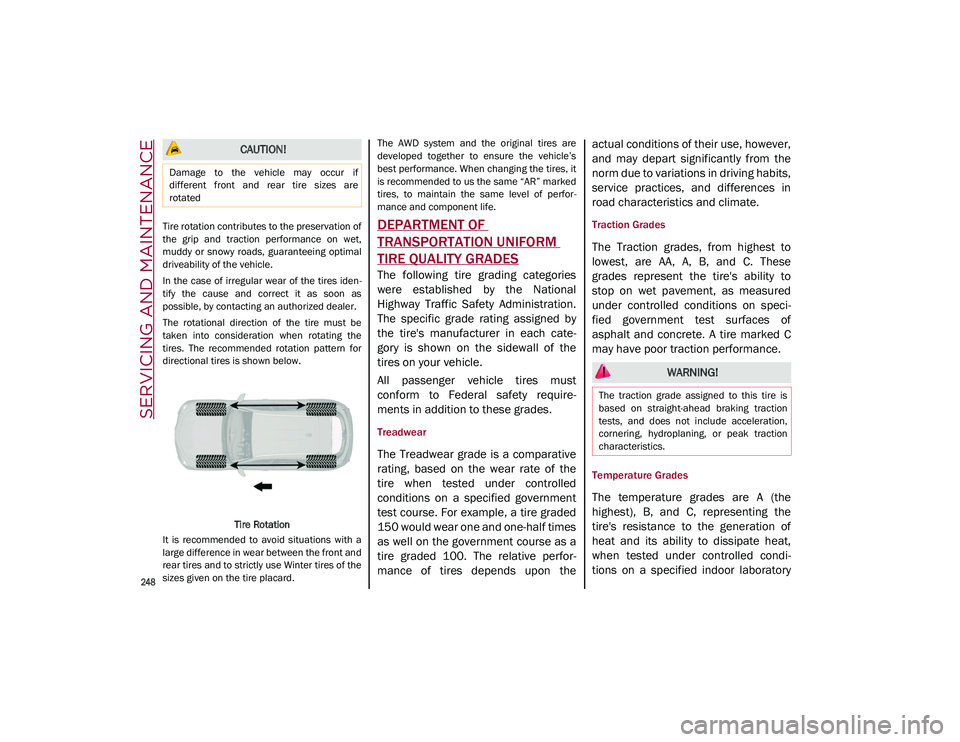
tires. The recommended rotation pattern for
directional tires is shown below.
Tire Rotation
It is recommended to avoid situations with a
large difference in wear between the front and
rear tires and to strictly use Winter tires of the
sizes given on the tire placard. The AWD system and the original tires are
developed together to ensure the vehicle’s
best performance. When changing the tires, it
is recommended to us the same “AR” marked
tires, to maintain the same level of perfor
-
mance and component life.DEPARTMENT OF
TRANSPORTATION UNIFORM
TIRE QUALITY GRADES
The following tire grading categories
were established by the National
Highway Traffic Safety Administration.
The specific grade rating assigned by
the tire's manufacturer in each cate -
gory is shown on the sidewall of the
tires on your vehicle.
All passenger vehicle tires must
conform to Federal safety require -
ments in addition to these grades.
Treadwear
The Treadwear grade is a comparative
rating, based on the wear rate of the
tire when tested under controlled
conditions on a specified government
test course. For example, a tire graded
150 would wear one and one-half times
as well on the government course as a
tire graded 100. The relative perfor -
mance of tires depends upon the actual conditions of their use, however,
and may depart significantly from the
norm due to variations in driving habits,
service practices, and differences in
road characteristics and climate.
Traction Grades
The Traction grades, from highest to
lowest, are AA, A, B, and C. These
grades represent the tire's ability to
stop on wet pavement, as measured
under controlled conditions on speci
-
fied government test surfaces of
asphalt and concrete. A tire marked C
may have poor traction performance.
Temperature Grades
The temperature grades are A (the
highest), B, and C, representing the
tire's resistance to the generation of
heat and its ability to dissipate heat,
when tested under controlled condi -
tions on a specified indoor laboratory
CAUTION!
Damage to the vehicle may occur if
different front and rear tire sizes are
rotated
WARNING!
The traction grade assigned to this tire is
based on straight-ahead braking traction
tests, and does not include acceleration,
cornering, hydroplaning, or peak traction
characteristics.
21_GU_OM_EN_USC_t.book Page 248
Page 251 of 280
249
test wheel. Sustained high temperature
can cause the material of the tire to
degenerate and reduce tire life, and
excessive temperature can lead to
sudden tire failure. The grade C corre-
sponds to a level of performance, which
all passenger vehicle tires must meet
under the Federal Motor Vehicle Safety
Standard No. 109. Grades B and A
represent higher levels of performance
on the laboratory test wheel, than the
minimum required by law.
STORING THE VEHICLE
If the vehicle is left inactive for longer than a
month, the following precautions should be
observed:
Park the vehicle in an area that is covered
and dry, and well-ventilated if possible.
Slightly open the windows.
Check that the Electric Park Brake (EPB) is
not activated.
Carry out the “Liftgate Emergency Opening”
procedure
Ú
page 62.
Disconnect the negative battery terminal
and check the battery charge. Repeat this
check once every three months during
storage.
If the battery is not disconnected from the
electrical system, check its state of charge
every 30 days.
Clean and protect the painted parts using
protective wax.
Clean and protect the shiny metal parts using
special compounds available commercially.
Sprinkle talcum powder on the windshield
wiper rubber blades, and lift them off the
glass.
Cover the vehicle with a fabric or perforated
plastic sheet, paying particular care not to
damage the painted surface by dragging
any dust that may have accumulated on it.
Do not use compact plastic sheets, as they
do not allow humidity to evaporate from the
surface of the vehicle.
Inflate tires to +7.25 psi (+0.5 bar) above
the standard prescribed pressure and
check it periodically.
Do not drain the engine cooling system.
Any time the vehicle is left inactive for two
weeks or more, operate the air conditioning
system with engine idling for at least five minutes, setting external air and with fan
set to maximum speed. This operation will
ensure appropriate lubrication for the
system, thus minimizing the possibility of
damage to the compressor when the
system is operated again.
NOTE:
After cycling the ignition to STOP and having
closed the driver side door, wait at least one
minute before disconnecting the electrical
supply from the battery. When reconnecting
the electrical supply to the battery, make sure
that the ignition is in the STOP position and the
driver’s side door is closed.
BODYWORK
Protection Against Atmospheric Agents
The vehicle is equipped with the best available
technological solutions to protect the body -
work against corrosion.
These include:
Painting products and systems which give
the vehicle resistance to corrosion and
abrasion.
Use of galvanized (or pre-treated) steel
sheets, with high resistance to corrosion.
Spraying of plastic parts, with a protective
function in the more exposed points: under
door, inner wing, edges, etc.
WARNING!
The temperature grade for this tire is
established for a tire that is properly inflated
and not overloaded. Excessive speed,
underinflation, or excessive loading, either
separately or in combination, can cause
heat buildup and possible tire failure.
21_GU_OM_EN_USC_t.book Page 249
Page 269 of 280
267
Service Contract
You may have purchased a service contract for
a vehicle to help protect you from the high cost
of unexpected repairs after FCA US LLC's New
Vehicle Limited Warranty expires. The Mopar
Vehicle Protection plans are the ONLY vehicle
extended protection plans authorized,
endorsed and backed by FCA US LLC to
provide additional protection beyond your
vehicle’s warranty. If you purchased a Mopar
Vehicle Protection Plan, you will receive Plan
Provisions and an Owner Identification Card in
the mail within three weeks of the vehicle
delivery date. If you have any questions about
the service contract, call FCA US LLC’s Service
Contract National Customer Hotline at
1-800-521-9922 (Canadian residents, call
(800) 465-2001 English / (800) 387-9983
French).
FCA US LLC is not responsible for any service
contract you may have purchased from
another manufacturer. If you require service
after the FCA US LLC New Vehicle Limited
Warranty expires, please refer to the contract
documents, and contact the person listed in
those documents.
We appreciate that you have made a major
investment when you purchased the vehicle.
An authorized dealer has also made a major
investment in facilities, tools, and training to
assure that you are absolutely delighted with
the ownership experience.
WARRANTY INFORMATION
See the Warranty Information for the terms
and provisions of FCA US LLC and FCA Canada
Inc. warranties applicable to this vehicle and
market.
REPORTING SAFETY DEFECTS
In The 50 United States And
Washington, D.C.
If you believe that your vehicle has a
defect that could cause a crash or
cause injury or death, you should imme-
diately inform the National Highway
Traffic Safety Administration (NHTSA) in
addition to notifying FCA US LLC. If NHTSA receives similar complaints, it
may open an investigation, and if it
finds that a safety defect exists in a
group of vehicles, it may order a recall
and remedy campaign. However,
NHTSA cannot become involved in indi
-
vidual problems between you, your
authorized dealer or FCA US LLC.
To contact NHTSA, you may call the
Vehicle Safety Hotline toll free at
1-888-327-4236 (TTY: 1-800-424-9153);
or go to http://www.safercar.gov; or write
to: Administrator, NHTSA, 1200 New
Jersey Avenue, SE., West Building, Wash -
ington, D.C. 20590. You can also obtain
other information about motor vehicle
safety from http://www.safercar.gov.
In Canada
If you believe that your vehicle has a
safety defect, you should contact the
Customer Service Department immedi -
ately. Canadian customers who wish to
report a safety defect to the Canadian
government should contact Transport
Canada, Motor Vehicle Defect Investiga-
tions and Recalls at 1-800-333-0510 or
go to
wwwapps.tc.gc.ca/Saf-Sec-Sur/7/
PCDB-BDPP
.
WARNING!
Engine exhaust (internal combustion
engines only), some of its constituents, and
certain vehicle components contain, or
emit, chemicals known to the State of
California to cause cancer and birth
defects, or other reproductive harm. In
addition, certain fluids contained in
vehicles and certain products of
component wear contain, or emit,
chemicals known to the State of California
to cause cancer and birth defects, or other
reproductive harm.
21_GU_OM_EN_USC_t.book Page 267
Page 271 of 280
269
A
Accessories Purchased By The Owner.......... 4
Active Blind Spot Assist .............................152
Active Safety Systems ................................ 145
Active Torque Vectoring (ATV) System ......145
Adaptive Cruise Control (ACC)
(Cruise Control) .................................104, 106Off ........................................................... 108
On............................................................108
Additives, Fuel ............................................ 261
Adjust Forward.............................................. 31, 33
Rearward ........................................... 31, 33
Air Bag......................................................... 170 Air Bag Operation ...................................171Air Bag Warning Light ............................169
Driver Knee Air Bag................................ 172Enhanced Accident Response .....175, 207
Event Data Recorder (EDR) ...................207
Front Air Bag...........................................170
If Deployment Occurs ............................175
Knee Impact Bolsters ............................172
Maintaining Your Air Bag System.......... 177
Maintenance ..........................................177
Redundant Air Bag Warning Light.........170
Side Air Bags ..........................................172
Transporting Pets...................................189
Air Bag Light ......................................169, 189
Air Pressure Tires ........................................................240
Alfa Active Suspension (AAS).....................101
Alfa DNA System .......................................... 98
Antifreeze (Engine Coolant) ....................... 262
Anti-Lock Braking (ABS) System ................ 145
Anti-Lock Warning Light ............................... 75 Automatic Climate Controls ........................ 49
Automatic Dimming Mirror .......................... 37
Automatic Door Locks ................................. 27
Automatic Headlights .................................. 43
Automatic Temperature Control (ATC)........ 49
Automatic Transmission .............................. 92
Auxiliary Driving Systems .......................... 149
Auxiliary Power Outlet .................................. 56
B
Battery ................................................. 78, 217 Charging System Light ............................ 78
Keyless Key Fob Replacement ............... 18
Battery Recharging .................................... 218
Belts, Seat .................................................. 189
Blind Spot Monitoring ................................ 150
Bodywork (Cleaning And Maintenance) ... 249
B-Pillar Location ......................................... 237
Brake System Warning Light .....................................74, 75
Brakes ........................................................ 255 Brake Fluid Level ................................... 217
Brightness, Interior Lights ........................... 46
Bulbs, Light ................................................ 190
C
Camera, Rear ............................................. 132
Capacities, Fluid ........................................ 262
Carbon Monoxide Warning ............... 190, 191
Certification Label...................................... 135
Chart, Tire Sizing ........................................ 234
Check Engine Light (Malfunction
Indicator Light) ............................................. 85
Checking Levels ................................ 214, 215
Checking Your Vehicle For Safety ............. 188 Checks, Safety ........................................... 188
Child Restraint ........................................... 178
Child Restraints
Booster Seats ........................................ 180
Child Seat Installation........................... 187
How To Stow An unused ALR Seat Belt ..................................................... 185
Infant And Child Restraints................... 179
LATCH Positions .................................... 182
Lower Anchors And Tethers For Children ............................................. 181
Older Children And Child Restraints .... 179
Seating Positions................................... 181
Clean Air Gasoline ..................................... 260
Cleaning Wheels ................................................... 245
Climate Control ...................................... 48, 54 Automatic..................................................49
Compact Spare Tire................................... 245
Contract, Service ....................................... 267
Cooling System Cooling Capacity .................................... 262
Selection Of Coolant (Antifreeze) ......... 262
Cruise Control (Speed Control) ........ 104, 106
Customer Assistance ................................ 266
D
Daytime Running Lights ...............................42
Defroster, Windshield ............................... 189
Dimensions ................................................ 257
Disabled Vehicle Towing ........................... 205
Door Ajar ................................................ 79, 80
Door Ajar Light ....................................... 79, 80
Door Locks ....................................................27 Automatic..................................................27
21_GU_OM_EN_USC_t.book Page 269
Page 272 of 280
270
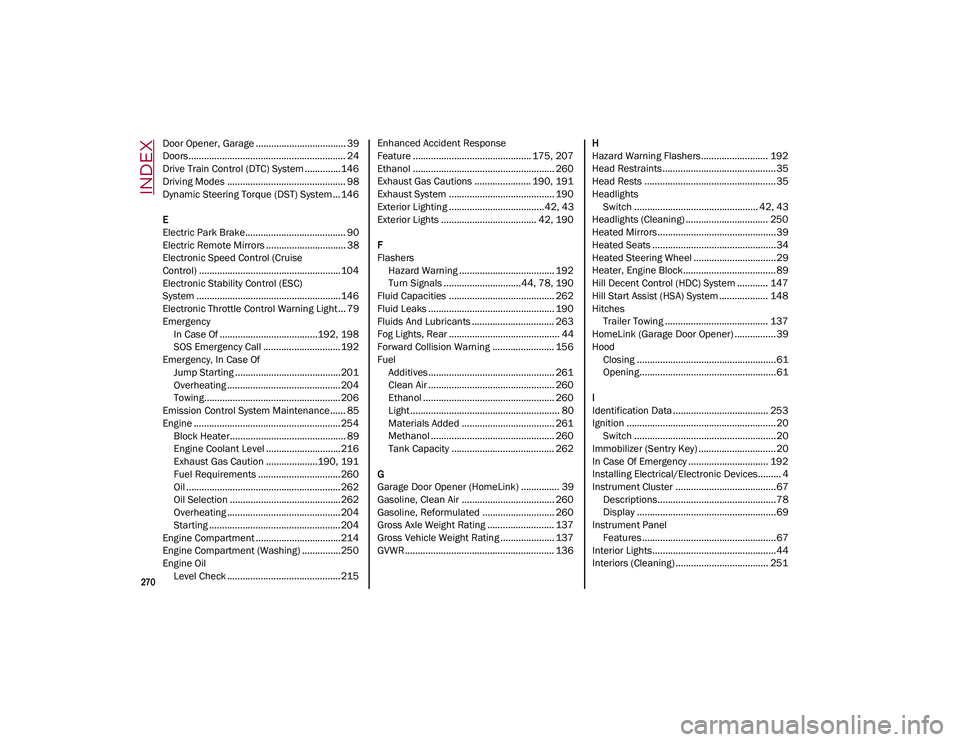
INDEX
Door Opener, Garage ................................... 39
Doors............................................................. 24
Drive Train Control (DTC) System ..............146
Driving Modes .............................................. 98
Dynamic Steering Torque (DST) System ... 146
E
Electric Park Brake....................................... 90
Electric Remote Mirrors ............................... 38
Electronic Speed Control (Cruise
Control) .......................................................104
Electronic Stability Control (ESC)
System ........................................................146
Electronic Throttle Control Warning Light... 79
Emergency In Case Of ......................................192, 198
SOS Emergency Call .............................. 192
Emergency, In Case Of Jump Starting .........................................201
Overheating ............................................ 204
Towing.....................................................206
Emission Control System Maintenance...... 85
Engine ......................................................... 254 Block Heater............................................. 89
Engine Coolant Level .............................216
Exhaust Gas Caution ....................190, 191
Fuel Requirements ................................ 260Oil ............................................................262
Oil Selection ...........................................262
Overheating ............................................ 204
Starting ................................................... 204
Engine Compartment .................................214
Engine Compartment (Washing) ...............250
Engine Oil Level Check ............................................ 215 Enhanced Accident Response
Feature .............................................. 175, 207
Ethanol ....................................................... 260
Exhaust Gas Cautions ...................... 190, 191
Exhaust System ......................................... 190
Exterior Lighting .....................................42, 43
Exterior Lights ..................................... 42, 190
F
Flashers Hazard Warning ..................................... 192
Turn Signals ..............................44, 78, 190
Fluid Capacities ......................................... 262
Fluid Leaks ................................................. 190
Fluids And Lubricants ................................ 263
Fog Lights, Rear ........................................... 44
Forward Collision Warning ........................ 156
Fuel Additives................................................. 261
Clean Air ................................................. 260
Ethanol ................................................... 260
Light .......................................................... 80
Materials Added .................................... 261
Methanol ................................................ 260
Tank Capacity ........................................ 262
G
Garage Door Opener (HomeLink) ............... 39
Gasoline, Clean Air .................................... 260
Gasoline, Reformulated ............................ 260
Gross Axle Weight Rating .......................... 137
Gross Vehicle Weight Rating ..................... 137
GVWR .......................................................... 136 H
Hazard Warning Flashers.......................... 192
Head Restraints............................................35
Head Rests ...................................................35
Headlights
Switch ................................................ 42, 43
Headlights (Cleaning) ................................ 250
Heated Mirrors..............................................39
Heated Seats ................................................34
Heated Steering Wheel ................................29
Heater, Engine Block.................................... 89
Hill Decent Control (HDC) System ............ 147
Hill Start Assist (HSA) System ................... 148
Hitches Trailer Towing ........................................ 137
HomeLink (Garage Door Opener) ................39
Hood Closing ......................................................61Opening.....................................................61
I
Identification Data ..................................... 253
Ignition ..........................................................20 Switch .......................................................20
Immobilizer (Sentry Key) ..............................20
In Case Of Emergency ............................... 192
Installing Electrical/Electronic Devices......... 4
Instrument Cluster .......................................67 Descriptions..............................................78
Display ......................................................69
Instrument Panel Features....................................................67
Interior Lights................................................44
Interiors (Cleaning) .................................... 251
21_GU_OM_EN_USC_t.book Page 270
Page 273 of 280
271
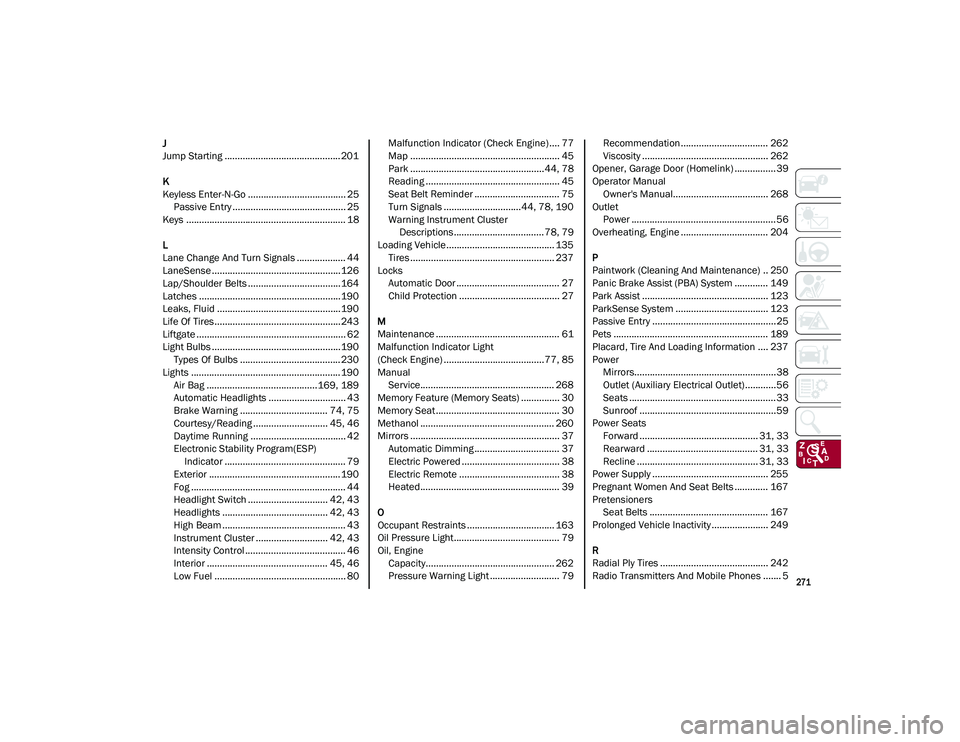
J
Jump Starting ............................................. 201
K
Keyless Enter-N-Go ...................................... 25Passive Entry ............................................ 25
Keys .............................................................. 18
L
Lane Change And Turn Signals ................... 44
LaneSense ..................................................126
Lap/Shoulder Belts ....................................164
Latches .......................................................190
Leaks, Fluid ................................................190
Life Of Tires.................................................243
Liftgate .......................................................... 62
Light Bulbs ..................................................190 Types Of Bulbs ....................................... 230
Lights .......................................................... 190 Air Bag ...........................................169, 189
Automatic Headlights .............................. 43
Brake Warning .................................. 74, 75Courtesy/Reading ............................. 45, 46Daytime Running ..................................... 42
Electronic Stability Program(ESP) Indicator ............................................... 79
Exterior ................................................... 190
Fog ............................................................ 44
Headlight Switch ............................... 42, 43 Headlights ......................................... 42, 43
High Beam ................................................ 43
Instrument Cluster ............................ 42, 43Intensity Control ....................................... 46
Interior ............................................... 45, 46
Low Fuel ................................................... 80 Malfunction Indicator (Check Engine).... 77
Map .......................................................... 45
Park ....................................................44, 78
Reading .................................................... 45
Seat Belt Reminder ................................. 75
Turn Signals ..............................44, 78, 190
Warning Instrument Cluster
Descriptions ...................................78, 79
Loading Vehicle .......................................... 135 Tires ........................................................ 237
Locks Automatic Door ........................................ 27
Child Protection ....................................... 27
M
Maintenance ................................................ 61
Malfunction Indicator Light
(Check Engine) .......................................77, 85
Manual Service.................................................... 268
Memory Feature (Memory Seats) ............... 30
Memory Seat ................................................ 30
Methanol .................................................... 260
Mirrors .......................................................... 37 Automatic Dimming ................................. 37
Electric Powered ...................................... 38
Electric Remote ....................................... 38
Heated...................................................... 39
O
Occupant Restraints .................................. 163
Oil Pressure Light ......................................... 79
Oil, Engine Capacity.................................................. 262
Pressure Warning Light ........................... 79 Recommendation.................................. 262
Viscosity ................................................. 262
Opener, Garage Door (Homelink) ................39
Operator Manual Owner's Manual..................................... 268
Outlet Power ........................................................ 56
Overheating, Engine .................................. 204
P
Paintwork (Cleaning And Maintenance) .. 250
Panic Brake Assist (PBA) System ............. 149
Park Assist ................................................. 123
ParkSense System .................................... 123
Passive Entry ................................................25
Pets ............................................................ 189
Placard, Tire And Loading Information .... 237
Power Mirrors.......................................................38Outlet (Auxiliary Electrical Outlet)............56
Seats .........................................................33
Sunroof .....................................................59
Power Seats Forward .............................................. 31, 33
Rearward ........................................... 31, 33
Recline ............................................... 31, 33
Power Supply ............................................. 255
Pregnant Women And Seat Belts ............. 167
Pretensioners Seat Belts .............................................. 167
Prolonged Vehicle Inactivity ...................... 249
R
Radial Ply Tires .......................................... 242
Radio Transmitters And Mobile Phones ....... 5
21_GU_OM_EN_USC_t.book Page 271