cooling ALFA ROMEO STELVIO 2021 User Guide
[x] Cancel search | Manufacturer: ALFA ROMEO, Model Year: 2021, Model line: STELVIO, Model: ALFA ROMEO STELVIO 2021Pages: 280, PDF Size: 10.02 MB
Page 225 of 280
223
To minimize the risk of damaging the catalytic
converter, proceed as follows:
Do not stop the engine or deactivate the
ignition with gear engaged and vehicle in
motion.
Do not attempt to start the engine by bump
starting.
Do not use the vehicle if irregular idling or
operating conditions are experienced.
Cooling System
Coolant Check
Your vehicle has two cooling systems and both
need to be checked to ensure they are at
proper fill levels
Ú
page 214.
Check the engine coolant and intercooler
coolant level every oil change or before long
trips.
If there are impurities in the engine coolant,
the system must be drained, flushed and
refilled: contact an authorized dealer. Check the front part of the condenser for any
build-up of insects, leaves or other debris.
Should it be dirty, clean by spraying delicately
with water.
Check the hoses of the engine/intercooler
cooling system to ensure that the rubber has
not deteriorated and that there are no cracks,
tears, cuts or obstructions in the expansion
tank side and radiator side connectors. Should
there be any doubt regarding leaks from the
system (e.g. if frequent top ups are required),
have the seal checked at an authorized
dealer.
With the engine off and at normal operating
temperature, check that the cooling system
radiator cap is closed properly.
NOTE:
Before removing the coolant reservoir cap,
wait for the system to cool down.
WARNING!
Exhaust gases can injure or kill. They
contain Carbon Monoxide (CO), which is
colorless and odorless. Breathing it can
make you unconscious and can eventually
poison you.
A hot exhaust system can start a fire if you
park over materials that can burn. Such
materials might be grass or leaves coming
into contact with your exhaust system. Do
not park or operate your vehicle in areas
where your exhaust system can contact
anything that can burn.
WARNING!
You or others can be badly burned by hot
engine coolant (antifreeze) or steam from
your radiator. If you see or hear steam
coming from under the hood, do not open
the hood until the radiator has had time to
cool. Never open a cooling system pres
-
sure cap when the radiator or coolant
bottle is hot.
Keep hands, tools, clothing, and jewelry
away from the radiator cooling fan when
the hood is raised. The fan starts automat -
ically and may start at any time, whether
the engine is running or not.
When working near the radiator cooling
fan, disconnect the fan motor lead or turn
the ignition to the OFF mode. The fan is
temperature controlled and can start at
any time the ignition is in the ON mode. WARNING!
Do not open hot engine cooling system.
Never add engine coolant (antifreeze)
when the engine is overheated. Do not
loosen or remove the cap to cool an over -
heated engine. Heat causes pressure to
build up in the cooling system. To prevent
scalding or injury, do not remove the pres -
sure cap while the system is hot or under
pressure.
Do not use a pressure cap other than the
one specified for your vehicle. Personal
injury or engine damage may result.
21_GU_OM_EN_USC_t.book Page 223
Page 226 of 280
SERVICING AND MAINTENANCE
224
(Continued)
(Continued)
Topping Up / Draining / Flushing The Engine/
Intercooler Coolant
If the engine coolant (antifreeze) is dirty, have
cleaning and flushing carried out at an autho
-
rized dealer.
For the correct servicing intervals
Ú
page 209.
NOTE:
For topping off, and proper coolant specifi -
cations
Ú
page 263.
Do not use pure water, alcohol-based cool -
ants, corrosions inhibitors or additional
anti-rust products because they may be
incompatible with the engine coolant and
cause the clogging of the radiator. The use
of propylene glycol-based coolant is also not
recommended.
Engine Cooling/Intercooler System Cap
To prevent loss of engine coolant, make sure
that the expansion tank cap is closed. If it is
open, screw it completely until you reach/hear
the click.
Periodically check the cap and clean it from
any foreign bodies that may have deposited on
the external surface. Disposal of Used Coolant
Disposal of engine/intercooler coolant is
subject to legal requirements. Contact the
appropriate body to determine local regula
-
tions.
NOTE:
To prevent the fluid from being ingested by
children or animals, do not keep it in open
containers or pour it on the ground. If
ingested, contact a doctor immediately.
Eliminate any traces of fluid from the
ground immediately.
When the vehicle stops after a short trip,
steam may be seen coming out from the
front of the hood. This is a normal phenom -
enon which is due to the presence of rain,
snow or a lot of moisture on the surface of
the radiator.
With engine and system cold, do not top up
with coolant beyond the maximum level
indicated on the reservoir in the engine
compartment.
Braking System
In order to guarantee the efficiency of the
braking system, periodically check its compo -
nents; for this operation, contact an autho -
rized dealer.
For the correct servicing intervals
Ú page 209.
NOTE:
Driving with your foot resting on the brake
pedal may compromise its efficiency,
increasing the risk of accidents. When driving,
never keep your foot on the brake pedal and
don’t put unnecessary strain on it to prevent
the brakes from overheating. Excess pad wear
may cause damage to the braking system.
When an insufficient oil level is detected,
contact an authorized dealer to have the
system checked.
Always keep the cap of the brake fluid reser-
voir (in the engine compartment)
completely closed.
WARNING!
Never add coolant with the engine hot or
overheated.
Do not attempt to cool an overheated
engine by loosening or removing the cap.
The heat causes a considerable increase
in pressure in the cooling system.
To prevent damage to the engine, only use
the engine cooling circuit caps provided.
WARNING! (Continued)
WARNING!
Use only manufacturer's recommended
brake fluid
Ú
page 263. Using the wrong
type of brake fluid can severely damage
your brake system and/or impair its
performance. The proper type of brake
fluid for your vehicle is also identified on
the original factory installed hydraulic
master cylinder reservoir.
21_GU_OM_EN_USC_t.book Page 224
Page 251 of 280
249
test wheel. Sustained high temperature
can cause the material of the tire to
degenerate and reduce tire life, and
excessive temperature can lead to
sudden tire failure. The grade C corre-
sponds to a level of performance, which
all passenger vehicle tires must meet
under the Federal Motor Vehicle Safety
Standard No. 109. Grades B and A
represent higher levels of performance
on the laboratory test wheel, than the
minimum required by law.
STORING THE VEHICLE
If the vehicle is left inactive for longer than a
month, the following precautions should be
observed:
Park the vehicle in an area that is covered
and dry, and well-ventilated if possible.
Slightly open the windows.
Check that the Electric Park Brake (EPB) is
not activated.
Carry out the “Liftgate Emergency Opening”
procedure
Ú
page 62.
Disconnect the negative battery terminal
and check the battery charge. Repeat this
check once every three months during
storage.
If the battery is not disconnected from the
electrical system, check its state of charge
every 30 days.
Clean and protect the painted parts using
protective wax.
Clean and protect the shiny metal parts using
special compounds available commercially.
Sprinkle talcum powder on the windshield
wiper rubber blades, and lift them off the
glass.
Cover the vehicle with a fabric or perforated
plastic sheet, paying particular care not to
damage the painted surface by dragging
any dust that may have accumulated on it.
Do not use compact plastic sheets, as they
do not allow humidity to evaporate from the
surface of the vehicle.
Inflate tires to +7.25 psi (+0.5 bar) above
the standard prescribed pressure and
check it periodically.
Do not drain the engine cooling system.
Any time the vehicle is left inactive for two
weeks or more, operate the air conditioning
system with engine idling for at least five minutes, setting external air and with fan
set to maximum speed. This operation will
ensure appropriate lubrication for the
system, thus minimizing the possibility of
damage to the compressor when the
system is operated again.
NOTE:
After cycling the ignition to STOP and having
closed the driver side door, wait at least one
minute before disconnecting the electrical
supply from the battery. When reconnecting
the electrical supply to the battery, make sure
that the ignition is in the STOP position and the
driver’s side door is closed.
BODYWORK
Protection Against Atmospheric Agents
The vehicle is equipped with the best available
technological solutions to protect the body -
work against corrosion.
These include:
Painting products and systems which give
the vehicle resistance to corrosion and
abrasion.
Use of galvanized (or pre-treated) steel
sheets, with high resistance to corrosion.
Spraying of plastic parts, with a protective
function in the more exposed points: under
door, inner wing, edges, etc.
WARNING!
The temperature grade for this tire is
established for a tire that is properly inflated
and not overloaded. Excessive speed,
underinflation, or excessive loading, either
separately or in combination, can cause
heat buildup and possible tire failure.
21_GU_OM_EN_USC_t.book Page 249
Page 264 of 280
TECHNICAL SPECIFICATIONS
262
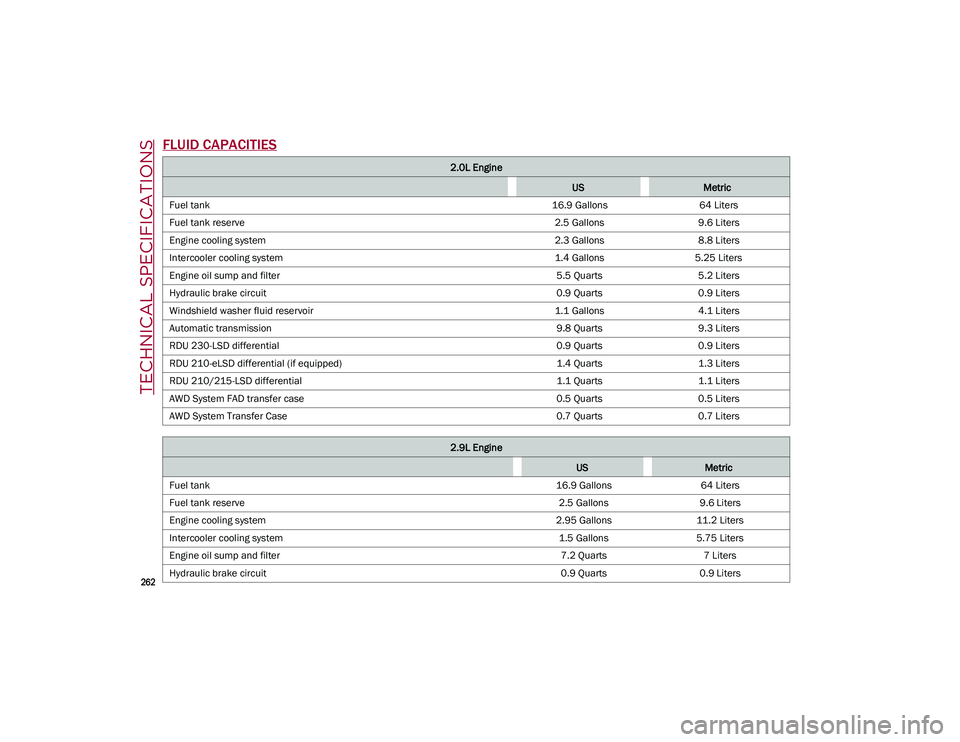
FLUID CAPACITIES
2.0L Engine
USMetric
Fuel tank 16.9 Gallons64 Liters
Fuel tank reserve 2.5 Gallons9.6 Liters
Engine cooling system 2.3 Gallons8.8 Liters
Intercooler cooling system 1.4 Gallons5.25 Liters
Engine oil sump and filter 5.5 Quarts5.2 Liters
Hydraulic brake circuit 0.9 Quarts0.9 Liters
Windshield washer fluid reservoir 1.1 Gallons4.1 Liters
Automatic transmission 9.8 Quarts9.3 Liters
RDU 230-LSD differential 0.9 Quarts0.9 Liters
RDU 210-eLSD differential (if equipped) 1.4 Quarts1.3 Liters
RDU 210/215-LSD differential 1.1 Quarts1.1 Liters
AWD System FAD transfer case 0.5 Quarts0.5 Liters
AWD System Transfer Case 0.7 Quarts0.7 Liters
2.9L Engine
USMetric
Fuel tank 16.9 Gallons64 Liters
Fuel tank reserve 2.5 Gallons9.6 Liters
Engine cooling system 2.95 Gallons11.2 Liters
Intercooler cooling system 1.5 Gallons5.75 Liters
Engine oil sump and filter 7.2 Quarts7 Liters
Hydraulic brake circuit 0.9 Quarts0.9 Liters
21_GU_OM_EN_USC_t.book Page 262
Page 271 of 280
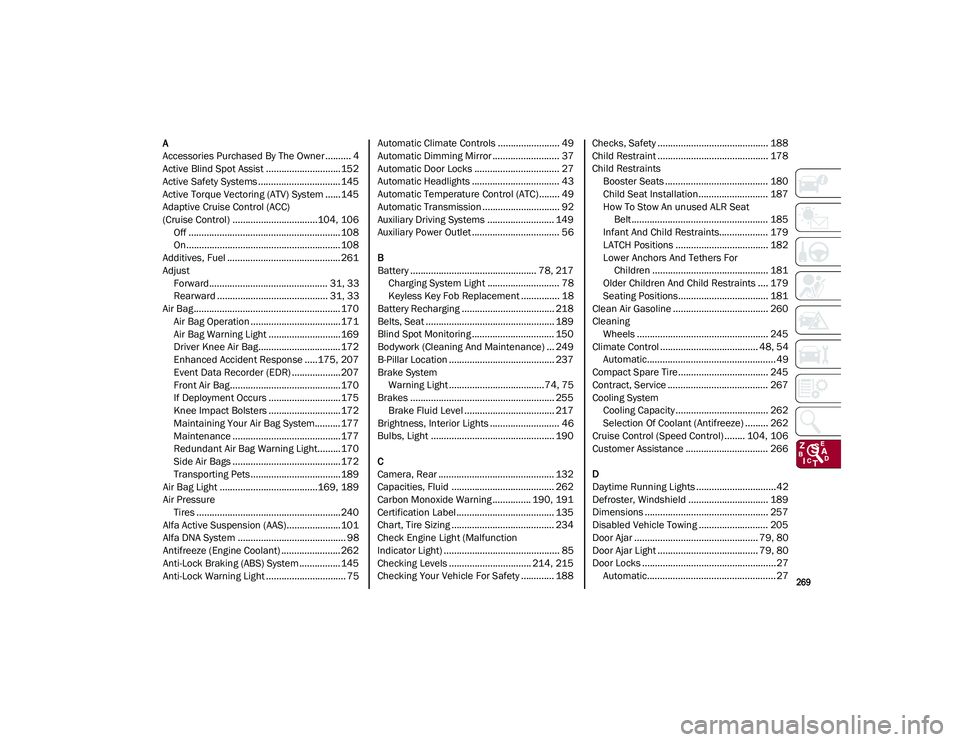
269
A
Accessories Purchased By The Owner.......... 4
Active Blind Spot Assist .............................152
Active Safety Systems ................................ 145
Active Torque Vectoring (ATV) System ......145
Adaptive Cruise Control (ACC)
(Cruise Control) .................................104, 106Off ........................................................... 108
On............................................................108
Additives, Fuel ............................................ 261
Adjust Forward.............................................. 31, 33
Rearward ........................................... 31, 33
Air Bag......................................................... 170 Air Bag Operation ...................................171Air Bag Warning Light ............................169
Driver Knee Air Bag................................ 172Enhanced Accident Response .....175, 207
Event Data Recorder (EDR) ...................207
Front Air Bag...........................................170
If Deployment Occurs ............................175
Knee Impact Bolsters ............................172
Maintaining Your Air Bag System.......... 177
Maintenance ..........................................177
Redundant Air Bag Warning Light.........170
Side Air Bags ..........................................172
Transporting Pets...................................189
Air Bag Light ......................................169, 189
Air Pressure Tires ........................................................240
Alfa Active Suspension (AAS).....................101
Alfa DNA System .......................................... 98
Antifreeze (Engine Coolant) ....................... 262
Anti-Lock Braking (ABS) System ................ 145
Anti-Lock Warning Light ............................... 75 Automatic Climate Controls ........................ 49
Automatic Dimming Mirror .......................... 37
Automatic Door Locks ................................. 27
Automatic Headlights .................................. 43
Automatic Temperature Control (ATC)........ 49
Automatic Transmission .............................. 92
Auxiliary Driving Systems .......................... 149
Auxiliary Power Outlet .................................. 56
B
Battery ................................................. 78, 217 Charging System Light ............................ 78
Keyless Key Fob Replacement ............... 18
Battery Recharging .................................... 218
Belts, Seat .................................................. 189
Blind Spot Monitoring ................................ 150
Bodywork (Cleaning And Maintenance) ... 249
B-Pillar Location ......................................... 237
Brake System Warning Light .....................................74, 75
Brakes ........................................................ 255 Brake Fluid Level ................................... 217
Brightness, Interior Lights ........................... 46
Bulbs, Light ................................................ 190
C
Camera, Rear ............................................. 132
Capacities, Fluid ........................................ 262
Carbon Monoxide Warning ............... 190, 191
Certification Label...................................... 135
Chart, Tire Sizing ........................................ 234
Check Engine Light (Malfunction
Indicator Light) ............................................. 85
Checking Levels ................................ 214, 215
Checking Your Vehicle For Safety ............. 188 Checks, Safety ........................................... 188
Child Restraint ........................................... 178
Child Restraints
Booster Seats ........................................ 180
Child Seat Installation........................... 187
How To Stow An unused ALR Seat Belt ..................................................... 185
Infant And Child Restraints................... 179
LATCH Positions .................................... 182
Lower Anchors And Tethers For Children ............................................. 181
Older Children And Child Restraints .... 179
Seating Positions................................... 181
Clean Air Gasoline ..................................... 260
Cleaning Wheels ................................................... 245
Climate Control ...................................... 48, 54 Automatic..................................................49
Compact Spare Tire................................... 245
Contract, Service ....................................... 267
Cooling System Cooling Capacity .................................... 262
Selection Of Coolant (Antifreeze) ......... 262
Cruise Control (Speed Control) ........ 104, 106
Customer Assistance ................................ 266
D
Daytime Running Lights ...............................42
Defroster, Windshield ............................... 189
Dimensions ................................................ 257
Disabled Vehicle Towing ........................... 205
Door Ajar ................................................ 79, 80
Door Ajar Light ....................................... 79, 80
Door Locks ....................................................27 Automatic..................................................27
21_GU_OM_EN_USC_t.book Page 269