heating ALFA ROMEO STELVIO 2021 User Guide
[x] Cancel search | Manufacturer: ALFA ROMEO, Model Year: 2021, Model line: STELVIO, Model: ALFA ROMEO STELVIO 2021Pages: 280, PDF Size: 10.02 MB
Page 97 of 280
95
REVERSE (R)
Select this mode only with the vehicle at a
standstill.NEUTRAL (N)
Use this range when the vehicle is standing for
prolonged periods with the engine running.
The engine may be started in this range. Apply
the EPB and shift the transmission into PARK
(P) if you must leave the vehicle.
DRIVE (D)
Use this mode in normal driving conditions.
Shifting from DRIVE (D) to PARK (P) or REVERSE
(R) modes must take place only after releasing the
accelerator pedal, with vehicle at a standstill and
brake pedal pressed.
This mode ensures automatic engagement of the
most suitable gears for driving needs and
maximum fuel economy in terms of consumption.
In this position, the transmission shifts the gears
automatically, selecting the most suitable for
forward driving among those available as you go.
In this way the vehicle's optimal driving charac
-
teristics are provided for all conditions.
AutoStick
In the case of frequent shifting (e.g. for sport
driving, when the vehicle is driven with a heavy
load, on slopes, when towing heavy trailers), it is
recommended to use the AutoStick (sequential
shifting) mode to select and keep a lower fixed
ratio.
In these conditions, the use of a lower gear
improves vehicle performance and prevents over
-
heating.
It is possible to shift from DRIVE (D) mode to Auto -
Stick mode regardless of vehicle speed.
Activation
Starting from DRIVE (D) mode, to activate the
sequential drive mode, move the gear selector to
the left (– and + indication of the trim). The gear
engaged will be shown on the display.
Shifting is made by moving the gear selector
forward, toward symbol – or backward, toward
symbol +.
Steering Column Mounted Shift Paddles — If
Equipped
The gear can be manually shifted also by using
the paddles behind the steering wheel, pull
the right paddle (+) toward the steering wheel
and release it to engage a higher gear,
perform the same operation with the left
paddle (-) to engage a lower gear.
Never leave children alone in a vehicle, or
with access to an unlocked vehicle.
Allowing children to be in a vehicle unat -
tended is dangerous for a number of
reasons. A child or others could be seri -
ously or fatally injured. Children should be
warned not to touch the park brake, brake
pedal or the transmission gear selector.
Do not leave the key fob in or near the
vehicle (or in a location accessible to chil -
dren), and do not leave the ignition in the
ACC mode. A child could operate power
windows, other controls, or move the
vehicle.
CAUTION!
Before moving the transmission gear
selector out of PARK, you must push the
ignition button to cycle from OFF mode to
the ACC mode, and also press the brake
pedal. Otherwise, damage to the gear
selector could result.
DO NOT race the engine when shifting
from PARK or NEUTRAL into another gear
range, as this can damage the drivetrain.
WARNING! (Continued)
WARNING!
Do not coast in NEUTRAL and never turn off
the ignition to coast down a hill. These are
unsafe practices that limit your response to
changing traffic or road conditions. You
might lose control of the vehicle and have a
collision.
21_GU_OM_EN_USC_t.book Page 95
Page 104 of 280
STARTING AND OPERATING
102
System Manual Activation/Deactivation
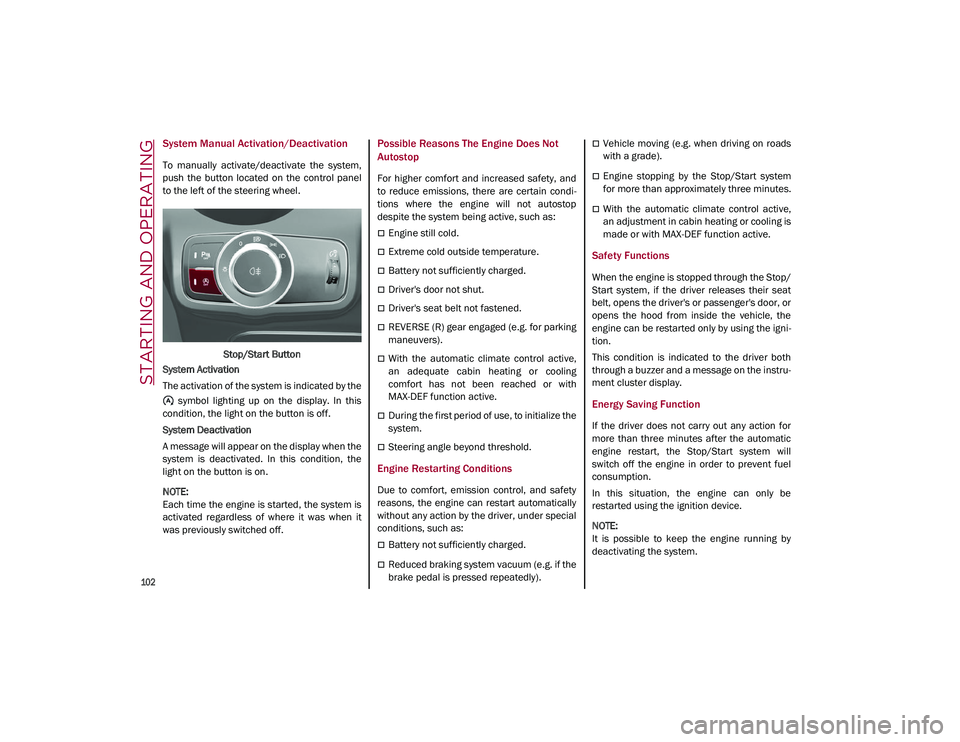
To manually activate/deactivate the system,
push the button located on the control panel
to the left of the steering wheel.Stop/Start Button
System Activation
The activation of the system is indicated by the symbol lighting up on the display. In this
condition, the light on the button is off.
System Deactivation
A message will appear on the display when the
system is deactivated. In this condition, the
light on the button is on.
NOTE:
Each time the engine is started, the system is
activated regardless of where it was when it
was previously switched off.
Possible Reasons The Engine Does Not
Autostop
For higher comfort and increased safety, and
to reduce emissions, there are certain condi -
tions where the engine will not autostop
despite the system being active, such as:
Engine still cold.
Extreme cold outside temperature.
Battery not sufficiently charged.
Driver's door not shut.
Driver's seat belt not fastened.
REVERSE (R) gear engaged (e.g. for parking
maneuvers).
With the automatic climate control active,
an adequate cabin heating or cooling
comfort has not been reached or with
MAX-DEF function active.
During the first period of use, to initialize the
system.
Steering angle beyond threshold.
Engine Restarting Conditions
Due to comfort, emission control, and safety
reasons, the engine can restart automatically
without any action by the driver, under special
conditions, such as:
Battery not sufficiently charged.
Reduced braking system vacuum (e.g. if the
brake pedal is pressed repeatedly).
Vehicle moving (e.g. when driving on roads
with a grade).
Engine stopping by the Stop/Start system
for more than approximately three minutes.
With the automatic climate control active,
an adjustment in cabin heating or cooling is
made or with MAX-DEF function active.
Safety Functions
When the engine is stopped through the Stop/
Start system, if the driver releases their seat
belt, opens the driver's or passenger's door, or
opens the hood from inside the vehicle, the
engine can be restarted only by using the igni -
tion.
This condition is indicated to the driver both
through a buzzer and a message on the instru-
ment cluster display.
Energy Saving Function
If the driver does not carry out any action for
more than three minutes after the automatic
engine restart, the Stop/Start system will
switch off the engine in order to prevent fuel
consumption.
In this situation, the engine can only be
restarted using the ignition device.
NOTE:
It is possible to keep the engine running by
deactivating the system.
21_GU_OM_EN_USC_t.book Page 102
Page 146 of 280

STARTING AND OPERATING
144
Preheating the carbon ceramic material brake
discs
The brake discs must be warmed up to make
them fully efficient. You are advised to perform
the following procedure to achieve optimal
efficiency:
Brake nine times from 80 mph to 18 mph
(130 km/h to 30 km/h) with deceleration
equal to 0.7g (the longitudinal acceleration
value is shown on the instrument cluster
display by setting RACE mode and selecting
the “Performance” page) with 20 second
intervals between brake applications; keep
the car at a speed comprised between
37 mph and 62 mph (60 km/h and
100 km/h) and do not brake for 4 minutes to allow the brakes to cool down.
Then brake three times from 124 mph to
18 mph (200 km/h to 30 km/h) with decel -
eration equal to 1.1g (ABS operation) with
30 second intervals between brake applica -
tions; keep the car at a speed comprised
between 37 mph and 62 mph (60 km/h
and 100 km/h) and do not brake for
5 minutes to allow the brakes to cool down.
21_GU_OM_EN_USC_t.book Page 144
Page 193 of 280
191
The best protection against carbon monoxide
entry into the vehicle body is a properly main-
tained engine exhaust system.
Whenever a change is noticed in the sound of
the exhaust system, when exhaust fumes can
be detected inside the vehicle, or when the
underside or rear of the vehicle is damaged,
have a competent mechanic inspect the
complete exhaust system and adjacent body
areas for broken, damaged, deteriorated, or
mispositioned parts. Open seams or loose
connections could permit exhaust fumes to
seep into the passenger compartment. In
addition, inspect the exhaust system each
time the vehicle is raised for lubrication or oil
change. Replace as required.
Carbon Monoxide Warnings
If it is necessary to sit in a parked vehicle
with the engine running, adjust your
heating or cooling controls to force
outside air into the vehicle. Set the blower
at high speed.
WARNING! (Continued)
WARNING!
Carbon monoxide (CO) in exhaust gases is
deadly. Follow the precautions below to
prevent carbon monoxide poisoning:
Do not inhale exhaust gases. They contain
carbon monoxide, a colorless and odor -
less gas, which can kill. Never run the
engine in a closed area, such as a garage,
and never sit in a parked vehicle with the
engine running for an extended period. If
the vehicle is stopped in an open area with
the engine running for more than a short
period, adjust the ventilation system to
force fresh, outside air into the vehicle.
Guard against carbon monoxide with
proper maintenance. Have the exhaust
system inspected every time the vehicle is
raised. Have any abnormal conditions
repaired promptly. Until repaired, drive
with all side windows fully open.
21_GU_OM_EN_USC_t.book Page 191
Page 206 of 280
IN CASE OF EMERGENCY
204
4. Disconnect the positive (+) end of thejumper cable from the positive (+) post of
the vehicle with the discharged battery.
If frequent jump starting is required to start
your vehicle, you should have the battery and
charging system inspected at an authorized
dealer.
Bump Starting
Never jump start the engine by pushing,
towing or coasting downhill.
NOTE:
You cannot start a vehicle with an automatic
transmission by pushing it.
ENGINE OVERHEATING
If your vehicle is overheating, it will need to be
serviced at an authorized dealer.
Engine overheating may occur in situations
such as (but not limited to) extreme environ -
mental temperatures or frequent engine
stops/starts. If the engine becomes over -heated, the Engine Temperature Warning
Light in the instrument cluster will illuminate
along with a dedicated message
Ú
page 79.
In any of the following situations, you can
reduce the potential for overheating by taking
the appropriate action.
On the highways — slow down.
In city traffic — while stopped, place the
transmission in NEUTRAL, but do not
increase engine idle speed.
NOTE:
There are steps that you can take to slow down
an impending overheat condition:
If your Air Conditioner (A/C) is on, turn it off.
The A/C system adds heat to the engine
cooling system and turning the A/C off can
help remove this heat.
You can also turn the temperature control
to maximum heat, the mode control to floor
and the blower control to high. This allows
the heater core to act as a supplement to
the radiator and aids in removing heat from
the engine cooling system.
NOTE:
If the cooling fan does not operate while the
engine is running, the engine temperature
will increase. Stop the engine and contact
an authorized dealer.
If the engine continues to overheat or
frequently overheats, have the cooling
system inspected. The engine could be seri
-
ously damaged unless repairs are made.
Contact an authorized dealer.
CAUTION!
Accessories plugged into the vehicle power
outlets draw power from the vehicle’s
battery, even when not in use (i.e., cellular
phones, etc.). Eventually, if plugged in long
enough without engine operation, the
vehicle’s battery will discharge sufficiently
to degrade battery life and/or prevent the
engine from starting.
WARNING!
You or others can be badly burned by hot
engine coolant (antifreeze) or steam from
your radiator. If you see or hear steam
coming from under the hood, do not open
the hood until the radiator has had time to
cool. Never try to open a cooling system
pressure cap when the radiator or coolant
bottle is hot.
CAUTION!
Driving with a hot cooling system could
damage your vehicle. If temperature gauge
reads “H”, pull over and stop the vehicle.
Idle the vehicle with the air conditioner
turned off until the pointer drops back into
the normal range. If the pointer remains on
the “H”, turn the engine off immediately,
and call for service.
21_GU_OM_EN_USC_t.book Page 204
Page 226 of 280
SERVICING AND MAINTENANCE
224
(Continued)
(Continued)
Topping Up / Draining / Flushing The Engine/
Intercooler Coolant
If the engine coolant (antifreeze) is dirty, have
cleaning and flushing carried out at an autho
-
rized dealer.
For the correct servicing intervals
Ú
page 209.
NOTE:
For topping off, and proper coolant specifi -
cations
Ú
page 263.
Do not use pure water, alcohol-based cool -
ants, corrosions inhibitors or additional
anti-rust products because they may be
incompatible with the engine coolant and
cause the clogging of the radiator. The use
of propylene glycol-based coolant is also not
recommended.
Engine Cooling/Intercooler System Cap
To prevent loss of engine coolant, make sure
that the expansion tank cap is closed. If it is
open, screw it completely until you reach/hear
the click.
Periodically check the cap and clean it from
any foreign bodies that may have deposited on
the external surface. Disposal of Used Coolant
Disposal of engine/intercooler coolant is
subject to legal requirements. Contact the
appropriate body to determine local regula
-
tions.
NOTE:
To prevent the fluid from being ingested by
children or animals, do not keep it in open
containers or pour it on the ground. If
ingested, contact a doctor immediately.
Eliminate any traces of fluid from the
ground immediately.
When the vehicle stops after a short trip,
steam may be seen coming out from the
front of the hood. This is a normal phenom -
enon which is due to the presence of rain,
snow or a lot of moisture on the surface of
the radiator.
With engine and system cold, do not top up
with coolant beyond the maximum level
indicated on the reservoir in the engine
compartment.
Braking System
In order to guarantee the efficiency of the
braking system, periodically check its compo -
nents; for this operation, contact an autho -
rized dealer.
For the correct servicing intervals
Ú page 209.
NOTE:
Driving with your foot resting on the brake
pedal may compromise its efficiency,
increasing the risk of accidents. When driving,
never keep your foot on the brake pedal and
don’t put unnecessary strain on it to prevent
the brakes from overheating. Excess pad wear
may cause damage to the braking system.
When an insufficient oil level is detected,
contact an authorized dealer to have the
system checked.
Always keep the cap of the brake fluid reser-
voir (in the engine compartment)
completely closed.
WARNING!
Never add coolant with the engine hot or
overheated.
Do not attempt to cool an overheated
engine by loosening or removing the cap.
The heat causes a considerable increase
in pressure in the cooling system.
To prevent damage to the engine, only use
the engine cooling circuit caps provided.
WARNING! (Continued)
WARNING!
Use only manufacturer's recommended
brake fluid
Ú
page 263. Using the wrong
type of brake fluid can severely damage
your brake system and/or impair its
performance. The proper type of brake
fluid for your vehicle is also identified on
the original factory installed hydraulic
master cylinder reservoir.
21_GU_OM_EN_USC_t.book Page 224
Page 241 of 280
239
(Continued)
(Conti n
ued)
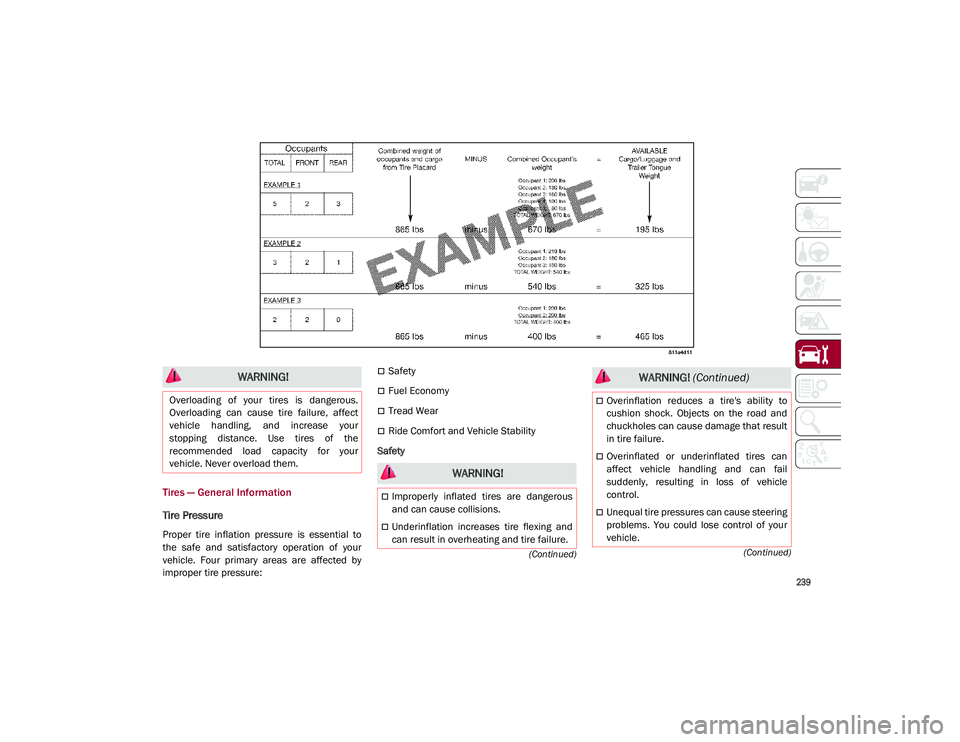
Tires — General Information
Tire Pressure
Proper tire inflation pressure is essential to
the safe and satisfactory operation of your
vehicle. Four primary areas are affected by
improper tire pressure:
Safety
Fuel Economy
Tread Wear
Ride Comfort and Vehicle Stability
Safety
WARNING!
Overloading of your tires is dangerous.
Overloading can cause tire failure, affect
vehicle handling, and increase your
stopping distance. Use tires of the
recommended load capacity for your
vehicle. Never overload them.
WARNING!
Improperly inflated tires are dangerous
and can cause collisions.
Underinflation increases tire flexing and
can result in overheating and tire failure.
Overinflation reduces a tire's ability to
cushion shock. Objects on the road and
chuckholes can cause damage that result
in tire failure.
Overinflated or underinflated tires can
affect vehicle handling and can fail
suddenly, resulting in loss of vehicle
control.
Unequal tire pressures can cause steering
problems. You could lose control of your
vehicle.
WARNING! (Continued)
21_GU_OM_EN_USC_t.book Page 239
Page 252 of 280
SERVICING AND MAINTENANCE
250
Use of “open” boxed sections to prevent
condensation and pockets of moisture
which could favor the formation of rust
inside.
Use of special films to protect against abra-
sion in exposed areas (e.g. rear wing, doors,
etc.).
Corrosion Warranty
Your vehicle is covered by Corrosion Warranty
against perforation due to rust of any original
element of the structure or bodywork. For the
general terms of this warranty, refer to the
Warranty Booklet.
Preserving The Bodywork
Paint
Touch up abrasions and scratches immedi -
ately to prevent the formation of rust.
Maintenance of paintwork consists of washing
the vehicle: the frequency depends on the
conditions and environment where the vehicle
is used. For example, it is advisable to wash
the vehicle more often in areas with high levels
of atmospheric pollution or salted roads.
Some parts of the vehicle may be covered with
a matte paint which, in order to be maintained
intact, requires special care.
To correctly wash the vehicle, follow these
instructions:
If high pressure jets or cleaners are used to
wash the vehicle, keep a distance of at least 15 inches (40 cm) from the bodywork to
avoid damage or alteration. Build up of
water could cause damage to the vehicle in
the long term.
To make it easier to remove any dirt
deposits in the area where the blades are
normally located it is recommended to posi
-
tion the windshield wipers vertically (service
position)
Ú
page 219.
Wash the bodywork using a low pressure jet
of water if possible.
Wipe a sponge with a slightly soapy solution
over the bodywork, frequently rinsing the
sponge.
Rinse well with water and dry with a leather
chamois.
Dry the less visible parts (e.g. door frames,
hood, headlight frames, etc.) with special care,
as water may stagnate more easily in these
areas. Do not wash the vehicle after it has
been left in the sun or with the hood hot: this
may alter the shine of the paintwork.
NOTE:
Avoid parking under trees; the resin dropped
by trees makes the paintwork go opaque and
increases the possibility of corrosion.
Exterior plastic parts must be cleaned in the
same way as the rest of the vehicle. If washing the vehicle in a service that moves
the vehicle, for vehicles with automatic trans
-
missions, proceed with the following direc -
tions:
Ensure that the vehicle is on a flat surface.
Disable the automatic engagement of the
parking brake
Ú
page 90.
With the vehicle stationary, the gear in
NEUTRAL (N) and the brake pedal pressed,
push the START button.
NOTE:
The vehicle will remain in NEUTRAL (N) for
15 minutes before PARK (P) will be engaged
automatically.
Windows
Use specific detergents and clean cloths to
prevent scratching or altering the transpar -
ency.
Front Headlights
Use a soft cloth soaked in water and detergent
for washing vehicles.
CAUTION!
Wipe the rear window inside gently with a
cloth following the direction of the filaments
to avoid damaging the heating device.
21_GU_OM_EN_USC_t.book Page 250
Page 272 of 280
270
INDEX
Door Opener, Garage ................................... 39
Doors............................................................. 24
Drive Train Control (DTC) System ..............146
Driving Modes .............................................. 98
Dynamic Steering Torque (DST) System ... 146
E
Electric Park Brake....................................... 90
Electric Remote Mirrors ............................... 38
Electronic Speed Control (Cruise
Control) .......................................................104
Electronic Stability Control (ESC)
System ........................................................146
Electronic Throttle Control Warning Light... 79
Emergency In Case Of ......................................192, 198
SOS Emergency Call .............................. 192
Emergency, In Case Of Jump Starting .........................................201
Overheating ............................................ 204
Towing.....................................................206
Emission Control System Maintenance...... 85
Engine ......................................................... 254 Block Heater............................................. 89
Engine Coolant Level .............................216
Exhaust Gas Caution ....................190, 191
Fuel Requirements ................................ 260Oil ............................................................262
Oil Selection ...........................................262
Overheating ............................................ 204
Starting ................................................... 204
Engine Compartment .................................214
Engine Compartment (Washing) ...............250
Engine Oil Level Check ............................................ 215 Enhanced Accident Response
Feature .............................................. 175, 207
Ethanol ....................................................... 260
Exhaust Gas Cautions ...................... 190, 191
Exhaust System ......................................... 190
Exterior Lighting .....................................42, 43
Exterior Lights ..................................... 42, 190
F
Flashers Hazard Warning ..................................... 192
Turn Signals ..............................44, 78, 190
Fluid Capacities ......................................... 262
Fluid Leaks ................................................. 190
Fluids And Lubricants ................................ 263
Fog Lights, Rear ........................................... 44
Forward Collision Warning ........................ 156
Fuel Additives................................................. 261
Clean Air ................................................. 260
Ethanol ................................................... 260
Light .......................................................... 80
Materials Added .................................... 261
Methanol ................................................ 260
Tank Capacity ........................................ 262
G
Garage Door Opener (HomeLink) ............... 39
Gasoline, Clean Air .................................... 260
Gasoline, Reformulated ............................ 260
Gross Axle Weight Rating .......................... 137
Gross Vehicle Weight Rating ..................... 137
GVWR .......................................................... 136 H
Hazard Warning Flashers.......................... 192
Head Restraints............................................35
Head Rests ...................................................35
Headlights
Switch ................................................ 42, 43
Headlights (Cleaning) ................................ 250
Heated Mirrors..............................................39
Heated Seats ................................................34
Heated Steering Wheel ................................29
Heater, Engine Block.................................... 89
Hill Decent Control (HDC) System ............ 147
Hill Start Assist (HSA) System ................... 148
Hitches Trailer Towing ........................................ 137
HomeLink (Garage Door Opener) ................39
Hood Closing ......................................................61Opening.....................................................61
I
Identification Data ..................................... 253
Ignition ..........................................................20 Switch .......................................................20
Immobilizer (Sentry Key) ..............................20
In Case Of Emergency ............................... 192
Installing Electrical/Electronic Devices......... 4
Instrument Cluster .......................................67 Descriptions..............................................78
Display ......................................................69
Instrument Panel Features....................................................67
Interior Lights................................................44
Interiors (Cleaning) .................................... 251
21_GU_OM_EN_USC_t.book Page 270
Page 273 of 280
271
J
Jump Starting ............................................. 201
K
Keyless Enter-N-Go ...................................... 25Passive Entry ............................................ 25
Keys .............................................................. 18
L
Lane Change And Turn Signals ................... 44
LaneSense ..................................................126
Lap/Shoulder Belts ....................................164
Latches .......................................................190
Leaks, Fluid ................................................190
Life Of Tires.................................................243
Liftgate .......................................................... 62
Light Bulbs ..................................................190 Types Of Bulbs ....................................... 230
Lights .......................................................... 190 Air Bag ...........................................169, 189
Automatic Headlights .............................. 43
Brake Warning .................................. 74, 75Courtesy/Reading ............................. 45, 46Daytime Running ..................................... 42
Electronic Stability Program(ESP) Indicator ............................................... 79
Exterior ................................................... 190
Fog ............................................................ 44
Headlight Switch ............................... 42, 43 Headlights ......................................... 42, 43
High Beam ................................................ 43
Instrument Cluster ............................ 42, 43Intensity Control ....................................... 46
Interior ............................................... 45, 46
Low Fuel ................................................... 80 Malfunction Indicator (Check Engine).... 77
Map .......................................................... 45
Park ....................................................44, 78
Reading .................................................... 45
Seat Belt Reminder ................................. 75
Turn Signals ..............................44, 78, 190
Warning Instrument Cluster
Descriptions ...................................78, 79
Loading Vehicle .......................................... 135 Tires ........................................................ 237
Locks Automatic Door ........................................ 27
Child Protection ....................................... 27
M
Maintenance ................................................ 61
Malfunction Indicator Light
(Check Engine) .......................................77, 85
Manual Service.................................................... 268
Memory Feature (Memory Seats) ............... 30
Memory Seat ................................................ 30
Methanol .................................................... 260
Mirrors .......................................................... 37 Automatic Dimming ................................. 37
Electric Powered ...................................... 38
Electric Remote ....................................... 38
Heated...................................................... 39
O
Occupant Restraints .................................. 163
Oil Pressure Light ......................................... 79
Oil, Engine Capacity.................................................. 262
Pressure Warning Light ........................... 79 Recommendation.................................. 262
Viscosity ................................................. 262
Opener, Garage Door (Homelink) ................39
Operator Manual Owner's Manual..................................... 268
Outlet Power ........................................................ 56
Overheating, Engine .................................. 204
P
Paintwork (Cleaning And Maintenance) .. 250
Panic Brake Assist (PBA) System ............. 149
Park Assist ................................................. 123
ParkSense System .................................... 123
Passive Entry ................................................25
Pets ............................................................ 189
Placard, Tire And Loading Information .... 237
Power Mirrors.......................................................38Outlet (Auxiliary Electrical Outlet)............56
Seats .........................................................33
Sunroof .....................................................59
Power Seats Forward .............................................. 31, 33
Rearward ........................................... 31, 33
Recline ............................................... 31, 33
Power Supply ............................................. 255
Pregnant Women And Seat Belts ............. 167
Pretensioners Seat Belts .............................................. 167
Prolonged Vehicle Inactivity ...................... 249
R
Radial Ply Tires .......................................... 242
Radio Transmitters And Mobile Phones ....... 5
21_GU_OM_EN_USC_t.book Page 271