ESP ALFA ROMEO STELVIO 2022 Workshop Manual
[x] Cancel search | Manufacturer: ALFA ROMEO, Model Year: 2022, Model line: STELVIO, Model: ALFA ROMEO STELVIO 2022Pages: 256, PDF Size: 10.17 MB
Page 229 of 256
227
Limited Use Spare — If Equipped
The limited use spare tire is for temporary
emergency use only. This tire is identified by a
label located on the limited use spare wheel. This
label contains the driving limitations for this
spare. This tire may look like the original
equipped tire on the front or rear axle of your
vehicle, but it is not. Installation of this limited use
spare tire affects vehicle handling. Since it is not
the same as your original equipment tire, replace
(or repair) the original equipment tire and
reinstall on the vehicle at the first opportunity.
WHEEL AND WHEEL TRIM CARE
All wheels and wheel trim, especially aluminum
and chrome plated wheels, should be cleaned
regularly using mild (neutral Ph) soap and water
to maintain their luster and to prevent corrosion.
Wash wheels with the same soap solution
recommended for the body of the vehicle and
remember to always wash when the surfaces are
not hot to the touch.Your wheels are susceptible to deterioration
caused by salt, sodium chloride, magnesium
chloride, calcium chloride, etc., and other road
chemicals used to melt ice or control dust on dirt
roads. Use a soft cloth or sponge and mild soap to
wipe away promptly. Do not use harsh chemicals
or a stiff brush. They can damage the wheel’s
protective coating that helps keep them from
corroding and tarnishing.
When cleaning extremely dirty wheels including
excessive brake dust, care must be taken in the
selection of tire and wheel cleaning chemicals
and equipment to prevent damage to the wheels.
Select a non-abrasive, non-acidic cleaner for
aluminum or chrome wheels.
NOTE:
If you intend parking or storing your vehicle for an
extended period after cleaning the wheels with
wheel cleaner, drive your vehicle and apply the
brakes to remove the water droplets from the
brake components. This activity will remove the
red rust on the brake rotors and prevent vehicle
vibration when braking.
Dark Or Low Gloss Wheels
TIRE TYPES
All Season Tires — If Equipped
All Season tires provide traction for all seasons
(Spring, Summer, Autumn, and Winter). Traction
levels may vary between different all season tires.
All season tires can be identified by the M+S,
M&S, M/S or MS designation on the tire sidewall.
Use all season tires only in sets of four; failure to
do so may adversely affect the safety and
handling of your vehicle.
WARNING!
Limited use spares are for emergency use
only. Installation of this limited use spare tire
affects vehicle handling. With this tire, do not
drive more than the speed listed on the limited
use spare wheel. Keep inflated to the cold tire
inflation pressures listed on your Tire and
Loading Information Placard located on the
driver’s side B-pillar or the rear edge of the
driver’s side door. Replace (or repair) the
original equipment tire at the first opportunity
and reinstall it on your vehicle. Failure to do so
could result in loss of vehicle control.
CAUTION!
Avoid products or automatic car washes that
use acidic solutions or strong alkaline
additives or harsh brushes. Many aftermarket
wheel cleaners and automatic car washes
may damage the wheel's protective finish.
Such damage is not covered by the New
Vehicle Limited Warranty. Only car wash soap
is recommended.
CAUTION!
Do not use scouring pads, steel wool, a bristle
brush, metal polishes or oven cleaner. These
products may damage the wheel's protective
finish. Such damage is not covered by the New
Vehicle Limited Warranty. Only car wash soap
is recommended.
CAUTION!
If your vehicle is equipped with these specialty
wheels, DO NOT USE wheel cleaners,
abrasives, or polishing compounds. They will
permanently damage this finish and such
damage is not covered by the New Vehicle
Limited Warranty. HAND WASH ONLY USING
MILD SOAP AND WATER WITH A SOFT CLOTH.
Used on a regular basis; this is all that is
required to maintain this finish.
22_GU_OM_EN_USC_t.book Page 227
Page 230 of 256
SERVICING AND MAINTENANCE
228
Summer Or Three Season Tires —
If Equipped
Summer tires provide traction in both wet and dry
conditions, and are not intended to be driven in
snow or on ice. If your vehicle is equipped with
Summer tires, be aware these tires are not
designed for Winter or cold driving conditions.
Install Winter tires on your vehicle when ambient
temperatures are less than 40°F (5°C) or if
roads are covered with ice or snow. For more
information, contact an authorized dealer.
Summer tires do not contain the all season
designation or mountain/snowflake symbol on
the tire sidewall. Use Summer tires only in sets of
four; failure to do so may adversely affect the
safety and handling of your vehicle.
Snow Tires
Some areas of the country require the use of
snow tires during the Winter. Snow tires can be
identified by a “mountain/snowflake” symbol on
the tire sidewall.If you need snow tires, select tires
equivalent in size and type to the
original equipment tires. Use snow tires
only in sets of four; failure to do so may
adversely affect the safety and handling of your
vehicle. Snow tires generally have lower speed ratings
than what was originally equipped with your
vehicle and should not be operated at sustained
speeds over 75 mph (120 km/h). For speeds
above 75 mph (120 km/h) refer to original
equipment or an authorized tire dealer for
recommended safe operating speeds, loading
and cold tire inflation pressures.
While studded tires improve performance on ice,
skid and traction capability on wet or dry surfaces
may be poorer than that of non-studded tires. Some
states prohibit studded tires; therefore, local laws
should be checked before using these tire types.
TIRE CHAINS AND TRACTION DEVICES
It is possible to fit 13 mm chains on the tires:
2.0L engines, 18” and 19” are chainable.
2.9L engines, 20” and 21” are chainable.
Use of traction devices require sufficient
tire-to-body clearance. Follow these recommen -
dations to guard against damage.
NOTE:
Traction device must be of proper size for the
tire, as recommended by the traction device
manufacturer.
Use on rear tires only.
Check the tension of the snow chains after the
first few meters have been driven.
Using snow chains with tires with non-original
dimensions may damage the vehicle.
Using different tires sizes or types (M+S, snow,
etc.) between the front and rear axles may
adversely affect vehicle drivability, with the
risk of losing control of the vehicle and
resulting accidents.
WARNING!
Do not use Summer tires in snow/ice
conditions. You could lose vehicle control,
resulting in severe injury or death. Driving too
fast for conditions also creates the possibility
of loss of vehicle control.
CAUTION!
To avoid damage to your vehicle or tires,
observe the following precautions:
Because of restricted traction device
clearance between tires and other
suspension components, it is important that
only traction devices in good condition are
used. Broken devices can cause serious
damage. Stop the vehicle immediately if
noise occurs that could indicate device
breakage. Remove the damaged parts of the
device before further use.
Install device as tightly as possible and then
retighten after driving about ½ mile (0.8 km).
Do not exceed 30 mph (48 km/h).
Drive cautiously and avoid severe turns and
large bumps, especially with a loaded
vehicle.
Do not drive for a prolonged period on dry
pavement.
Observe the traction device manufacturer’s
instructions on the method of installation,
operating speed, and conditions for use.
Always use the suggested operating speed of
the device manufacturer’s if it is less than
30 mph (48 km/h).
Do not use traction devices on a compact
spare tire.
22_GU_OM_EN_USC_t.book Page 228
Page 232 of 256
SERVICING AND MAINTENANCE
230
TEMPERATURE GRADES
The temperature grades are A (the
highest), B, and C, representing the
tire's resistance to the generation of
heat and its ability to dissipate heat,
when tested under controlled conditions
on a specified indoor laboratory test
wheel. Sustained high temperature can
cause the material of the tire to
degenerate and reduce tire life, and
excessive temperature can lead to
sudden tire failure. The grade C
corresponds to a level of performance,
which all passenger vehicle tires must
meet under the Federal Motor Vehicle
Safety Standard No. 109. Grades B and
A represent higher levels of
performance on the laboratory test
wheel, than the minimum required by
law.
STORING THE VEHICLE
If the vehicle is left inactive for longer than a
month, the following precautions should be
observed:
Park the vehicle in an area that is covered and
dry, and well-ventilated if possible. Slightly
open the windows.
Check that the Electric Park Brake (EPB) is not
activated.
Carry out the “Liftgate Emergency Opening”
procedure
Ú
page 59.
Disconnect the negative battery terminal and
check the battery charge. Repeat this check
once every three months during storage.
If the battery is not disconnected from the
electrical system, check its state of charge
every 30 days.
Clean and protect the painted parts using
protective wax.
Clean and protect the shiny metal parts using
special compounds available commercially.
Sprinkle talcum powder on the windshield
wiper rubber blades, and lift them off the
glass.
Cover the vehicle with a fabric or perforated
plastic sheet, paying particular care not to
damage the painted surface by dragging any
dust that may have accumulated on it. Do not
use compact plastic sheets, as they do not
allow humidity to evaporate from the surface
of the vehicle.
Inflate tires to +7.25 psi (+0.5 bar) above the
standard prescribed pressure and check it
periodically.
Do not drain the engine cooling system.
Any time the vehicle is left inactive for two
weeks or more, operate the air conditioning
system with engine idling for at least five
minutes, setting external air and with fan set to
maximum speed. This operation will ensure
appropriate lubrication for the system, thus
minimizing the possibility of damage to the
compressor when the system is operated
again.
NOTE:
After cycling the ignition to STOP and having
closed the driver side door, wait at least one
minute before disconnecting the electrical supply
from the battery. When reconnecting the elec-
trical supply to the battery, make sure that the
ignition is in the STOP position and the driver’s
side door is closed.
WARNING!
The traction grade assigned to this tire is
based on straight-ahead braking traction
tests, and does not include acceleration, cor -
nering, hydroplaning, or peak traction charac -
teristics.
WARNING!
The temperature grade for this tire is estab -
lished for a tire that is properly inflated and not
overloaded. Excessive speed, under-inflation,
or excessive loading, either separately or in
combination, can cause heat buildup and pos-
sible tire failure.
22_GU_OM_EN_USC_t.book Page 230
Page 235 of 256
233
For the enthusiasts, the technician, or those who
just want to know every detail of their vehicle,
useful information on understanding how your
vehicle works is contained in this chapter and
illustrated with data, tables, and graphics.
VEHICLE IDENTIFICATION
NUMBER (VIN)
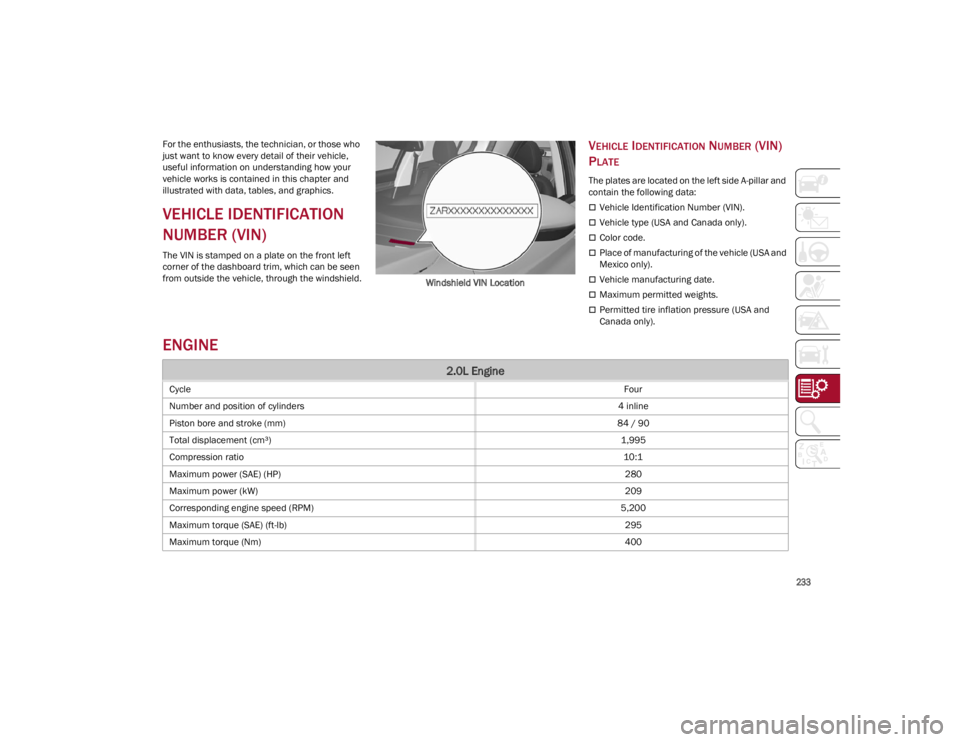
The VIN is stamped on a plate on the front left
corner of the dashboard trim, which can be seen
from outside the vehicle, through the windshield.
Windshield VIN Location
VEHICLE IDENTIFICATION NUMBER (VIN)
P
LATE
The plates are located on the left side A-pillar and
contain the following data:
Vehicle Identification Number (VIN).
Vehicle type (USA and Canada only).
Color code.
Place of manufacturing of the vehicle (USA and
Mexico only).
Vehicle manufacturing date.
Maximum permitted weights.
Permitted tire inflation pressure (USA and
Canada only).
ENGINE
2.0L Engine
Cycle Four
Number and position of cylinders 4 inline
Piston bore and stroke (mm) 84 / 90
Total displacement (cm³) 1,995
Compression ratio 10:1
Maximum power (SAE) (HP) 280
Maximum power (kW) 209
Corresponding engine speed (RPM) 5,200
Maximum torque (SAE) (ft-lb) 295
Maximum torque (Nm) 400
22_GU_OM_EN_USC_t.book Page 233
Page 236 of 256
234
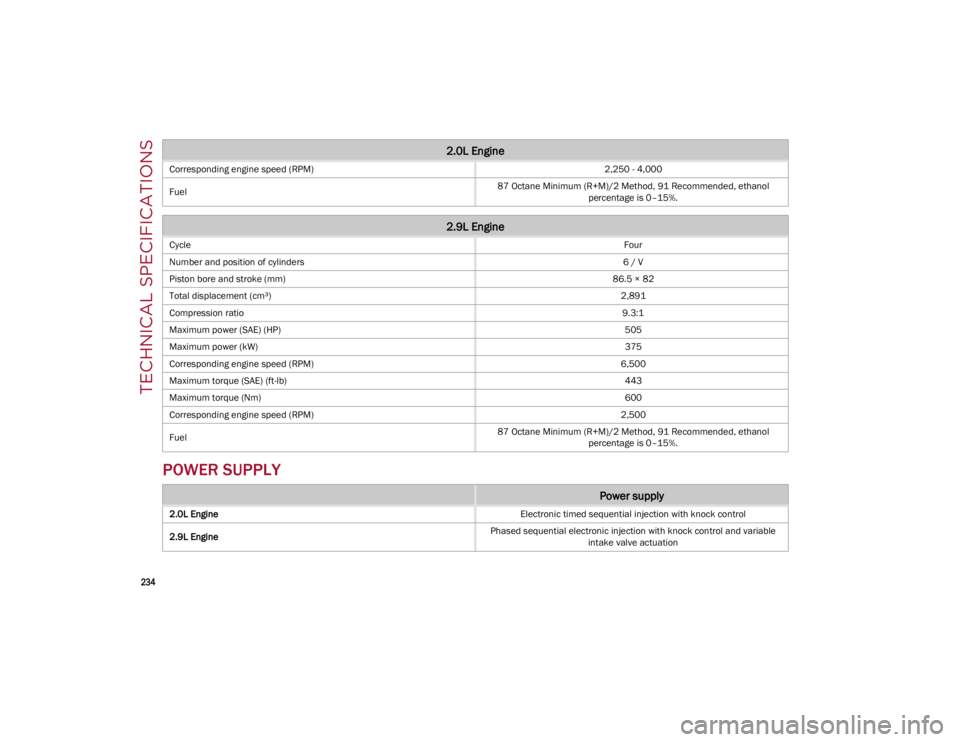
POWER SUPPLY
Corresponding engine speed (RPM)2,250 - 4,000
Fuel 87 Octane Minimum (R+M)/2 Method, 91 Recommended, ethanol
percentage is 0–15%.
2.9L Engine
Cycle Four
Number and position of cylinders 6 / V
Piston bore and stroke (mm) 86.5 × 82
Total displacement (cm³) 2,891
Compression ratio 9.3:1
Maximum power (SAE) (HP) 505
Maximum power (kW) 375
Corresponding engine speed (RPM) 6,500
Maximum torque (SAE) (ft-lb) 443
Maximum torque (Nm) 600
Corresponding engine speed (RPM) 2,500
Fuel 87 Octane Minimum (R+M)/2 Method, 91 Recommended, ethanol
percentage is 0–15%.
Power supply
2.0L Engine Electronic timed sequential injection with knock control
2.9L Engine Phased sequential electronic injection with knock control and variable
intake valve actuation
2.0L Engine
22_GU_OM_EN_USC_t.book Page 234
TECHNICAL SPECIFICATIONS
Page 237 of 256
235
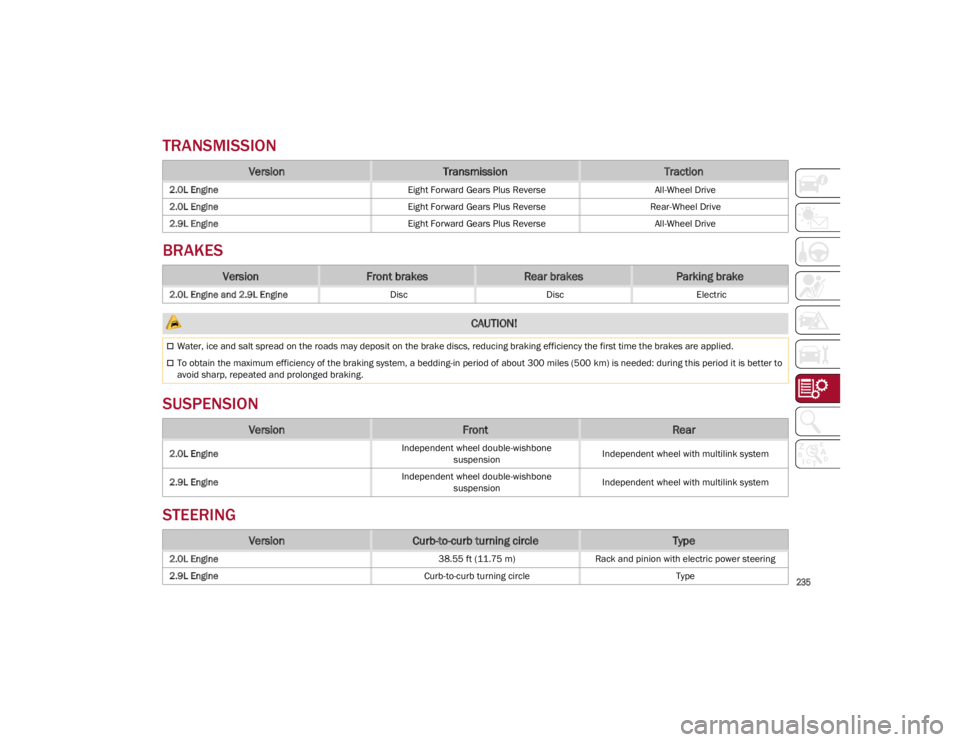
TRANSMISSION
BRAKES
SUSPENSION
STEERING
VersionTransmissionTraction
2.0L EngineEight Forward Gears Plus Reverse All-Wheel Drive
2.0L Engine Eight Forward Gears Plus Reverse Rear-Wheel Drive
2.9L Engine Eight Forward Gears Plus Reverse All-Wheel Drive
VersionFront brakesRear brakesParking brake
2.0L Engine and 2.9L EngineDiscDiscElectric
CAUTION!
Water, ice and salt spread on the roads may deposit on the brake discs, reducing braking efficiency the first time the brakes are applied.
To obtain the maximum efficiency of the braking system, a bedding-in period of about 300 miles (500 km) is needed: during this period it is better to
avoid sharp, repeated and prolonged braking.
VersionFrontRear
2.0L Engine Independent wheel double-wishbone
suspension Independent wheel with multilink system
2.9L Engine Independent wheel double-wishbone
suspension Independent wheel with multilink system
VersionCurb-to-curb turning circleType
2.0L Engine
38.55 ft (11.75 m)Rack and pinion with electric power steering
2.9L Engine Curb-to-curb turning circleType
22_GU_OM_EN_USC_t.book Page 235
Page 238 of 256
TECHNICAL SPECIFICATIONS
236
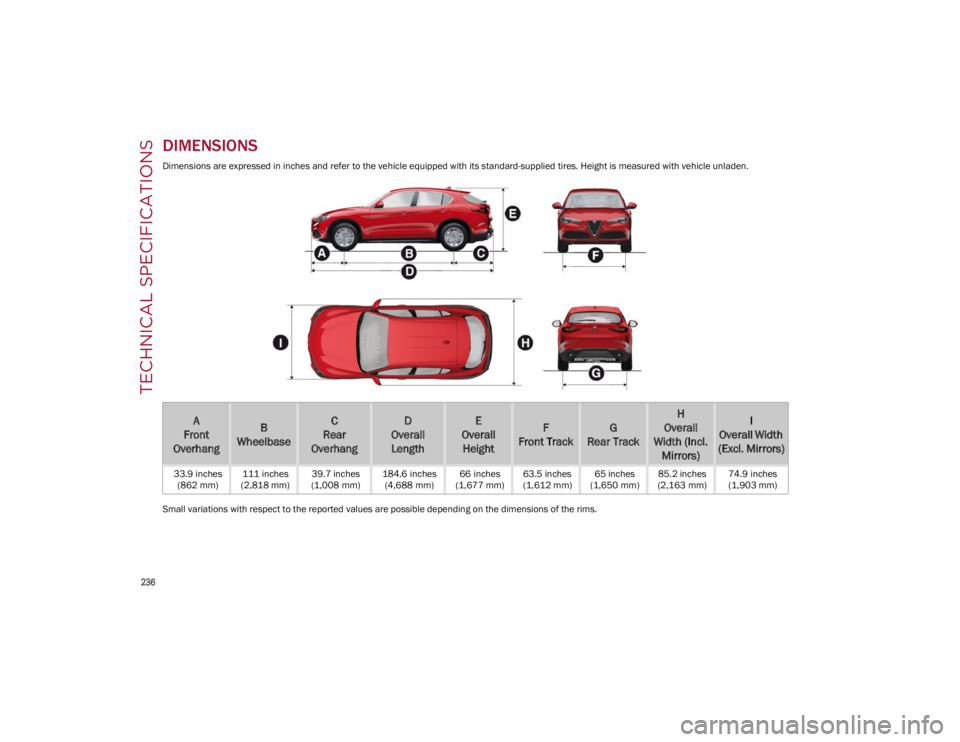
DIMENSIONS
Dimensions are expressed in inches and refer to the vehicle equipped with its standard-supplied tires. Height is measured with vehicle unladen.
Small variations with respect to the reported values are possible depending on the dimensions of the rims.
A
Front
OverhangB
WheelbaseC
Rear
OverhangD
Overall LengthE
Overall HeightF
Front TrackG
Rear Track
H
Overall
Width (Incl. Mirrors)I
Overall Width
(Excl. Mirrors)
33.9 inches (862 mm) 111 inches
(2,818 mm) 39.7 inches
(1,008 mm) 184.6 inches
(4,688 mm) 66 inches
(1,677 mm) 63.5 inches
(1,612 mm) 65 inches
(1,650 mm) 85.2 inches
(2,163 mm) 74.9 inches
(1,903 mm)
22_GU_OM_EN_USC_t.book Page 236
Page 240 of 256
TECHNICAL SPECIFICATIONS
238
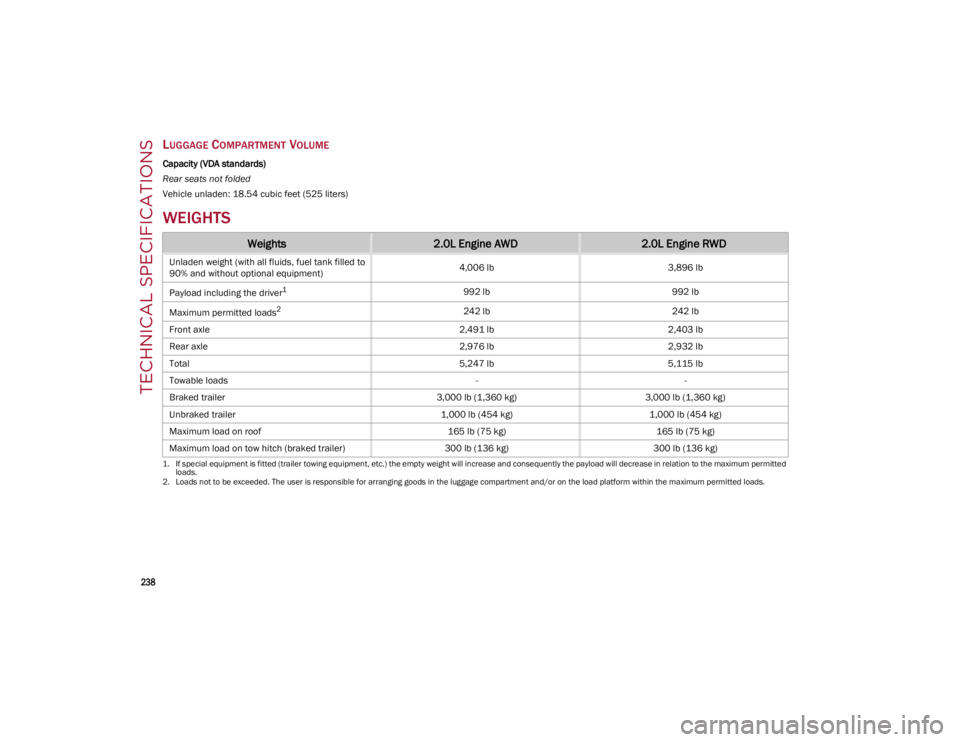
LUGGAGE COMPARTMENT VOLUME
Capacity (VDA standards)
Rear seats not folded
Vehicle unladen: 18.54 cubic feet (525 liters)
WEIGHTS
Weights2.0L Engine AWD2.0L Engine RWD
Unladen weight (with all fluids, fuel tank filled to
90% and without optional equipment) 4,006 lb
3,896 lb
Payload including the driver
1
1. If special equipment is fitted (trailer towing equipment, etc.) the empty weight will increase and consequently the payload will decrease in relation to the maximum permitted loads.
992 lb 992 lb
Maximum permitted loads
2
2. Loads not to be exceeded. The user is responsible for arranging goods in the luggage compartment and/or on the load platform within the maximum permitted loads.
242 lb 242 lb
Front axle 2,491 lb2,403 lb
Rear axle 2,976 lb2,932 lb
Total 5,247 lb5,115 lb
Towable loads --
Braked trailer 3,000 lb (1,360 kg)3,000 lb (1,360 kg)
Unbraked trailer 1,000 lb (454 kg)1,000 lb (454 kg)
Maximum load on roof 165 lb (75 kg)165 lb (75 kg)
Maximum load on tow hitch (braked trailer) 300 lb (136 kg)300 lb (136 kg)
22_GU_OM_EN_USC_t.book Page 238
Page 241 of 256

239
FUEL REQUIREMENTS
This engine is designed to meet all
emission regulations, and provide
satisfactory fuel economy and
performance when using high-quality
unleaded regular gasoline having a posted octane
number of 87 as specified by the (R+M)/2 method.
For optimal performance the use of 91 or higher
octane premium gasoline is recommended in these
engines.
While operating on gasoline with the required
octane number, hearing a light knocking sound
from the engine is not a cause for concern.
However, if the engine is heard making a heavy
knocking sound, see an authorized dealer
immediately. Use of gasoline with a lower than
recommended octane number can cause engine
failure and may void or not be covered by the New
Vehicle Limited Warranty. Poor quality gasoline can cause problems such as
hard starting, stalling, and hesitations. If you
experience these symptoms, try another brand of
gasoline before considering service for the
vehicle.
REFORMULATED GASOLINE
Many areas of the country require the use of
cleaner burning gasoline referred to as
“reformulated gasoline”. Reformulated gasoline
contains oxygenates and are specifically blended
to reduce vehicle emissions and improve air
quality.
The use of reformulated gasoline is
recommended. Properly blended reformulated
gasoline will provide improved performance and
durability of engine and fuel system components.
GASOLINE/OXYGENATE BLENDS
Some fuel suppliers blend unleaded gasoline with
oxygenates such as ethanol.
Weights2.9L engine
Unladen weight (with all fluids, fuel tank filled to 90% and without optional
equipment) 4,308 lb
Payload including the driver
1
1. If special equipment is fitted the empty weight will increase and consequently the payload will decrease in relation to the maximum permitted loads.
992 lb
Maximum permitted loads
2
2. Loads not to be exceeded. The user is responsible for arranging goods in the luggage compartment and/or on the load platform within the maximum permitted loads.
242 lb
– Front axle 2,579 lb
– Rear axle 2,976 lb
– Total 5,423 lb
Maximum load on roof 165 lb (75 kg)
CAUTION!
DO NOT use E-85, gasoline containing
methanol, or gasoline containing more than
15% ethanol (E-15). Use of these blends may
result in starting and drivability problems,
damage critical fuel system components,
cause emissions to exceed the applicable
standard, and/or cause the Malfunction
Indicator Light to illuminate. Please observe
pump labels as they should clearly
communicate if a fuel contains greater than
15% ethanol (E-15).
22_GU_OM_EN_USC_t.book Page 239
Page 242 of 256
TECHNICAL SPECIFICATIONS
240
(Continued)
Problems that result from using gasoline
containing more than 15% ethanol (E-15) or
gasoline containing methanol are not the respon
-
sibility of the manufacturer and may void or not
be covered under New Vehicle Limited Warranty.
CNG AND LP FUEL SYSTEM
M
ODIFICATIONS
Modifications that allow the engine to run on
Compressed Natural Gas (CNG) or Liquid
Propane (LP) may result in damage to the engine,
emissions, and fuel system components.
Problems that result from running CNG or LP are
not the responsibility of the manufacturer and
may void or not be covered under the New
Vehicle Limited Warranty.
MMT IN GASOLINE
Methylcyclopentadienyl Manganese Tricarbonyl
(MMT) is a manganese-containing metallic
additive that is blended into some gasoline to
increase octane. Gasoline blended with MMT
provides no performance advantage beyond
gasoline of the same octane number without
MMT. Gasoline blended with MMT reduces spark
plug life and reduces emissions system
performance in some vehicles. The manufacturer
recommends that gasoline without MMT be used
in your vehicle. The MMT content of gasoline may
not be indicated on the gasoline pump; therefore,
you should ask your gasoline retailer whether the
gasoline contains MMT. MMT is prohibited in
Federal and California reformulated gasoline.
MATERIALS ADDED TO FUEL
Besides using unleaded gasoline with the proper
octane rating, gasolines that contain detergents,
corrosion and stability additives are
recommended. Using gasolines that have these
additives will help improve fuel economy, reduce
emissions, and maintain vehicle performance.
Designated TOP TIER Detergent
Gasoline contains a higher level of
detergents to further aide in minimizing
engine and fuel system deposits. When
available, the usage of TOP TIER Detergent
Gasoline is recommended. Visit
www.toptiergas.com
for a list of TOP TIER
Detergent Gasoline Retailers.
Indiscriminate use of fuel system cleaning agents
should be avoided. Many of these materials
intended for gum and varnish removal may
contain active solvents or similar ingredients.
These can harm fuel system gasket and
diaphragm materials.
FUEL SYSTEM CAUTIONS
NOTE:
Intentional tampering with the emissions control
system can result in civil penalties being
assessed against you.
CAUTION!
Follow these guidelines to maintain your
vehicle’s performance:
The use of leaded gasoline is prohibited by
Federal law. Using leaded gasoline can
impair engine performance and damage the
emissions control system.
An out-of-tune engine or certain fuel or
ignition malfunctions can cause the catalytic
converter to overheat. If you notice a
pungent burning odor or some light smoke,
your engine may be out of tune or malfunc-
tioning and may require immediate service.
Contact an authorized dealer for service
assistance.
The use of fuel additives, which are now
being sold as octane enhancers, is not
recommended. Most of these products
contain high concentrations of methanol.
Fuel system damage or vehicle performance
problems resulting from the use of such fuels
or additives is not the responsibility of the
manufacturer and may void or not be
covered under the New Vehicle Limited
Warranty.
CAUTION!
22_GU_OM_EN_USC_t.book Page 240