Window fuse ASTON MARTIN V8 VANTAGE 2010 Workshop Manual
[x] Cancel search | Manufacturer: ASTON MARTIN, Model Year: 2010, Model line: V8 VANTAGE, Model: ASTON MARTIN V8 VANTAGE 2010Pages: 947, PDF Size: 43.21 MB
Page 7 of 947
Safety Precautions
Issue 5, January 2010 Workshop Manual 0-0-7
Safety Precautions
All service workshops are a source of potential danger and
repair work should only be performed by technically trained
staff following procedures detailed in this manual. A safety
conscious approach to the performance of all service
procedures must be observed at all times. Statutory
requirements governing all aspects of health and safety at
work including directives for the proper use of materials and
equipment must be implemented.
The following contains a list of particular safety precautions
which should be observed; it is not intended to be
exhaustive.
Battery Disconnection
When a service manual procedure requires the vehicle
battery to be disconnected - always physically disconnect
the vehicle battery earth (Negative) lead.
Do not use the ‘Battery Disconnect Switch’.
After reconnecting the vehicle battery the following items
will have to be reset or re-learnt:
•Radio pre-sets
•Windows
• DTCs will be lost
Air Conditioning (A/C) System
Do not break into the A/C refrigeration system until the
refrigerant has been evacuated using the procedure detailed
in this manual. Do not disconne ct any A/C refrigerant system
pipes unless trained and instructed to do so. The refrigerant
used can cause blindness if allowed to contact your eyes.
Chemical Handling and Storage
Chemicals used in the servicing of motor vehicles include
acids, adhesives, antifreeze, brake fluids, coolants, grease,
oil, paint, resin and solvents. Exposure to certain chemicals
through direct contact or inhalation can be fatal.
Potential hazards may also be present through the incorrect
use, storage and handling of chemicals causing a fire risk.
The following precaution s should be observed.
• Strictly adhere to handling and safety information found on containers and labels.
• Do not store chemicals in unlabelled or incorrectly labelled containers.
• Containers used for storing chemicals should not be left open; there is a risk of spilling , or evaporation of fumes
which may be inflammable or toxic.
• Do not mix chemicals unless instructed to do so following manufacturers guidelines.
• Do not inhale chemical materials to determine identity, they may be toxic.
• Do not use petrol, kerosene, diesel fuel, gas oil, thinners or solvents for washing skin.
• Containers whose capacity is over 25 litres (5 gallons) require a bund wall in order to contain spillages. • Chemicals based on solvents such as paint should not be
sprayed in a confined space; work areas used for such
operations should be well ve ntilated and fume extraction
equipment should be utilised.
• Ensure that adequate ventilation is provided when volatile de-greasing agents are being used.
• Avoid splashing the skin, eyes and clothing .
• Clean chemicals from the skin and clothing as soon as
possible after soiling .
• Wear protective clothing such as goggles, non porous gloves and apron when handling battery acid and other
corrosive and toxic substances.
Electrical Equipment
• Ensure that electrical equipment is in safe working order before use.
• Inspect power leads of all mains electrical equipment for damage and security, and check that it is properly earthed.
• Ensure that electrical equipment is protected by a fuse of the correct current rating .
• Disconnect the battery before commencing repair operations to the electrical sy stem, fuel system and engine
or when working beneath the vehicle.
Exhaust Fumes
Engines should not be run in confined spaces as exhaust
fumes contain harmful and to xic substances including
carbon monoxide which can prove fatal if inhaled. Engines
must only be run where there is fume extraction equipment
in operation or where there is adequate ventilation.
Fire Precautions
• Ensure that a suitable form of fire extinguisher is conveniently located near the work area.
• Keep oils, solvents and combustible materials away from naked flames and other sources of ignition.
• Ensure that NO SMOKING signs are posted around areas where combustible materials and vapour may be present
and ensure that the warnings are strictly observed.
• Ensure that dry sand is availabl e to soak up any spillage of
fuel or other flammable solutions.
• Fume extraction equipment must be available and in full working order to remove combustible and toxic vapours.
• All personnel should be aware of the fire drill procedures and precautions. WAR NI NG
DO NOT SMOKE IN THE VICINITY OF VOLATILE DE- GREASING AGENTS.
WAR NI NG
FUME EXTRACTION EQUIPMENT MUST BE IN
OPERATION WHEN SOLVENTS ARE USED E.G. TRICHLOROETHANE, WHITE SPIRIT, SBP3,
METHYLENE CHLORIDE, PERCHLORETHYLENE.
Page 693 of 947
Wiring and Circuit Protection (18.01)
Electric Distribution/E lectronic Control (18.00)
18-1-4 Workshop Manual May 2007
How to Read the Circuits
Below is a simple guide to what symbols mean on the circuit
diagrams. For some of the symbols there are descriptions as
to how they function.
Wires
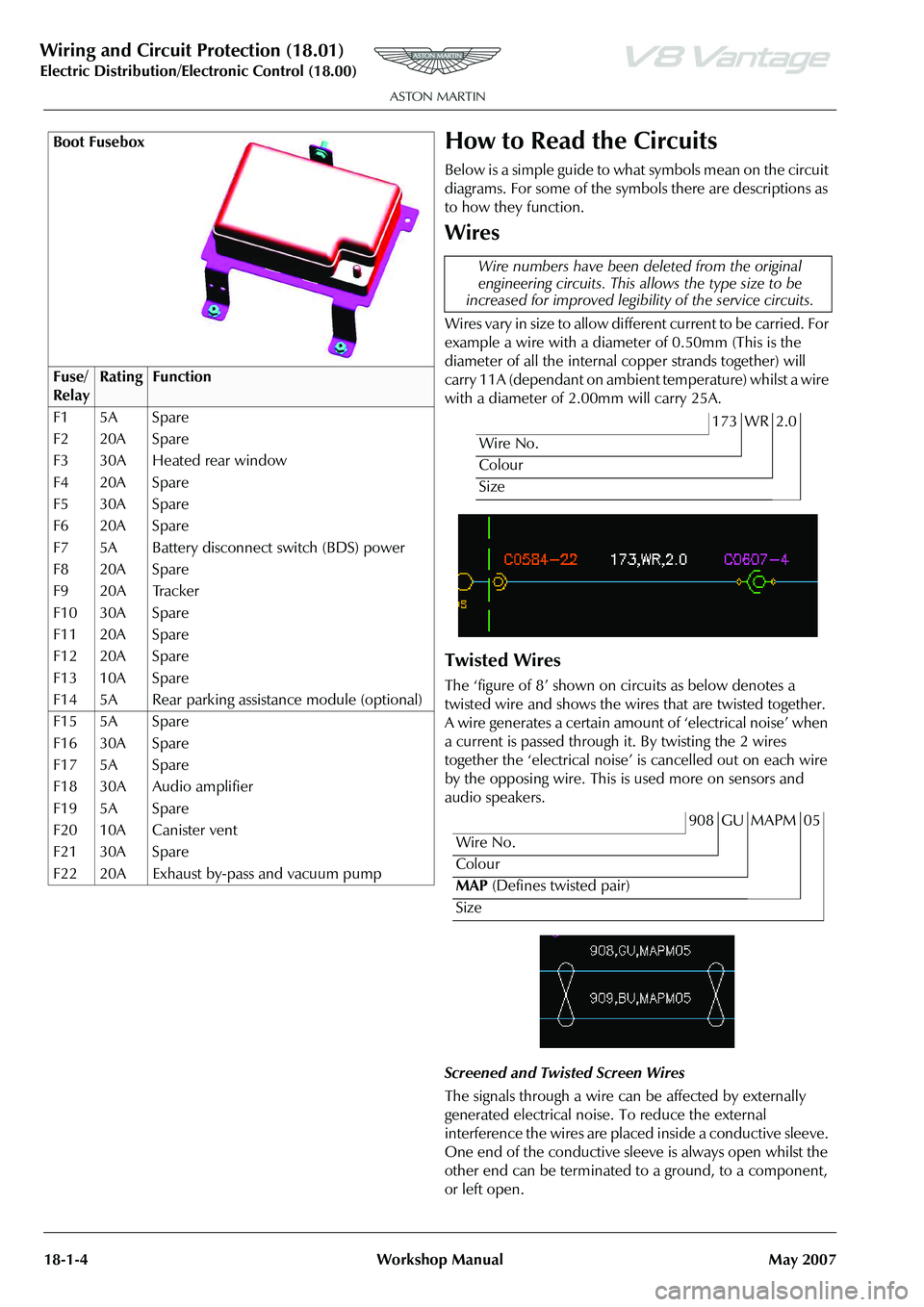
Wires vary in size to allow diffe rent current to be carried. For
example a wire with a diamet er of 0.50mm (This is the
diameter of all the internal copper strands together) will
carry 11A (dependant on ambient temperature) whilst a wire
with a diameter of 2.00mm will carry 25A.
Twisted Wires
The ‘figure of 8’ shown on circuits as below denotes a
twisted wire and shows the wires that are twisted together.
A wire generates a certain amount of ‘electrical noise’ when
a current is passed through it. By twisting the 2 wires
together the ‘electrical noise’ is cancelled out on each wire
by the opposing wire. This is used more on sensors and
audio speakers.
Screened and Twisted Screen Wires
The signals through a wire can be affected by externally
generated electrical noise. To reduce the external
interference the wires are placed inside a conductive sleeve.
One end of the conductive sleeve is always open whilst the
other end can be terminated to a ground, to a component,
or left open.
Boot Fusebox
Fuse/
RelayRatingFunction
F1 5A Spare
F2 20A Spare
F3 30A Heated rear window
F4 20A Spare
F5 30A Spare
F6 20A Spare
F7 5A Battery disconnect switch (BDS) power
F8 20A Spare
F9 20A Tracker
F10 30A Spare
F11 20A Spare
F12 20A Spare
F13 10A Spare
F14 5A Rear parking assistance module (optional)
F15 5A Spare
F16 30A Spare
F17 5A Spare
F18 30A Audio amplifier
F19 5A Spare
F20 10A Canister vent
F21 30A Spare
F22 20A Exhaust by-pass and vacuum pump
Wire numbers have been deleted from the original
engineering circuits. This al lows the type size to be
increased for improved legibil ity of the service circuits.
173 WR 2.0
Wire No.
Colour
Size
908 GU MAPM 05
Wire No.
Colour
MAP (Defines twisted pair)
Size