warning AUDI A3 2011 Owner´s Manual
[x] Cancel search | Manufacturer: AUDI, Model Year: 2011, Model line: A3, Model: AUDI A3 2011Pages: 320, PDF Size: 75.79 MB
Page 133 of 320
& WARNING (continued)
under the brake pedal and accelerator pedal causing a loss of
vehicle control. •
Stowing luggage
Loading the luggage compartment
All luggage and other objects must be properly stowed
and secured in the luggage compartment.
~ ... a'. ., m
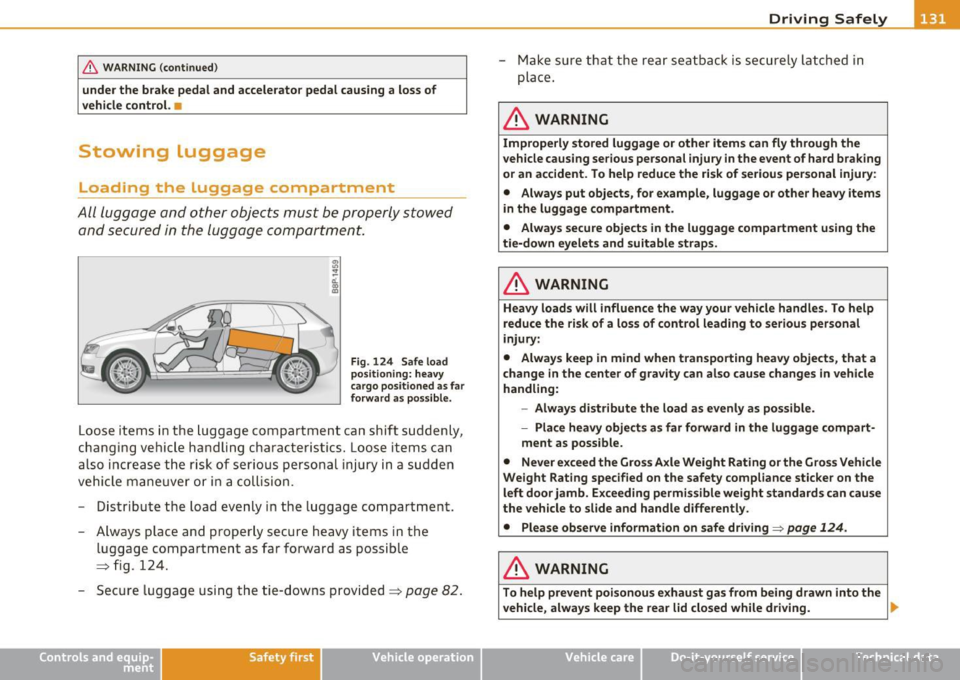
Fig . 124 Safe load
positioning: heavy
cargo positioned as far
forward as possible.
Loose items in the luggage compartment can shift suddenly,
changing vehicle handling characteristics. Loose items can
also increase the risk of serious personal injury in a sudden
vehicle maneuver or in a collision.
- Distribute the load evenly in the luggage compartment.
- Always place and properly secure heavy items in the luggage compartment as far forward as possible
~ fig . 124.
- Secure luggage using the tie-downs provided~ page 82.
Safety first Vehicle OP-eration Driving
Safely
-
Make sure that the rear seatback is securely latched in
place.
& WARNING
Improperly stored luggage or other items can fly through the
vehicle causing serious personal injury in the event of hard braking or an accident. To help reduce the risk of serious personal injury:
• Always put objects, for example, luggage or other heavy items
in the luggage compartment.
• Always secure objects in the luggage compartment using the
tie-down eyelets and suitable straps.
& WARNING
Heavy loads will influence the way your vehicle handles. To help
reduce the risk of a loss of control leading to serious personal
injury:
• Always keep in mind when transporting heavy objects, that a
change in the center of gravity can also cause changes in vehicle
handling:
-Always distribute the load as evenly as possible.
- Place heavy objects as far forward in the luggage compart-
ment as possible.
• Never exceed the Gross Axle Weight Rating or the Gross Vehicle
Weight Rating specified on the safety compliance sticker on the
left door jamb. Exceeding permissible weight standards can cause
the vehicle to slide and handle differently.
• Please observe information on safe driving=>
page 124.
& WARNING
To help prevent poisonous exhaust gas from being drawn into the
vehicle, always keep the rear lid closed while driving . .,_
Vehicle care Do-it-yourselt service iTechnical data
Page 134 of 320
-L_!:D~ r!:_! i~v ~in ~ g~S~ a.!_fe ~ LyL __________________________________________ _
& WARNING (conti nu ed )
• Never tran sport object s larger than those fitting completely
into the luggage are a because the rear lid cannot be fully clos ed.
• If you absolutely must dri ve with the rear lid open , observe the
following note s to reduce the risk of po isoning:
- Clo se all windows,
- Close the power roof*,
- Open all air outlets in the instrument panel,
- Switch off the air recirculation ,
- Set the fresh air fan to the h ighest speed.
& WARNING
Always make sure that the doors , all windows, the power roof*
and the read lid are securely closed and lo cked to redu ce the ri sk
of inju ry when the vehicle is not being used.
• After closing the r ear lid, always make sure that it is properly
closed and locked.
• Never leave your vehicle unattended especially with the rear lid
left open. A child could crawl into the vehicle through the luggage
compartment and close the rear lid becoming trapped and unable
to get out. Being trapped in a vehicle can lead to serious personal
injury.
• Never let children play in or around the vehicle.
• Never let passengers ride in the luggage compartment . Vehicl e
occupants must alway s be properly restrained in one of the
vehicle 's seating positions.
00 Tips
• The tire pressu re mus t cor respond to the load - see the tire pres
sure st icker on th e fuel filler doo r. •
The tire pressure must correspo nd to the load . The tire p ressure is
shown on t he tire press ure label. O n USA ve hicl es, t he tire press ure
label is located on the d river's s ide B-pillar. On Canada vehicles, the
tire press ure label is located either on the driver 's side B -pillar or
inside the fuel fille r flap . The t ire pressure labe l lists the recom
mended co ld ti re inflation pressures for t he ve hicle at its maximum
c apacity weight and the tires that were on yo ur vehicle at the ti me it
was manufactured. For recommended tire pressures for normal load
c ondi tions, p le ase see cha pte r=>
page 249. •
Tie-downs
The lugg ag e co mportment is equipped with four tie
downs to secure lugga ge and other items.
Use the t ie-downs to sec ure your ca rgo prope rly=> page 131,
"Loading the luggage compartment" .
In a co lli sion, t he laws of phys ics mean tha t even sma ller i tems th at
are loose in the vehicle will become heavy m issi les t hat can cause
ser ious injury. Items in the vehicle pos sess energy whi ch v ary wi th
vehicle speed and t he weight of the item. Vehicle speed is the most
significant factor .
For exampl e, in a fron tal col lis io n at a speed of 30 mp h (4 8 k m/h),
the forces actin g on a 10 -lb (4.S kg) o bject are about 20 times t he
normal weight o f the item. This means that the weig ht of the item
wou ld suddenly be abo ut 200 lbs. (90 kg) . You can imagine the inju
r ies tha t a 200 lbs. (90 kg) i tem flying freely thro ugh t he p assenge r
compartment could cause in a collision like this.
& WARNING
Weak , damaged or improper straps used to secure items to t ie
downs can fail during hard braking or in a collision and cause
ser ious personal injury.
Page 135 of 320
& WARNING (continued)
• Always use suitable mounting straps and properly secure items
to the tie-downs in the luggage compartment to help prevent items from shifting or flying forward as dangerous missiles.
• When the rear seat backrest is folded down, always use suit
able mounting straps and properly secure items to the tie-downs
in the luggage compartment to help prevent items from flying
forward as dangerous missiles into the passenger compartment.
• Never attach a child safety seat tether strap to a tie-down. •
Reporting Safety Defects
Applicable to U.S.A.
If you believe that your vehicle has a defect
which could cause a crash or could cause injury
or death, you should immediately inform the National Highway Traffic Safety Administration
(NHTSA) in addition to notifying Audi of
America, Inc.
If NHTSA receives similar complaints, it may
open an investigation, and if it finds that a
safety defects exists in a group of vehicles, it
may order a recall and remedy campaign.
However, NHTSA cannot become involved in
individual problems between you, your dealer,
or Audi of America, Inc.
To contact NHTSA, you may call the Vehicle
Safety Hotline toll-free at:
Controls and equip ment Safety first Vehicle operation
Driving Safely
-
Tel.: 1-888-327-4236 (TTY: 1-800-424-9153)
or write to:
Administrator
NHTSA
1200 New Jersey Avenue, SE
Washington, D.C. 20590
You can also obtain other information about motor vehicle safety from:
http:/ /www.safercar.gov
Applicable to Canada
Canadian customers who wish to report a
safety-related defect to Transport Canada, Defect Investigations and Recalls, may tele
phone the toll free hotline :
Tel.: 1-800-333-0371 or
Tel.: 1-613-998-8616 if you are in the Ottawa
area
TTY for hearing impaired: 1-888-675-6863
email comments/questions to: roadsafetyweb
[email protected]
or contact Transport Canada by mail at:
Road Safety and Motor Vehicle Regulation
Directorate
Transport Canada
Vehicle care Do-it-yourself service Technical data
Page 137 of 320
Safety belts Ill
----------------
Safety belts
General notes
Always wear safety belts!
Wearing safety belts correctly saves lives!
This chapter explains why safety belts are necessary, how
they work and how to adjust and wear them correctly.
- Read all the information that follows and heed all of the
instructions and WARNINGS.
& WARNING
Not wearing safety belts or wearing them improperly increases
the risk of serious personal injury and death.
• Safety belts are the single most effective means available to
reduce the risk of serious injury and death in automobile acci
dents. For your protection and that of your passengers, always
correctly wear safety belts when the vehicle is moving.
• Pregnant women, injured, or physically impaired persons must
also use safety belts. Like all vehicle occupants, they are more
likely to be seriously injured if they do not wear safety belts. The
best way to protect a fetus is to protect the mother - throughout
the entire pregnancy. •
Number of seats
Your Audi has a total of five seating positions: two in the front and
three in the rear . Each seating position has a safety belt .
Controls and equip
ment Safety first Vehicle operation
& WARNING
Not wearing
safety belts or wearing them improperly increases
the risk of serious personal injury and death.
• Never strap more than one person, including small children,
into any belt. It is especially dangerous to place a safety belt over
a child sitting on your lap.
• Never let more people ride in the vehicle than there are safety
belts available.
• Be sure everyone riding in the vehicle is properly restrained
with a separate safety belt or child restraint. •
Safety belt warning light t
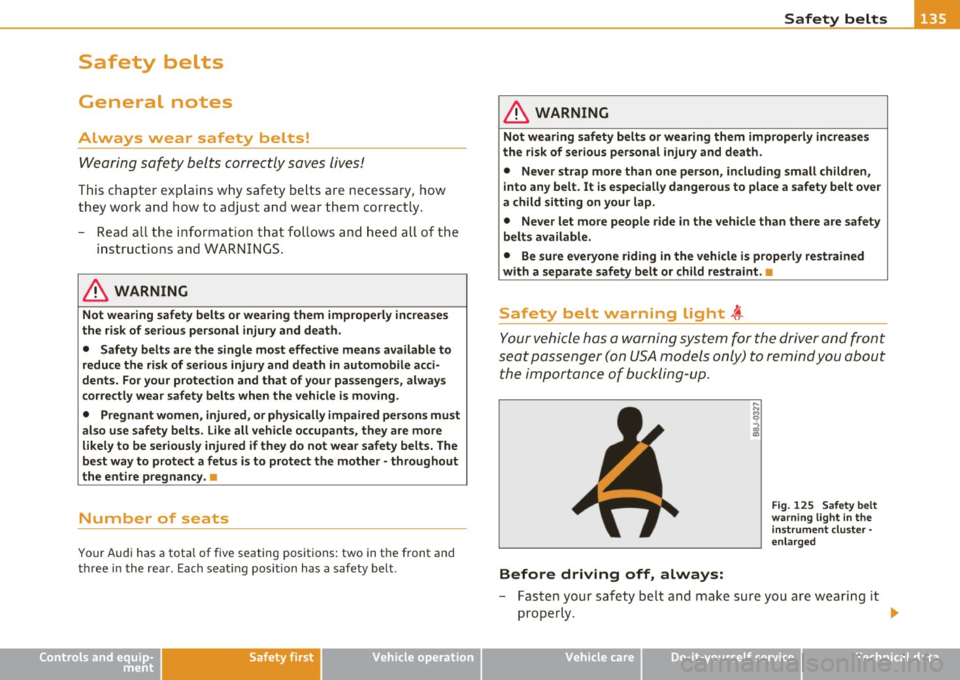
Your vehicle has a warning system for the driver and front
seat passenger ( on USA models only) to remind you about
the importance of buckling-up.
Before driving off, always:
Fig. 125 Safety belt
warning light in the
instrument cluster·
enlarged
- Fasten your safety belt and make sure you are wearing it
properly .
IJ,-
Vehicle care Do-it-yourself service Technical data
Page 138 of 320
-Safety belts pn, _______________ _
-Make sure that your passengers also buckle up a nd prop
erly wear their safety belts .
- Protect c hildren with a child rest raint system appropria te
fo r the size and ag e.
The warn ing light ~ in the instrument cluster lights up when the igni
tion is sw itched on as a reminder to fasten the safety belts. In addi
tion, you w ill hear a wa rning tone for a certa in period of t im e.
Fasten your safety belt and ma ke sure that your passenge rs also
properly put on their safety belt s.
& WARNING
• Safety belts are the singl e most effective means available to
reduce the risk of serious injury and death in automobile a cci
dents . For your protection and that of your pas senger s, always
co rrectly wear safety belts when the vehicle is mo ving .
• Failure to pay attention to the warning light that come on,
could lead to personal injur y.
u
Why safety belts?
Frontal collisions and the law of physics
Frontal crashes create very stron g forc es for people
riding i n vehi cles.
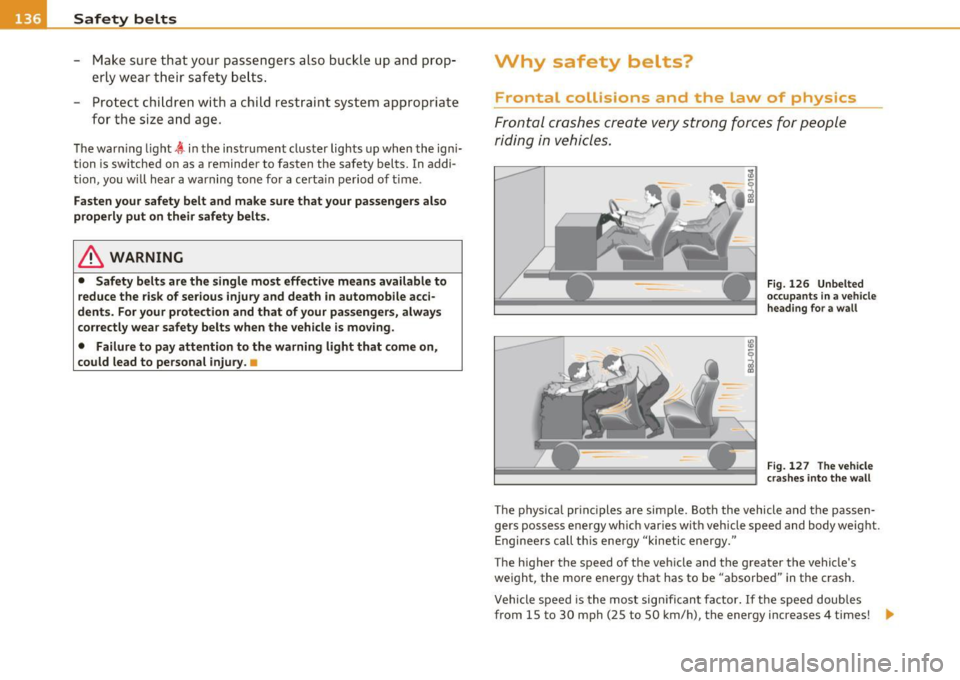
Fig . 12 6 U nbelted
o ccupa nts in a vehicle
h eadin g for a w all
Fig . 127 The ve hicle
cr as hes int o t he w all
T he p hys ica l pr inc iples are simple. Both the vehicle and the passen
gers possess energy which var ies wit h veh icle speed and body weight.
Enginee rs ca ll t his ene rgy "kinetic energy."
The higher the speed of the veh icle and the greater the vehicle's
we ight, the more energy that has to be "absorbed" in the crash .
Vehicle speed is the most sig nifican t fa ctor. If t he speed doubles
from 15 to 30 mph (25 to 50 km/h), the energy increases 4 times! .,
Page 140 of 320
•--=S~a ~f ~e ~t ,z.Y ...: b~ e~lt ~ s~ --------------------------------------------
Safety belts protect
People think it's possible to use the hands to brace the
body in a minor collision . It's simply n ot true!
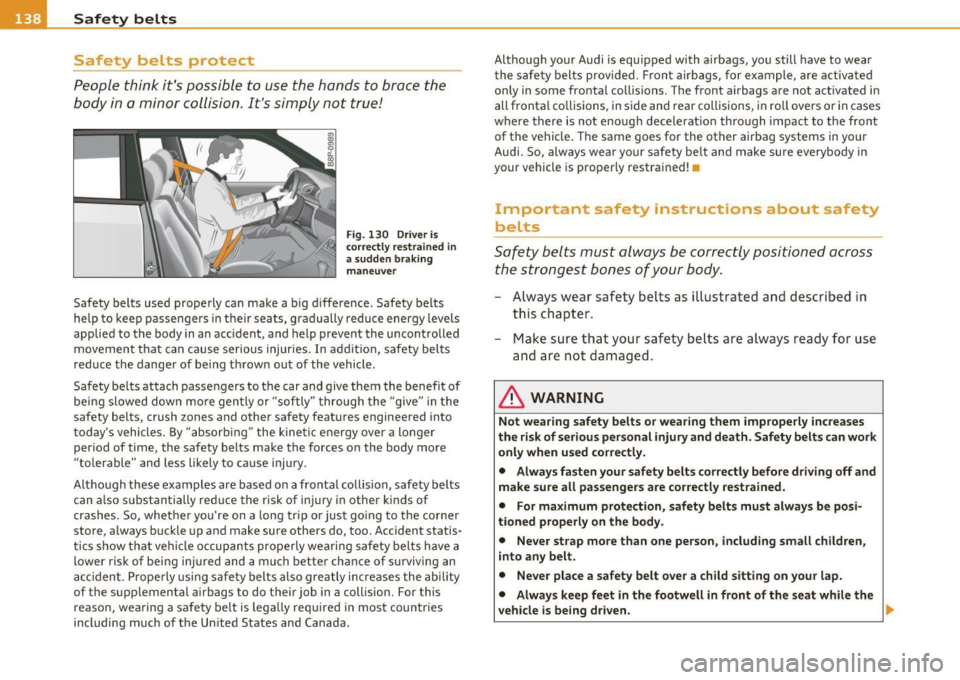
F ig . 1 30 Driv er is
c o rr ect ly res trai ned i n
a su dden bra kin g
m ane uver
Safety belts used prope rly can make a big difference. Safety belts
help to keep passengers in their sea ts, gradually reduce energy leve ls
applied to the body in an accident, and help prevent the uncontrolled
movement that can cause serious injuries . In add it io n, safety bel ts
red uce the danger of be ing t hrown out of the vehicle.
Sa fety be lts attach passengers to the car and give them the benefit of
being slowed down mo re gently or "softly" through the "give" i n the
safety belts, crush zones and other safety features engineered into
t oday 's vehicle s. By "absorb ing" the kine tic e nergy over a lo nger
period of time, the safety belts make the forces on the body more
"tolerable" and less likely to ca use inju ry.
Although these examples are based on a frontal collision, safety belts can a lso s ubstantially red uce the risk of i nju ry in other kinds of
cr ashes . So, whet he r you're on a long trip or just going to the corner
store, always b uckle up and make sure others do , too. Accident statis
t ic s show that vehi cle occupan ts properly wea ring safety belts have a
lower risk of being injured and a much better chance of surviv ing an
a cc iden t. Properly usi ng s afe ty belts also greatly in cre ases the ability
of the supp lemental airbags to do their job in a collision. For this
reaso n, wea ring a sa fety belt is lega lly req uired in mos t countries
including much of the Un ited States and Canada . Altho
ugh your Audi is equ ipped with a irbags, you still have to wear
t he s afe ty belts provided. Fron t air bags, for ex ample, are a ctiv ate d
only in some fronta l collisions . T he front a irbags a re not act ivated in
all frontal co llisions, in s ide and rear coll isio ns, in roll overs or in cases
where there is not enough decelerat ion thro ugh impact to the front
of the vehicle . The same goes for the other airbag systems in yo ur
Audi. So, always wea r you r safety be lt and make su re everybody in
your vehicle is proper ly restrained!
Important safety Instructions about safety
belts
Safety b elts must always be correctly positioned across
the strongest bones of your body.
- Always wear safety belts as illustrated and described in
this chapter.
- Make sure that your safety belts are always ready for use and are not damaged.
& WARNING
Not wea ring safety belts o r wearing them improperly inc reases
the risk of s eriou s personal injury and death . Safety belts can work
only when u sed correctl y.
• Alway s fasten your safety belts correctly bef ore driving off and
make sure all passengers are corre ctly restrained.
• For ma ximum protection , safety belts must alw ays be posi
ti oned properly on the body.
• Never strap more than one person , including small children ,
into any belt .
• Never place a safety belt o ver a ch ild sitting on your lap .
• Alway s keep feet in the footwell in front of the seat while the
vehicle is being driven.
~
Page 141 of 320

& WARNING (continued)
• Never let any person ride with their feet on the instrument
panel or sticking out the window or on the seat.
• Never remove a safety belt while the vehicle is moving. Doing
so will increase your risk of being injured or killed.
• Never wear belts twisted.
• Never wear belts over rigid or breakable objects in or on your
clothing, such as eye glasses, pens, keys, etc., as these may cause
injury.
• Never allow safety belts to become damaged by being caught
in door or seat hardware.
• Do not wear the shoulder part of the belt under your arm or
otherwise out of position .
• Several layers of heavy clothing may interfere with correct
positioning of belts and reduce the overall effectiveness of the
system.
• Always keep belt buckles free of anything that may prevent the
buckle from latching securely.
• Never use comfort clips or devices that create slack in the
shoulder belt. However, special clips may be required for the
proper use of some child restraint systems.
• Torn or frayed safety belts can tear, and damaged belt hard
ware can break in an accident. Inspect belts regularly. If webbing, bindings, buckles, or retractors are damaged, have belts replaced
by an authorized Audi dealer or qualified workshop.
• Safety belts that have been worn and loaded in an accident
must be replaced with the correct replacement safety belt by an
authorized Audi dealer. Replacement may be necessary even if
damage cannot be clearly seen. Anchorages that were loaded
must also be inspected.
• Never remove, modify, disassemble, or try to repair the safety
belts yourself.
Safety first Vehicle OP-eration
Safety belts
& WARNING (continued)
• Always keep the belts clean. Dirty belts may not work properly
and can impair the function of the inertia reel=>
page 217,
"Safety belts". •
Safety belts
Fastening safety belts
Seat first -everybody buckle up!
Fig. 131 Belt buckle
and tongue on the
driver's seat
To provide maximum protection , safety belts must always be
positioned correctly on the wearer's body.
- Adjust the front seat and head restraint properly
=>
page 73 , "General recommendations" .
- Make sure the seatback of the rear seat bench is in an
upright position and securely latched in place before using
the belt =>& .
- Hold the belt by the tongue and pull it evenly across the
chest and pelvis=>& . _,.
Vehicle care Do-it-yourselt service iTechnical data
Page 142 of 320

___ s_ a_ f_ e_ t_ y~ b_ e_ lt_s _____________________________________________ _
- Insert t he tongue into the correct buck le of your seat until
you hear it latch secure ly==> fig. 131 .
- Pull on the be lt to make sure tha t it is secure ly la tched in
the buck le.
Automatic safety belt retractors
Every safety be lt is equipped with an automatic be lt retractor on the
shoulder be lt. This feat ure locks the be lt whe n the belt is pulled out
fast, during hard braking and in an acc ident. The belt may also lock
w hen you dr ive up or dow n a steep hill or throug h a sharp curve.
Dur ing normal driv ing the belt lets you move freely.
Safety belt pretensioners
The safety belts are equipped w ith a belt pretensioner that helps to
t ighten the safety be lt and remove sla ck when the p re tensioner is
act ivated. The function of the pretensioner is monitored by a warn ing
light =>
page 15.
Switchable locking feature
Every sa fety be lt ex ce pt t he one on the driver sea t is eq uipped wi th a
switchab le locking feature that
must be used when the safety belt is
used to at tach a child safety seat. Be s ure to read t he importa nt info r
mation about this feature=>
page 177.
& WARNING
Imp roperly positioned safety belts can c au se se rious injury in a n
accident =>
page 140, "Safety b elt po sition ".
• Safety belts offer optimum protection only when the seatback
i s upr ight and belts are properly positioned on the body .
• Always make sure th at the rear seat backre st to which the
center rear safety belt is attached i s secur ely latched when ever the
rear cente r sa fety belt is be ing u sed . If the ba ckre st is not securely
latched, the pas senger will move forward with th e backre st during
sudde n braking, in a sudden maneuve r and especiall y in a crash .
& WARNING (continued )
• Never attach the safety belt to the buckle fo r another seat .
Attaching the belt to the wrong buckle will reduce safety belt
effectiveness and can cause ser ious personal injury.
• A pass enger who i s not properly restrained can be seriou sly
i njured by the safety belt itself when it mo ves from the stronger
part s of the body into critical area s like the abdomen.
• Alway s loc k the convertible locking retractor when you a re
securing a child safety seat in the vehicle=>
page 179. •
Safety belt position
Correct belt position is the key to getting maximum
pro tection from safety belts .
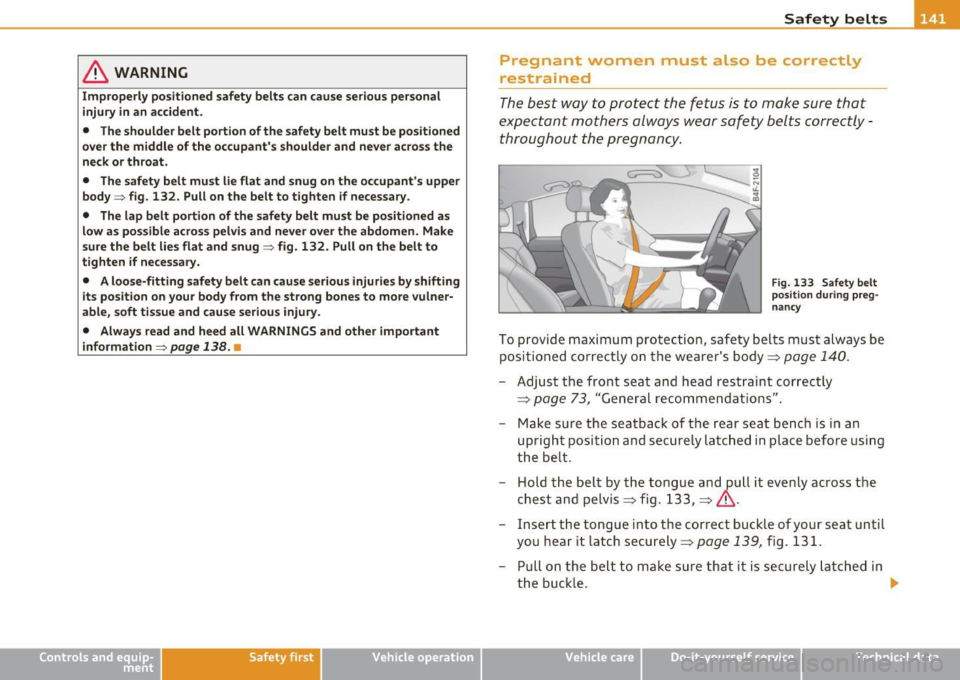
Fig. 132 Hea d
r e str aint a nd safet y
belt po sit ion a s seen
from the side
Standard features on your vehicle help you adjust the position of the
safety belt to match your bo dy size.
• belt h eight adjustment for the fron t sea ts,
• automatic belt height adjustment for the rear seats .
Page 143 of 320
& WARNING
Improperly positioned safety belts can cause serious personal
injury in an accident. • The shoulder belt portion of the safety belt must be positioned
over the middle of the occupant's shoulder and never across the
neck or throat.
• The safety belt must lie flat and snug on the occupant's upper
body => fig. 132. Pull on the belt to tighten if necessary.
• The lap belt portion of the safety belt must be positioned as
low as possible across pelvis and never over the abdomen. Make
sure the belt lies flat and snug => fig. 132. Pull on the belt to
tighten if necessary.
• A loose-fitting safety belt can cause serious injuries by shifting
its position on your body from the strong bones to more vulner
able, soft tissue and cause serious injury.
• Always read and heed all WARNINGS and other important
information =>
page 138. •
Safety first Vehicle OP-eration
Safety belts
Pregnant women mus.t also be c:orrectly
restra ined
The best way to protect the fetus is to make sure that
expectant mothers always wear safety belts correctly -
throughout the pregnancy.
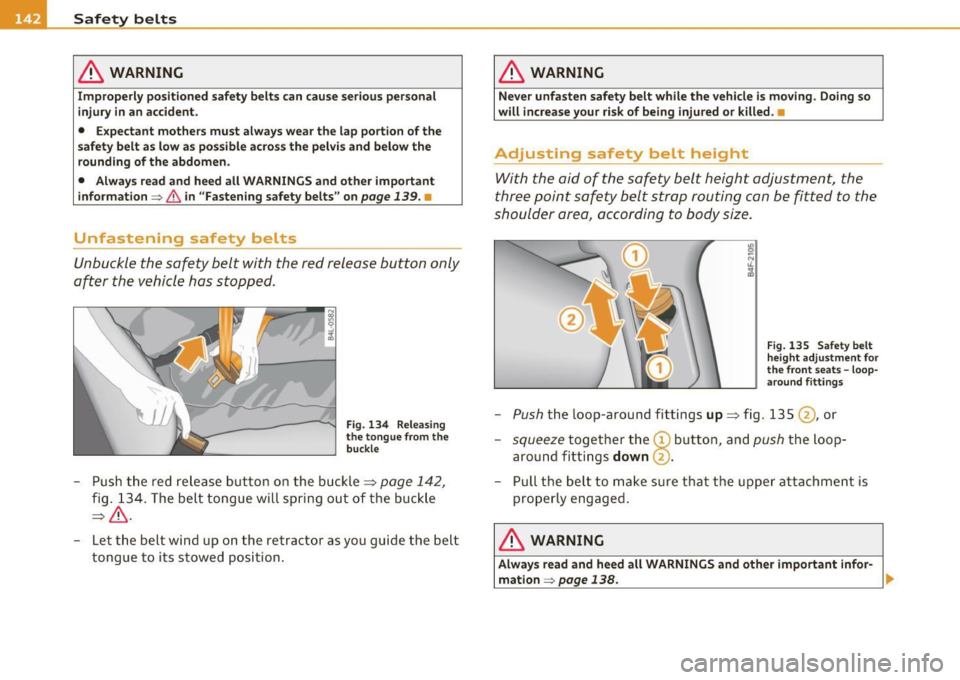
Fig. 133 Safety belt
position during preg
nancy
To provide maximum protection, safety belts must always be
positioned correctly on the wearer's body=>
page 140.
- Adjust the front seat and head restraint correctly
=>
page 73, "General recommendations".
- Make sure the seatback of the rear seat bench is in an
upright position and securely latched in place before using
the belt .
- Hold the belt by the tongue and pull it evenly across the
chest and pelvis=> fig. 133 , =>
& .
- Insert the tongue into the correct buckle of your seat until
you hear it latch securely =>
page 139, fig. 131.
- Pull on the belt to make sure that it is securely latched in
the buckle.
IJ),
Vehicle care Do-it-yourselt service iTechnical data
Page 144 of 320
-Safety belts ----------------
& WARNING
Improperly positioned safety belts can cause
serious personal
injury in an accident.
• Expectant mothers must always wear the lap portion of the
safety belt as low as possible across the pelvis and below the
rounding of the abdomen.
• Always read and heed all WARNINGS and other important
information ~
& in "Fastening safety belts" on page 139. •
Unfastening safety belts
Unbuckle the safety belt with the red release button only
after the vehicle has stopped.
Fig. 134 Releasing
the tongue from the
buckle
- Push the red release button on the buckle ~ page 142 ,
fig. 134. The belt tongue will spr ing out of the buckle
~& -
- Let the belt wind up on the retractor as you guide the belt
tongue to its stowed position.
& WARNING
Never unfasten safety belt while the vehicle is moving. Doing so
will increase your risk of being injured or killed. •
Adjusting safety belt height
With the aid of the safety belt height adjustment , the
three point safety belt strap routing can be fitted to the
shoulder area, according to body size.
Fig. 135 Safety belt
height adjustment for
the front seats -loop
around fittings
-Push the loop-around fittings up~ fig. 135 @, or
- squeeze together the (D button, and push the loop-
around fittings
down @.
- Pull the belt to make sure that the upper attachment is
properly engaged.
& WARNING
Always read and heed all WARNINGS and other important infor-
mation ~
page 138. .,