warning AUDI A3 2011 Owner´s Manual
[x] Cancel search | Manufacturer: AUDI, Model Year: 2011, Model line: A3, Model: AUDI A3 2011Pages: 320, PDF Size: 75.79 MB
Page 285 of 320
_______________________________________________ F_u _s_ e_ s_ a_ n_ d_ b_u _ l_ b _ s __ _
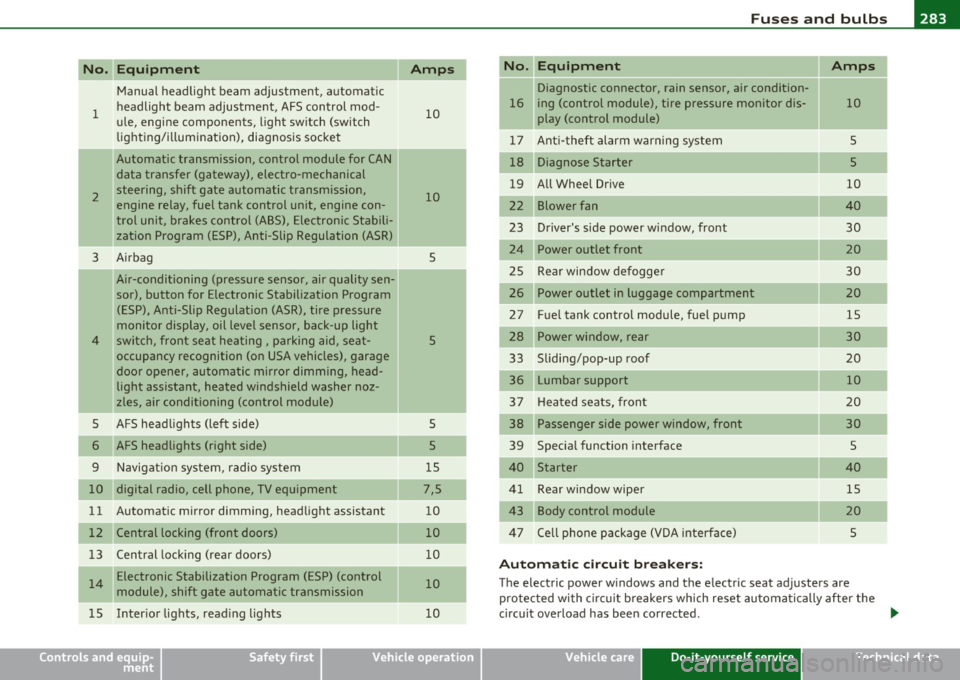
Equipment No. II Equipment
Amps
Manual headlight beam adjustment, automatic Diagnostic connector, rain sensor, air condition-
headlight beam adjustment, AFS control mod-
16 ing (control module), tire pressure monitor dis-10
1 ule, engine components, light switch (switch 10 play (control module)
-lig hti ng/i llum i nation), diagnosis socket 1 7 Ant i-theft alarm warning system 5
Automatic transmission, control module for CAN 18 Diagnose Starter 5
data transfer (gateway), electro-mechanical
19 All Whee l Drive 10 steering, shift gate automatic transmission, 2 10 engine relay, fuel tank control unit, engine con-22 Blower fan 40
trol unit, brakes control (ABS), Electronic Stabili-23 Driver's side power window, front 30 zation Program (ESP), Anti-Slip Regulation (ASR)
3 Airbag 5 24 Power outlet front 20
Air-conditioning (pressure sensor, air quality sen-25 Rear window defogge r 30
sor), button for Electronic Stabilization Program 26 Power outlet in luggage compartment 20
(ESP), Anti-Slip Regulation (ASR), tire pressure 27 Fuel tank control module, fuel pump 15
monitor display, oil level sensor, back-up light
28 Power window, rear 30 4 switch, front seat heating, parking aid, seat-s
occupancy recognition (on USA vehicles), garage 33 Sliding/pop-up roof 20
door opener, automatic mirror dimming, head-
Lumbar support
10 light assistant, heated windshield washer noz-
zles, air conditioning (control module)
3 7 Hea ted seats, front 20
--
5 AFS headlights (left side) 5 38 Passenger side power window, front 30
AFS headlights (right side) 5 39 Specia l function interface 5
9
Navigat ion system, radio system 15 40 Starter 40
digital radio, cell phone, TV equipment 7,5 Rear window wiper 15
11
Automatic mirror dimming, headlight assistant 10 Body control module 20
12 Central locking (front doors) 10 47 Ce ll phone package (VDA interface) 5
13
Central locking (rear doors) 10
A uto m atic c ircu it bre ake rs :
14 Electronic Stabilization Program (ESP) (control 10 The electric power w indows and the electric seat adjusters are
module), shift gate automatic transmission protected with circuit b reakers which reset automatically after the
1 5 Inter ior lights, read ing lights 10 circuit overload has been corrected . ...
Safety first Vehicle care Do-it-yourself service Technical data
Page 287 of 320
_______________________________________________ F_u _s_ e_ s_ a_ n_ d_ b_u _ l_ b _ s __ _
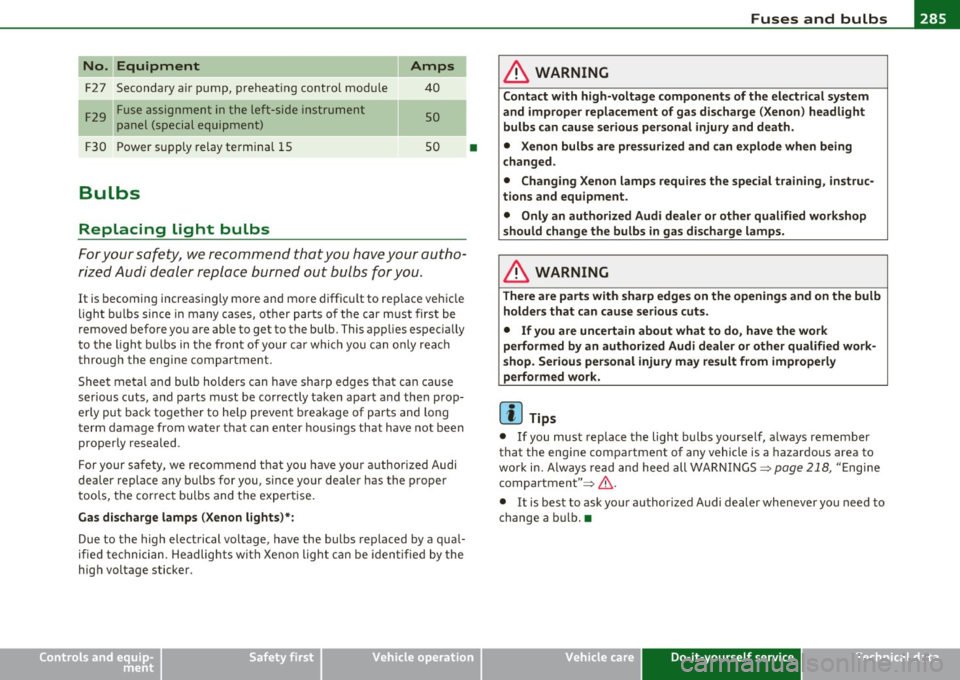
No. Equipment
F2 7 Secondary a ir pump, preheating contro l module
F 29 Fuse assignment in the left-side instrument
panel (special equipment)
F30 Power supply relay termina l 15
Bulbs
Replacing light bulbs
Amps
40
so
so
For you r safety, we recommend that you have your autho
ri zed Audi dealer replace burned out bulbs for you.
It is becoming increasingly more and more difficu lt to rep lace vehicle
light bulbs since in many cases, ot her parts of the car must first be
removed before you are able to get to the bu lb. This app lies espec ially
to the l igh t bu lbs in the front of your car whi ch you can o nly rea ch
through the engine compartment .
Sheet metal and bu lb holders can have sharp edges that can ca use
serious cuts, and parts must be correctly taken apart and the n prop
erly put back together to he lp prevent b reakage of parts and long
term damage from wate r that can enter housings that have not been
p roperly resealed.
For your safety, we recommend that you have you r authorized Audi
deale r replace any bu lbs fo r you, since your dealer has the proper
too ls, the cor rec t bu lbs and the expertise .
Gas dis charge lamp s (Xenon lights)* :
Due to the high electrical voltage, have the bulbs replaced by a qual
ified technician. Headlights with Xe non light can be iden tified by the
high voltage sticker.
Safety first
•
& WARNING
C ontact with high-voltag e components of the electrica l system
and improper replacement of g as discharge (Xenon ) headlight
bulb s can caus e serious personal injury and death .
• Xenon bulb s are pres surized and can explode when b eing
c hanged .
• Changing Xenon lamp s requir es the special training , instruc
tions and equipment.
• Only an authori zed Audi dealer or oth er qualified workshop
should change the bulbs in ga s di scharge lamp s.
& WARNING
There are parts with sharp edge s on the openi ngs and on the bulb
holde rs that can cau se se rious cuts.
• If you are uncertain about what to do, ha ve the work
performed b y an auth orized Audi de aler or oth er qualified work
s hop. Seriou s per sonal injur y m ay re sult from improperl y
p erformed w ork.
(I] Tips
• If you must replace the light bulbs yourself , a lways remember
that the engine compar tment of any vehicle is a hazardo us area to
work in. Always read and heed all WARNINGS=>
page 218, "E ngi ne
compa rtment" =>& .
• It is best to ask you r author ized Audi dealer whenever you need to
change a bu lb. •
Vehicle care Do-it-yourself service Technical data
Page 288 of 320
111.___E_ m_ e_r-= g=- e_ n_c-= y'-- s_ i_t _u _a_ t_ i_ o _ n_ s ____________________________________________ _
Emergency situations
General
This chapter is intended for trained emergency crew s and working
pe rsonnel who have the necessary tool s and equipment to perform
the se operation s. •
Starting by pushing or towing
0 Note
Veh icles with an automatic transmission cannot be started by
pushing or towing .•
Starting with jumper cables
J umper c able : Note the manufacturer 's information .
If the battery is discha rged, another ve hicle can p rovide sta rting
assistance. For this yo u require a jumper cab le. Bot h batter ies m ust
h ave the s ame vo lt a ge (V) and a sim ila r cap acity (Ah).
Jumper cables Use
only jumpe r cables o f sufficiently la rge cross section to safely
carry the starter current. Refer to the man ufact urer's spec ificat ions.
Use only j umpe r ca bles with
isola ted t ermin al cl am ps and pro p erl y
marked for distinct ion:
plu s(+) cable in most cases co lored red
minus( ·) cable i n most cases colo red black .
T he w ire cross sect ion must be at least 0.038 in
2 (25 mm2
) for gaso
line engines and a t least 0. 054 in
2 (3 5 mm2
) for diese l engines.
& WARNING
Batterie s contain el ectricity, acid, and gas . Any of the se can cause
very serious or fatal injury. Follow the inst ructions below for safe
handling of your vehicle 's battery.
• Always shield your eyes and avoid leaning over the battery
whenev er po ssible .
• A discharged battery can alre ady freeze at temperatures just
below 32 °F (0 °C) . Never attempt to provide starting assistance
on a frozen or thawed out battery- Danger of explosion and chem
ical burns! Replace a battery if it has been frozen.
• Do not allow battery acid to contact eyes or skin. Flush any
contacted area with water immediately .
• Improper u se of a booste r battery to start a vehicle m ay cause
an explosion .
• Vehicle batteries generate explosive gases . Keep sparks, flame
and lighted cigarettes away from batteries .
• Do not try to jump start any vehicle with a low acid level in the
battery .
• The voltage of the booster battery mu st also have a 12 -Volt
rating. The capacity (Ah) of the booster battery should not be
lower than that of the discharged battery . Use of batteries of
different voltage or substantially different "Ah" rating may cause
an explosion and personal injury.
• Never charge a frozen battery . Gas t rapped in the ice may cause
an explosion .
• Never charge or use a b attery that has been frozen. The battery
case may have be weakened.
• Use of batteries of different voltage or substantially different
capacity (Ah) rating may cause an explosion and injury. The
capacity (Ah) of the booster battery should not be lower than that
of the di scharged battery .
~
Page 289 of 320
_____________________________________________ E_ m_ e_r-= g ::.. e_ n_c-= y'- s_ i_t _u _a_ t_ i_ o _ n_ s __ fflll
& WARNING (co ntinued )
• Before you che ck anything in the engine compartment , alway s
r e ad and heed all WARNINGS =>
page 218, "Engi ne compart
ment ".
0 Note
• App lying a higher vo ltage booster battery will cause expens ive
damage to sens itive e lec tro nic components, such as contro l units,
re lays, rad io, etc.
• Th ere must be no electrical contact between the veh icles as othe r
wise current could a lready sta rt to flow as soon as the posit ive(+)
term inals are con nected.
• Improperly connecte d jumper cables can cause substantial
damage to the e lectr ica l system of the vehicle .
[I) Tips
• The discharged batte ry mu st be properly co nne cted to the
vehicle's elect rical system. •
General information of starting
assistance
Please observe that the procedure descr ibed below for connect ing
jumpe r cab les is intended to p rovide a ju mp s tart for your ve hicl e.
Make sure t hat the co nnected clamps have suff ic ient
metal contact.
Sta rt assistance differs for vehicles w ith a 4-cylinde r engine:
=> page 288, "Use of jumper cables"
Safety first
& WARNING
Improper handling of the jumper cables can lead to an explosion
of the battery and severe injurie s. To reduce the ri sk of injury, note
the following:
• The section s of the terminal clamps that are not insul ated
must not touch each other. In addition, the cable clamped to the
battery' s po sitive terminal must not come in contact with electri
cally connected parts of the veh icle -danger of short circu it!
• Route the jumper cable so that it cannot catch in any rotating
parts in the engine compartment .
• Do not bend over the batteries -danger of chemical burns!
• The battery cell locking screws must be tightened securely.
• Keep ignition source s (open flame , burning cigarettes, etc.)
away from the batteries -danger of explosion!
• Do not clamp the minus cable to parts of the fuel system or the
brake lines.
0 Note
If you prov ide sta rt assistance for others with your vehi cle, you shou ld
not clamp the minus cable( -) to the negative te rm inal of the
discharged batte ry =>
page 288, fig. 19 7 © but to a solid metal part
sc rewed firm ly to the eng ine b lock, or to the e ng ine block itse lf . In
case of an inadequately venti lated battery o f the veh icle receiving
powe r, the re is a dange r of explosi on du e to detonat ing gas! •
Vehicle care Do-it-yourself service Technical data
Page 291 of 320
_____________________________________________ E_ m_ e_r-= g ::.. e_ n_c-= y'- s_ i_t _u _a_ t_ i_ o _ n_ s __ _
13. Disconnect the cable w hile the engine is runn ing exactly
in
reverse or der to t hat described in~ page 288,
"Connec ting/discon nect ing the jumper cable" . When
doi ng so , ma ke sure that t he cab le ca nnot contact rotat ing
eng ine parts .
14 . T urn the h eater bl ower a nd th e re ar w indow hea tin g off
a gain.
Th e bat tery is ven ted to the o utsi de to p reven t ga ses from en ter ing
the ve hicle interior .
M ake s ure that the jumpe r clamps a re well connected w ith their
metal parts in full contact with t he battery termi na ls .
& WARNING
To avoid serious personal injury and damage to the vehicle, heed
all warnings and instructions of the jumper cable manufacturer . If
in doubt, call for road service.
• Jumper cable s mu st be long enough so that the vehicles do not
touch.
• When connecting jumper cable s, make sure that they cannot
get caught in any moving parts in the engine compartment.
• Before you check anything in the engine compartment, always
read and heed all WARNINGS=>
page 218, "Engine compart
ment ".
0 Note
Im pro perly con ne cte d jum per c abl es c an dam age or destroy the
generator.
• Do not use the ba ttery nega tive term inal for jum p star ting or a
ma lf u nction co uld occ ur in the vehicle electrica l system .
• Always co nnect POSITIV E(+) to POSI TIVE( +), a nd NEGATIVE( -)
to N EGATIVE{ -) termina l.
Safety first
• Check that all screw p lugs on the battery cells are screwed in
fir mly . If no t, tig hten plugs pr ior to connectin g clamp o n negative
battery term inal.
• P lease note that the pr ocedur e fo r connecting a jumper cable as
described above app lies specifically to the case of your vehicle being
jum p st ar te d . When you are giving a jump start to anot her vehi cle, do
not conn ect the m in u s (-) cable to t he minus( -) term inal on the
discharged battery ©=>
page 288, fig. 197 . In stea d, sec urely
connect the mi nus( -) cable to either a massive metal component
that is f irm ly bo lte d to t he eng ine block or to the engine bloc k itse lf .
If the battery that i s bei ng charged does not ven t to t he ou tside,
escaping battery gas could ignite and explode! •
Emergency towing with
commercial tow truck
c;eneral hints
Your Audi requires s pecial h andling for to win g.
The follow ing informat ion is to be used by commercial tow truck
oper ator s w ho know how to oper ate th eir equipmen t sa fe ly.
• Never tow your Audi, towing will cause damage to the engine
and transmission.
• Never wrap the safety chains or winch cables around the brake
lines.
• To prevent unnecessary damage, your Audi must be transported
with a car carrier (flat bed truck ).
• To load the vehicle on to the flat bed, use the towing loop found
in the vehicle tools and attach to the front or rear anchorage
=> page 290 and=> page 290 . ..
Vehicle care Do-it-yourself service Technical data
Page 292 of 320
llffl!l.,___E_ m_ e_r-=g :.. e_ n_c -=y '-- s_i_t _u _a _ t_ i_ o _ n_ s ____________________________________________ _
& WARNING
A vehicle being towed is not safe for passengers. Never allow
anyone to ride in a vehicle being towed, for any reason. •
Front towing loop
Do not install the front towing loop until it is needed .
Fig. 198 Front
bumper: removing the
cover cap
Fig. 199 Front
bumper: screwing in
the towing loop
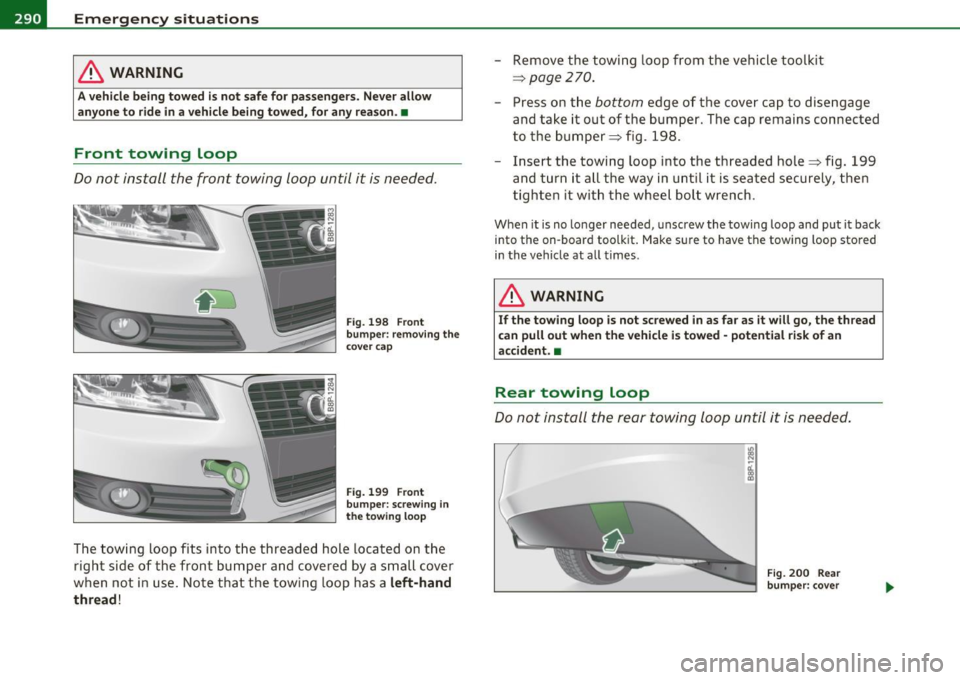
The towing loop fits into the threaded hole located on the
right side of the front bumper and covered by a small cover
when not in use. Note that the towing loop has a
left-hand
thread!
- Remove the towing loop from the vehicle toolkit
=> page 270.
-Press on the bottom edge of the cover cap to disengage
and take it out of the bumper. The cap remains connected
to the bumper => fig. 198.
- Insert the towing loop into the threaded hole=> fig. 199
and turn it all the way in unt il it is seated securely, then
tighten it with the wheel bolt wrench .
When it is no longer needed , unscrew the towing loop and put it back
into the on-board toolkit. Make sure to have the towing loop stored
in the vehicle at all times .
& WARNING
If the towing loop is not screwed in as far as it will go, the thread
can pull out when the vehicle is towed -potential risk of an
accident. •
Rear towing loop
Do not install the rear towing loop until it is needed.
Fig. 200 Rear
bumper: cover
Page 293 of 320
_____________________________________________ E_ m __ e_r-=g =- e_ n_c -==y "- s_i_ t _u _a _ t_ i_ o _ n_ s _ __.fflll
Fig. 201 Rear
bumper: towing loop
inserted
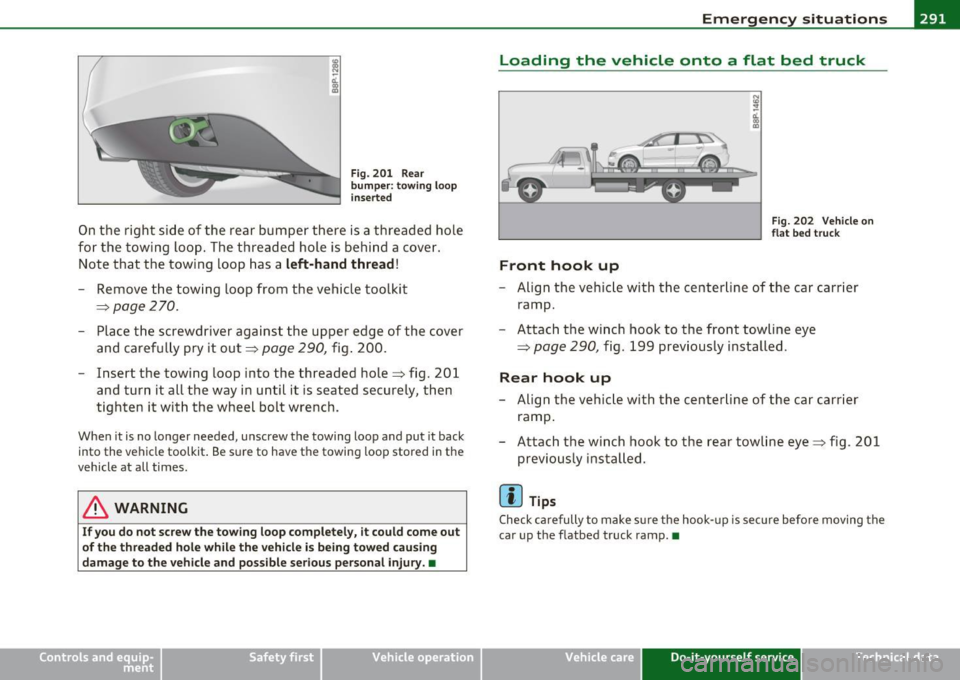
On the right side of the rear bumper there is a threaded hole
for the towing loop. The threaded hole is behind a cover.
Note that the towing loop has a
left-hand thread!
Remove the towing loop from the vehicle toolkit
=> page 270.
Place the screwdriver against the upper edge of the cover
and carefully pry it out :::>
page 290, fig. 200.
- Insert the towing loop into the threaded hole=> fig. 201
and turn it all the way in until it is seated securely, then
tighten it with the wheel bolt wrench.
When it is no longer needed, unscrew the towing loop and put it back
into the vehicle toolkit. Be sure to have the towing loop stored in the
vehicle at all times.
& WARNING
If you do not screw the towing loop completely, it could come out
of the threaded hole while the vehicle is being towed causing
damage to the vehicle and possible serious personal injury. •
Vehicle OP-eration
Loading the vehicle onto a flat bed truck
Front hook up
N (0 :? 0:. CD
"'
Fig. 202 Vehicle on
flat bed truck
- Align the vehicle with the centerline of the car carrier
ramp.
- Attach the winch hook to the front towline eye
=>
page 290, fig . 199 previously installed .
Rear hook up
-Align the vehicle with the centerline of the car carrier
ramp.
- Attach the winch hook to the rear towline eye=> fig. 201
previously installed.
rn Tips
Check carefully to make sure the hook-up is secure before moving the
car up the flatbed truck ramp. •
Vehicle care Do-it-yourself service iTechnical data
Page 294 of 320
IJIIL--___:E:::..:.. m:..:..: e..:.r-=g ~ e:::..:.. n:..:c ::=y :.....: s..:.i..:.t ..:.u :..:a :... t.:.; i:..: o :... n:..:..: s ____________________________________________ _
Lifting the vehicle
Important safety precautions
Be aware of the following hazards before lifting the vehicle with a
workshop hoist or floor jack:
• The vehicle should never be lifted or jacked up from underneath
the engine oil pan, the transmission housing, the front or rear axle
or the body side members. This could lead to serious damage.
• Use lifting equipment with padded contact surfaces to avoid
damage to the underbody or chassis frame.
• Alternatively, cover the contact surfaces on workshop hoist or
floor jack with rubber pads before lifting.
• Before driving over a workshop hoist, check that the vehicle
weight does not exceed the permissible lifting capacity of the hoist.
• Before driving over a workshop hoist, ensure that there is suffi
cient clearance between the hoist and low parts of the vehicle.
& WARNING
To reduce the risk of serious injury and vehicle damage:
• Always lift the vehicle only at the special workshop hoist and
floor jack lift points illustrated
~ fig. 203 and=> fig. 204.
• Failure to lift the vehicle at these points could cause the vehicle
to tilt or fall from a lift if there is a change in vehicle weight distri
bution and balance. This might happen, for example, when heavy
components such as the engine block or transmission are removed.
• When removing such heavy components, anchor vehicle to
hoist or add corresponding weights to maintain the center of
gravity. Otherwise, the vehicle might tilt or slip off the hoist,
causing serious personal injury. •
Lifting with workshop hoist and with floor
jack
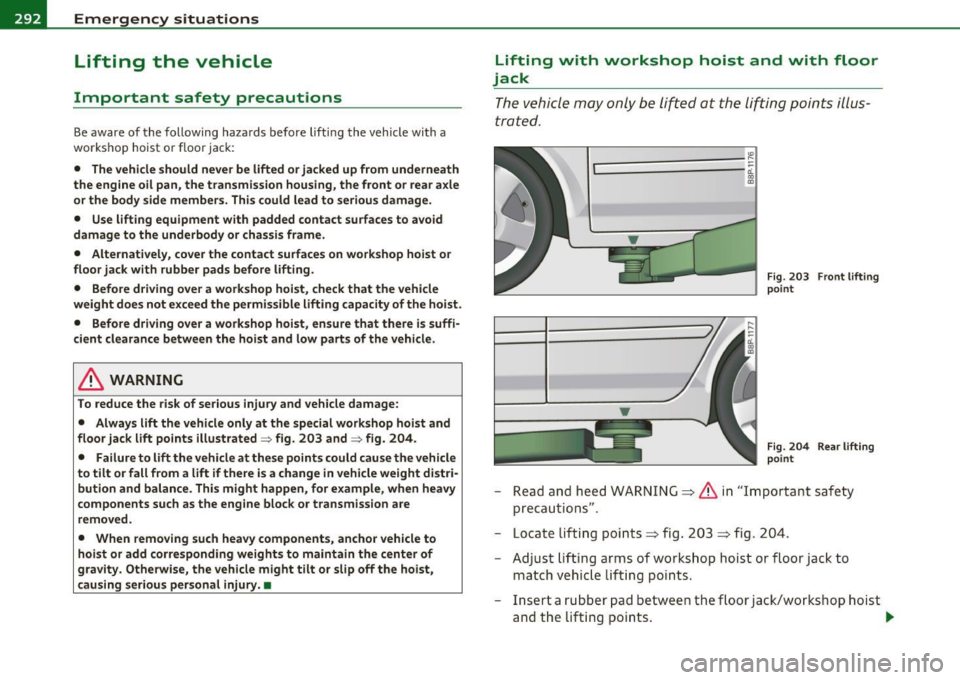
The vehicle may only be lifted at the lifting points illus
trated.
-L==-=--=--=--=--=-----_-_- __,--~ cf..
,,
ex, m
Fig. 203 Front lifting
point
Fig. 204 Rear lifting
point
- Read and heed WARNING=> & in "Important safety
precautions".
- Locate lifting points=> fig. 203 => fig . 204 .
- Adjust lifting arms of workshop hoist or floor jack to
match vehicle lifting points.
- Insert a rubber pad between the floor jack/workshop hoist
and the lifting points. -.,,
Page 297 of 320

________________________________________________ G ..... e_ n_e ___ ra ___ l_i_n _ f_ o ___ r_m :....:....: a ..... t ..... i...: o ..... n---- --
left door jamb . It shows the month and year of production and the
vehicle iden tifica tion n umber of your veh icle ( perfo ration) as well as
the Gross Vehicle Weight Rating (GVWR) and the Gross Axle Weight Rating (GAWR).
The high voltage warning label
is loca ted on the loc k carr ier .
The spark ignition system complies with the
Canadian standard ICES-002. •
Weights
Gross Vehicle Weight Rating
The Gross Vehicle Weight Rating (GVWR), and the Gross Axle Weight
Ra ting (GAWR) for fron t and rear are listed on a st icker on the left
door jamb.
Th e Gross Vehicle Weight Rating includes the weight of the basic
vehicle plus f ull fue l tank, oil and coo la nt, plus max im um load, which
includes passenger we ight (150 lbs/68 kg per des ignated seating
position) a nd luggage weight .
Gross Axle Weight Rating
The Gross Axle Weight Rating is the maximum load that can be
applie d at each axle of the vehicle~& .
Vehicle capacity weight
The vehicle capacity weight (max. load) is liste d either o n the driver's
side B -pillar or inside the fuel f iller flap .
Roof weight
The maximum permiss ible roof weight is 165 lb (75 kg ). The roof
we igh t is ma de up o f the weig ht of the roof rack sys tem and the
we ight of the object being transported~
page 88, "Load ing the roof
rack" .
Safety first
& WARNING
• The actual Gross Axle Weight Rating at the front and rear axles
s hould not exceed the permis sible weights, and their combination
must not exceed the Gross Vehicle We ight Rating.
• Exceeding permi ssible weight rating s can result in vehicle
damage, accidents and personal injury .
0 Note
• The vehicle capac ity we ight figu res apply when the load is distrib
uted evenly i n the vehicle (passengers and luggage). When trans
porti ng a heavy load i n the l uggage compartment, ca rry the load as
near to the rear axle as possible so that the veh icle's handling is not
impa ired.
• Do not exceed the maximum permiss ible axle loads or the
maximum gross vehicle weig ht. Always remember that the vehicle's
hand ling will be affecte d by the extra load. Therefore, adjust your
speed a ccording ly .
• Always observe loca l reg ulations. •
Dimensions
The specifications refer to the basic mo de l. Differences may occur
depend ing on the model ty pe a nd options ordered, for exam ple, tir e
sizes .
0 Note
When d riving up steep ramps, on rough roads, over c urbs, etc . it is
impo rtan t to remember that some parts of yo ur vehicl e, s uch as
spoilers or ex haust system components, may be close to the ground.
B e careful not to d amage them .•
Do-it,yourself service Technical data
Page 302 of 320
___ C_ o_n_ s _ u_m_ e_ r_ I_ n_ f_o _r_ m_ a_ t_io _ n _____________________________________________ _
Under difficult operating conditions, for example at extreme ly low
outs ide temperatu res, in very d usty reg ions, whe n tow ing a trailer
very frequently, etc ., some service work s ho ul d be performed
between the intervals specified . This app lies part icu larly to:
• oil changes, and
• cleaning or rep lacing the air fi lter .
For the sake of the environment
By regular ly maintai ning you r vehicle, yo u he lp make sure that emis
sion sta nda rds are ma inta ined, t hus m inimi zin g adve rse effects on
the environment .•
Important considerations for you and your
vehicle
T he increasing use of e lec tronics, sophisticated fuel in jection and
em ission control systems, a nd the generally increasing tec hnical
complexity of to day's automobi les, have stea dily reduced the scope
o f ma inte nance a nd repai rs wh ich can be ca rried out by veh icle
owners.
Also , safety and environmental concerns p lace very strict
limits o n the na ture of repa irs and adjustments to engi ne and trans
mission parts which an owner can perform.
M ainte nance, adjustments and repairs us ually re quire spe cial tools,
testing devices and other equipme nt available to spec ially trained
workshop pe rsonnel in order to assure p roper per formance, reli
ability and safety of the vehicle and its many systems .
Improper maintenance, ad justments and repairs can impa ir the oper
ation and reliability of you r ve hicl e and even void you r vehicle
warranty. Therefore, proof of servicing in accordance with the ma in
t enance schedule may be a c ondi tion for upholding a possib le
warranty claim made w ith in the warra nty period.
Above all, operat iona l sa fety can be a dve rsely af fec ted, crea ting
unnecessary risks for you and your passenge rs . If
in doubt about any serv ic ing, have it done by your authorized Audi
de aler or any o ther p rope rly equippe d and qua lifi ed workshop. We
strongly u rge you to give yo ur aut horized Audi dealer the opportunity
to pe rform all scheduled ma intenance an d necessary repairs . Yo ur
dealer has t he facilit ies, original parts a nd trai ned spec ia lists to keep
your vehicle runni ng proper ly.
Performing Limited maintenance yourself
Th e follow ing pages describe a lim ite d nu mber of proce dures which
can be performed on your vehicle w ith ord inary tools, sho uld the need
arise and traine d personne l be unavailable. Before pe rforming any of
these p rocedures, always tho rough ly read all of the applicable tex t
and caref ully follow the instructions g iven. A lways rigorous ly observe
t he
WARNINGS prov ided.
B efore you check anything in the engine compartment , always read
and heed all WARNINGS=>
& and=> & in "Wor king in t he engine
compartment" on
page 226 .
& WARNING
• Serious personal injury may occur as a result of improperly
performed maintenan ce, adju stments or repairs .
• Always be extremely careful when working on the vehicle.
Alway s follow commonly ac cepted safety practice s and general
common sense. Never risk personal injury.
• Do not attempt any of the maintenance, check s or repairs
described on the following pages if you are not fully familiar with
the se or other procedure s with respect to the vehicle, or are uncer
tain how to proceed.
• Do not do any work without the prop er tools and equipment.
Have the necessa ry work done by your autho rized Audi dealer or
another properly equipped and qualified workshop .
• The engine compartment of any motor vehicle is a potentially
hazardous area . Never reach into the area around or touch the
radiator fan. It is temperature controlled and can switch on
suddenly -even when the engine is off and the ignition key ha s .,_