ESP AUDI A3 2011 Owner´s Manual
[x] Cancel search | Manufacturer: AUDI, Model Year: 2011, Model line: A3, Model: AUDI A3 2011Pages: 320, PDF Size: 75.79 MB
Page 206 of 320
Trailer towingL _____________________________________________ _
ment of the tow vehicle while observing tongue load requirements
and vehicle loading considerations.
Speed
The higher the speed, the more difficult it becomes for the driver to
control the rig. Do not drive at the maximum permissible speed. Reduce your speed even more under unfavorable load, weather or
wind conditions -particularly when going downhill.
Reduce vehicle speed
immediately if the trailer shows the slightest
sign of swaying .
Do not try to stop the swaying by accelerating.
Observe speed limits . In some areas speeds for vehicles towing
trailers are lower than for regular vehicles .
Always apply brakes early . When driving downhill, shift into lower
gear to use the engine braking effect to slow down the vehicle. Use of
the brakes alone can cause them to overheat and fail.
Coolant temperature
The coolant temperature gauge~ page 9 must be observed care
fully. If the needle moves close to the upper end of the scale, reduce
speed immediately and/or switch off the air conditioner .
If the coolant temperature warning light in the instrument cluster
starts flashing
-t-, pull off the road , stop and let the engine idle for
about two minutes to prevent heat build-up.
& WARNING
Anyone not properly restrained in a moving vehicle is at a much
greater risk in an accident. Never let anyone ride in your car who is
not properly wearing the restraints provided by Audi. •
Trailer towing tips
Important to know
-------------
Your vehicle handles differently when towing a trailer because of the
additional weight and weight distribution. Safety, performance and
economy will greatly depend on how carefully you load your trailer
and operate your rig.
Before you actually tow your trailer, practice turning, stopping and
backing up in an area away from traffic. Keep practicing until you have
completely become familiar with the way your vehicle-trailer combi
nation behaves and responds.
Backing up is difficult and requires practice. Backing up with a trailer
generally requires steering action opposite of that when backing up
your vehicle without a trailer.
Maintain a greater distance between your vehicle and the one in front
of you. You will need more room to stop.
To compensate for the trailer, you will need a larger than normal
turning radius .
When passing, remember that you cannot accelerate as fast as you normally would because of the added load. Make sure you have
enough room to pass. After passing, allow plenty of room for your
trailer before changing lanes again.
Avoid jerky starts, sharp turns or rapid lane changes.
[I] Tips
• Do not tow a trailer during the break-in period of your vehicle .
• If you tow a trailer, your Audi may require more frequent mainte
nance due to the extra load~
page 299. •
Page 207 of 320
Parking on a slope
Do not park with a trailer on a slope. If it cannot be
avoided, do so only after doing the following:
When parking:
-Apply the foot brake.
- Have someone place chocks under both the vehicle and the
trailer wheels.
- With chocks in place, slowly release the brakes until wheel
blocks absorb the load.
- Turn the wheels towards the curb.
- Apply the parking brake.
- Place an automatic transmission in
P, respectively a
manual transmission in first or reverse gear.
When restarting after parking:
- Start the engine .
- Shift transmission into gear .
- Release the parking brake and slowly pull out and away from the wheel blocks .
- Stop and have someone retrieve the wheel blocks.
[I] Tips
If you move the selector lever of the automatic transmiss ion to P
before applying the parking brake and before blocking the wheels,
you may have to use more force later to move the leve r out of the
P
position. •
Controls and equip ment Safety first Vehicle operation
Vehicle care Do-it-yourself service Technical data
Page 212 of 320
lffl!l,.___C_ le_ a_n_ i _n_ g=- a_ n_d__, p_ ro_ t_e _c_ t_ i_ o _ n ___________________________________________ _
Dirt and marks on the trim str ips should be removed with a pH
balanced
cl eani ng agen t (d o no t use a chr ome cleaner). Au thori ze d
Audi dealers carry cleaning products w hich have bee n tested fo r use
on yo ur vehicle an d are not harmful to the environment.
T o avoid co rrosion on the exte rio r trim s trips, o nly a pH-b alanced
so lution should be used for the windshield washer.
& WARNING
Always read and heed all WARNINGS and other information
~ page 206 . •
Plastic and vinyl
P lastic nee ds special care.
Use a clean, damp cloth or s ponge to remove d ust and light surface
dirt . For other soil, use a lukewarm all-purpose cleaning solution or a
m ild saddle soap fo r viny l tr im . Remove water spots and traces o f
soap with a clean, damp cloth or sponge. Use a clean, soft cloth to rub
dry.
Grease , tar or oi l stains can be removed with a clean cloth o r sponge
soa ke d wi th all- pur pose cleaner or wi th a so lvent des igned especially
to clean v inyl.
Occas ionally app ly a colorless v inyl or leather p reservative to retain
t he m ateria l's luster and p liabili ty.
& WARNING
Always read and heed all WARNINGS and other information
~page 206 . •
Aluminum trim
Use on ly neutral-pH products to remove spots and depos its from
alum inum su rfaces. Chro m e care produ cts an d alka line cle aners will
attack aluminum surfaces and ca n damage them over t ime .
& WARNING
Always read and heed all WARNINGS and other information
~page 206 . •
Touch-up paint
M inor paint damages should be touched up immedia tely.
- Use e ither a touch-up paint st ick o r spray p ain t to cover
minor scratches a nd nicks.
Your author ized A udi d ea le r has touch- up paint fo r minor scratches
and stone ch ips. Sc ra t ch es should be touched up soon afte r they
occur to preve nt corros ion .
If a s pot start s to ru st, however, a sim ple touch-up job will not be
enoug h. T he affected surface must be sanded smooth and coated
w it h an an ti- rus t pr ime r before the pai nte d finish can be restore d.
Th e number fo r the o rigina l veh icle pain t can be found o n the vehicle
ide ntificat io n label ~
page 294.
& WARNING
Always read and heed all WARNINGS and other information
~page 206 . •
Page 217 of 320
Cleaning and protection -
---------------=---------=----
Appli es to veh icles : with n atural leathe r
Natural leather
Audi makes great efforts to maintain the properties,
na tural look and feel of interior leather .
General
We offer many different types of leather on our vehicles . Most are
different types of nappa leather, which has a smooth s urface and
comes in various colors.
Th e intensity of the color determines the visual cha racter istics and
appearance .
If the surface of the leat her has a typical natural look,
then the leather is a nappa leather that has been left in a relatively
natura l condition. This leathe r offers pa rticu la rly good comfo rt and
breathes wel l. Fine veins, closed gra ins, insect b ites, sk in fo lds, and
s u btl e var iations in co lor remai n visible . These c harac ter istics demon
strate that the mater ial is natural.
N atural nappa leather is not covered by a color fin ish . It is the refore
more sensitive to soiling and wea r, which is something you need to
consider if children, animals or other factors might prove to be partic
ular ly hard on the leather .
By contrast, leather types that are covered by a colored fin ish layer
are more dur able. This h as a pos it ive e ffect on t he leather 's resist ance
to wear and so iling in daily use . On the other hand, the typical charac
t eris tics of na tura l leather are ba rely o r not app aren t. H oweve r, this
does not mean that the leather itself is of inferior quality.
Care and handling
Because of the exclusive nature of the types of leather that Audi uses
and the ir un ique properties (such as sensitivi ty to oils, gre ase, soiling,
etc.), you will need to be somewhat careful with these leathe rs, a nd
a ce rtain type of care is req uired. For example, dark clo thing mate
r ials can discolor leather seats (especially if such clothing is damp and
was not dyed cor rect ly). Dust and dirt particles in pores, folds, and
seams can have a n ab rasive effect and ca n damage the leathe r
surface as well as weaken seams.
Safety first
The leather should be cleaned regularly as needed . After having been
used for a rela tively long time, yo ur leat her seats w ill acq uire a rich
aged fi nish. This is a characteristic of natural leather and a s ign of
true quality .
I n orde r to maintain the va lue of this nat ural p rodu ct over t he life of
your vehicle, you should fo llow the recommendations be low:
0 Note
• To keep your leather from b leach ing out, do not allow it to be
exposed to b right s unl igh t fo r long pe riod s of time. If yo u have to
leave t he veh icle parked outside for long periods, cover the leather to
protect it from direct exposure to sunlight.
• Sharp objects on cloth ing, such as zippers, rivets or sharp pieces
on belts can le ave pe rm an ent sc ratches o r scrape mar ks on the
surface of the leather.
[I] Tips
• After each t ime you clean the leather and at regular intervals, use
a leathe r preservat ive creme that con tains UV -bloc ke rs and that
works into the leather. This creme will nourish and mo istur ize the
leather, helping it to b reathe and s tay supp le . It also he lps to build up
a p rotect ive coa ting on the surface .
• C lean the leather every 2 -3 months, a nd clean any areas that get
soiled .
• Remove fresh marks made by ballpoint pens, ink, lipstick, shoe
polish, etc . as soon as poss ible.
• P reserve t he colo r of t he lea ther as needed by us ing a specia l
co lored leather care creme to touch up areas of uneven color. •
Vehicle care Technical data
Page 218 of 320
-~_C_ le_ a_n_ i_ n_ g=- a_ n_d___. p_ ro_ t_e _c_ t_ i_o _n ___________________________________________ _
Applies to vehicles : w ith natural leather
Cleaning and caring for leather upholstery
and trim
Natural leather requires special care and attention.
Normal cleaning
-Clean so iled areas with a slightly moistened cotton or
woolen cloth .
More stubborn dirt
- More stubborn dirt can be removed using a cloth satu
rated with a mild soap solution (2 tablespoons mild liquid
soap).
- Never allow the soap solution to saturate the leather, and
make certain that no water soaks into the seams.
-Wipe off the soap solution with a soft, dry cloth.
Cleaning spots
- Remove fresh water-based spots (such as coffee, tea,
juices, blood) with an absorbent cloth or paper towel.
- Remove fresh
grease or oil-based spots (such as butter,
mayonnaise, chocolate) with an absorbent cloth or paper
towel, or use the cleaner from the leather care kit if the
spot has not yet penetrated into the surface of the
leather.
- Use an oil/grease dissolving spray, if
oil/grease spots
have dried on .
-Remove specific kinds of spots (ballpoint pen, felt marker,
fingernail polish, water-based paint, shoe polish, etc .)
with a spot remover specifically formulated for leather.
Leather care
- Every half year use an approved leather care product
(available from your authorized Audi dealer) to care for
the leather.
- Apply the product very sparingly .
- Wipe it off with a damp cloth .
If you have any questions about cleaning and caring for the leather in
your vehicle, it is best to contact your author ized Audi dealer, who will
be glad to help you and tell you about our fu ll range of leather care
products, such as:
• Leather cleaning and care kit
• Creams to care for colored leather
• Spot removers for ba llpoint pens, shoe polish, etc.
• Oil/grease dissolving spray
• New and upcoming products .
& WARNING
Always read and heed all WARNINGS and other information
~page 206.
0 Note
• Never use chemical so lvents (e.g. lighterfluid, turpentine), waxes,
shoe po lish or simi lar products on the leather surfaces in your Aud i.
• To avoid damage, hav e stubborn stains removed by a commercial
cleaning specialist .•
Page 220 of 320

-~_C_ le_ a_n_ i_ n_ g=- a_ n_d___. p_ ro_ t_e _c_ t_ i_o _n ___________________________________________ _
Engine compartment
Be especially careful when cleaning the engine compa rt
men t.
Always switch off the ignition before cleaning the engine=:>& .
Plenum panel
Remove leaves from the plenum panel in front of the win dshi eld
unde r th e eng ine hood . T hi s prevents the water d rain holes from
becoming b locked, and it prevents debris from entering the vehicle
inter io r th rough the heat ing and vent ilation ducts .
Corrosion protection
The eng ine compartment and transmission have been cor rosion
protected at the factory.
Good ant i-cor rosion treatment is very impo rtant , pa rtic ular ly in the
w inter . If the vehicle is frequently driven on sa lt treated roads, the
en tire eng ine compar tment and plenum p anel sho uld be thoroug hly
cleaned at the end of winter and retreated to prevent salt damage. At
t he same t ime, the underside of the vehi cle should be washed as well.
If the e ng ine compartment is clea ned at any t ime with grease
removing so lutions
5>, or i f you have the engine washed , the anti
co rros io n treatment is a lmost a lways removed as w ell.
It is t herefore
essential to have a long-last ing corrosion p rotect ion reapplied to all
surfa ces, seams, jo ints and compo nents in the engi ne co mpa rt ment .
& WARNING
Be aware: The engine compartment of any motor vehicle is a
potentially hazardous area .
• Before working in the engine compartment, be sur e to read the
information =:>
page 218.
S) Use on ly th e co rr ect clean ing so lut ions. Never use gaso line or diese l fuel.
& WARNING (c on tinued )
• Before reaching into the front plenum panel , alway s remove
the ignition key. Otherwise, the windshield wiper system could unintentionally be switched on , possibly causing personal injury
from the moving wiper linkage.
• Never reach into the area around or touch the radiator fan. The
auxiliary fan is temperature controlled and can switch on suddenly
· ev en when the ignition is off.
• Do not wash, wax or dry the engine with th e engine running.
Moving or hot pa rts could injure you.
• Do not clean the underside of the chass is, fenders, wheel
covers, or other hard to reach part s without protecting your hands
and arm s. You may cut yourself on sharp-edged metal parts.
• Always read and heed all WARNINGS and other information
=:> page 206. •
Page 222 of 320
Fuel supply and filling your fuel tank
Blend of gasoline and MTBE
• Anti-knock index must be 87 AKI or higher.
• Blend must contain not more than 15% MTBE.
Seasonally adjusted gasoline
Many gasoline grades are blended to perform especially well fo r
winter or summer driving. During seasonal change-over, we suggest
that you fill up at busy gas stat ions where the seasonal adjustment is
more likely to be made in time.
0 Note
• Methano l fuels which do not meet these requirements may cause
corrosion and damage to plastic and rubber components in the fue l
system .
• Do not use fuels that fail to meet the specified criteria in this
chapter .
• If you are unab le to determine whether or not a particu lar fuel
blend meets the spec ifications, ask your serv ice station or its fuel
supplier.
• Do not use fuel for which the contents cannot be identified.
• Fuel system damage and performance problems resulting from
the use of fuels different from those specified are not the responsi
bility of Aud i and are not covered under the New Vehicle or the Em is
sion Control System Warranties.
• If you experience a loss of fuel economy or driveab ility and perfor
mance problems due to the use of one of these fuel blends, we
recommend that you switch to unblended fuel.•
Gasoline additives
A major concern among many auto manufacturers is carbon deposit
build-up caused by the type of gasoline you use. Although gasoline grades differ from one manufacturer to another,
they have certain things
in common. All gaso line g rades contain
substances that can cause deposits to collect on v ital engine parts,
such as fuel injectors and intake valves. A lthough most gasoline
brands include additives to keep eng ine and fuel systems clean, they
are not equally effective.
Audi recommends using TOP TIER Detergent Gasoline. For more
information on TOP TIER Detergent Gasoline, please go to the officia l
webs ite (www.toptiergas.com).
After an extended period of using inadequate fuels, built-up carbon
deposits can rob your engine of peak performance.
0 Note
Damage or malfunction due to poor fuel quality is not covered by the
Audi New Vehicle Limited Warranty. •
Applies to veh icles: wit h diese l eng ine
Diesel fuel
Always use ULSD (Ultra Low Sulfur Diesel) sulfur content
15 ppm or less.
Th e ULSD (Ultra Low Sulfur Diesel) meets the ASTM-D -975 (grade 2).
Diesel fuel with a higher concentration than ULSD-Diesel No. 2
ASTM D975 and Bio-diesel with a higher concentration than S
%
like Bll, B20 or BlOO are strictly prohibited.
Service station fuel pumps are labeled with the correct fuel informa
tion for easy recognition by the user. If the diesel fuel pump is not
labeled ask the station operator what fuel is being dispensed before
filling up your vehicle.
Service stations offering diesel fuel are generally located on truck
routes or major highways . D irectories of diesel fuel stat ions are
usually available at diesel fuel stations.
Page 225 of 320
________________________________ _:_F..=u :.:e :.: l:....: s:..: u=.!::.!: PP :..:l:!.y .....:a=- n :....:..= d:.... f:....: i..::. ll .:..i.:..n -=g ~ y_o _u_ r __ fu_ e_l _t _a _n_ k __ _
To avoid fuel s pillin g or evapo ra ti ng from t he f uel tank a lways clos e
f ue l fi ller ca p p rope rl y and compl ete ly . A n imp rop erly close d f uel
f iller cap may also ca use a message in t he driver information sys tem
or ca use the MIL lamp =>
page 20 to come on.
& WARNING
Improper refueling or handling of fuel can cause fire, explosion
and severe burns .
• Fuel is highly flammable and can cause severe burns and other
injuries.
• Failure to shut the engine off while refueling and/or to insert
the pump nozzle fully into the fuel filler neck could cause fuel to
spray out of filler neck or to overflow. Fuel spray and overflowing
fuel can cause a fire.
• Never use a cellular telephone while refueling. The electromag
netic radiation can cause sparks that can ignite fuel vapors and
cause a fire.
• Never get back into your vehicle while refueling. If in excep
tional circumstances you must get back
in your vehicle while refu
eling, make certain that you close the door and touch metal to
discharge static electricity before touching the filler nozzle again.
Static electricity can cause sparks that can ignite fuel vapors
released during refueling .
• Never smoke o r have an open flame anywhere
in or near your
vehicle when refueling or filling a portable fuel container .
• For your safety , we strongly recommend that you do not travel
with a portable fuel container in your vehicle . The container, full
or empty may leak and could cause a fire , especially
in a crash.
• If, under exceptional circumstances, you must transport a
portable fuel container , please observe the following:
- Never fill a portable fuel container while it is anywhere in or
on the vehicle (for example, in the luggage compartment, or
on the trunk ). Static electricity can build up while filling and
can ignite fuel vapors causing a fire.
Safety first
& WARNING (co ntinued )
-Alw ays place a portable fuel container on the ground before
filling .
- Always keep the filler nozzle completel y inside the portable
container before and during filling .
- If filling a portable container made of metal, the filler nozzle
must always be in contact with the container. Th is will help
prevent static electricity from discharging and cause a fire .
- Never spill fuel inside the veh icle or luggage compartment.
Fuel vapors are highly flammable.
- Always observe local and state/provincial laws regarding the
use, storage and tran sportation of fuel containers .
- Make certain the fuel container meets industry standards
(ANSI/ ASTM F8S2-86).
(D Note
• If any f uel has spilled onto the car, it s hou ld be rem oved immed i
ately to p revent damage to the pa int.
• If the fue l tank runs co mplete ly empty in a ve hicle wit h a
die sel
engine ,
the ignit io n must remai n switched on for at least 30 seconds
after refueli ng befo re st arting t he e ngine .
It may take longer than
usual for the eng ine to start, even up to a mi nute. This is because the
air m ust firs t bleed o ut of t he fuel sys tem w hen s tarting t he eng ine.
For the sake of the environment
As soon as the correctly o pera ted no zzle swi tc h es off a utomat ic all y
for t he first t ime, the tan k is full. Do not try to add mo re fuel because
fue l m ay s pill ou t. In addi tion, the ex pansion s pace in the fuel tank
w ill be fi lled - caus ing t he fue l to overf low w hen it becomes warm and
poll ute the environment. ..,
Vehicle care Technical data
Page 228 of 320

___ C_ h_ e_c _k _i _ n _g ~ a_n _d_ f_il _l_in _ g _________________________________________ _
Closing the engine hood
- Pull the hood down until the pressure from the strut is
reduced.
- Let the hood
drop down and latch in place . Do not try to
push it shut;
it may fail to engage=> &.
& WARNING
A hood that is not completely latched could fly up and block your
view while driving.
• When you close the engine hood, check it to make sure the
safety catch has properly engaged. The hood should be flush with
the surrounding vehicle body parts.
• If you notice while driving that the hood is not secured prop
erly, stop at once and close it. •
Working in the engine compartment
Be especially careful whenever you work in the engine
compartment!
Whenever you must perform any work in the engine compartment,
for example checking and filling different fluids, there is a risk of
injury, burns and accidents. To prevent personal injury always
observe the following WARNINGS. The engine compartment of any
vehicle is a hazardous area!~
&
& WARNING
To help avoid injury, before you check anything under the hood :
• Turn off the engine.
• Remove the ignition key.
• Set the parking brake fully.
& WARNING (continued)
• Move selector lever of automatic transmission to "P" (Park);
put manual transmission in Neutral.
• Always let the engine cool down. Hot components will burn
skin on contact.
• To reduce the risk of being burned, never open the hood if you
see or hear steam or coolant escaping from the engine compart
ment. Wait until no steam or coolant can be seen or heard before
carefully opening the hood.
• Keep children away from the engine compartment.
• Never spill fluids on hot engine components. They can cause a
fire.
• Never touch the radiator fan. The auxiliary electric fan is
temperature controlled and can switch on suddenly.
• Never open the coolant reservoir cap when the engine is still
warm. The coolant system is pressurized and hot coolant could
spray out!
• Protect your face, hands and arm from steam or hot engine
coolant by placing a thick rag over the cap when you open the
coolant reservoir.
• If work on the fuel system or the electrical system is necessary:
-Always disconnect the battery .
- Never smoke or work near heaters or open flames. Fluids in
the engine compartment could start a fire.
- Keep an approved fire extinguisher immediately available.
• To avoid electrical shock and personal injury while the engine is
running or being started, never touch:
- Ignition cables
- Other components of the high voltage electronic ignition
system.
• If you must perform a check or repair with the engine running: .,_
Page 237 of 320
Checking and filling --------------------=------=:;______,.J VPII
You can mix the G12++ coolant additive with other additives G12+ or
Gl2. Always check with yo ur authorized Aud i dealer.
& WARNING
Before you check anything in the engine compartment, always
read and heed all WARNINGS =>
& in "W orking in the engine
co mpartment " on
page 226.
0 Note
• Before winter sets in, have the coolan t checked to see if the
coolant additive in your vehicle is sufficient to meet the clima te
conditions. This is especially important if you live in a region where
the winter is extremely cold . If necessary, increase the proportion of
coo lant additive to 60%.
• When adding coolant additive to your cooling system, remember :
- We recommend using only coolant additive
G12++ (check the
label) for your vehicle. This coolant additive is available at autho
rized Audi dealers. Other types of antifreeze can significantly
reduce corrosion protection . The resulting corrosion can cause a
loss of coolant and serious engine damage.
• Do not add any type of radiator leak sealant to your vehicle's
eng ine coolant. Adding radiator repair fluid may adversely affect the
function and performance of your cooling system and could result in
damage not covered by your New Vehicle Limited Warranty. •
Vehicle OP-eration
Checking the engine coolant level
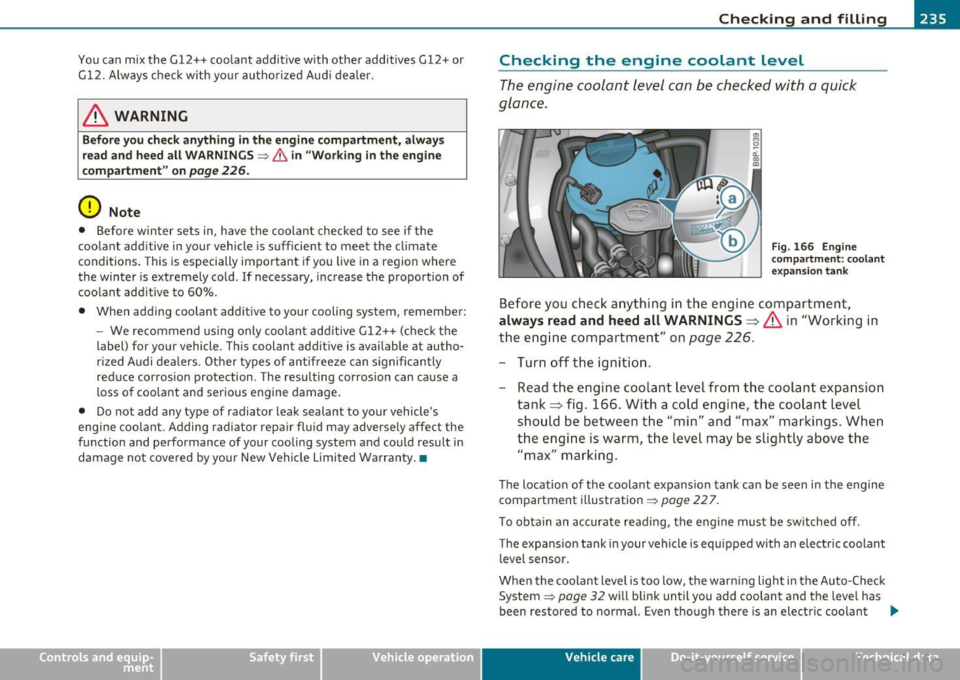
The engine coolant level can be checked with a quick
glance.
Fig. 166 Engine
co mpartm ent: cool ant
expansion tank
Before you check anything in the engine compartment,
always read and heed all WARNINGS => & in "Working in
the engine compartment" on
page 226.
- Turn off the ignition.
- Read the engine coolant level from the coolant expansion
tank=> fig. 166 . With a cold engine, the coolant level
should be between the "min" and "max" markings. When
the engine is warm, the level may be slightly above the
"max" marking .
The location of the coolant expans ion tank can be seen in the engine
compartment illustration=>
page 227.
To obtain an accurate reading, the engine must be sw itched off.
The expans ion tank in your vehicle is equipped with an electric coolant
level sensor.
When the coolant level is too low, the warn ing light in the Auto-Check
System =>
page 32 will blink until you add coolant and the level has
been restored to normal. Even though there is an elect ric coolant
~
Vehicle care Do-it-yourselt service iTechnical data