tire pressure AUDI A3 2012 Owner´s Manual
[x] Cancel search | Manufacturer: AUDI, Model Year: 2012, Model line: A3, Model: AUDI A3 2012Pages: 280, PDF Size: 70.11 MB
Page 228 of 280

226 Tires and wheels
and drive with extra care. Refit the nor
mal road wheel as soon as safely possi
ble.
- Never drive faster than the maximum
speed for which the tires on your vehicle
are rated because tires that are driven
faster than their rated speed can fail
suddenly.
- Overloading tires cause heat build-up,
sudden tire failure, including a blowout
and sudden deflation and loss of control.
- Temperature grades apply to tires that are properly inflated and not over or un
derinflated .
- For technical reasons it is not always
possible to use wheels from other vehi
cles -in some cases not even wheels
from the same vehicle model.
- If you install wheel trim discs on the ve
hicle wheels , make sure that the air flow
to the brakes is not blocked. Reduced air
flow to the brakes can them to overheat,
increasing stopping distances and caus
ing
a collision.
- Run flat tires may only be used on vehi cles that were equipped with them at the
factory. The vehicle must have a chassis designed for run flat tires and a factory
installed tire pressure monitoring sys
tem* that indicates a loss of tire pres
sure . Incorrect use of run flat tires can
lead to vehicle damage or accidents .
Check with an authorized Audi dealer or
tire specialist to see if your vehicle can be
equipped with run flat tires . If run flat
tires are used, they must be installed on
all four wheels. Mixing tire types is not
permitted .
(D Note
-For technical reasons, it is not generally
possible to use the wheel rims from oth
er vehicles. This can hold true for wheels
of the same vehicle type.
- If the spare ti re is different from the
tires that you have mounted on your ve
hicle (for example winter tires or wide
profile tires), then use the spare tire for a short period of time only and
drive with
extra care. Replace the flat tire with the
tire matching the others on your vehicle
as soon as possible.
- If you put different wheels and tires on
your vehicle (e .g. winter wheels and
tires), you must be certain that the
wheels and tires are compatible with the
tire pressure monitoring system* . Other
wise the system will register a malfunc
tion and a fault message will be dis
played. For more information, contact
your authorized Audi dealer.
- Never drive without the valve stem cap .
The valves could get damaged .
@ For the sake of the environment
Dispose of old tires in accordance with the
local requirements.
Uniform tire quality grading
- Tread wear
- Traction AA A B C
- Temperature ABC
Quality grades can be found where applicable
on the tire side wall between tread shoulder
and maximum section width
¢ page 223,
fig. 171 .
For example: Tread wear 200, Traction AA,
Temperature A.
All passenger car tires must conform to Feder
al Safety Requirements in addition to these
grades .
Tread wear
The tread wear grade is a comparative rating
based on the wear rate of the tire when tested
under controlled conditions on a specified
government test course.
For example, a tire graded 150 would wear
one and one half (11/2) times as well on the
government course as a tire graded 100.
The relative performance of tires depends
upon the actual conditions of their use, how-
ever, and may depart significantly from the
ll-
Page 231 of 280

@ Tips
-Where snow chains are mandatory on
certain roads, this normally also applies
to vehicles with All Wheel Drive .
- If snow chains are insta lled, the tire
pressures shou ld not be stored in the tire
pressure monitoring system (TPMS).
Otherwise the system could malfunction
¢page 232.
Wheel bolts
Wheel bolts must always be tightened to the
correct torque .
The design of whee l bolts is matched to the
factory installed rims. If different rims are fit
ted, the correct wheel bolts wit h the right
length and correctly s haped bolt heads must
be used. This ensures that wheels are fitted
secure ly and that the bra ke system f unctions
cor rectly .
In certain circumstances, you may not use
wh eel bolts from a differ ent vehicle -even if it
i s the same mode l.
.&, WARNING
Improperly tig hte ned o r maint ained wheel
bol ts can become loose ca using loss of
cont ro l, a co llision and ser ious persona l in
jury.
- Always keep the wheel bolts an d the
threads in the wheel hubs clean so the
whee l bolts can tu rn easily and be pro p
er ly t ightened.
- Never grease or oil the wheel bo lts and
the threads in the w heel hubs. They can
become loose w hile driving if greased or
o iled, even if tightened to the specified
torq ue.
- Only use wheel bolts t hat belong to the
r im being installed.
- Never use different whee ls bolts on your
vehicle.
- Always maintai n the co rrect tighten ing
torq ue for the wheel bo lts t o reduce the
risk of a wheel loss. If the tightening tor-
Tire s an d wheel s 229
que of t he whee l bolts is too low, they
can loosen and come out when the vehi
cle is mov ing. If the tig htening torq ue is
too high, the wheel bolts and threads
can be damaged and the whee l can be
come loose.
(D Note
The specified torque for the whee l bolts is
90 ft lb (120 Nm) with a tolerance of± 7,4
ft lb(± 10 Nm). Torq ue whee l bolts diago
nally. After changing a whee l, the tor que
must be checked as so on as possible with a
torq ue w rench -prefe rably by an au thor
iz ed A udi de aler or qu alified workshop .
Low aspect ratio tires
Your Audi is factory -eq uipped w ith low aspect
r atio tires . These tires have been tho ro ughly
tested and been se lected specifically for your
model for their superb performance, road fee l
and handli ng u nder a var iety of driving condi
tions . Ask your au thorized Aud i dealer for
more d etails.
The low aspect ratio of these t ires is ind icated
by a numeral of
55 or less in the tire's s ize
designation . The numera l represen ts the ratio
of the t ire's sidewa ll height in relation to its
t read width exp ressed in perce ntage. Conven
tiona l tires have a he ight/w idth ratio of 60 o r
more.
The performance of low-a spect-ratio tires i s
particularly sensitive to improper inflation
pre ssure.
It is therefore important that low
aspect ratio tires are inflated to the specified
pres sure and that the inflation pressure is
regularly checked and maintained. Tire pre s
sures should be checked at least once a month and always befo re a long trip
¢ page 218, Checking tire pressure.
What you can do to avoid tire and rim
damage
Low aspect ratio tires can be damaged mo re
easily by impact w it h potholes, curbs, gul lies ..,.
•
•
Page 232 of 280

230 Tire s and wheel s
or ridges on the road, part icu larly if the tire is
u nderinflated.
I n o rder to m inim ize the o ccurrence of impact
damage to the t ires of your vehicle, we recom
mend that you observe the following precau
tions:
- Always maintain recommended infla tion
pressures. Check your t ire pressure every
2,000 miles (3,000
km) and add air if neces
sary .
- Drive carefu lly on roads with potholes, deep
gullies or ridges. The impact from driving
t h rough or over such obstacles can damage
your tires. Impact with a curb may also cause damage to your tires.
- After any impact, immediately inspect your
tires or have them inspected by the nearest
authorized Aud i dealer. Replace a damaged
t ire as soon as possible .
- Inspect your t ires every 2,000 miles (3,000
km) for damage and wear . Damage is not al
ways easy to see . Damage can lead to loss of
air and underinflation, wh ich could eventu
ally cause t ire failure . If you be lieve that a
t ire may have been damaged, replace the
t ir e as soon as possible.
- T hese tires may wea r mo re quick ly than oth
ers.
- Please a lso remember that, wh ile these t ires
deliver respons ive handling, they may ride
l ess comfortably and make mo re no ise than
other choices.
Reduced performance in winter /co ld
sea son condit ion s
All ti res a re des igned for certa in pu rposes.
The low aspect ratio, ultra high performance
tires originally installed on your vehicle are in
tended for max imum dry and wet road per
formance and handling. They are not suitable
for cold, snowy or icy weather condit ions. If
you dr ive under those circumstances, you
should equip your vehicle with all -season or
winter tires, which offer better traction under
those cond it ions. We suggest you use the rec
ommended snow or all-season tires specified
fo r your vehi cle, or their eq uivalent. Refer to
q page 22 7 for more detailed infor
mation regarding winter tires.
Tire pressure monitoring system
ill General notes
Applies to veh icles: w ith tire pressure monitoring system
Each tire, incl uding the spare ( if provided),
sho uld be checked monthly when co ld and in
flated to the inflation pressure recommended by the veh icle manufacturer on the veh icle
placard or tire inflation pressure label. (If your
vehicle has tires of a different size than the s ize indicated on the vehicle placard or tire in
flat ion p ressure labe l, you should dete rmine
the p roper t ire infla tion p ress ure fo r those
t i res.)
As an added safety feature, your ve hicle has
been equipped with a tire pressure mon itoring
system ( TPMS) tha t illum ina tes a low ti re
pressure tel ltale when one or more of your
tires is significant ly under-inflated . Acco rding
l y, when the low tire pressure te lltale i llumi
nates, you should stop and check your tires as
soon as possib le, and inflate them to the
proper pressure. Driving on a sign ificantly un
der- inflated t ire causes the tire to overheat
and can lead to tire fa ilure . Under-inflation al
so reduces fuel effic iency and tire tread life,
and may affect the vehicle 's handling and
stopp ing ability.
Please note that the TPMS is not a substitute
for proper tire ma intenance, and it is the driv
er's respons ibility to maintain co rrect tire
pressure, even if under-inflation has not
reached the leve l to tr igger illum inat ion of the
T PMS low tire pressu re tellta le .
You r vehicle has also been equipped with a
T PMS ma lf un ction indicator to ind icate when
the sys tem is not operating properly. The
T PMS ma lf u nction indicator is combined w ith
t h e low tire pressure te lltale. When the sys
tem detects a malfunction, the telltale will
flash for approximately one min ute and then ..,_
Page 233 of 280

remain continuously illuminated. This se
quence will continue upon subsequent vehicle
start-ups as long as the malfunction exists.
When the malfunction indicator is illuminat
ed, the system may not be able to detect or
signal low tire pressure as intended . TPMS
malfunct ions may occur for a variety of rea
sons, including the installation of replace
ment or alternate tires or wheels on the vehi
cle that prevent the TPMS from functioning
properly . Always check the TPMS malfunction
tellta le after replacing one or more tires or
wheels on your vehicle to ensure that the re
placement or alternate tires and wheels allow
the TPMS to continue to function properly.
Tire pressure indicator appears
Appl ies to vehicles: with tire pressur e monitoring sys te m
The tire pressure indicator in the instrument
cluster informs you if the tire pressure is too
low or if there is a system malfunction.
Fig. 172 Display : underinflation warning
Fig. 173 Display: System malfunction
Using the ABS sensors, the tire pressure moni
toring system compares the tire tread circum
ference and vibration characteristics of the in
dividual tires. If the pressure decreases in one
or more tires, this is indicated in the instru
ment cluster with a warning symbol
ti] and a
Tires and wheels 231
message r=!) fig. 172. The driver message in the
display goes out after 5 seconds. The driver
message can be displayed again by pressing
the
ICHECKI button @¢ page 10, fig . 3 . If on
ly one tire is affected, the display will indicate
its position .
The tire pressure monitoring must be reset in
the menu display each time the pressures are
adjusted (e .g. when switching between parti
al and full load pressure) or after changing or
replacing a tire on your vehicle¢
page 232.
You can find the recommended tire pressures
for your vehicle on the label on the driver's
door pillar¢
page 216.
Tire tread circumference and vibration charac
teristics can change and cause a tire pressure
warning if:
- the tire pressure in one or more tires is too
low,
- the tire has structural damage,
- the tire pressure was changed, wheels rotat- ed or replaced but the TPMS was not reset
¢page 232.
Warning symbols
ti] Loss of pressure in at least one tire¢&.
Check the tire or tires and replace or repair if
necessary. The indicator light
ti] in the instru
ment cluster also illuminates
¢page 13.
Check/correct the pressures of all four tires
and reset TPMS in the menu display .
11@1&1 (Tire Pressure Monitoring System) Tire
pressure! System malfunction . Ifll@IS, ap
pears after switching the ignition on or while
driving ¢
fig. 173 and the indicator light ti] in
the instrument cluster blinks for approx i
mately one minute and then stays on, there is
a system malfunction. See your autho rized
Audi dealer as soon as possible.
A WARNING
-If the tire pressure indicator appears in
the instrument cluster display, one or
more of your tires is significantly under
inflated. Reduce your speed immediately
and avoid any hard steering or braking ..,.
Page 234 of 280

232 Tires and wheels
maneuvers. Stop as soon as possible and
check the tires and their pressures. In
flate the tire pressure to the proper pres
sure as indicated on the vehicle's tire
pressure label ¢
page 216. Driving on a
significantly under-inf lated tire causes
the tire to overheat and can lead to tire
failure. Under-inflation also is likely to
impair the vehicle's handling and stop
ping ability.
- T he driver is responsible for maintain ing
the correct tire pressures. You must
check the tire pressures regularly.
- Under certain cond itions (such as a spor
ty driving style, winter conditions or un
paved roads), the pressure monitor indi
cator may be delayed.
- Ask your authorized Audi dealer if run
flat tires may be used on your vehicle .
Your vehicle registration becomes invalid
if you use these tires when not permit
ted. Damage to your veh icle or acc idents
could also result .
(D Tips
- The tire pressure monitoring system
stops working when there is an ESP/ABS malfunction .
- Using snow chains may result in a system
malfunction.
- Tires with the identification "AO" or "RO"
have been specially matched with your
Audi. We recommend using only these
tires because they meet the highest
standards regarding safety and driving
characteristics when used correctly. Your
a uthorized Audi dea ler will g ladly pro
v ide you w ith more information.
Reset tire pressure monitoring system
(Stepl)
Applies to veh icles: w ith tire pressure monitoring system
If the tire pressure is adjusted, wheels ore ro
tated or changed, the TPMS must be reset in
the menu display.
----- ®
Fig. 174 Wipe r lever: Contro ls fo r the menu d isplay
Fig. 175 Disp lay: S ta rt m enu
I Rese t I button @ and rocker switch @
¢ fig. 17 4 functions:
To open the menu
" Press the I Reset ! button @ unt il the menu
disp lay¢
fig. 175 appears
Selections and settings
" Press the rocker switch @ to reach a menu
d isp lay. The switch is operated the same as
the display (up/down) .
Entering and confirming
" Press the I Reset I button @.
Returning to the Start menu
" Press the I Rese t I button longer than 2 sec
onds to return from any menu level to the
Start menu.
Page 235 of 280

@ Tips
-Before resetting the TPMS, the current
pressures of
all four tires must corre
spond t o the specified va lues. Adjust the
tire pressu re and reset the pressure in
the tire pressure mon itor ing system ac
cord ing to the load yo u are carry ing
~pag e
216.
- Do not store the tire pressures if snow
cha ins a re installed. Otherw ise the sys
tem could malfunction.
Reset tire pressure monitoring system
(Step2}
Applies to vehicles: with tire pressure monitoring system
Fig. 1 76 Display: Tire pressure
Fig. 1 77 Display: Tire pressure
I Reset ! button @ and rock e r swit ch @
~ page 232, fig . 17 4 func tions:
Storing tire pressures
.. Turn on the ignition .
.. Se lect the menu:
> Adjusting * > Tire pres-
sure
> Store .
Entering and confirming
.. Se lect the menu : Store now
.. Press the
I Reset I button @ .
.. Se lect the menu : Confirm
Tires and wheels 233
.. Press the I Reset I button @.
Returning to the Start menu
.. Press the I Reset ! button longer than 2 sec
onds to re tur n from any menu level to the
S ta rt men u.
{!) Tips
Befo re resetting the TPMS, t he cur rent
p re ssu res of
all four tires mus t corres pond
to the speci fied val ues. Adjus t the tire
pr essure and rese t the pressure in the ti re
press ure monitoring system acco rding to
the load you are carry ing
~ page 216 .
Page 237 of 280

You will find the compact spare wheel under
the floor in the luggage compartment . It is
secured w ith a large nut.
Using the compact spare wheel
The compact spa re wheel is only intended for
emergenc ies until you can reach a repair shop .
Replace i t as quickly as possible with a normal
wheel.
There are some restrictions on the use of the
compact spare wheel~ &. . The compact spare
wheel has been developed especially for your
type of vehicle . It must not be exchanged for
the compact spare whee l from another type of
vehicle.
Normal summer or winter tires must not be
installed on the compact spare whee l rim.
Snow chains
For technica l reasons, the use of snow chains
on the compact spare wheel is
n ot permitted .
If you do have to dr ive w ith snow cha ins and
have a t ire failure on a
front wheel, insta ll the
spa re wheel in place of a rear wheel. Install
the snow chains on the rear wheel and use it
to replace the defective front whee l.
Using the spare wheel
The spare wheel is only intended for emergen
cies until you can reach a repair shop. Replace
it as qu ickly as possib le with a no rmal wheel.
There are some restrict ions on the use of a
spare wheel
Q &. . The spare wheel has been
developed especially for your type of vehicle.
It m ust not be exchanged for the spare whee l
from anot her type of vehicle.
Normal summer or winter tires must not be
i nstalled on the spare wheel rim.
Snow t ires
For technical reasons, the use of snow chains
on the spare whee l is
not p erm itte d.
If you do have to drive with snow chains and
have a t ire failure on a
front wheel, insta ll the
spare wheel in place of a rear wheel. Install
What do I do now? 235
the snow chains on the rear whee l and use it
to replace the defective front wheel.
A WARNING -
A lways store jacking equipment, spare
wheel in the luggage compartment. Tight
en screw for the spare wheel secure ly. Un
der no circumstances should you store the
spa re wheel o r jack and tools unsecured in
the passenger compartment . This could
cause ser ious persona l inju ry to passen
gers in the veh icle in case of a collision .
- The compact spare tire is for temporary
use only and is so marked on the side
walls .
- Do not dr ive at speeds exceeding SO mph
(80 km/h) wi th the compact spare whee l
mounted . A lso rapid acce lerat ion, ha rd
braking and hard cornering must be
avoided to he lp prevent loss of vehicle
contro l.
- Any continuous road use of the compact
spare tire may result in tire failure, loss
of vehicle control and injury to vehicle
occupants.
- Do not put a snow chain on your compact
spare tire. Due to the smaller t ire size,
the chain will not fit properly and can
thus damage your vehicle. You cou ld also
lose the chain, as well as contro l of the
veh icle .
- If you have a flat front t ire in road condi
tions which require snow chains, first re
move the undamaged rea r whee l and
mount the compact spare wheel in its
place. Then remove the damaged front
wheel, take the snow cha ins off it and at
tach them to the whee l taken from the
rear. This wheel can now be mounted on
the front with its snow chains. Check and
adjust t ire pressure promptly .
- Never use two or more compact spare
tires at the same time.
(D Note
When using the compact spare wheel, note the fo llowing: •
•
Page 238 of 280
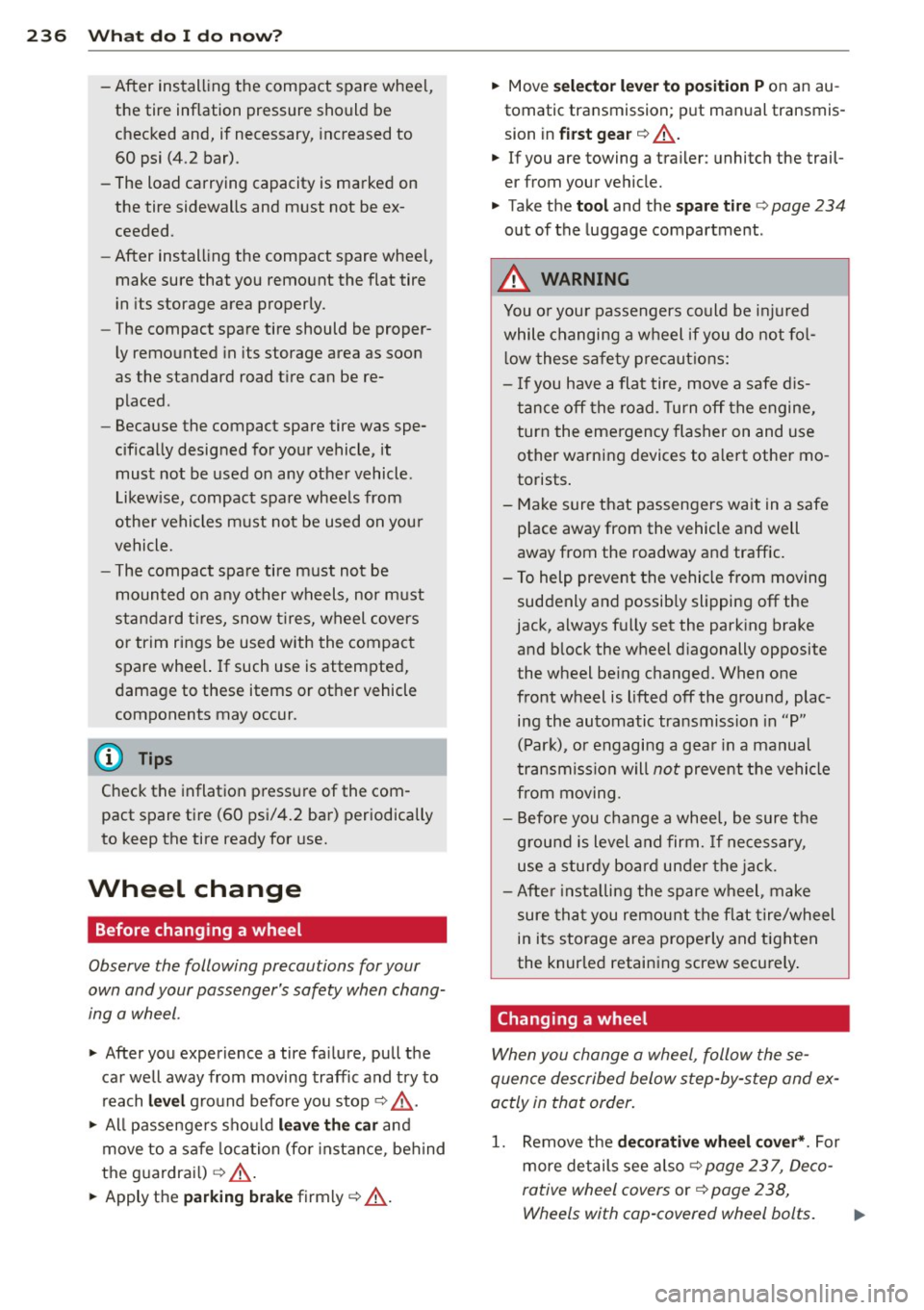
236 What do I do now?
-After installing the compact spare wheel,
the tire inflation pressure should be
checked and, if necessary, increased to
60 psi (4.2 bar).
- The load carrying capacity is marked on
the tire sidewalls and must not be ex
ceeded.
- After installing the compact spare wheel,
make sure that you remount the flat tire
in its storage area properly.
- The compact spare tire should be proper
ly remounted in its storage area as soon
as the standard road tire can be re placed .
- Because the compact spare tire was spe
cifically designed for your vehicle, it must not be used on any other vehicle .
Likewise, compact spare wheels from
other vehicles must not be used on your
vehicle.
- The compact spare tire must not be
mounted on any other wheels, nor must
standard tires, snow tires, wheel covers
or trim rings be used with the compact
spare wheel. If such use is attempted,
damage to these items or other vehicle
components may occur .
(D Tips
Check the inflation pressure of the com
pact spare tire (60 psi/4.2 bar) periodically
to keep the tire ready for use.
Wheel change
Before changing a wheel
Observe the following precautions for your
own and your passenger's safety when chang
ing a wheel .
.. After you experience a tire failure, pull the
car well away from moving traffic and try to
reach
level ground before you stop c:> ,&. .
.. All passengers should leave the car and
move to a safe location (for instance, behind
the guardrail)
c:> _&. .
.. Apply the parking brake firmly c:> _&. .
.. Move selector lever to position Pon an au
tomatic transmission ; put manual transmis
sion in
first gear c:> _&..
.. If you are towing a trailer : unhitch the trail
e r from your vehicle.
.. Take the
tool and the spare tire c:> page 234
out of the luggage compartment .
.&, WARNING
You or your passengers could be injured
while changing a wheel if you do not fol
low these safety precautions:
- If you have a flat tire, move a safe dis
tance off the road. Turn off the engine,
turn the emergency flasher on and use
other warning devices to alert other mo
torists.
- Make sure that passengers wait in a safe place away from the vehicle and well
away from the roadway and traffic .
- To help prevent the vehicle from moving suddenly and possibly slipping off the
jack, always fully set the parking brake
and block the wheel diagonally opposite
the wheel being changed. When one
front wheel is lifted off the ground, plac
ing the automatic transmission in "P"
(Park) , or engaging a gear in a manual
transmission will
not prevent the vehicle
from moving.
- Before you change a wheel, be sure the
ground is level and firm. If necessary,
use a sturdy board under the jack.
- After installing the spare wheel, make
sure that you remount the flat tire/wheel
in its storage area properly and tighten
the knurled retaining screw securely.
Changing a wheel
-
When you change a wheel, follow these
quence described below step-by-step and ex
actly in that order .
1. Remove the decorative wheel cover*. For
more details see also
c:> page 23 7, Deco
rative wheel covers
or c:> page 238,
Wheels with cap-covered wheel bolts.
Page 246 of 280
244 Fuses and bulbs
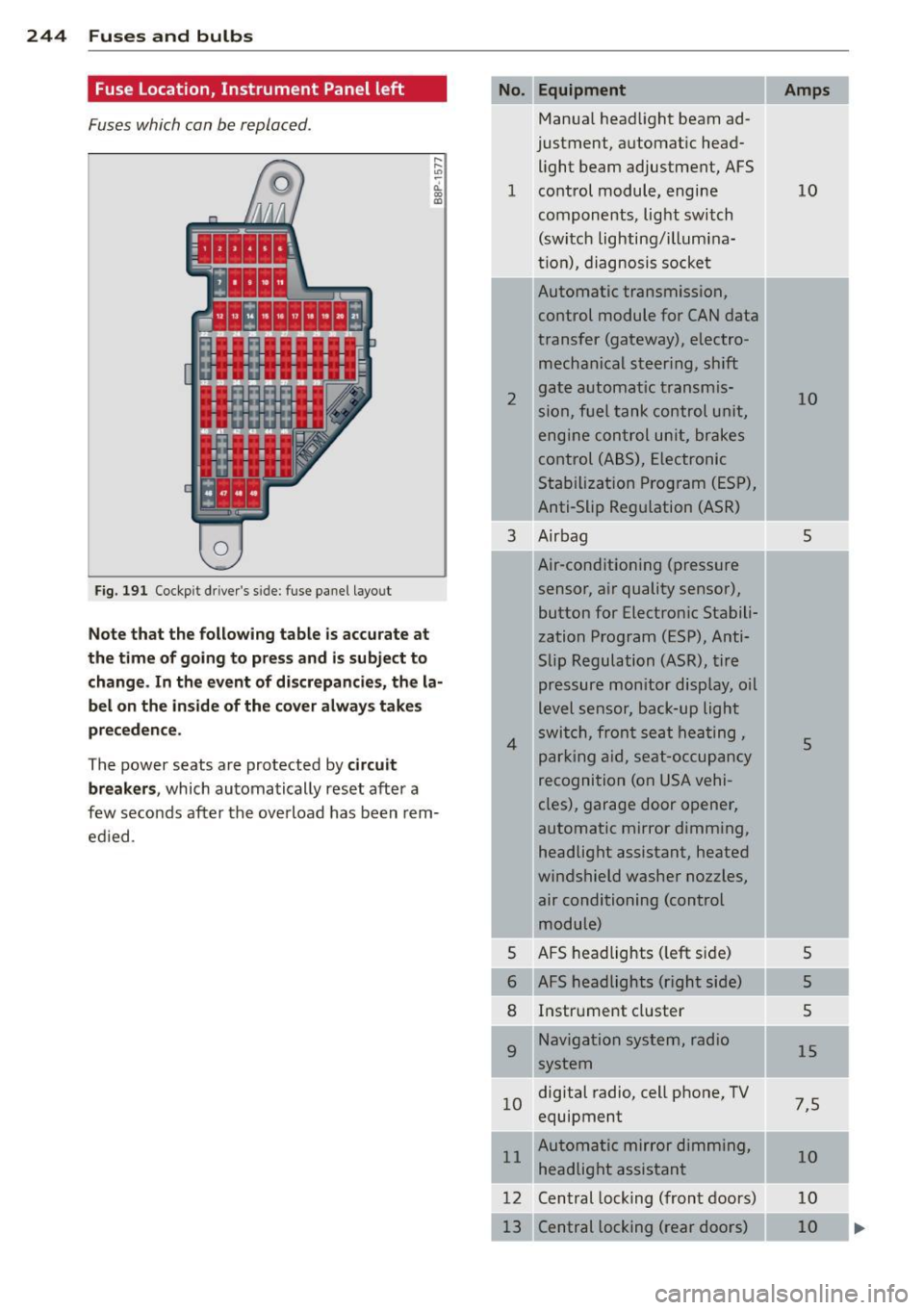
Fuse Location, Instrument Panel left
Fuses which can be replaced.
Fig. 191 Cockp it driver 's s ide: fuse pane l layout
Note that the following table is accurate at
the time of going to pr ess and i s subject to
change . In the event of d iscrepancies, the la
bel on the in side of the cover always take s
pr eceden ce .
The power seats are protected by circuit
break ers,
which automatically reset after a
few seconds after the ove rload has been rem
ed ied .
Equipment
Manua l head light beam ad
justment, a utomat ic head
light beam adjustment, AFS
1 co ntrol m odule, engine
components, light switch
(switch lighting/illumina
ti on), diagnosis socke t
2
3
4
5
6
8
9
Automatic transmission,
control module for CAN data
transfer (gateway), electro
mechanical steering, shift
gate automatic transmis
sion, fuel tank control unit,
engine control unit, brakes
control (A BS), Electronic
Stabili zation Program (ESP) ,
Anti-Slip Regulation (ASR)
Air bag
Air-conditioning (pressure
sensor, air quality sensor), button for Electronic Stabili
zation Program (ESP), Anti
Slip Regulat ion
(ASR), tire
pressure monitor display, oil
level senso r, back-up ligh t
s w itch, front se at he ati ng ,
p ark ing aid, sea t-occupancy
recognition (on USA vehi
cles), garage door opener,
automa tic mirror dimming,
headlight assistant, heated
windshield washer nozzles, air conditioning (control
module)
AFS headlights ( left si de)
AFS headlights (right side) Instr ument cluster
Navigation system, radio
system
1 0 digital
radio, cell phone, TV
equipment
11 Automatic mirror dimming,
headlight assistant
12 Central lock ing (front doors)
Central locking ( rear doors)
Amps
10
10
5
5
5
5
5
15
7 ,5
10
10
10
Page 268 of 280
26 6 Index
Changing engine oil
Chass is 201
Unde rcoat ing . ............. .. .... . 183
also refer to Aud i magnetic ride ... .... 95
Checking
Eng ine coolant level ........ .... ....
204
Checking tire pressure . ... .. .. ... ... . 218
C hi ld restra int
Danger of us ing c hild restra ints in the
front seat ... .... ..... ... .. .. .... .
123
Child restra ints
Where can I get add it iona l information
about child restra ints and their use? ..
160
Ch ild restra int system anchors ... .. ... 155
Child safety . . . . . . . . . . . . . . . . . . . 143, 148
Convertible locking retractor . . . . . . . . . 152
Important safety instructions for using
chi ld safety seats ..................
146
Important things to know when dr iving
with children ............. .... ....
143
Install ing a child restraint using the
LA TC H system ............. ... .. ...
157
M ount ing and releasing the ancho rage
hook .. .... ... .......... .. .. .. .. .
157
158
158
Tether anchors
Tether straps
Ch ild safety lock
· ............... ..... 42
Child safety seats ................... 148
Booster seats .. .......... .. .. .... . 151
Convertible child seats .... .. .. .. .. . 149
Convertible locking retractor .. .. .. ... 152
H ow do I properly install a child safety
seat in my vehicle? ........ .. .. .... .
146
Infant seats ...................... 148
Ins tall ing ... ............ .. .. .. .. . 152
LA T CH system .... ..... ... .. .. .... . 157
Safety instructions . . . . . . . . . . . . . . . . . 146
Child seats
L owe r ancho rages ........ .. .. .... .
156
Clean ing
Alcantara (synthet ic suede) ..........
186
Eng ine compartment ...... .. .. .. .. . 187
Exhaust tail pipes .................. 183
Fabrics and fabr ic coverings .. .. .... . 184
Instrumen t panel .................. 184
Inter ior
L eather .. .. ... .. ..... ... .. .. .... .
. ... ... . ...... ... ... ...
' . .
183
186
Plastic and vinyl ..... .. ..... .... . .. 181
Plastic parts ..... ... .. ..... ... .. .. 184
Safety be lts ... .. ... ....... ... .. .. 187
trim strips
Tr im strips 181
181
Cleaning and protection .. ..... ... .. .. 178
Cl imate controls . .. ................ .. 79
Additional heater . ... .......... .. .. . 85
Air distrib ution . .. ............. .... . 83
Air o utlets · · · · · · · · · · · · · · · ......... 84
Air recirculation . . .. ... ..... .... ... . 83
Air recircu lation mode (manual) . ... .. . 82
Automatic air recirculation ... .... . .. . 82
AUTO (standard setting) ........ .. .. . 81
Controls . . . . . . . . . . . . . . . . . . . . . . . . . . 80
Defrost ing/defogging ............. .. 82
Description . . . . . . . . . . . . . . . . . . . . . . . . 79
Fan ......... ... .. .............. .. 83
Key- coded setting ... .......... .. .. . 84
Recommended settings ......... .... . 79
Setting the temperatu re ........ .. .. . 82
Switching between Fa hrenhe it and Centi-
grade . ... .... .. .. .... .... ... .. .. .
83
Switching the air conditioning on and off 81
Using the climate control economically . 84
Warm and cold . .. ............. .... . 79
Clock . ... .. .... .. .. ... ..... ... .. .. . 11
Clutch overheat ing ................. . 101
Coat hooks ..... .. ............. .... . 78
Cold tire infla tio n press ure ........ .... 216
coming home ... .................. .. 48
Compartments in the door trims ... .. .. . 77
Compass mir ro r . . . . . . . . . . . . . . . . . . . . . 59
Compliance . .... .. ............. .... 262
Consumer Information. .. ..... .. 111,259
Contacting NHTSA ................. . 111
Convenience close/open feature
Windows . .... .. ............. .... .
44
Convertib le child safe ty seats ..... .. . . 149
Convertible locking retractor
At· .
c 1vatmg ... .. .. .. ... ....... ... . .
154
D t" t· eac 1va mg ... .. ............. .. .. 155
Using to secu re a child safety seat 1.52, 154
Coolant system ..................... 203
Cooling System
Expansion tank ... .. .... .... ... .. ..
204