ESP AUDI A3 2012 Owner´s Manual
[x] Cancel search | Manufacturer: AUDI, Model Year: 2012, Model line: A3, Model: AUDI A3 2012Pages: 280, PDF Size: 70.11 MB
Page 210 of 280
208 Check ing and filling
for questions about the battery -danger
of acid burns and explosion hazard!
- The battery must not be opened! Do not try to change the battery's liq uid level ,
otherwise detonating gas will escape
from the battery- explosion hazard!
- The AGM battery in the luggage com
partment cannot leak, because the elec
trolyte for th is battery is absorbed into a
spec ial glass mat . Th is leak-proof battery
must not be replace with a conventional
battery .
- Make sure the ventilat ion hose on the
s ide of the battery is connected, other
wise fumes or battery acid can leak out .
- Battery ho lder and terminals a lways
have to be secured correctly .
- Before all work on the battery follow the
warning s below c> &. in Working on the
battery on page 208 .
Working on the battery
All work on the battery requires technical
knowledge! Be especially careful when work
ing on or near the battery!
Be fo re you check any thing in the engine com
partment, always
r e ad a nd heed all WARN
INGS
~ .&. in Working in the engine compart
ment on page 194 .
Always heed the s afety warnings , when work
i ng on the vehicle battery or the vehicle elec
tr ica l system to preve nt injury .
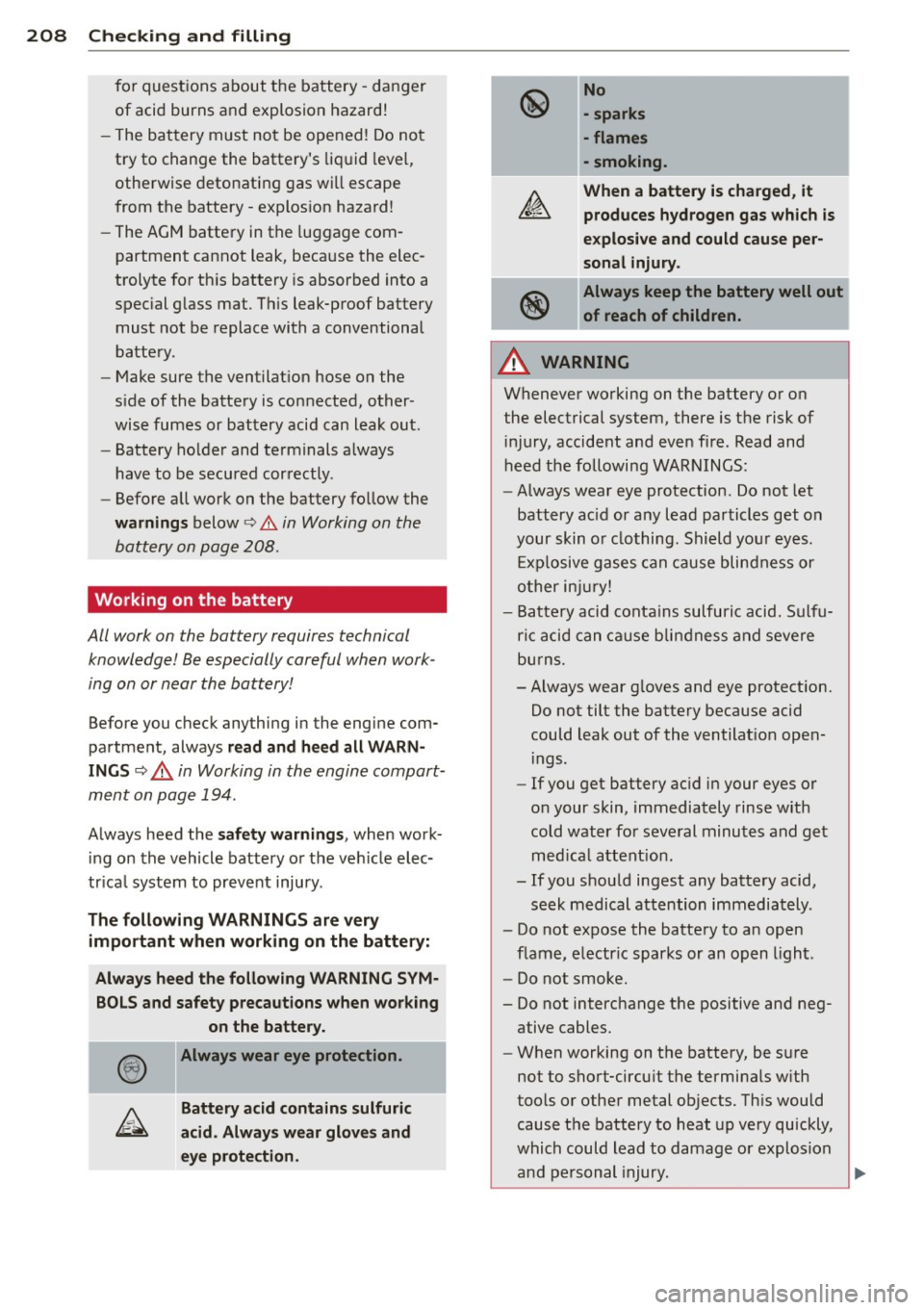
The following WARNINGS are very
important when working on the battery:
Always heed the following WARNING SYM ·
BOLS and safety precautions when working on the battery.
Always wear eye protection.
Battery acid contains sulfuric
acid . Always wear glove s and
eye prote ction . No
• sparks
• flames
- smoking.
When a battery is charged , it
produces hydrogen gas which is
e x plosive and cou ld cause per
sonal injury .
®
Always keep the battery well out
of reach of children.
A WARNING ,___
Whenever working on the battery or on
the electrical system, there is the risk of
i njury, accident and even fire . Read and
heed the following WARNINGS :
- Always wear eye protection . Do not let
battery ac id or any lead particles get on
your skin o r clothing . Shield you r eyes.
Exp losive gases can cause blindness or
o ther inju ry!
- Battery acid conta ins sulfuric acid. Sulfu
ric acid can ca use blindness and severe
bu rns.
-Always wear g loves and eye protection.
Do not tilt the battery because acid
could leak out of the ventilat ion open
ings .
- If you get battery ac id in your eyes or
on your skin, immediately rinse with
cold water for several minutes and get med ica l attent ion .
- If you shou ld ingest any battery acid,
seek medical attention immediately .
- Do not expose the batte ry to an open
flame, electr ic sparks or an open l ight.
- Do not smoke.
- Do not interchange the positive and neg-
ative cables.
- When working on the battery, be s ure
not to short-circu it the terminals w ith
too ls or othe r metal objects. Th is would
cause the battery to heat up very quickly,
which could lead to damage or explosion
-
and pe rsonal injury . ~
Page 212 of 280
![AUDI A3 2012 Owner´s Manual 210 Check ing and filling
POS IT IVE E] and NEGATI VE [:] to NEGATIVE
(j ump sta rt pins)[:].
.. Switch on the charger.
• Make sure the charging rate is not over
6 amps.
â€](/img/6/40267/w960_40267-211.png "AUDI A3 2012 Owner´s Manual 210 Check ing and filling
POS IT IVE E] and NEGATI VE [:] to NEGATIVE
(j ump sta rt pins)[:].
.. Switch on the charger.
• Make sure the charging rate is not over
6 amps.
â€")
210 Check ing and filling
POS IT IVE E] and NEGATI VE [:] to NEGATIVE
(j ump sta rt pins)[:].
.. Switch on the charger.
• Make sure the charging rate is not over
6 amps.
• Turn off the charger¢,&..
• Disconnect the charger cables.
• Connect both battery cables to the battery
i f necessary -
first plus, then minus.
The battery must not be opened!
¢ @ in Gen
eral information on page 207 .
Chargi ng the b attery
Only use chargers with a m ax im um cha rg in g
v oltage o f
14.8 V. The battery connecting ca
bles do not need to be disconnected. Do not
open the battery when charging.
Read all of the manufacturer's instructions for
the charger before charting the battery.
It is not necessary to remove the battery from
the engine compartment, and it is a lso not
necessary to disconnect the cables.
Normally, a battery should be charged at no
more than 10 percent of its rated capacity.
For example, a charging current of 4.5 amps
wo uld be used on a battery rated at 45 Ah.
Rated capacity of the battery in your veh icle is
listed on the battery housing .
The battery caps shou ld
not be opened when
cha rg ing a battery.
_& WARNING
Cha rging a battery can be dangerous.
- Never charge a frozen battery. It may ex
plode because of gas trapped in the ice .
Allow a frozen battery to thaw o ut first .
- Do not reuse batteries which we re fro
zen. They must be replaced. The battery
housing may have cracked and weakened
when the battery froze.
- Charge the battery in a we ll ventilated
area. Keep away from open f lame or elec
trical spark. Do not smoke. Hydrogen gas generated by the battery is explosive. -
To reduce the danger of exp losion, never
connect or d isconnect charger cab les
while the charger is operating.
- Fast charging a battery is dangerous and
should only be attempted by a compe
tent techn ic ian with the proper equip
ment.
- Battery acid that may sp ill dur ing charg
ing should be washed off with a solut ion
of warm water and baking soda to neu
tralize the ac id.
{[) Note
-Make sure that the gas venting hose is
always connected to the or iginal opening
on the battery s ide. Otherwise gasses or
battery acid could leak out.
- Never use a fast charger as a booster to start the engine. This will seriously dam
age sensitive electron ic components,
such as contro l units, re lays, radio, etc.,
as well as the batte ry charger.
- T he vehicle may be optionally equ ipped
w ith a gel battery, wh ich can only be
charged at a cons tant current-lim ited
voltage . To prevent damage to the bat
tery and the electronics system, a gel battery that is connected must under no
circumstances be charged with a quick
charger.
{!) Tips
- The vehicle battery must not be charged
with a standard small charger that pl ugs
into the outlet.
- Only charge the battery through the con
nections in the engine compartment.
Battery replacement
The new battery must hove the some specifi
cations as the old one.
Intelligent energy management in your vehi
cle is responsible for distributing the electri
ca l energy throughout your vehicle
¢
page 167. The intelligent energy manage-
ment system will keep the engine battery .,..
Page 214 of 280
212 Tire s and wheel s
Tires and wheels
Tires
General notes
Tires may be the least appreciated and most
abused parts of a motor vehicle .
Tires may be the least appreciated and most
abused parts of a motor vehicle . Tires are,
however, one of the most important parts of a
vehicle, particularly considering the compara
tive ly small patch of rubber on each tire that
assures that a ll-impo rtant contact between
you, your vehicle and the road.
Maintaining the correct tire pressure, mak ing
sure that your vehicle and its tires do not have
to carry mo re weight than they can safe ly han
d le, avoiding damage from road hazards and
reg ularly inspecting t ires for damage includ
ing cuts, slashes irregu la r wear and ove rall
condition are the most important things that
you can do to he lp avoid sudden tire failure in
cluding tread separation and blowouts.
Avoiding damage I f you have to drive over a curb or similar ob
stacle, drive very s low ly and as close as possi
b le at a right angle to the curb.
A lways keep chem ica ls includ ing gre ase, o il,
gasoline and b rake fluid off the ti res .
Inspect the t ires regularly for damage (cuts,
cracks or b listers, etc.). Remove any fo reign
bod ies embedded in the treads.
Storing tires Mark tires when you remove them to indicate
the direction of rotation . Th is ensures you to
be ab le to mount them correctly when you re
install t hem.
When removed, the whee ls or t ires should be
stored in a cool, d ry and preferably dark place .
Store tires in a vertical pos ition if they are not
mounted on rims, in a horizontal pos it ion if
they are mounted on rims. New tire
s
New t ires have to be broken in¢&,. .
T he tread depth of new t ires may vary, accord
ing to the type a nd make of t ire and the tread
pa tte rn .
Hidden damage
Damage to tires and r ims is ofte n not readily
vis ible . If you notice unusual v ibrat ion or the
vehicle p ulls to one side, th is may ind icate
t h at one of the t ires has been damaged . Th e
t ir es m ust be checked immed iate ly by an au
tho rized Aud i dea le r or q uali fied wor ks hop.
Unidirectional t ires
A un idirectional tire can be identified by ar
rows on the sid ewa ll, that po int in the direc
t ion the t ire is desig ned to rotate. You mus t
f ol low the specified d irection of rotation . This
is necessary so that these tires can develop
their optimum characterist ics regarding grip,
road no ise, wear and hyd rop laning resistance.
For more information ¢
page 241.
A WARNING
-New tires or tires that are old, worn or
damaged cannot provide maximum con
trol and braking ability .
-
-New tires tend to be slippery and must
be broken in . To reduce the risk of losing
control, a co llision and ser ious personal
in jur ies, d rive w ith special ca re fo r the
fi rst 350 m iles (560 km).
- Driving with worn or damaged tires can
le ad to loss of control, sudden tire fail
ure, including a blowou t and sudden de
fl ation, c rashes and seriou s personal in
juries . Have wo rn or damaged t ires re
p laced immediate ly .
- T ires age even if they are not being used
an d can fai l sudden ly, especially at high
speeds. Tires that are more than 6 years
old can only be used in an emergency
and then w ith specia l care and at low
speed.
Page 215 of 280
-Never mount used tires on yo ur vehicle if
you are not sure of their "previous histo
ry." Old used tires may have been dam
aged even though the damage cannot be
seen that can lead to sudden tire failure
and loss of vehicle control.
Glossary of tire and loading terminology
Accessory weight
means the comb ined weight (in excess of
those standard items wh ich may be rep laced)
of automa tic tra nsmission, power steering,
power br akes, power w indows, power sea ts,
radio, and heater, to the ex tent that these
items are avai lab le as factory -installed equip
ment (whether installed or not).
Aspect ratio
means the rat io of the height to the w idt h of
the tire in percent. Numbers of 55 or lower in
d icate a low sidewall fo r improved s teer ing re
sponse and better overall handling on dry
pavement.
Bead
means the pa rt of the t ire t hat is made o f
s teel wires, wrapped o r rein force d by ply cor ds
and that is shaped to fit the r im.
Bead separation
means a b reakdown of the bond between
components in the bead.
Cord
means the strands forming the plies in the
tire.
Cold tire infl ation pressure
means t he tire pressure recommended by the
vehicle manufacturer for a t ire of a designated
size that has not been dr iven for more than a
couple of miles (kilometers) at low speeds in
the three hour period before the tire pressure
i s measu red or adjusted.
Tire s an d wheel s 213
-If you notice un usua l vibration or if the
veh icle pulls to one side when driv ing, a l
ways stop as soon as it is safe to do so and check the wheels and tires for dam
age.
Curb weight
mea ns the we ight of a motor ve hicle w it h
standard equipment in cl ud ing t he maximum
capa city of fuel, o il, and coolant, ai r cond i
tion ing a nd addi tional weig ht o f optiona l
equipment .
Extra load tire
means a t ire designed to operate at higher
loads and at highe r inflat ion p ressu res tha n
th e co rresponding standard tire. Extra load
tir es my be i dent ified as "XL", "xl", "EXTRA
L O AD", or "R F" on t he sidewall.
Gross Axle Weight Rating ("GAWR ")
mea ns the load-carry ing capac ity of a s ingle
axle system, measured at the tire-ground in
te rfaces.
Gross Vehicle Weight Rating ( "GVWR ")
means the maximum total loaded we ight of
the ve hicle.
Groove
means the space between two adjacent tread
ribs.
Load rating (code )
means the maximum load tha t a t ire is rated
to carry for a given inflation press ure. Yo u
may not find this information on all tires be
ca use it is not required by law.
Maximum load rating
me ans the load r ating for a tire at the maxi
mum pe rm issi ble inf lat ion pressure for that
ti re . •
•
...
Page 216 of 280

214 Tires and wheels
Maximum loaded vehicle weight
means the sum of:
(a) Curb weight
(b) Accessory weight
(c) Vehicle capacity weight, and
(d) Production options weight
Maximum (permissible) inflation pressure
means the maximum cold inflation pressu re
to which a tire may be inflated. Also called
"maximum inflation p ressure."
Normal occupant weight
means 150 lbs. (68 kilograms) times the
number of occupants seated in the vehicle up
to the total seating capacity of your vehicle.
Occupant distribution means distribution of occupants in a vehicle .
Outer diameter means the overa ll diameter of an inf lated new
tire.
Overall width
means the linear distance between the exteri
ors of the sidewalls of an inflated tire, includ
ing e levations due to labeling, decorations, or
protective bands or ribs.
Ply
means a layer of rubber-coated parallel cords.
Production options weight
means the comb ined weight of those installed
regular production options weighing over 5
lbs . (2 .3 kg) in excess of those standard items
which they replace, not previously considered
in curb weight or accessory weight, including
heavy duty brakes, r ide leve lers, roof rack,
heavy duty battery, and specia l trim .
Radial ply tire
means a pneumatic tir e in which the p ly cords
that extend to the beads are laid at substan
tially 90 degrees to the centerline of the
tread . Recommended inflation pressure
see
~
page 213, Cold tire inflation pressure.
Reinforced tire
means a t ire designed to operate at higher
loads and at higher inflation pressures than
the corresponding standard tire . Re inforced
t ir es my be identified as "XL", "xl", "EX TRA
LOAD", or "RF" on the sidewall.
Rim
means a metal support for a tire or a t ire and
tube assembly upon which the tire beads are seated.
Rim diameter
means nom inal d iameter of the bead seat. If
you change your wheel s ize, you w ill have to
purchase new tires to match the new r im di
ameter .
Rim size designation
means rim diameter and width.
Rim width
means nominal distance between rim flanges .
Sidewall
means that portion of a tire between the
t read and bead.
Speed rating (letter code)
means the speed at which a tire is designed to
be driven for extended periods of time. The
ratings range from 93 mph (150 km/h) to
186 mph (298 km/h)
~ page 224 . You may
not find this information on all tires because
it is not requ ired by law.
The speed rating letter code, where applica
ble, is molded on the tire sidewall and indi
cates the max imum pe rmissibl e road speeds
~ A in Winter tires on page 228.
Tire pressure monitoring system*
means a system that detects when one or
more of a veh icle's tires are underinflated and
illuminates a low tire pressure warning tell
tale.
Page 218 of 280
216 Tires and wheels
Cold tire inflation pressure
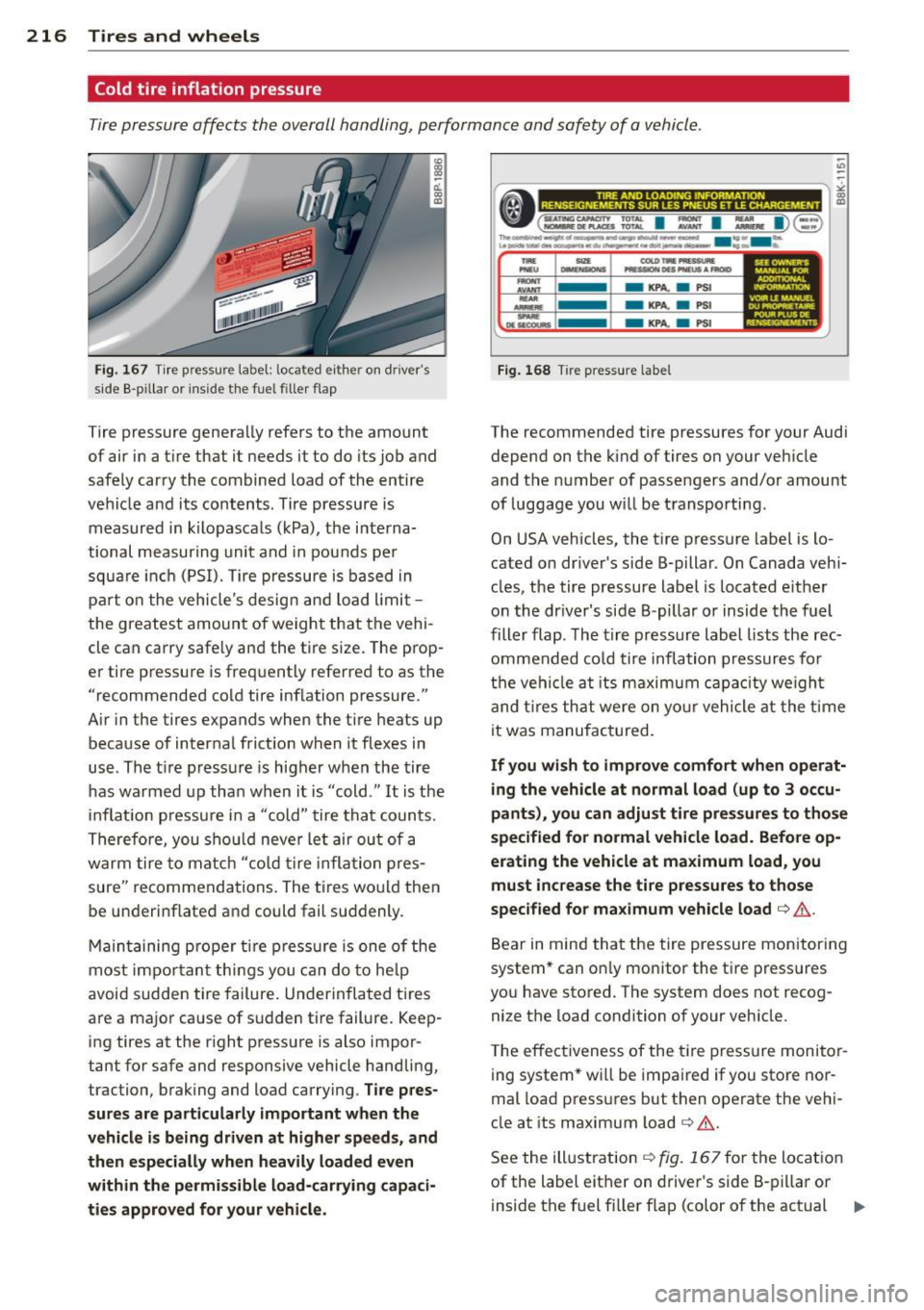
Tire pressure affects the overall handling, performance and safety of a vehicle .
Fig. 167 Tire press ure labe l: loca ted ei the r on dr iver 's
side 8-pillar or inside the fuel filler flap
Tire pressure generally refers to the amount
of air in a tire that it needs it to do its job and
safely carry the combined load of the entire
vehicle and its contents . Tire pressure is
measured in kilopascals (kPa), the interna
tional measuring unit and in pounds per
square inch (PSI). Tire pressure is based in
part on the vehicle's design and load limit
the greatest amount of weight that the vehi
cle can carry safely and the tire size. The prop
er tire pressure is frequently referred to as the
"recommended cold tire inflation pressure."
Air in the tires expands when the tire heats up
because of internal friction when it flexes in
use . The tire pressure is higher when the tire
has warmed up than when it is "cold ." It is the
inflation pressure in a "cold " tire that counts.
Therefore, you should never let air out of a
warm tire to match "cold tire inflat ion pres
sure" recommendations. The tires would then
be underinflated and could fail suddenly .
Maintaining proper tire pressure is one of the
most important things you can do to help
avoid sudden tire failure. Underinflated tires
are a major cause of sudden tire failure. Keep
ing tires at the right pressure is also impor
tant for safe and responsive vehicle handling,
traction, braking and load carrying .
Tire pres
sures are particularly important when the
vehicle is being driven at higher speeds, and
then especially when heavily loaded even
within the permissible load -carrying capaci
ties approved for your vehicle.
,;
•(=~: I : I :,.. I)@ ~
The~-----~---w-o- ....... -e.....i -·· - u ........ -.-..,.0, ... -....,.,...tot~---....... ._.,. -..
....
-..... ...........
- KPA. a PSI
- KPA.
a PSI
- KPA. a PSI
Fig. 168 Tir e pressure label
SU OWNER'S MANUAl FOR AD0"10NAL l10N VOl!ILEMANU£1. DU _,...,
POUR Pl.US DE
REHSEKi.\'IEME NTS
The recommended tire pressures for your Audi
depend on the kind of tires on your veh icle
and the number of passengers and/or amount
of luggage you will be transporting .
On USA vehicles, the t ire pressure label is lo
cated on driver's side B-pillar . On Canada vehi
cles, the tire pressure label is located e ither
on the dr iver 's side B-pillar or inside the fuel
filler flap . The tire pressure label lists the rec
ommended cold tire inflation pressures for
the vehicle at its maximum capacity we ight
and tires that were on your vehicle at the time
it was manufactured.
If you wish to improve comfort when operat
ing the vehicle at normal load (up to 3 occu
pants), you can adjust tire pressures to those
specified for normal vehicle load. Before op
erating the vehicle at maximum load, you
must increase the tire pressures to those
specified for maximum vehicle load¢.&..
Bear in mind that the tire pressure mon itoring
system * can on ly monitor the tire pressures
yo u have stored. The system does not recog
nize the load condition of your vehicle.
T he effectiveness of the tire pressure monitor
ing system * wi ll be impaired if you store nor
mal load pressures but then operate the vehi
cle at its maximum load
¢ .&..
See the illustration ¢ fig. 167 for the location
of the label either on driver's side B-pillar or
i nside the fuel fi ller flap (color of the actual
IJI>
Page 219 of 280
Tires an d wheel s 21 7
labe l and exact location on the vehicle will
vary slightly).
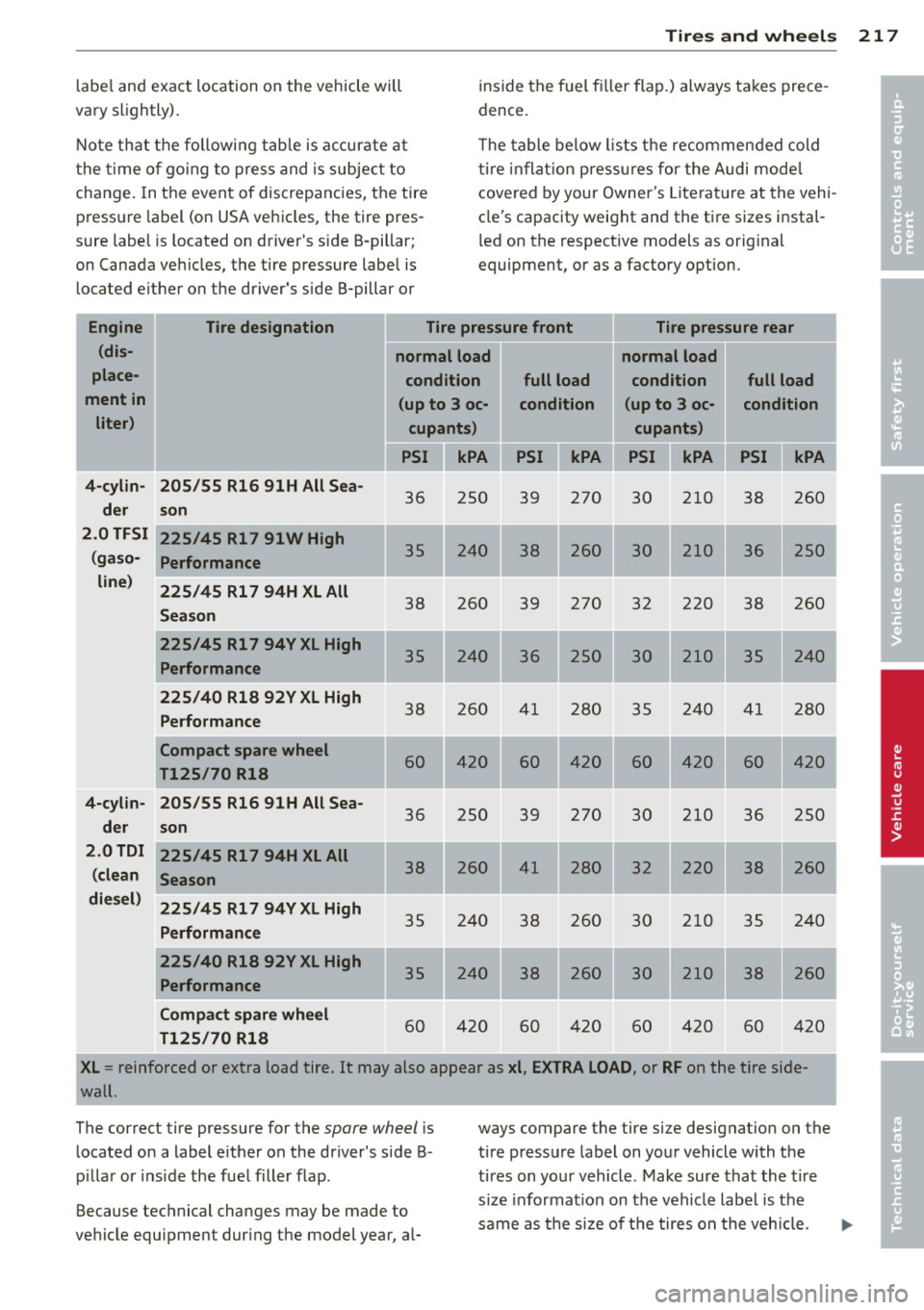
Note that the fo llowing tab le is accurate at
t he t ime o f go ing to press and is subject to
change. In the event of discrepancies, the tire
pressure label (on USA vehicles, the tire pres
sure label is located on driver's side B -pillar;
on Canada vehicles, the tire pressure label is
located e ither on the driver's side B-pillar or inside the f
uel filler flap.) always takes prece
dence.
T he table below lists the recommended cold
ti re inflat ion p ressu res for the Audi mode l
cove red by your Owner's Literat ure at the vehi
cle's capacity weight and the tir e sizes instal
l ed on the respect ive models as orig inal
equipment, or as a factory option.
Engine
(dis
place
ment in liter ) Tire designation
Tire pressure front Tire pressure rear
4- cylin
d er
2.0 TFSI (ga so
line )
4-cylin -
der
2 .0
TOI
(clean
die sel) 205
/55 Rl6 91H All Sea-
son
2 25 /45 Rl7 91W High
Performance
22S /45 Rl7 94H XL All
Season
225 /45 Rl7 94Y XL High
Performance
225 /40 Rl8 92V XL H igh
Perfo rmance
Compact spare wheel
Tl25 /70 Rl8
205 /S5 Rl6 91H All Sea-
s on
225 /45 Rl 7 94H XL All
Season
225 /4S Rl 7 94V XL High
P erformance
225 /40 Rl8 92V XL High
Performance
C ompa ct spare whe el
Tl25 /70 Rl8 no
rmal load
condition
( upto 3 oc-
cupant s)
PSI kPA
36 250
•
JI
35 2 40
38 260
35 240
38 260
60 420
36 250
38 260
35 240
35 240
60 420
normal load
full load condition full load
condition (up to 3 oc- condition
cupant s)
PSI kPA PSI kPA PSI kPA
39 270 30 210 38 260
..
38 260 30 210 36 250
"
39 270 32 220 38 260
36 250 30 210 35 240
41 280 35 240 41 280
60 420
60 420 60 420
39 270 30 210 36 250
41 280 32 220
38 260
38 260 30 210 35 240
38 260 30 210 38 260
60 420 60 420 60 420
X L = reinforced or extra load tire. It may also appear as xl, EX TRA LOAD , or RF on the tire side
wall.
The correct tire pressure for the spare wheel is
located on a label e ither on the driver's side B
p illar or i nside the fuel filler flap . ways
compare the tire size designatio n on the
tire pressure label on your vehicle with the
tires on yo ur vehicle . Make sure that the t ire
s ize informat ion on the vehicle labe l is the
I
J
•
I
Because technical changes may be made to
vehicle equipment during the model year, al- same as the size of the tires on the veh
icle. .,.
•
•
Page 220 of 280
218 Tires and wheels
This is especia lly important if the vehicle be
longs to someone else or you bought the vehi
cle with different rims/tires or you bought the
vehicle as a previously owned vehicle.
Remember, your safety and that of your pas
sengers also depends on making sure that
load limits are not exceeded. Vehicle load in
cludes everybody and everything in and on the
vehicle. These load limits are technically refer
red to as the vehicle's Gross Vehicle Weight
Rating (' 'GVWR"). The Gross Axle Weight Rat
ing ("GAWR") is the maximum load that can
be applied at each of the vehicle's two axles.
The Gross Vehicle Weight Rating and the
Gross Axle Weight Rating are listed on the
safety compliance sticker label located either
on the driver's side B-pillar or on the inside of
the fuel filler flap. The tire pressure label on
your Audi lists the maximum combined
weight of all of the occupants and luggage or
other cargo that the vehicle can carry. For the
location of the tire pressure label
o fig. 167.
_& WARNING
Overloading a vehicle can cause loss of ve
hicle control, a crash or other accident, se
rious personal injury, and even death.
- Carrying more weight than your vehicle
was designed to carry will prevent the
vehicle from handling properly and in
crease the risk of a loss of vehicle con
trol.
- The brakes on a vehicle that has been
overloaded may not be able to stop the
vehicle within a safe distance.
- Tires on a vehicle that has been overload
ed can fail suddenly causing loss of con
trol and a crash.
- Always make sure that the total load be
ing transported -including the weight of
a trailer hitch and the tongue weight of a
loaded trailer -does not make the vehi
cle heavier than the vehicle's Gross Vehi
cle Weight Rating.
A WARNING
- Incorrect tire pressures and/or underin
flation can lead to a serious or fatal acci
dent.
- Incorrect tire pressures and/or underin
flation cause increased tire wear and can affect the handling of the vehicle.
- Incorrect tire pressures and/or underin
flation can also lead to sudden tire fail
ure, including a blowout and sudden de
flation, causing loss of vehicle control.
Checking tire pressure
The correct tire pressure for the tires original
ly installed on your vehicle is listed on the tire
pressure label located either on driver's side 8-pillar or inside the fuel filler flap.
The recommended tire pressures are on the
tire pressure label and in the table
o page 216, Cold tire inflation pressure. This
means that the pressure must be checked and
adjusted when the tire has not been driven for
more than a couple of miles (kilometers) at
low speeds during the previous three hours.
Air in the tires expands when the tire heats up
as a result of internal friction as it flexes in
use. The tire pressure is highe r when the tire
has warmed up than when it is "cold ."
It is the inflation pressure in a "cold" tire that
counts. Therefore, you should never let air out
of a warm tire to match "Cold tire inflation
pressure" recommendations
o page 216. The
tires would then be underinflated and could
fail suddenly.
The tire pressure label on your Audi lists the
recommended cold tire inflation pressures for
the new, original equipment tires that were
on your vehicle at the time it was manufac
tured. For the location of the label
opage 216, fig. 167.
Most tires lose air naturally over time . They
can also lose some air if you drive over a pot
hole or hit a curb while parking. It is usually
not possible to see whether the radial tires ..,.
Page 221 of 280

used today are underinflated just by looking
at them.
Therefore, be sure to check tire pressures at l eas t once a mon th and always before going
on a long trip. Make sure to take the number
of people and the amount of luggage into ac
count when adjusting tire pressure for a trip -
even one that you would not consider to be
"long." See ¢
page 220, Tires and vehicle
load limits
for more important information .
A lways use an accurate tire pressure gauge
when check ing and adjusting inflation pres
sures . Check all of the tires and be sure not to
forget the spare t ire . If the pressure in any tire
is too high when the tire is "cold," let air out
of the tire slowly with the edge of the t ire
gauge and keep checking the pressure until
you reach the p ress ure th at is cor rect for the
l oad (passengers and luggage) and kind of
driving you plan to do .
I f the p ressu re in any tire is too low , note the
d ifference between the pressure in the cold
tire and the pressure you need and add the air
that you need to reach the correct pressure for
the vehicle load (passengers and luggage) for
the tires on your vehicle as listed on the on
your veh icle and in this manual and the kind
of dr iving you p lan to do.
Never e xceed the m aximum inflation pre s
su re li sted on th e tir e side wall for any rea
son.
Remember that the vehicle manufacturer, not
the tire manufacturer, determines the co rrect
tire p ressure for the tires on your vehicle .
It is important to check the tire pressure when
the tires are cold .
- Read the requ ired ti re p ressu re from the tire
pressure label. On USA veh icles, the t ire
pressure label is located on driver's side 8-
pillar . On Canada vehicles, the tire pressure
label is located either on the driver's side 8-
pillar or inside the fuel fi ller flap.
- Turn the valve stem cap counter-clockwise
to remove it from the tire valve.
- Place the air pressure ga uge on the valve.
Tire s an d wheel s 219
- The tire pressures should only be checked
and adj usted when the tires are co ld . The
slightly raised pressures of warm tires must
not be reduced.
- Adjust the tire pressure to the load you are
carrying.
- Reinstall the valve stem cap on the va lve.
When should I check the tir e pressu re?
T he co rrect tire pressu re is especially impor
tant a t high speeds. The pressure should
therefore be checked at least once a month
and always before starting a jo urney . Do not
forget to check the tire pressure for the spare
whee l
¢page 234.
When should I adjust the tire pres sur es?
Adjus t the t ire press ure to the load you a re
carrying . After changing a whee l
or rep lacing
whee ls you have to adjust the tire pressu res
on all whee ls. In addition, yo u m ust then initi
ali ze the new t ire pressures in the tire pres
sure monitoring system*¢
page 230.
A WARNING
...---
Incorrect tire pressures and/or underinfla-
tion can lead sudden tire fa ilure, loss of
control, collision, serio us personal injury
or even death.
- When the warning symbol
ti] appears in
the instrument cluster, stop and inspect
the t ires.
- Inco rrect tire pressure and/or underinfla
tion can cause increased tire wea r and
can affect the hand ling of the vehicle and
s topping abi lity.
- I nco rrect tire pressures and/or unde rin
flation can a lso lead to sudden t ire fail
ure, including a blowou t and sudden de
flation, ca using loss of vehicle contro l.
- The driver is responsib le for the correc t
tire pressures for all tires on the veh icle.
The applicable pressure values are locat
ed on a sticker on the dr iver's side 8-pil
lar or on the ins ide of the fuel filler flap. •
•
Page 225 of 280

unbalanced, resulting in vib rations you can
usually feel through the steering wheel.
Unba lanced wheels mus t be rebalanced to
avoid excessive wea r on s teer ing, suspens ion
and tires. A wheel must a lso be rebalanced
when a new tire is installed.
Incorrect wheel alignment
Inco rrect whee l alignment can cause exces
sive tire wea r, impair ing t he safety of the veh i
cle. If t ires show excess ive wear, have the
wheel alignment checked by an authorized
Audi dealer or qualified workshop.
All Wheel Drive
Ve hicles w it h quattro ® must always have t ires
of the same s ize, construction and tread type.
F or details see
¢ pag e 166 .
A WARNING
Sudden tire failure can lead to loss of con
tro l, a crash and serious persona l injury!
- Never drive a veh icle when the tread on
any t ire is worn down to the wear indica
tors.
- Worn tires are a safety hazard , they do
not grip well on wet roads and increase
your risk of"hydrop lan ing" and loss of
co ntrol.
- Always keep chemicals that can cause
tire damage, such as grease, oil, gasoline
and brake fluid away from tires.
- Tires age even if they are not being used
and can fail suddenly, especially at high
speeds. Tires that are more than 6 years
old can only be used in an emergency and then with special care and at lower
speeds .
- Never mount used tires on yo ur vehicle if
you are not sure of their "previous histo
ry." Old used tires may have been dam
aged even though the damage cannot be
seen that can lead to s udden tire failure
and loss o f vehicle con trol.
Tires and wheels 223
New tires and replacing tires and wheels
New tires and wheels have to be broken in .
Fig. 171 Tir e spec ification codes on t he sid ewall o f a
t ire
No . Desc ription
(D Passenger car tire (where applicable)
@ Nomina l w idth of t ire in mill imeters
@ Ratio of height to width (aspect ratio)
© Rad ial
® Rim diameter code
@ Load index and speed rating
(J) U.S. DOT tire identification number
@ Aud i Origina l tire
® Tire ply composition and materials
used
@
@
M axim um load rating
Treadwear, traction and temperature
I
grades Maxim um permissible inflation p res
sure
T he tires and rims are essential parts of the
vehicle's des ign . The tires and rims approved
by Audi are specia lly matched to the charac
teristics of the ve hicle and can make a major
contribution to good road holding and safe ..,.