change time AUDI A3 2015 User Guide
[x] Cancel search | Manufacturer: AUDI, Model Year: 2015, Model line: A3, Model: AUDI A3 2015Pages: 288, PDF Size: 71.46 MB
Page 170 of 288

168 Child Safety
-Always read and heed all WARNINGS
whenever using a child restraint in ave
hicle
q page 131, Safety belts,
q page 140, Airbag system and
q page 166, Important things to
know.
(D Tips
Always replace child restraints that were
installed in a vehicle during a crash. Dam
age to a child restraint that is not visible
could cause it to fail in another collision
situation.
Advanced front airbag system and children
Your vehicle is equipped with a front "Ad
vanced Airbag System" in compliance with United States Federal Motor Vehicle Safety
Standard (FMVSS) 208 as applicable at the
time your vehicle was manufactured.
The Advanced Airbag system in your vehicle
has been certified to meet the "low-risk" re
quirements for 3- and 6-year old children on
the passenger side and small adults on the
driver side. The low risk deployment criteria
are intended to reduce the risk of injury
through interaction with the airbag that can
occur, for example, by being too close to the
steering wheel and instrument panel when
the airbag inflates . In addition, the system
has been certified to comply with the "sup
pression" requirements of the Safety Stand
ard, to turn
off the front airbag for infants up
to 12 months who are restrained on the front
passenger seat in child restraints that are list
ed in the Standard .
Even though your vehicle is equipped with an
Advanced Airbag system, all children, espe
cially those 12 years and younger, should al
ways ride in the back seat properly restrained
for their age and size. The airbag on the pas
senger side makes the front seat a potentially
dangerous place for a child to ride. The front
seat is not the safest place for a child in a for
ward -facing child safety seat. It can be a very dangerous place
for an infant or a larger child
in a rearward-facing seat.
The vehicle's Advanced Airbag System has a
capacitive passenger detection system in the
front passenger seat cushion that can detect
the presence of a baby or a child in a child re
straint system on this seat.
The capacitive passenger detection system
registers the changes that result in an electri
cal field when a child, a child restraint, and a
baby blanket are on the front passenger seat .
The change in the measured capacitance due
to the presence of a child, a child restraint,
and a baby blanket on the front passenger
seat is related to the child restraint system
resting on the seat. The measured capacitance
of a child restraint system varies depending
on the type of system and specific make and
model.
The electrical capacitance of the various
types, makes, and models of child restraints
specified by the U.S.National Highway Traffic
Safety Administration (NH TSA) in the relevant
safety standard are stored in the Advanced
Airbag System control unit together with the capacitances typical of infants and a 1-year
old child. When a child restraint is used on the
front passenger seat with a typical 1 year-old infant, the Advanced Airbag System compares
the capacitance measured by the capacitive passenger detection system with the data
stored in the electronic control unit. Child restraints and Advanced front
airbag system
Regardless of the child restraint that you use,
make sure that it has been certified to meet
United States Federal Motor Vehicle Safety
Standards and has been certified by its manu
facturer for use with an airbag. Always be sure
that the child restraint is properly installed at
one of the rear seating positions. If in excep
tional circumstances you must use it on the
front passenger seat, carefully read all of the
information on child safety and Advanced Air-
bags and heed all of the applicable .,..
Page 187 of 288
Smart Technology Notice about data
recorded by vehicle
control modules
Your veh icle is not equipped with an Event Da
ta Recorde r (EO R), installed by some manu
facture rs fo r the express purpose o f capturing
data for retr ieval after an accident or cras h
event . EDR's a re sometimes called "crash re
corders".
Some state laws res trict the retr ieval or down
l oadi ng of data stored by E DR's that were in
stalled in a veh icle for the exp ress purpose of
retrieving data after an accide nt or crash
event w ithout the owner's consent.
A lthough yo ur vehicle is no t equ ipped w it h an
EDR, it is equipped with a number of elect ron
ic control modules fo r various vehicle systems
such as, for examp le, eng ine f unction, em is
sion control, as well as for the airbags and
safety belt s.
These electronic contro l modules also record
veh icle -re lated data dur ing no rma l veh icle op
erat ion for d iagnostic and repa ir purposes .
T he recording capacity of the electronic con
trol modules is limited to data (no sound is re
corded) and only a small amount of data is ac
tually recorded ove r a ve ry limited pe riod of
time and stored when a sys tem faul t or o ther
condition is se nse d by a cont rol u nit. Some o f
the data then stored may re la te to vehicle
speed, dir ect io n, bra king as we ll as restra int
system use and perfo rmance in the event of a
crash or other condit ion. Stored data can only
be read and downloaded w ith special equip
ment.
Electronic stabilization
control (ESC)
Description
The ESC reinforces driver safety. It reduces
the r isk of slipp ing and improves driving sta
b ili ty . E SC detects cr itical s it u ations such as
the veh icle ove rsteer ing and understee ring or
Smart Technolog y 185
th e wheels a re sp inning . The vehicle is stabi
li zed by applying the brakes or red ucing en
gine torq ue. Once the ESC is act ive ly reg ulat
ing, the
G) i ndicato r light b links in the instru
ment cluster.
The anti-lock braking system (ABS), brake as s ist system, ant i-slip regu lation (ASR), e lec
tron ic different ia l loc k (EDU, electron ic differ
ential lock* (front wheel drive) and se lective
whee l to rque control* (a ll whee l drive) are in
teg rated in the ESC. The ESC suppo rts the sta
bilization of the vehicle th rough a change in
t h e s teer ing torq ue.
Anti-lock braking system (ABS)
ABS prevents the whee ls from locking when
braking . The vehicle ca n still be steered even
dur ing ha rd braking. App ly steady pressure to
the b rake peda l. Do not pump the p edal. A
puls ing in the bra ke peda l indicates t hat the
system is acting to st abil ize the ve hicle.
Brake assist system
The brake ass ist system can decrease braking
dis tance. It increases bra king power when the
drive r presses the bra ke peda l quickly in emer
gency s ituations. Yo u m ust pres s and hol d the
brake pedal unt il the dangerous s it u at ion is
ove r. In vehicles with adap tive c ruise control *,
the b rake assist system is more sensitive if the
distance detected to the vehicle ahead is too
small.
Anti-slip regulation (ASR )
ASR reduces eng ine power when the drive
whee ls beg in spi nning and adapts the fo rce to
the road conditions . This makes it easier to
start, accelerate and dr ive up inclines.
Electronic differential lock (EDL)
The EDL bra kes whee ls tha t a re sp inning and
trans fers the dr ive power to the othe r drive
whee l or w heels if the vehicle is equ ip ped with
a ll w heel d rive*) . This function is availab le up
to approximately 62 mph (100 km/h).
I n extreme cases, EDL au toma tically sw itches
off to keep t he b rake on the bra ked wheel
from overheat ing. The ve hicle is still working .,..
•
•
•
Page 209 of 288
Many gasoline grades are blended to perform
especially well for winter or summer driving. During seasonal change-over , we suggest that
you fill up at busy gas stations where the sea sonal adjustment is more likely to be made in
time.
Q;) Note
- Methanol fuels which do not meet these requirements may cause corrosion and
damage to plastic and rubber compo
nents in the fuel system .
- Do not use fuels that fail to meet the
specified criteria in this chapter .
- If you are unable to determine whether
or not a particular fuel blend meets the
specificat ions, ask your service station or
i ts fuel supp lier .
- Do not use fuel for which the contents cannot be identified .
- Fuel system damage and performance
problems resulting from the use of fuels
different from those specified are not
the responsibility of Audi and are not
covered under the New Vehicle or the
Emission Control System Warranties.
- If you experience a loss of fuel economy
or driveability and performance prob
lems due to the use of one of these fuel
blends, we recommend that you switch
to unblended fuel.
Gasoline additives
A major concern among many auto manufac
turers is carbon deposit build-up caused by
the type of gasoline you use .
Although gasoline grades differ from one manufacturer to another, they have cer tain
things in common. All gasoline grades contain substances that can cause deposits to collect
on vital engine parts, such as fuel injectors
and intake valves. Although most gasoline
brands include additives to keep engine and
fuel systems clean, they are not equally effec
tive.
Checking and Filling 207
Audi recommends using TOP TIER Detergent
Gasoline . For more information on TOP TIER
Detergent Gasoline, please go to the official
website (www .toptiergas .com) .
After an extended period of using inadequate
fuels, carbon deposit build-ups can rob your engine of peak performance.
CJ) Note
Damage or malfunction due to poor fuel
quality is not covered by the Audi New Ve
hicle Limited Warranty.
Refueling
Fuel filler neck
The fuel filler neck is located on the right rear
side panel behind the fuel filler flap.
If the power locking system should fail, you
can still open the flap manually -for detailed
instructions see
c::> page 209.
You can find the fuel tank capacity of your ve
hicle in
c::> page 266.
The label on the inside of the fuel filler flap
tells you the correct fuel for your vehicle. For
more information about fuel specifications,
see
c::> page 206 .
Your vehicle fuel tank has an on board refuel
ling vapor recovery system. This feature helps
to prevent fuel vapors from escaping from the
tank and polluting the environment while you refuel your vehicle. In order to fill the tank
properly while protecting the environment,
please follow this refueling procedure careful
ly .
A WARNING ~
Under normal operating conditions, never
carry additional fuel containers in your car.
Gas canisters and other containers used to
transport fuel can be dangerous. Such con
tainers, full or empty, may leak and could
cause a fire in a collision . If you must
transport fuel to use for your lawn mower, ..,.
•
•
•
Page 215 of 288
smoothly and reliably. Choosing the right oil
and changing oil within the time and mileage intervals printed in your vehicle's Warranty
&
Maintenance booklet matters a lot more to
day than it did years ago . Audi has developed
a special quality standard for engine oil that
will help assure that your vehicle's engine will get the lubrication it needs for proper opera
tion .
Modern engine lubrication has taken a quan
tum leap in the last few years. Many synthetic
oils available today provide better engine lu
brication that can outlast traditional petrole
um-based oils , making them a smart choice
for use throughout the life of your Audi.
Whether you use synthetic or petroleum based engine oil , the oil that you use must
conform to Audi's oil quality standard
VW 502 00 to help keep your vehicle's engine
running smoothly and help prevent the for
mation of harmful deposits, sometimes called
"sludge", that over time can lead to expensive
repairs .
At the time of printing, engine oils available in
the U.S. and Canada that meet the exacting
specifications of Audi oil standard VW 502 00
are synthetic engine oils. This does not mean, however, that every synthetic engine oil will
meet Audi oil standard VW 502 00 . So always
be sure that you use an approved oil.
To help prevent the formation of harmful de posi ts use only oil with the following specifi
cations printed on the oil container:
Audi oil standard VW 502 00
Oil container labels may carry the specifica
tion singly or in combination with other desig
nations and oil quality standards.
Viscosity
Engine oils are graded according to their vis
cosity . The proper viscosity grade oil for your
engine depends on climactic or seasonal con
ditions where you drive. You can use oil with a
viscosity grade of SAE 5W40 across all tem
perature ranges for normal driving conditions.
Checking and Filling 213
However, if engine oil viscosity grade SAE
5W40 is not available , you can also use viscos
ity grade SAE 5W -30 or SAE OW-40 as long as
it meets Audi oil quality standard VW 502 00
specifications.
Because engine oil that meets the Audi oil
standard may not be available everywhere
when you need it, we strongly recommend
that you always carry with you an extra quart
(liter) of oil that expressly conforms to the
VW 502 00 spec ificat ion, in case you have to
top off the oil while on the road .
Only if the level of the oil is at or below the
minimum mark -and no oil that expressly
conforms to Audi oil standard VW 502 00
specifications is available - may you top off
with a high quality engine oil , preferably syn
thetic-based, that meets ACEA A3 or API SM specifications, but even then, only in viscosity
grades SAE 5W-40 , SAE SW-30, or SAE
OW-40. However, during the entire time be
tween oil change intervals, never top off with
more than a total of 0.5 qt/liter engine oil
that does not conform to Audi oil specification
vw 502 00.
For more information about engine oil that
has been approved for your vehicle, please
contact either your authorized Audi dealer or
Audi Customer Relations at 1 (800) 822 -2834
or v isit our web site at www.audiusa .com or
www .audicanada .ca. Here you will also find a
current list of oils (manufacturers, brand
names etc.) that conform to Audi oil standard
vw 502 00.
Changing the engine oil
The engine oil and oil filter must be changed
according to the mileage (kilometers) and
time intervals specified in your veh icle's War
ranty
& Maintenance booklet. Do not exceed
these intervals -harmful deposits from old
engine oil can reduce engine performance and
can lead to expensive engine repairs.
Changing the oil at the recommended inter-
vals is so very important because the lubricat
ing properties of oil decrease gradually during
normal vehicle use. If you are not sure when .,..
•
•
•
Page 216 of 288
214 Checking and Filling
you have your oil changed, ask your author
ized Audi Service Advisor.
Under some circumstances the engine oil
should even be changed more frequently .
Change oil more often if you drive mostly
short distances, operate the vehicle in dusty
areas or mostly under stop-and-go traffic con
ditions, or when you use your vehicle where
temperatures stay below freezing point for
long periods .
Detergent additives in the o il wi ll make fresh
oil look dark after the engine has been run
ning for a short time. This is normal and is not
a reason to change the oil more often than recommended .
Damage or malfunctions due to lack of
maintenance
It is essential that you change your oil at the
recommended interva ls using only engine oil
that complies with Audi oil standard
VW 502 00. Your Lim ited New Vehicle War
ranty does not cover damage or malfunctions
due to fa ilure to follow recommended mainte
nance and use requ irements as set forth in
the Audi Owner's Manual and Warranty
&
Maintenance booklet . Your dea ler will have to
deny warranty coverage un less yo u present to
the dea ler proof in the form of Service or Re
pair Orders that all schedu led maintenance
was performed in a timely manner.
Engine oil consumption
The engine in your vehicle depends on on ade
quate amount of oil to lubricate and cool all
of its moving ports.
In order to provide effective lubrication and
cooling of internal engine components , a ll in
ternal combustion eng ines consume a certain
amount of o il. Oil consumption var ies from
engine to engine and may change significantly
over the life of the eng ine . Typically, engines
with a specif ied break-in period (see
¢
page 193) consume more oil during the
b reak-in period than they consume after oil
consumption has stabilized. Under
normal conditions, the rate o f oil con
s u mption depends on the quality and viscosity
of the oil, the RPM (revolut ions per minute) at
which the engine is operated, the ambient
temperature and road conditions. Further fac
tors are the amount of oil dilut ion from water
co nd ensat ion or fuel residue and the oxida
t ion level of the oil. As any engine is subject to
wea r as mileage builds up, the oil consump
tion may increase over time until replacement
of worn components may become necessary.
With a ll these variab les coming into play, no
standard ra te of oil consumpt io n can be es
tablished or specified. There is no alternative
to regu lar and frequent check ing of the oil lev
el , see
Note.
If the yellow engine oil leve l warning symbo l
Ill in the instr ument cl uster light s up, you
shou ld check the oil leve l as soon as possible
¢
page 215. Top off the oil at your earliest
convenience
~ page 215.
A WARNING
-~
Before you check anything in the engine
compartment, always read and heed all
WARNINGS¢
page 210.
(D Note
Driving wit h an insufficient oil level is like
l y to cause severe damage to the engine.
(D Tips
-The oil pressure warning display. is
not an indicator of the oil level. Do not
rely on it. Instead, check the oil level in
your engine at regular intervals, pref
erably each time you refuel, and always
before going on a long trip .
-If you have the impression your engine
consumes excessive amounts of oil, we
recommend that you consult an author
ized Aud i dea ler to have the cause of
your concern properly diagnosed. Keep in
mind that the accurate measurement of
oil consumption requ ires great care and
may take some time. An authorized Audi ..,.
Page 218 of 288
216 Check ing and F illin g
@ For the sake of the environment
-Oil should never enter the sewer system
or come into contact with the ground .
- Pay attentio n to lega l requ irements
when disposing of empty oil containers .
Changing the engine oil
We recommend that have your oil changed by
an authorized Audi dealer or a qualified serv
ice station.
Before you check anything in the engine com
partment,
a lways r ea d and heed all WARN
ING S
r=>page 210.
The engine oil must be changed according to
the intervals specified in you r Warranty
&
Maintenance book let. This is very important
because the lubricating properties of oil di
minish gradua lly during norma l veh icle use.
Under some circumstances the engine oi l
should be changed more frequently. Change
oil more often if you drive most ly short dis
tances, operate the vehicle in dusty areas or
under predominantly stop-and-go traffic con
ditions, or have your vehicle where tempera
tures remain below freezing for extended pe riods .
Detergent additives in the oil will make fresh
oil look dark after the eng ine has been run
n ing for a short time. This is normal and is not
a reason to change the oil more often than recommended.
Because of the problem of proper disposal,
along w ith the special tools and necessary ex
pertise required, we strongly recommend that
you have you r o il changed by an author ized
A udi de ale r or a q ual ified servi ce station.
If yo u choo se to c hang e your o il yo urse lf,
please note the following important informa
tion :
.8, WARNING
To reduce the ris k of persona l injury if yo u
m ust change the engine oil in your veh icle
yourself : -
Wear eye protection .
- To reduce the risk of burns from hot en -
gine oi l, let the engine cool down to the
touch.
- When removing the oil drain p lug with
your fingers, stay as far away as possible.
Always keep your forearm parallel to the
ground to help prevent hot oil from running down your arm.
- Drain the oil into a container designed
for this purpose, one large enough to
hold at least the tota l amount of oil in
your engine.
- Engine oil is poisonous. Keep it we ll out
of the reach of childre n.
- Continuous contact with used eng ine o il
is harmful to your sk in . Always protect
your skin by washing oil
off tho roughly
with soap and water.
(D Note
Never mix oil additives with your engine
oil. These additives can damage your en
gine and adversely affect your Aud i Limit
ed New Veh icle Warranty.
@ For the sake of the environment
- Before changing your oil, first make sure
yo u know where you can properly dispose
of the used oil.
- Always dispose of used eng ine oil proper
ly. Do not dump it on garden soil, wood
ed areas, into open st reams o r down
sewage drains.
- Recycle used engine oil by taking it to a
used eng ine oil collect io n fac ility in you r
are a, or contact a se rvice station.
coolant system
Coolant
The engine coolant performs two functions: it
keeps the engine from overheating and it pro tects the engine from freezing in the winter.
The cooling system is sealed and genera lly re-
quires little attention. .,..
Page 221 of 288
Brake fluid
Checking brake fluid level
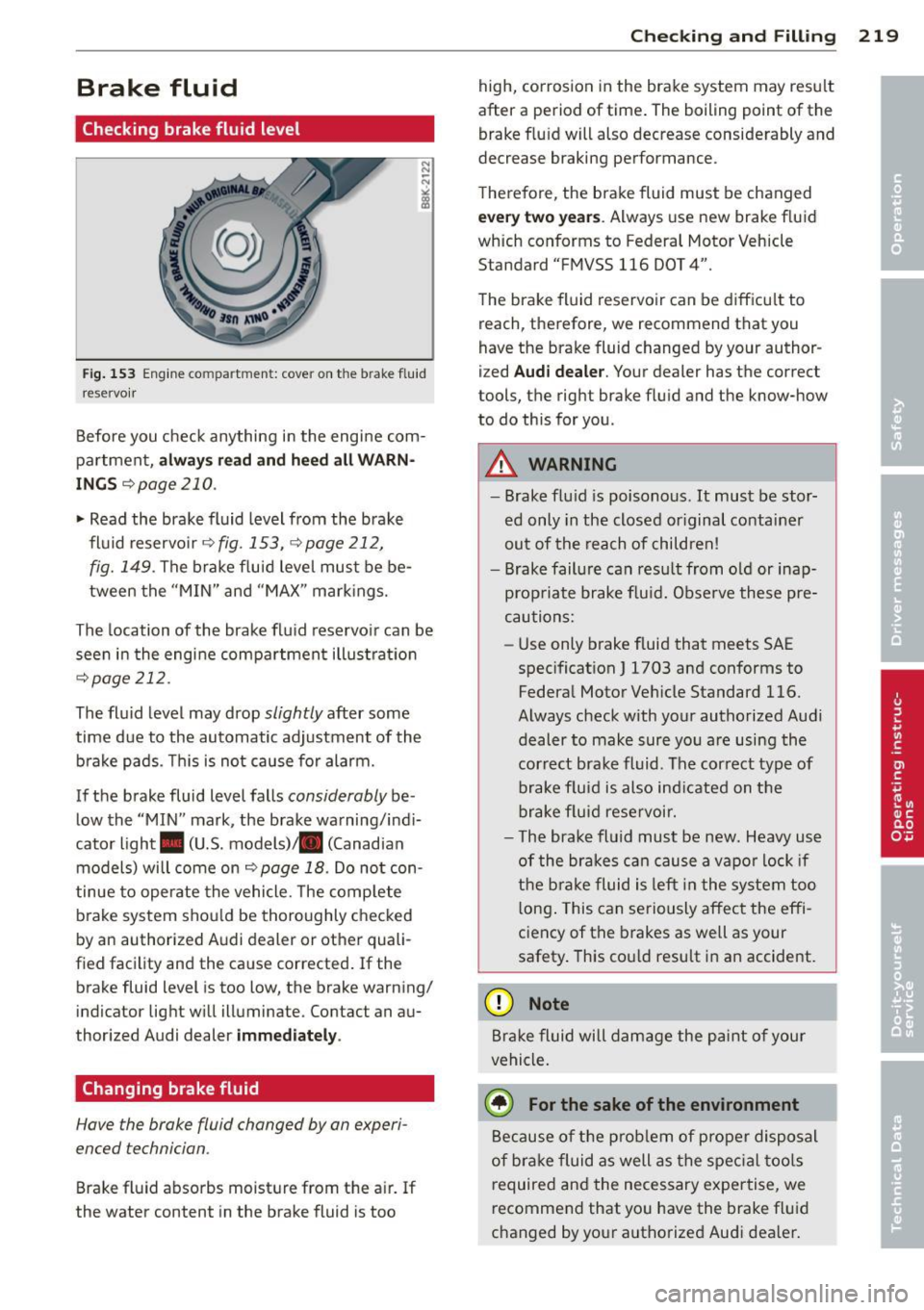
Fig . 153 Engine co mpa rtment: cove r on the b rake f lu id
reservo ir
B efore you check anything in the engi ne com
partment,
alwa ys read and heed all WARN ·
INGS r:=:,page 210 .
~ Read the brak e fluid level from the brake
fluid reservo ir
r:=;, fig . 153, r:=:, page 212,
fig. 149 .
The brake f luid leve l mus t be be
tween the "MIN" and "MAX " ma rkings.
The location of the brake flu id reservo ir can be
seen in the engi ne compa rtment illust ra ti on
¢ page 212 .
The fluid level may drop slightly after some
time due to the automatic adjustment of the b rake pads . Thi s is not cause for alarm.
If the brake fluid level falls
considerably be
low the "MIN" mark, the b rake wa rning/ind i
cato r light . (U .S . models)/ . (Canadian
models) will come on
r:=;, page 18 . Do not con
tinue to operate the vehicle. The comp lete
brake system should be thoroughly checked
by an authorized A udi dealer or other quali
f ied fac ility and the ca use corrected . If the
br ake fluid level is too low, the brake warning/
indica tor light w ill illuminate. Contact an au·
thor ized Audi dealer
immediately .
Changing brake fluid
Have the brake fluid changed by an experi
enced technician .
Brake fluid abso rbs moist ure from the air. If
the water content in the brake fluid is too
Che cking and Fillin g 219
high, co rrosion in the brake system may resu lt
after a period of time . The boiling point of the
brake f lu id will also decrease conside rably and
decrease braking performance.
T herefore, the brake fluid must be changed
eve ry two year s. Always use new brake f luid
which conforms to Federal Motor Veh icle
Standard "FMVSS 116 DOT 4".
The brake fluid reservoi r can be difficu lt to
reach, therefore, we recomm end that you
have the brake fluid changed by your author
i z ed
Audi dealer . Your dealer has the correct
tools, the right brake flu id and the know-how
to do this for you .
A WARNING
-
-Brake flu id is poisonous. It must be stor-
ed only in the closed or iginal containe r
out of the rea ch of children!
- Brake failure can resu lt from o ld or inap
p rop riate brake f lu id. Observe these pre
cautions:
- Use only brake f luid that meets SAE
spec ificat ion
J 1703 and conforms to
Federa l Motor Ve hicle Standard 116.
Always check with your authorized Audi
dealer to make sure yo u are using the
cor rect bra ke fluid. The cor rect type of
brake f luid is also i nd icated on t he
brake f lui d rese rvoir.
- The bra ke flu id must be new. Heavy us e
of the brake s can cause a vapo r lock if
the b ra ke fluid is left i n the system too
l ong . This can se riously affect the effi
ciency of the brakes as we ll as your
safety . This co uld resu lt i n an accident .
(D Note
Brak e fluid will dam age the pa int of your
vehicle .
@ For the sake of the environment
Because of the p rob lem of proper disposal
o f bra ke fluid as well as the spec ial too ls
r equired and the necessary exper tise, we
recommend that yo u have the brake flu id
changed by yo ur authorized Audi dea ler.
Page 222 of 288

220 Checking and Filling
Battery
General information
Under normal operating conditions, the bat
tery in your Audi does not need any mainte
nance. With
high outs ide temperatu res or
long daily drives we recommend that you have
the electro lyte level checked by a service fa
cility. The e lectrolyte level shou ld also be
checked each time the battery is charged
c:>page222.
Have the battery checked when you take your
vehicle in for service. You are well advised to replace a battery that is older than 5 years.
With certain types o f airbag deployment, the
battery is disconnected from the vehicle elec
trica l system for safety reasons
c;, .&. in Re
pair , care and disposal of the airbags on
page 156.
Disconnecting the battery terminals
Some vehicle functions such as power win
dows are unavai lable if the battery termina ls
are d isconnected. These functions have to be
relearned after the battery terminals are con
nected again. To prevent this, the battery
should only be disconnected from the vehicle
electrical system when absolutely necessary
for repairs .
To reprogram the functions, proceed as fol lows:
Function Reprogramming
Power window one-c;, page 40, Correcting
touch up/down power window mal-
function functions
Remote control key If the vehicle does not
or react to the key, it
convenience key must be synchroni zed
c:>page 33
Digital clock c:>page 10
ESC indicator light The indicator light
goes out after driving
a few meters
Vehicles not driven for long periods
If you do not drive your vehicle over a period
of severa l days or weeks, e lectrica l compo
nents are gradually sca led back or switched
off. This reduces energy consumption and
maintains starting capability over a longer pe
riod
c;, page 190. Some of the conven ience
functions may not operate, such as the interi
or lights or power seat adjustment. The con
venience functions will be availab le aga in
when you switch on the ignition and start the
engine.
Winter operation
During the winter months, battery capacity
tends to decrease as temperatures drop. This
is because more power is also consumed wh ile
sta rting, and the headlights, rear window de
fogger, etc. , are used more often.
Avoid unnecessary power consumpt ion, par
ticularly in city traffic or when traveling only
short distances. Let your authorized Aud i
dealer check the capacity of the vehicle bat
tery before winter sets in ~ page 222. A well
charged battery will not on ly prevent starting
problems when the weather is cold, but will
also last longer.
A WARNING -
-Work on the battery requ ires expert
know ledge. Contact your authorized Audi
dealer qualified repair facility for infor
mat ion regarding the vehicle battery.
There is a risk for chemical burns or ex
p losions.
- Never open the vehicle batte ry . Do not
try to change the battery electrolyte lev
el. Otherwise explosive gas will escape
from the battery and increase the risk of
an explosion .
(i) Tips
If your vehicle is left standing for several
weeks at extremely low temperatures, the
vehicle battery should be removed and
stored where it w ill not freeze. This will ..,.
Page 224 of 288
222 Checking and Fill in g
and then the negative cable . Never inter
change the cables -this could start a fire!
- Never charge a frozen or a thawed-out
battery. It could explode! If a battery has
frozen, then it must be replaced. A dead battery can freeze over at 32°F (0°C).
- Make sure the vent hose is always attach
ed to the opening on the side of the bat
tery.
- Never use batteries which are damaged.
There is the danger of an explosion! Al
ways replace a damaged battery.
&_ WARNING
California Propos ition 65 Warning:
- Battery posts, terminals and related ac
cessories contain lead and lead com
pounds, chemicals known to the State of
California to cause cancer and reproduc
t ive p roblems. Wash hands after han
dling.
(D Note
- Do not d isconnect t he veh icle battery
when the ignition is on or when the en
gine is running, otherwise, you will dam
age ele ctron ic componen ts in the elec tri
ca l system.
- If your vehicle is going to stand for a
l ong period of time wi thout being driven,
protect the battery from "freezing", oth
e rwise it w ill be damaged and wi ll then
have to be replaced.
Battery charging
Starting the engine requires a well charged battery.
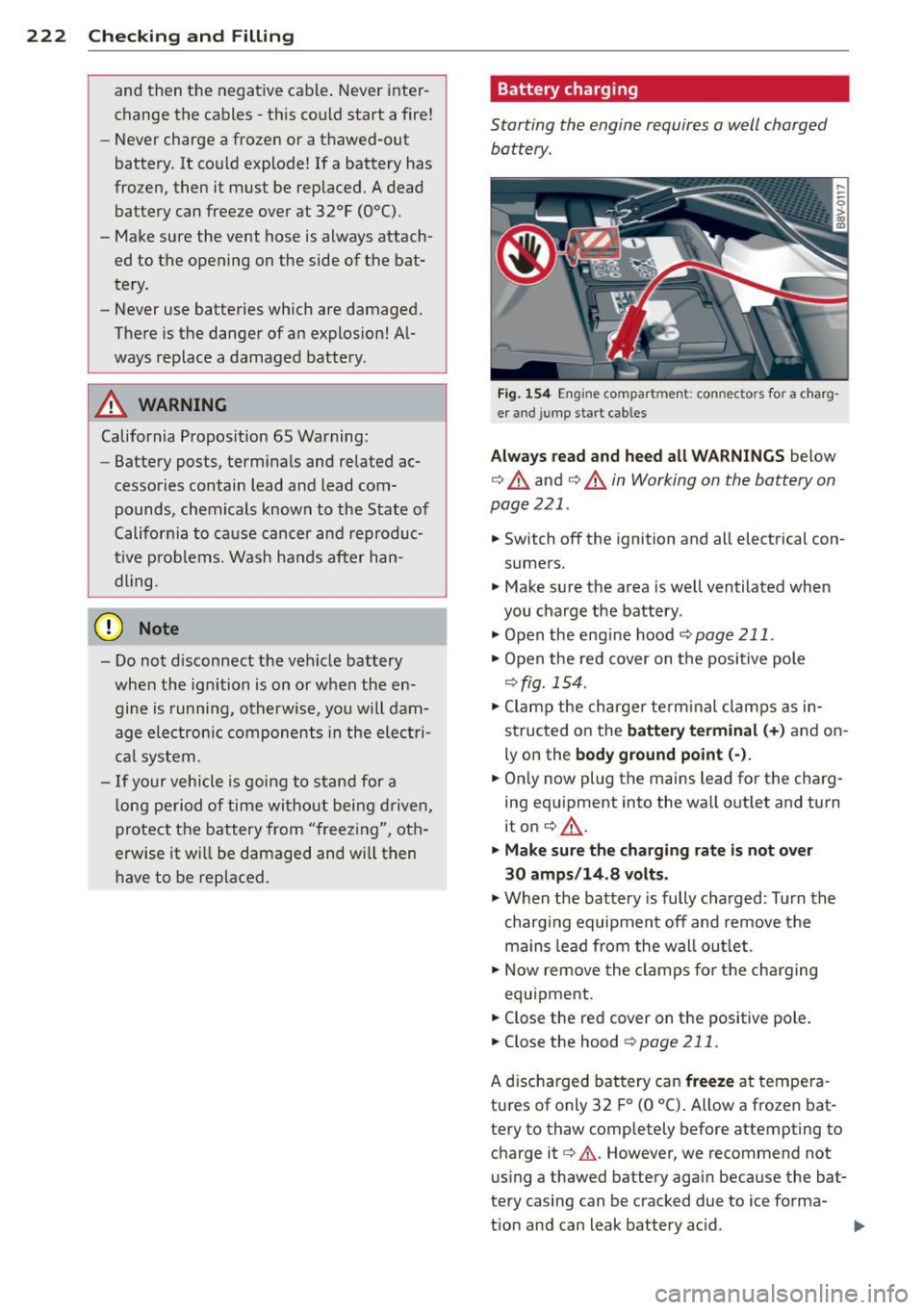
F ig . 1 54 Engine co mpartment : connectors for a charg
er and jump start cab les
Alwa ys read and heed all WARNINGS below
c> &. and c> &. in Working on the battery on
page 221.
.. Switch off the ignition and all electrical con
sumers.
.. Make sure the area is well ventilated when
you charge the battery .
.. Open the eng ine hood
r=;, page 211 .
.. Open the red cover on t he positive pole
r=;, fig. 154 .
.. Clamp the ch arger term inal clamps as in
structed on the
batter y terminal (+ ) and on
ly o n the
body ground po int (-) .
.. On ly now plug the mains lead for the charg
ing equ ipment into the wa ll outlet and turn
iton
c> &, .
.. Make sure th e charging rate is not over
30 amps /14 .8 volts .
.. When the battery is fully charged: Turn the
charg ing equipment off and remove the
mains lead from the wall ou tlet .
.. Now remove the clamps for the cha rging
equipment .
.. Close the red cover on the positive pole .
.. Close the hood
~ page 211.
A d ischarged bat tery can freeze at tempera
tu res of only 32 F
0 (0 °C). Allow a frozen bat
tery to thaw completely before attempting to charge it
r=;, .&, . However, we recommend not
using a thawed battery again because the bat
te ry casing can be cracked due to ice forma-
t ion and can leak battery acid . ..,.
Page 225 of 288
Battery charging (Ma ximum charging rate
o f 30 am ps/ 14.8 volt s)
When charging at
low voltages (e.g . with a
tri ckle ch arg er), the batte ry cables do not
have to be d isconnected first. The battery
caps should
not be opened when charging a
battery .
It is not necessary to remove the battery from
the luggage compartment, and it is also not
necessary to disconnect the cables.
F ast charging th e battery (charging rate
a bo ve 14 .8 volt s)
For technical reasons do not use a battery
charger that uses voltage greater than 14.8
volts to charge your ve hicle 's battery .
A WARNING
Charging a battery can be dangerous .
- Always follow the operating instructions
provided by the battery charge r manu
fact urer when charging your battery .
- Never charge a frozen battery . It may ex
plode because of gas t rapped in the ice .
Allow a frozen battery to thaw out first.
- Do not reuse batteries which we re fro
zen . The batte ry housing may have
cr acked and weakened whe n the battery
froze.
- Charge the battery in a we ll ventilated
area. Keep away from open flame o r ele c
trical spark. Do not smoke. Hydroge n gas
generated by the battery is exp losive.
- T o redu ce the danger o f explosion , never
conne ct or disconnect cha rger cables
wh ile the charger is operating .
- F ast charg ing a battery i s dangerous and
sho uld on ly be attempted by a compe
tent technician with the proper eq uip
me nt.
- Battery acid that may spill during charg
ing should be washed off with a so lution
of warm water and ba king soda to neu
tralize the acid.
Checking and Fillin g 223
@ Note
Neve r use a fast charger as a booster to
start the eng ine . This w ill seriously dam
age sens itive e lectronic components, such
as contro l units, relays, radio, etc., as well
as the batte ry charger .
Battery replacement
The new ba ttery mus t hove the some specifi
cations and dimensions as the original equip
ment battery .
Intelligent energy management in your vehi
cle is responsible for distributing the electri
ca l ene rgy throughout your vehicle
~ page 190 . The intelligent energy manage
ment system will keep the engine battery
c h arged better than vehicles without this sys
tem. To make sure the addition al ele ctri cal e n
ergy is ava ilab le once again after yo u have
changed the batte ry, we recommend that you
insta ll batteries of the same type an d manu
facture on ly (the same as those insta lled at
the time your veh icle was delivered) . Specif i
cations are listed on the battery housing. Your
authorized dea ler must code the battery in
the ene rgy management system to enab le you
to use the ene rgy management functions cor
re ct ly afte r repla cing the battery.
The new battery must have the same capacity,
vo ltage ( 12-volts) , amperage, construction
and plug sea ling .
When install ing the battery, make sure the ig
nition and a ll electrical consumers are switch
ed off .
~ Note
Make sure the ventilat ion hose on the side
of the battery is con nected, otherwise
fumes o r batte ry acid can lea k out.
@) For the sake of the environment
Because of the prob lem of proper disposal
of a battery, we recommend your author
i zed Audi dealer change the battery for
you. Batteries contain sulfur ic acid and ..,.
•
•
•